







Abstract
A linear elastic analytical model of curved beam with constant curvature coupled with curved strings has been developed. To model the connections between the strings and the beam, a continuous distribution of tangential and orthogonal linear elastic springs have been introduced. To evaluate the behavior of the system, a numerical integration of the field equations has been performed. A parametric analysis, capable of pointing out the influence on the behavior of the system of both the stiffness of the tangential connection between strings and beam and of the geometrical characteristic of the beam, has been performed. The results of the proposed model have been compared with those obtained from a finite element model. They show that the strings, in some cases, do not work as expected.
Introduction
The coupling between curved structural elements and reinforcing layers is very frequent in the retrofit of masonry arches or vaults of historical buildings. In the last years, the Fiber Reinforced Polymer (FRP) composites seem to be one of the best candidates to assume the role of ideal reinforcement, given their good combination of properties such as lightness, stiffness, corrosion resistance, and ease of application compared with other methods. Many analyses have been carried out to better understand the role of composite materials as such the reinforcement. For this purpose, numerical and experimental tests have been carried out on unreinforced and reinforced masonry arches, confirming the effectiveness of FRP extrados strips in terms of both load-bearing capacity and ultimate displacement (Cancelliere et al., 2010). Other experimental analyses have shown that composite materials are significant in enhancing the capability to support horizontal loads and in increasing the collapse load, stiffness, and ductility (Briccoli Bati et al., 2007). Moreover, strengthening at the intrados seems to be the most effective option to increase structural strength, whereas the application of fiber composites at the extrados provides higher deformation capacity prior to failure (Oliveira et al., 2010). Considering a four-hinge mechanism, hinge positions on the arch under external loads were varied along the arch barrel to identify their optimum positions to achieve the minimum collapse load (Chen et al., 2007). Furthermore, FRP allows the line of thrust to fall outside the thickness of the arch, increasing the capacity of the arch and reducing the lateral thrust transmitted to the piers (De Lorenzis et al., 2007). Stress analyses were carried out considering the composite material as a linear elastic material and the perfect adhesion between the masonry and the FRP reinforcement (Marfia et al., 2008). In other analyses, the performance of the interface between fiber composite and masonry is one of the key factors affecting the behavior of strengthened structures. For this reason, experimental studies to evaluate the bond between FRP and masonry were carried out (Capozucca, 2010; D’Ambrisi et al., 2013).
The aim of this article is to investigate the role of reinforcing fibers applied to curved beams realized with homogeneous and isotropic materials. The results of this article are not generally applicable to no-tension-materials. However, the results obtained here could provide useful information in curved masonry structures, where the prevailing stress is the compression, until the low-tension strength of the material is reached.
A linear elastic analytical model of a curved beam with constant curvature coupled with curved strings is developed. A continuous distribution of tangential and normal linear elastic springs is used to model the connections between the strings and the beam. The kinematic, equilibrium, and constitutive equations, capable of describing the behavior of the mechanical system, are obtained. A numerical integration of the field equations, written as a set of ordinary differential equations, is performed to obtain the solution to the elastic problem.
Two types of static excitation of the coupled system are taken into account. The first kind is a distributed load, while the other is base displacements of the arch. A parametric analysis, capable of pointing out the role of some geometrical or mechanical parameters characterizing the system, is conducted. Specifically, the stiffness of the tangential connection between strings and beam and some geometrical characteristics of the arch are taken as variable parameters in the analyses.
The results provided by the proposed model are compared with those obtained by a finite element (FE) model. The good agreement between the analytical and the computational models allows the use of the FE model to investigate the case of strings that are not able to react to compression.
Assumptions and motivation for the research
In many bidimensional structures, two families of curved interacting beams can be recognized. Depending on the geometrical characteristics of the shell, often, arches constitute one of these families. These elements usually play an important role in the statics (i.e. in barrel shells, spherical shells, and others as in De Leo et al. (2015a, 2015b).
It is important to remark that, for the purpose of this analysis, the shells are considered built with homogeneous isotropic material; hence, the structure works well both in compression and in tension. To improve the performance of these types of structures, the use of reinforcing fibers can be done. In recent years, the use of fiber composites has become common practice.
In masonry buildings, fiber-reinforcement is often used for the strengthening of bidimensional curved structures, such as barrel and pavilion vaults. However, since the analyses performed in this investigation are conducted considering an elastic, linear behavior of the structure, they are only partially applicable to masonry structures.
Although the results of this article may seem far from the real behavior of masonry structures, under some assumption, they could offer interesting indications about the use of fiber-reinforcement for masonry structural elements. For example, an arch-like structure works properly if only compressive stresses occur due to the limited tensile strength of the masonry. If the tensile stresses exceed this limit, damage appears. However, until some damage is shown, the structure works in the linear, elastic field. Inside this operating range, this article could be useful to give some indications regarding the use of fiber-reinforcements.
Analytical model
An arch is characterized by a few parameters (Figure 1(a) and (c)). Specifically, R is the radius of the arch,
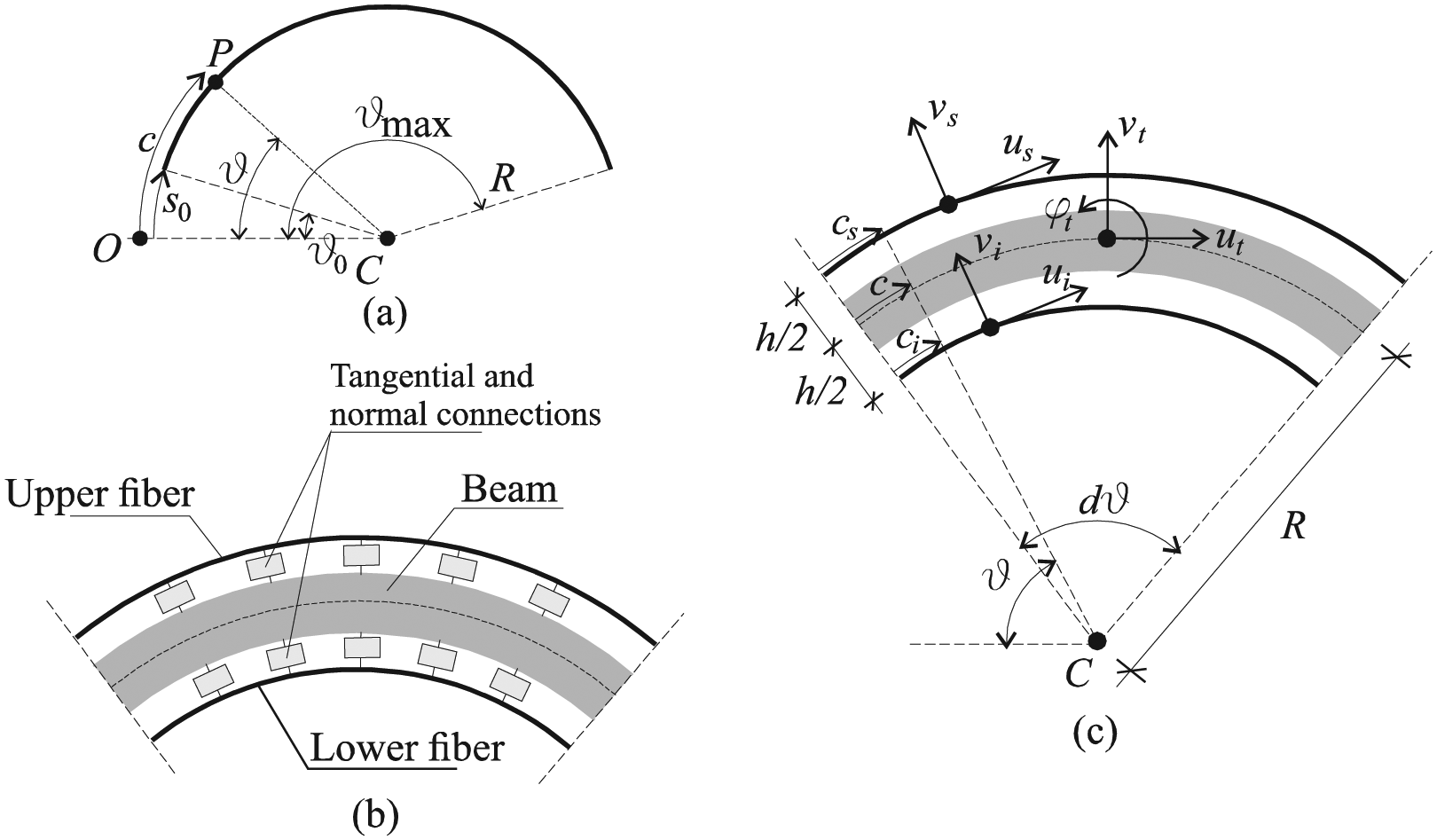
Kinematics of the coupled system, arch plus strings: (a) geometrical parameters characterizing the arch, (b) connection between the strings and the arch, and (c) displacement components.
To span the curved domain of the two fiber layers and of the arch, three different local curvilinear coordinates are considered:
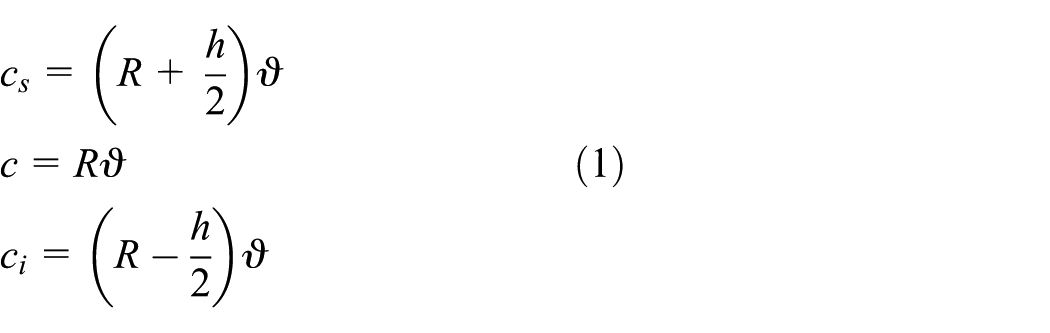
However, since in beams the dimensions of the section are small compared to their length
Kinematic, equilibrium, and constitutive equations
To describe the kinematics of the arch, the three classical displacement components









The equilibrium equations of the arch coupled with the strings are obtained referring to the internal stresses and the external forces shown in Figure 2. The quantities







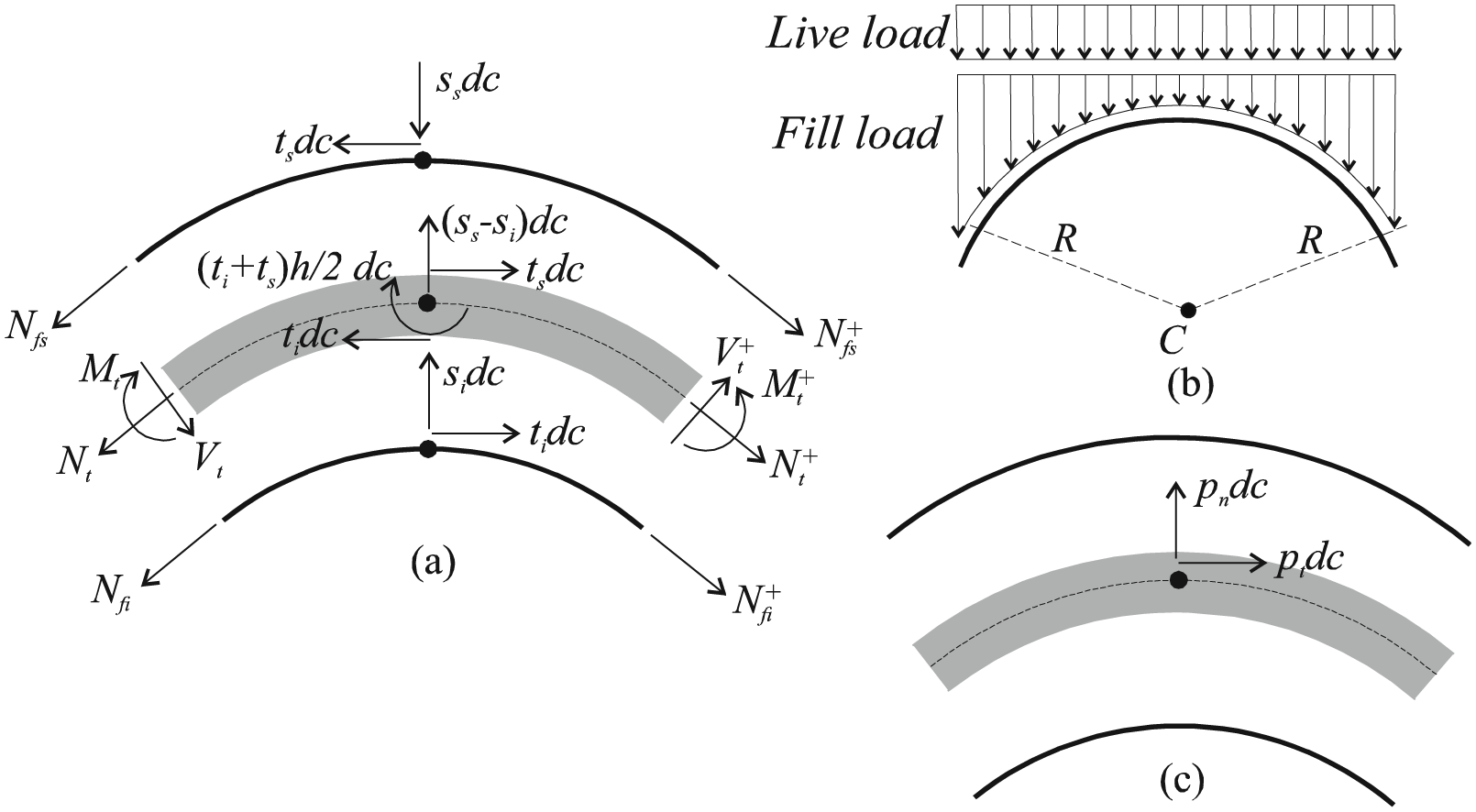
Statics of the coupled system, arch plus strings: (a) internal stresses, (b) shape of the external loads, and (c) total external forces acting on the infinitesimal portion of the beam.
Equations (3.1) to (3.3) represent the equilibrium of the internal and external forces acting on an infinitesimal portion of arch. Specifically, they describe the equilibrium of forces acting in the tangential direction, in the normal direction and of the moments, respectively. Equations (3.4) and (3.5) represent equilibrium of forces acting on an infinitesimal portion of the upper fiber, in the tangential and normal directions, respectively. Finally, the last two equations (3.6) and (3.7) describe the equilibrium of forces acting on an infinitesimal portion of the lower fiber. It is worth noticing that the kinematic problem (equation (2)) is the adjoint of the equilibrium problem (equation (3)).
Assumptions and simplifications
Some internal constraints are introduced following suitable assumptions on the kinematical behavior of the mechanical system. Consequently, a simplification of the mathematical problem occurs. However, the introduction of these constraints makes the equations yet capable of well describing the mechanical behavior of the system.
The first internal constraint considered is the classical shear indeformability of the beam. It leads to the vanishing of the shear strain

The second internal constraint is the infinite stiffness of the springs in the direction normal to the axis of the arch, representing the connection between the strings and the arch. This constraint has been introduced to simulate the impossibility of the fibers detaching from the arch in the normal direction, and it leads to the vanishing of deformations

By taking into account equation (4), the kinematic equations (equation (2)) become
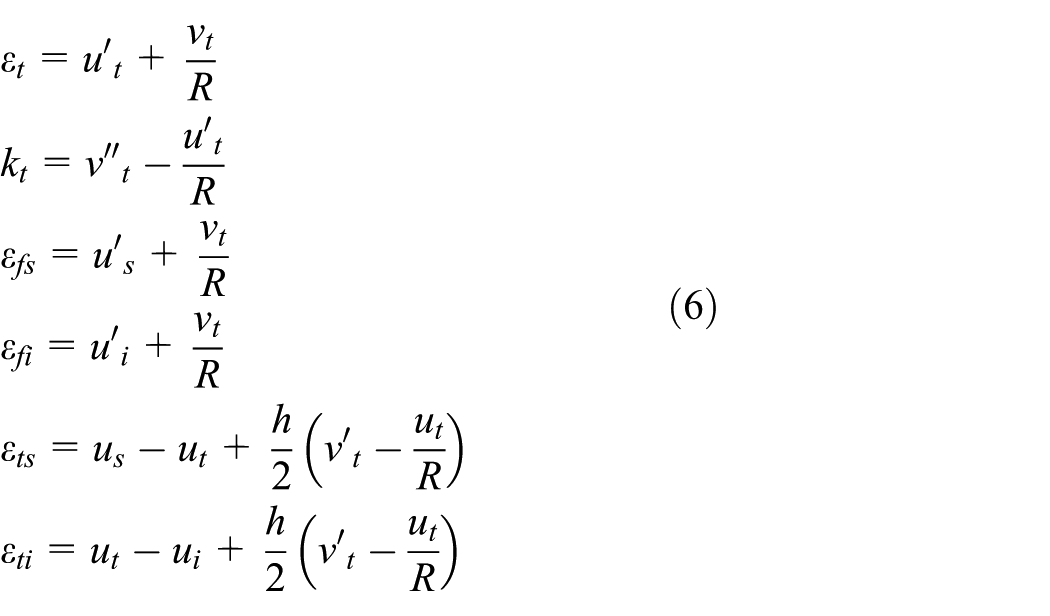
The equilibrium equations, instead, must be condensed since some internal forces become reactive quantities. Specifically, the shear
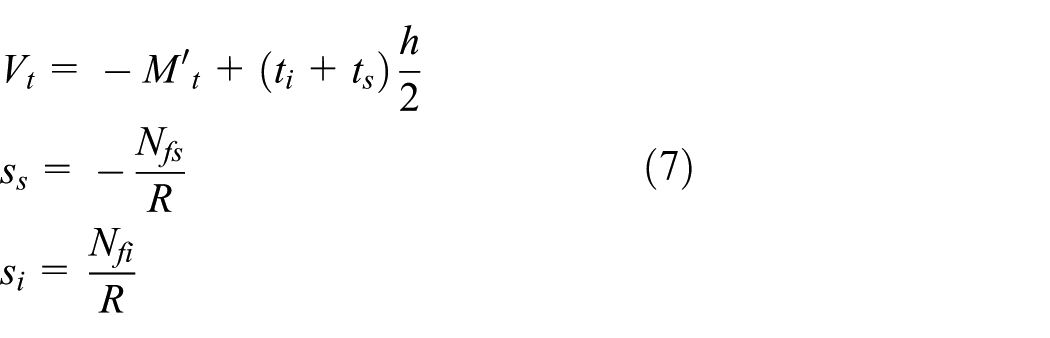
By substituting equation (7) into the equilibrium equations (equation (3)), the final condensed equilibrium equations appear as follows
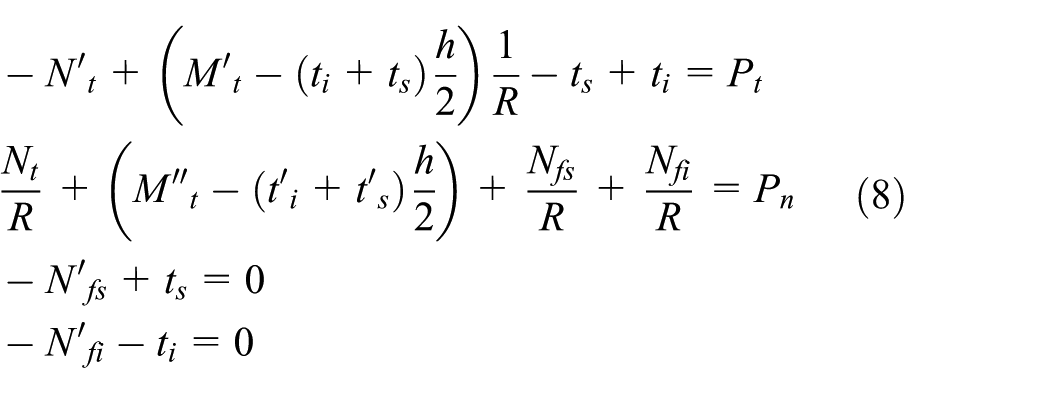
Even after the introduction of the internal constraints, the kinematic and equilibrium problems appear as the adjoint of each other.
A linear elastic behavior of the arch, fibers, and connection springs has been considered. The constitutive laws read
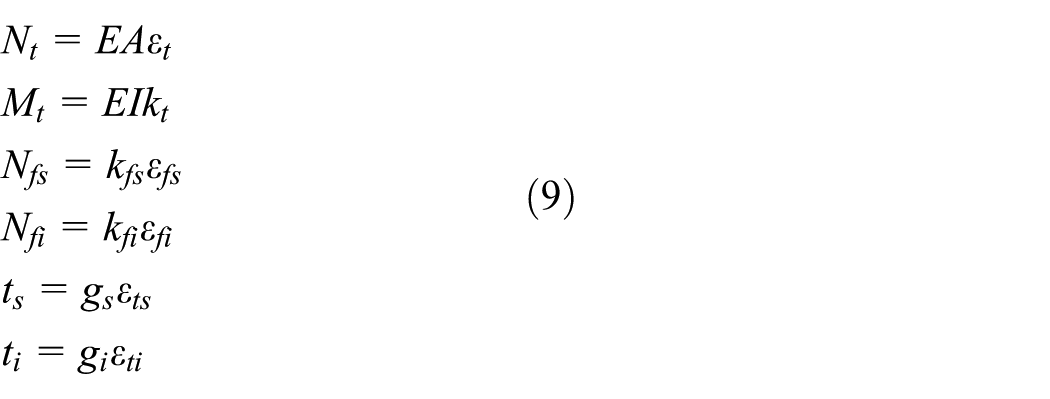
where E is the Young’s modulus of the arch; A and I are the area and the moment of inertia of the section of the arch, respectively;
The reactive quantities
Field equations
By combining the internal constraints, given by equations (4) and (5), the kinematic equations (equation (6)), the equilibrium equations (equations (7) and (8)), and the constitutive laws (equation (9)), the following set of first-order differential equations is obtained
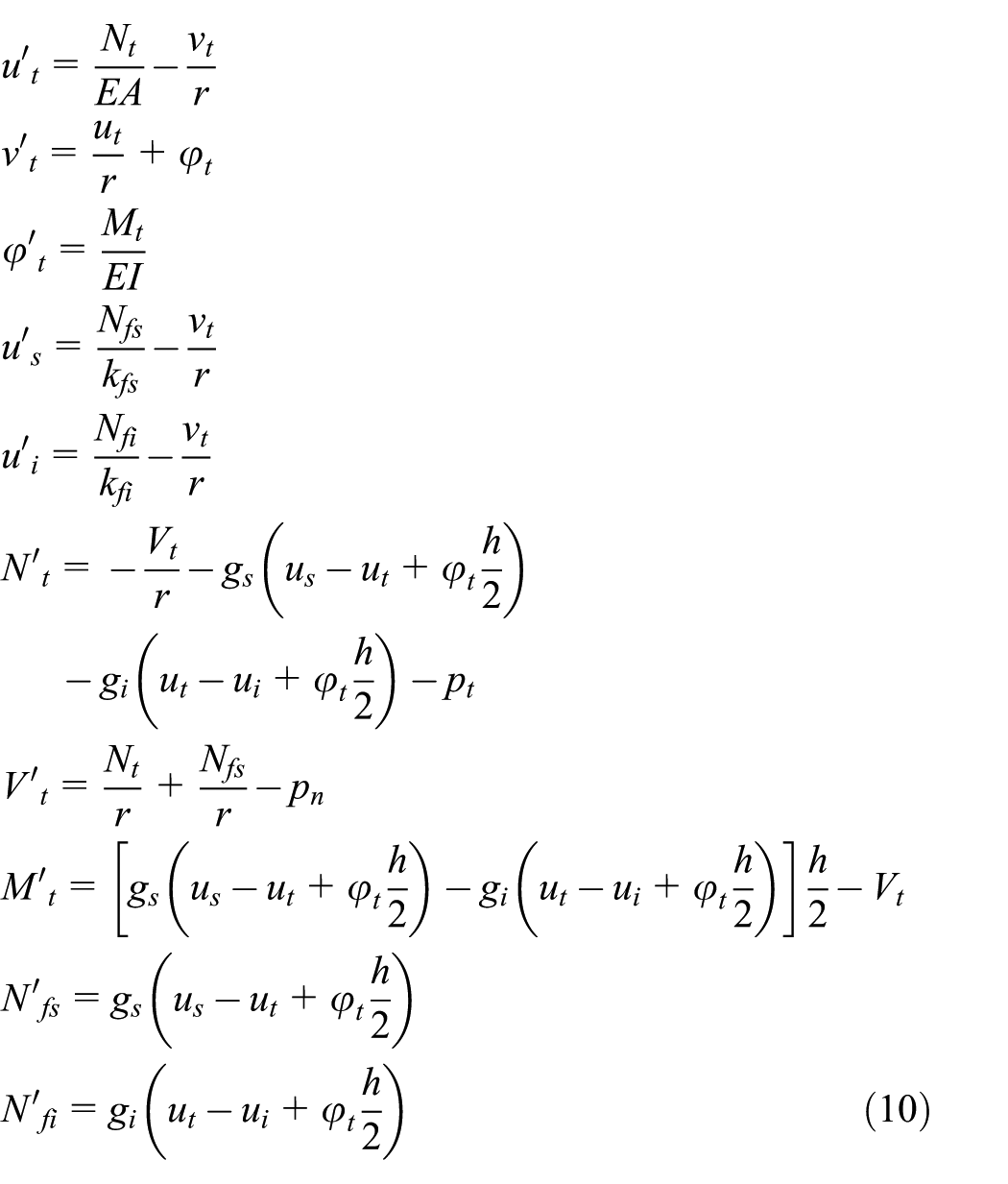
The boundary conditions now read
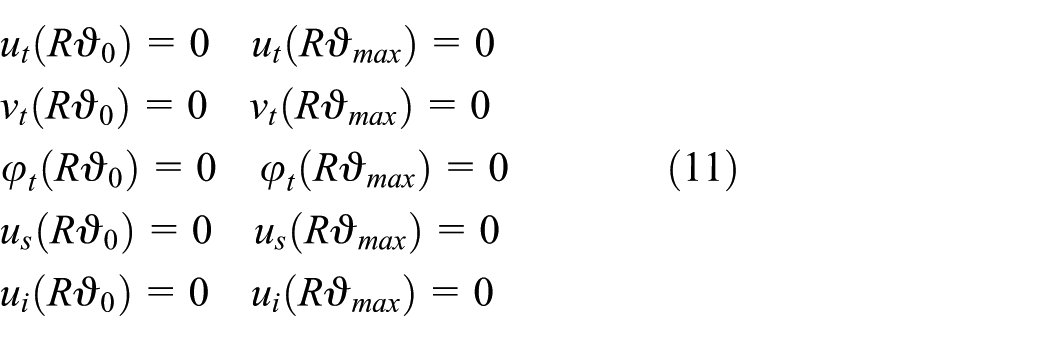
They refer to clamped boundaries of the arch and fully constrained fibers. Results have been obtained by numerical integration of equation (10), together with the relevant boundary conditions (equation (11)).
Computational model
A comparison with a FE model is performed. To build the FE model, the use is made of standard 3- or 4-node shell elements to model the arch. The fiber-reinforcements are modeled by using frame elements, while the connections between the fibers and the arch are modeled through tangential and normal link-type elements. The use of shell elements permits the modeling of fibers not connected to the axis of the arch but to the extrados or the intrados of the beam at a distance
Along the height, the section is meshed with four shell elements. Along the axis of the arch, instead, for the fibers and the arch, frame and shell elements of angular amplitude of
These characteristics of the mesh have been determined by performing a preliminary convergence analysis of the results provided by the FE model (see Figure 3).
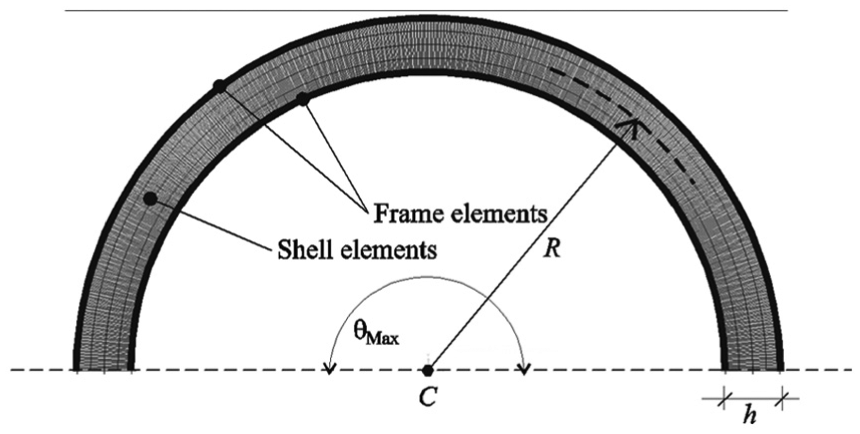
Finite element model.
Numerical simulations
The model developed in section “Analytical model” allows the study of numerous types of problem. In the numerical simulations carried out, semicircular and segmental arches are studied, initially only under operational loads and then applying base displacements.
Only fill and live loads are considered (see Figure 2(b)) because fiber-reinforcements are usually applied to structures already deformed under proper weight load. Therefore, only when fill and live loads are restored, the stress state in the fibers changes.
Static operational loads
The system described by equation (10) with the relevant boundary conditions (equation (11)) allows finding the unknown quantities of the problem. The simulations described below refer to an arch built with materials that possess the same characteristics of masonry and carbon fibers. It must be remarked that the analyses performed here are able to describe only a linear elastic behavior of the system. Hence, results are valid until the low tensile strength of the masonry is reached. However, if the arch works well under operational loads, no tensile stress would manifest itself in the masonry. Moreover, it is worth noting that this is a specific example, and the results cannot be generalized to masonry structures. It is useful to remark that the aim of the article is the study of the role of the fiber-reinforcement of a curved homogeneous isotropic beam.
In the cases reported here, the following geometrical and mechanical characteristics have been used: geometrical radius 3 m, rectangular section of the arch of dimensions 0.30 × 0.50 m2 (width × height); Young’s modulus of the arch of 3.0 × 10⁶ kN/m2; thickness of the carbon fibers of 0.378 mm; Young’s modulus of the carbon fibers of 0.19 × 10⁹ kN/m2; fill load of 19.0 kN/m3; and live load of 50.0 kN/m2. Equation (11) gives the boundary conditions for the fibers.
In Figure 4, it is possible to see the deformed shape of a semicircular arch under operational loads and the stresses on the arch and the fibers. Both the upper and the lower fibers are stretched in several areas. Specifically, the lower fibers exhibit tensile stresses on the extremities of the arch and near the key stone, as can be surmised by the deformed shape of the arch.
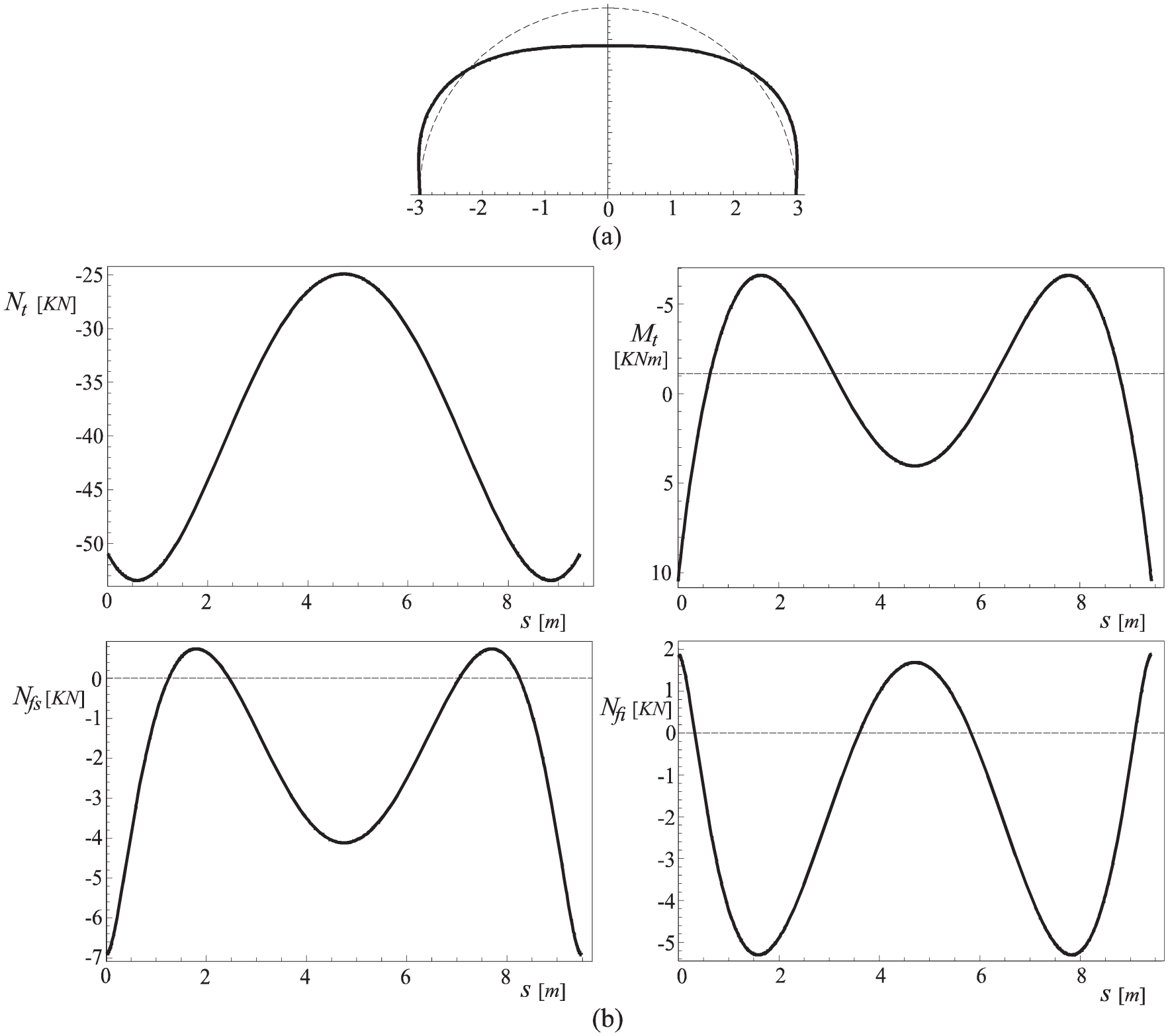
Deformation and stresses in the fiber-reinforced arch: (a) deformed shape of the arch, (b) normal stress Nt and bending moment Mt in the arch; longitudinal stress in the upper fiber Nfs and in the lower fiber Nfi
In the analysis of the role of the degree of flattening of the arch, two different types of flattening have been taken into account. In the first, the radius of the arch is kept constant for analysis purposes as the solution progresses. A change of the degree of flattening leads to a change in the length of the arch. In the second, the length of the arch is kept constant and, therefore, a change of the degree of flattening implies a change of the radius of the arch. For the first kind of analyses, a segmental arch with

Stress in the upper fiber Nfs and the lower fiber Nfi in a segmental arch with
To evaluate the effects of the mechanical characteristics of the connections between the fibers and the arch, the same semicircular arch of Figure 3 is analyzed. The tangential stiffnesses of the connections
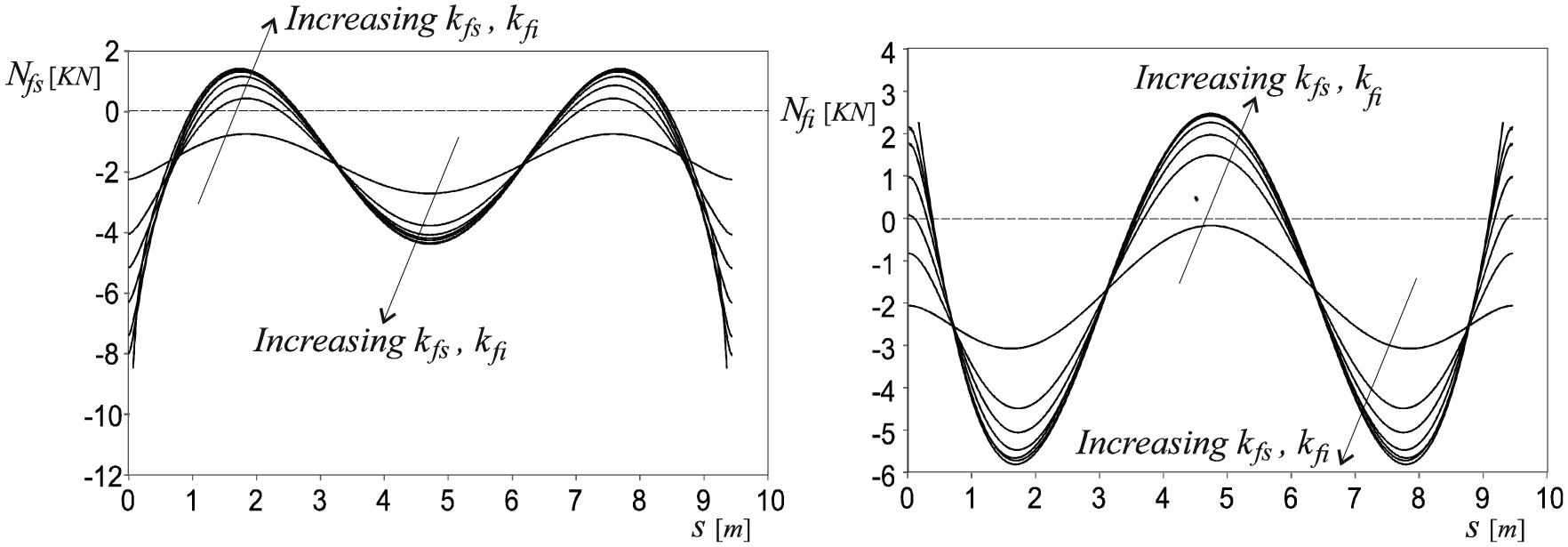
Longitudinal stress in the upper (Nfs) and in the lower (Nfi) fibers of a semicircular arch
The case of a segmental arch
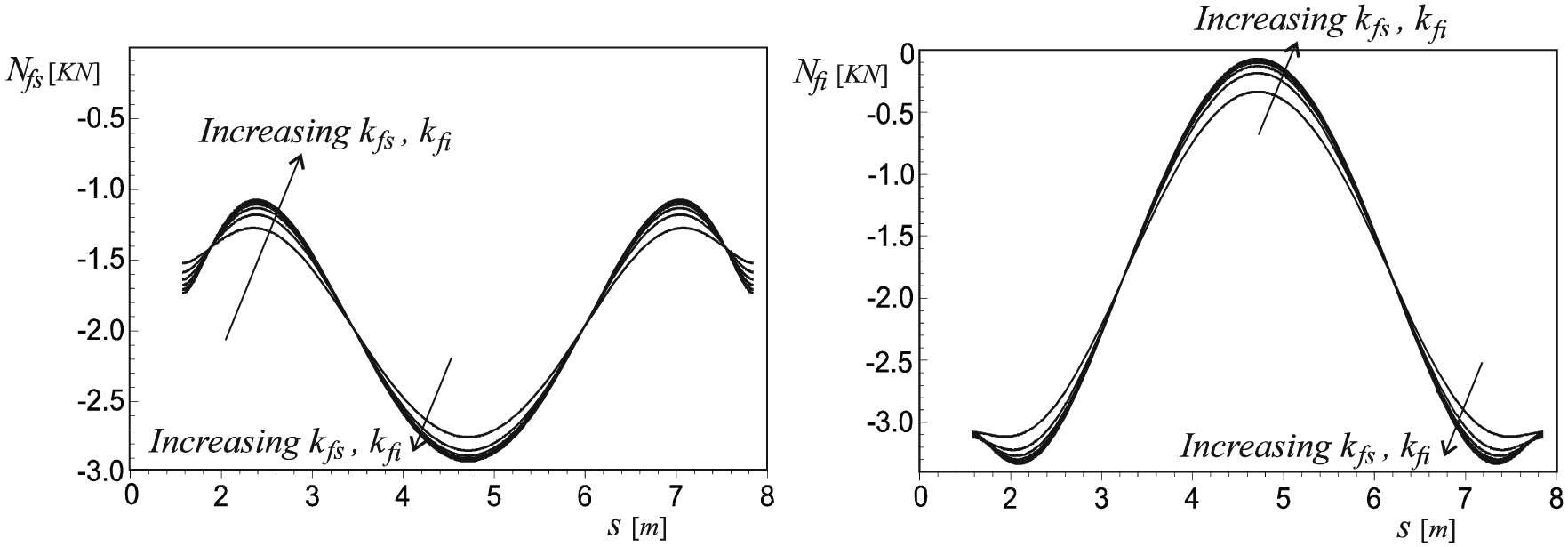
Stress in the upper (Nfs) and in the lower (Nfi) fibers of a segmental arch with
In both the previous cases, increasing the tangential stiffness of the connections, the curves representing the longitudinal stresses of the fibers asymptotically tend to the case of perfectly rigid connections between fibers and arch. Moreover, the stresses in the fibers of segmental arches (Figure 7) are less sensitive to the stiffness of the tangential connections compared to those in the fibers of semicircular arches (Figure 6). In particular, in segmental arches with constant arc length, the stresses in the fibers appear almost independent of the stiffness of the connections.
Base displacements
In the following analyses, the effects on the behavior of the system of horizontal base displacements, introduced to simulate the displacements of the supports of the arch, are analyzed.
In Figure 8, the longitudinal stresses in the fibers of an arch subject to fill and live loads together with a base displacement are shown. The same geometrical and mechanical characteristics of the semicircular arch of Figure 4 are considered. The results labeled with
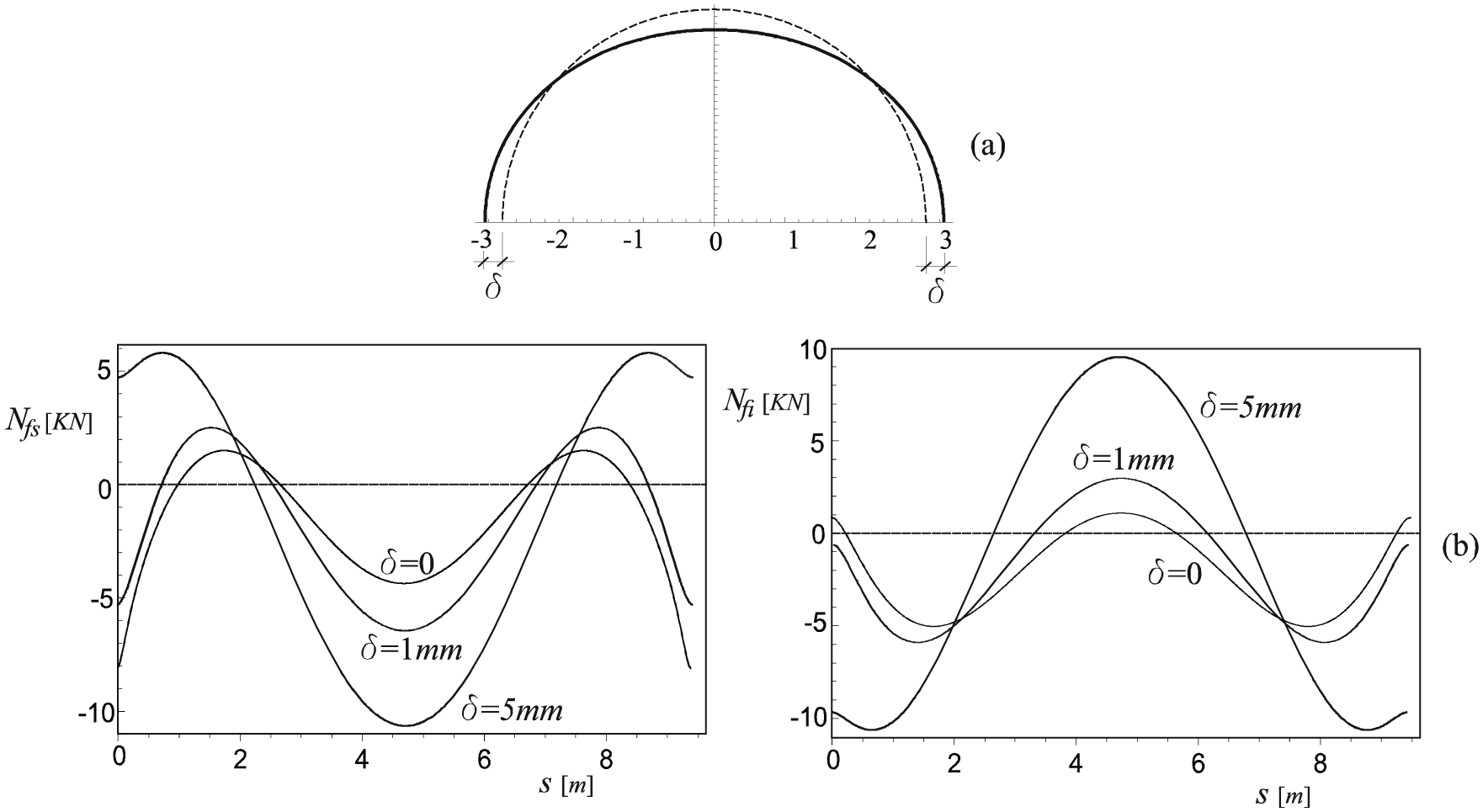
Effects of the base displacement: (a) deformation of a semicircular arch subject to operational fill and live loads, and base displacement; (b) longitudinal stresses in the upper (Nfs) and lower (Nfi) fibers in a semicircular arch by varying the displacement d
Also in the case of a segmental arch with constant radius and with constant arc length, the effects of the base displacements are considered (results are not reported here for brevity). Again, the presence of base displacements changes the stresses in the fibers. Even when there is a base displacement
Comparison between the results of the analytical and computational models
Test case
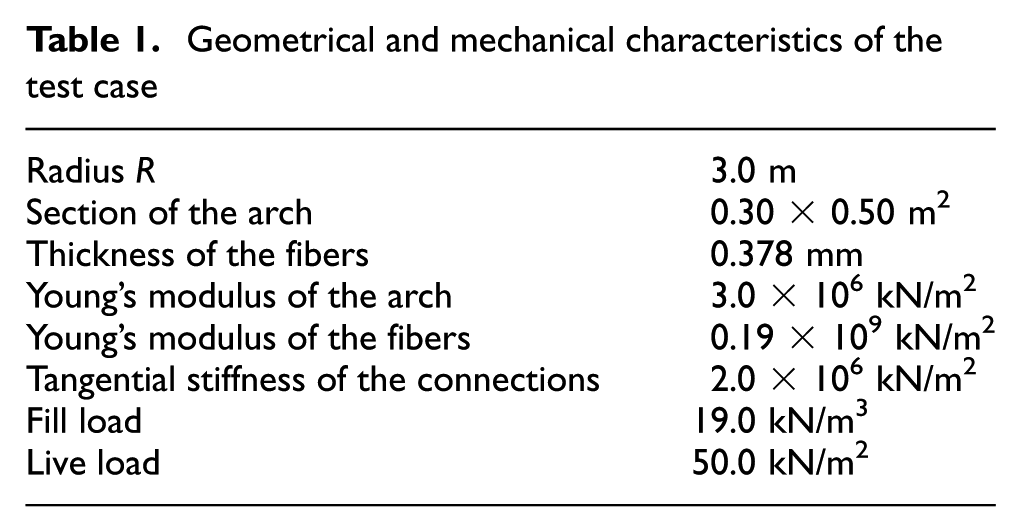
Several comparisons among the results of different cases obtained from the analytical and FE models are performed. For the sake of brevity, only one case is discussed. The test case is one of those already discussed in section “Computational model.” Specifically, the geometrical and the mechanical characteristics of the system are summarized in Table 1.
Geometrical and mechanical characteristics of the test case
In Figure 9, the stresses in the upper (Nfs) and lower (Nfi) fibers are shown for a semicircular arch
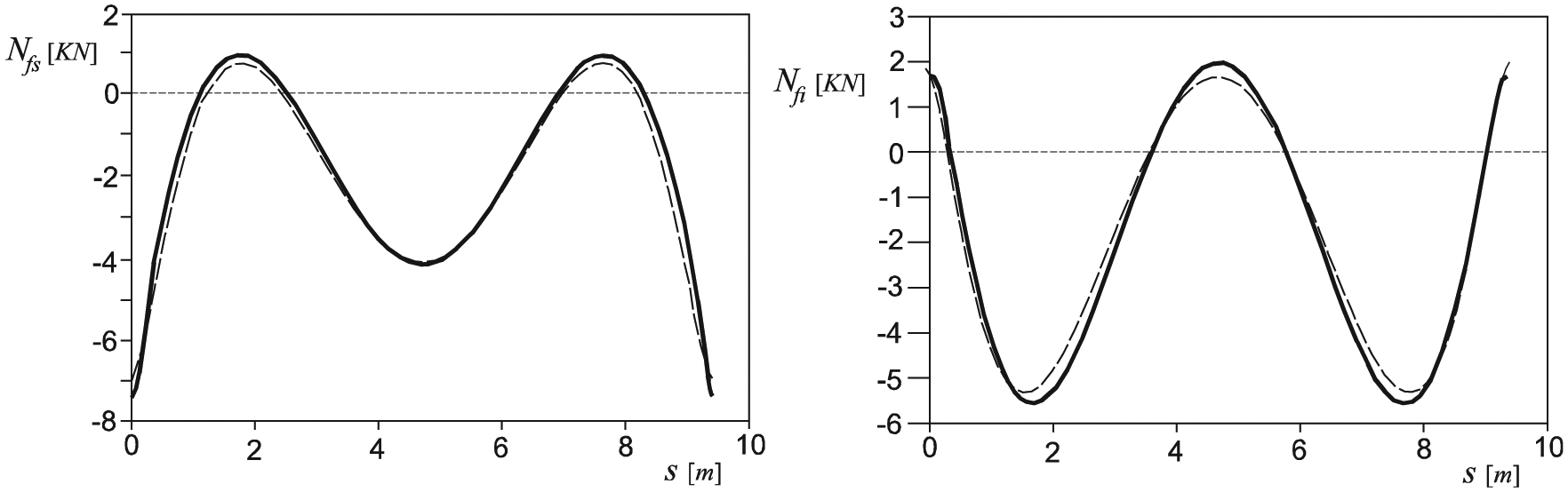
Stress in the upper (Nfs) and lower (Nfi) fibers in the test case (
Non-linear behavior of the fibers
The good agreement between the analytical and the FE models allows the use of the FE model to investigate the non-linear behavior of the fibers under the assumption that they do not resist compression. Since the compression strength of the fibers is very small due to stability problems related to their very small thickness, usually, this small contribution is neglected. A non-linear computational analysis is conducted with the aim of understanding whether the conclusions reached from the above linear analyses are still applicable in the non-linear field.
In Figure 10, comparison is shown between the results obtained from the analytical model, already shown in Figure 9 (dashed lines), and those obtained from the FE model (solid lines), where the fibers are considered not to be able to resist compression. It is interesting to observe that the non-linear FE model confirms the results of the linear analytical model. Specifically, the results are only slightly affected by the different constitutive laws of the fibers. The ranges where the fibers are stretched remain substantially unchanged. Only a slight enlargement of these ranges occurs together with a slight increase in the tensile stresses in the fibers.
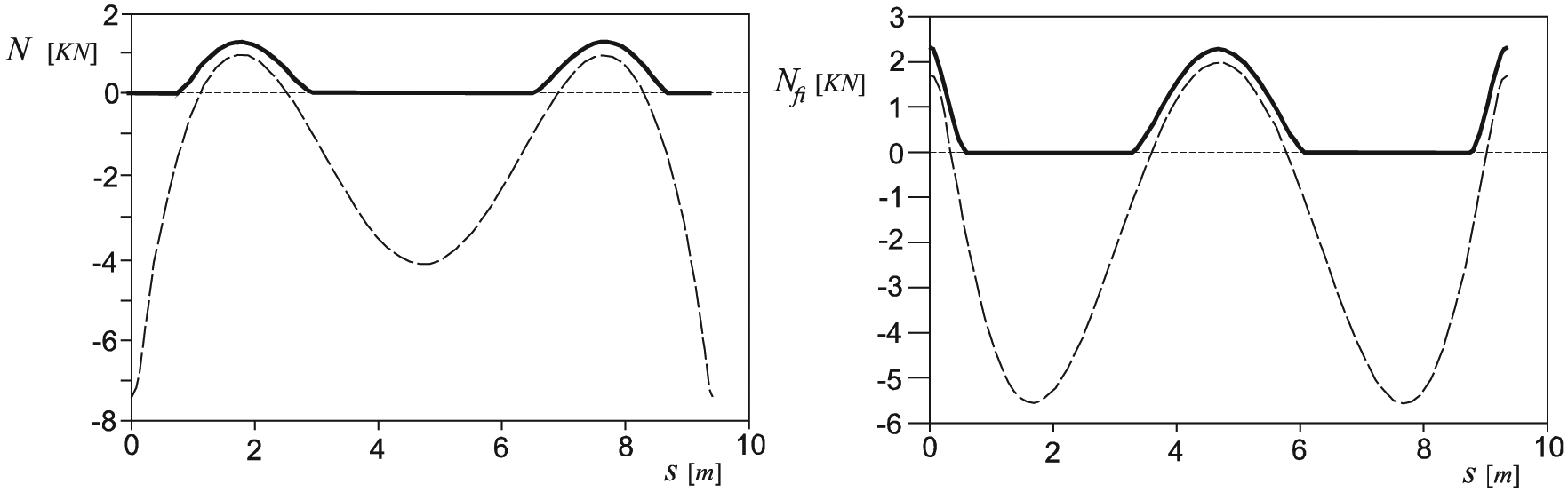
Stress in the upper (Nfs) and lower (Nfi) fibers in the test case (
As observed in section “Computational model,” the ranges where the tensile stresses manifest themselves in the fibers reduce when the degree of flattening of the arch increases. To investigate whether this behavior manifests itself when fibers which are able to resist compression are considered, the case of the segmental arch with
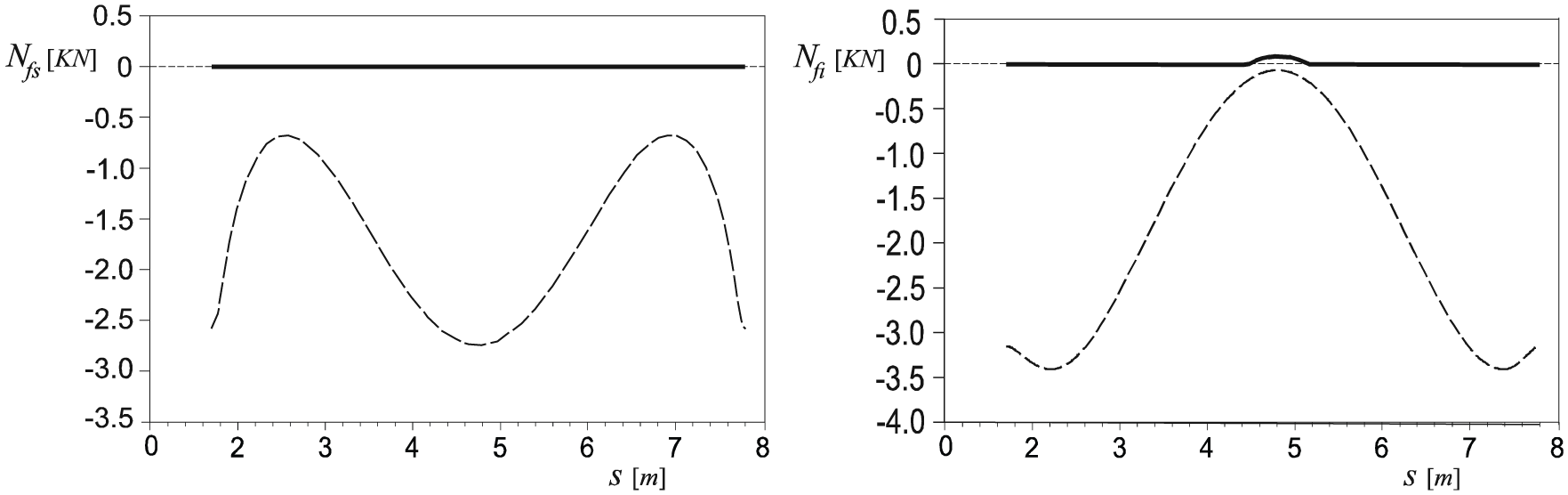
Stress in the upper (Nfs) and lower (Nfi) fibers in the test case (
Conclusion
A linear elastic analytical model of curved beam with constant curvature, coupled with curved strings, has been developed. The arch has been modeled using a classical monodimensional polar model of curved planar beam. A continuous distribution of tangential and normal linear elastic springs has been used to model the connections between the strings and the arch. A numerical integration of the field equations has been performed. The strings considered are intended to represent fiber-reinforcements.
The main objective of this article is to investigate the role of reinforcing fibers applied to curved beams realized with homogeneous and isotropic materials. However, the results obtained provide useful information for curved masonry structures subject to operational loads, until the low-tension strength of the material is reached.
Two types of static excitations of the coupled system, arch–strings, have been taken into account. The first kind represents operational loads (fill loads and live loads), the other one, instead, base displacements of the arch. In the parametric analyses, the stiffness of the tangential connection between strings and arch and the degree of flattening of the arch have been taken as main variable parameters. Comparison of the results provided by the analytical model and those obtained from a FE model has been performed.
Results show that the use of fiber-reinforcement is effective mainly in arches, where a base displacement occurs. In this case, fibers are stretched over vast areas of the arch. On the contrary, when the fibers are used to strengthen an arch-like structure, with the aim of improving its behavior under static loads, the fibers do not work as expected. In this case, the ranges over which the fibers exhibit tensile stresses are very small. Their amplitude further reduces in segmental arches. In arches with a medium degree of flattening
Given the good agreement between the analytical and the computational models, the FE model has been used to investigate the case of fibers that do not resist compression. The results obtained show that, when only the tensile strength of the fibers is taken into account, only small quantitative changes in the results occur and, therefore, since no qualitative modifications exist, all the previous conclusions apply.
Footnotes
Acknowledgements
The authors are very grateful to the “Filauro” Italian Foundation for the economic support which was given to Ing. Sergio Chirivì, during his stay at the University of Bath in the UK.
Declaration of Conflicting Interests
The author(s) declared no potential conflicts of interest with respect to the research, authorship, and/or publication of this article.
Funding
The author(s) received no financial support for the research, authorship, and/or publication of this article.