







Abstract
Prestressed concrete slabs (PCS) are one of the top choices in many applications, which is due to their significantly improved performance compared to conventional normal-weight concrete slabs (NCS). However, very limited models exist for the two-way shear behavior of PCS, in particular, lightweight ones (PLCS). In this study, a two-way shear mechanical behavior model is developed for PCS, that accounts for all effective parameters and capable of predicting both strength and deformation. An experimental database of PCS was compiled from the literature with emphasis on lightweight concrete. A mechanical model developed by the author for lightweight concrete slabs (LCS) was adapted and modified in order to include the effect of prestressing in terms of the following components: (1) the membrane compression stress; (2) the prestressing eccentricity; and (3) the prestressing vertical component. The extended model was used to predict the behavior of PLCS and prestressed normal-weight concrete slabs (PNCS), which was compared to that using selected design codes and models. The model predicted the rotation accurately and consistently compared to the experimentally measured rotation. The strength predicted using the proposed model was better than existing ones concerning experimentally measured strength, yet it was found to be reasonably safe. However, conclusions are limited to the experimental database.
Introduction
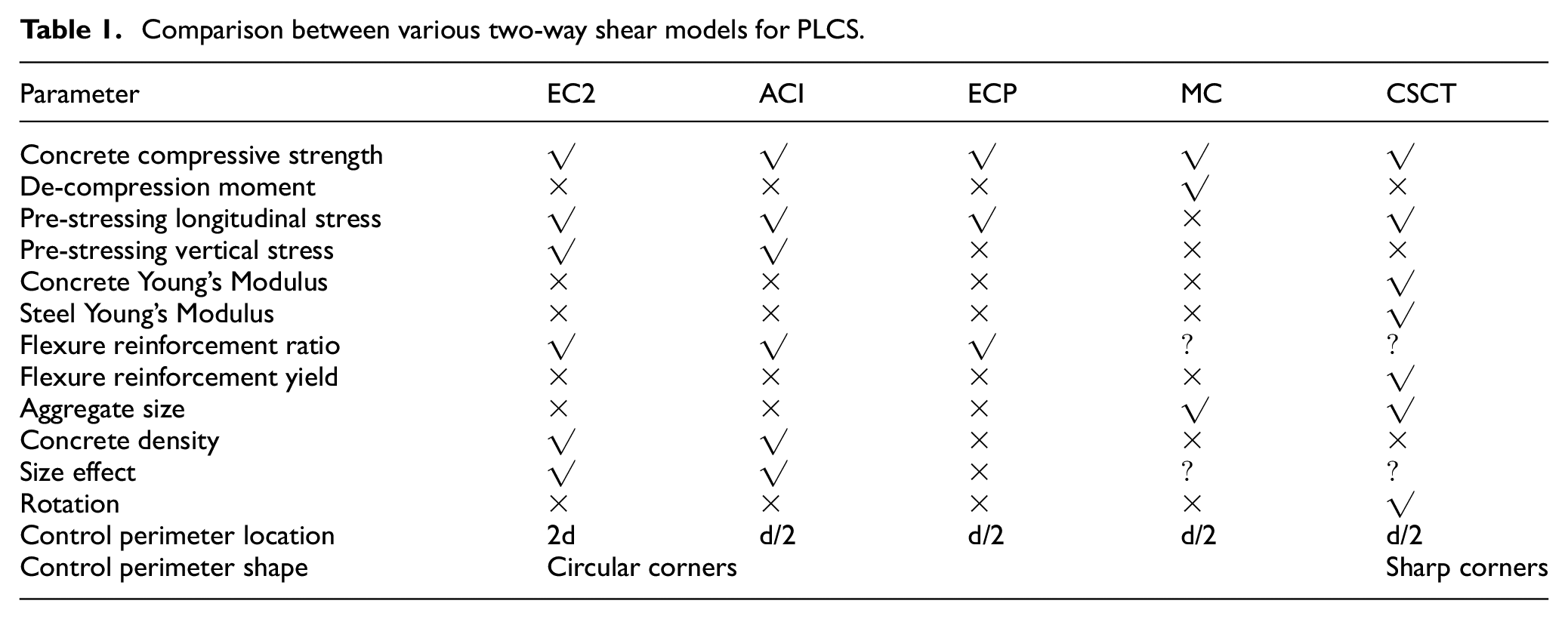
The usage of lightweight concrete slabs in Tall buildings provides up to a 30% reduction in the concrete slabs’ own weight, just result in significant savings in the overall cost of construction. In addition, the usage of prestressed concrete slabs extends to various applications, in particular prestressed lightweight concrete slabs (PLCS), however, fail quite suddenly with little warning as shown in Figure 1 (Aguilera, 2020; Deifalla, 2020a, 2020b, 2020c; Deifalla et al., 2020a, 2020b). For two-way shear of prestressed concrete slabs (PCS), design methods are different in the considered parameters as shown in Table 1 and Appendix B (ACI-318, 2019; Clément et al., 2014; EC2, 2004; ECP-203-18, 2018; MC, 2010). Considered parameters include prestressing compression stress, prestressing eccentricity, prestressing vertical component, aggregate nominal size, concrete density, rotation, control perimeter, and flexure reinforcement ratio. All design methods include the effect of the concrete compressive strength; however, the effect of all other parameters is different from none. In addition, various design codes provide two-way shear provisions for PLCS, which is developed for conventional PNCS.
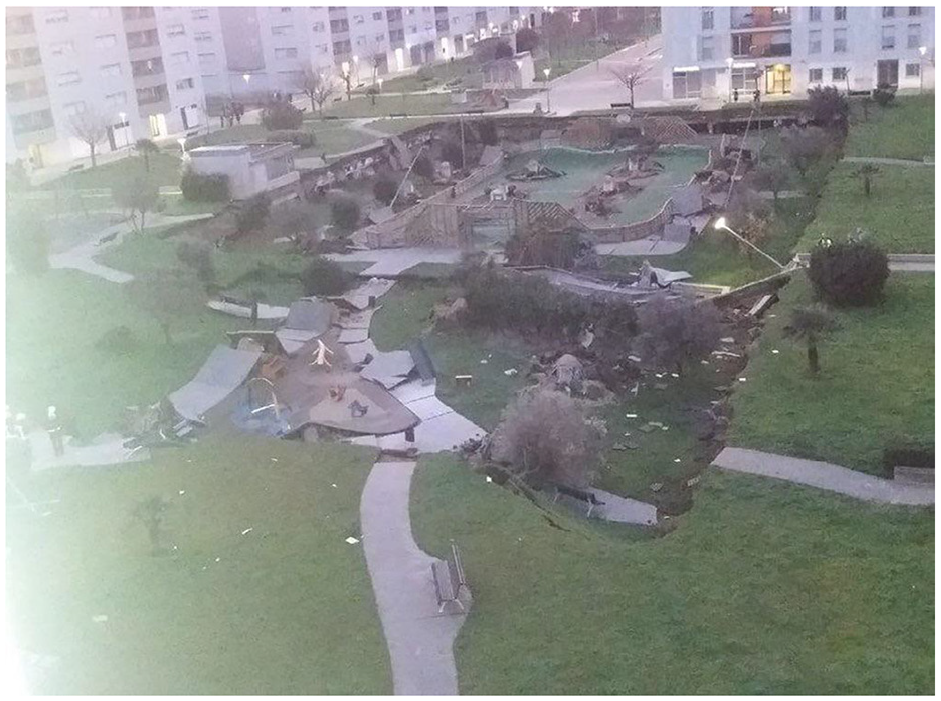
Parking garage failure on a play ground in Santander, Spain (Aguilera, 2020).
Comparison between various two-way shear models for PLCS.
The two-way shear strength of PCS has been experimentally by many researchers (Amir et al., 2016; Barbán et al., 2019; Burns and Hemakon, 1977; Correa, 2001; Eid, 2013; Franklin and Long, 1982; Gerber and Burns, 1971; Grow and Vanderbilt, 1967; Hasssanzadeh, 1998; Kordina and Nolting, 1984; Koust, 1977; Mao and Yaung, 2012; Melges, 2000; Moreillon, 2008; Mostafaei et al., 2011; Moussa and Salama, 2008; Nylander et al., 1977; Pralong et al., 1979; Ragab et al., 2014; Ramos and Lucio, 2006; Ramos et al., 2008, 2011; Regan, 1983; Rezai Kallage, 1993; Saleh and Suaris, 2009; Scordelis et al., 1958; Shehata, 1982; Silva, 2005; Smith and Burns, 1974). Only two studies focused on PLCS. In 1967, Grow and Vanderbilt (1967) tested 10 PLCS under two-way shear. The tested slabs were 1 m squared plan with a 75 mm thickness. The main investigated parameter was the level of prestressing, which varied between 0.04 and 4.5 MPa. It was concluded that the ultimate shear strength at a distance of d/2 from the column face varied from
Pioneering work in the modeling of the two-way shear behavior of prestressed concrete slabs was conducted by many researchers, which resulted in several models including but not limited to: The Critical Crack Theory (CSCT) and The Two Point Kinematic Theory for PNCS (Clément et al., 2013, 2014; Kueres and Hegger, 2020; Ramos et al., 2014). However, the CSCT was selected in this study due to its simplicity and that it accounts for PLCS as shown in Figure 2 (Clément et al., 2014). In addition, the cracking of lightweight concrete is smooth and passes through the lightweight aggregate as shown in Figure 2. Since 2018, a worldwide call for giving the shear and torsion of concrete elements physical meaning is ongoing, Deifalla and co-workers in order to investigate the behavior and design of beams and slabs under one-way shear, two-way shear, flexure, and torsion (Deifalla, 2020d; Deifalla and Ghobarah, 2010a, 2010b, 2014; Deifalla et al., 2013, 2015; El-meligy et al., 2017; Hassan and Deifalla, 2016, 2014; Saleh et al., 2019). In this current study, the design of the two-way shear behavior of PLCS is investigated and a new physically sound model is developed. A comparison between various design codes is conducted. A mechanical model developed for PLCS, which is based on the CSCT and compared with selected models. The conclusions of this work could help further design code development.
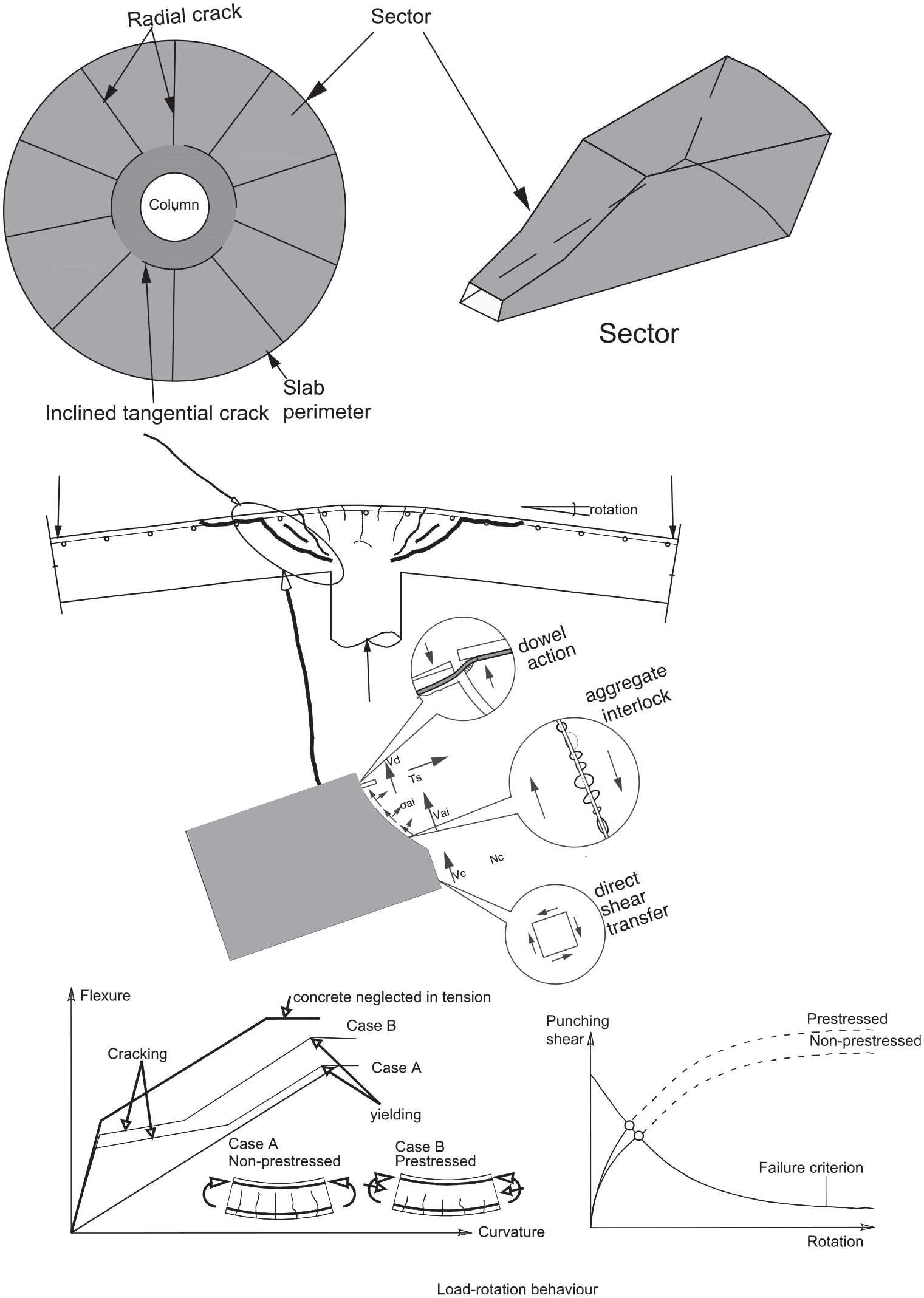
CSCT for PLCS (Clément et al., 2014).
Designing PLCS for two-way shear
Several selected codes and models exist for PLCS including EC2 (2004), ACI (2019), ECP-203 (2018), MC (2010), and CSCT developed by Clément et al. (2014). In this section, a brief discussion of each model is outlined. A number of two-way shear provisions of various design codes for PLCS are available. However, it differs from each other in the principle, where some are based on pure empirical formulation (EC2, ECP-203, and ACI-19) and some are based on physical models calibrated using experimental databases (MC and CSCT). Significantly different parameters considered in the strength calculation of various design codes. Where the EC2, the MC, and the CSCT model account for both the longitudinal reinforcement ratio and the maximum nominal aggregate size, while the ACI design codes ignored it. For Lightweight concrete, the MC and the CSCT neglect the aggregate size, thus reduce the aggregate interlock. While both the EC2 and the ACI implement a 60-year-old model, which decrease the concrete tensile strength using a factor based on the concrete density. Last but not least they use different critical sections for the two-way shear check, where all models use a critical section at d/2 from the edge of loaded area, except EC2 uses a critical section at 2d from the loaded area edge.
EC2
The two-way shear strength for PLCS using the EC2 is expressed in equation (A.1) of Appendix B. It is an empirical model, which accounts for size effect, flexure reinforcement ratio, concrete compressive strength, axial compression stresses from prestressing, lightweight concrete effect, and loading eccentricity as well as take the critical section at 2d from loaded area.
ACI
The two-way shear strength for PLCS using the ACI is expressed in equation (A.2) of Appendix B. It is an empirical model, which accounts for concrete compressive strength, axial compression stresses from prestressing, and loading eccentricity as well as take the critical section at d/2 from loaded area. However, it did not consider the size effect and flexure reinforcement ratio.
ECP-203
The two-way shear strength for PLCS using the ECP is expressed in equation (A.3) of Appendix B. It is an empirical model, which accounts for concrete compressive strength, axial compression stresses from prestressing, and loading eccentricity as well as take the critical section at d/2 from loaded area. However, it did not consider the size effect and flexure reinforcement ratio.
MC
The two-way shear strength for PLCS using the MC is expressed in equation (A.4) of Appendix B. It is based on the physical sound model critical shear crack theory (CSCT). In addition, it offers three levels of approximation (LOA) approach for design, which improves the accuracy of strength predictions, by progressively refining the values of the physically effective parameters. Such approach allows for performing quick and easy preliminary design checks (LOA I) as well as highly accurate and sophisticated strength predictions (LOA II and LOA III). It takes the critical section at d/2 from loaded area. However, no direct account for the size effect. LOA I was selected to simplify the calculations.
CSCT
The two-way shear strength for PLCS using the CSCT is expressed in equation (A.5) of Appendix B. It is a physically sound model developed for two-way shear, which relates the strength to the deformation. In addition, it predicts the rotation of the slab. Moreover, it takes the critical section at d/2 from loaded area. However, no direct account for the size effect.
Findings from testing of PLCS under two-way shear
Very limited investigations were conducted in order to investigate the two-way shear behavior of PNCS, which yielded the following conclusions:
- Punching shear increase due to prestressing through the following: (1) the vertical component of prestressing tendons with acts against shear forces due to gravity, especially, those in the nearby region of the loading area; (2) the axial compressive stresses due to prestressing; and (3) the eccentricity of the prestressing cables, especially those acting against applied bending moments due to gravity.
- Using ACI is more conservative compared to the EC2, which is due to the critical perimeter at 2d rather than d/2. Both ACI and EC2 strength predictions is inconsistent. Using the EC2 provides more accurate estimations compared to ACI.
- Using the MC provides the most accurate and consistent strength estimates compared to the ACI and EC2. Which is due to the fact that it is based on the physical model of the CSCT and accounts for the normal in-plane compression force, the cable eccentricity, and the cable inclination. In addition, the levels-of-approximation approach proposed by the code lead to a range of estimates, from simplified but inaccurate to sophisticated but accurate.
Model development
In the development of the mechanical model, the failure criterion proposed by Deifalla (2020b), which was developed for LCS based on the CSCT. It was adapted and extended for PLCS.
Slab rotation
The slab rotation was plotted versus the ratio between the prestressing axial compression stress and the concrete young’s modulus as shown in Figure 3(a). Thus, the rotation was modified using linear regression in order to reflect the reduction due to prestressing axial compression stresses as derived within the CSCT by Clément et al. (2014), such that:

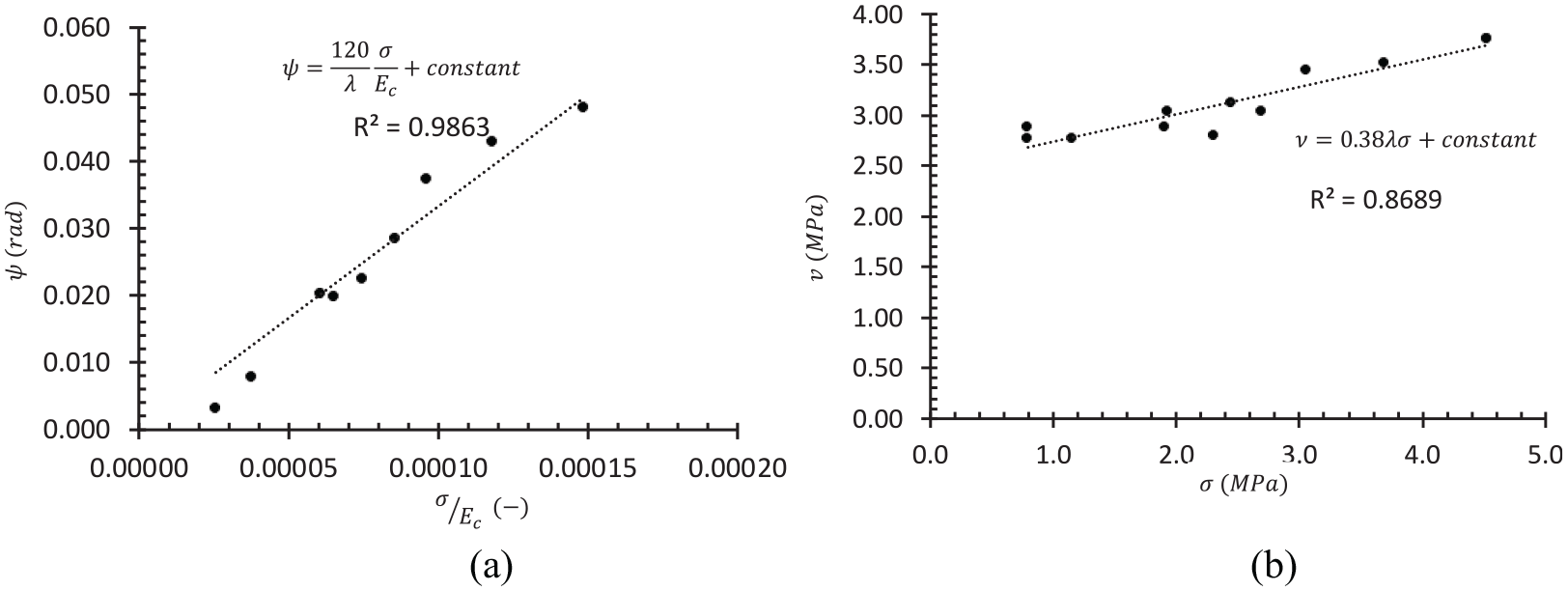
Regression best fit for two-way shear: (a) strength and (b) rotation for PLCS.
Failure criterion
The adapted model was calibrated using the experimentally observed two-way shear behavior of PLCS as shown in Figures 3(b) and 4, such that:
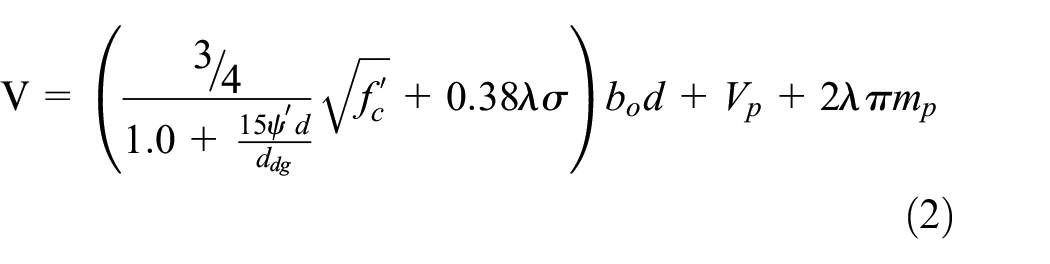
Where
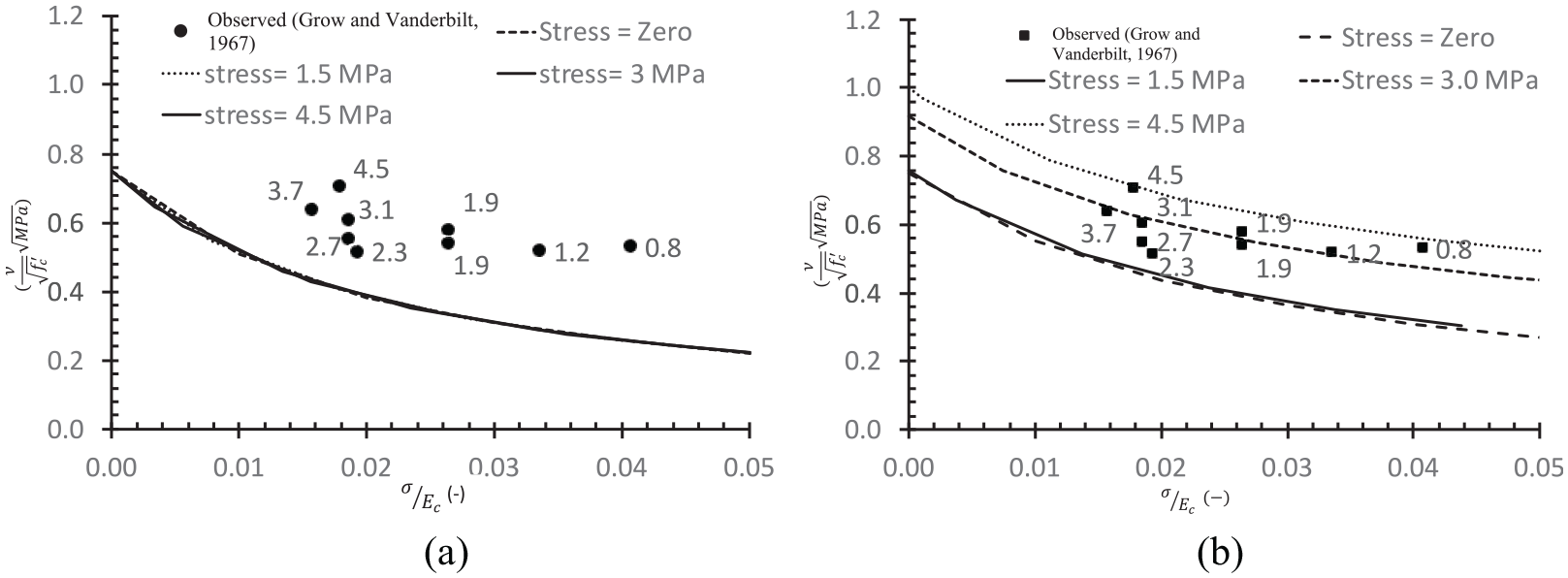
Failure criteria at different prestressing stress: (a) CSCT and (b) proposed.
Validation
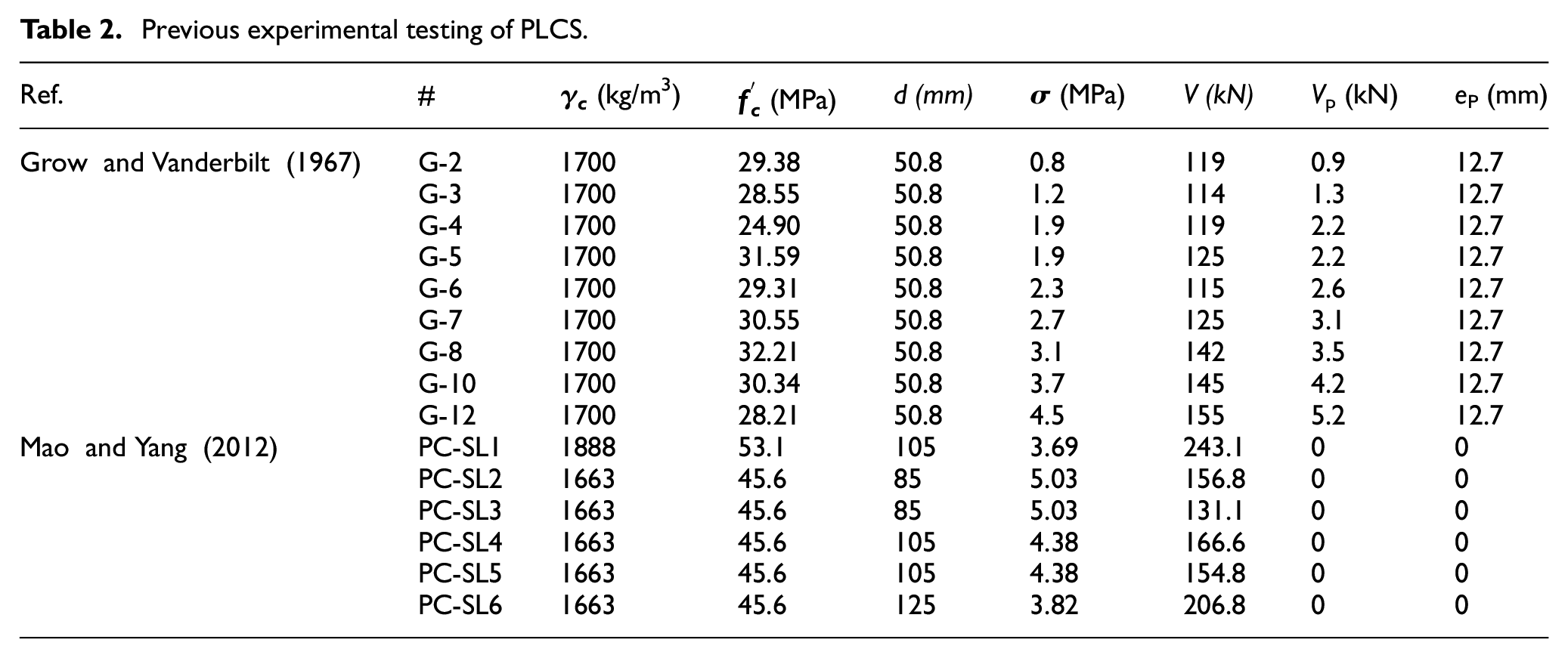
An extensive data base of over 213 PCS tested under two-way shear, where 15 were PLCS and 198 were PNCS as shown in Table 2 and Appendix C, respectively. The validation of the model is conducted using the ratio of the experimentally measured strength to that calculated using various methods (SI), where statistical measures including the average, the coefficient of variation (C.O.V.), and the lower 95%. When the average is close to unity, this indicates a more accurate model prediction. A better consistent model has a reduced C.O.V. The lower limit with 95% probability, should be more than 0.85, which is approximately the safety factor set by most design code provisions. This evaluation approach is the same implemented for validating models and design codes used by many researchers. In addition, a regression line for the relation between the calculated and measured resistance, which is chosen as linear to examine the scattering of the model predictions from the ideal 1:1 line passing through the origin. Moreover, the variation of the predicted strength using various models versus the values of selected parameters were investigated using a series of figures plotted between the SI using different models and the parameter values. These figures are ideally a constant line passing through SI value of unity, therefore, the closer the data to unity, indicates a more consistent model with respect to the investigated parameter. The figures were evaluated using an evaluation criterion developed the Canadian Society Association, where the following six categories were identified: Extremely conservative, Moderately conservative, Approximate conservative, Dangerous, Moderately dangerous, Extremely dangerous for SI values of more than 2, 1.30–2.00, 0.85–1.30, 0.65–0.85, 0.5–0.65, and less than 0.5, respectively..
Previous experimental testing of PLCS.
Overall
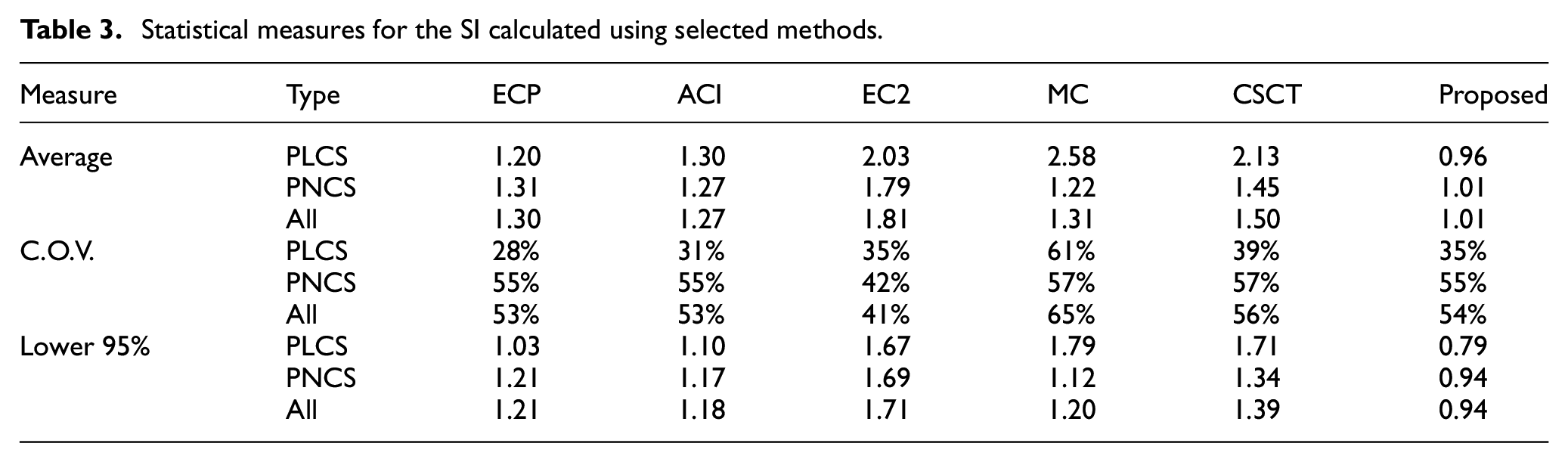
Figure 5 shows the measured strength for PLCS and PNCS versus that calculated using the selected methods. For PLCS, the scattering of the proposed model is much better than the CSCT, the ACI, and EC2. For PNCS, the scattering of the ACI and EC2 is better than the proposed model, the CSCT, and the MC. However, the Proposed model and the CSCT capable of predicting the rotation. Table 3 shows the statistical measures for the SI calculated using selected methods for PLCS, PNCS, and all. For PLCS and PNCS, the proposed model is better compared to all selected methods. The selected model has an average of 1.01 and C.O.V. similar to other models, while it’s lower 95% confidence limit is 0.94, which is safe.
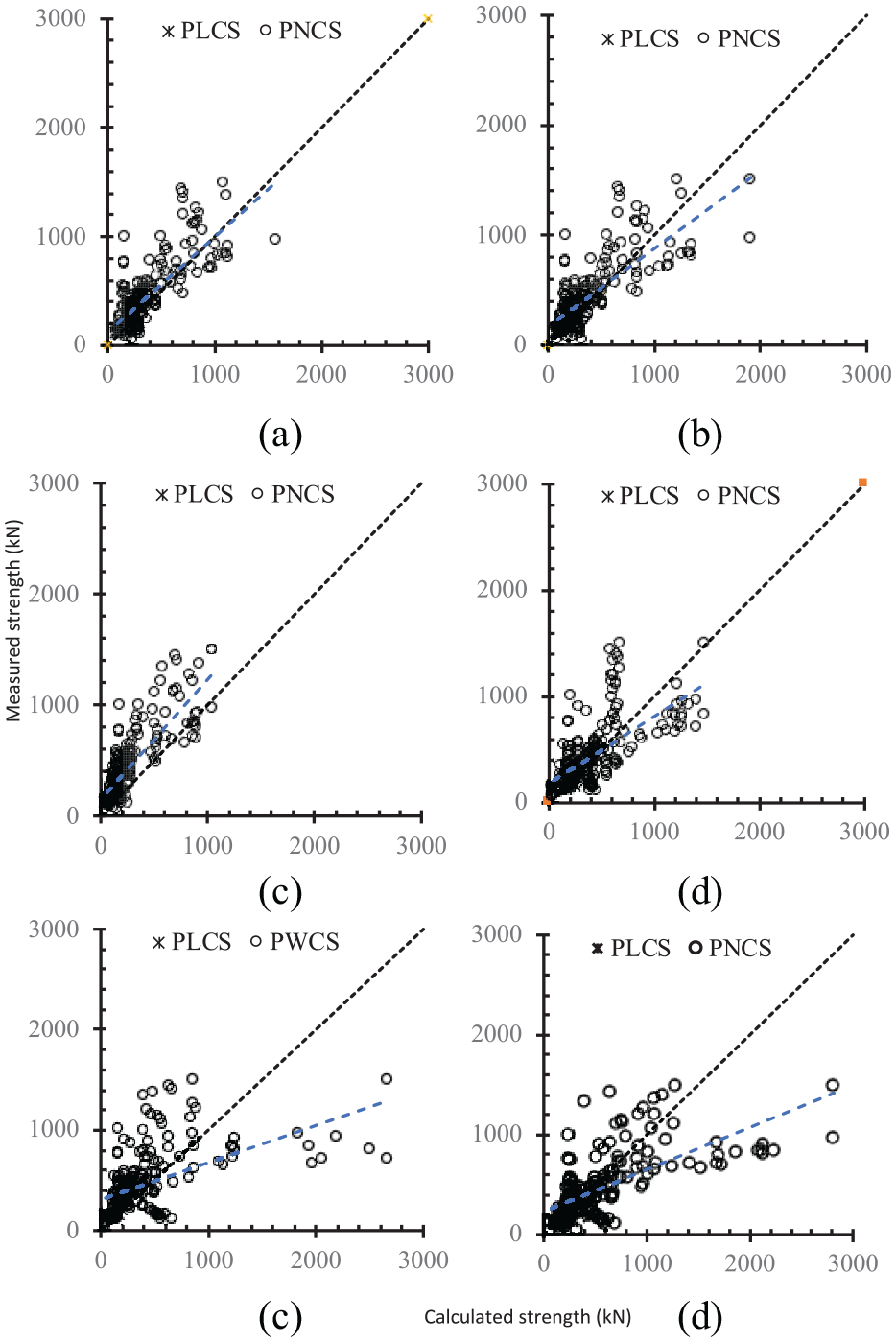
Measured versus calculated strength for PNCS and PLCS using: (a) ECOP, (b) ACI, (c) EC2, (d) MC, (e) CSCT, and (f) proposed.
Statistical measures for the SI calculated using selected methods.
Versus the axial and vertical components as well as eccentricity of prestressing
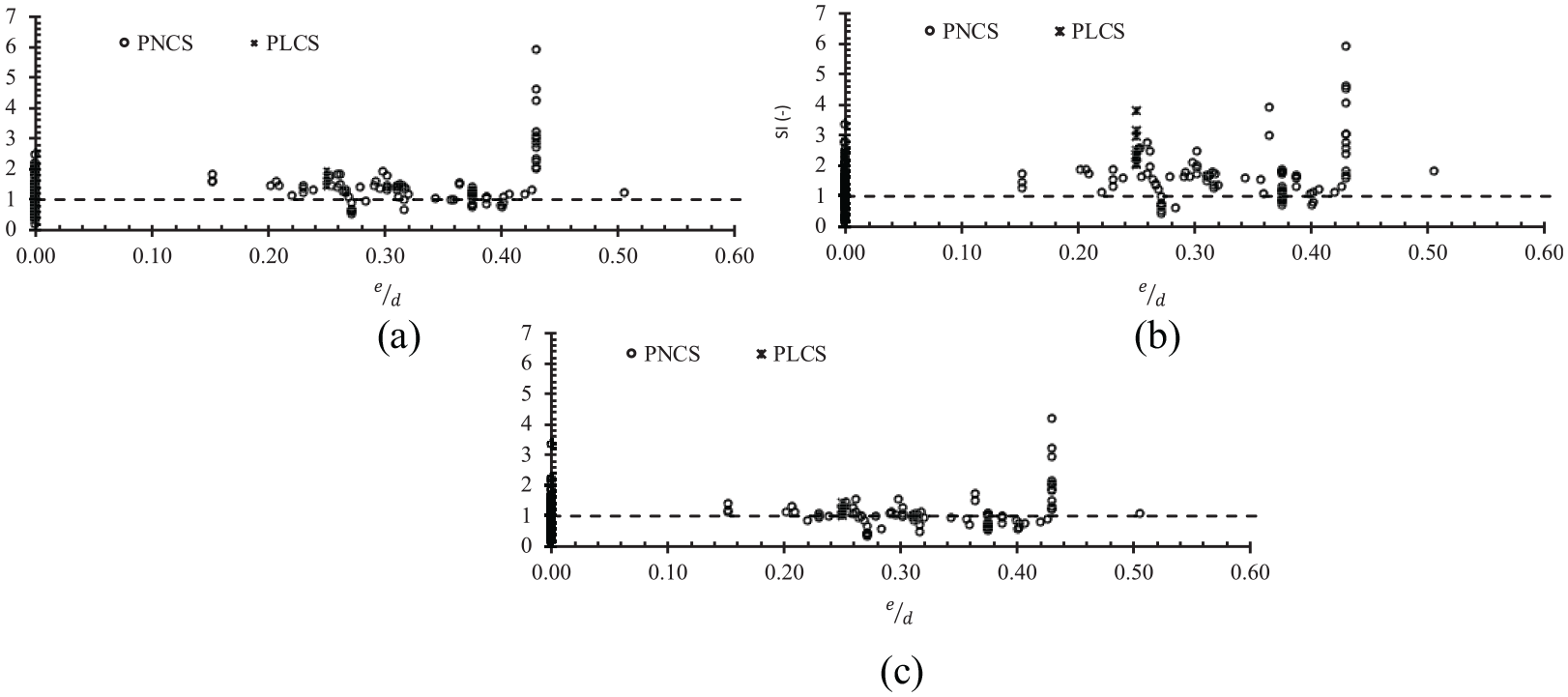
Prestressing have a vertical component, which increase the shear resistance. In addition, it decreases the width of cracks and rotation, thus reduce the ductility. Moreover, the pre-stressing increases the flexure strength. Last but not least, non-uniform stress concentrations around the loading area. Figure 6 shows the variation of the calculated strength using the CSCT and the proposed versus the prestressing compressive stress. It is clear that the proposed model captured the effect of the compressive stress on PLCS quite good, however, data is rare and further experimental testing is needed. Figures 7 to 9 show the variation of the SI calculated using ACI, CSCT, and proposed model versus the prestressing stresses, vertical component, and the eccentricity. It is clear that the proposed model is more consistent compared to the CSCT and more capable compared to the ACI. This is because the proposed model is capable of predicting the rotation of the PLCS and PNCS.
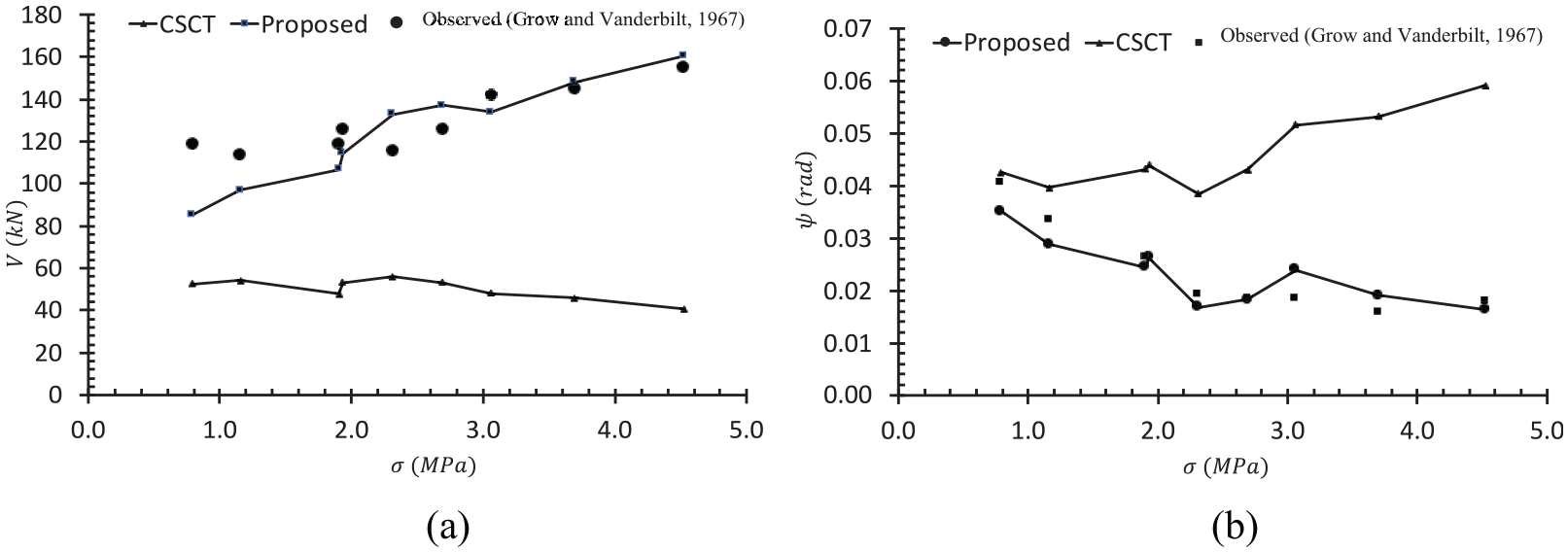
Model validation versus the compression in-plane stress due to prestressing.
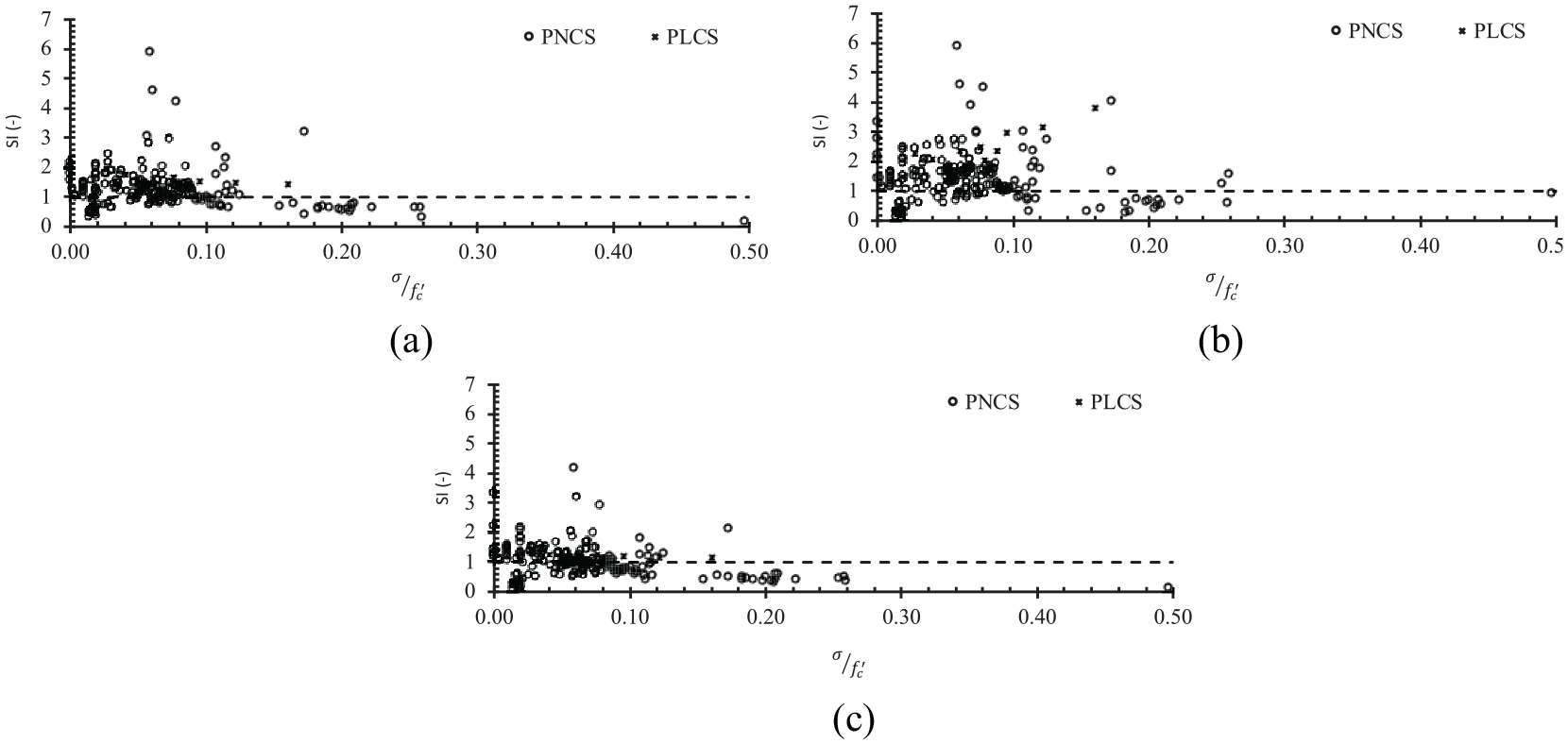
Comparison between SI calculated using ACI, CSCT, and proposed versus compression stress.
Comparison between SI calculated using ACI, CSCT, and proposed versus prestressing vertical component.
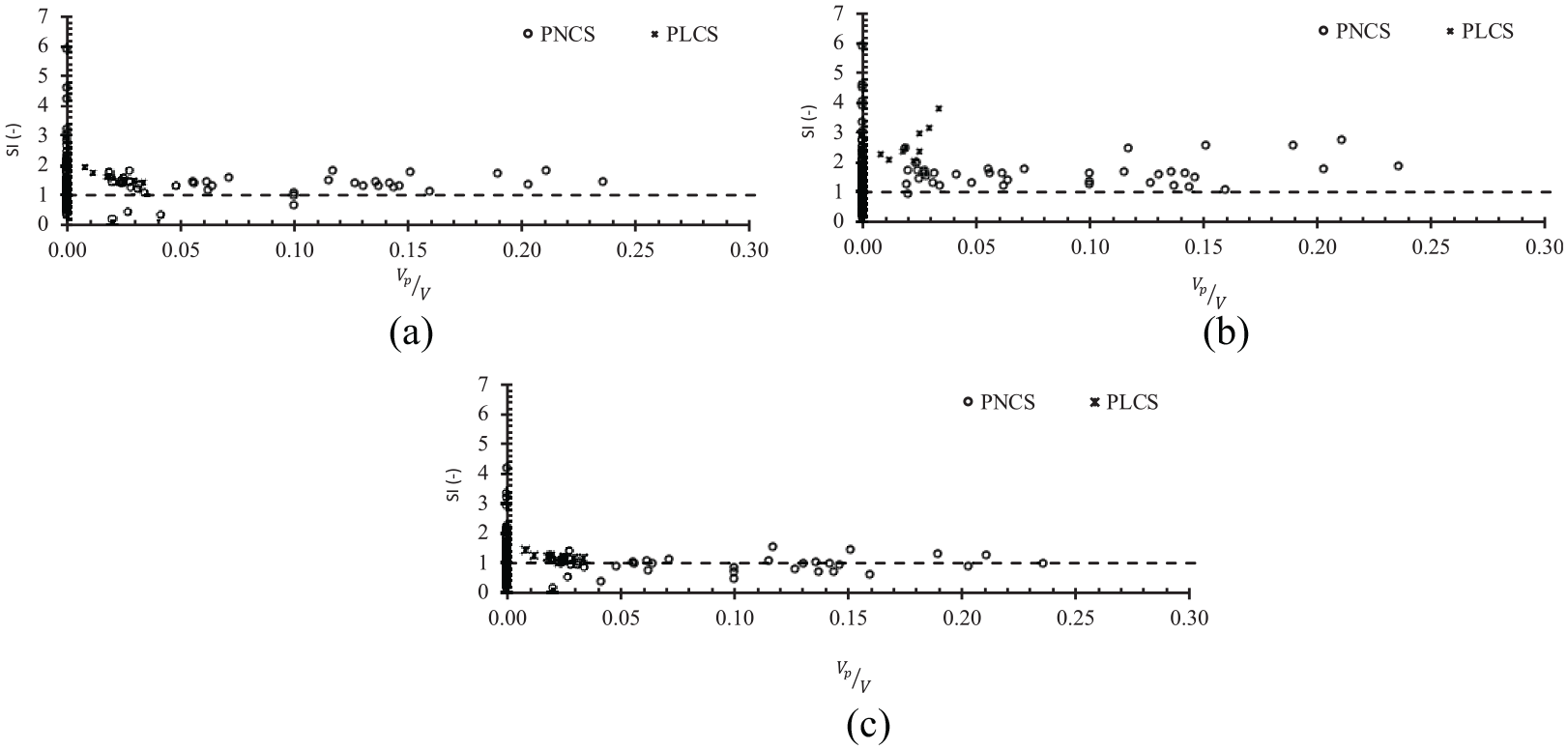
Comparison between SI calculated using ACI, CSCT, and proposed versus prestressing eccentricity.
Summary and conclusions
A mechanical model based on the principles of the Critical Crack Shear Theory, which is capable of predicting the two-way shear strength and deformation at failure, was extended and calibrated for prestressed lightweight concrete slabs. The proposed model is more accurate and consistent compared to available models and design codes.
Footnotes
Acknowledgements
The author would like to express their special thanks and gratitude to the Future University in Egypt for their continuous support.
Declaration of conflicting interests
The author declared no potential conflicts of interest with respect to the research, authorship, and/or publication of this article.
Funding
The author received no financial support for the research, authorship, and/or publication of this article.
Compliance with ethical standards
The author declares full compliance with ethical standards

Data availability
All data, models, and code generated or used during the study appear in the submitted article.