







Abstract
This study investigated and classified typical structures in rural village and analyzed the vulnerability. Based on the statistics of earthquake damages with magnitudes above 5 from 1996 to 2013 in China, the damage matrixes of types of structures in rural village are obtained. The vulnerability index and equation of structure are crucial to assess the earthquake losses of typical structures under different magnitudes earthquakes. According to the seismic loss of different types of structures under different earthquake magnitudes, there are possible to improve the seismic resilience of the buildings in rural village. Moreover, the regional vulnerability is analyzed by β probability distribution function. The comprehensive seismic vulnerability index of different types of structures in rural villages is obtained. The main research is to predict the loss of different types of structures under different earthquake magnitudes in the future, and to provide technical support for types of buildings in rural village reinforcement.
Introduction
In developing countries, the seismic resistance capabilities of buildings in rural villages are weak. Under the same earthquake intensity, the casualties and the buildings collapse in rural areas are more serious than those in cities (Yao, 2017a; Yao, 2017b). The developing countries have large numbers of structures in rural village (Polat and Randolph, 2004; Güçhan, 2007). Due to the weak seismic resistance capacity of large number of buildings in rural villages of developing countries, the seismic performance of buildings in rural villages can reflect the seismic capacity of a region or a country (Yao et al., 2019, Yao, 2017). From 2005, China accelerated the construction of structures in rural area. According to the statistical results in 2005, there were 61,963 new rural buildings were built in China, accounting for 2.27% of total buildings in China (Yao et al., 2020). The buildings in rural areas of China are constantly increasing (Yao et al., 2018). The key method to prevention and reduction loss is enhancing the seismic resistance capabilities of rural buildings in China and other developing countries. The research has great significance for improving rural buildings seismic capabilities in developing countries.
It is reasonable to choose the analysis method of structure seismic vulnerability method, which is the key to accurately assess the earthquake vulnerability of buildings in rural villages. There are the VI method has been used worldwide (Kenneth et al., 2008; Lourenco and Roque, 2006; Lourenco et al., 2013), to elaborate seismic scenarios at large scale as in RISK–UE approaches (Milutinovic and Trendafiloski, 2003), Hazard - United States (HAZUS) (National Institute of Building Sciences, 1997) and Risk Assessment Tools for Diagnosis of Urban Areas against Seismic Disaster (RADIUS) (OYO, 1999) methodologies. The seismic vulnerability of different types of structures in Algerian cities is analyzed by Delphi method, and the vulnerability of masonry structure is highlighted by empirical analysis (Yousfi and Bensaibi, 2018). Moreover, Votsis et al. (2012) analyzed the seismic vulnerability of different types of buildings in Cyprus city by SAP2000. Whether it is empirical analysis or finite meta-analysis, the seismic vulnerability of building structures can be given. Romis et al. (2021) used the building structure vulnerability index to evaluate the seismic structural vulnerability. However, both types of vulnerability analysis methods require a lot of time and cannot meet the needs vulnerability analysis of a wide range of buildings in rural villages. Therefore, it is very necessary to establish a rapid analysis method of building vulnerability.
The method of vulnerability analysis should be based on the seismic damage state of different type of structures in historical earthquakes. Şahin et al. (2007) analyzed the 1894-Istanbul, 1970-Gediz and 1999-Kocaeli earthquake damage in Turkey, and discussed the seismic damage scenarios of different building structures. Vettore et al. (2020) have studied the regional seismic disaster matrix and presented in GIS through the analysis of building vulnerability. Preciado et al. (2020) provides different seismic damage scenarios by associating building vulnerability levels and expected seismic damage levels with seismic intensity. Li et al. (2020) based on the seismic damage data to establish the empirical seismic damage probability matrix, the average susceptibility seismic index probability matrix model considering the probability of empirical earthquake vulnerability in multi-seismic areas is proposed. Gautam et al. (2016) studied a detailed field survey of Nepal’s major world earthquake paradigm and historical earthquakes, as well as the Gurkha earthquake, is fully considered, explaining the lessons Nepal will learn from the Gurkha earthquake. A retrospective study of the seismic damage data of historical buildings is carried out to provide data support for the rapid analysis of the vulnerability of building structures.
In this paper, the historical disaster data are reviewed and the earthquake disaster matrix is established. Based on the seismic site survey data (Lourenço, 2002), five states of structural damage were determined: Basically intact, Minor, Medium, Serious, and Collapse (Pakdamar & Lourenço, 2019). Based on the rapid analysis method of building earthquake vulnerability, the historical seismic disaster data are studied retrospectively and the historical earthquake disaster matrix is established. Therefore, the comprehensive seismic vulnerability index of different types of building structures is obtained.
Background and analysis method
Evaluation standard classification of earthquake damage level of rural structures
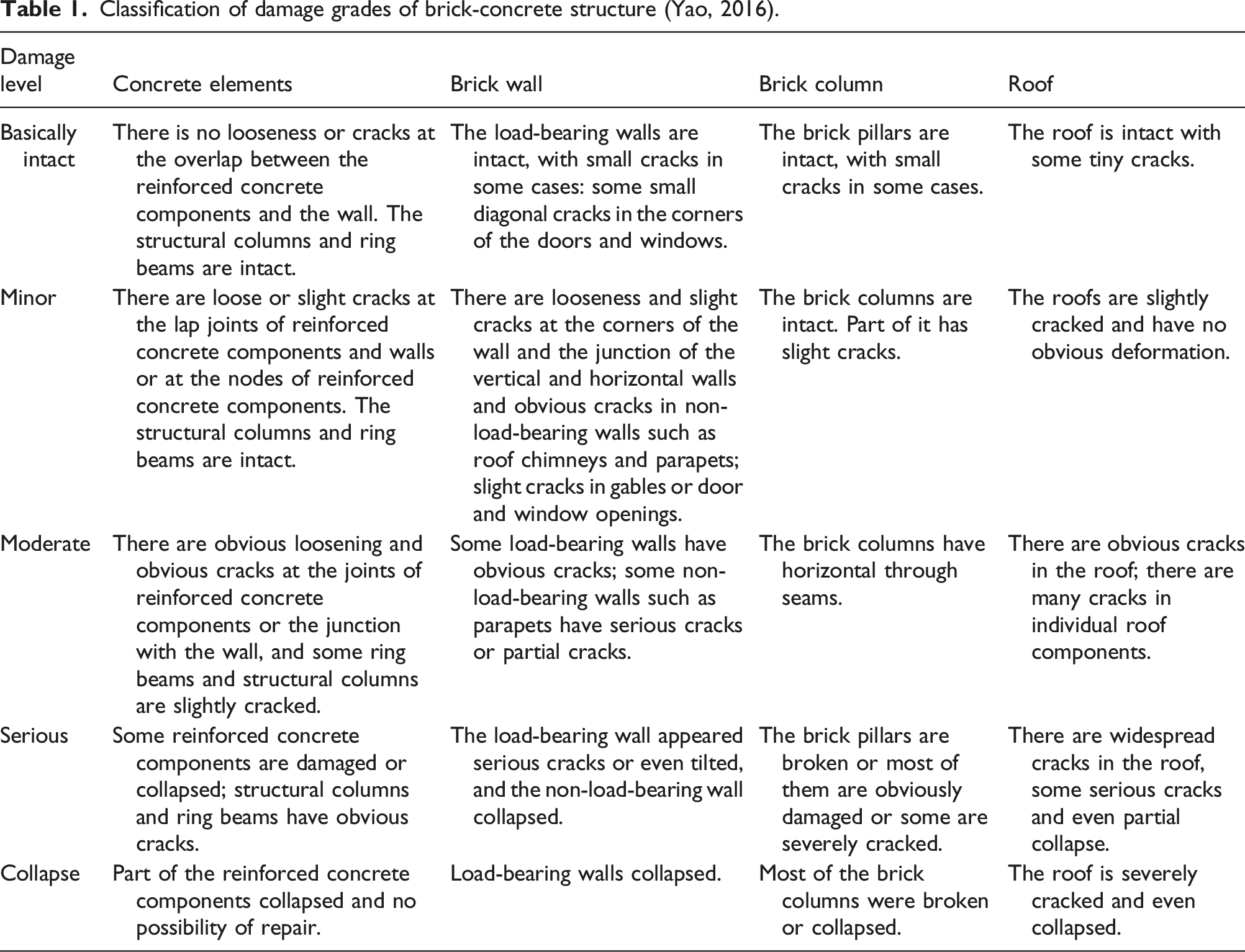
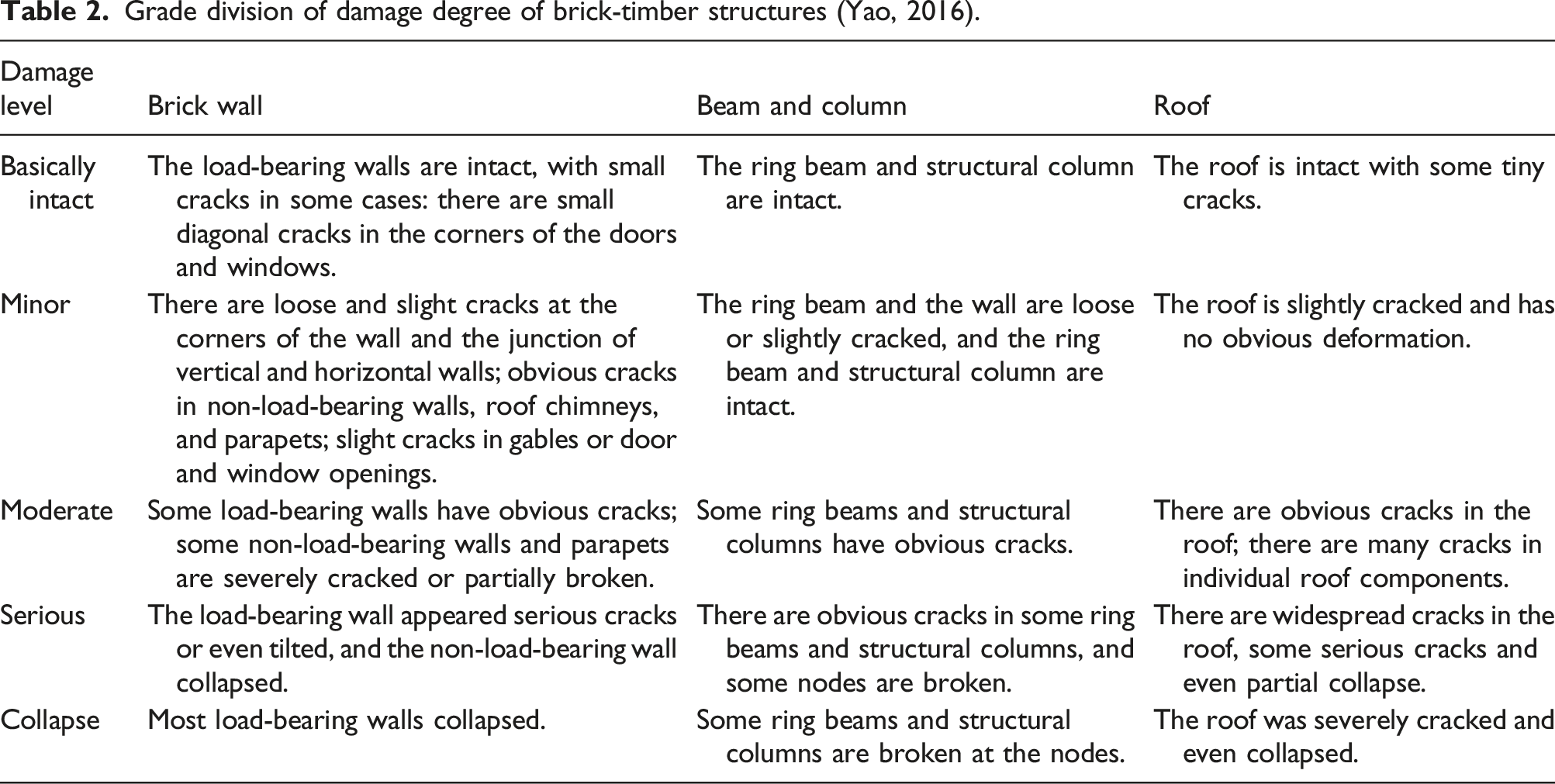
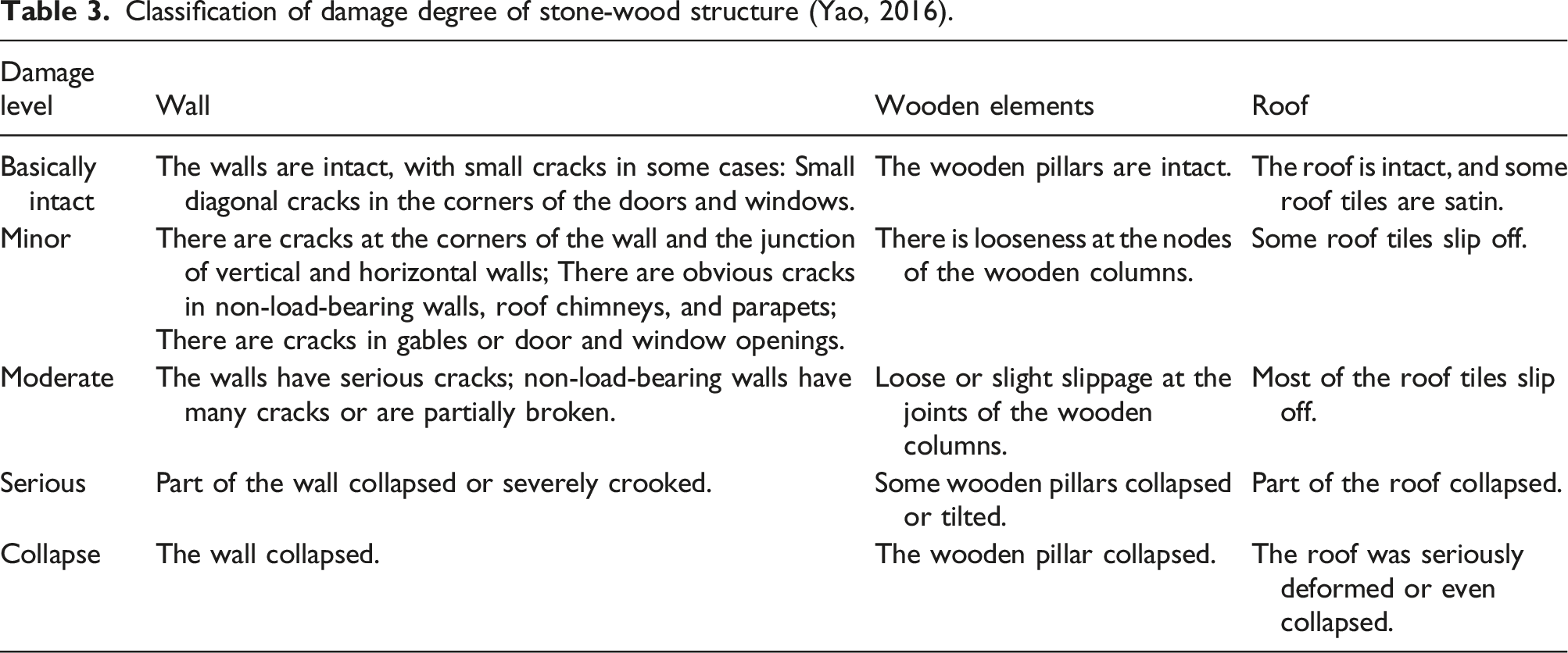
According to the historical earthquake damage data, it is necessary to divide the seismic damage state level of the structures. The rule of dividing the seismic damage based on the damage state of the load-bearing components and non-load-bearing components of the structures and the difficulty of fixing the damage. According to the “Outline and Technical Guidelines for Earthquake Site Work” (China Earthquake Administration, 1998) and “Chinese building damage grade classification standards” (GB/T18208.4-2005, 2005; GB/T18208.3-2000, 2000), the earthquake damage states can be divided into 5 grades (e.g.intact, minor, moderate, and serious and collapse). The standard describes in detail the damage states of different types of structure.
The mentioned classification of earthquake damage levels is used to classification of typical structures, especially the classification standards of earthquake damage levels adopted for structures designed with codes. However, most of the rural residential structures have not been designed or constructed with the national code (Yao et al., 2021). Therefore, the seismic damages are quite different from those designed in accordance with the specifications.
Classification of damage grades of brick-concrete structure (Yao, 2016).
Grade division of damage degree of brick-timber structures (Yao, 2016).
Classification of damage degree of stone-wood structure (Yao, 2016).
Classification of damage degree of wooden buildings components (Yao, 2016).
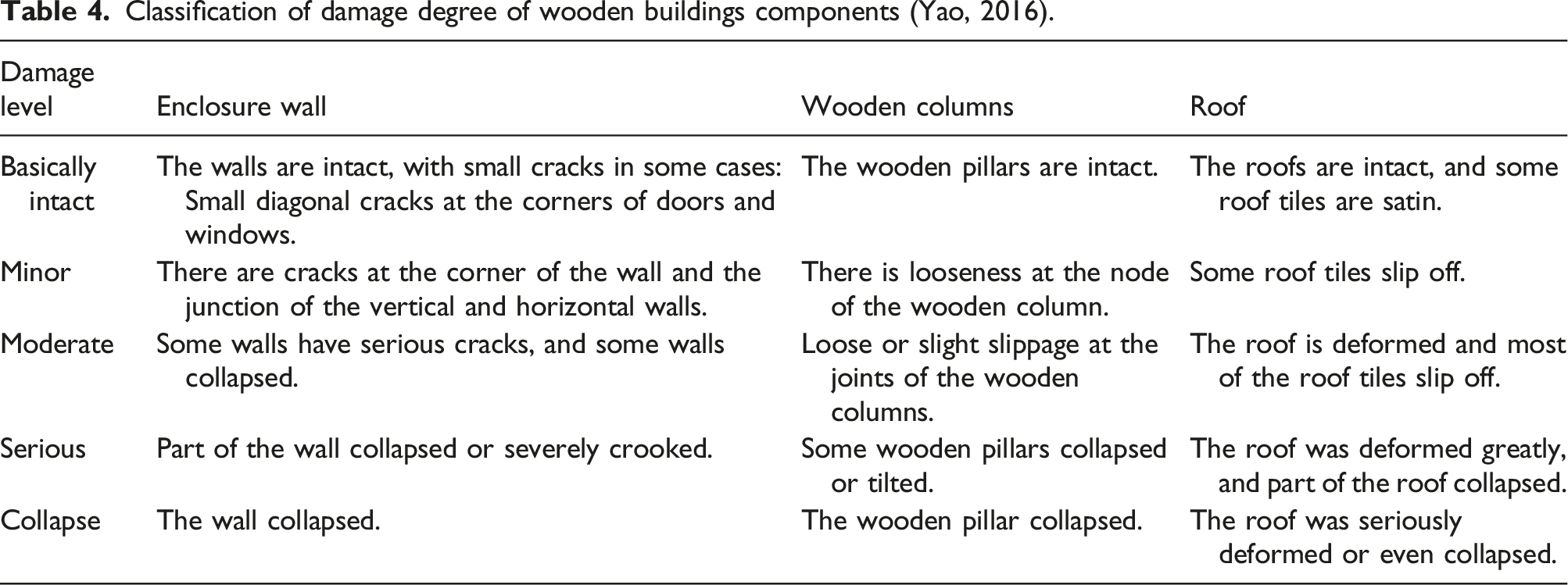
The states of seismic damages are divided into five levels. And the detailed classification standards for each structure type are different. The establishment of the earthquake loss matrix of buildings in rural villages requires not only a detailed classification of the loss of the structures, but also a combination of the vulnerability analysis of the structure. The seismic vulnerability analysis of the structure is an estimation and synthesis of the various damage degrees of the structure under the action of earthquake. Choosing the appropriate analysis method of vulnerability is the key to accurately evaluate the comprehensive vulnerability of structures and regional buildings. Since the seismic capacity of structure varies with the structure type, the diversity of structure types leads to the diversity of seismic capacity evaluation methods.
Vulnerability analysis methods
Reasonable vulnerability estimation method can be used to make correct analysis of the existing structure, so as to make a relatively accurate evaluation seismic resistance ability of the structures in rural village in future earthquakes. The purpose of improving the comprehensive earthquake resistance of a city or a country could be achieved. However, the vulnerability analysis method must be based on large of historical seismic damage data. At present, the seismic damage data of buildings in the world is scarce. In the past several major earthquake disasters occurred in China, most of the buildings that were damaged or affected were weak seismic resistance ability. They were not able to adapt to the rapid development of the demand of seismic resistance of buildings in such fast-developing time.
At present, the vulnerability analysis methods which commonly used are mainly divided into empirical analysis methods and theoretical analysis methods. The empirical analysis method requires a large amount of seismic damage data, analyses the seismic damage data and then defines the damage level, summarizes the relationship between the ground motion and the degree of damage to the structures, and estimates the existing structures which under the different intensity destruction level. The theoretical analysis rules need to refer to the relationship between seismic damage data and characteristics of structures, and calculate using seismic design code calculations or dynamic response analysis methods, and then establish the relationship between structural response characteristics and ground motion intensity.
Based on the results of characteristics of structure seismic response, the earthquake damage level could be obtained. The empirical analysis method is to predict the earthquake damage of the structures according to the relationship between the earthquake damage index and the damage degree obtained from the seismic damage survey data. This method can be specifically divided into direct statistical analysis method, equivalent statistical method and experience summary method. The theoretical analysis method is to obtain the structural response through theoretical calculations, and finally to assessing the structural seismic damage degree through the relationship between the structural response and the seismic damage degree. The theoretical analysis method analyses the vulnerability of the structure, which need to select the indicators that correspond to the damage status of the structure and can reflect the seismic resistance of various types of structures. Finally, the relationship between the seismic capacity of the structure and the degree of damage is determined. Based on the available data, this article will use empirical methods to analyses the vulnerability of structure.
Since the 20th century, many destructive earthquakes have occurred in China, especially in recent decades (Yao, 2016). These earthquakes have caused huge economic losses and casualties to China. This article summarizes the earthquake damages that have great impact on rural villages among these earthquakes, and gives the proportion of rural structures with different degrees of damage during different earthquake intensities, which is the historical damage matrix (HDM). Based on the summary of HDM of structures in rural village, the damage matrix of different types structure under different intensity of 6–10° is provided as a basis for estimating the seismic resistance ability of existing buildings in rural village and the possible earthquake damage in future earthquakes.
In order to quantitatively describe the vulnerability level of structures in rural village, the seismic vulnerability index (VID) is used to express as follow equation
The VID of building refers to the average value of the earthquake loss rate of a certain type of building under the intensity of 6–10° (GB/T 17742-2020, 2020). The greater of the VID, the seismic resistance ability of the structures are worse. From the equation, we can see that the vulnerability index is related to the loss ratio of the structures, and it increases with the increase of the loss ratio. The loss ratio means that after a certain level of damage to the buildings, which is the ratio of the required cost to restore to original state.
The seismic vulnerability of building mainly refers to the comprehensive consideration of the degree of structural damage, and the loss ratio has a certain relationship with the current price of the buildings. This paper considers that is not appropriate to introduce the loss ratio into the vulnerability index.
The seismic vulnerability index should be a comprehensive value of the probability of damage to the same type of structure in the study area under various earthquake intensities. It should be said that the vulnerability is an inherent property of the structure, and the seismic vulnerability is the response of the structural vulnerability to the earthquake. Therefore, the seismic vulnerability index is the response of the structure to the earthquake. Although the seismic vulnerability index is calculated through the damage ratio of different damage levels of the structure under different ground motion parameters, the index and the ground motion parameters are not necessarily related to VID. Therefore, this study gives the recommended equation for VID. The equation is
It can be seen from the newly study about seismic vulnerability index. It should be said that this calculation method is relatively straightforward to operate. The damage level is divided into five levels. The boundary between the five levels is a method based on fuzzy mathematics. In the definition of the vulnerability index, the contribution of each damage level to the vulnerability index is different. In order to distinguish this difference in contribution rate, this paper introduced the serial earthquake damage state. Assuming that the percentage of basic integrity is 100% and the other damage levels are 0%, the vulnerability index is 0.2. Under all severity, the percentage of damage is 100%, and the other damage levels are 0%, then the vulnerability index is 1. In other words, the maximum value of the vulnerability index is 1, and the minimum value is 0.2. The smaller number of vulnerability index, the strongest of the earthquake resistance ability of the buildings.
Based on the statistical analysis of large of earthquake damage matrices, this study has given the distribution rule of earthquake damage index and corresponding intensity. The seismic damage matrix of unknown intensity is derived from the earthquake damage matrix of existing intensity. It is assumed that the expected value and variance of the earthquake damage index between adjacent intensities are the same as the expected value and variance of the standard earthquake damage matrix. As a result, the expected value and variance of the seismic damage index under different intensities can be obtained. At the same time, the distribution of the seismic damage index under other intensities is considered to obey the beta distribution. The equation of probability density of distribution as follow: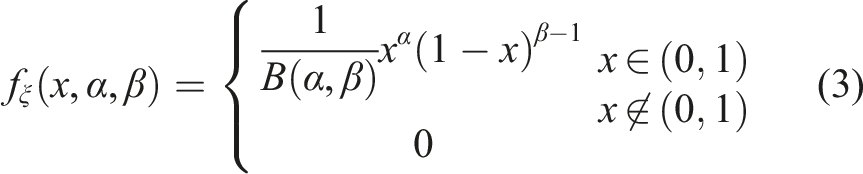
The β distribution corresponding to the intensity sub-seismic damage index can be determined (see equation (4)). Then, the transcendental probability value for each level of destruction can be obtained.
Considering of the historical seismic loss data of buildings in rural villages, the classification criteria of earthquake damage of buildings are perfected, and a database of vulnerability analysis is established. Based on the analysis of seismic vulnerability of different types of building structures, the probability distribution function of β is used to carry out a detailed classification of historical seismic data to obtain the seismic vulnerability index of different types of rural buildings under different seismic intensity conditions.
Seismic vulnerabilities of the structures in rural area
The characteristics of seismic damage of structure in rural village
Seismic vulnerability analysis refers to the probability of a certain degree of damage to the structures under various intensities of earthquakes, which know as earthquake damage prediction (Mauro et al., 2003; Alex et al., 1996). The object of vulnerability analysis can assess a single structure, a city or an area. Before conducting vulnerability analysis, basic data must be available: (1) predict the ground motion or intensity of the site, such as the corresponding 50-year probability obtained from seismic hazard analysis; (2) the inherent factors of the building include structural type, number of floors, age, quality, etc.; (3) predict the magnitude of the earthquake and proportion of various types of structures in the unit.
It can be seen that the main research content of vulnerability analysis data are seismic hazard analysis data and engineering structure seismic capability analysis data. Assessing the seismic resistance ability of buildings is to analyses and evaluates the damage of the building group under different seismic intensity conditions. Generally, the results of structure vulnerability analysis can have the following two forms: the first is the vulnerability function, which means a continuous probability density function of a certain damage level under a certain intensity condition, and represents the vulnerability of the structures. The other is the seismic damage matrix, which represents the conditional probability of a certain damage level under a certain seismic intensity, which is expressed in the form of discrete quantities. This damage matrix was proposed by Ferreira et al. (2016). It was used to predict the seismic vulnerability of building structures in 1973.
The main reason lead direct economic losses are large number of buildings collapsed in the earthquake. Statistics show that the damage and loss to structures in rural village under Mw 7 earthquakes accounted for more than 60%–96.7% of the total direct economic loss (see Figure 1). The seismic damage of residential buildings in different areas is quite different. The geographical environment in the western region is relatively poor, and the economic level is relatively backward. The degree of seismic damage is relatively heavy. The central and eastern regions of China are densely populated, and the economy is relatively developed. The renewal period of structures in rural village is short. The quality of buildings is high, and the degree of earthquake damage is relatively light. Traditional adobe structure, Brick-concrete structure, Wooden structure and Stone structure, Brick-wood structure are prone to collapse or severe damage under earthquakes. By comparison, the seismic performance of brick-concrete structure is better. Earthquake secondary disasters are severe, especially due to the nature of the epicenter and the special terrain. Sand liquefaction, landslides, mudslides and other phenomena are common occurrence, which magnifies the earthquake effect. The impact of small and medium-sized earthquakes below Mw 5 on rural residential buildings cannot be ignored, and even some Mw3 and Mw4 earthquakes have caused of millions USD in economic losses and casualties. The losses of private buildings caused by small and medium earthquakes are equal to the total disaster losses. Proportion of loss of rural structures in earthquakes with magnitude 5 or higher in China from 2000 to 2012.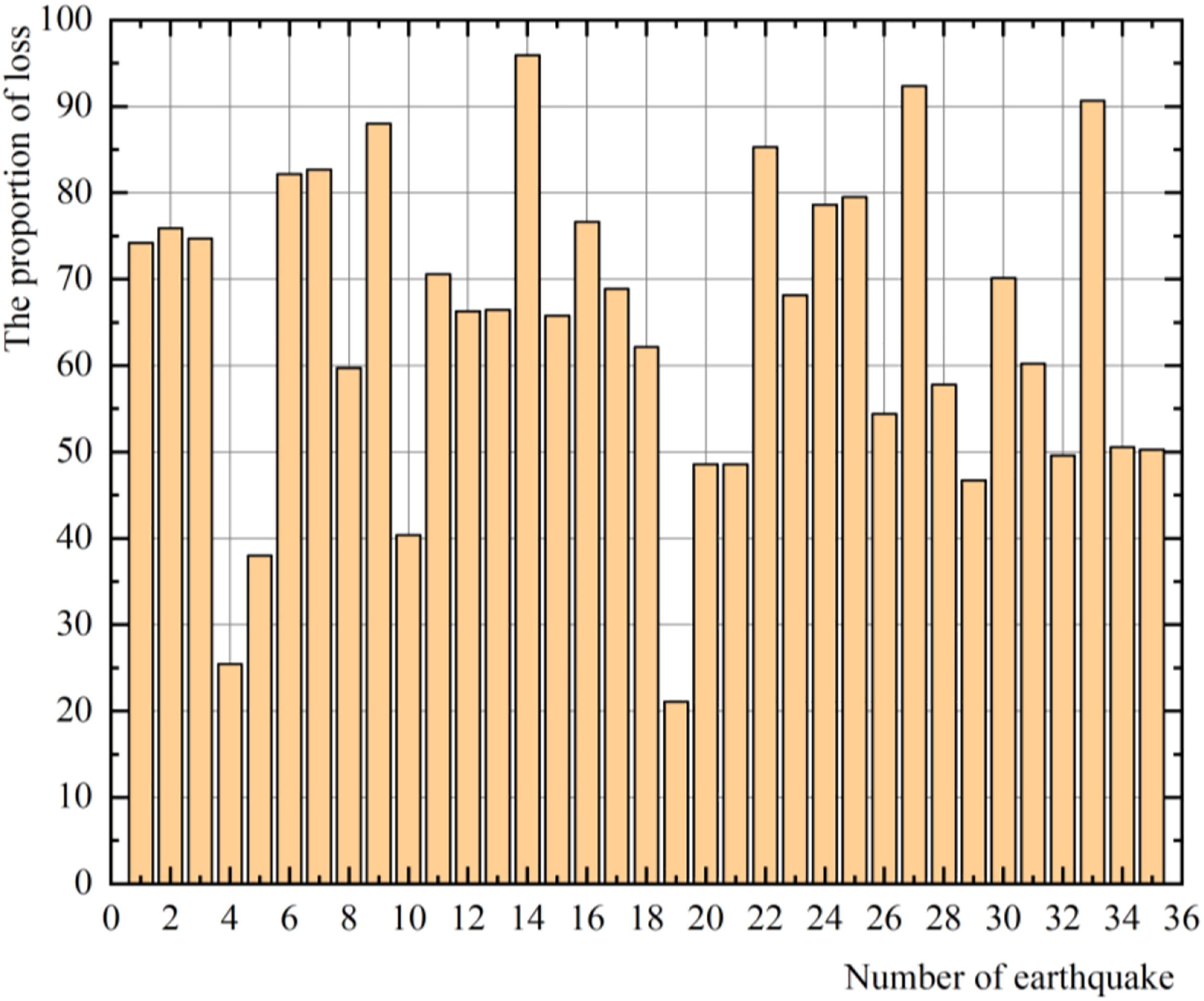
The types of structures in rural village
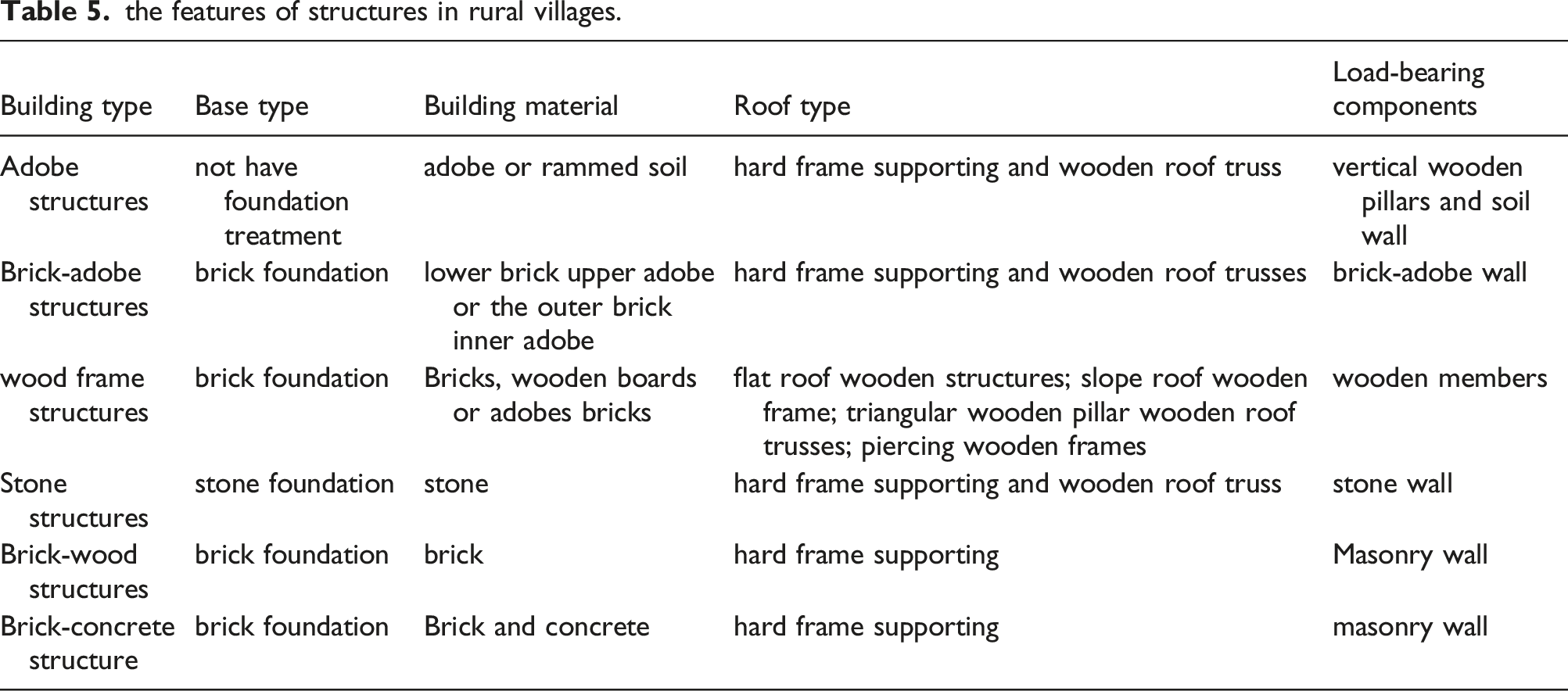
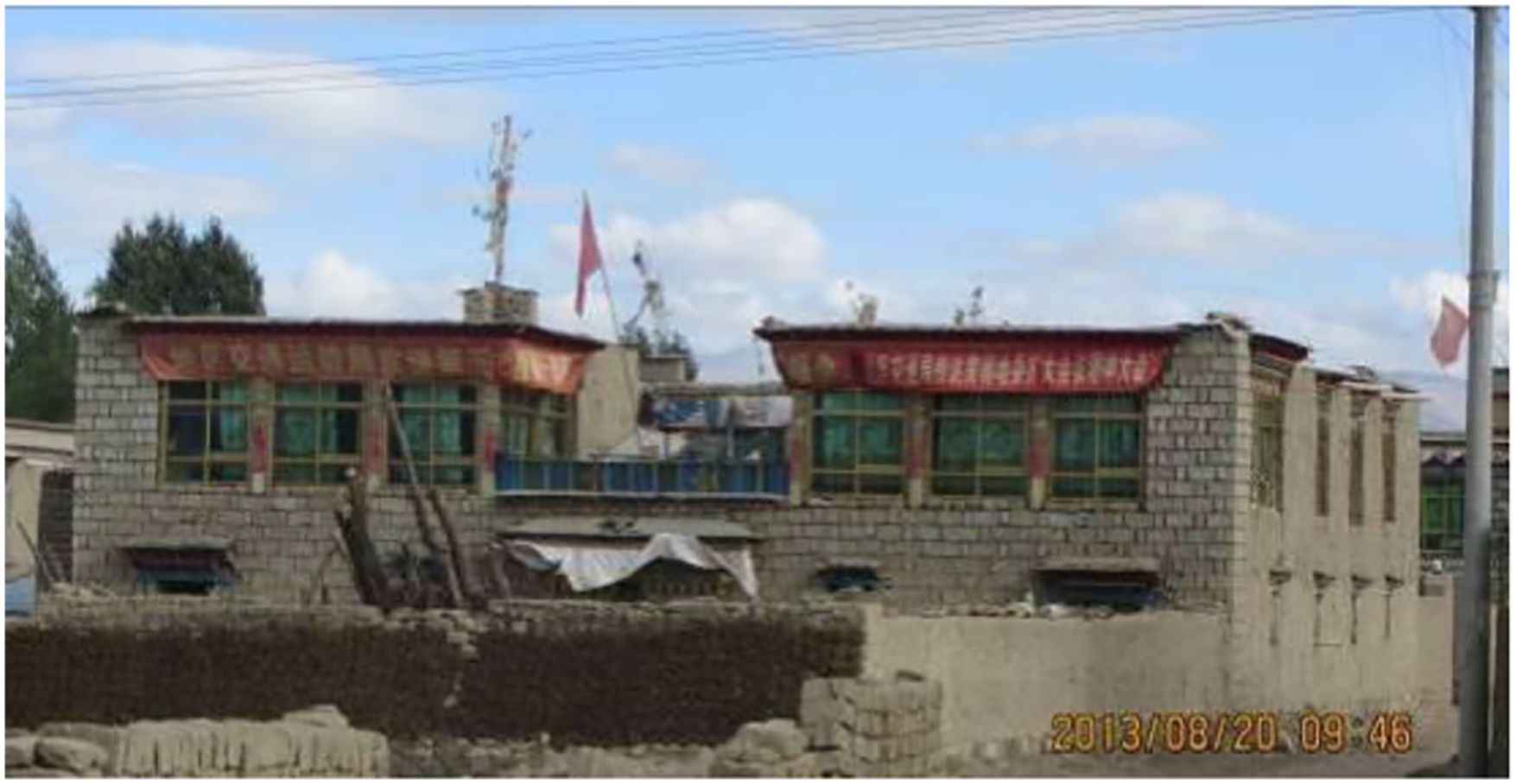
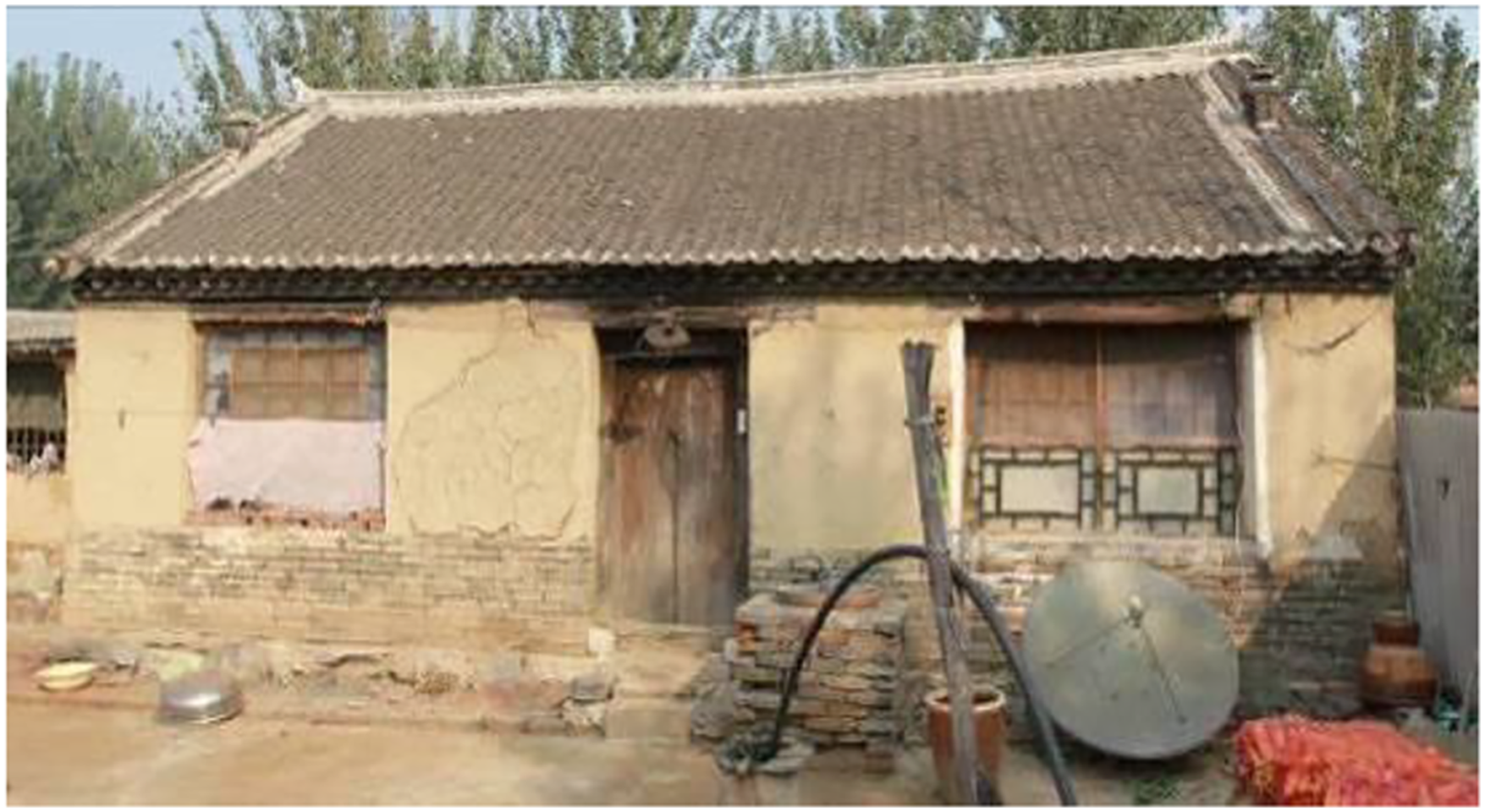
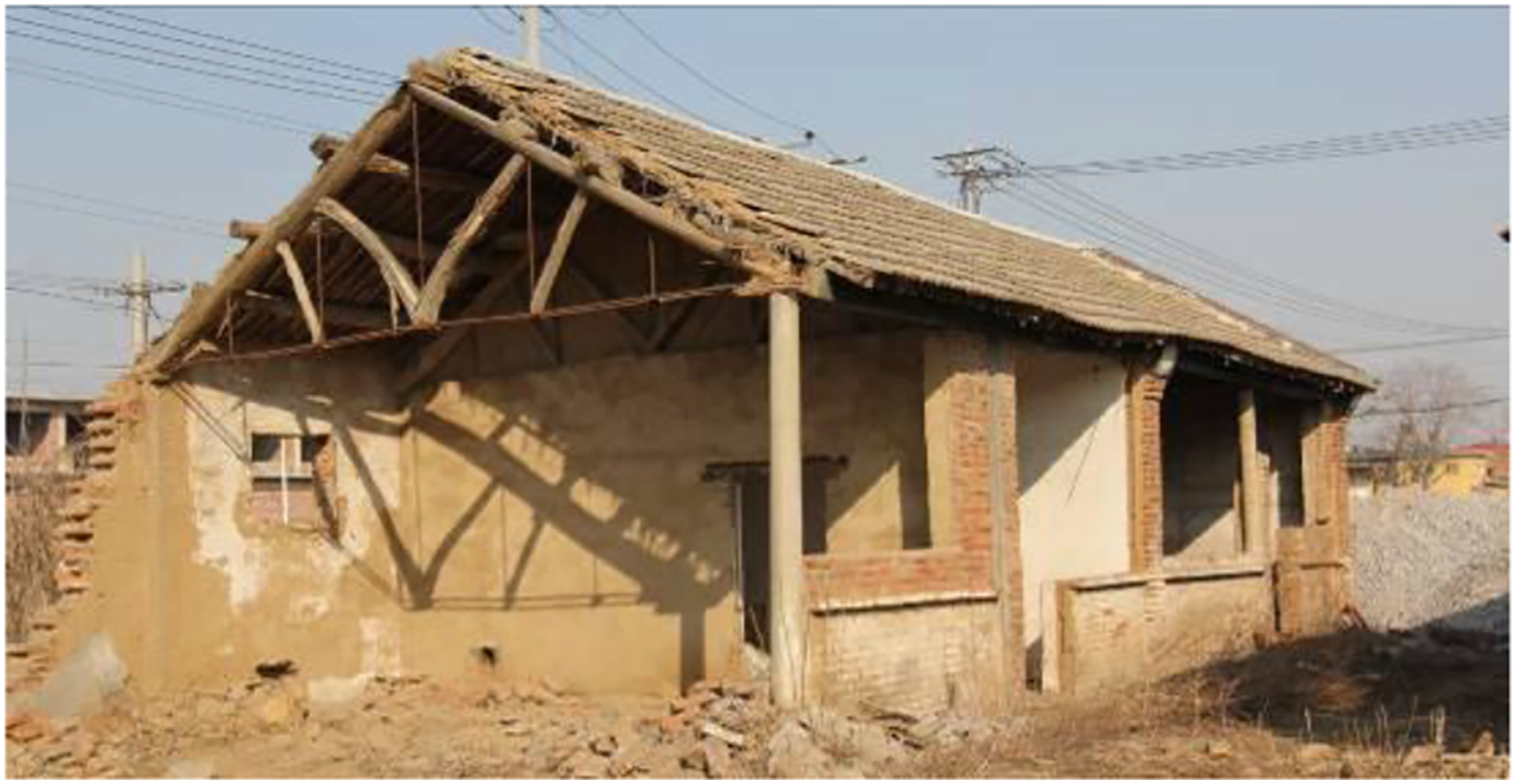
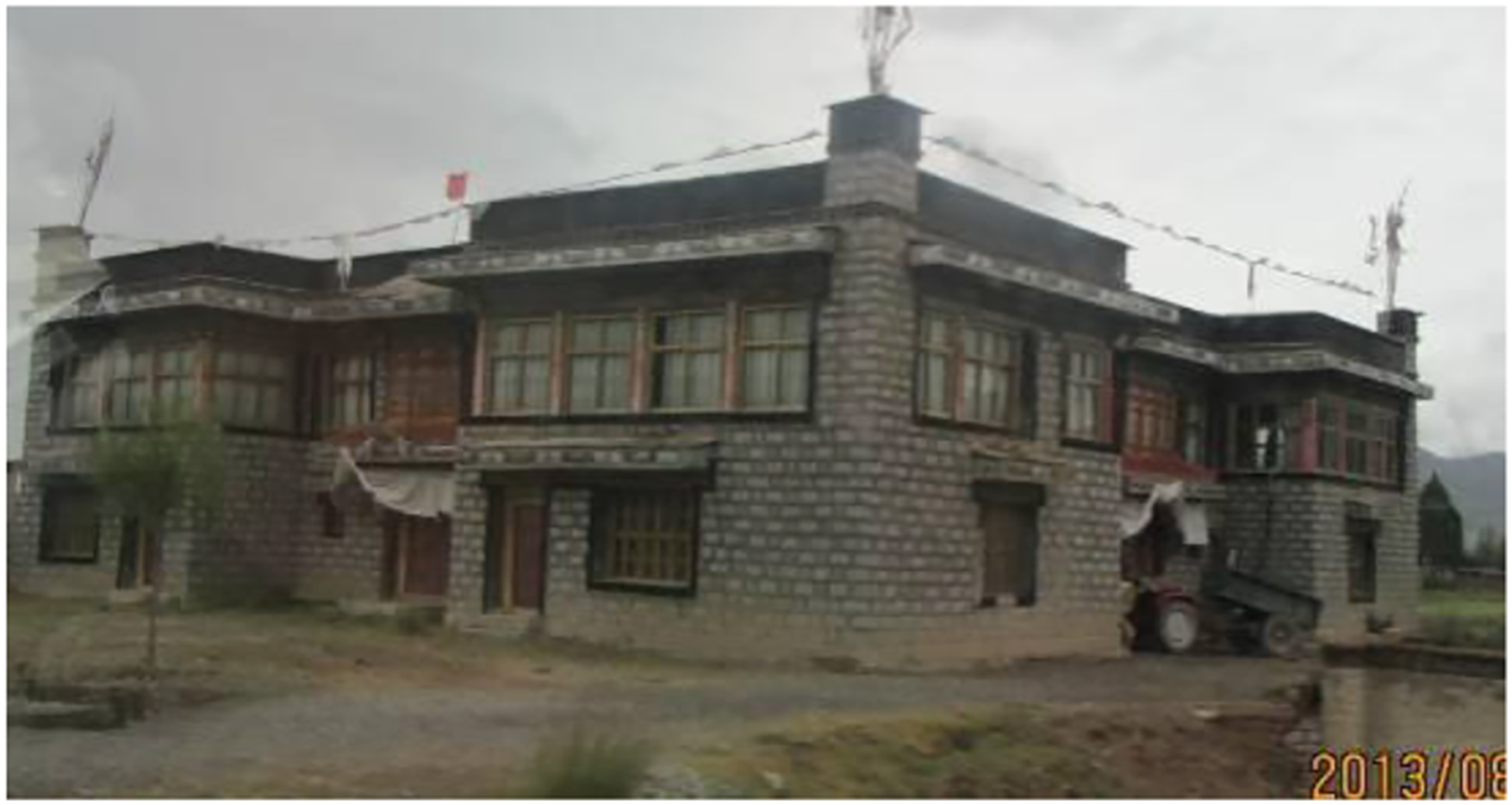
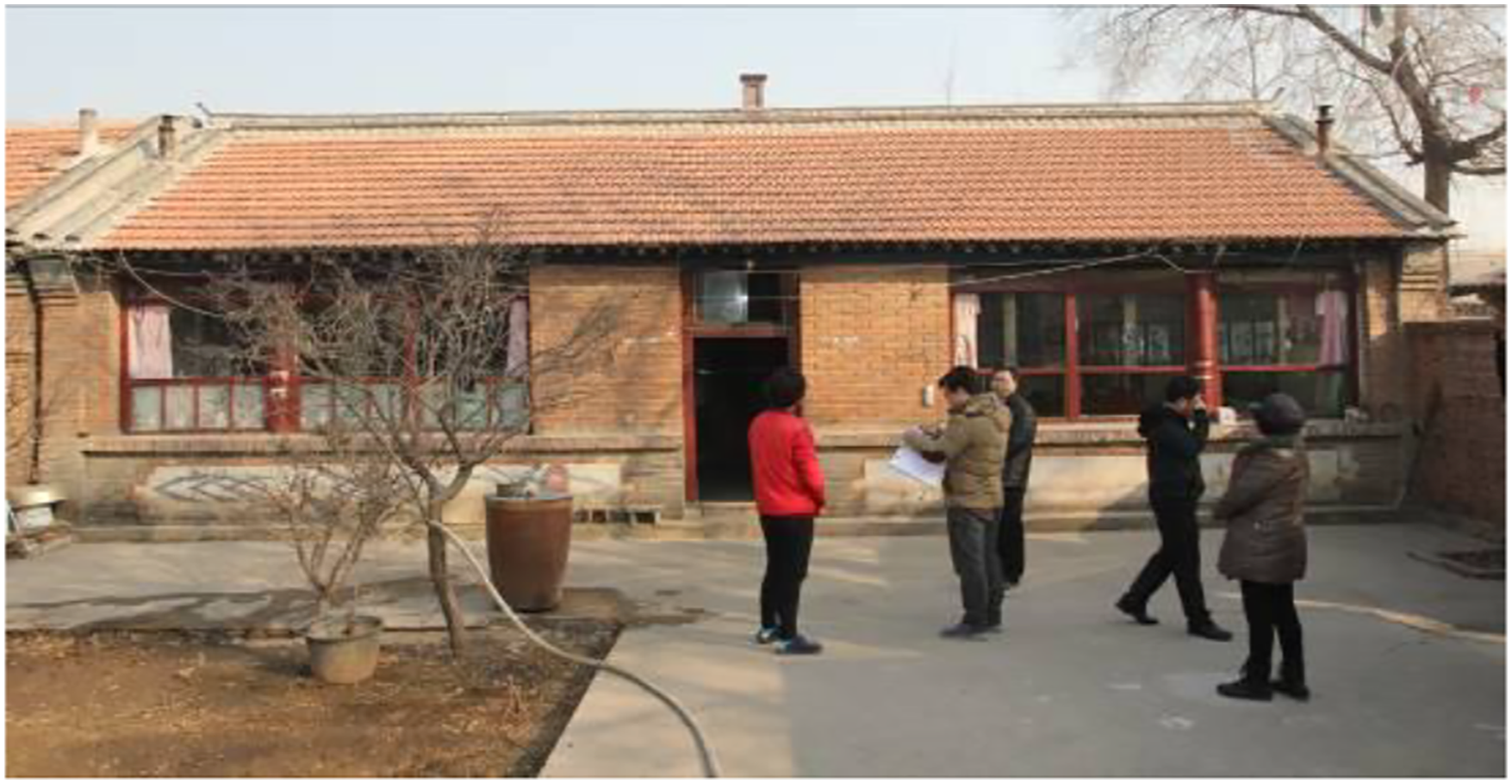
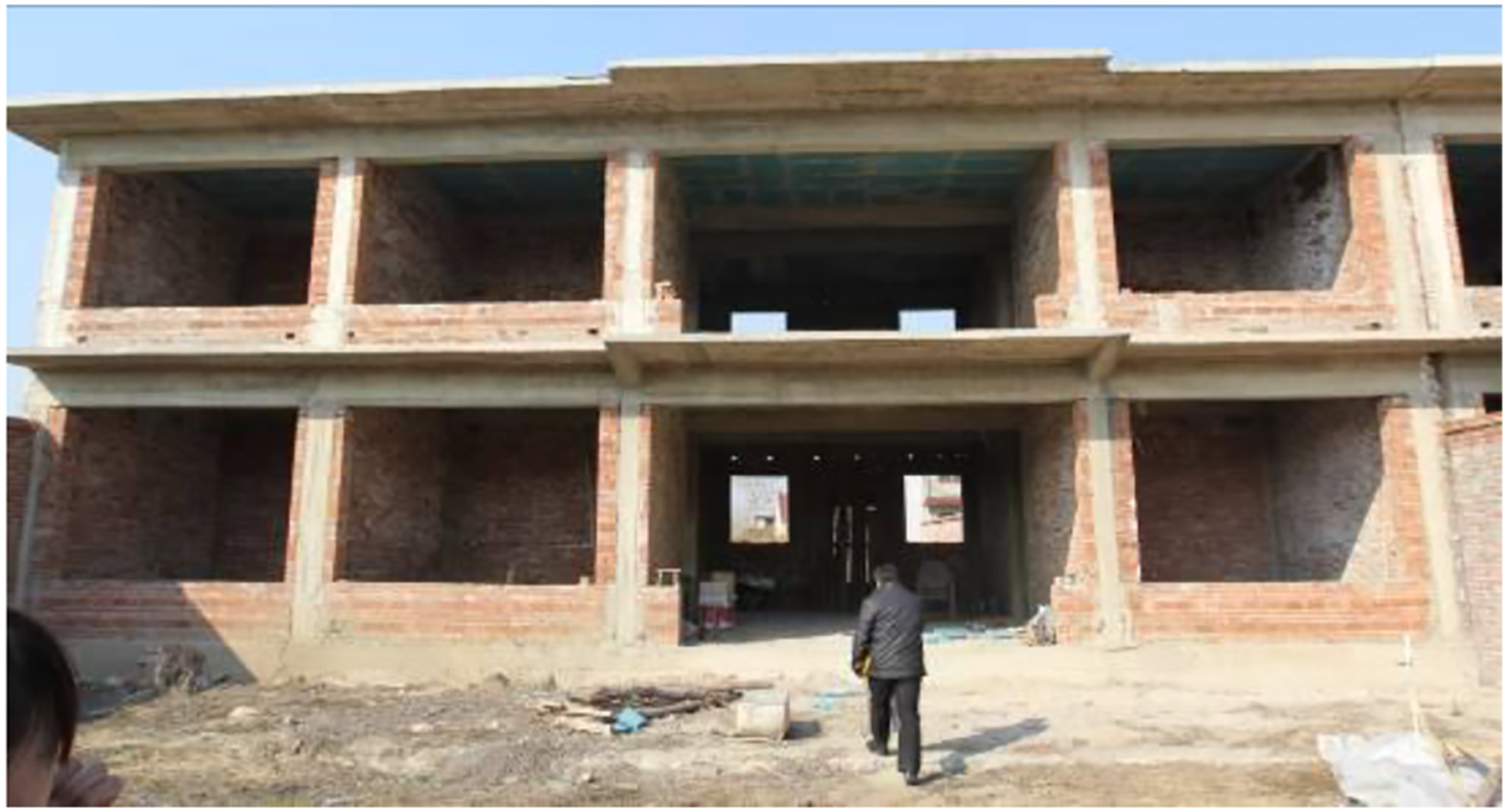
The construction of structures in rural village of China usually carried out by local construction craftsmen according to personal economic conditions, use requirements and local traditional habits. Most of structures are masonry structures with basically the same unit types, cheap construction costs, and local easy-to-use materials. The structural form and architectural style of structures in rural village have obvious regional characteristics. However, taking a broad view in China, the structures in rural village of same region are basically same. From the perspective of earthquake action, according to the vertical load-bearing elements of the rural structures, it can be divided into the following six types of structures (see Table 5). 1. Adobe structures (see Figure 2) generally do not have foundation treatment. The wall is built with adobe or rammed soil. Generally, adobe blocks, which use cohesive soil, are often mixed with wheat straw as tie bars during the production process. In the process of building the wall use dry soil for level, the adobe blocks are laid vertical or horizontal for the wall. Meanwhile, the structures have smaller doors and windows. Roofs are used wood, which built by two methods that are hard frame supporting and wooden roof truss. The support loads of adobe structure are vertical wooden pillars and soil wall, which is the main structural form of structures in China before 1950s. With the rapid development of the economy, the proportion of adobe structures in economically developed areas is very low. It is mainly distributed in economically backward rural areas in the west and northeast China. 2. Brick-adobe structures (see Figure 3) is the lower brick upper adobe or the outer brick inner adobe. Some of the gables are made of adobe and other walls are built with bricks. In general, the roof weight is borne by the brick-adobe wall. There are two types of roofs for brick-adobe mixed structures: one is for hard frame supporting and the other is for wooden roof trusses. Brick-adobe structure is a type of transitional structure between adobe structure and brick-wood structure. It is a result of the economic development, and the safety and reliability of rural buildings has been paid attention, but this kind of structure use two type of materials with different mechanical properties, including the connection of the two materials. However, the connection between the two materials is not reliable. From the perspective of seismic damage, the seismic capacity of the brick-adobe structure is even lower than that of the soil structure. 3. The horizontal and vertical load-bearing members of wood frame structures (see Figure 4) are wooden members. Wooden columns are used as vertical supports. Bricks, wooden boards or adobes bricks are used as retaining walls. The roofs are in the form of wooden roof trusses. This structure has four types of roofs: flat roof wooden structures. (This kind of roof truss is thick with thin columns, wooden columns are built into the retaining wall, and there is no connection between the wooden columns and the wall. There is no concealed joint between the wooden columns and the beam. There are no other diagonal braces or connections. Measures, this structural form is widely distributed throughout the country, mainly in northern regions and western regions with less rain); Slope roof wooden frame (the main beam in this type of roof truss is relatively thick, with beams of different heights on the melon pillars, sandals are placed on each melon pillar, and sandalwood is laid on the sandalwood); triangular wooden pillar wooden roof trusses (wood pillars are used vertically Load-bearing, triangular wooden roof trusses are placed in each room, wooden posts are connected to the roof mortise and tenon, sandalwood is placed at the nodes of the two isosceles of the triangular roof truss, and rafters are laid on the wooden rafters. This structure is mainly distributed in the east area); piercing wooden frames (each frame is supported by 3–5 wooden columns in the vertical direction, the top and middle of the wooden columns are connected by piercings, and the short columns in the upper part of the frame are also connected by piercings and wooden members. It is relatively rich, and generally consists of tenon-joint, dovetail connection, butt joint, etc. This type of structure is mainly distributed in southwest China. 4. Stone structures (see Figure 5) is vertically supported by stone walls. The stones were often built with silty clay or cement mortar. This type of structure is restricted by stones and is mainly distributed in mountainous areas such as the western and southeast coasts of China. 5. Brick-wood structures (see Figure 6) are currently the most common structural form used in rural village of China. The main supporting structure of a brick-wood structure is masonry structure or wooden truss structure. The roofs of brick and wood structure are wooden roofs, which have four types such as double-slope roofs, single-slope roofs, and flat roofs. Most of them are in the form of hard frame supporting. The brick walls of the structures are mainly used as vertical load-bearing members. Masonry materials generally include mud, slag mortar, cement mortar. The wall varies significantly from north to south. The temperature in the northeast is relatively low. In order to keep warm, the thickness of the wall is 49 cm. The thickness of walls is 37 cm mainly distributed in the central and western regions of China. 6. Brick-concrete structure (see Figure 7) is the most commonly used structural form in rural villages of China in recently years. Vertical brick walls are used to load-bearing walls. The brick walls are built with cement mortar. The form of roof has precast slab or reinforced concrete cast-in-place. Due to the unreliable connection between the prefabricated slabs and the prefabricated slabs and the wall, the seismic capacity of the two brick-concrete structures is quite differment. the features of structures in rural villages. Adobe structure. Brick-adobe structure. Wooden frame structure. Stone structure. Brick-wood structure. Brick-concrete structure.
The characteristic of earthquake damage
the structure damage matrix in Mw 6.6 earthquake in Minxian County.
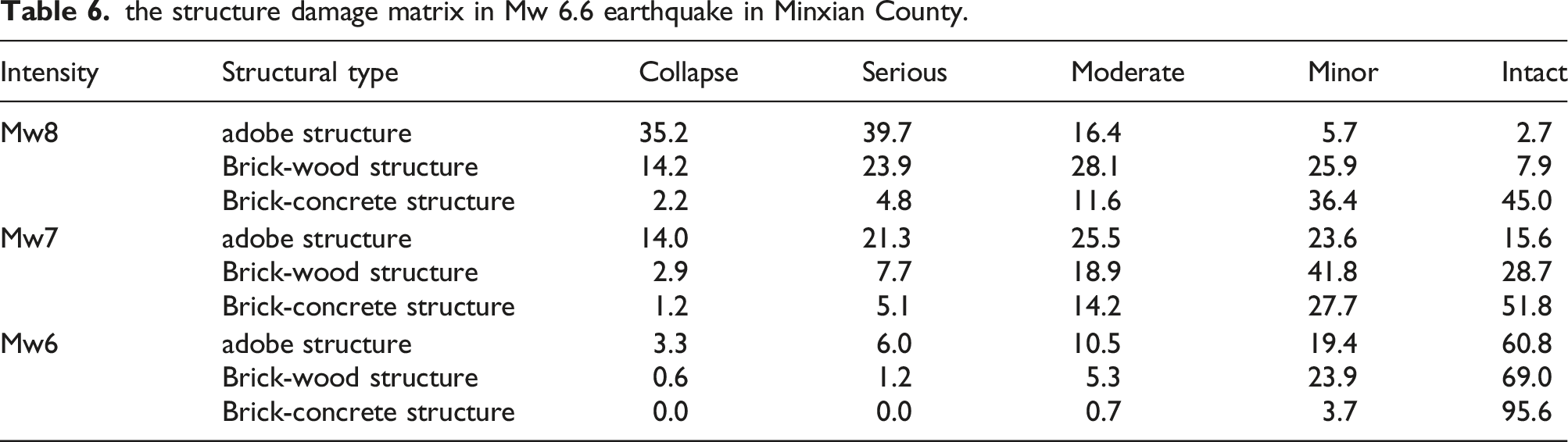
the seismic damage matrix under Mw7 earthquake (%).

the seismic damage matrix under Mw6 earthquake (%).

In 2013, the 6.6 magnitude earthquake in Zhangxian County, Minxian County, Gansu Province, with a focal intensity of 8°, the structural types of buildings in the disaster area can be mainly divided into civil structures, brick and wood structures, brick-concrete structures and frame structures. The houses collapsed in this earthquake are mainly civil and old brick and wood type houses.
The earthquake damage in Minxian County was relatively light, and a few structures showed slight cracks. The structures on the mountain in Meichuan Town and Hetuo Town were seriously damaged by the earthquake. The adobe structures are mostly partially collapsed or totally collapsed. The main reason was that the adobe wall was used as a dry wall or used as a base. The adobe wall has very low strength resistant ability. The roof is connected to the top of the wall as simple shelving, without tie-in measures. The connection between the adobe wall junctions is poor, and the gable wall is easy to flash out under strong earthquakes. The wooden roof is thicker. The soil and grass mixed surface layer, resulting in a heavy roof. Most rural structures with wooden framed soil walls collapsed as gables, a small number were collapsed with multi-sided earth walls, and a few were severely inclined, but the wooden frame basically did not fall. The main reason is that there is no tie between the soil wall and the wooden frame, and the external wall is easy to flash out; the material laid on the wooden roof is too heavy. As long as the anti-seismic structure measures are in place, the brick wall load-bearing wooden roof farm structures will perform well under the action of the earthquake and its structure is basically intact. The single-story farm structures with the wooden frame and the wooden roof of the brick wall is basically intact, only cracks appear between the front walls and the wooden pillars on both sides of the structures; the single-story farm structures with the brick wall and the wooden roof has ring beams but no structural columns. The wall was severely damaged and the cracks were wide. Brick-concrete structures are mainly concentrated in the township government.
The structures in Uyghur region are mainly divided into adobe structures and brick-timber structures. The adobe structures include dry earth walls or adobe masonry walls. The adobe structures were built earlier, and more than 90% of them were built by the building owner. The local loess has heavier sand content and poor wall adhesion. Most of the brick-wood structures were built in 2011, and it is also the main structural form for the implementation of the project to enrich the people in Uyghur region. The foundations of the brick-wood structure farm structures mostly use sand and stone cushions. The foundation is made of concrete ground ring beams, the roof is set with concrete roof ring beams, and the roof truss is in the form of a wooden roof. In the past 20 years, the historical earthquake damage to rural residences in Uyghur region shows that when the earthquake intensity of civil structure structures is 6°, the proportion of civil structure structures above the damage level accounted for 60.3%, and the proportion of damage accounted for 13.3%, 7°. At the time, the percentage of damage above the level even reached 81.2%, and the percentage of damage was 34.1%. The earthquake resistance of adobe structures is relatively poor and the earthquake damage is heavy. For brick-timbered structures, when the earthquake intensity is 6°, the proportion of damage above the medium level is 22.05%, and the proportion of damage is 0.67%, and when the earthquake intensity is 7°, the proportion of damage above the medium level is 34.38%, and the proportion of damage is 0.85%.
Data analysis
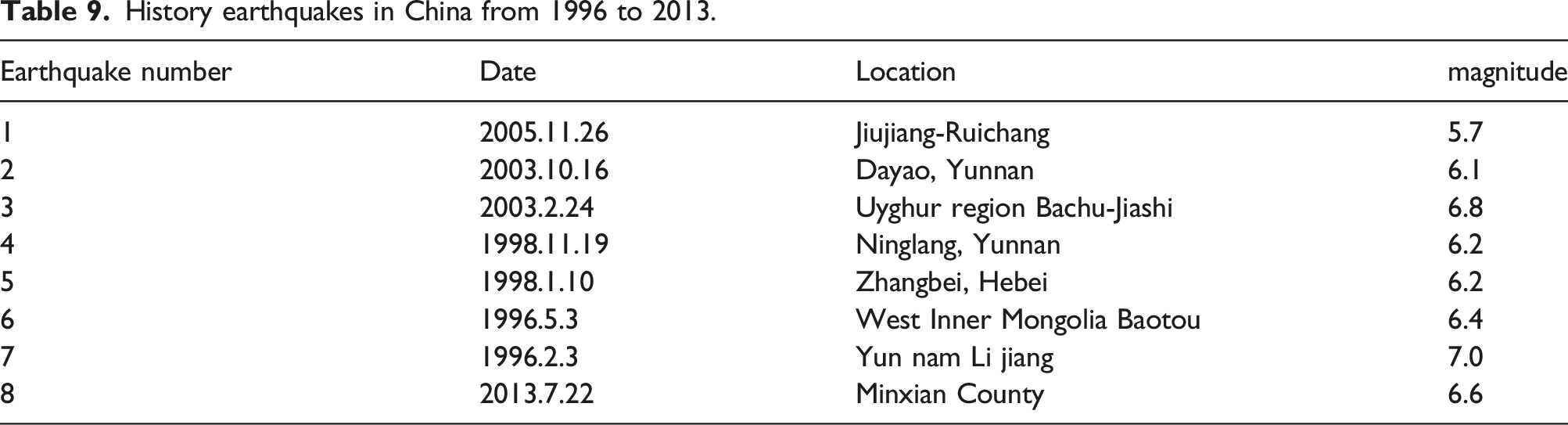
History earthquakes in China from 1996 to 2013.
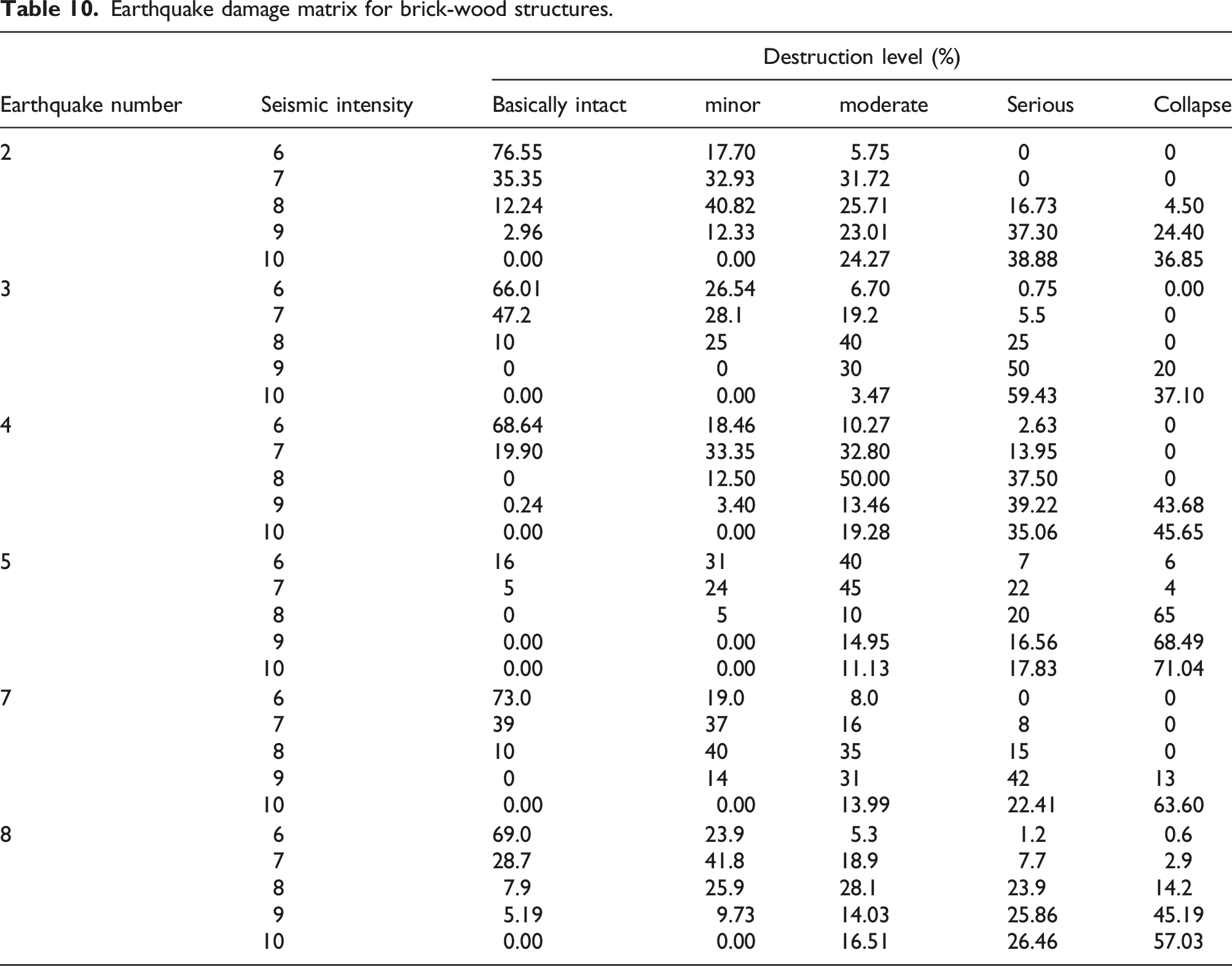
Earthquake damage matrix for brick-wood structures.
Earthquake damage matrix for adobe structure.
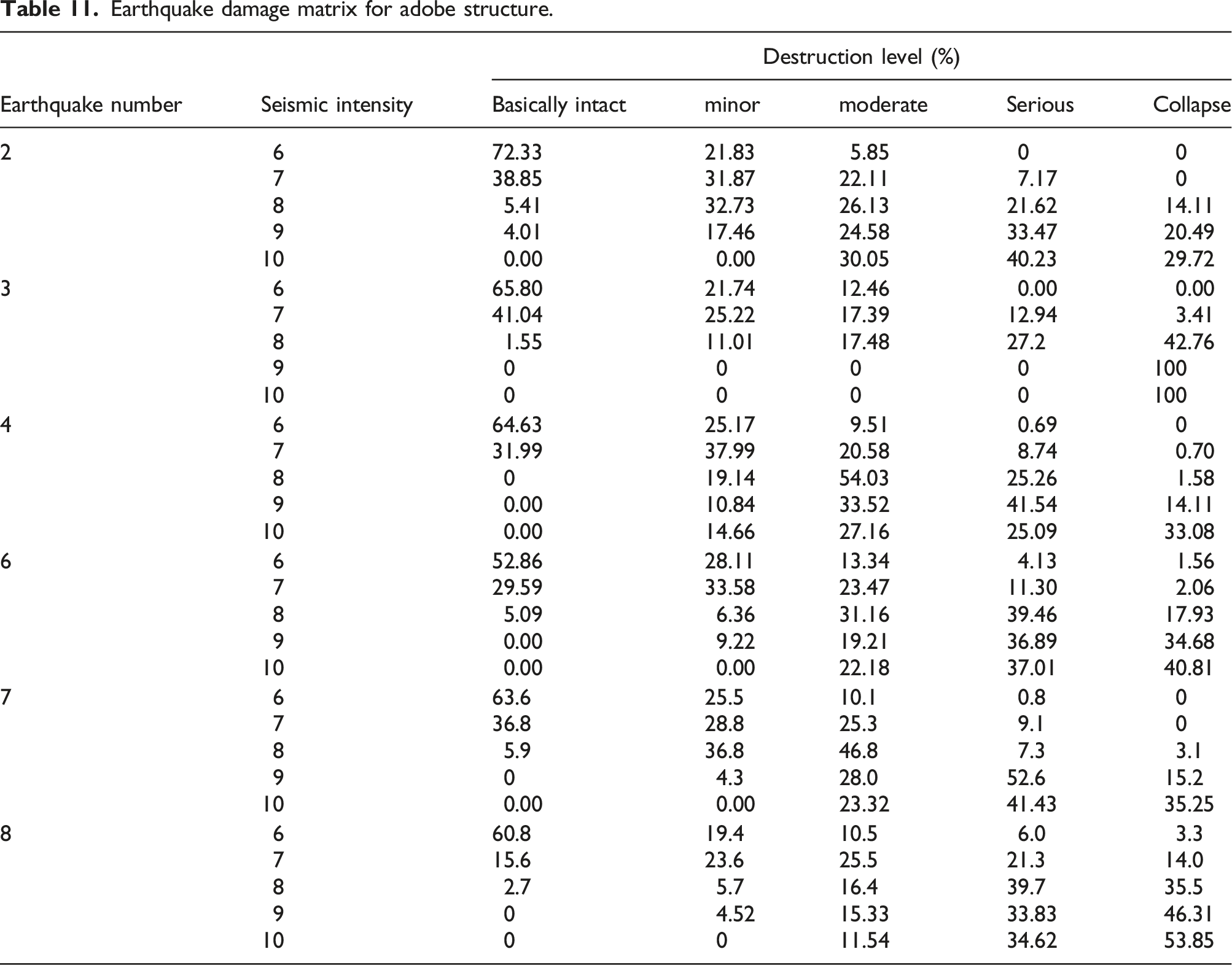
Earthquake damage matrix of brick-concrete structure.
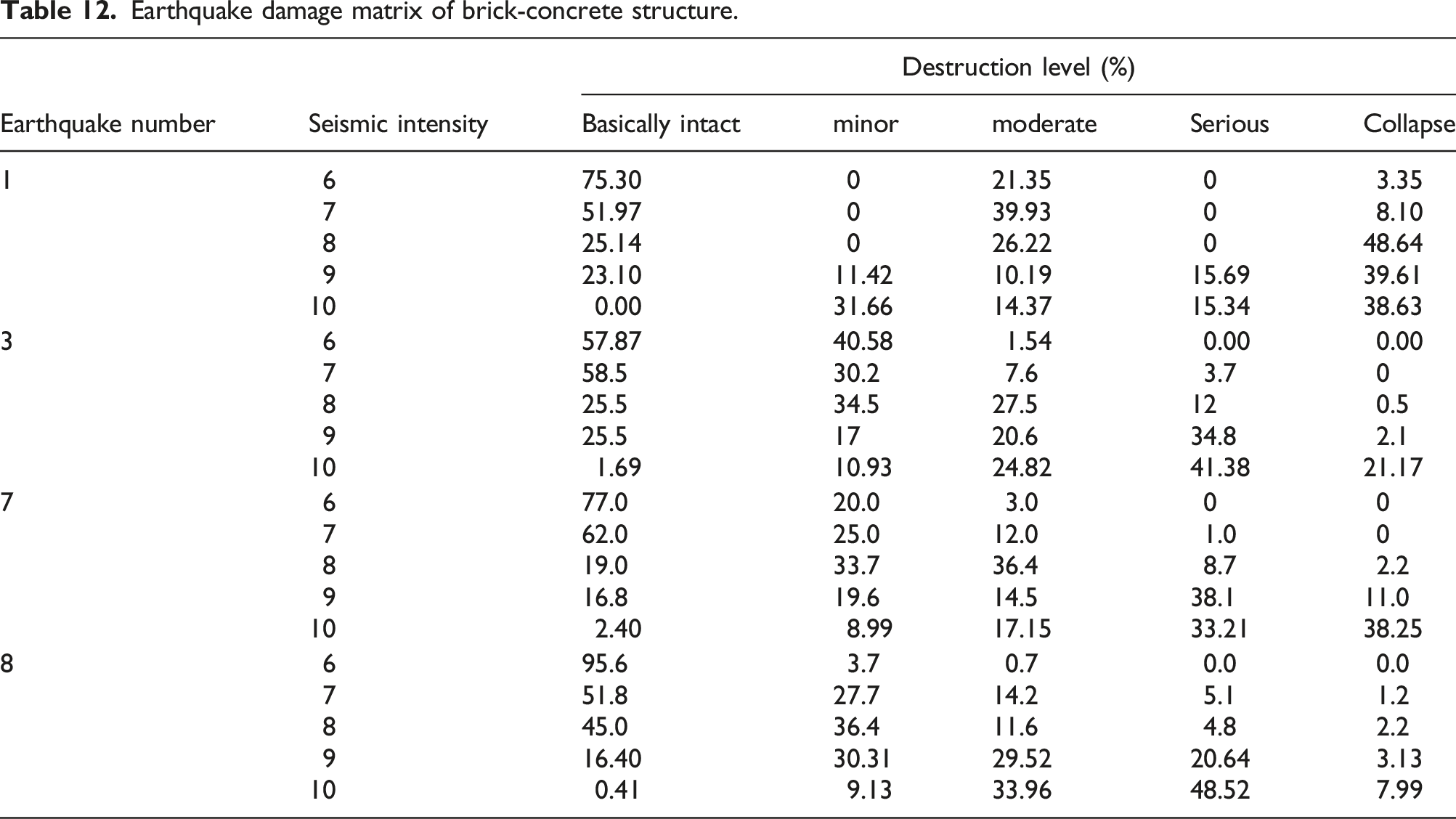
The actual earthquake damage matrix is based on the buildings damage survey statistics of a specific earthquake in rural village. It is affected by some special conditions and may not be universally representative. This study selects the earthquake damage matrix of the rural buildings formed during the earthquake and supplemented with the earthquake damage matrix of 6–10°.
Based on the research on the structural types and characteristics of structures in rural village, this study analyses the vulnerability of buildings under typical earthquakes in China from 1996 to 2013, the results are as follows: earthquake damage matrix for buildings in rural village; the buildings with different structure types; characteristics of earthquake damages; reasons for severe damage to structures. On the basis of these theories, earthquake damage matrix of the buildings was improved, and the vulnerability index of typical structures in rural villages under earthquakes was given.
According to the actual construction of dwellings in rural villages, the dwellings are divided into six structural types, which are studied from the structural elements, structural characteristics and weak points of seismic resistance of the dwellings. The earthquake damage shows that there are many dwellings damaged, the casualties and losses are also high. This study analyzes the earthquake cases of typical dwellings in recent years. Therefore, this study focuses on the analysis of the damage characteristics and the damage mechanism of structures during the earthquake.
Regarding the characterization of structural vulnerability, this paper gives a new definition and corresponding formula of seismic vulnerability index based on the vulnerability index proposed by Asteris et al. (2014) the new formula is only related to the vulnerability index, which shows that different damage levels have different contributions to vulnerability. Finally, based on the earthquake damage matrix, the vulnerability index of dwellings with brick-wood structure, adobe structure, and brick-concrete structure are given.
Results
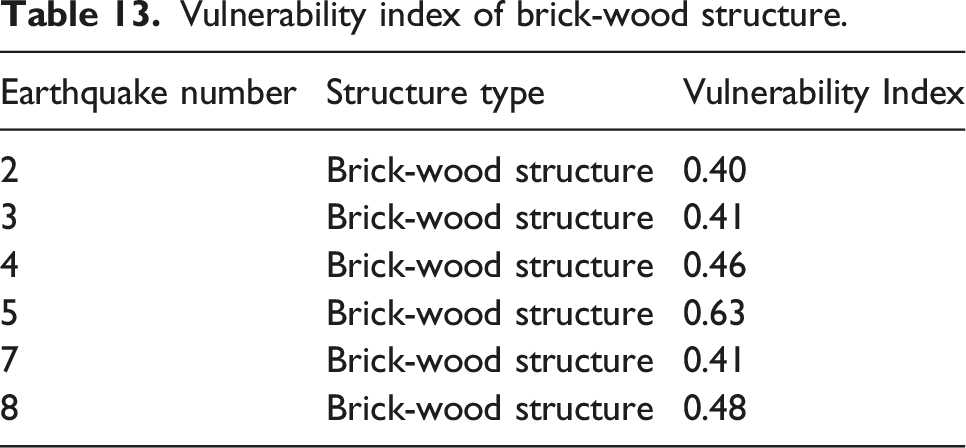
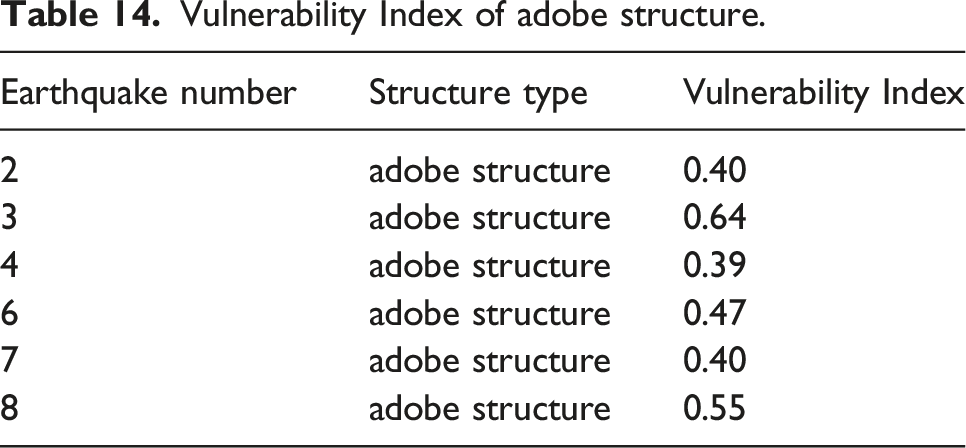
According to the definition of the vulnerability index in this study, the vulnerability index of different structure types in each earthquake was calculated. The vulnerability index can indicate the seismic performance of structures under earthquake action. According to the history earthquake damage data, the brick-concrete structures, brick-wood structures and adobe structures have different the range vulnerability index, which are 0.31–0.47, 0.40–0.48 and 0.39–0.63, respectively. The average values of vulnerability index of the adobe structure structures, brick-wood structures and brick-concrete structures are 0.46, 0.44 and 0.37, respectively. There is crossover in the range of vulnerability index for those structures. The average values of vulnerability index indicate that the seismic performance of brick-concrete structures is better than the adobe structures and the brick-wood structures. However, the range value of vulnerability index indicates that the seismic performance of some brick-concrete structures is inferior to other structures.
Vulnerability index of brick-wood structure.
Vulnerability Index of adobe structure.
Vulnerability Index of Brick-concrete structure.

The average seismic vulnerability index of adobe structures is 0.475, which is greater than the 0.465 of brick-wood structures. The seismic resistance of adobe structures is poor compared to brick-wood structures. However, the vulnerability index of adobe structures in No.4 is lower than that of brick-wood structures, which indicate that its seismic performance is better than that of brick-wood structures. The average seismic vulnerability index of brick-concrete structures is 0.367, which indicate that the seismic performance of brick-concrete structures is greatly improved compared with adobe structures and brick-and-wood structures.
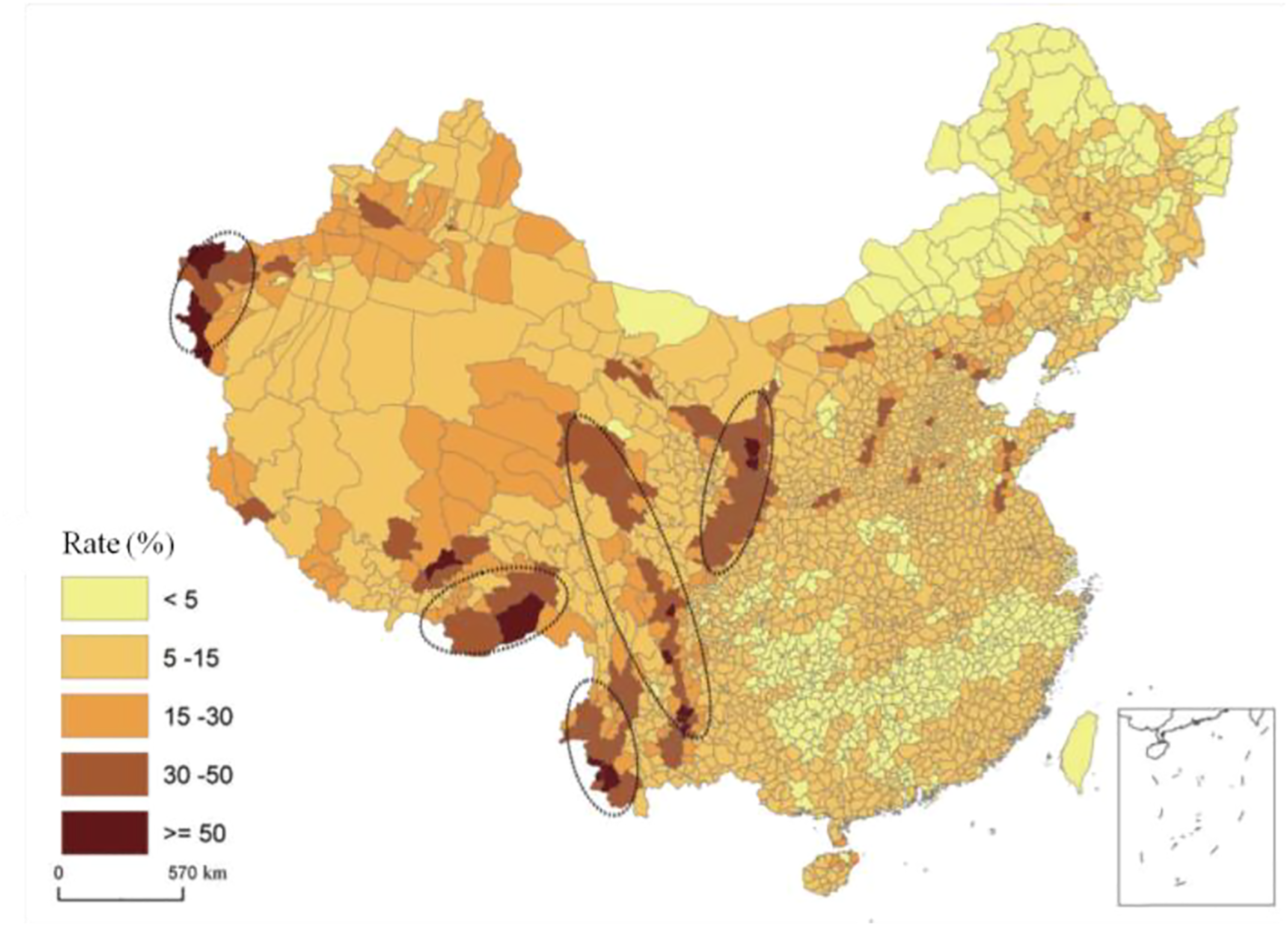
Based on the Chinese county-level structures database (the base data is available under http://www.gopi.com.cn/), with reference to the research results of the disaster matrix and vulnerability index of different structures, the number of buildings with different structure types reaching the level of destruction and above under different intensity is calculated in the same area and then summed separately. The spatial distribution map of the number of buildings damaged in the country is obtained (see Figure 8). The total number of buildings in each area is divided to obtain the spatial distribution of the proportion of buildings destructed (see Figure 9). Distribution of the number of buildings destructed. Distribution of the proportion of buildings destructed.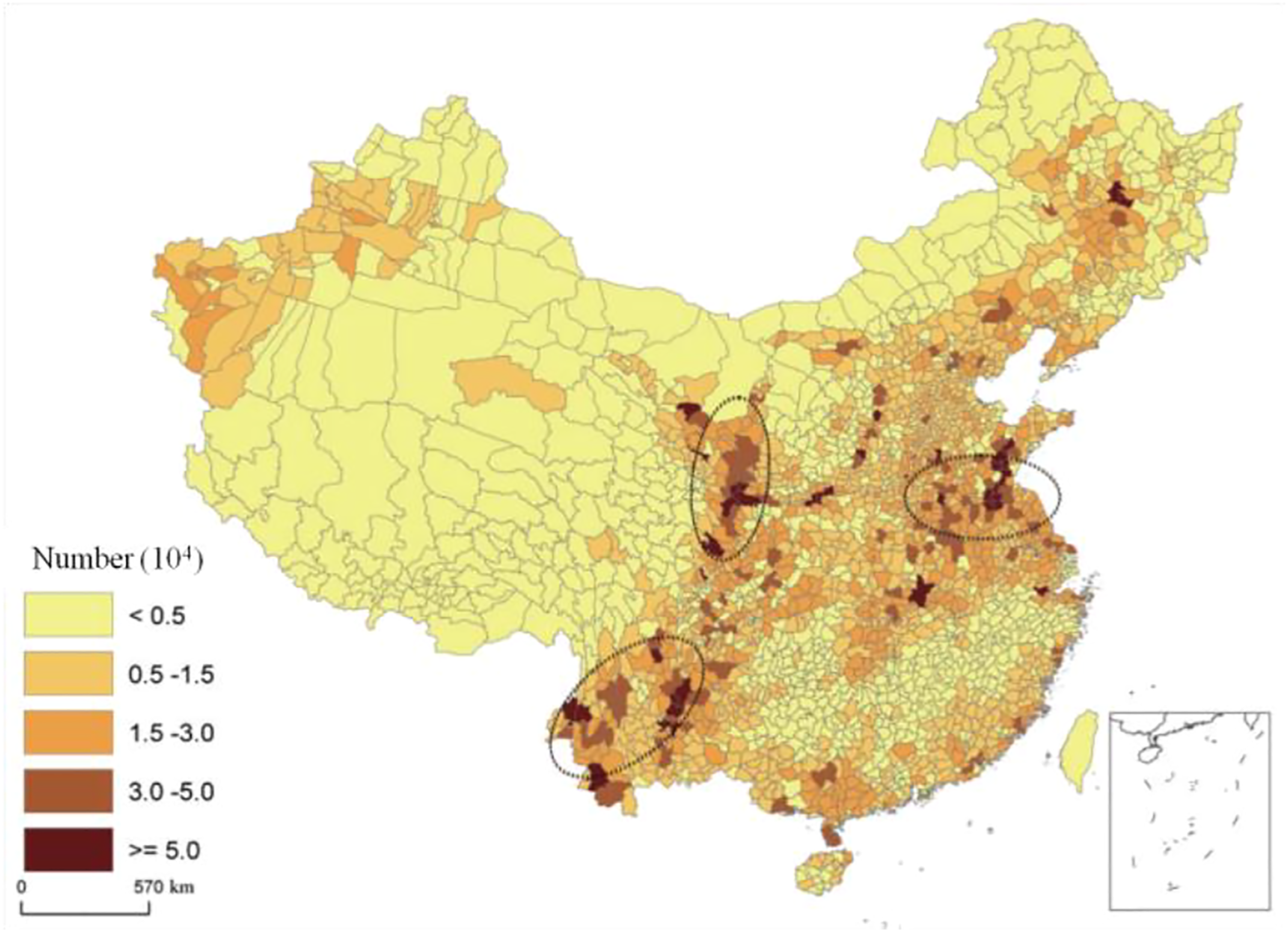
Conclusion
Based on the research on the types and structural characteristics of structures in rural villages of China, this study analyzed the vulnerability of structures in rural villages under earthquakes in China from 1996 to 2013. The results are as follows: earthquake disaster matrix for buildings; the buildings with different structure types; characteristics of earthquake damages; reasons for severe damage to structures. On the basis of theories, earthquake damage matrix of the buildings was improved, and the vulnerability index of typical structures under earthquakes in China was given.
According to the results of vulnerability index, the vulnerability index of the brick-concrete structure is relatively minimal, which indicate that its seismic performance is the best, and its average value is 0.367. Since the physical seismic performance of building materials of adobe structures is the worst, its average vulnerability index is up to 0.475. The seismic performance of adobe structure is the worst. However, the vulnerability index in NO. 4 of adobe structures are smaller than that of brick-wood structures, which are 0.39 and 0.46 respectively. The seismic performance of adobe structure is better. Therefore, the vulnerability index of buildings in different areas should not be cross-referenced.
According to the construction of structures in rural villages of China, the dwellings are divided into six structural types, which are studied from the structural elements, structural characteristics and weak points of seismic resistance of the structures. The earthquake damage shows that there are many structures damaged. The casualties and losses are also high. This study analyzes the earthquake cases of typical rural dwellings in recent years. Therefore, this study focuses on the analysis of the damage characteristics and the damage mechanism of structures during the earthquake.
Regarding the characterization of structural vulnerability, this paper gives a new definition and corresponding equation of seismic vulnerability index. The new equation is only related to the vulnerability matrix, which shows that different damage levels have different contributions to vulnerability. Finally, based on the earthquake damage matrix, the vulnerability index of dwellings with brick-wood structure, civil structures, and brick-concrete structure, are given.
Footnotes
Acknowledgements
The authors extend thanks to China Science and Nature Foundation (41772123), Tianjin Science and Technology Major Project (18ZXAQSF00110), China Earthquake Science and Technology Spark Project (XH18005), Research topic of major policy theory and practice of China Earthquake Administration: Research on refined strategies for earthquake disaster risk prevention and control in megacities in soft land areas (CEAZY2022JZ05) funds support.
Declaration of conflicting interests
The author(s) declared no potential conflicts of interest with respect to the research, authorship, and/or publication of this article.
Funding
The authors disclosed receipt of the following financial support for the research, authorship, and/or publication of this article: This study was supported by grants from the China Science and Nature Foundation (41772123), Tianjin Science and Technology Major Project (18ZXAQSF00110), China Earthquake Science and Technology Spark Project (XH18005), Research topic of major policy theory and practice of China Earthquake Administration: Research on refined strategies for earthquake disaster risk prevention and control in megacities in soft land areas (CEAZY2022JZ05)
