







Abstract
Based on the constitutive relation of recycled aggregate concrete (RAC, referred to as recycled concrete), from the calculation formulas of the equivalent rectangular block parameters in the compression zone of recycled concrete beams under different recycled coarse aggregate replacement ratios, the calculation formulas of the key parameters 𝛼1 and 𝛽1 of recycled concrete are deduced. Based on 𝛼1 and 𝛽1, the flexural bearing capacity of recycled concrete beams is given. In addition, the nonlinear finite element method is applied, and the simulation results are compared with the calculation results to verify the accuracy of the calculation results. Then, the limit compression zone height and maximum reinforcement ratio of recycled concrete beams, as well as the variation characters of compression zone height and reinforcement ratio under certain size and load are analyzed and obtained.
Keywords
Introduction
Recycled aggregate concrete (referred to as “recycled concrete”) is concrete using recycled aggregate produced by crushing, sieving, and grading waste concrete blocks. It is a kind of ecological concrete used to partially or completely replace natural aggregates, and then add cementitious materials (Xiao, 2018). In China, about 1.297 billion tons to 1.704 billion tons of construction solid waste was discharged from 2013 to 2018. This has attracted the attention of many scholars. Until 2021, in China, a total of 146 projects had been approved by Natural Science Foundation (NSFC) (Xu et al., 2022). Only about 5%–10% of the discharged construction solid waste is recycled (Ghisellini et al., 2018). Recycling the solid waste of construction to produce recycled concrete is of great significance to the protection of resources and the environment. Also, it is significance to the realization of the sustainable development of the construction industry in China.
A large number of relevant research results show that on average, the flexural normal section of recycled concrete beams obeys the assumption of flat section during the failure process, and the failure form is basically similar to that of natural aggregate concrete (NC) beams; but the ultimate bearing capacity is slightly reduced and the deflection at failure is increased. The initial stiffness decreases and the crack width increases as the replacement ratio of recycled aggregate rises (Mahdi et al., 2015; Sato et al., 2007; Sindy et al., 2018). Through experiments and theoretical analysis, Zhao and Sun (2013) pointed out that when calculating the cracking moment of recycled concrete beams, the existing codes need to be modified. Through experiments, Zhang et al. (2016) and Yang et al. (2020) showed that recycled concrete beams conform to the assumption of a flat section during the loading process and have the similar pattern of conventional concrete cracking. Through experiments, Xiao et al. (2012) found that the stiffness of recycled concrete beams has been reduced under the same conditions. Through experiments, Wu et al. (2010) found that the mid-span deflection of recycled coarse aggregate concrete beams is greater than that of ordinary aggregate concrete beams. Tosic et al. (2016) established a flexural strength database based on the test results of 217 beams and validated the application of Eurocode 2 in designing recycled concrete beams. The results showed that the beam with stirrups needs further research. Through experiments, Choi et al. (2012) found that the maximum flexural strength of natural aggregate beams is 20% higher than that of recycled concrete beams. Due to the reduced interface strength between mortar and recycled coarse aggregate, the neutral axis of 100% recycled coarse aggregate beams is higher. Deng and Yun (2010) tested the practicability of present code of China in the calculation of recycled concrete beams and found the poor prediction of cracking moment, deflection and crack width. Through experiments, Deresa et al. (2020) found that the cracking moment decreases as the replacement ratio of recycled aggregate increases.
In summary, the current research on recycled concrete has found the performance of recycled concrete beams designed with conventional concrete specifications will be lower than expected because of the lower material property of recycled concrete. Even with the same strength, the constitutive properties of recycled concrete and conventional concrete are different, and the equivalent rectangular area coefficients α1 and β1 of the recycled concrete beam section based on the constitutive are different from those of conventional concrete. Therefore, the influence of the mechanical properties of recycled concrete on its components must be considered and included in the structural design. In this study, the effect of the variation in the constitutive relation of recycled concrete with the replacement ratio of RCA on flexural capacity of RAC beams is analyzed theoretically and numerically. The key parameters of the simplified calculation method are proposed. The authors hope this study can improve the design technique of RAC structures, and encourage the further studies in this field.
Comparative analysis of the constitutive relationships of recycled concrete
The difference between the flexural performance of recycled concrete beams and NC beams is mainly due to the different constitutive relationship of concrete. Referring to the constitutive structure of NC proposed by Guo (2004), Xiao (2007) took the replacement ratio of recycled coarse aggregate as an influencing factor and established the constitutive model shown in equation (1), which was adopted by Technical Code on The Application of Recycled Concrete (DG/TJ 08-2020-2007, 2007)

Among them, x = ε/ε0, ε is strain, ε0 is the strain corresponding to the peak stress, y = σ/fc, σ is stress, fc is the axial compressive strength, and r is the replacement ratio of recycled coarse aggregate. For recycled concrete, a
r
and b
r
can be expressed by the rational equation of the replacement ratio of recycled coarse aggregate, and the values proposed by Xiao (2007) are

The parameter values proposed by Xie et al. (2018) are

In Code for Design of Concrete Structures (GB 50010-2010, 2015) the stress remains unchanged after the peak strain is exceeded. When the strength grade of concrete is lower than C50, the constitutive relationship is

Wang and Xiao (2018) proposed the stress-strain relationship of recycled concrete confined by stirrups. This constitutive model reflects the influence of constraints on peak stress, peak strain and ultimate strain. Wang and Xiao (2018) proposed the stress-strain relationship of recycled concrete confined by stirrups. This constitutive model reflects the influence of constraints on peak stress, peak strain and ultimate strain.
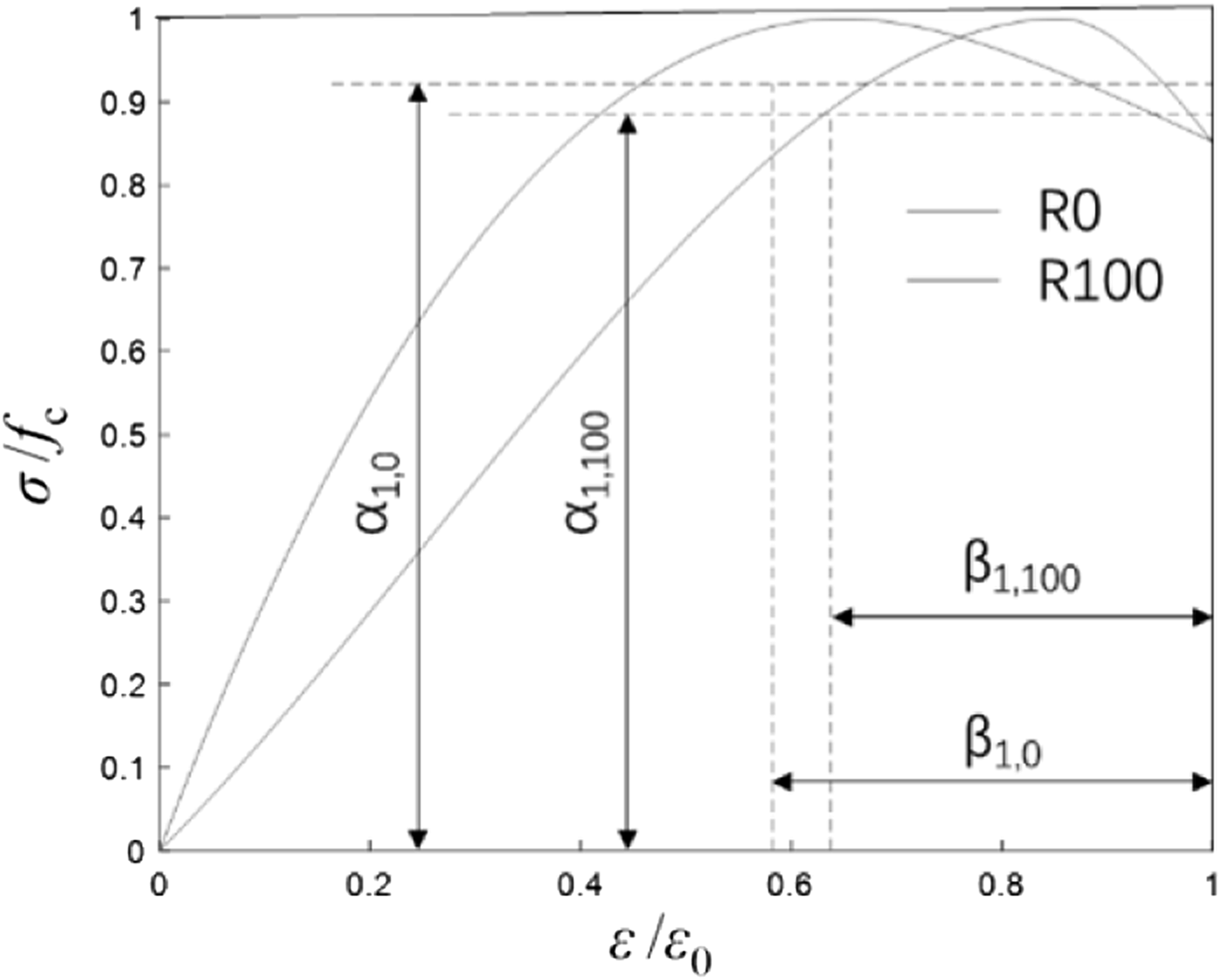
Comparing the compressive stress-strain curve equations of recycled concrete given by the above scholars, equations (2) and (3) are currently given with the replacement ratio of recycled coarse aggregate as a variable and in good agreement with the test results. Choose equations (2) and (3) to calculate the stress-strain curve of recycled concrete under different recycled coarse aggregate replacement ratio, as shown in Figure 1, where the 0 replacement ratio of recycled coarse aggregate represents the compressive stress-strain curve of NC. For the rising section of the constitutive curve, the curve of equation (2) basically coincides with the curve of Specification for Design of Concrete Structures. When the replacement ratio of recycled coarse aggregate is 100%, the curves drawn by equations (2) and (3) are basically the same. The constitutive curves of equation (2) and equation (3) reflect the approximate range of constitutive dispersion of recycled concrete. When the restraint of the stirrups on the concrete increases, the deformability of recycled concrete will be improved. The constitutive curve of Wang and Xiao (2018) improved the deformability of recycled concrete due to the consideration of stirrup constraints. However, when the beam is loaded in flexure and is damaged, the restraint effect is less obvious. In the following, the nonlinear constitutive structure of conventional concrete, that is, literature (Choi and Yun, 2013) and literature (Choi et al., 2012) are used for analysis. Stress-strain curve of recycled concrete. (a). r = 0%; (b) r = 100%.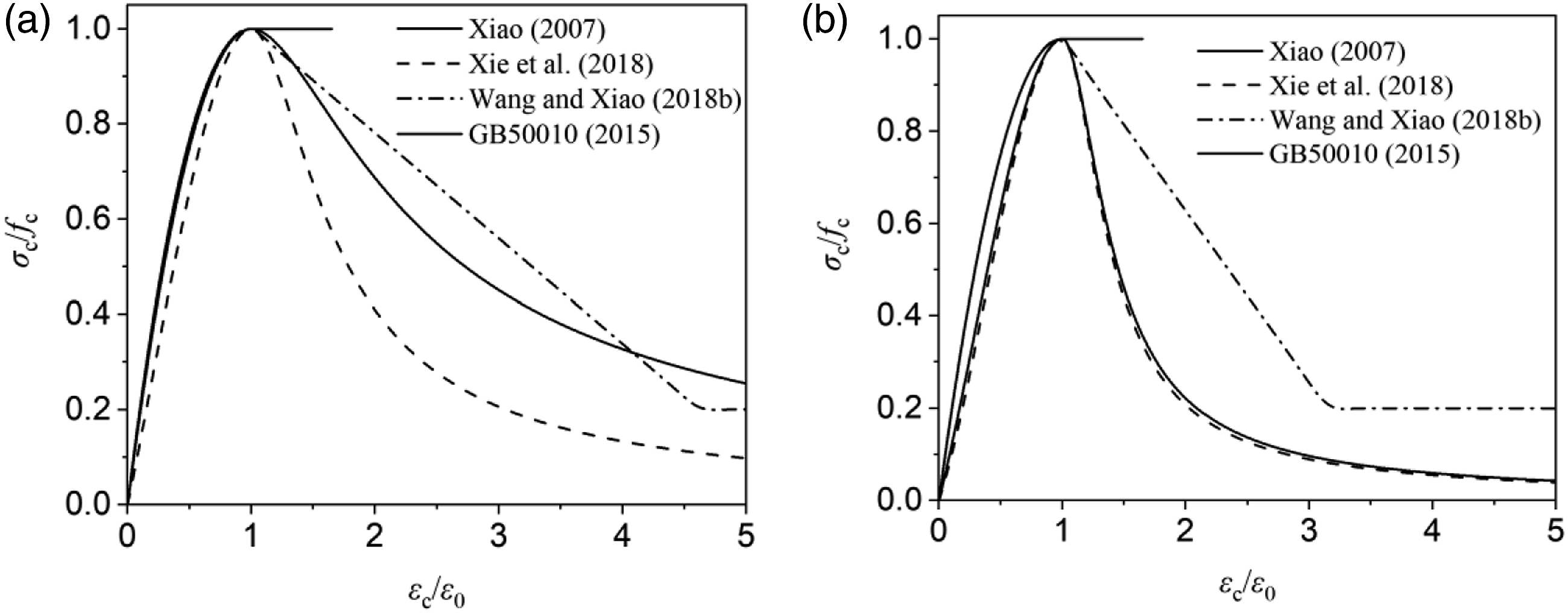
According to the previous study (Xiao, 2007), the peak strain of recycled concrete is desirable

Among them, r is the replacement ratio of recycled coarse aggregate, 𝑓c is the axial compressive strength, (r) is a parameter, determined as

Conversion relationship between the cubic compressive strength of recycled concrete and the compressive strength of prisms (Wang and Xiao, 2018)

Among them, 𝑓cu is the compressive strength of the cube, 𝜌 is the density, (r) is the parameter, and the value is

Calculation of equivalent stress distribution of recycled concrete
In the Code for Design of Concrete Structures (GB 50010-2010, 2015), the nonlinear compressive stress distribution on the section can be equivalent to a rectangular distribution. The stress distribution of the single-reinforced concrete beam and the equivalent rectangular stress distribution are shown in Figure 2. The resultant force of the concrete internal compressive stress is 𝐶, and the distance between the center of the resultant force in the compression zone and the edge of the compression zone is 𝑦c. The force 𝐶 and the distance 𝑦c should remain identical before and after the equivalence process. Suppose the equivalent compressive stress of concrete is 𝛼1𝑓c, and the compression height in the equivalent rectangular stress graph is 𝛽z, where x is the height of the compression zone, that is, 𝛽1 is assumed as the ratio of the equivalent compression height to the compression height. Equivalent rectangular stress distribution. (a). r = 0%; (b). r = 100%.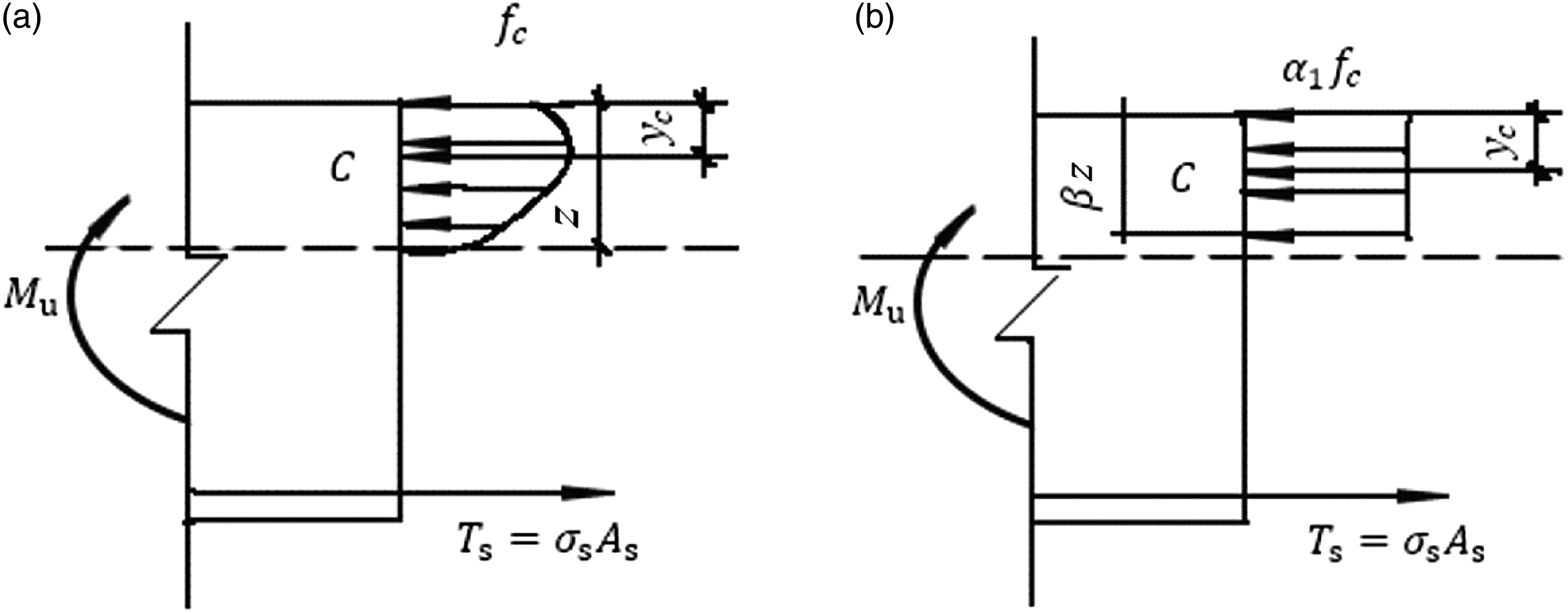
As shown in Figure 2(a), when a concrete beam is flexural damaged, the pressure on the concrete in the compression zone is

Among them, b is the beam width, h0 is the effective height of the beam, and ξn is the height of the relative compression zone. Take x = ε/ε0, ε0 and εcu are the peak strain and ultimate strain of concrete, respectively. σy = σx integrates the compressive stress of concrete in the compression zone of the section as the pressure force in the compression zone

Bringing equation (10) into the constitutive equation (1) of recycled concrete, we get
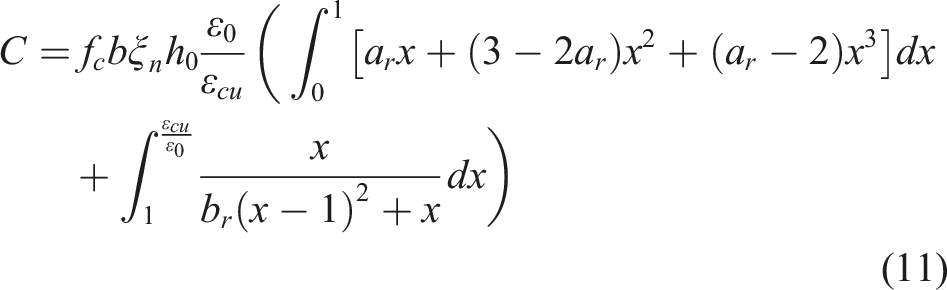
Among them, a
r
and b
r
are respectively the rising section coefficient and the falling section coefficient of the constitutive structure of recycled concrete. After integration, the pressure of the concrete in the compression zone is obtained

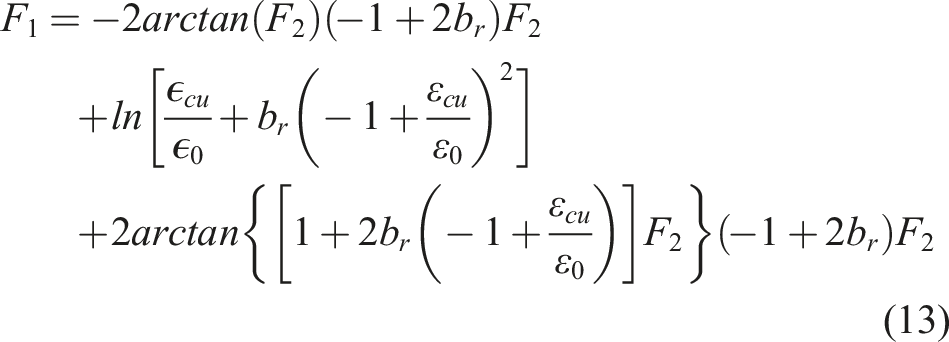

The distance between the equivalent pressure force and the edge of the compression zone (𝑦c) is calculated according to the moment balance

The solution is

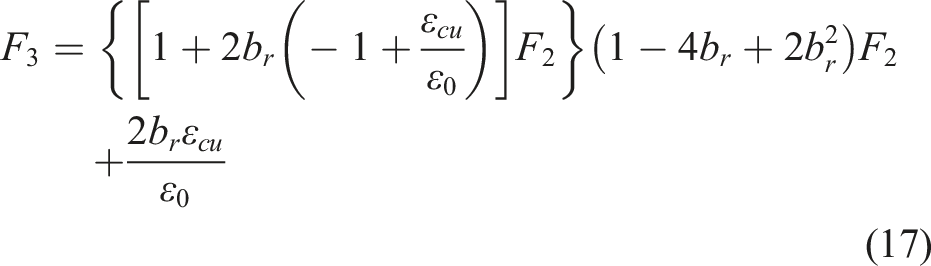
Incorporating equation (1) and equation (2) or equation (3) into equation (12) and equation (16), the equivalent stress diagram coefficients 𝛼1 and 𝛽1 of recycled concrete can be calculated, and the two have the following relationship with 𝐶 and 𝑦c

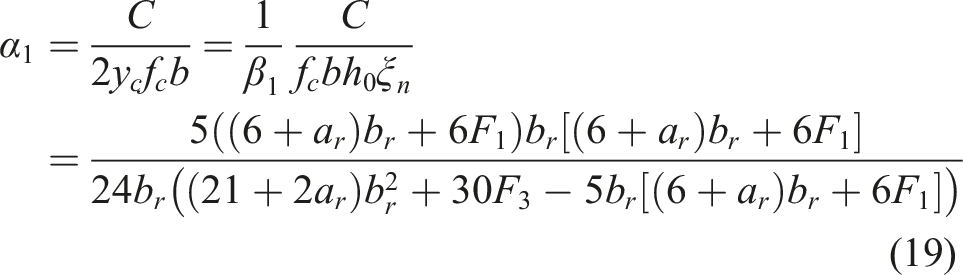
In Code for Design of Concrete Structures (GB 50010-2010, 2015), the

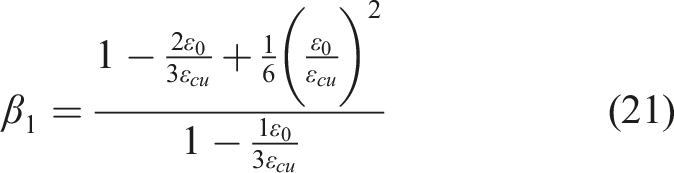
When the concrete strength grade is less than C50, the values of 𝛼1 and 𝛽1 calculated by equation (20) and equation (21) for NC are 0.969 and 0.824, respectively, and the approximate values 1.0 and 0.8 are taken in the specification. According to the equivalent method of equivalent rectangular block in the concrete pressure zone, the stress distribution is the same as that of the concrete stress-strain curve in [0, ε/εcu]. As shown in Figure 2, it can be known that 𝛼1 and 𝛽1 represent the height and the width of the equivalent rectangular block respectively.
Verification of calculation method of equivalent stress distribution through FEA
The finite element method was used to simulate the bending failure process of recycled concrete beams, and the experimental dimensions of recycled concrete beams by Wang and Zhang (2016) were used for modeling and simulation analysis.
In the finite element analysis, the concrete adopts a damage plastic constitutive model (Concrete Damaged Plastic Model). The model includes dilation angle (Dilation Angle) 𝜓, flow potential offset (Eccentricity) 𝜖, biaxial compression and uniaxial compression stress ratio σb0/σc0, invariant stress ratio 𝐾𝑐, and viscosity coefficient 𝜇. The dilatancy angle is the angle between the actual plastic strain ε and the shear strain 𝛾. In the Mohr-Coulomb criterion, the plastic angle 𝜙 is replaced by the dilatancy angle 𝜓, and the potential function G of the Mohr-Coulomb criterion is (Drescher and Detournay, 1993)

Three-dimensional failure parameters.
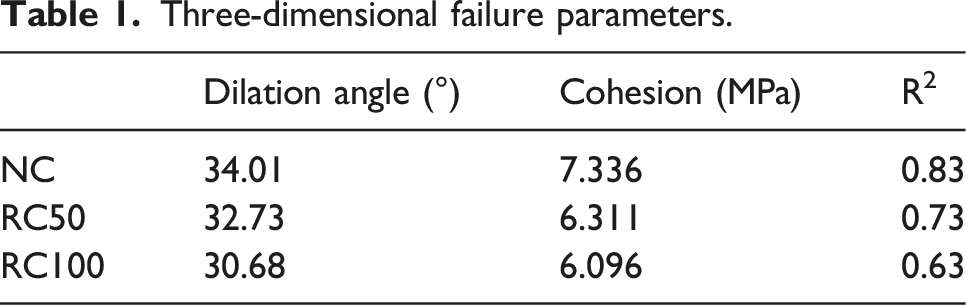
Using the data in Table 1 to regress, the dilatancy angle of recycled concrete and the replacement ratio of recycled coarse aggregate have the following linear relationship
The axial compressive strength 𝑓c and the tensile strength 𝑓t are determined by the relationship between the strength grade of recycled concrete 𝑓c and 𝑓t in the Specifications for Design of Concrete Structures (GB 50010-2010, 2015) and Technical Specification for Application of Recycled Aggregate Concrete (DG/TJ 08-2020-2007, 2007), and the regression results are obtained as the following relationships
Among them, 𝑓t, RAC is the tensile strength of recycled concrete, and 𝑓c, RAC is the compressive strength of recycled concrete.
Simulation parameters.

The compression damage factor is calculated according to the formula in Abaqus Analysis User’s Manual (6.14) (SIMULIA, 2014), the compression damage factor 𝑑c and the tensile damage factor 𝑑t are respectively

Among them, 𝛽c and 𝛽t are the proportion of plastic strain in the inelastic strain during tension and compression respectively;
Based on the ABAQUS software, the finite element model for the recycled concrete beam is established shown in Figure 3(a), same as the experimental specimen in the previous literature (Wang and Xiao, 2018), and the longitudinal reinforcement and stirrup are shown in Figure 3(b). The width, height, and length directions of the model correspond to the X axis, Y axis and Z axis of the system coordinates respectively. In order to increase the accuracy of the calculation, while considering the calculation efficiency, the calculation unit is more finely meshed in the middle area of the beam. Recycled aggregate concrete beam mode. (a). Finite element mesh, (b). Rebar.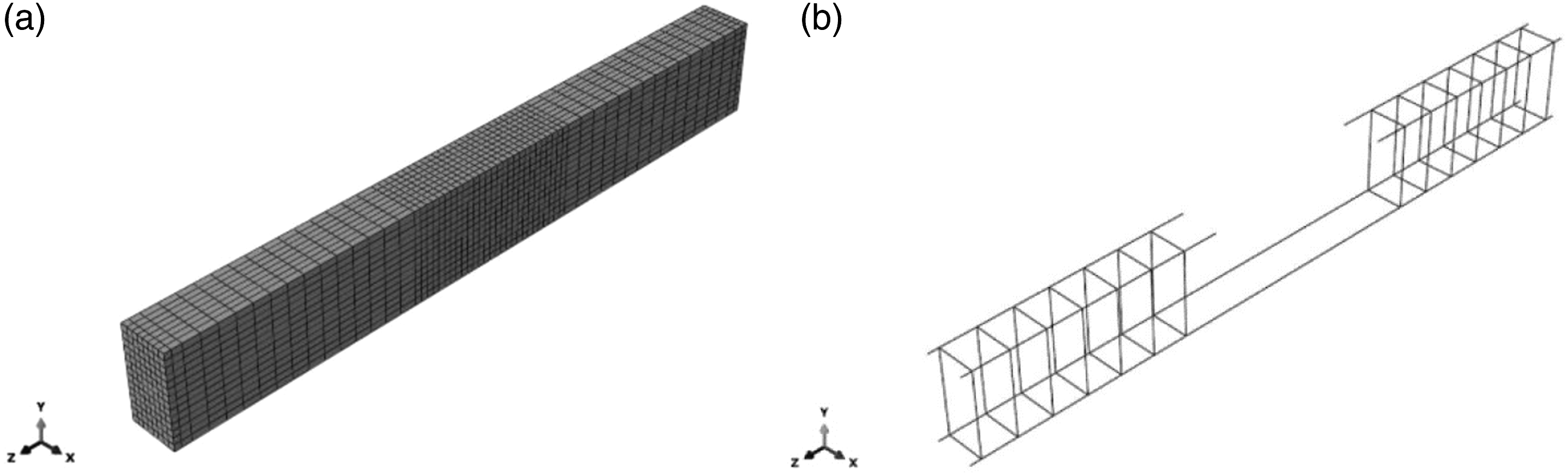
The reinforcement unit is embedded in the concrete. The load is applied by the distribution beam in the middle area, which increases linearly with the load step. Using static calculation, after each step of load is stabilized, the next level of load is applied, and the calculation step length is automatically optimized by the software, and the calculation is performed until the beam is broken.
The beam model was generated using a ABAQUS script program developed in Python. Concrete and reinforcement are modeled separately using C3D8R elements and T3D2 elements, respectively. Since the beam divided by the plane of longitudinal reinforcement bars and stirrups during generation, the entire model satisfies the conditions of map meshing, so the beam was meshed into regular hexahedral meshes. At the support positions of the beam, the nodes along the thickness direction are constrained with hinge and sliding constraints respectively. Reinforcement embedded in concrete by overlapping nodes.
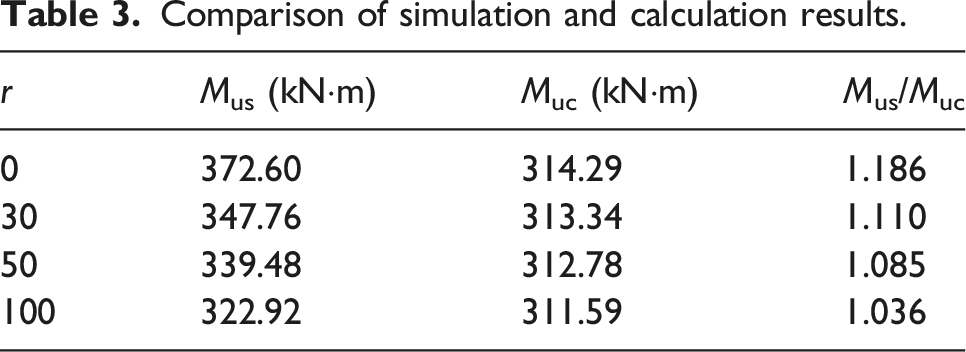
The simulated flexural bearing capacities of concrete beams with 0% and 100% recycled coarse aggregate replacement ratios are 37.28kN·m and 29.97kN·m, respectively, and the test results are 34.90kN·m and 31.38kN·m, the errors are 6.8% and 4.5%, the simulation effect is good. Using the revised α1 and β1 in this paper, the calculated flexural bearing capacities of concrete beam are 33.13 MPa and 29.50 MPa at 0% and 100% replacement ratio of recycled aggregate, respectively, with errors of 5.1% and 6.0%, respectively. The prediction effect of the calculation formula is good. The flexural bearing capacities of concrete beams calculated by specification is 32.17 MPa and 32.12 MPa. When the replacement ratio of recycled aggregate increases from 0% to 100%, the flexural bearing capacity only changes by 0.1%, while the experimental result changes by 10%. And when the replacement ratio of recycled aggregate is 100%, the calculated value is higher than the experimental value. This may leady to poor safety.
In order to study the influence of recycled concrete on the bending performance of beams in engineering, the size of the finite element model was modified and the model shown in Figure 4(a) was established. The revised beam length is 6.43 m, and the span is 6m. The beam has a width of 300 mm and a height of 700 mm. The bottom longitudinal ribs are 2 HRB335 with the diameter of 22 mm and 2 HRB335 with the diameter of 18 mm, the top longitudinal rib is 2 HRB335 with the diameter of 18 mm, the stirrup is HPB235 with the diameter of 8 mm, and the spacing is 200 mm, as shown in Figure 4(b). The load is loaded by distribution beams, which are respectively loaded at a distance of 1.8 m from the support, and the shear-span ratio is between 1 and 3. The width, height and length of the beam correspond to the X axis, Y axis and Z axis of the system coordinates respectively. The material parameters of the concrete in the model still use the parameters in Table 2 of the material. Revised recycled aggregate concrete beam mode. (a). Finite element mesh, (b). Rebar.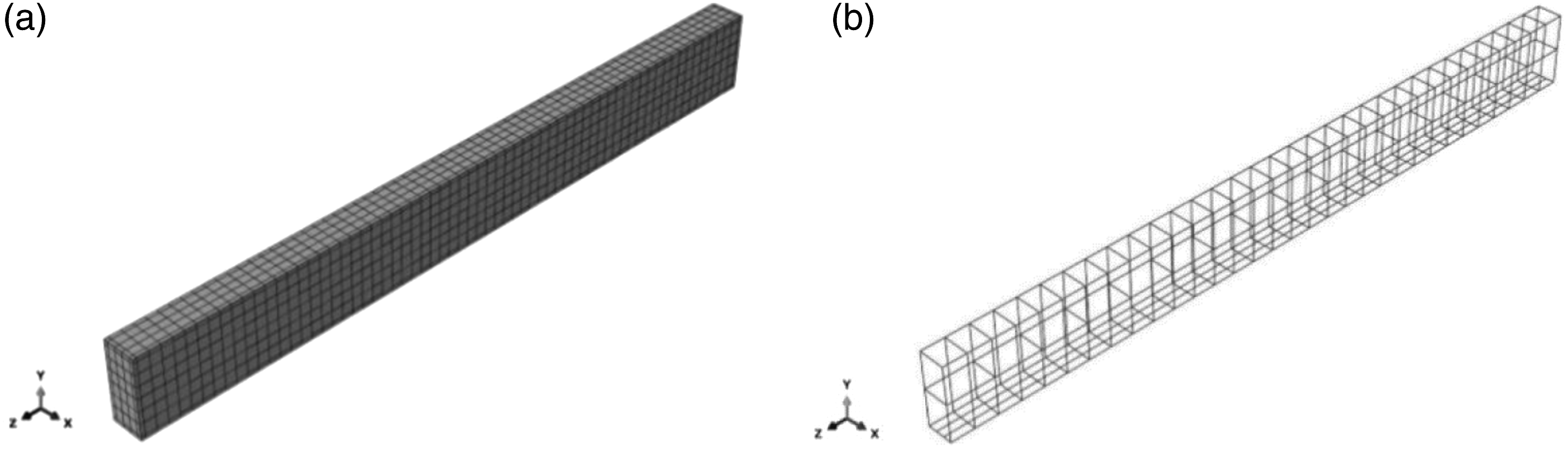

Comparison of simulation and calculation results.
Results and discussion
Effect of replacement ratio of RCA and compressive strength on 𝛼1 and 𝛽1
The influence of 𝑓cu on εu is given in the specification (GB 50010-2010, 2015)
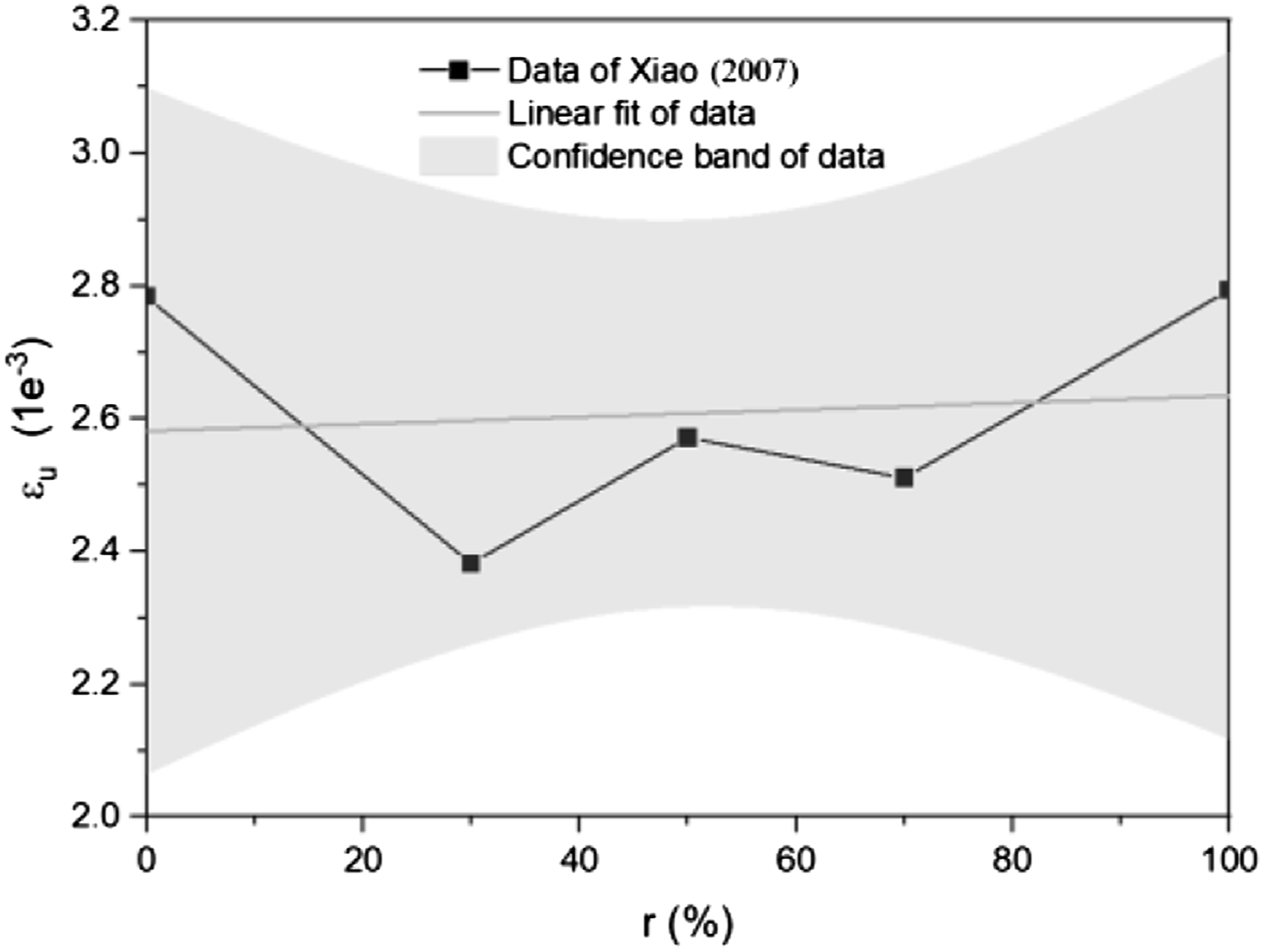
The influence of r on ε0 is given in equation (5). Using the equation (5), the contour of ε0 is shown in Figure 5. It can be seen from Figure 7 that as the replacement ratio of recycled coarse aggregate increases, the peak strain increases with the increase in the compressive strength of the cube. From the experimental results of Xiao (2007), The variation of εcu with r is showed in Figure 6. It can be seen from the figure that the mean value of the data changes very little and has great fluctuations. The confidence band of data completely, shown in Figure 6, includes all data points, indicating that the data changes with the change of RCA replacement ratio are caused by the larger data dispersion. With equation (1) and the established stress-strain curve of recycled concrete under uniaxial action, when the strength of concrete with different recycled aggregate replacement ratios is 30 MPa, the descending section of the calculated stress-strain is significantly reduced after adding recycled aggregate. Influence of 𝑓cu and 𝑟 on ɛ0. Influence of 𝑓
𝑦
and 𝐸
𝑠
on x. The variation of ɛcu with 𝑟.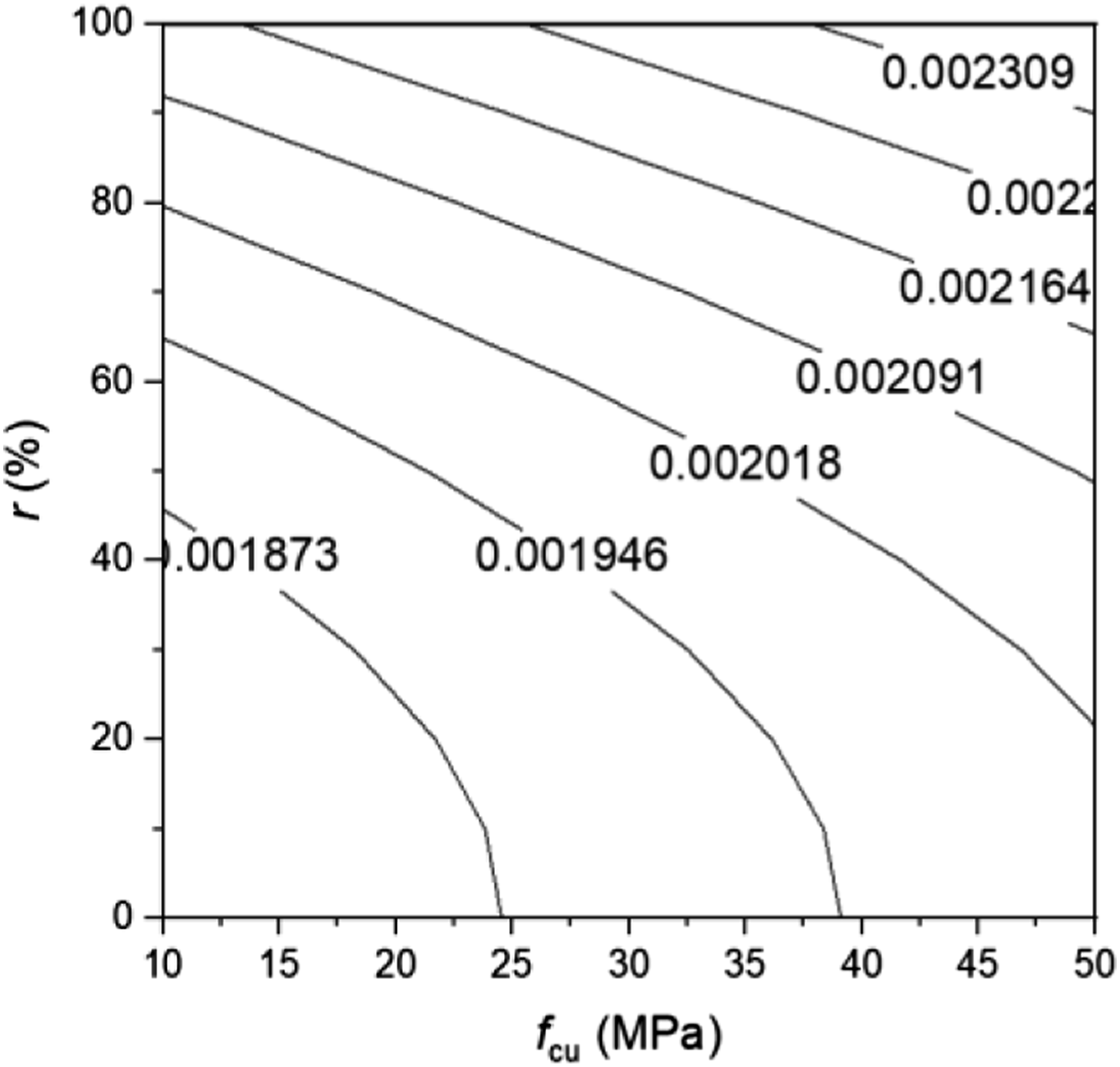
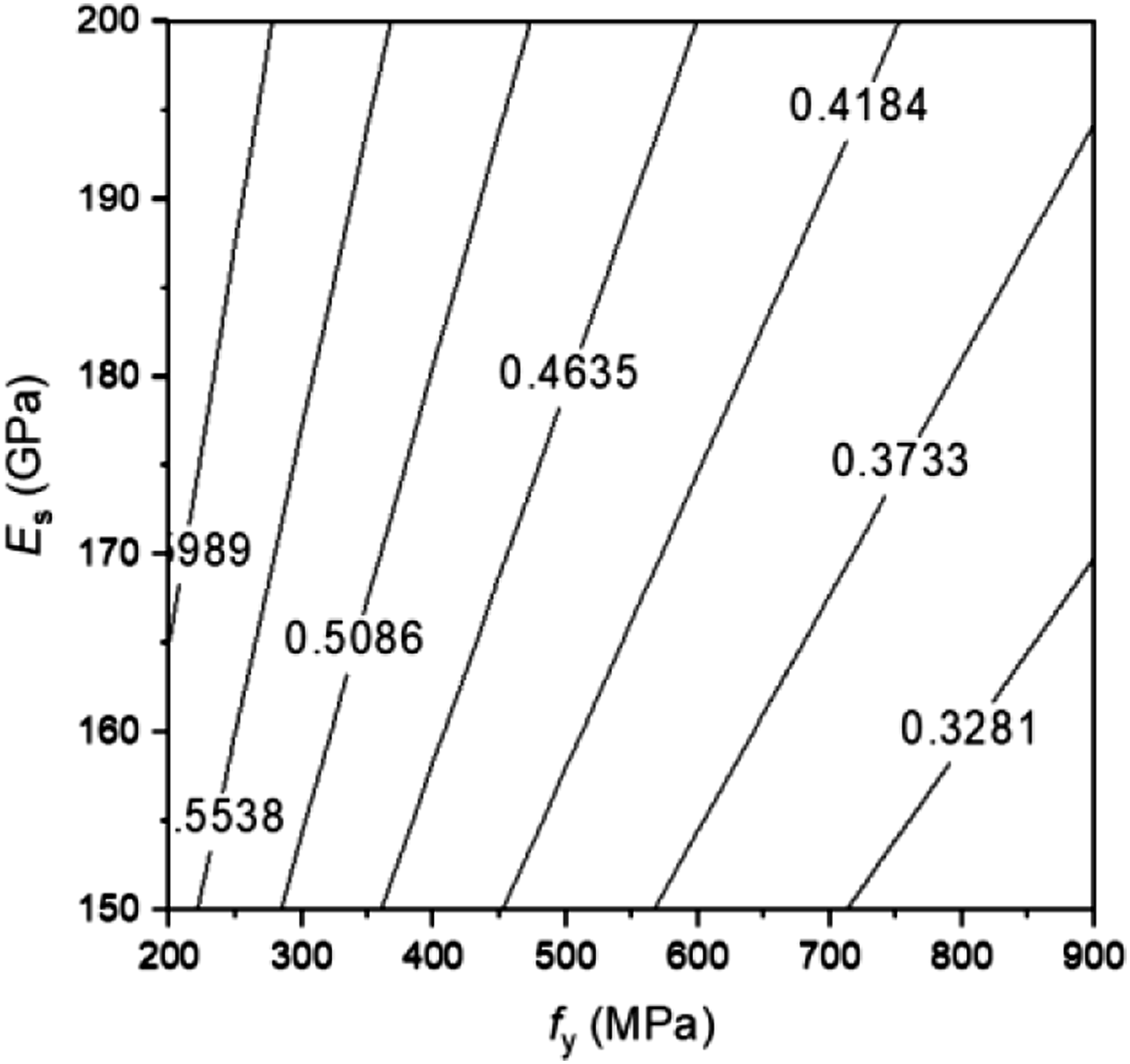
The height of the compression zone x is related to the 𝑓y and 𝐸s of the steel bars, and the relationship is shown in Figure 7. As 𝑓y decreases and 𝐸s increases, εn gradually increases. Taking equation (5) and equation (28) into equation (18) and equation (19), the parameters 𝛼1 and 𝛽1 of recycled aggregate concrete are derived.
Xiao’s experimental data (Xiao, 2007) is used to analyze the correlation between 
Take it into equation (7), then obtained
From equation (5), equation (6), equation (13), equation (14), equation (17), equation (18), equation (19), equation (28) and equation (30), 

The changes as the influence of r and 𝑓cu are shown in Figure 8(a) and Figure 8(b), respectively. When the replacement ratio of recycled aggregate is low, namely below 50 MPa, the decrease of 𝛼1 is faster, and the decrease ratio gradually slows down with the increase of the replacement ratio. Under the same recycled aggregate replacement ratio, as the strength increases, the 𝛼1 of recycled concrete slowly decreases. The variation range of 𝛼1 is 0.27. 𝛽1 decreases with the increase of the strength of recycled concrete, increases at first and then decreases with the increase of the replacement ratio of recycled aggregate. The variation range of 𝛽1 is 0.167. Influence of 𝑓𝑐u and 𝑟. (a). 𝛼1, (b). 𝛽1.
Using the ratio of the ultimate strain and the peak strain of the stress-strain curve of recycled concrete as a variable, use the different stress drop to determine the ultimate strain of recycled concrete, we can obtain the relation of 𝛼1 and 𝛽1 with the replacement ratio of recycled coarse aggregate and the stress drop amplitude at the limit state (σcu/𝑓c), as shown in Figure 9. The light-colored curved surface in Figure 9 is the result of calculation using the parameters of equation (2), and the dark-colored curved surface is the result of calculation using equation (3). It can be seen from Figure 9 that the stress in the limit state has a greater impact on each parameter. As the stress increase during failure, 𝛼1 shows an increasing trend, and 𝛽1 shows a decreasing trend. Equivalent rectangular parametric surface of recycled concrete pressure zone. (a). 𝛼1, (b). 𝛽1.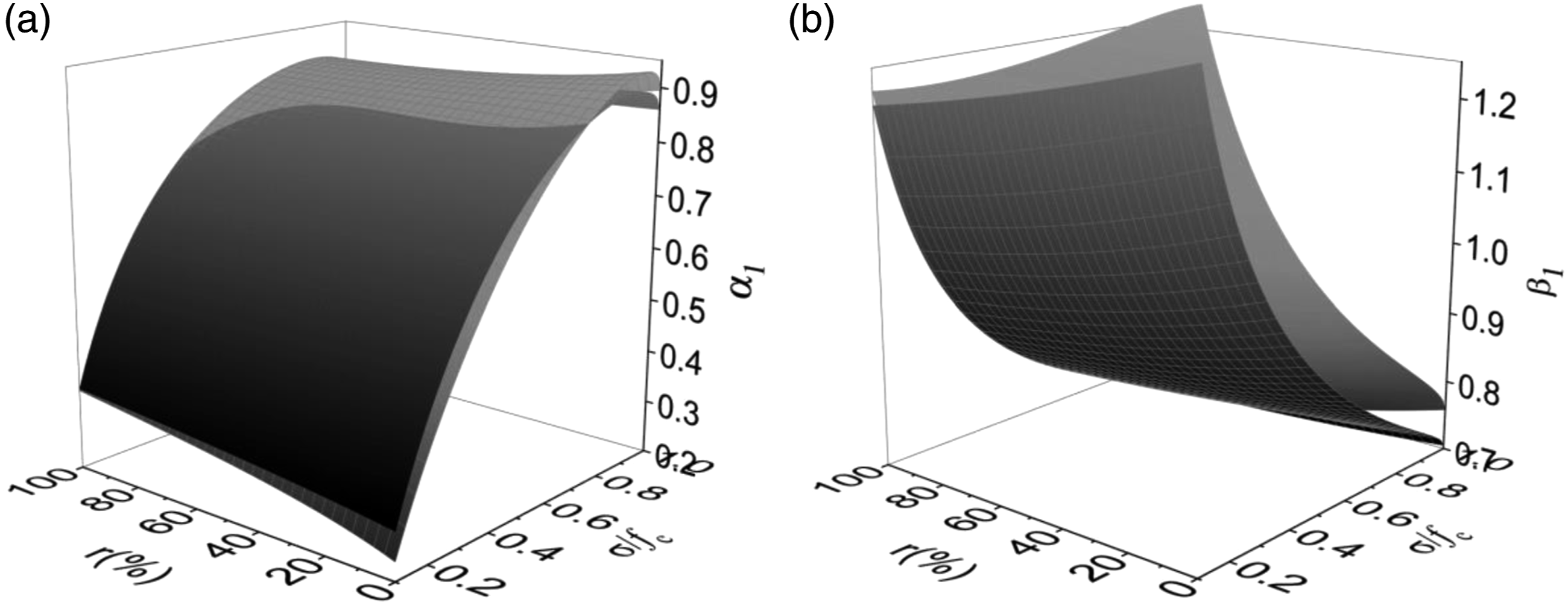
In the study of Xiao (2007), when the stress of stress-strain curve is reduced to 85% of the peak stress, the corresponding strain is the ultimate strain, and the corresponding strain is shown in Figure 10. In Figure 10, the replacement ratio of zero recycled aggregate corresponds to the value in the specification. The 𝛼1 and 𝛽1 are shown in Figure 11, when the replacement ratio of recycled aggregate is 0% and 100%. From Figure 11, it can be seen that 𝛼1 and 𝛽1 decrease after mixing with recycled aggregate. When the replacement ratio of recycled coarse aggregate is 100%, the value of 𝛼1 decreases by 2%, and the value of 𝛽1 decreases by 6%. The value calculated by Wang and Xiao (2018) is in the middle of the value calculated by the standard and the value calculated by Wang and Xiao (2007) and Xie et al. (2018). Relationship between ultimate compressive strain and replacement ratio of recycled coarse aggregate. Comparison of 𝛼1 and 𝛽1 before and after add recycled aggregate.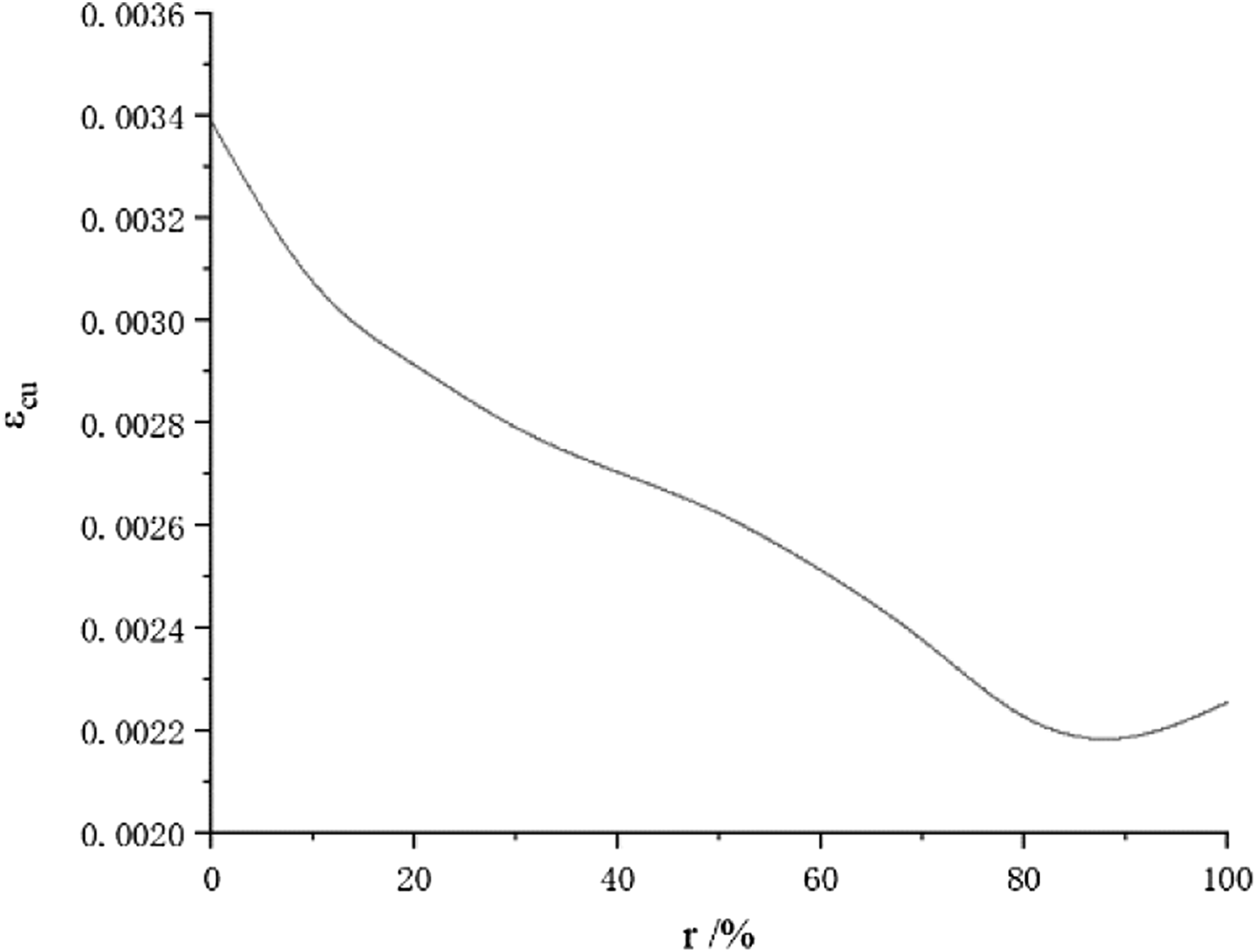
When the replacement ratio of recycled coarse aggregate changes, the change of 𝛼1 is expressed by the change of the rising section coefficient 
Therefore, the change of 𝛼1 caused by the replacement ratio of recycled coarse aggregate r can be decomposed into the change of 𝛼1 corresponding to the change of the rising section curve caused by r, the change of 𝛼1 corresponding to the change of the falling section curve caused by r, and the ultimate strain caused by r, represented as 
Similarly, the change of 𝛽1 caused by the replacement ratio of recycled coarse aggregate r is decomposed into the change of 𝛽1 corresponding to the change of the rising section curve, the change of 𝛼1 corresponding to the change of the falling section curve, and the ultimate strain caused by r respectively, using 
Figure 12 is the effect of recycled aggregate replacement ratio on the coefficients of the rising and falling sections of the stress-strain curve. Using equation (31) and equation (32), take the partial derivatives of Effect of recycled aggregate replacement ratio on the coefficients of the rising and falling sections of the stress-strain curve. (a). Coefficients of the rising sections, (b). Coefficients of the falling sections.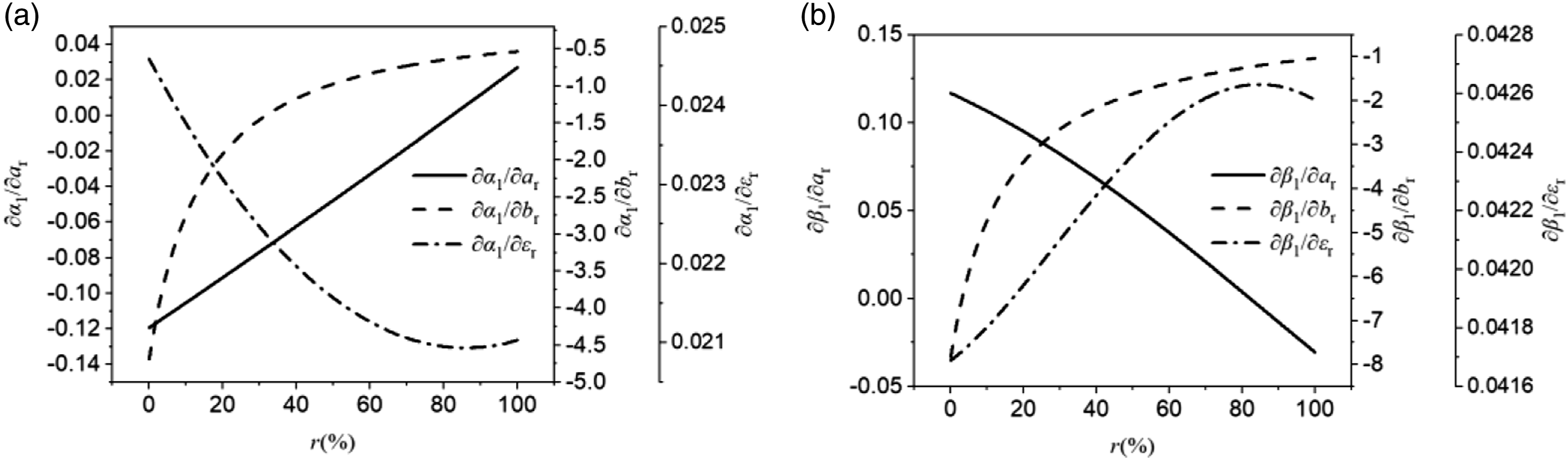
Effect of replacement ratio of RCA and compressive strength on bending capacity
When the beam fails, the crushing of the concrete in the compression zone and the yielding of the reinforcement in the tension zone occur simultaneously, the limiting relative height of the compression zone, is obtained from the cross-sectional stress distribution at the time of the failure (GB 50010-2010, 2015).
HRB400 steel reinforcements according to the Chinese standard are used, the Variable parameter analysis results. (a). Maximum section resistance moment, (b). Maximum reinforcement ratio, (c). Maximum reinforcement ratio, (d). Relative pressure zone height, (e). Longitudinal reinforcement ratio.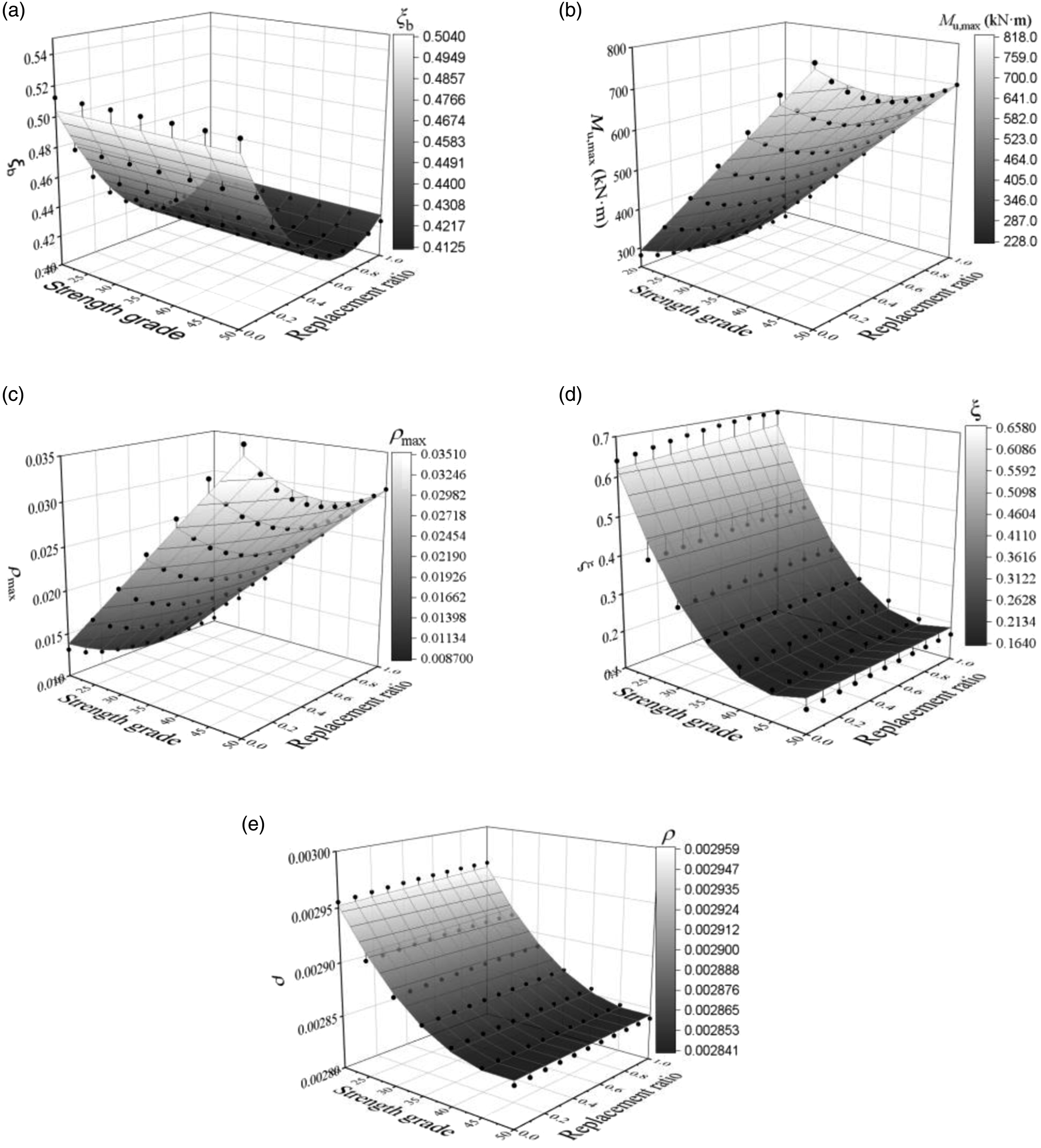
It can be seen from Figure 13(a) that when the strength grade of recycled concrete is below 50 MPa, the increase of recycled aggregate leads to ξb a first decrease and then a slight increase. When the replacement ratio of recycled aggregate is 70%, ξb is the minimum, and it is reduced by 19% compared to natural concrete. When the replacement ratio larger than 70%, ξb increase by 2% than that in 70% replacement ratio. Relative to the previous decline, this stage can be considered to remain unchanged. The variation in the relative height of the compression zone is fitted as
Where, r is the replacement ratio of recycled aggregates. The slight increase in the later stage is due to the low elastic modulus of recycled concrete with the same strength as conventional concrete, which led the ε0 of equation (5) increases with the increase of the replacement ratio of recycled aggregate. With the increase of the replacement ratio of recycled aggregates, the stress-strain drop stage becomes steeper. The combined effect of the two causes the ultimate strain of recycled concrete not to decrease monotonically, and cause ξb not to change in monotonically decreasing. Considering the balance condition of beam axial force (

Since 
The maximum sectional resistance moment Mu,max of recycled concrete under different strength grades of recycled concrete and the replacement ratio of recycled aggregate are calculated as shown in Figure 13(b).
From Figure 13(b), it can be seen that the strength grade of recycled concrete and the replacement ratio of recycled aggregate have an effect on Mu,max. The effect of strength grade to Mu,max is constant at different replacement ratios of recycled aggregates and Mu,max has an increase of 95kN·m for every 5 MPa strength grade increase.
Under the same strength grade, with the increase of the replacement ratio of recycled aggregates, Mu,max is gradually slowing parabolic decline, and the decline amplitude is at most 15.7%. Fit the surface, it can be got
Where Sg is the strength grade of concrete. The maximum reinforcement ratio of recycled concrete beams can be obtained by taking 
Figure 13(c) shows the 𝜌max at different strength grades and the replacement ratios of recycled aggregates.
It can be seen from Figure 13(c) that both the strength grade of recycled concrete and the replacement ratio of recycled aggregate have effects on 𝜌max. Among them, the effect of strength grade is relatively small. Under different replacement ratios of recycled aggregates, the strength grade increases by 0.4% for every 5 MPa increase. Under a same strength grade, with the increase of the replacement ratio of recycled aggregates, 𝜌max shows a gradual slowing parabolic increase, and the increase amplitude is at most 20.4%. Fit the surface, it can be got
From equation (38) and equation (39), these can be obtained

Bring the parameters in a project into equation (38) and equation (39), the height x of the concrete compression zone and the reinforcement area at different ratios of recycled aggregate replacement can be determined. Referring to the Chinese specification for recycled concrete structures, HRB400 steel bars commonly used in buildings and C20 - C50 strength grade concrete are used. Mu takes 80kN·m. The section size of the beam selected 250 mm × 600 mm. The compressive strength of concrete of C20, C25, C30, C35, C40, C45 and C50 are 9.6 MPa, 11.9 MPa, 14.3 MPa, 16.7 MPa, 19.1 MPa, 21.1 MPa and 23.1 MPa (GB 50010-2010, 2015).
Since 
Since 
Taking equation (27) and equation (29) into equation (33), it can be got
Taking equation (45) into equation (37), it can be got
Taking equation (45) into equation (39), it can be got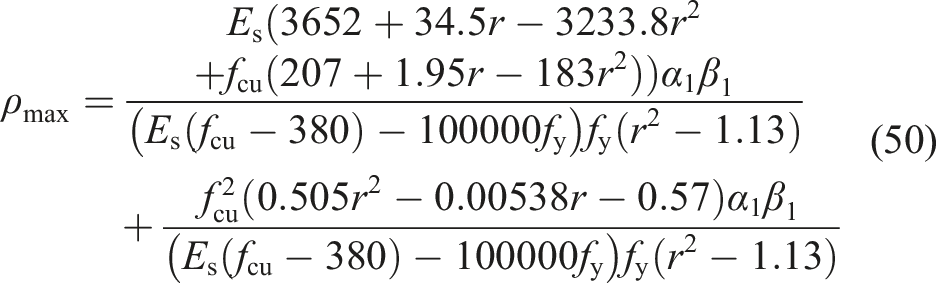
According to equation (43) into equation (47), variable parameter analysis results are shown in Figure 13. It can be seen from Figure 13(d) that the strength grade has a great influence on ξ, and with the increase of concrete strength grade, ξ gradually decreases. When the strength grade of concrete remains unchanged, with the increase of the replacement ratio of recycled aggregate, ξ shows an increasing trend. When the strength grade of concrete is lower, the effect of the replacement ratio of recycled aggregate is more pronounced. When the concrete strength grade is C20 and the beam with 100% recycled aggregate replacement ratio, ξ increases by 8%. When the concrete strength grade is C50 and the beam with 100% recycled aggregate replacement ratio, ξ increases by 4%. Fit the surface, it can be got
The calculated relative pressure zone height ξ under different strength grades and the replacement ratio of recycled aggregate is shown in Figure 13(e).
It can be seen from Figure 13(e) that the strength grade has a great influence on 𝜌, and with the increase of concrete strength grade, 𝜌 gradually decreases. The increase of recycled aggregate leads to an increase in 𝜌, but the increase is small, only 0.35%. Fit the surface, it can be got
Conclusion
Based on the stress-strain relationship, peak strain and other concrete mechanical parameters of recycled concrete, calculation of recycled concrete beams under bending are analyzed. The value and change law of the relevant calculation parameters equivalent to the rectangular distribution of the compressive stress of recycled concrete beams are studied. The following conclusions can be obtained: 1. For recycled concrete with a strength grade lower than 50 MPa, based on the nonlinear constitutive of recycled concrete, the equivalent rectangular block parameters, 𝛼1 and 𝛽1 was be deduced. The parameter 𝛼1 is increased significantly at first, and then keeps stable with the increase of replacement ratio of recycled aggregate. Besides, the decreasing trend is found for the parameter 𝛼1 as the strength grade increases. When the above factors change, the maximum variation amplitude of 𝛼1 is 27%. 𝛽1 is increased in the initial stage and then decreased as the increase in the replacement ratio of recycled aggregate. And 𝛽1 is decreased with the increase in the strength grade of recycled concrete. When the above factors change, the maximum variation amplitude of 𝛽1 is 0.16. 2. It is verified by ABAQUS that the calculation method in this paper can better reflect the difference in flexural capacity of recycled concrete and conventional concrete beams, as well as different recycled concrete beams. At the 100% replacement ratio of recycled aggregate, without considering the change of 𝛼1 and 𝛽1, the error between calculation and simulation is 16%; when considering the change of 𝛼1 and 𝛽1, the error is reduced to 4%. 3. With the increase in replacement ratio of recycled aggregate, the relative height of the limiting compression zone ξ
b
of recycled concrete is reduced by 19% at 70% recycled aggregate replacement ratio, and remain unchanged at higher replacement ratio. The ultimate flexural bearing capacity Mu,max, is reduced by a maximum of 15.7% as the replacement ratio of recycled aggregate increased from 0% to 100%. With the increase in replacement ratio of recycled aggregate, the maximum reinforcement ratio 𝜌max is gradual parabolic increase, and the max amplitude is at most 20.4%. With the replacement ratio increase, the relative height of the limiting compression zone ξ increase and the reinforcement ratio 𝜌 decrease. Under the beam size and loads assumed in this paper, the change of ξ and 𝜌 are 4%–8% and 0.35%.
Footnotes
Declaration of conflicting interests
The author(s) declared no potential conflicts of interest with respect to the research, authorship, and/or publication of this article.
Funding
The author(s) disclosed receipt of the following financial support for the research, authorship, and/or publication of this article: The authors would like to acknowledge the financial support of the National Natural Science Foundation (NSFC) of PR China (Nos. 52078370, 51778463).
