







Abstract
Corrosion will cause cross-sectional area loss of steel members, which will lead to redistribution of internal force and affect the performance of structures. In this paper, a generalized formula for the internal force variation of pin-jointed structures due to variation of external force, cross-sectional area, and initial length is derived. The area-loss sensitivity coefficient (ASC) and the area-loss evenness coefficient (AEC) based on statistical measures are then defined. By calculating these two coefficients, the influence of single member’s area-loss on the behavior of the structure as well as the evenness of internal force variation are evaluated. Besides, a method to determine the area-loss limit of pin-jointed structures is proposed based on the structural reliability theory and mathematical nonlinear programming. According to the above process, the effect of members’ area loss on structural properties is analyzed without complicated numerical approaches such as FEM, and then the safety of corroded structures is assessed preliminarily. The proposed method is verified by two numerical examples, and provides a convenient tool for pre-manufacturing, maintenance during service life, and structural health monitoring of pin-jointed structures.
Introduction
Pin-jointed structures have the advantages of lightweight, elegant appearance, and high controllability. Therefore, they are widely used in practical engineering such as building structures, bionic engineering and aerospace engineering (Khomami and Najafi, 2021; Chen and Dong, 2013; Puig et al., 2010). The initial stresses of members in pin-jointed structures are always caused by prestress or external loads. Accordingly, pin-jointed structures can be divided into two types (Zhang and OHSAKI, 2011). One is the bar structure. It is composed of bars, which provide material stiffness to the structure. The other is the cable-strut system. It is composed of cables and struts and the initial prestress is essential to stiffen the system which provides geometry stiffness to the entire structure to form an equilibrium and stable configuration (Montuori and Skelton, 2017). The stiffness of this type of structure is collectively provided by the geometry stiffness and material stiffness.
With the increase of the service life, many factors such as long-term wear, accidental loads and especially corrosion will inevitably lead area loss even vitiation of the members; thereby the stiffness distribution of the structures will be changed. At least it will affect the performance degradation of the structure, and at worst it will cause structural damage. In 1982, a two-truck collision in Panama caused the collapse of the Chiriqui River suspension bridge in that several suspender ropes snapped. A subsequent investigation revealed the hanger cables had been significantly weakened by rust. One of the most serious strands had lost two-thirds of its cross section due to corrosion (Hopwood and Havens, 1984). The suspended prestressed cable structure applied in the roof of the ice hockey stadium in Slovakia was built in 1966. The cable roof was exposed to varying environment, resulting in the aging and corrosion of the steel cables. It was found that the corrosion depth had reached 2 mm with approximately 17% of area loss, and all external wires of the strand in specific cables were heavily impaired. (Kmet et al., 2019). In 2005, a roof collapse accident occurred in a swimming pool in the Russian town of Chusovoy due to the severe corrosion of the roof metal frame and the fracture of the members. This was a typical stress corrosion cracking accident (Murphy, 2019). From these engineering accidents, it can be seen that the members’ area losses will lead to the degradation of structural performance (Hamilton, 1995; Shun-Ichi et al., 2004). Therefore, it is necessary to conduct further studies on the cross-sectional area-loss of pin-jointed structures.
Existing researches on the area-loss of members predominantly focused on the corrosion of materials. Daniels (Daniels and Jeffreys, 1945) and Weibull (1949) proposed a fiber bundle model to study the redistribution of internal forces as a result of corrupted steel cables. Furthermore, Coleman (1958) introduced breakdown function to measure the dynamic failure of fiber bundles. Cai et al., (2010) investigated the effects of applied torque on corrosion behavior of 316L stainless steel with crevices. Liu et al. (2020) studied mechanical properties of welded hollow spherical joints under corrosion and de-rusting conditions, and then established a practical corrosion evaluation method with the statistical distribution and corrosion damage kinetics. Jena et al. (2020) proposed a manufacturing process for reduced coating on the surface of carbon steel to study the anti-corrosion and self-cleaning properties of the coating. However, most studies emphasized the performance of the component level under the current state after corrosion, lacking researches on the structure level. In practical engineering, many structures are designed in complex style and composed of plenty of members, of which the contribution to structural stiffness varies greatly. And the degree of corrosion in members usually increase with time. Therefore, it is necessary to determine the member’s area loss of the structure under its service life and establish the relationship between the member’s area loss and the structural performance.
In structural safety studies, the mechanical performance of pin-jointed structures was studied with both geometric and material properties of structural members. Chen et al. (Chen et al., 2014; Zhou et al., 2015) carried out a distributed indeterminacy evaluation considering the effect of member stiffness. And Jiang et al. (2019) studied the influence of members’ material variation on the structural mechanical performance. At present, most studies can only analyze the mechanical properties of the whole structure in the current state (Gholipour et al., 2020; Gao et al., 2021; Kong et al., 2023), and then determine whether the structure is safe. But it provides less help in evaluating the performance degradation of the structure during the remaining service period. So a quick and accurate method is thus essential to determine the limit value of area loss of members which can ensure the structural safety in the present and future service periods.
In this paper, the traditional finite element analysis method is reduced to a generalized formula for the variation of external force, cross-sectional area, and initial length. According to the formula, the part that involves variation of area, the area-loss sensitivity coefficient (ASC) and area-loss evenness coefficient (AEC) are defined in turn to evaluate the impact of the specific member’s area loss on the internal force distribution of overall structures. Furthermore, a systematic method for determining the area-loss limit is also presented based on reliability theory and mathematical nonlinear programming to ensure structural safety. By means of graphical configuration, two numerical examples are designed to illustrate the physical and mathematical implications of the proposed methodology. Finally, a simplified calculation method and its prerequisite for the area-loss limit is discussed.
Generalized formula of internal force variation
For a pin-jointed structure with


Prestress can rigidify pin-jointed structure (such as cable-strut system) into a structure, thereby having a decisive effect on the stability of the structure. Pellegrino (Pellegrino and Calladine, 1986; Calladine and Pellegrino, 1991) explored that the essence of structural rigidity is that the first-order infinitesimal displacement related to the second-order nonlinear deformation of the pin-jointed structure is activated by prestress. Therefore, the second-order nonlinear deformation as shown in Figure 1 should be considered to calculate the effect of prestress. Deformation of the single member (Considering second-order nonlinear deformation).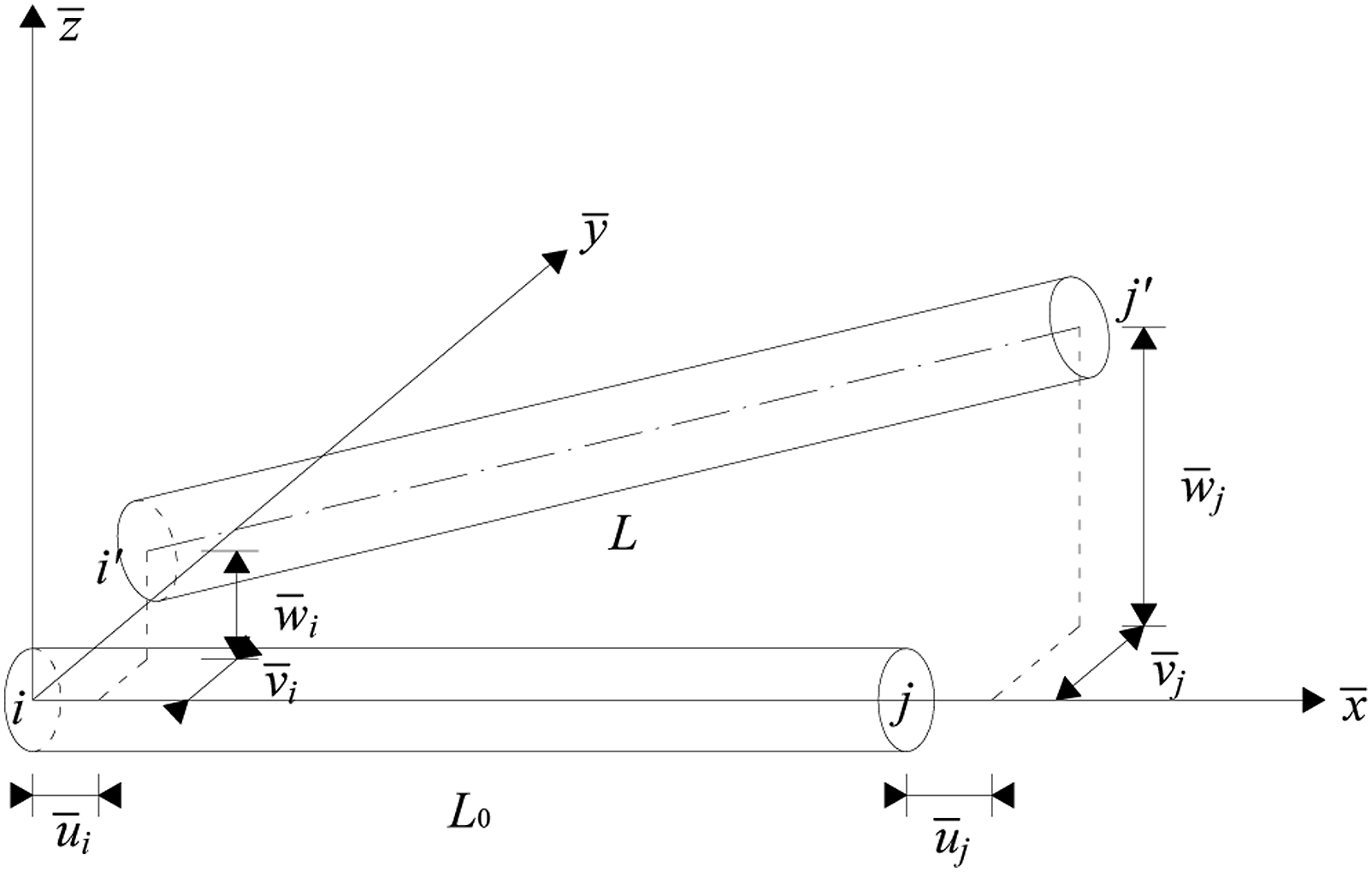

For the member i, the internal force is



Substitute Equation (5) into Equation (1), the following equation can be derived:

According to Equation (7), the mechanical properties of a specific structural system is affected by the variables of

As for boundary constraints,


Therefore, with the boundary constraints the degrees of freedom is reduced to

Substitute Equation (11) into Equation (8) and multiply it by

Similarly, stress matrix

By virtue of Equation (3), the partial derivative of the length of the deformed member to the nodal displacement is shown below:



By substituting Equations (11), (12) and (16) into Equation (15), the formula with
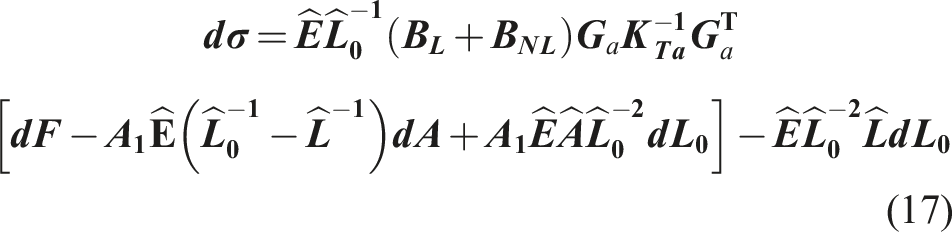
Based on Equation (6), the two variables

By substituting Equations (6), (16), and (17) into Equation (18), we derive the following result:
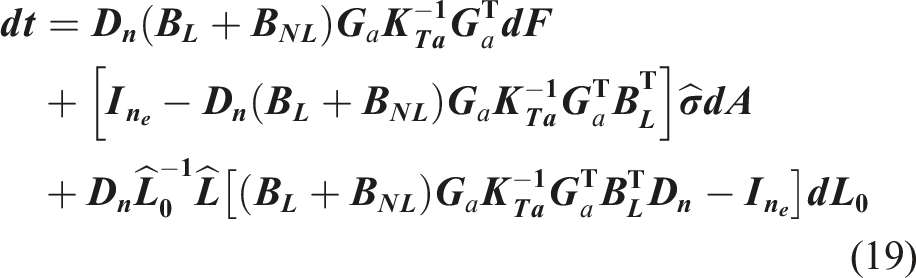

Equation (20) is the generalized analysis formula for the members’ internal force variation of pin-jointed structures, where
Area-loss effect of members based on statistical measures
When the assumption of small deformation is introduced, it is considered that

Under steady load, when the area-loss of member i is

When

Area-loss sensitivity coefficient
The elements in vector of the internal force variation obtained by Equation (23) belong to multivariate data, which are difficult to evaluate the impact on structural performance directly. Mathematical analysis of multivariate data is usually based on the concept of distance. Here the mathematical concept of Euclidean distance (Balaji and Bapat, 2007) is introduced to measure the internal force variation of structural members caused by unit area loss of member i.
Suppose there are two points in n-dimensional space:

Euclidean distance is one of the most common distance measurement methods. Mathematically, it can be interpreted as the linear distance between two points, which involves all data in vector. By calculating the length of the distance, Euclidean distance can comprehensively measure the size of the vector. The distance between

Since the dimension of

The larger the value of ASC, the greater the internal force changes in structural members. It also shows that the structure is more sensitive to the member’s area-loss. If the number of members is large, the calculation results can be normalized and then sorted in ranking. The ASC corresponding to all members should be arranged in order. The top 10% of members in the ranking (based on actual engineering situation) are defined as area-loss sensitive members. Such members are essential to the entire structure, and many aspects such as pre-manufacturing, anti-corrosion methods, and stress state of the members must be strictly controlled.
Area-loss evenness coefficient
The ASC discussed above can measure the size of the internal force variation. However, this method cannot judge the evenness of multivariate data. For structural safety, the evenness of internal force variation is also one of the important indicators. When the force-transferred path among some members in the structure is unreasonable, internal force variation caused by area loss may have large discreteness. In some special cases, the value of ASC of member i may relatively be small, that is, the area loss will not have much effect on the whole structure. However, due to the large discreteness of internal force variation, it may lead to overstress of some components in the structure. To ensure the safety of the structure, this situation should also be avoided. Therefore, the coefficient of variation (Zahra et al., 2021) is introduced to measure the evenness of internal force variation.
Suppose

The coefficient of variation can mathematically describe the evenness of multivariate data, which is a normalized method for degree of evenness of the probability distribution. At the same time, it is a dimensionless quantity, by which the data can be compared directly. However, its disadvantage is that when the mean value is small, the coefficient of variation will be disturbed heavily with low accuracy.
Equation (23) can be rewritten as Equation (28):

To modify the above disadvantage, we take the absolute value of
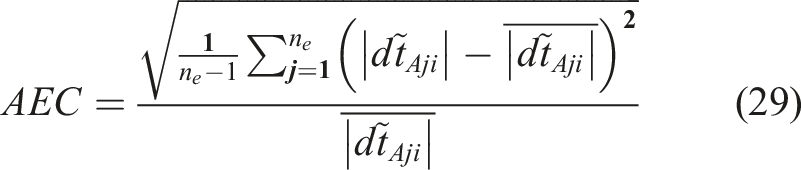
A smaller value of AEC corresponds to a better evenness of internal force variation, that is, the internal force variation can be uniformly transferred to other members when the area loss occurs in member i. Such member has better adaptability and resistance. Conversely, it means the internal force variation will only delivery to a few members. This may cause excessive stress of such members, thereby resulting in structural instability, partial damage, or even continuous collapse. Similar to ASC, the calculation results of AEC can be normalized and then sorted in ranking. All members in the structure should be arranged from large to small. The top 10% of members in the ranking (based on actual engineering situation) are defined as the area-loss unevenness member and additional attention should also be paid to such members.
Area-loss limit of members based on reliability theory and nonlinear programming
The above coefficients can assess the influence of internal force variation of members, but they are not directly related to structural safety. To ensure the safety of structure, it is necessary to consider the bearing capacity of members to determine the area-loss limit.

From Equation (30), it can be seen that
Therefore, it is necessary to supplement the safety conditions of members and the structure based on reliability theory. Further study as well as area-loss limit of members could be analyzed with above calculations and theories.
Area-loss analysis based on reliability theory
In the reliability theory (Duan et al., 2022), the structural state equation Z can be expressed by the structural resistance R and the external load effect S as Equation (31).

Applying Equation (31) to multiple random variables, if the state equation of the structure contains n independent random variables

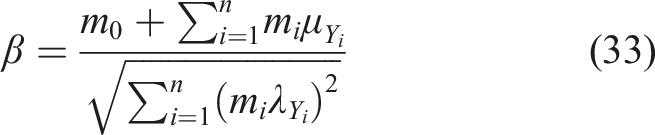
The safety of the structure is represented by the reliability index β (Alvarez and Hurtado, 2014) as Equation (33):
The allowable variation of the internal force is used to calculate the limit of the members’ area-loss, and the critical state equation of the i-th member can be established as Equation (34):

The expression for

When the area loss of the member is small relative to the structure, the performance variation of the structure is approximately linear. And the influence of the area losses of different members on the internal force of the same member can be superimposed linearly.
Introducing the area loss of each member as a random variable into the reliability formula, it can be obtained that the reliability index
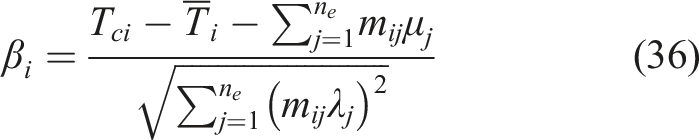
According to reliability theory, if the structure stays safe, its reliability index needs to be greater than a certain value
For each member, there is a reliability index

And Equation (37) can be rewritten as follows:

By the same method, the reliability inequalities of each member can be obtained in turn. And they can be grouped in matrix:

We define
According to Equation (21),

Written in matrix, Equation (41) can be expressed as follows:
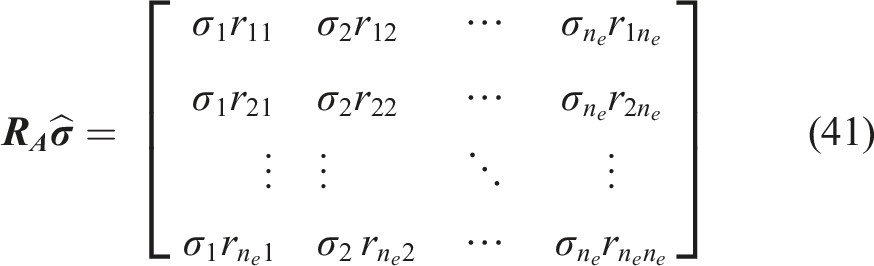
The element of the i-th row and the j-th column in above matrix can represent the influence of the unit area loss of member j on the internal force of member i, that is,
There are still two kinds of variables marked as
Feliu et al. (Feliu S et al., 1993) conducted statistical processing based on atmospheric corrosion and environmental data of building steels, and established the general corrosion model of them. The model is as follows:

Liang et al. (Liang and Hou, 2005), considering the domestic climatope, after 16 years of exposure corrosion experiments, fitted a corrosion model of the same form for a variety of steels, and determined the ranges of corresponding parameters. The value of U is mainly related to the environment and increases with the increase of the pollution severity. The steel type has relatively small influence on the value of U, which generally decreases with the increase of the alloy content. The value of U generally ranges from 0.02 mm to 0.10 mm. And the value of n represents the trend of corrosion, which varies greatly with types of steel and environments, which generally ranges from 0.3 to 1.89.
The mathematical model fitted by a large number of experimental data generally conforms to the normal distribution. Therefore, the mean value
According to the law of large numbers (Huang, 2021), the population mean
In statistics, the Pauta criterion (Liu et al., 2018) can be used to describe the distribution of data. That is, 99.73% of the data can be contained within three times the interval of the standard deviation. According to this property, there is the following relationship among the area-loss limit

It can be seen that to solve the area-loss limit of members, the main problem is to determine standard deviation
Area-loss limit based on nonlinear programming
Since
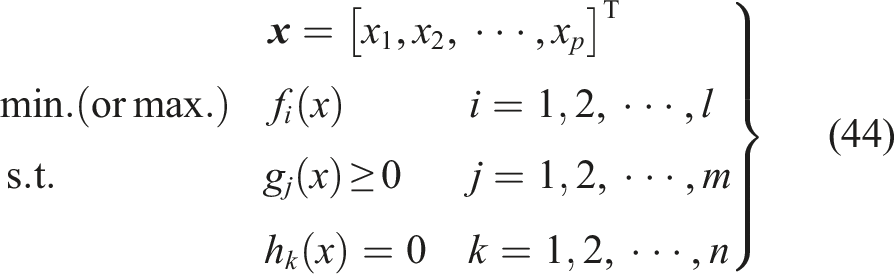
Taking Equation (39) as the nonlinear constraint function considering reliability, it can form a group of closed high-dimensional spatial curved surfaces in design space. And each point falling within these spatial curved surfaces represents for a combination of standard deviations of area losses that satisfies the constraints. Obviously, the closer these points are to the origin, the higher the reliability and the smaller the limit of area loss, and vice versa. Therefore, in order to calculate the area-loss limit under the premise of ensuring structural safety, it is necessary to find a point as far as possible away from the origin within the spatial curved surfaces. So this optimization problem is a single-objective nonlinear programming problem. The design variables and the objective function are established as follows:


Based on the determination of objective function and the nonlinear constraint function considering reliability, the basic framework of nonlinear programming problem has been established. However, other constraints should be abstracted from practical problems to ensure the rationality and feasibility of the solution.
Novák et al. (Novák L and Novák D, 2021) studied coefficient of variation of the functions which contain correlated and uncorrelated random variables in practical problems, they pointed out that the characteristics of materials usually obey normal distribution and the coefficient of variation

Although the points within the spatial curved surfaces are the combination of standard deviation of area error satisfying the constraint conditions, the possibility of each point is not the same. Without additional constraints, the standard deviation combination of small probability may be solved.
We consider that the corrosion model in Equation (42) is obtained by the experiment of multiple groups and multiple specimens, so the mean value calculated conforms to the central limit theorem. Therefore,

The size of the reliable constrained confidence interval is affected by
The standard deviation combination in the target point is the optimal solution we required, and the area-loss limit can be conveniently calculated by substituting the combination into Equation (43).
Numerical examples
In Section 3 and 4, the ASC, the AEC, and the area-loss limit based on reliability theory and nonlinear programming are proposed. To verify the rationality and accuracy of them, an algorithm is programmed by Matlab, and a triangular truss (without prestressed members) and a cable dome (with prestressed members) are taken as two examples to analyze the effect of the members area-loss on the structural performance. In addition, the analytical solution of the internal force caused by member’s area loss is also deduced in the first example. Compared with the solution, the result calculated by proposed method is verified to be valid and accurate.
Example 1. Triangular truss
The triangular truss with non-prestressed member is shown in Figure 2. It consists of 3 steel bars, which are connected by a hinged joint. The top nodes are constrained by displacement in the x-, y-, and z-directions. The elastic modulus Triangular truss.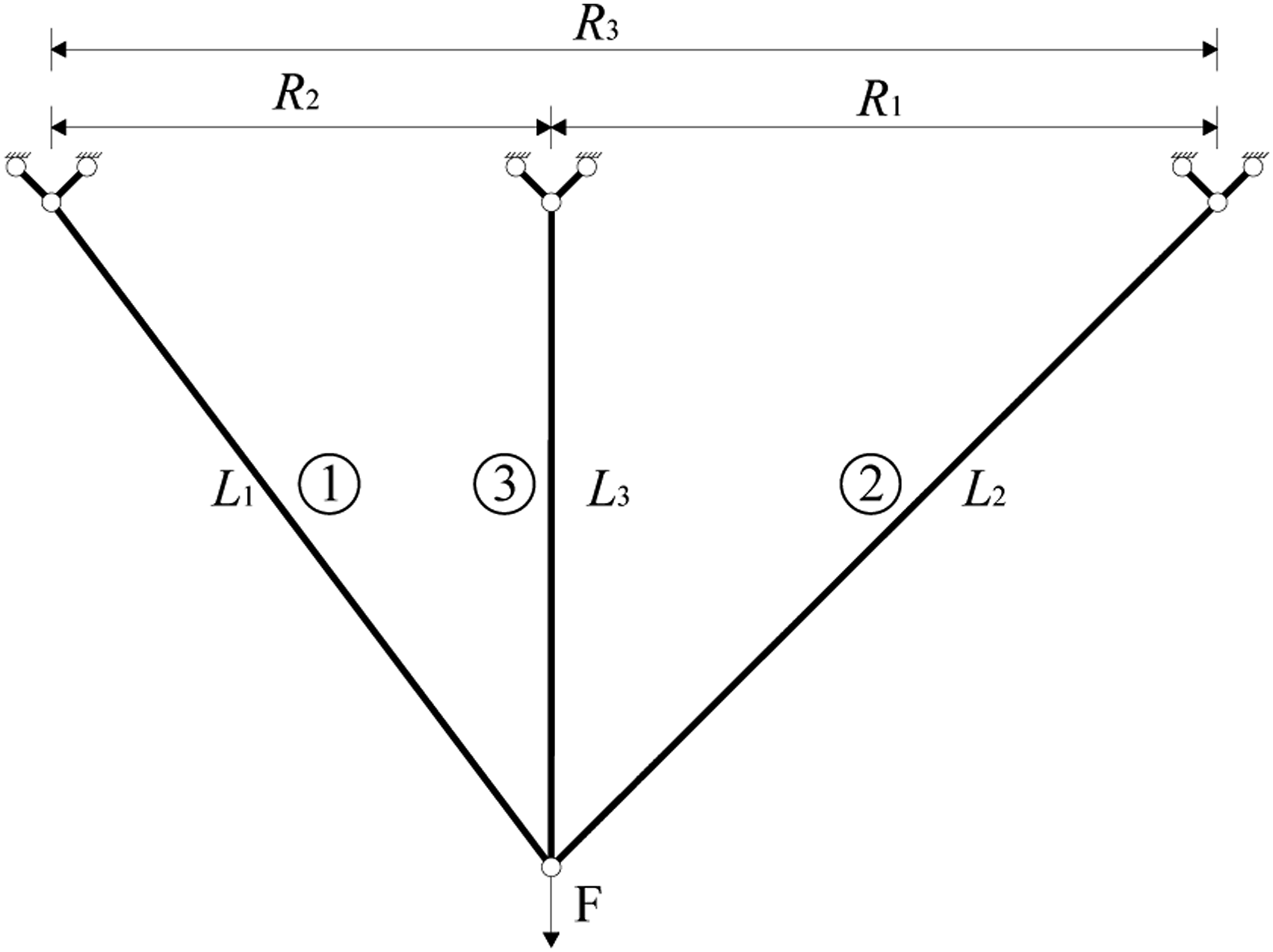
Relationship between internal force variation and member’s area loss
According to Equation (21), the relationship between internal force variation and member’s area loss can be quickly calculated. As a simple structure, the theoretical solution of the internal force caused by member’s area loss can be solved by mechanical analysis easily. The solution could provide a theoretical basis for verifying the accuracy of the proposed method.
The theoretical solution of the internal force of member i with initial area is as follows:
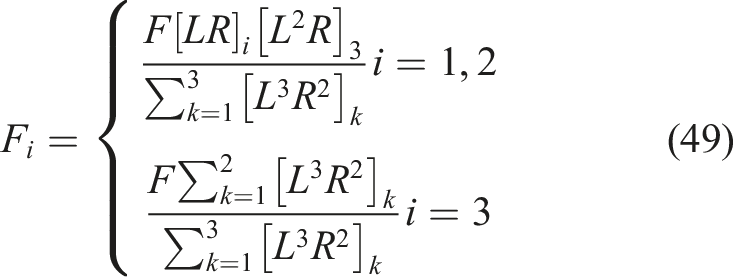
Under the premise of not exceeding the yield strength of members, it is assumed that the areas of three members are weakened to
When the above-mentioned area loss occurs in a single member j, the theoretical solution of the internal force of member i can be written as follows:
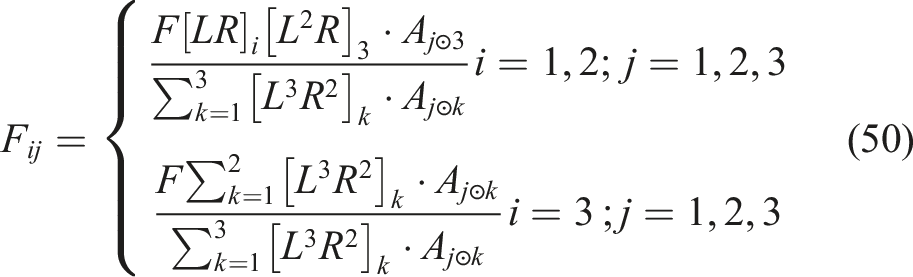
According to Equation (49) and Equation (50), the internal force variation of member i caused by the area loss of member j can be calculated in Equation (51).

Based on relationship between internal force variation and area loss of members, the ASC, the AEC, and the area-loss limit can be analyzed.
Reliability and nonlinear programming
In this example, the structure consists of three bars. According to Equations (45) and (46), the design variable can be written as
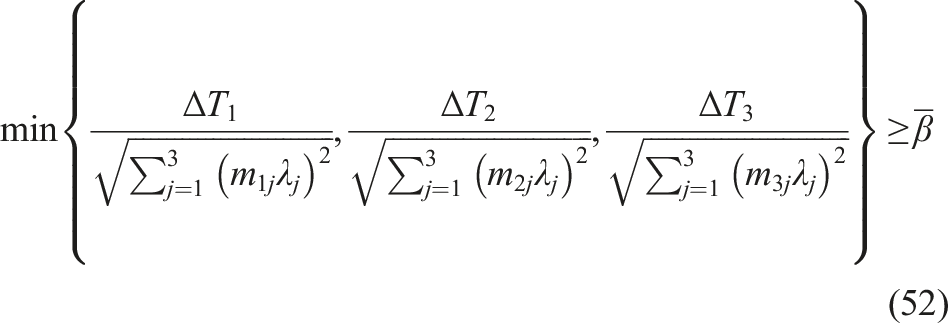
Equation (52) is equal to
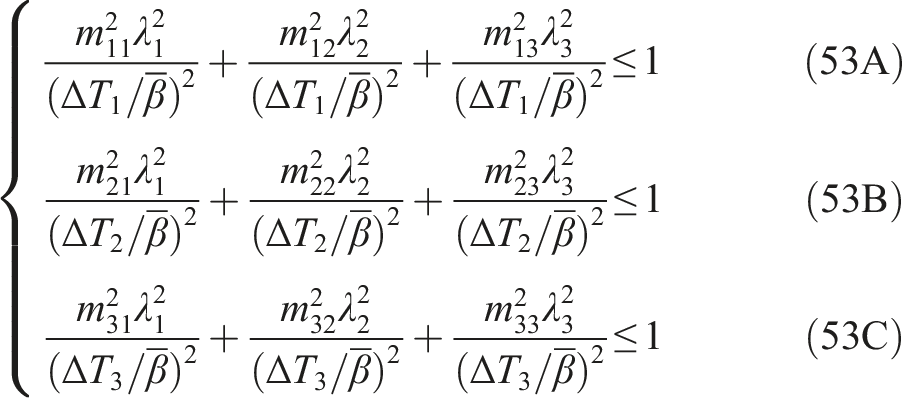
The solutions to the group of inequality equations are three ellipsoid regions in space, as shown in Figure 3. The overlapped ellipsoid region satisfies Equation (52), and the points within it can ensure the reliability of the structure. Feasible region of critical state equation.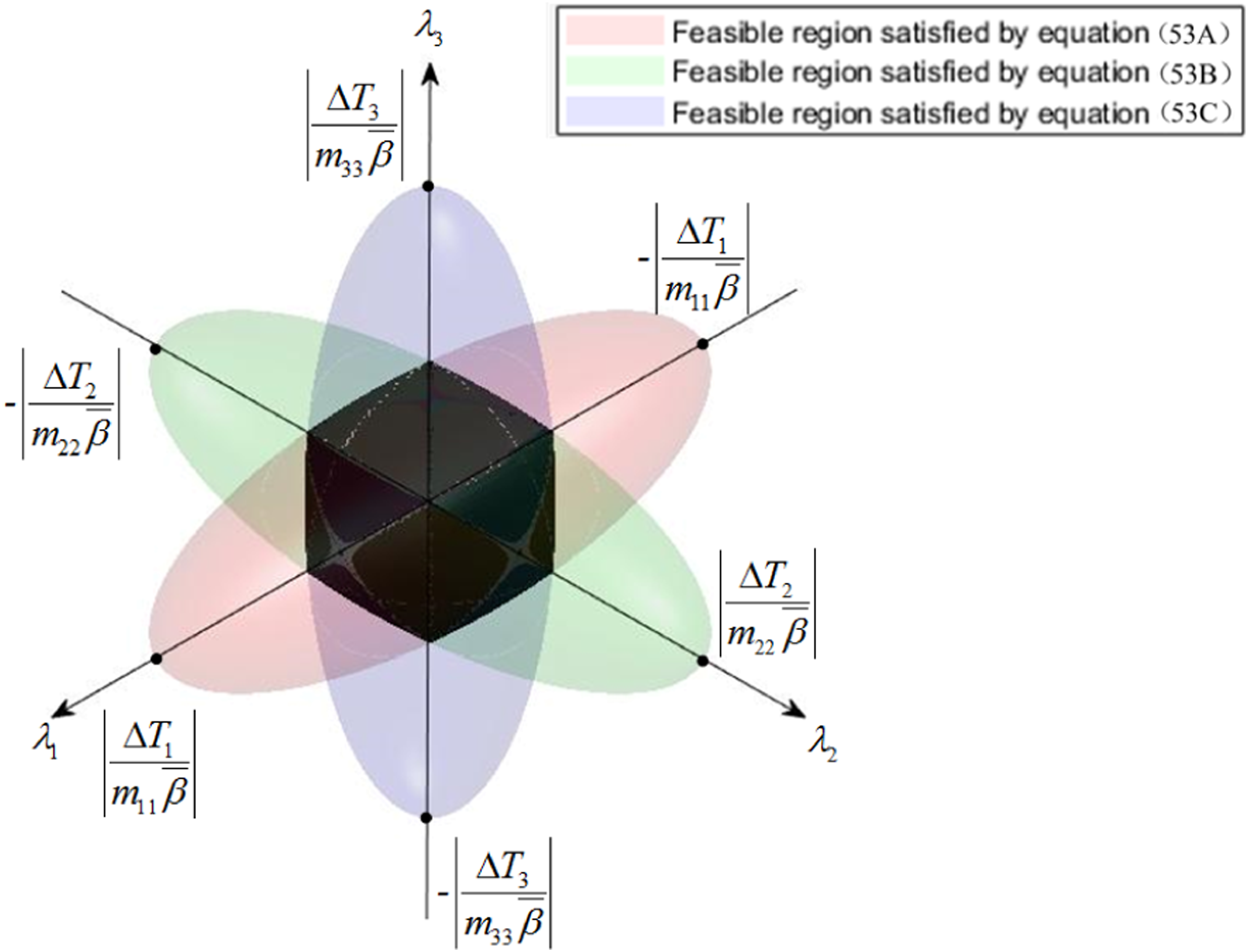
Taking appropriate
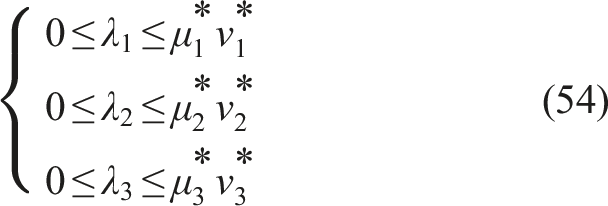
Similarly, according to Equation (48), the reliable constrained confidence interval of the truss can be calculated and be expressed in Equation (55) when appropriate
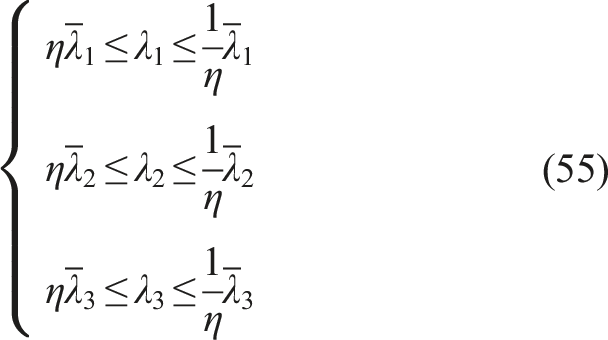
The target point could be calculated based on the above formula. The feasible region, reliable constrained confidence interval as well as three typical points are shown in Figures 4 and 5: Feasible regions and two typical points. (a) feasible region and reliable constrained confidence interval. (b)Target feasible region and target point.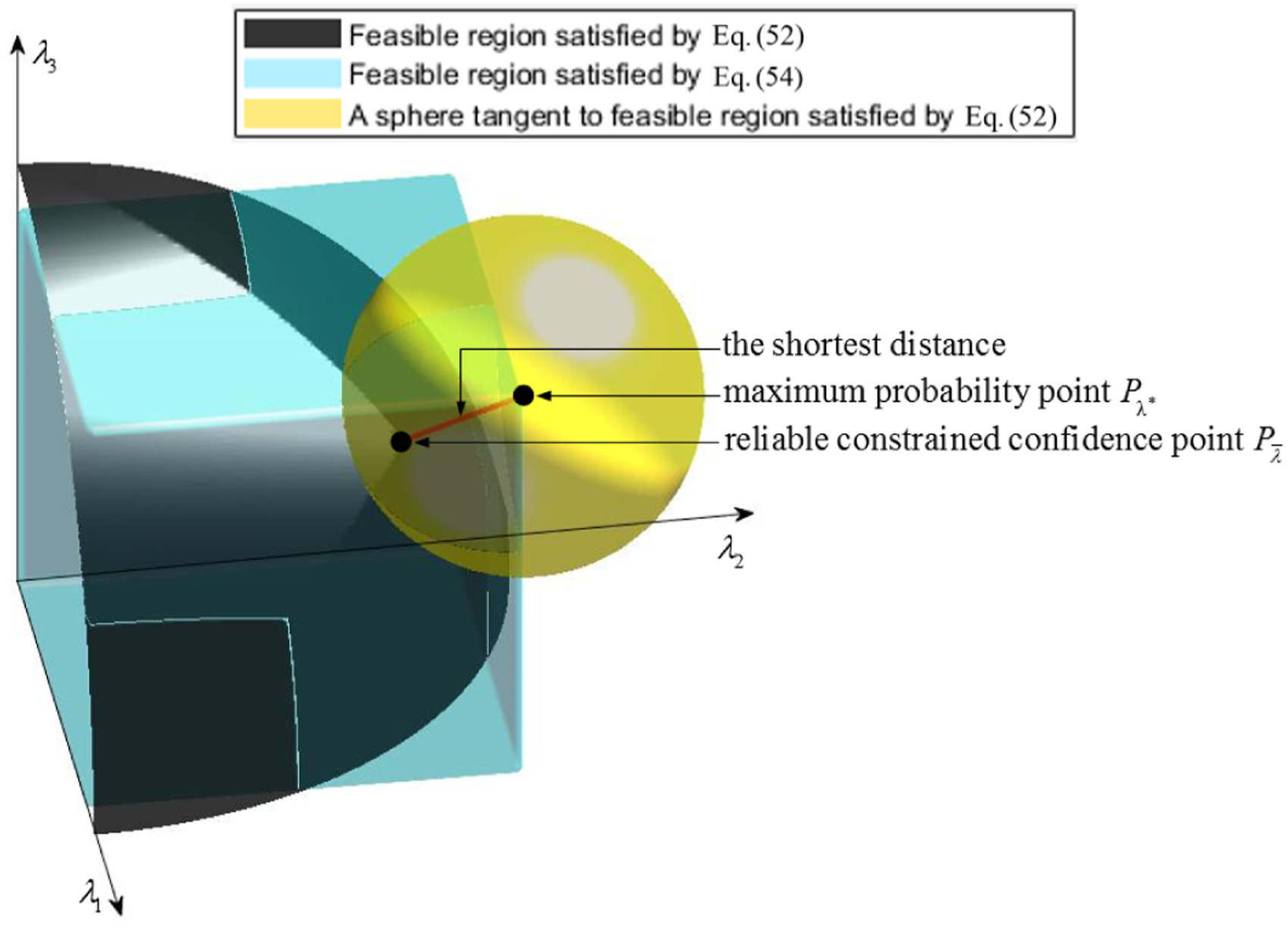
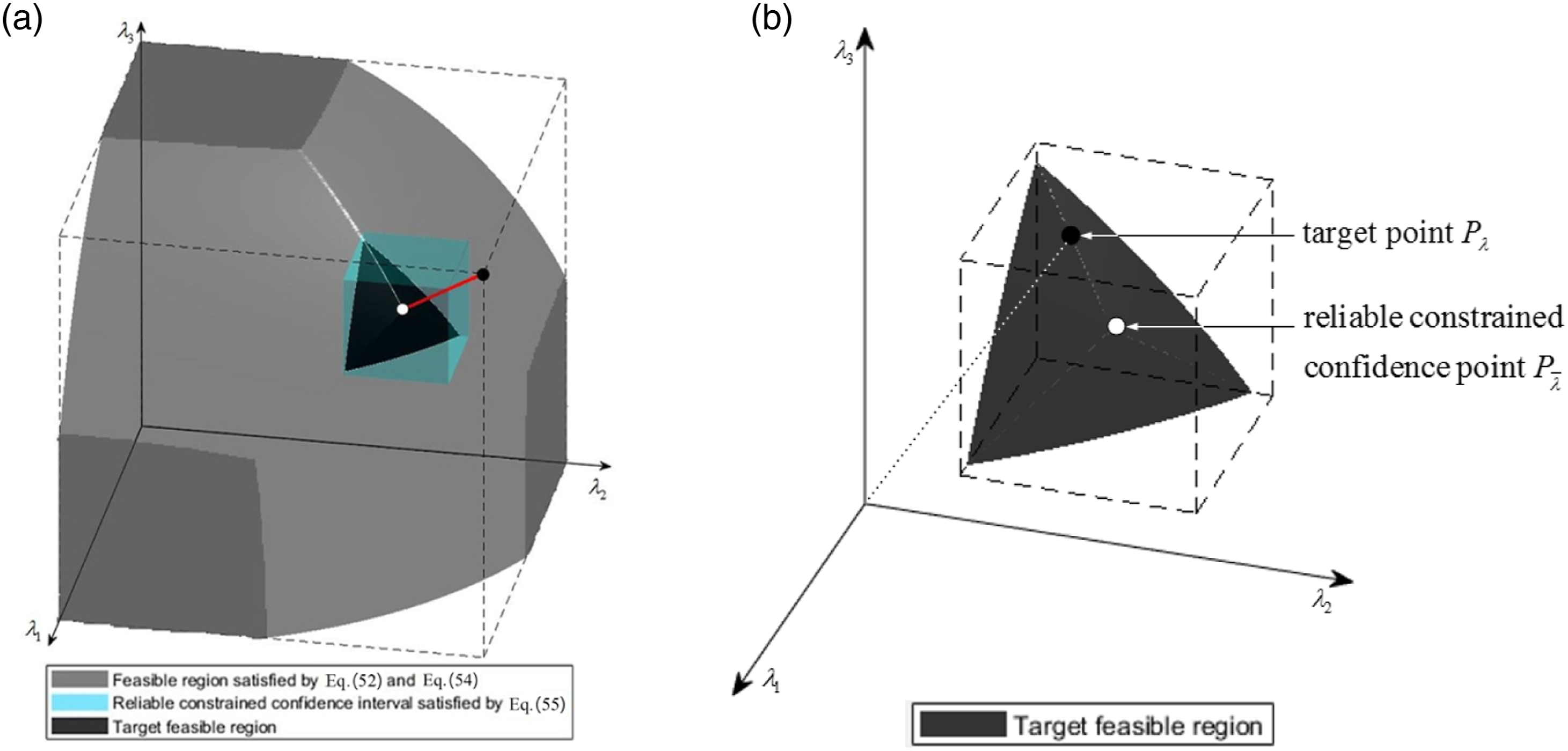
In Figure 4, the part of the overlapped ellipsoid region satisfies the requirement that the variable is positive and reliability by Equation (52). The cube is the feasible region satisfied by the side constraints in Equation (54), of which the vertex farthest from the origin point is the maximum probability point
Here, a specific example of a triangular truss is given. For the triangular truss shown in Figure 2, the elastic modulus
The internal force variation caused by the specific members’ area loss can be calculated by Equation (21). The result can be compared with the theoretical solution by Equation (51). The relationship between 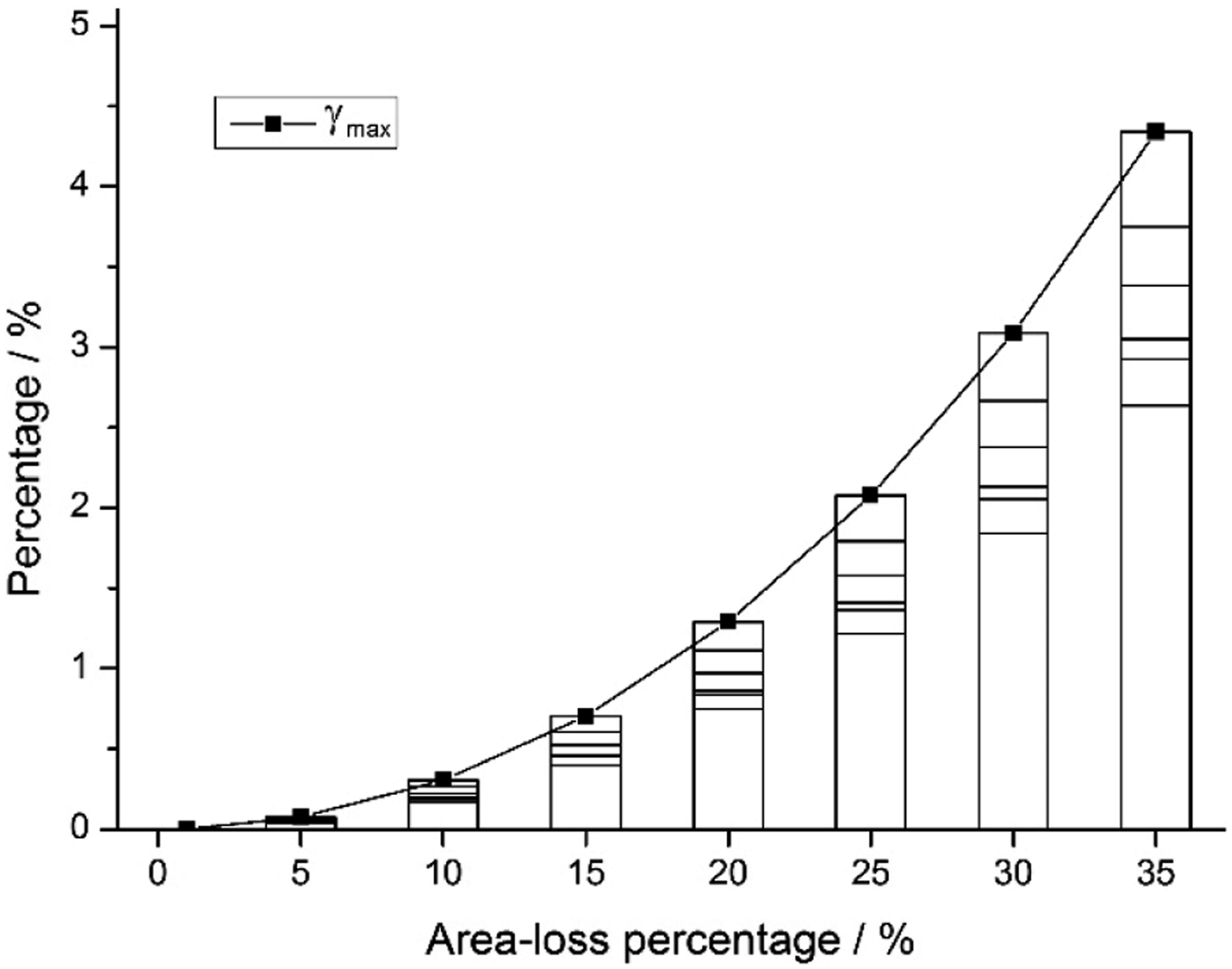
The ASC and the AEC are calculated to analyze the influence of member’s area loss by Equation (26) and Equation (29). According to
Area-loss effect and limit of members in triangular truss.

It can be seen from the results in Table 1 that the ASC of bar ③ is the largest, which means it is the most sensitive bar among all members. And bar ③ has the greatest impact on the structure in case of area loss. The sensitivity of the rest two bars is related to the distance of bar end to the end of bar ③, and the closer the distance is, the more sensitive the bar is. The AEC of three bars is almost the same, which may be due to the simple form of the structure, and the three bars are forced through the same vertex. It makes the internal force variation could be transferred uniformly when the members’ area loss occurs.
Based on reliability theory and nonlinear programming, the mean value
Example 2. Cable dome
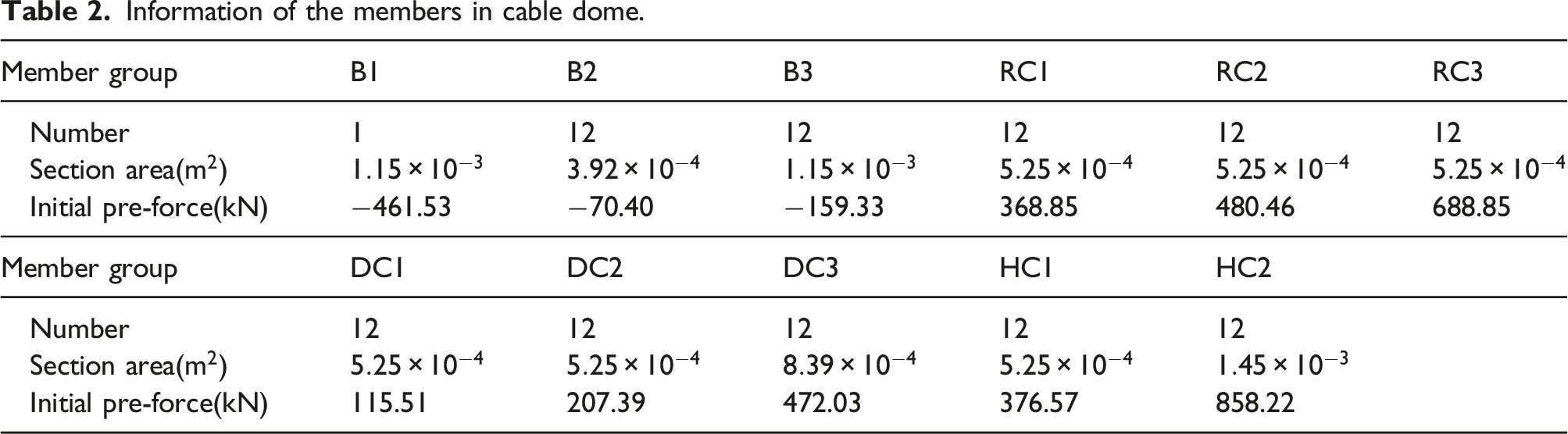
Cable dome is a simple kind of pin-jointed structure with prestressed members. The cable dome in this study is circumferentially divided into 12 sections, with a span of 60 m. The layout and geometric dimensions of the dome are shown in Figure 7(a). Steel cables are used as tension members with an ultimate tensile strength of 1670 MPa, and the elastic modulus of steel cables marked as Cable dome: (a) axonometric drawing (b) geometric parameters and external force. Information of the members in cable dome.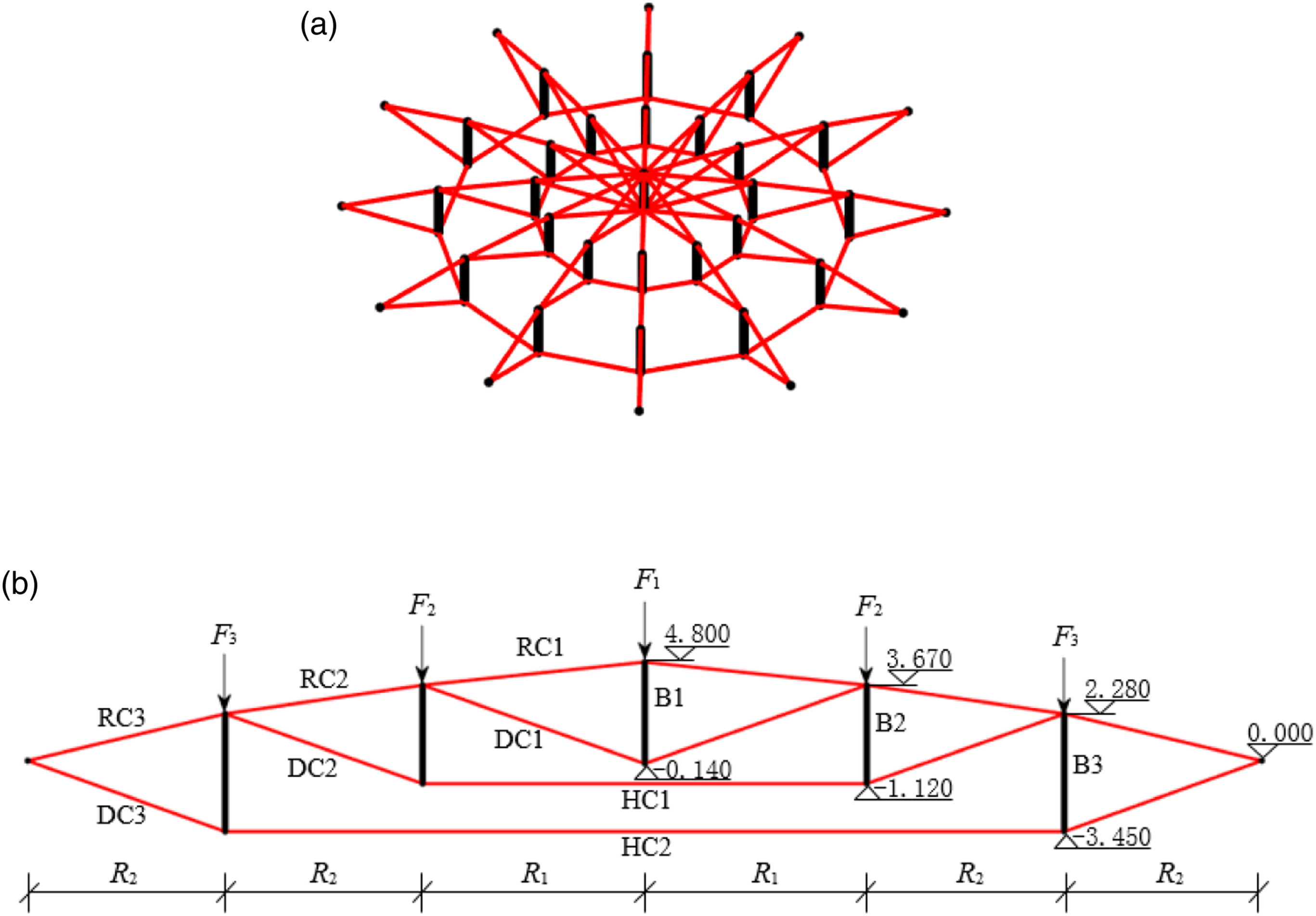
Relationship between internal force variation and member’s area loss
Analysis of the internal force variation of the dome caused by members’ area loss can be carried out. According to the symmetry of the structure, members in the same group have the same properties. Therefore, only one representative member in each group needs to be selected for calculation. According to Equation (21), the internal force variation of all kinds of members in dome caused by specific member’s unit area loss is shown in Figure 8. Internal force variation caused by member’s area loss in cable dome.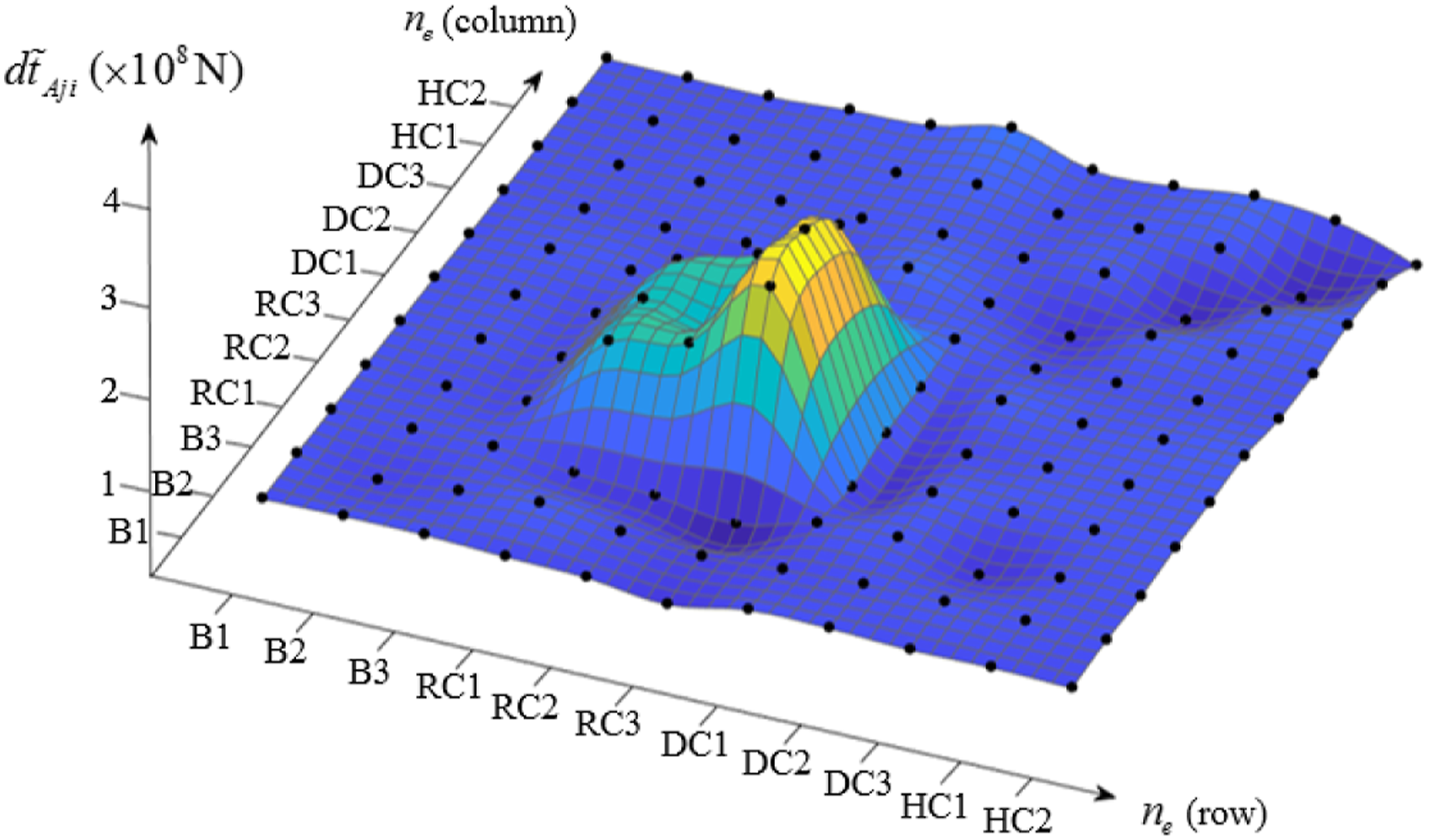
The plane coordinate of each point in Figure 8 represents the influence relationship between members, and the vertical coordinate of each point is the value of the internal force variation. Taking the point at row j and column i as an example, it represents that when the unit area loss occurs in member i, the internal force in member j will change by
According to Figure 8, the points with larger values in vertical coordinate are distributed among RC1, RC2, and RC3, which indicates that these three groups of cables have a greater influence on themselves.
Area loss analysis and safety assessment
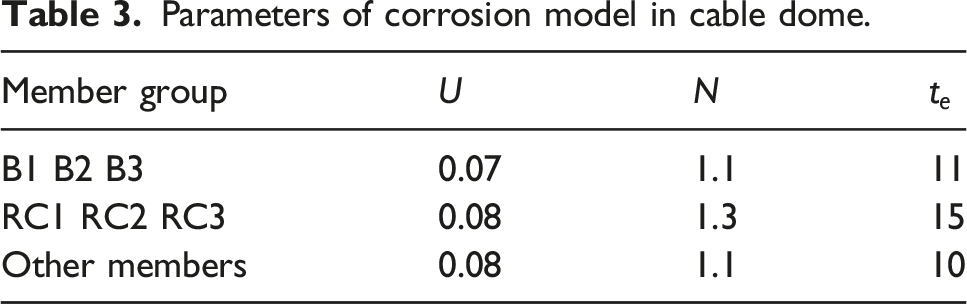
Parameters of corrosion model in cable dome.
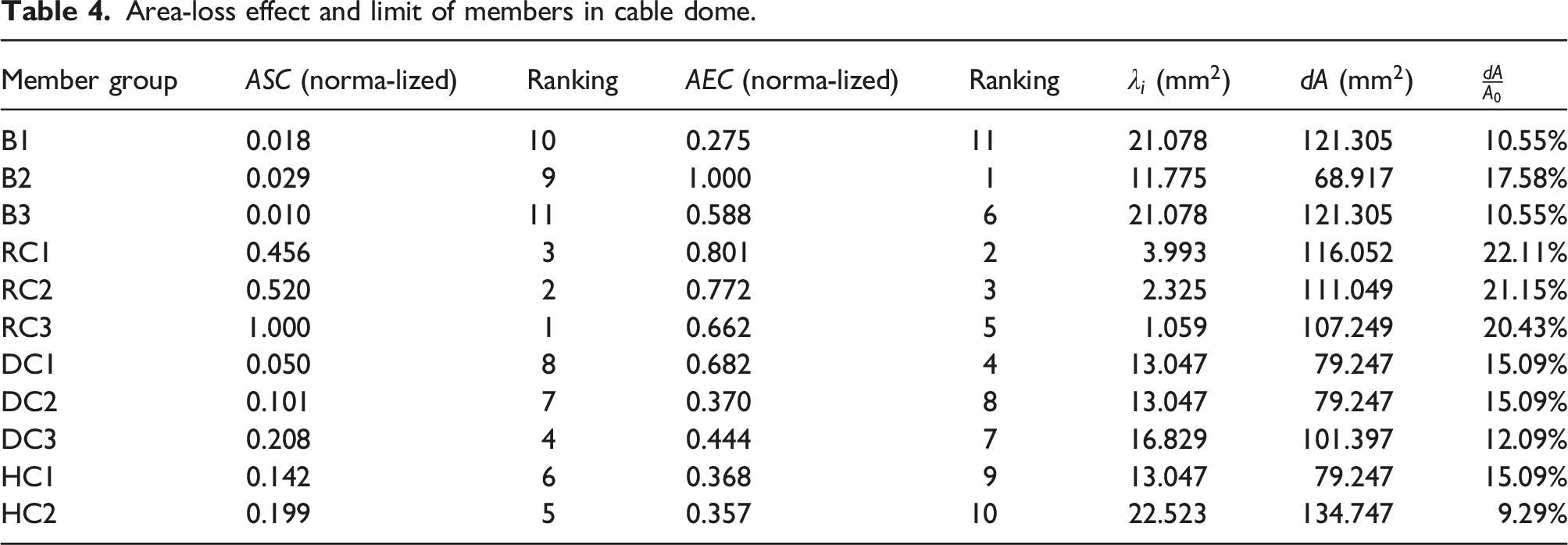
Area-loss effect and limit of members in cable dome.
The coefficient of variation
It can be seen from Table 4, the cables of RC1, RC2, and RC3 have a relatively higher ranking of the ASC which reflects that these cables have a greater impact on the whole structure than other members. And the ASC of RC3 is the largest, so this group of cables should be defined as the area-loss sensitive members. B1, B2, and B3 have a lowest ranking of the ASC, it can be considered that the steel cables are more sensitive than bars, that is these members are more essential to the dome. In the ranking of the AEC, B2 is higher than other members. And this group of bars should be defined as the area-loss unevenness members. The cables of RC1, RC2, and RC3 also have a relatively higher ranking of the AEC, which means these members cannot uniformly transfer the internal force variation to other members. When area loss occurs in such members, specific members are prone to large variation of internal force and their safety will be reduced. Based on the ASC and the AEC, the members belong to B2, RC1, RC2, and RC3should be paid additional attention to. The pre-manufacturing error and the anti-corrosion measures for such members should be strictly controlled.
Based on reliability theory and nonlinear programming, the area-loss limits of each member can be obtained. Among them, RC1, RC2, RC3 in cables and B1, B3 in bars have a larger area-loss limit than other members. They are
Discussion
The method proposed in Section 4 to solve the target point
The set of critical state equations of the reliability index can be determined by Equation (38), by which the unique set of positive solutions to equations can be calculated. The set of solutions is just the coordinates of point Simplified solution of target point.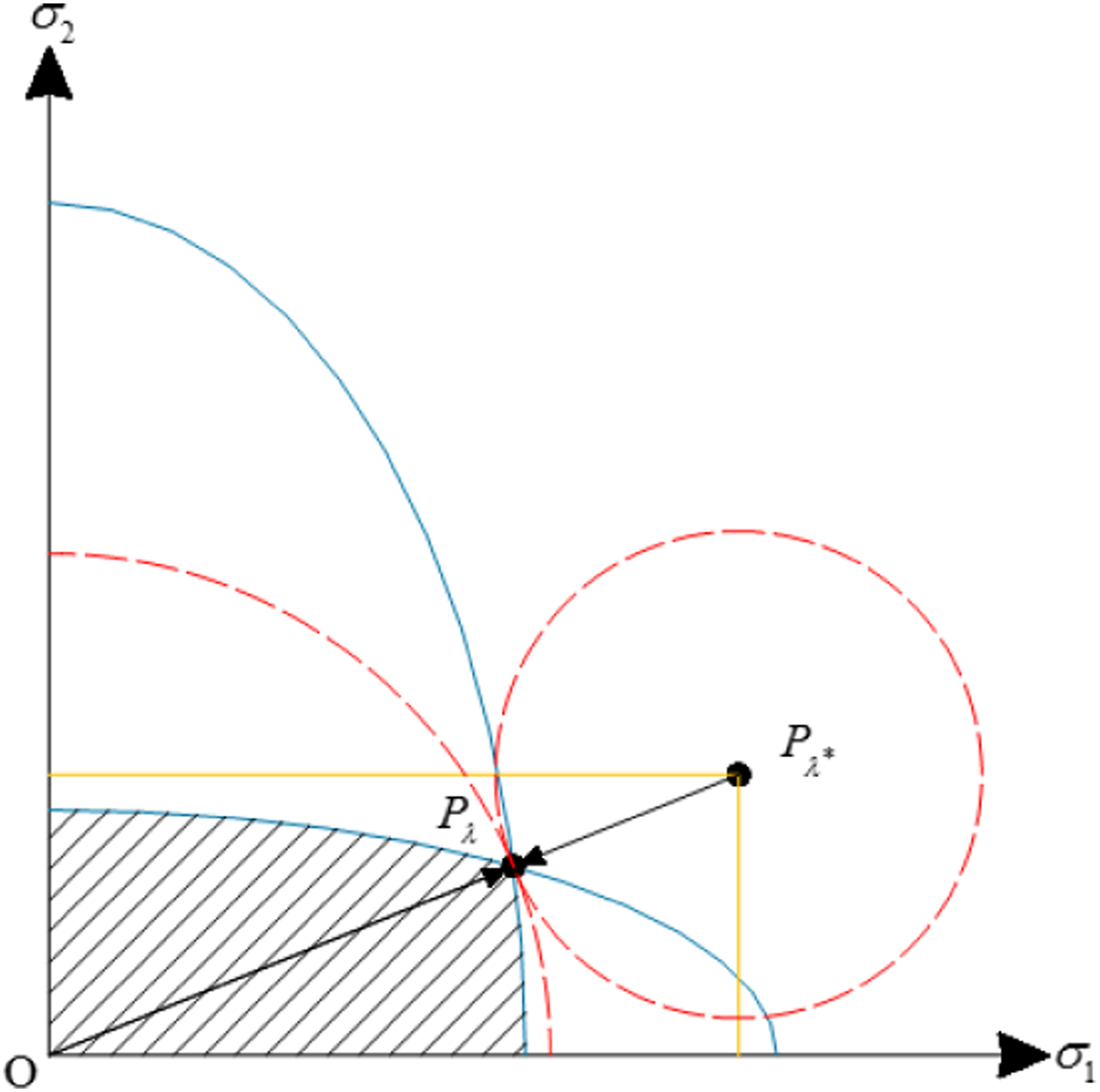
However, in practical engineering, it is difficult to meet the situation that the coordinates of
Conclusion
(1) A generalized formula is proposed for members’ internal force variation of pin-jointed structures. According to this formula, internal force variation of members can be obtained conveniently when the external force, cross-sectional area, and initial length changed respectively. The formula is validated with analytical solutions and provides a fast calculation method for area loss analysis without the complicated numerical approaches such as FEM. (2) The area-loss sensitivity coefficient (ASC) of the member is defined for the pin-jointed structures, which can evaluate the degree of influence on the structure. Besides, the area-loss evenness coefficient (AEC) is proposed to assess the evenness of the internal force variation. Two types of essential members can be selected accordingly, which provides a theoretical basis for maintenance during the service life and selection of members in structural health monitoring. (3) The critical state equations and the reliability inequalities of the structure are established based on the structural reliability theory. Based on the mathematical nonlinear programming, the complex multivariate data can be calculated by nonlinear optimization, and then a complete method for determining the area-loss limit of pin-jointed structure is proposed. Example analysis shows that the method is accurate and feasible which provides a scientific guidance for setting alarm threshold for member’s internal force and the determination of area-loss limit in aged structures.
Footnotes
Declaration of conflicting interests
The author(s) declared no potential conflicts of interest with respect to the research, authorship, and/or publication of this article.
Funding
The author(s) disclosed receipt of the following financial support for the research, authorship, and/or publication of this article: This work was supported by the National Natural Science Foundation of China (Grant No. 51878600 and 51978605) and National Key R&D Program of China (2017YFC0806100).
