





Abstract
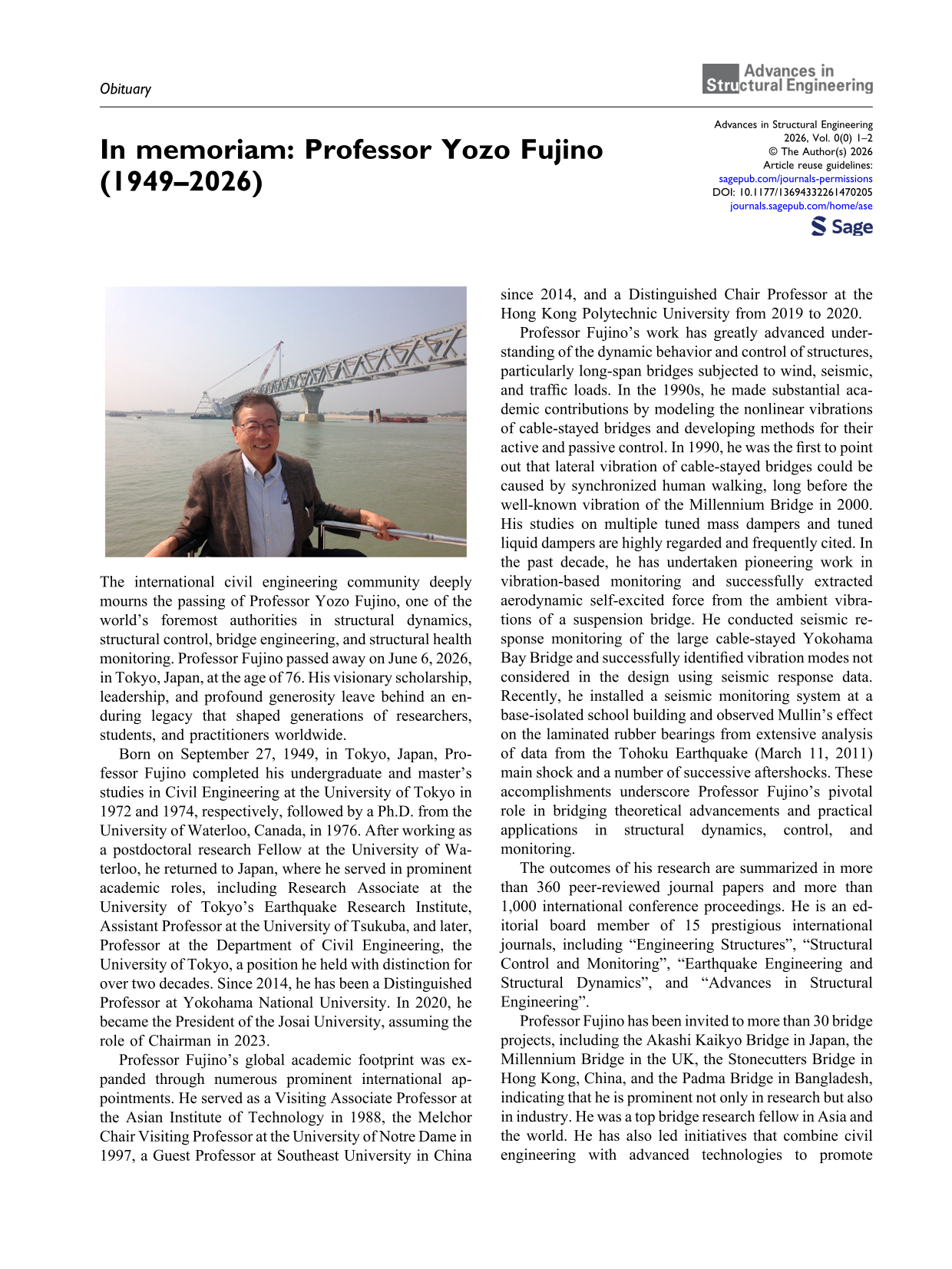
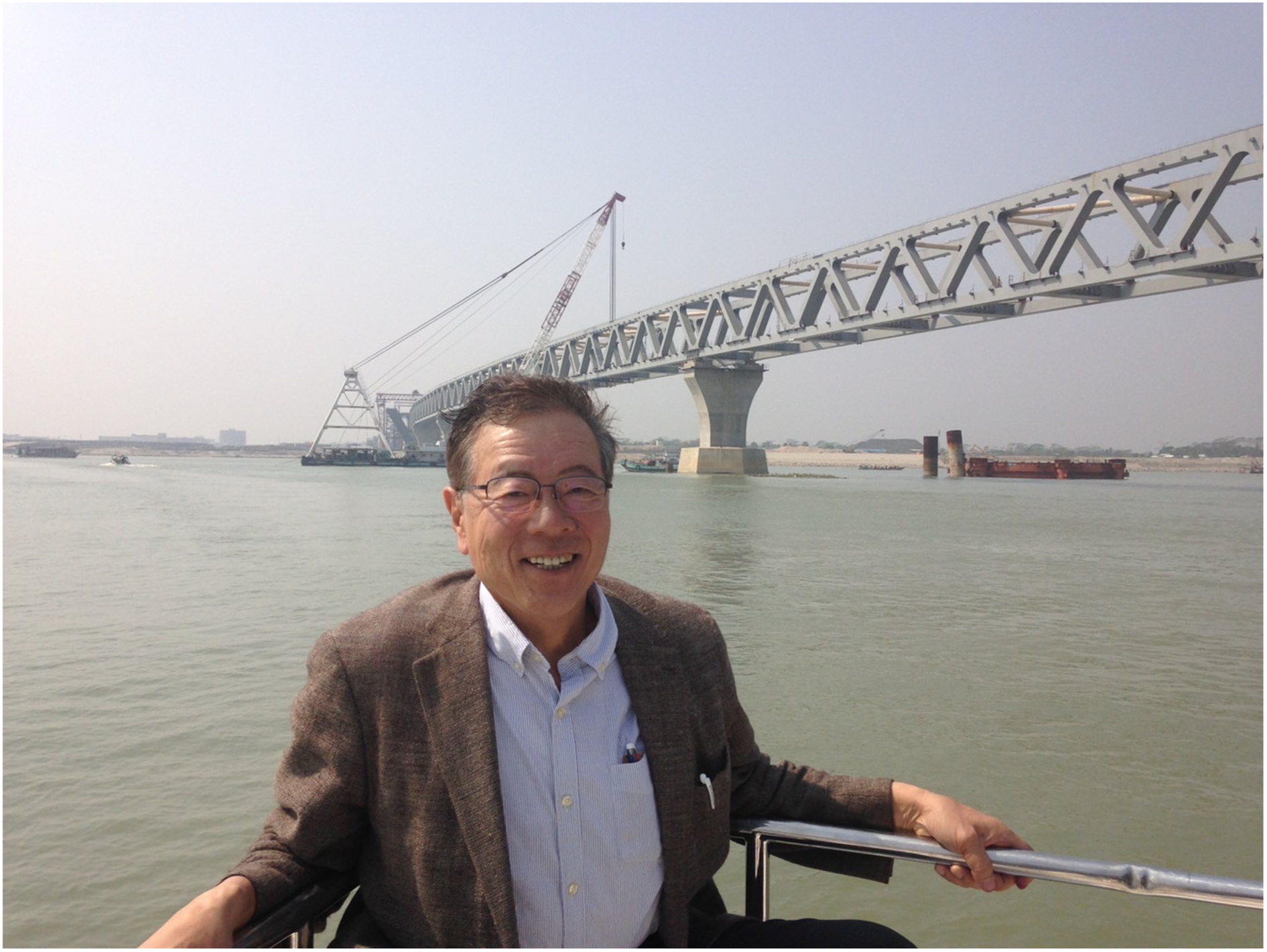
The international civil engineering community deeply mourns the passing of Professor Yozo Fujino, one of the world’s foremost authorities in structural dynamics, structural control, bridge engineering, and structural health monitoring. Professor Fujino passed away on June 6, 2026, in Tokyo, Japan, at the age of 76. His visionary scholarship, leadership, and profound generosity leave behind an enduring legacy that shaped generations of researchers, students, and practitioners worldwide.
Born on September 27, 1949, in Tokyo, Japan, Professor Fujino completed his undergraduate and master’s studies in Civil Engineering at the University of Tokyo in 1972 and 1974, respectively, followed by a Ph.D. from the University of Waterloo, Canada, in 1976. After working as a postdoctoral research Fellow at the University of Waterloo, he returned to Japan, where he served in prominent academic roles, including Research Associate at the University of Tokyo’s Earthquake Research Institute, Assistant Professor at the University of Tsukuba, and later, Professor at the Department of Civil Engineering, the University of Tokyo, a position he held with distinction for over two decades. Since 2014, he has been a Distinguished Professor at Yokohama National University. In 2020, he became the President of the Josai University, assuming the role of Chairman in 2023.
Professor Fujino’s global academic footprint was expanded through numerous prominent international appointments. He served as a Visiting Associate Professor at the Asian Institute of Technology in 1988, the Melchor Chair Visiting Professor at the University of Notre Dame in 1997, a Guest Professor at Southeast University in China since 2014, and a Distinguished Chair Professor at the Hong Kong Polytechnic University from 2019 to 2020.
Professor Fujino’s work has greatly advanced understanding of the dynamic behavior and control of structures, particularly long-span bridges subjected to wind, seismic, and traffic loads. In the 1990s, he made substantial academic contributions by modeling the nonlinear vibrations of cable-stayed bridges and developing methods for their active and passive control. In 1990, he was the first to point out that lateral vibration of cable-stayed bridges could be caused by synchronized human walking, long before the well-known vibration of the Millennium Bridge in 2000. His studies on multiple tuned mass dampers and tuned liquid dampers are highly regarded and frequently cited. In the past decade, he has undertaken pioneering work in vibration-based monitoring and successfully extracted aerodynamic self-excited force from the ambient vibrations of a suspension bridge. He conducted seismic response monitoring of the large cable-stayed Yokohama Bay Bridge and successfully identified vibration modes not considered in the design using seismic response data. Recently, he installed a seismic monitoring system at a base-isolated school building and observed Mullin’s effect on the laminated rubber bearings from extensive analysis of data from the Tohoku Earthquake (March 11, 2011) main shock and a number of successive aftershocks. These accomplishments underscore Professor Fujino’s pivotal role in bridging theoretical advancements and practical applications in structural dynamics, control, and monitoring.
The outcomes of his research are summarized in more than 360 peer-reviewed journal papers and more than 1,000 international conference proceedings. He is an editorial board member of 15 prestigious international journals, including “Engineering Structures”, “Structural Control and Monitoring”, “Earthquake Engineering and Structural Dynamics”, and “Advances in Structural Engineering”.
Professor Fujino has been invited to more than 30 bridge projects, including the Akashi Kaikyo Bridge in Japan, the Millennium Bridge in the UK, the Stonecutters Bridge in Hong Kong, China, and the Padma Bridge in Bangladesh, indicating that he is prominent not only in research but also in industry. He was a top bridge research fellow in Asia and the world. He has also led initiatives that combine civil engineering with advanced technologies to promote sustainable maintenance of infrastructure, as the Program Director for the Cabinet Office’s Strategic Innovation Promotion Program from December 2013 to March 2019.
His monumental achievements were recognized with the highest distinctions. He was inducted into the Engineering Academy of Japan in 2012 and elected a Member of the Japan Academy in December 2025. In 2007, he was honored with the Medal with Purple Ribbon from the Emperor of Japan in recognition of his scientific and academic contributions. In 2019, he received the 109th Japan Academy Prize, the most prestigious scientific award in Japan, awarded annually to only nine recipients across all fields. Because of this prize, he had the privilege of delivering a lecture to the Emperor and Empress of Japan, making him only the seventh civil engineer to be recognized with this distinction in its 109-year history. Internationally, he has received many international awards, including the ASCE Raymond C. Reese Research Prize in 2007, the ASCE Scanlan Medal in 2011, the ASCE George Winter Medal in 2015, the ASCE Moisseiff Award in 2020, and the ASCE G. Housner Medal in 2020. He has also been awarded the T.Y. Lin Medal from IABMAS in 2008, the Nishino Medal from EASEC in 2009, and the IABSE Award in 2014.
Besides Professor Fujino’s outstanding research and educational achievements, he has also served in various capacities for international associations and organizations. He served as the President of the International Association of Structural Control and Monitoring from 2008 to 2012 and the Vice President of the International Association of Bridge and Structural Engineering from 2005 to 2013. He was the President of the Asia-Pacific Network for Research in Smart Structures Technology from 2008 to 2012. He is also very keen on educating young researchers by coordinating summer internships for overseas students and summer school programs. In fact, he twice organized 3-week summer schools in Japan, namely APSS2010 and APESS2017, with more than 100 students in attendance.
Professor Fujino's greatest legacy lies in the warmth, kindness, and rigorous mentorship he shared over 40 years, during which he supervised and nurtured over 60 Ph.D. students. According to his wife, Atsuko, his passion for discovery never waned; even in his final hours, he remained a true researcher, moving naturally between English and Japanese while actively discussing technical differences between structural measurement systems.
The Editorial Board of Advances in Structural Engineering extends its deepest condolences to his family, friends, and global colleagues. He will be profoundly missed, but his influence will permanently endure in the safer bridges he designed, the scientific communities he built, and the countless lives he touched across the globe.
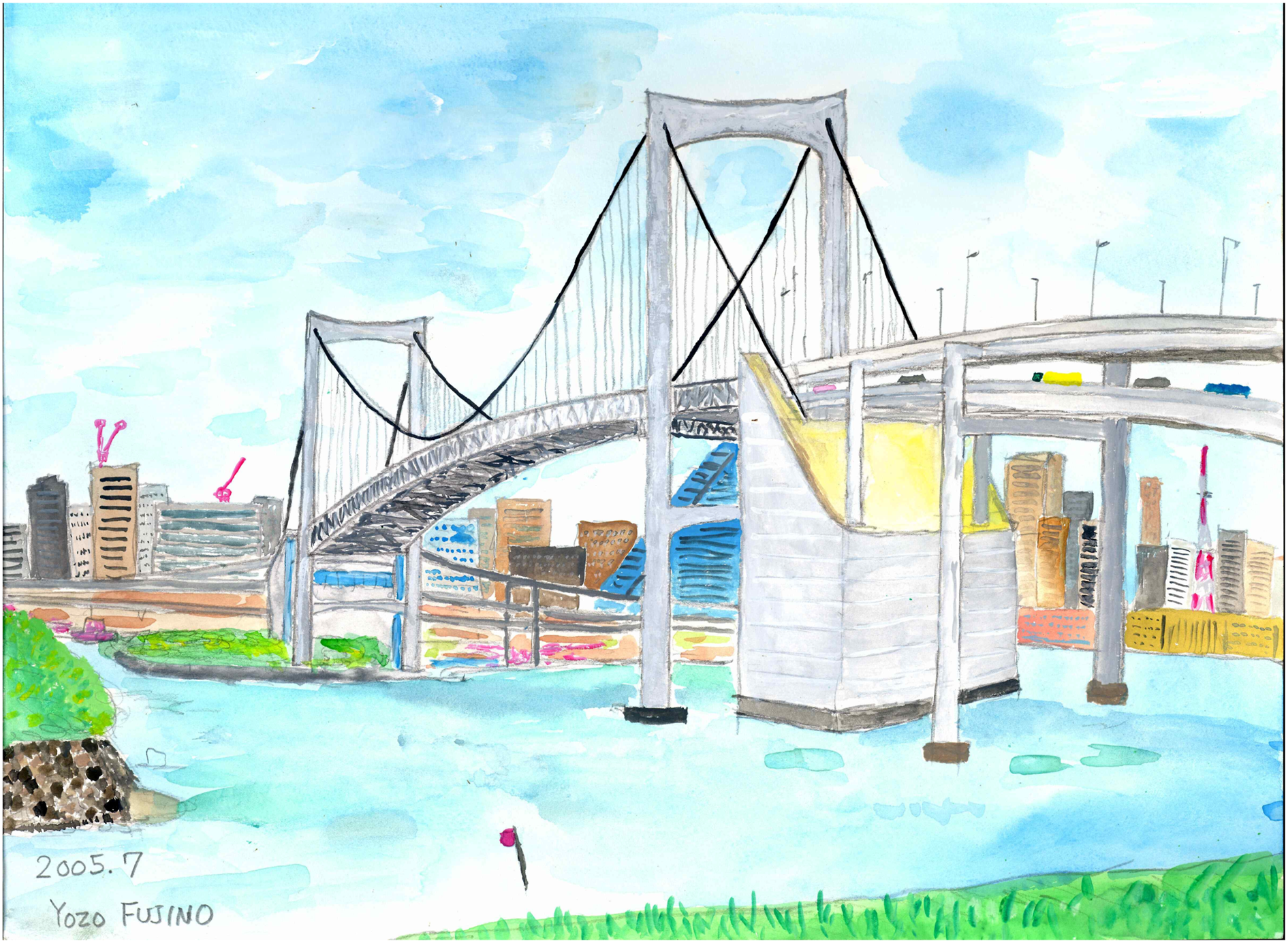
Yong Xia and Tao Yu.
On behalf of the Editorial Board of Advances in Structural Engineering.