







Abstract
Non-destructive evaluation methods for characterizing solid and liquid dielectric material deploy Parallel Disc Capacitor (PDC) as sensing probes. In this work, the authors demonstrate a non-conventional numerical technique known as the Algebraic Topological Method (ATM) to build a numerical model of the PDC probe and validate it using the experiment as well as the Finite Element Model (FEM). The PDC probe under study is made with two metallic (SS 304) discs of diameter 75 mm and thickness 1.5 mm, soldered with SS terminals of length 40 mm and diameter 1.5 mm, and they are separated by the dielectric material under test. The capacitance of PDC with Air, Teflon, Perspex, and Nylon as dielectric material was measured using an LCR meter, and dielectric constants were calculated as per ASTM D150 standard. The dielectric constant values were incorporated into PDC numerical models developed using ATM and FEM. To account for leaking fields, the PDC models were embedded within an air domain measuring 100 mm in diameter and 50 mm in height. The 3D Maxwellian capacitance was then extracted by computing the stored energy within these dielectric regions and compared with results from measurements and FEM simulations. The findings demonstrate that ATM effectively computed electrostatic potential, electric fields—including fringing fields—stored energy, and 3D capacitance of the PDC model, showing good agreement with FEM and experimental results.
Keywords
Introduction
Parallel Disc Capacitor (PDC) probes are extensively used for non-destructive evaluation of dielectric permittivity towards characterising solid and liquid insulating materials.1-3 One typical application is measurement of the dielectric constant and dielectric losses of solid insulating materials, using parallel metallic discs probes as specified in the ASTM D150 (IEC 60250) standard. 4 The capacitor probes have different geometries depending on the application. Numerical and analytical models of such probes are helpful for virtual prototyping and functional optimization during the design and fabrication process.5-8 Unlike conventional numerical methods 9 such as Finite difference (FDM),Finite Element Method (FEM), and Method of Moments (MoM), the Algebraic Topological Method (ATM) offers multi-physics computations in multiscale exclusively with measurable scalar quantities without field vectors. 10 Hence, we can develop computationally efficient numerical models using the ATM for modelling and simulation of capacitive devices used in NDE. A detailed formulation of theory of electromagnetism in terms of algebraic topology is described in. 11 The theoretical description of fundamental laws in physics in terms of algebraic topology is discussed in detail by E Tonti. 12 This enables us to develop numerical simulations of NDE tools using algebraic topological method as well.
In the present work, numerical model of a parallel disc capacitor with three different solid polymer materials as dielectric medium is compared with FEM and experimental results. The dielectric permittivity of the material under test is estimated using capacitance method as per ASTM D150 standard. These estimated dielectric permittivity values of Teflon, Perspex and Nylon is used to solve numerical models of the PDC by Finite Element Method (using COMSOL) and Algebraic Topological Method (ATM). The extracted values of 3D Maxwellian capacitance values are compared with the experimentally measured capacitance value in single as well as multiple dielectric layer configurations of the PDC probe. The methodology and workflow are given as a flow chart in below Figure 1.
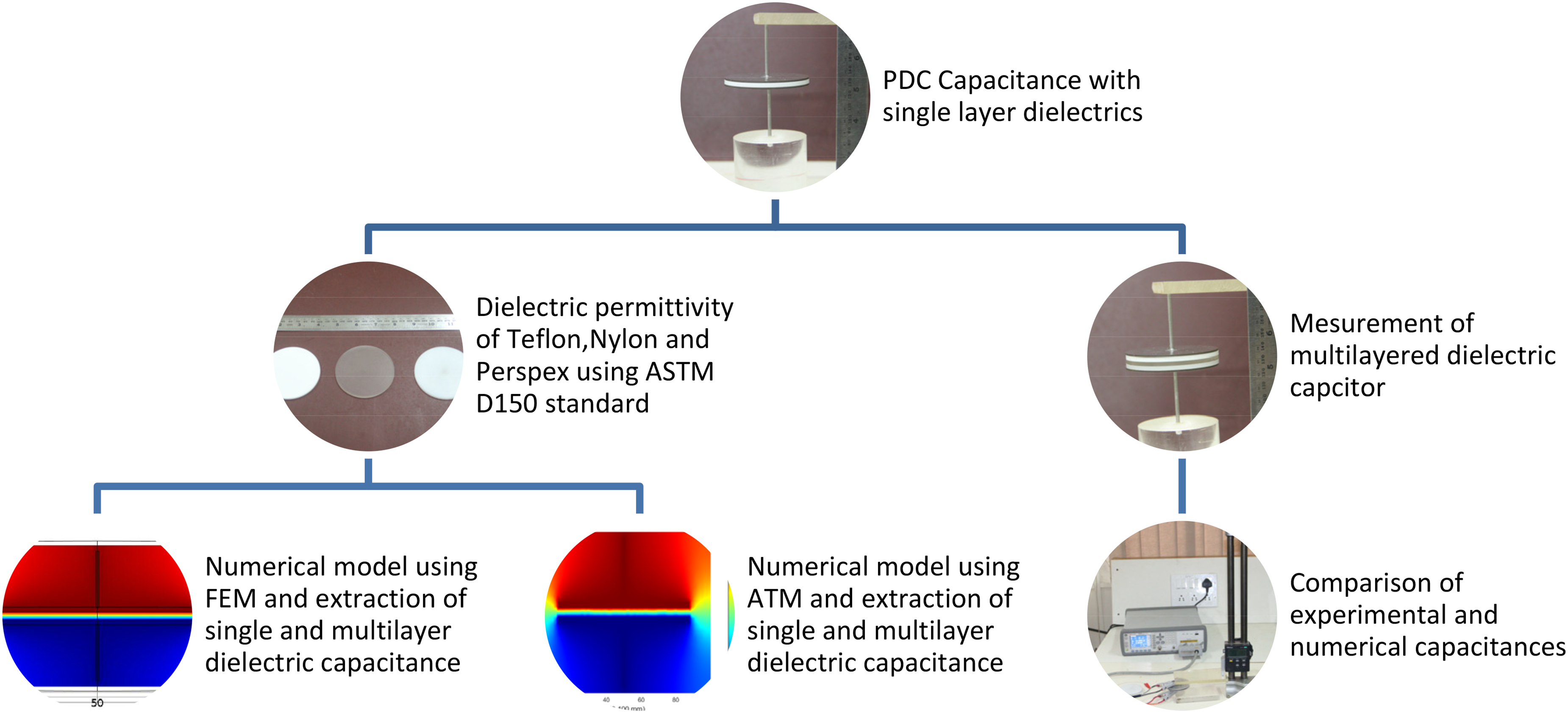
The workflow of the manuscript.
Experimental measurements
The parallel disc capacitor probe under study was constructed using two metallic (SS) discs measuring 75 mm in diameter and 1.5 mm in thickness. Connection terminals made up of SS material with 40 mm length and 1.5 mm radius for capacitance measurements. The electrodes of PDC are separated with the dielectric materials under test in each case (See Figure 2).
The geometrical parameters and the theoretical densities of dielectric (ρ Theory) discs under test 13 along with their densities by weight measurement (ρ Measured) are given in Table 1.
The geometrical properties and densities of dielectric discs under test.

A photograph of the experimental setup for capacitance measurement is shown in Figure 3. As shown in the figure, an LCR meter (Model Keysight E4980A) was used for capacitance measurements, and all the measurements were carried out as per ASTM D150 standard. This LCR meter has a basic impedance accuracy of ±0.01% and hence the measured capacitances are reported with two decimal points accuracy. The bottom disc electrode of Parallel Disc Capacitor probe is fixed on an acrylic cylinder and the top disc electrode is attached to a height gauge for maintaining fixed distance of separation. The clip type connectors of the LCR meter are hooked onto the terminal of PDC disc electrodes.
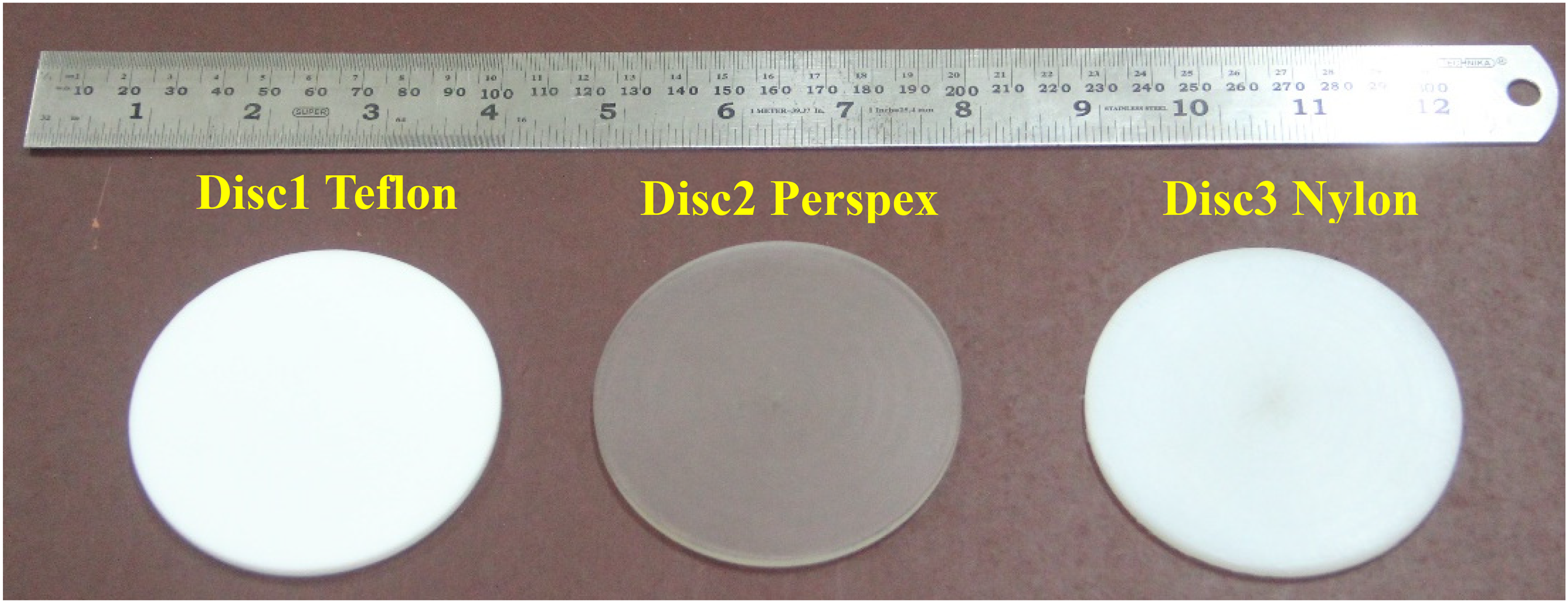
The dielectric discs Disc1 (Teflon), Disc2 (Perspex) and Disc3 (Nylon) under test.
The dielectric constants of Teflon, Nylon and Perspex were calculated from the ratio of capacitance with air and the respective medium. The measured capacitance and estimated dielectric permittivity values are given in Table 2.
The dielectric permittivity calculation of material under test from capacitance measured using PDC probes.

The capacitance of PDC with air as dielectric medium without considering the fringe field is given by
Algebraic topological method for electrostatics model
In algebraic topological method electrostatic problems are formulated using four global variables electric potential, electromotance, electric flux and charge content. The spatial distribution of the above measurable physical quantities in a model is represented using respective co-chains in the cell complex. The electric potential and electromotance are configuration variables associated with primal grids. The electric flux and charge content are source variables attributed to dual grids. In terms of algebraic topology, the fundamental problem of electrostatics is stated as follows “Given the charge content of dual 3-cell (3-cochain) in a cell complex determine the electric potential at every vertex of primal complex (0-cochains)”. Algebraic topology defines co-boundary operators in a sparse matrix form containing incidence numbers corresponding to the k-cochains lying on the boundary of (k + 1)-cochains. Using co-boundary operators, we can relate the charge content Qc to the electric flux ψ associated with dual complex. Similarly, the electric potential distribution on the nodes of primal complex can be expressed in terms of the electromotance defined on the branches of the primal complex. The electric flux defined on the dual surface with outer orientation is related to corresponding inner oriented branches using medium constitutive relations. A detailed formulation of electrostatics theory in terms of algebraic topology is given in. 15
Numerical model of capacitor probe using ATM
The numerical model of parallel disc capacitor defines the electric potential distribution in the space between electrodes as well as the space surrounding the capacitor geometry. This is obtained by solving the Laplace equation of electrostatics for the given boundary conditions i.e the electric potential at the electrodes and the boundary of model domain. The solution to 3D Laplace equation for electrostatic boundary value problem using Algebraic topological method is demonstrated by the authors in.
16
Further, the 3D capacitance of parallel disc configuration is computed using ATM as follows. The electric potentials {ϕi}, ∀ i = 1, 2 …. Nn nodes, are defined as 0-cochains in ATM, associated with the nodes (0-chains) of the primal complex of the capacitor geometry model. The electromotance {Vj}, ∀ j = 12,3 … Ne edges (1-cohains) associated with the edges (1-chains) of primal mesh are computed by applying first coboundary operator on the 0-cochains of electric potentials. The first coboundary process in ATM is equivalent to the gradient operator used in differential vector calculus. Further, by using constitutive relation, we compute the electric flux {ψk}, ∀ k = 12,3 … Nds dual surfaces lying at the boundary of dual volumes in the dual cell complex. Now the electromotances and the electric flux distribution in the dielectric space (both the space between discs and the surrounding) is used to evaluate the total electrostatic energy (U) stored in the dielectric medium. The capacitance of the model geometry C is computed as
Results and discussions
The calculated dielectric constant values for Teflon, Perspex and Nylon were used in the ATM numerical model. The PDC model is designed with an air region surrounding the model geometry with a diameter of 100 mm and a height of 50 mm (Figure 4 (a) and (b)) to account for leak fields.
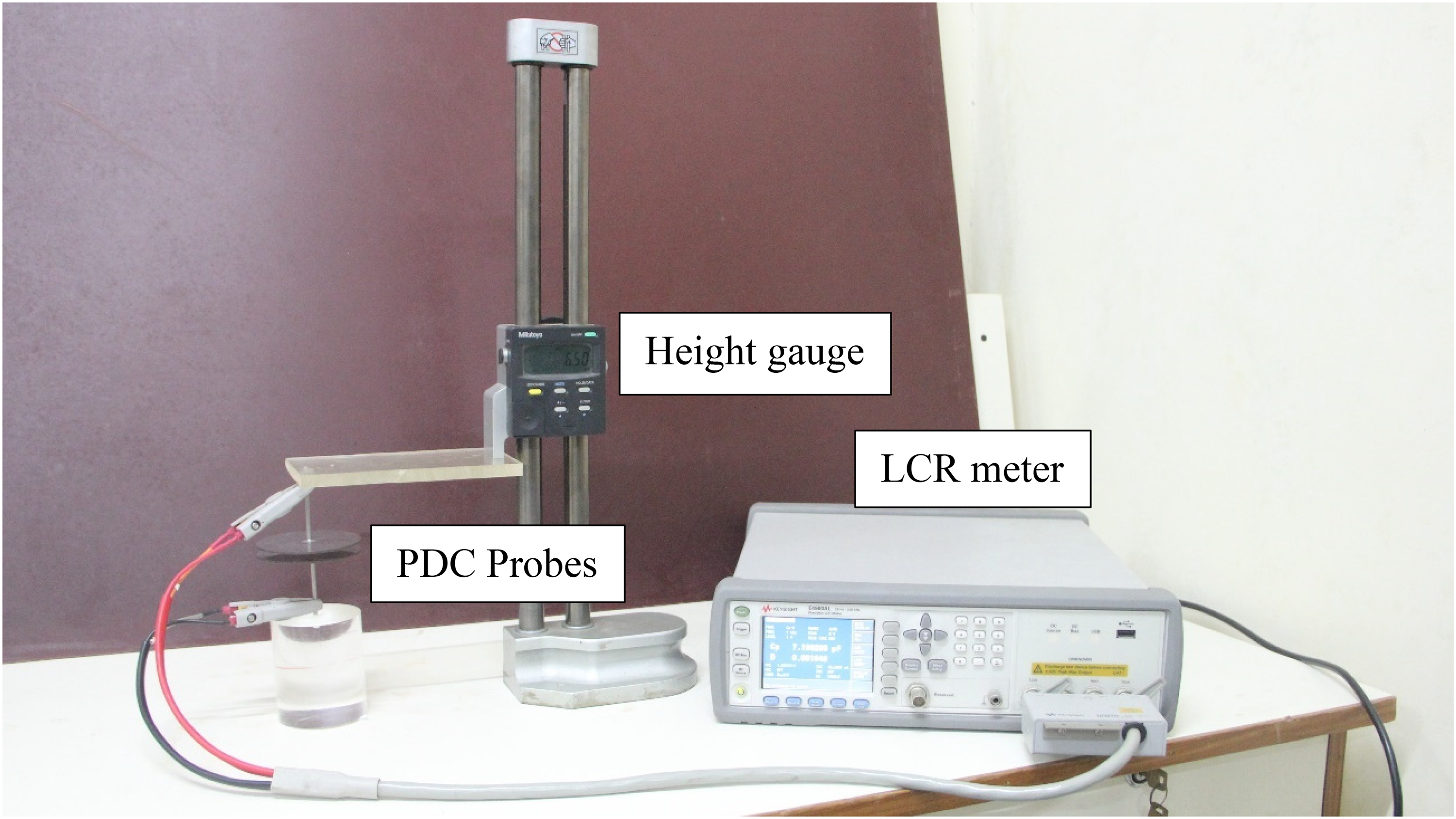
The capacitance measurement of parallel disc capacitor using LCR meter.
The numerical solutions to the Laplace equation in electrostatics with Dirichlet boundary condition for PDC with single dielectric layer is given in Figure 5. The electric potential distribution across the XZ and YZ planes shows the uniform electric field distribution (negative gradient of potential) between the disc electrodes and fringe field distribution near the edges of the disc electrodes. The equipotential lines between the disc electrodes shows that the ATM could solve the Laplace equation accurately using fine mesh elements for better resolution.
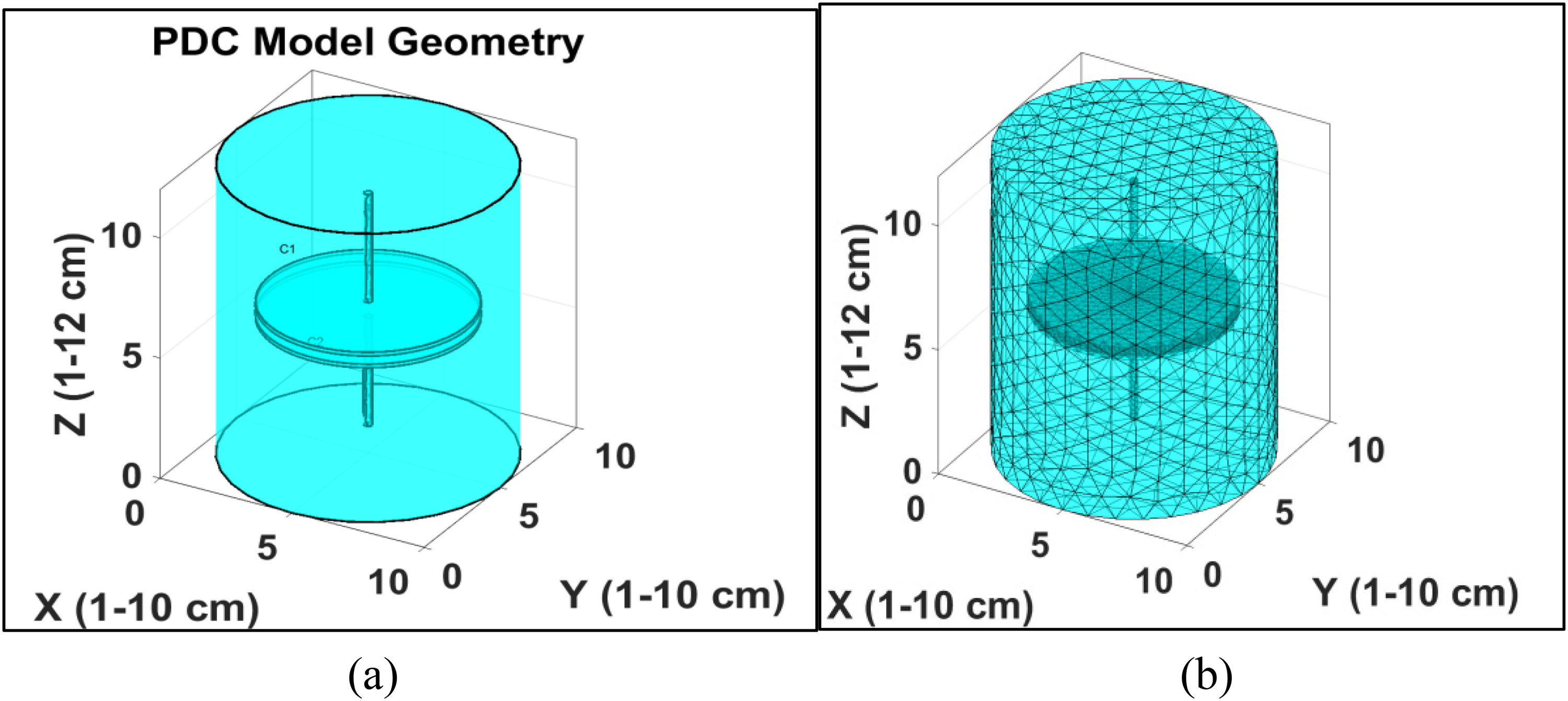
(a) Geometrical model of parallel disc capacitor (b) domain tessellation.
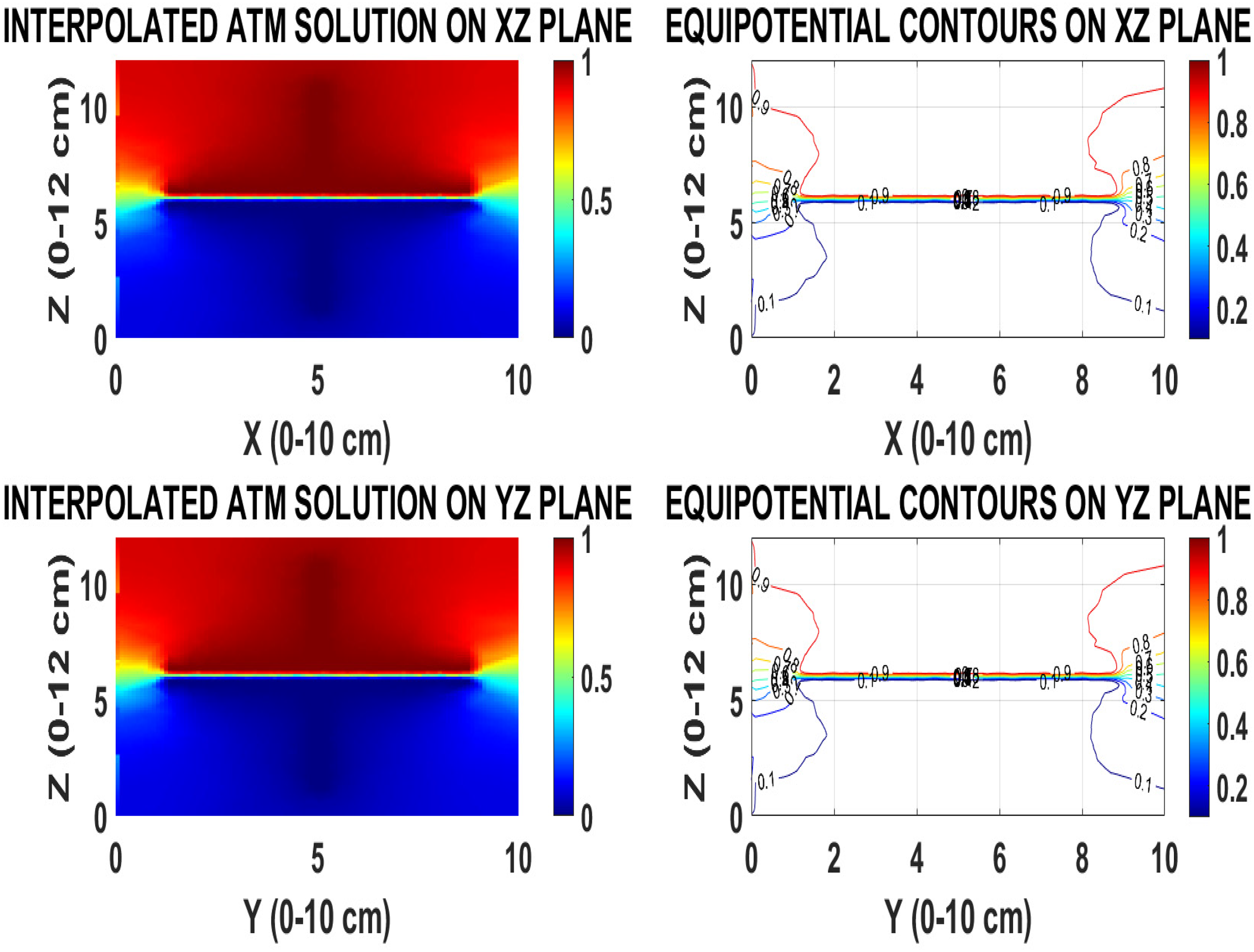
The numerical solution to Laplace equation of PDC model using ATM.
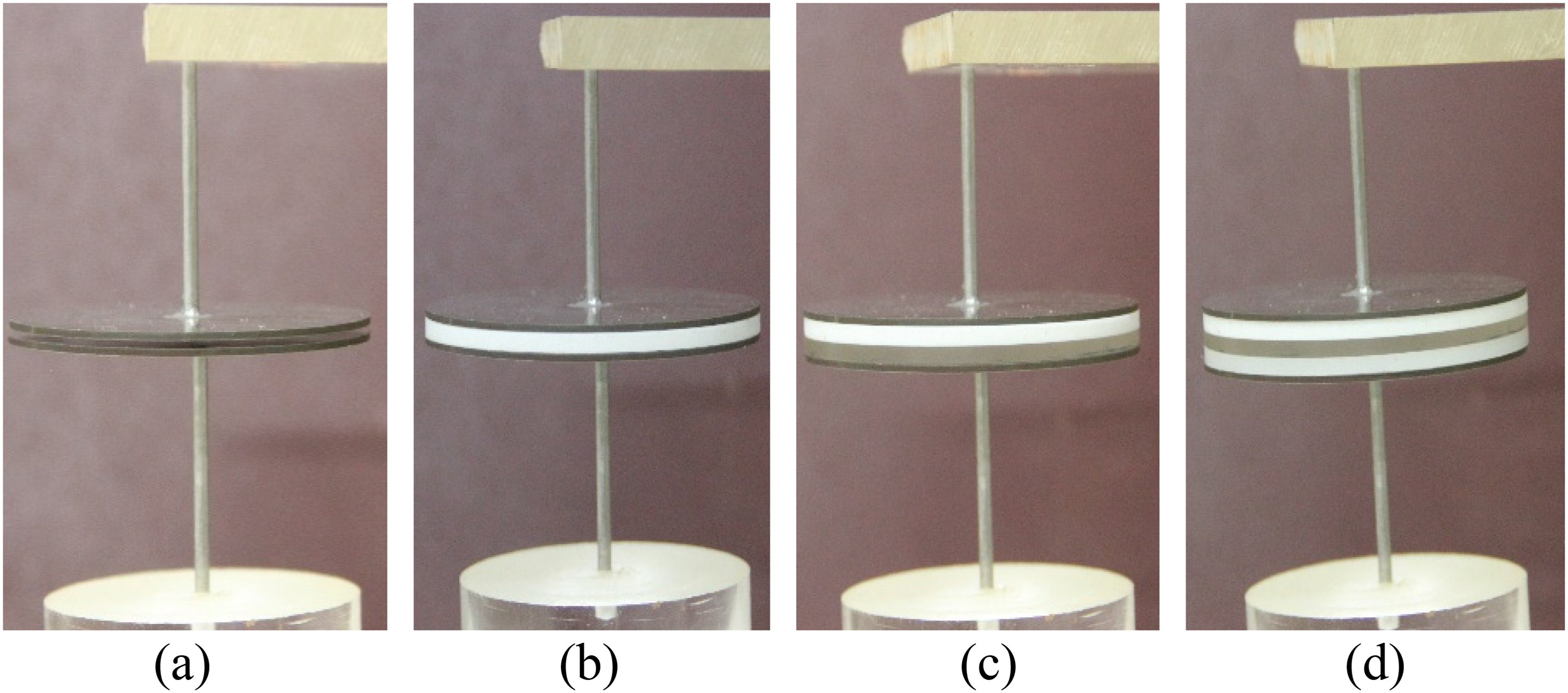
PDC with (a) air (b) Teflon (c) Teflon/Perspex (d) Teflon/Perspex/Nylon dielectric medium.
Further the numerical solution of the electric potential distribution is used in computing the capacitance of the PDC probes. The 3D capacitance was extracted by calculating the energy stored in the dielectric medium using the ATM for different dielectric medium compositions.
The PDC capacitors with single as well as multiple dielectric layers considered in this study are shown in Figure 6 (a-d) The dielectric permittivity distribution in the model domain is represented using square diagonal matrices with dimension of number of edges. The electric potential distribution across the Z axis at X = 0 and Y = 0 of multi dielectric layer capacitor are shown in Figures 7 and 8.
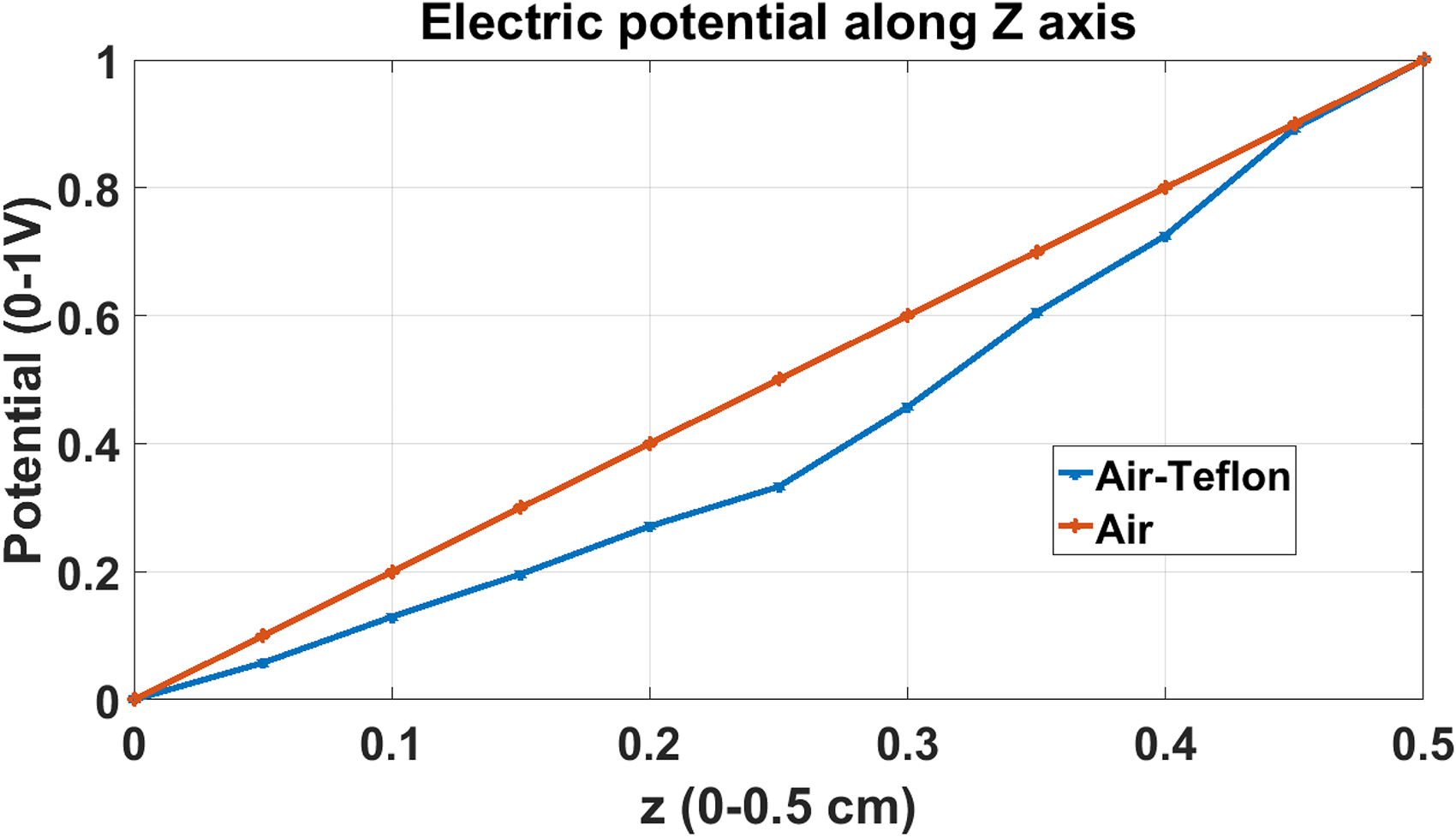
The electric potential distribution across the Z axis at X = 0 and Y = 0 of two dielectric layer (air = 2.5 mm and Teflon = 2.5 mm) capacitor.
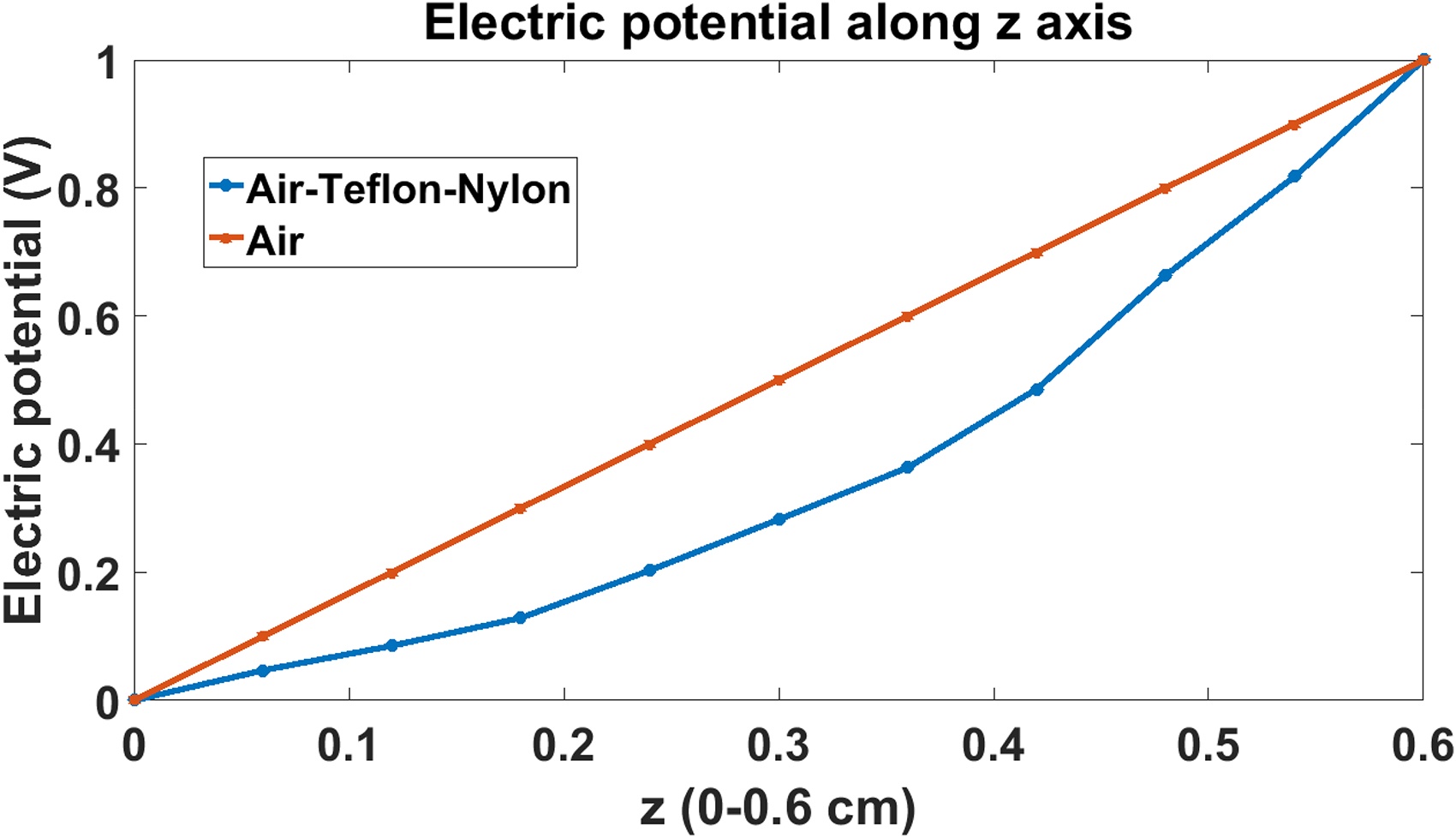
The electric potential distribution across the Z axis at X = 0 and Y = 0 of three dielectric layer (air = 2 mm, Teflon = 2 mm and Nylon = 2 mm) capacitor.
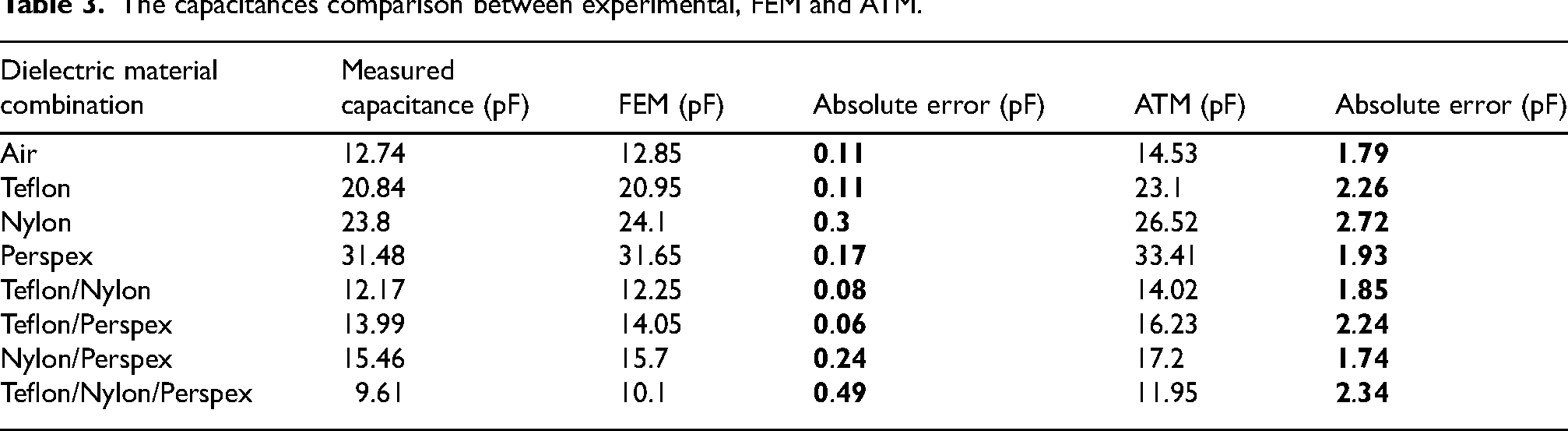
The capacitance of single as well as multi dielectric layer configurations between measured value and computed values from the ATM and FEM are given in Table 3. The absolute error calculated for both ATM and FEM predictions are given in bold in respective columns of the Table. The capacitance computed using the ATM is higher than the experimental results as well as the prediction by FEM. The maximum absolute error in the ATM scheme evaluation of capacitance with respect to experimental results is 2.72 pF. The error can further be reduced using mesh refinement strategies. The numerical convergence test results shown in Figure 6 for the case of PDC with Teflon as dielectric medium. The capacitance value converges to 21 pF as the tessellation density is doubled. The convergence of numerical value of capacitance assures the numerical stability and accuracy for the ATM Figure 9.
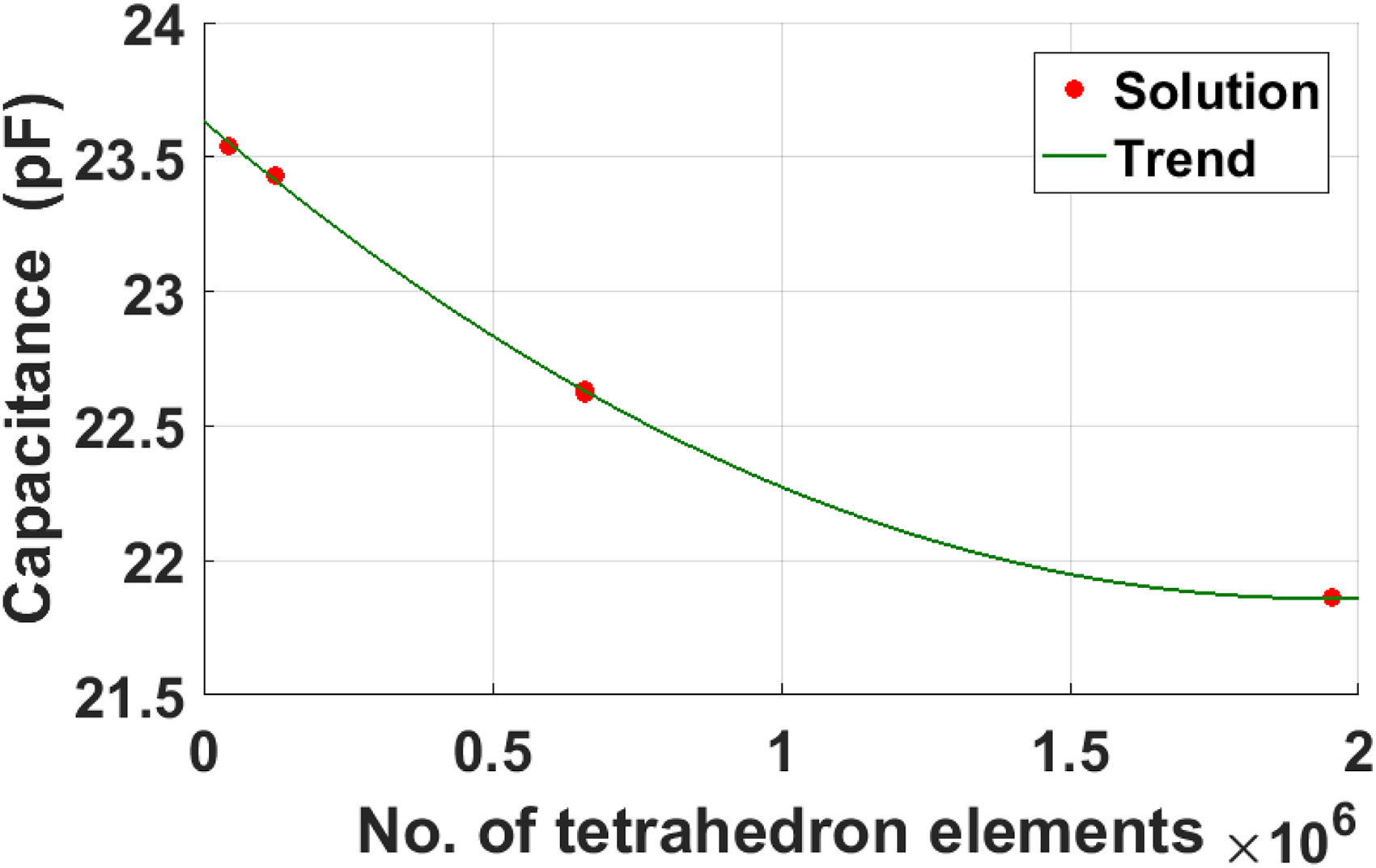
The ATM solution convergence upon mesh refinement.
The capacitances comparison between experimental, FEM and ATM.
Conclusion
This study developed a numerical model of a Parallel Disc Capacitor (PDC) probe using the Algebraic Topological Method (ATM) and compared its predictions with experimental results and the Finite Element Method (FEM). The ATM-based model accurately predicted uniform electric potential distributions in homogeneous dielectric regions and discontinuous potentials at dielectric inhomogeneities between the disc electrodes. The absolute error in 3D capacitance values extracted using ATM—both for single and multiple dielectric layer capacitors—was quantified against measured values and FEM predictions. Additionally, numerical convergence of the ATM solution toward FEM results was demonstrated through mesh refinement. The proposed algebraic topological numerical models offer valuable applications in virtual prototyping and functional optimization of PDC probes for non-destructive evaluation (NDE). Future research will expand the model's scope to predict capacitance variations caused by defects and fluctuations in dielectric properties. arising from changes in dielectric properties.
Footnotes
Acknowledgements
The authors are extremely grateful to Mr M. Sivaramakrishna, Head, SISD, Indira Gandhi Centre for Atomic Research (IGCAR) Kalpakkam, India, Mr N. Sridhar, Director, EIG, IGCAR and Dr B. Venkatraman, Director, IGCAR for their wholehearted support and constant encouragement throughout this work.

Funding
The authors received no financial support for the research, authorship, and/or publication of this article.
Declaration of conflicting interests
The authors declared no potential conflicts of interest with respect to the research, authorship, and/or publication of this article.