






Abstract
The Pinching Antenna Systems (PAS) technology functions as a fully operational flexible antenna platform which supports future wireless network applications through its ability to switch radiation points along a waveguide using low-power electronic control. The system enables PAS adaptive beamforming through the activation of its individual pinching elements which results in less mechanical movement needed to create different beam patterns while saving energy and simplifying system design and increasing operational range compared to traditional array systems and adaptive intelligent surfaces. The process of identifying which antennas need to operate for optimal communication results in a NP-hard Quadratic Fractional 0–1 optimization challenge which requires extensive computational power making it impossible to use in active system operations. The current solutions to the problem depend on two main approaches which either use complete solvers or need supervised learning systems that depend on costly labeled training data which restricts their ability to expand and change. To develop a self-supervised framework which proposed Graph Attention Lagrangian-Reinforced Network (GALR-Net) to tackle these difficulties. The Graph-based model of PAS represents its antennas as graph nodes which use attention-based message passing to establish spatial relationships between them. The system uses a Straight-Through Estimator which makes it possible to use binary activation for differentiation while the physics-aware Lagrangian loss function maximizes the reachable rate without requiring actual ground-truth data. The results from our simulations show that GALR-Net achieves better performance than MLP and GNN baseline systems and all traditional methods. The proposed method achieves SNR optimality at 93–95% while enhancing antenna gain by 3.2 dB and achieving a 12–15% increase in radiation efficiency and a 40% decrease in beamforming errors and an approximate 22% improvement in spectral efficiency. The framework demonstrates its ability to handle arrays containing 1000 antennas while it maintains high performance standards when users experience localization errors between ±1 and 2 meters. The results show that physics-informed self-supervised learning enables scalable and operational solutions for real-time PAS optimization in upcoming 6G wireless networks.
Introduction
Background on flexible antenna systems and PAS
The development of sixth-generation (6G) wireless infrastructure needs next-generation antenna technologies which must achieve three competing goals. Current solutions 1 which include Reconfigurable Intelligent Surfaces (RISs) and fluid antenna systems still face operational challenges because RISs experience double fading which causes major signal loss, and fluid antennas work within fixed spatial boundaries that cannot handle extreme path loss. 2 NTT DOCOMO developed PAS which transform spatial modulation through their introduction. 3 This system uses an advanced waveguide network which enables users to switch between two states by moving dielectric particles through mechanical and electronic controls. 4 The binary activation system enables PAS to choose between multiple radiation points which lets users create stable Line-of-Sight (LoS) connections while avoiding physical barriers. 5 PAS enables precise electromagnetic wave control which increases system throughput and spectral efficiency through its hardware system design that operates at low power consumption needed for 6G network expansion. 6
PAS technology enables dynamic control over electromagnetic wave propagation, allowing for precise beamforming and steering. This is achieved by strategically manipulating the permittivity of the dielectric particles within the waveguide. In their “open” state, these particles have a specific dielectric constant that influences the wave's path. When switched to a “closed” state, their dielectric properties change, effectively altering the waveguide's characteristics and redirecting the electromagnetic energy. This binary control allows the PAS to adapt to the surrounding environment, avoiding obstacles and focusing the signal towards the intended receiver. The ability to select radiation points at sub-wavelength intervals further enhances this precision, enabling the creation of virtual line-of-sight paths even in complex environments. This dynamic adaptability is a key advantage of PAS over traditional antenna systems, which often have fixed radiation patterns.
Motivation for self-supervised physical learning
The physical advantages of PAS create challenges because engineers must find ways to use active antennas to achieve maximum communication rates. The system involves binary antenna activation and waveguide phase shifts and power distribution which creates a Quadratic Fractional 0-1 optimisation problem that falls under non-convex combinatorial problems that require NP-hard methods for real-time solution. Most deep learning methods today use supervised learning because they depend on Gurobi to generate optimal labels through its resource-intensive solving process. The process of creating training datasets requires substantial time which acts as a major obstacle because supervised models fail to perform adequately in new situations where they lack perfect channel state information. The system requires users to have location information because user location uncertainty combined with estimation errors requires a model that can understand the system's physical behavior instead of simply memorizing activation patterns. Researchers need self-supervised learning systems to activate antennas. The development of a physics-based model for system operation enables us to create an optimized Lagrangian loss function that derives from SNR information. The method enables the neural network to acquire knowledge through direct electromagnetic environment interactions which make real-time optimization scalable and inherently resistant to wireless channel randomness.
Research objectives
The main objective of the work is to address the limitations present in the existing optimization methods for PAS by introducing a self-supervised learning framework that operates effectively under uncertainty. The main goals to achieve are as follows,
To rigorously model the PAS architecture, by considering the waveguide geometry, channel fading and impact of user location uncertainty and to formulate the antenna activation task as a Quadratic Fractional Binary Optimization problem. To propose a GALR-Net Graph Attention Lagrangian-Reinforced Network, a self-supervised architecture capable of learning optimal activation policies without ground truth labels. The architecture uses GATs (Graph Attention Networks) to capture spatial dependencies and STE (Straight through Estimators) to handle discrete activation states within a differentiable optimization loop. To design a physics-informed Lagrangian loss function that maximizes the achievable rate while enforcing power constraints, thereby embedding the physical constraints of the problem directly into the training process. To evaluate the performance of the proposed GALR-Net against baseline methods, including heuristic approaches and supervised neural networks, demonstrating its superiority in terms of scalability, accuracy, and robustness under user localization uncertainty.
Key contributions and novelty
This work introduces a self-supervised antenna activation framework for Pinching Antenna Systems (PAS) that fundamentally differs from existing supervised learning and heuristic optimization approaches. The main contributions of this study are summarized as follows:
Self-Supervised Optimization without Label Dependency: Unlike existing GNN-based PAS optimization methods that rely on NP-hard solvers to generate optimal activation labels, the proposed GALR-Net framework directly optimizes physical layer performance metrics. This eliminates the costly data generation bottleneck and enables scalable training for large antenna arrays. Differentiable Discrete Antenna Activation Learning: This work integrates a Straight-Through Estimator (STE) into the PAS optimization pipeline, enabling end-to-end gradient-based learning of binary antenna activation decisions. This represents a significant departure from conventional soft-selection or relaxation-based approaches commonly used in neural antenna optimization. Physics-Aware Lagrangian Learning for Quadratic Fractional Optimization: Unlike conventional physics-informed neural networks that primarily focus on solving partial differential equations, the proposed approach embeds the Shannon capacity formulation of the PAS system directly into the loss function. This allows the network to solve quadratic fractional 0–1 optimization problems through physics-driven self-supervision. Scalable Graph Attention-Based Spatial Modeling: By incorporating graph attention mechanisms, GALR-Net explicitly captures spatial correlations and electromagnetic coupling between antenna elements, improving activation accuracy and scalability compared to standard GNN and MLP-based methods.
Thus, these contributions establish GALR-Net as a novel learning paradigm for real-time PAS optimization that combines graph attention learning, discrete optimization, and physics-aware self-supervision within a unified framework.
Related work
Flexible antenna systems (PAS, FAS, MA, and RIS)
The prevailing study 7 has completed its examination of Fluid Antenna Systems (FAS) which serve as both the theoretical foundation and the potential practical use case for 6G wireless networks. The research team conducted an extensive performance evaluation of FAS systems by analyzing their operational capabilities through the use of antenna position modeling as an optimization task that required resolution within a restricted liquid space. The research used stochastic geometry model data to assess FAS performance against standard massive MIMO systems under different fading conditions. The research found that FAS technology enabled systems to achieve diversity order equivalent to their available port positions which produced major benefits in spatial multiplexing performance. The suggested study 8 has developed a system to improve wireless transmission efficiency through the control of Movable Antenna (MA) movements. The authors developed a position update algorithm based on gradient methods which successively modifies antenna positions to follow pathways that create constructive interference. The team ran tests in a simulated indoor office space that used a three-dimensional ray-tracing channel model. The MA-assisted systems produced better results than fixed-position systems because of their ability to increase SNR beyond 10 dB. The existing study Reconfigurable Intelligent Surfaces (RIS) which used passive beamforming with discrete phase shifts to optimize multi-user sum rate performance. 9 Their methodology employed a Branch-and-Bound framework combined with semi-definite relaxation to handle the non-convex constraints. The hybrid LoS and NLoS channel model generated the dataset for this existing. The system achieved 90% of continuous phase shift performance using 2-bit phase shifters which provided low-resolution capability. The existing team conducted a review which examined existing study about smart radio environments that use reconfigurable meta-surfaces. 10 The existing team developed a systematic framework to categorize all existing RIS hardware prototypes together with their respective communication protocols. The study used multiple datasets which had been collected from previous studies to measure system performance. The results demonstrated that metasurfaces can decrease power usage while providing increased coverage area.
The dataset included 50 to 1000 antennas which operated at a frequency of 3 GHz. The GNN-based method achieved superior SNR results when compared to the heuristic methods according to the results. The existing in 11 sought to optimize the placement of PA to enhance coverage. The existing employed a particle swarm optimization (PSO) algorithm to identify the best activation pattern that would produce the highest coverage probability. The existing study assessed user distribution within a square service area through their study which used a specific dataset. The results showed that coverage probability increased by 15 percent when compared to activation methods which activated all components at the same time. The existing in 12 assessed the application of RIS technology to create secure wireless networks which protect against eavesdropping. The objective required the system to achieve maximum secrecy rate by conducting joint optimization of transmit beamforming and RIS reflector coefficients. The existingers applied block coordinate descent algorithm to solve the coupled non-convex problem. The simulation dataset included various eavesdropper locations. The results demonstrated that RIS technology provides substantial advantages for securing physical layer communications. The existing in 13 studied both the potential benefits and difficulties which Movable Antenna wireless networks present. The existing process involved deriving the functions which describe channel correlation and establishing capacity limits for MA systems. The existingers conducted theoretical analysis which they supported with Monte Carlo simulations through spatially correlated channels. The existing showed that MAs perform effectively to reduce both multipath fading and interference issues. The existing in 14 investigated how PAS function under conditions when obstacles block their signals. The existing developed mathematical equations which calculate outage probability based on random blockage scenarios. The existingers created their dataset through the use of stochastic geometry which simulated blockage events. The results indicated that PAS provides superior resilience to blockages compared to conventional fixed antennas.
Optimization-Based antenna activation and beamforming
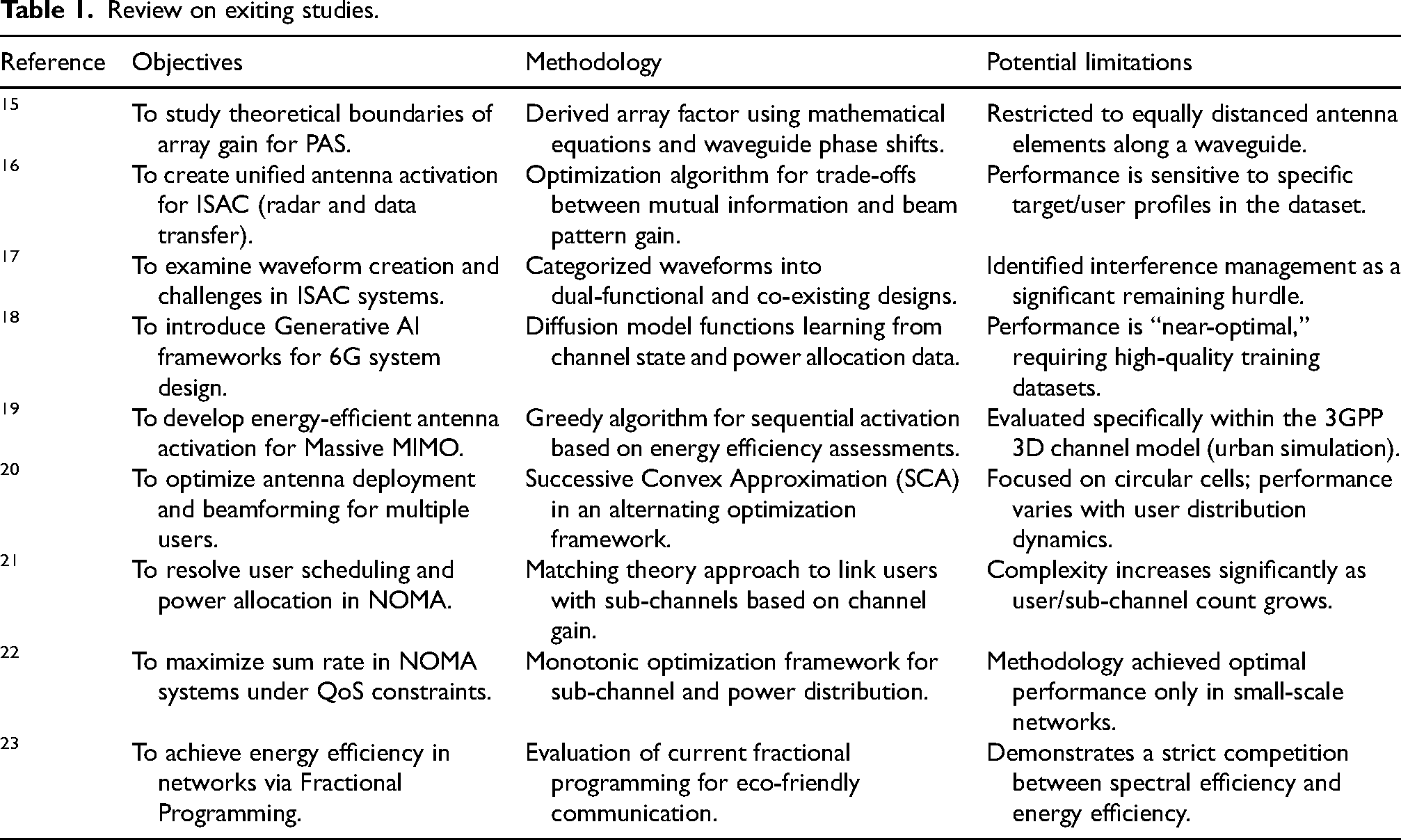
See (Table 1).
Review on exiting studies.
Graph and attention-based learning in wireless
The existing 24 used graph neural networks to develop an antenna scheduling solution that can operate effectively in intricate usage situations. The existing team developed a graph structure that connects antennas as nodes and their channel relationships function as edges. The model used a training dataset that included various challenging urban environments. The prevailing approach in 25 implemented Graph Neural Networks to find solutions for the problem of wireless resource distribution. Prevailing wanted to develop a learning system that would find the optimal solution more quickly than standard iterative methods. The process required prevailing to model the wireless network as a graph, which they used to train their Message Passing Neural Network system. The dataset used in the study included 10,000 specific user topologies, which prevailing created through random generation. The results demonstrated that the GNN method reached 99 per cent of its maximum sum-rate performance while needing much less operational work. The results showed that the system performed better when compared to CNNs and MLPs. The existing study in 26 examined how Deep Reinforcement Learning technology applies to intelligent wireless network systems. The existing team divided DRL algorithms into two separate categories based on their applications, which involved both spectrum access and power management systems. The prevailing conducted their study was conducted by testing different datasets that they collected from multiple simulation testing environments. The study demonstrated that dynamic network conditions could be effectively managed by using DRL technology. The prevailing study in 27 studied how Deep Learning technology operates within the physical layer of communication systems. The purpose of this existing work was to create an end-to-end constellation design system that would use autoencoders as its core technology. The prevailing developed a neural network model which learned to convert bits into complex symbols through a noisy channel environment. The dataset was generated using Additive White Gaussian Noise (AWGN) and fading channels. The results showed learned constellations outperformed traditional QAM in high-SNR regimes. The prevailing in 28 used Attention mechanisms to develop their solution for the Travelling Salesman Problem. The methodology introduced the Attention, Learn to Solve Routing (ALSR) framework. The study used a dataset of TSP instances of varying sizes. The results established a new state-of-the-art for combinatorial optimisation with neural networks, serving as a basis for antenna routing. In, 29 Graph Attention Networks (GAT). The prevailing attention weights are used to achieve the goal of node classification. The methodology utilised masked self-attention layers over graph structures. The dataset included standard citation networks. The results showed GNN architectures from previous studies achieved lower interpretability and performance than the new system. In 30 aimed to apply Deep Reinforcement Learning for real-time beamforming. The methodology used a Deep Deterministic Policy Gradient (DDPG) agent for its implementation. The simulation environment used the COST 2100 channel model to simulate user movement. The results showed stable throughput even at high speeds. The prevailing 31 used Multi-Agent Reinforcement Learning (MARL) to study resource allocation in cellular networks. The objective was to maximise network-wide utility through decentralised agent interaction. The methodology used a multi-agent deep deterministic policy gradient (MADDPG) algorithm for its execution. The dataset simulated a multi-cell network. The results showed improved convergence speed and fairness compared to centralised methods. The study in 32 examined how to use compressive channel estimation for applications that require large-scale connectivity. The prevailing aimed to reduce pilot usage by implementing compressive sensing methods. The existing method used a deep learning network to reconstruct channels that had sparse data. The dataset originated from extensive MIMO channel simulation tests. The study proved that accurate reconstruction required much lower pilot numbers. The authors of 33 conducted a review of unsupervised learning techniques used in physical layer signal processing. The existing evaluated autoencoders and GANs through their performance in modulation classification tasks. The study used standard radio frequency datasets for testing. The results demonstrated that unsupervised learning methods can help organisations save money on labelling expenses. Recent advancements in wearable and smart antenna systems have demonstrated significant potential in addressing the evolving demands of wireless communication. The first approach utilizes an FR-lossy substrate-based dual-band wearable antenna with U-shaped slot, designed using CST simulation technology with compact dimensions of 41 × 44 mm2. This design employs aluminum nitrate and pattern gain Teflon (PTFE-lossy) materials to analyze substrate effectiveness, achieving suitable frequency deviation between 2.4 GHz and 5.8 GHz for telemedicine applications. To overcome inherent limitations of standalone deep learning models—such as overfitting, reduced accuracy, and vulnerability to noisy data—the researchers integrated deep bi-directional long short-term memory (D-BiLSTM) with random forest (RF), where D-BiLSTM captures temporal dependencies while RF enhances feature selection and noise resilience. In parallel, another significant development involves a quad-band MIMO smart antenna designed for Wi-Fi and UWB applications, incorporating vertical slots to achieve multiple operating bands spanning from 2.4 GHz to 5 GHz, covering satellite communication (X-band), baby monitors, S-band radars, point-to-point military communications, and 5G mobile networks. This MIMO configuration achieves excellent envelope correlation coefficient (ECC) values below 0.16 and radiating efficiency exceeding 80% across all bands. Together, these studies underscore the critical role of advanced substrate materials, machine learning optimization, and multi-band MIMO configurations in enhancing antenna performance for real-world wireless applications.34,35
Self-supervised and physics-informed optimisation
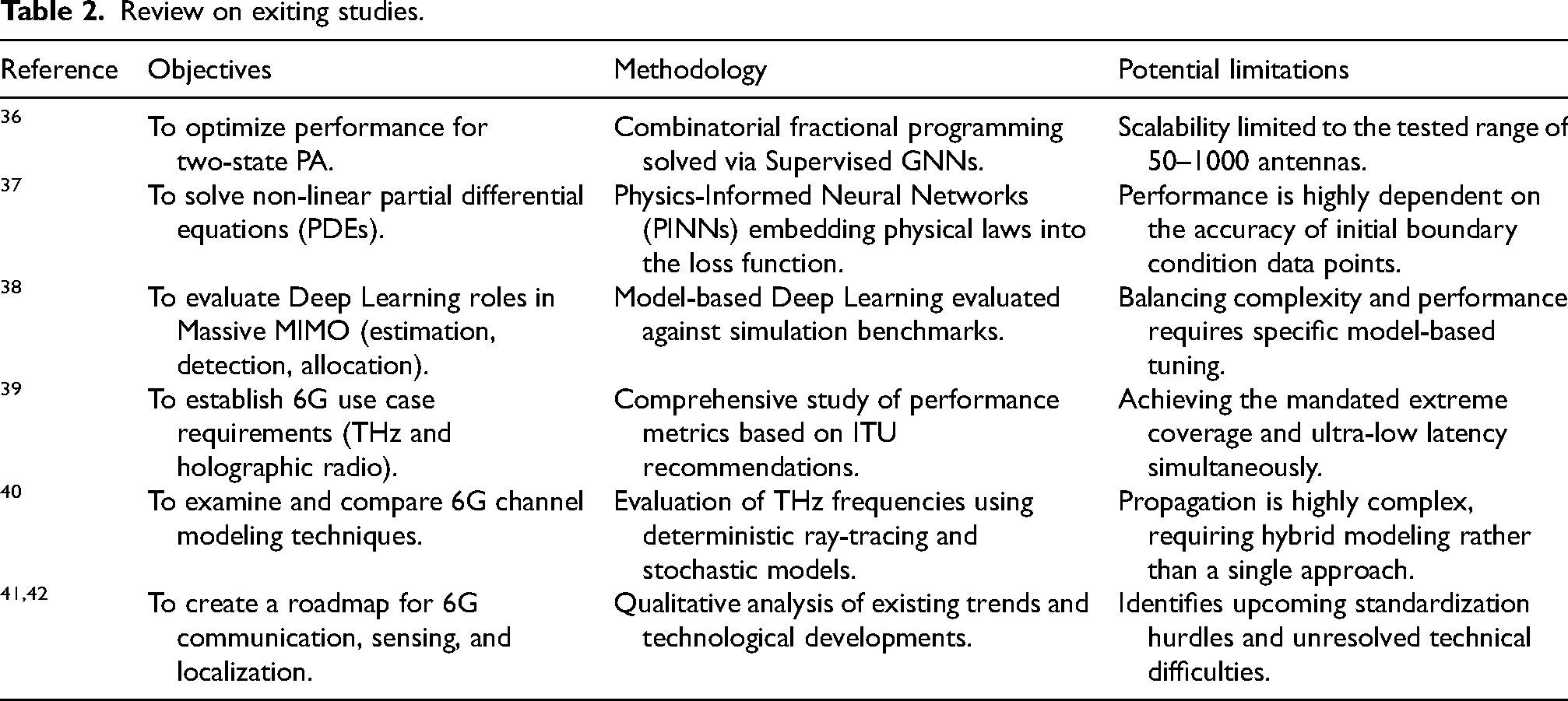
See (Table 2).
Review on exiting studies.
Research gap
Current antenna technologies face problems with efficient PAS antenna activation because flexible systems like RIS, fluid antennas, movable antennas and PAS systems face this limitation. Existing optimisation approaches rely on exhaustive search or external solvers, which create high computational requirements that become unmanageable when applied to extensive arrays or systems needing real-time performance. Learning-based methods reduce complexity but require supervised labels, which results in their failure to consider spatial relations between antennas and their shared signal patterns. Practical elements like user location uncertainty remain unaddressed in existing solutions. The self-supervised GALR-Net system needs development because it requires a scalable learning framework that functions without solvers while understanding physical principles.
System model
The proposed PAS mathematical framework includes three components: geometric configuration, electromagnetic channel model, and achievable rate derivation. The simulation pipeline, which includes system initialisation and dataset generation, is necessary for the experimental setup explained in the next sections.
Pinching antenna geometry
The system uses waveguide-based technology to transmit electromagnetic waves through dielectric materials and create radiation from designated areas, which operators can control. The model enables operators to choose particular radiation points, which lets them control electronic beam movement without requiring mechanical equipment. The model uses a horizontal waveguide, which keeps a stable elevation above the ground to deliver PA throughout its length for uniform space sampling and signal reception. It enables multiple activated pinches to create a virtual antenna array, which provides directional transmission capabilities. The user terminal operates within a designated ground area, which produces different propagation delays and phase shifts because of changing antenna-user distances that affect total array gain. The model utilises a horizontal linear waveguide that maintains a constant height above ground level and extends along the x-axis. As shown in Figure 1, the system uses a horizontal linear waveguide that maintains a fixed height above ground level and extends along the x-axis according to the design shown in Figure 1. The waveguide extends from the centre point y = 0 to a total distance of L meters. The system operates with K PA, which are arranged at equal intervals throughout the system.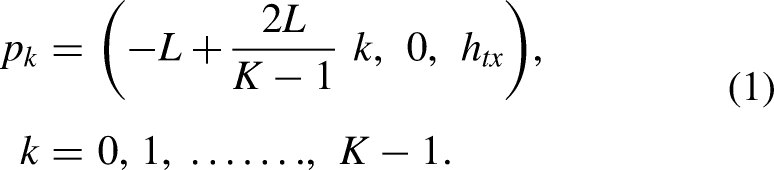
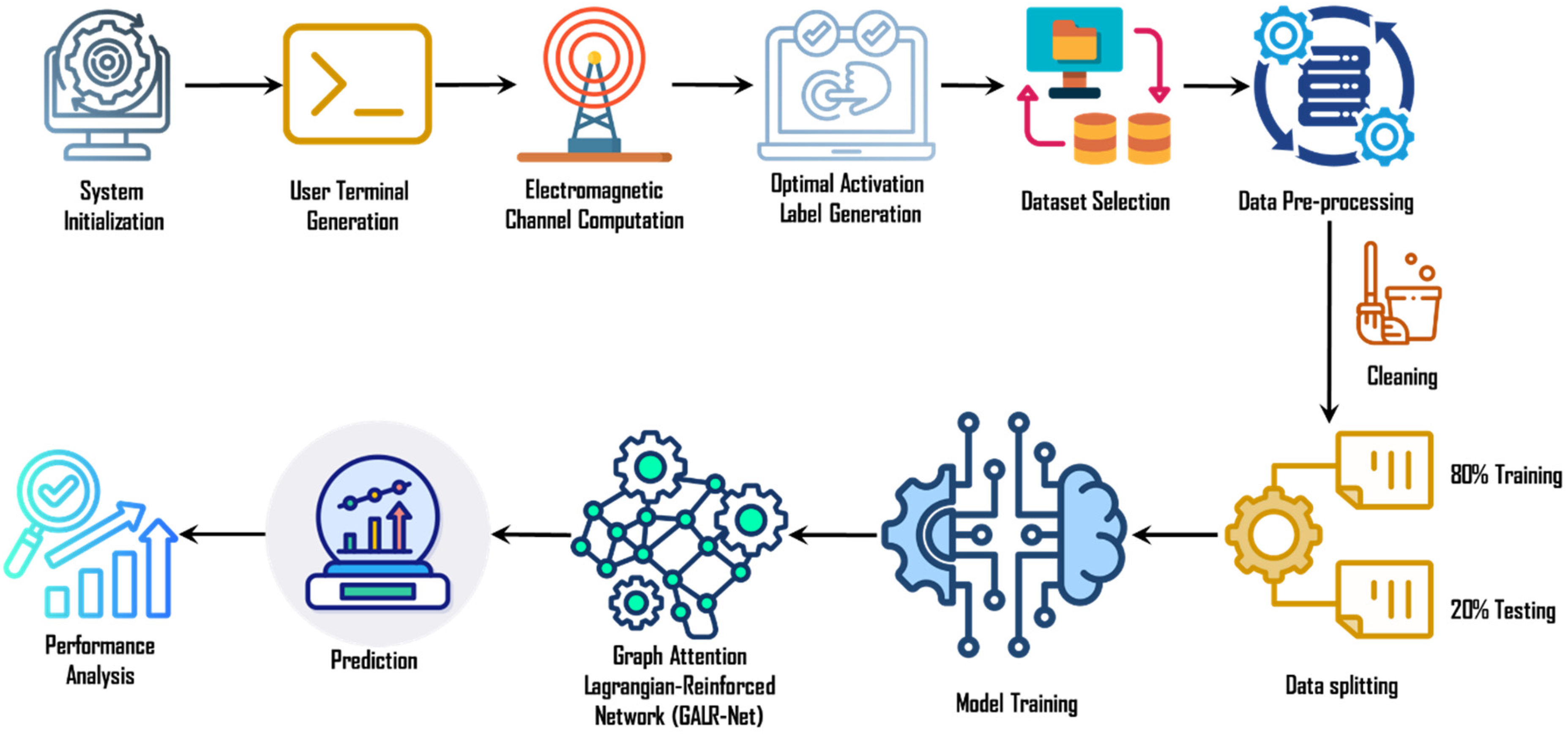
Proposed methodology.
The waveguide extends along the x-axis from
The communication scenario adopts a Time Division Multiple Access (TDMA) protocol, such that only a single user terminal (UE) is served during each time slot. The UE is located within a square service area on the ground plane, with side length 2R. The service area is centred at the origin of the horizontal plane. The three-dimensional position of the UE is denoted by the vector 
The horizontal coordinates x and y specify the UE's location within the square service region of side length 2R, which spans from −R to R along both axes. The vertical coordinate
Channel and signal model
The channel model describes how signals move from each active antenna to the user through both waveguide transmission and free space transmission. The electromagnetic waves travelling through space experience two effects that create different complex gain values at the receiver for each antenna. The spatial separation between antennas causes their signals to arrive at different times, which results in either constructive or destructive interference. The signal experiences free-space path loss and also gains additional phase delay when it travels through the waveguide medium. The complete channel response needs both propagation effects included, which will enable researchers to understand how signals reach their destinations. The proposed PAS activates only one K PAs from its complete set of available antennas at any moment. Let
Channel model
The wireless channel between the k-th PA and the user is modelled using free-space path loss with a distance-dependent phase shift. The complex channel coefficient 
Where Λ denotes the carrier wavelength, and
To improve the practical relevance of the proposed PAS framework under realistic 6G propagation environments, the channel model is further extended to include Rician fading, which captures both deterministic Line-of-Sight (LoS) propagation and scattered Non-Line-of-Sight (NLoS) multipath components.
Where 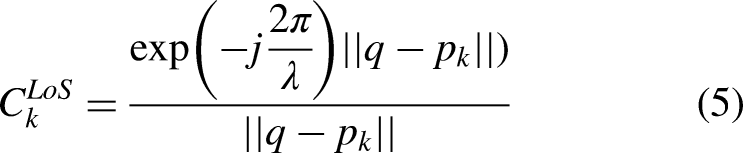
Further, 
Where
Waveguide-Induced phase shift
As the signal propagates through the waveguide, it experiences an additional phase shift relative to the feed point located at 


Where
Effective antenna gain
By combining the free-space channel response and the waveguide-induced phase shift, the effective complex gain of the k-th PA is defined as
The effective gains of all antennas are collected in the vector
Received signal model
Let 
Where
The adopted free-space path loss model is intended to provide a simplified and controlled environment for validating the core PAS activation and optimization framework before incorporating complex channel impairments. Although dense indoor and urban 6G scenarios are strongly influenced by multipath fading, shadowing, and blockage, the proposed GALR-Net architecture is fundamentally channel-agnostic because it operates directly on the channel coefficient vector and can therefore be extended to more realistic propagation environments, including Rayleigh/Rician fading and standardized 3GPP TR 38.901 channel models. Accordingly, the present results should be interpreted as proof-of-concept validation under ideal propagation assumptions rather than direct deployment-level performance evaluation. Future work will incorporate stochastic channel effects, imperfect channel state information (CSI), and blockage-aware propagation models to further assess the robustness and practical applicability of the proposed framework in realistic 6G wireless environments.
Achievable rate and SNR
The antenna subset that transmits its signals through its activated antennas creates combined signals that reach the receiver path through their direct phase matching. The system achieves maximum performance when its components establish proper phase synchronization while improper phase synchronisation causes the system to lose signal strength. The system shares its total transmit power across all functioning antennas, which creates a spatial diversity effect but reduces individual antenna power capacity when more antennas operate at the same time. The Signal-to-Noise Ratio (SNR) measures link quality through its definition, which calculates the ratio of received signal power to noise power. The achievable data rate follows Shannon's capacity formula, which increases logarithmically with SNR and serves as the primary optimisation objective. The user terminal calculates its instant received signal power through the signal model provided in equation 6.
The received power is obtained by squaring the magnitude of the coherent sum of the effective gains corresponding to the active antennas. Since the total transmit power
The Signal-to-Noise Ratio (SNR) at the user, denoted by γ, is defined as the ratio of the received signal power to the noise power 
This expression directly follows from (7) by normalising the received power by the noise variance
The achievable communication rate, measured in bits/s/Hz, is evaluated using Shannon's capacity formula as
The achievable rate increases without interruption as SNR increases because it represents the highest possible spectral efficiency, which can be achieved through perfect coding and decoding methods. The antenna activation and optimisation problem uses this expression as its main objective function.
Simulation workflow and dataset generation pipeline
The simulation workflow produces a dataset that accurately represents the electromagnetic wave propagation behaviour that occurs in a PAS. The system establishes a strong and scientifically valid basis that researchers can use to train and test the GALR-Net architecture.
Problem formulation
Antenna activation objective
The primary objective of the proposed system is to maximise the communication performance of the user terminal by optimally selecting a subset of PAs for activation. As established in Section 3.3, the achievable communication rate R is a monotonically increasing function of the Signal-to-Noise Ratio (SNR) γ. Consequently, maximising the achievable rate is equivalent to maximising the SNR expression in (8). The system distributes the total transmit power
To formalise this trade-off, we define the antenna activation objective function 
Where
Quadratic fractional binary optimisation
To facilitate formal analysis of the antenna activation problem, the objective function in (10) is reformulated into a standard quadratic fractional programming form. We begin by expanding the numerator term as
Since the expression in (11) is a real-valued scalar representing received signal power, it can equivalently be written using the real part of the Hermitian matrix 
Substituting (11) and (12) into the objective function (10), and noting that for a binary vector 
The optimisation problem in (13) belongs to the class of Quadratic Fractional 0–1 Programming (QF01P) problems. Such problems are inherently non-convex and combinatorial in nature, and are known to be NP-hard.
The objective function in (13) directly corresponds to maximizing the physical Signal-to-Noise Ratio (SNR) of the PAS system. The quadratic numerator term represents the coherent array gain produced by constructive signal combining among the activated antennas, while the denominator term represents the effective power sharing among active elements. By incorporating the transmit power scaling factor and noise variance defined in Section 3.3, this formulation becomes equivalent to the instantaneous SNR expression. Since the achievable data rate is a monotonic function of SNR according to Shannon's capacity formula, maximizing (13) is equivalent to maximizing the achievable communication rate. This relationship enables the antenna activation problem to be optimized using a physics-driven learning objective (Table 3).
Structural properties of Q.
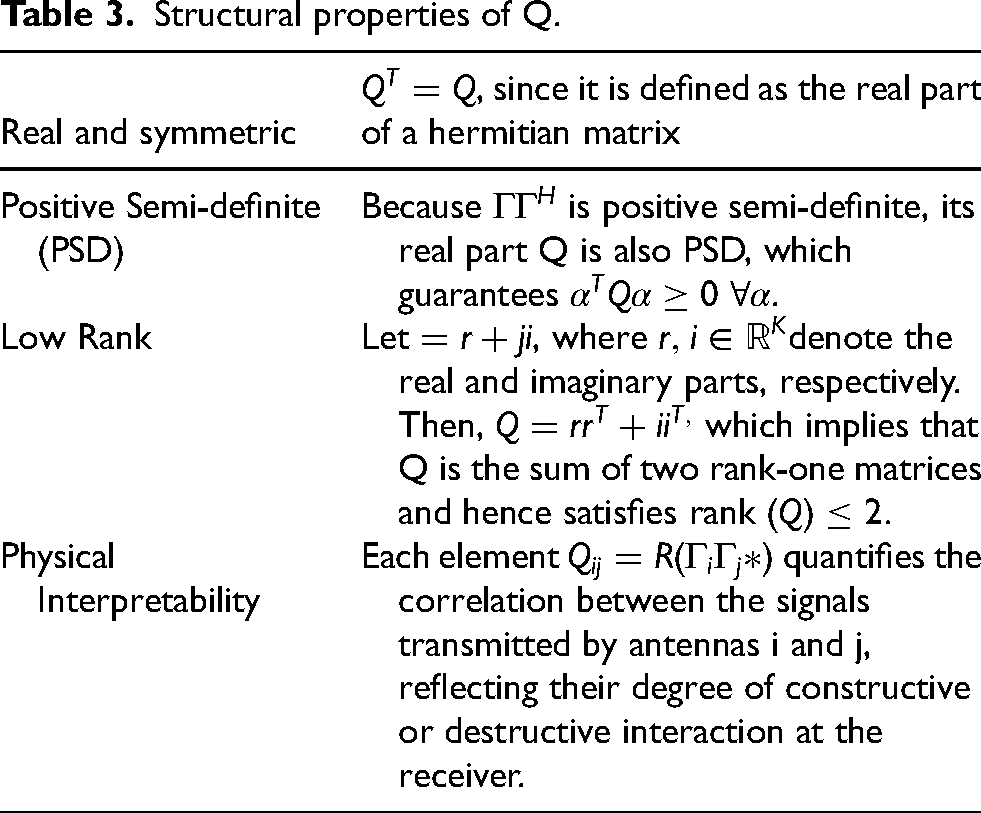
The matrix Q exhibits several important structural properties that stem directly from its physical construction: The optimisation problem in (13) seeks a subset of antennas that maximises array gain through correlation while maintaining the least cost of their activation. The exact solution of this problem through exhaustive search and branch-and-bound methods becomes infeasible because large-scale arrays require more than 50 antennas, which creates a need for efficient approximation and learning-based methods, which include GALR-Net as a proposed solution
Baseline learning architectures
The proposed solution will be evaluated through testing, which uses two fundamental learning systems that differ in their capability to model and comprehend their environment. The first baseline is a Multi-Layer Perceptron (MLP)–based model that approaches antenna activation as a set of independent binary decisions. The system processes each PAs through its own local electromagnetic properties, which include the effective gain magnitude and phase. The system extracts local features through a shared encoder, which generates latent representations that contain information for each individual antenna. The system uses an average of all antennas’ latent features as its global context, which it provides to decision modules for making choices. The design allows the system to obtain fundamental system knowledge while maintaining low operational requirements. The system design treats antennas as conditionally independent entities, which leads to restricted spatial dependency between antennas and prevents the system from detecting constructive or destructive interference and mutual coupling effects that result from their actual positioning. The second baseline overcomes these restrictions because it uses a Graph Neural Network (GNN), which creates a mathematical model that represents the spatial and connection patterns of the PAS. The implemented system uses a graph structure to represent both users and antennas as nodes, while their physical connections are represented by edges that carry electromagnetic attributes.
The graph uses message passing for information transfer, which enables antenna nodes to improve their channel characteristics through user contact. The GNN system learns advanced spatial connections through multilayer information aggregation, which MLP systems cannot access because they process features without dependence on other features. The system gathers system information through pooling operations, which create a global graph representation that combines with antenna embeddings to generate activation decisions for the system. The GNN-based baseline delivers an advanced modelling system which uses physical principles to create better activation strategies for situations that need an understanding of both spatial patterns and antenna connection patterns. The two baselines establish two important assessment standards that researchers can use to measure the performance advancements achieved through the proposed method.
Proposed method: GALR-net
GALR-Net (Graph Attention Lagrangian-Reinforced Network) is a self-supervised framework for antenna activation in dynamic PAS systems, which handles antenna activation through self-supervised learning. This system uses a Graph Attention Network (GAT) to determine how much different spatial and electromagnetic interactions between antennas matter while a physics-based Lagrangian loss function maintains the constraints of the original quadratic fractional optimisation problem. GALR-Net conducts system performance optimisation through its direct engagement with the physical model, enabling it to create effective activation strategies without needing actual verification data, making it suitable for large dynamic PAS operations.
GALR-Net architecture
The GALR-Net system uses its proposed model to represent the PAS as a graph structure, which uses attention mechanisms to identify which antenna linkages possess greater significance. The system architecture comprises three fundamental components, which include feature embedding, graph attention layers, and a distributed scoring head for activation prediction (Figure 2).
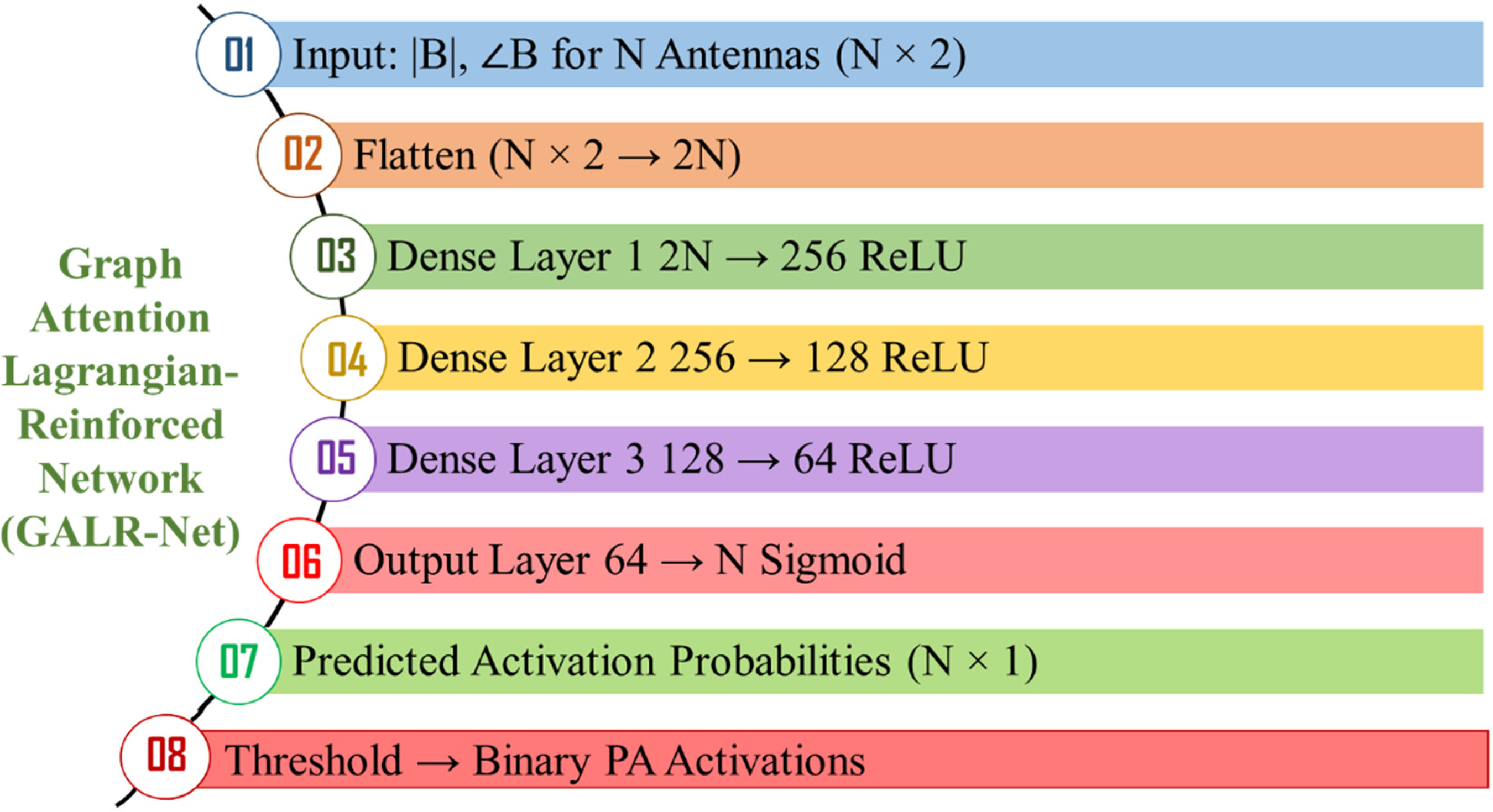
Proposed GALR-NET architecture.
Input and graph representation
For a given user location, we compute the effective gain vector 
The PAS is represented as a graph G = (V, E), which defines V as the set of antennas and E as the network links. The system permits two types of edge connections, which include links between nearby antennas and links that establish a complete network connection, while the edge characteristics originate from channel correlation data. The network representation enables explicit modeling of spatial relationships between antennas and their interference patterns.
Graph attention layers
GALR-Net uses Multi-Head Graph Attention for better modeling of complex interactions which traditional message passing systems do not handle effectively. Every antenna node in the system keeps a hidden state 
The shared linear transformation W applies to the node features of the transformation. The learnable vector a determines how each neighbour contributes to the system. The symbol ∥ shows the process of combining two features into one. The softmax normalisation ensures that the attention coefficients over all neighbours sum to one. The LeakyReLU activation creates nonlinearity because it allows slight negative gradients to pass through. The hidden state of node k is calculated through a weighted summation of transformed features from its neighbouring nodes.
Where σ denotes a non-linear activation function such as ReLU. This update allows each node to aggregate information from neighbours, emphasising the most relevant interactions as determined by the attention coefficients. By stacking L such graph attention layers, GALR-Net produces high-level relational embeddings:
Straight-through discrete sampling
The antenna activation problem requires a binary decision for each antenna, represented by a vector 
Where 
Where
activations:
The method enables the network to acquire separate activation rules through traditional gradient optimisation methods while maintaining operational capacity to produce authentic binary results during testing.
Physics-aware lagrangian loss
GALR-Net uses a physics-informed loss function as its main feature because this function enables the network to directly improve system performance without using pre-existing labelled data. GALR-Net uses self-supervised optimisation to solve antenna activation instead of traditional supervised learning because the network needs to attain the system's maximum achievable rate as its physical system goal.
Physical loss
Using the discrete activation vector α∼ obtained through the Straight-Through Estimator, the instantaneous SNR for a given user location is computed as:

The formula directly ties network training to the underlying physics of the system, thus providing possibilities for self-supervised learning.
The physical loss in (21) is defined as the negative Shannon capacity evaluated using the discrete antenna activation vector obtained from the Straight-Through Estimator. This design ensures that the network training directly optimizes the same physical objective as the original quadratic fractional formulation. The coherent array gain contribution and the power normalization constraint are both preserved, allowing the model to learn antenna activation policies that maximize achievable throughput without requiring solver-generated labels. The small constant ε is introduced to ensure numerical stability during training. It prevents division-by-zero errors when the network temporarily predicts zero active antennas during early optimization stages. Since ε is chosen to be very small, it does not affect the final optimization outcome after convergence.
Binary regularizer
Incorporating an additional regularisation term could help in yielding confident binary decisions against soft probabilities, around 0.5.
The binary regularization term enforces confident antenna activation decisions by penalizing uncertain probability outputs. This term reaches its minimum value when activation probabilities approach binary values and reaches its maximum near intermediate values. Minimizing this regularizer encourages the network to generate sharp activation boundaries, improving discrete switching reliability and ensuring compatibility with practical PAS hardware constraints.
Total loss

Where,
Training algorithm
The training procedure for GALR-Net, summarized in Algorithm 1, operates in an offline batch-mode but requires no external solver. The network learns through weight adjustments which help to enhance the physical rate metric.
proposed GALR-Net training procedure
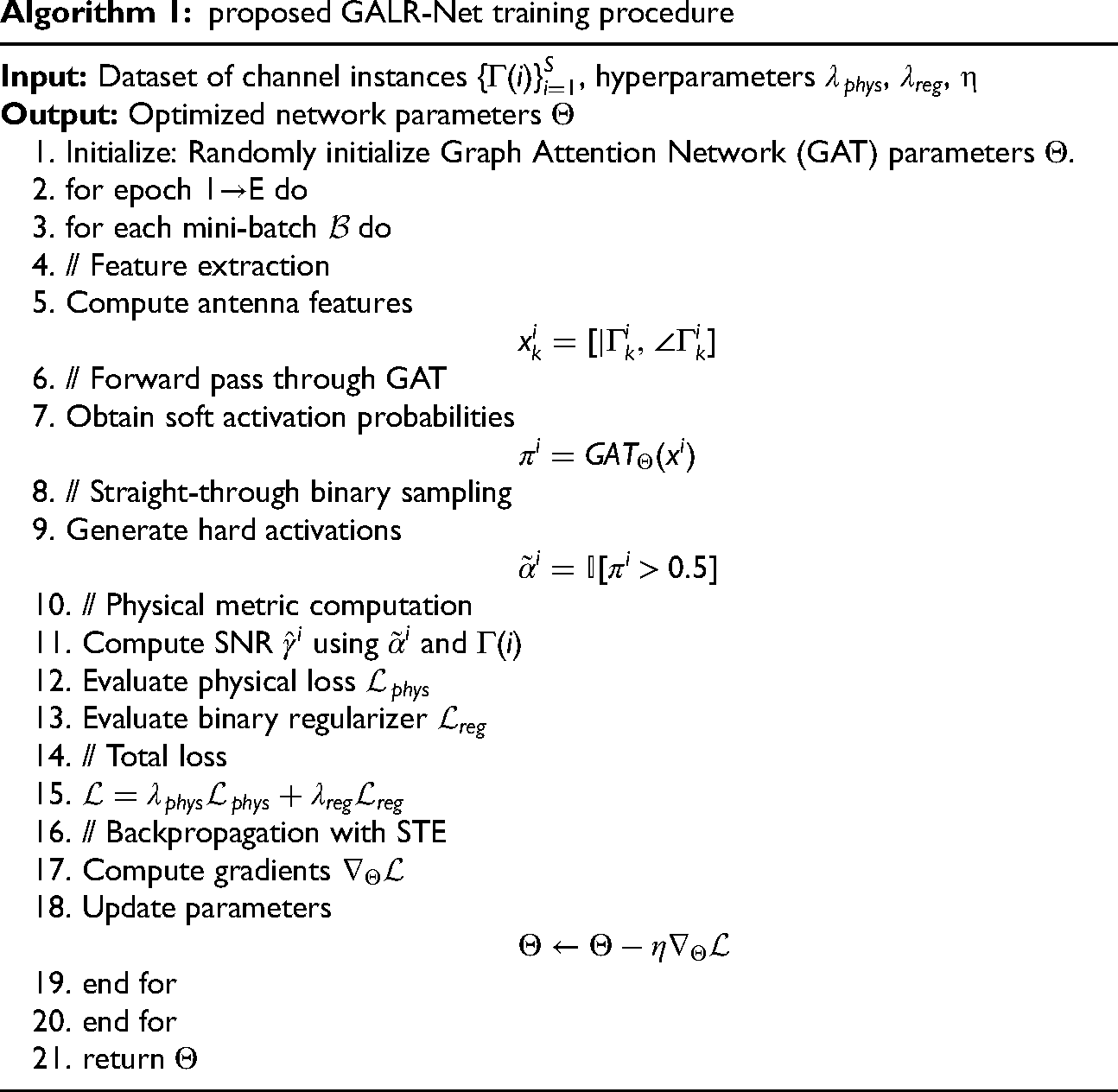
In algorithm 1, The GALR-Net Training Procedure describes an iterative optimization process which aims to improve a Graph Attention Network (GAT) through its application to antenna-based decision tasks. The process begins by extracting magnitude and phase features from channel instances which are then processed through the GAT to generate soft activation probabilities. The model needs to make discrete decisions so the system uses a Straight-Through Estimator (STE) to transform soft activation probabilities into binary activations which enable backpropagation to select binary sampling methods that the model cannot differentiate. The network training process requires the system to minimize a multi-objective loss function which combines physical performance metrics with a binary regularizer that enables specific hardware selection. The system updates parameters through gradient descent which continues for multiple epochs until the process yields optimized weight results.
Simulation results
Simulation parameters
The performance assessment requires this Table 4 present its base system settings which create a testing environment that supports one user at a time. The system requires a Pinching-Antenna array which needs between 50–1000 units that function at a 3 GHz carrier frequency which serves as the standard for Sub-6 GHz 5G deployments. The system operates at a high Transmit SNR value of 40 dB which tests efficiency limits through its physical installation that covers a 10 m×10 m square service region with a waveguide height of 3 meters. The research parameters demonstrate that MIMO simulations for indoor spaces and small-cell environments require high precision to assess how different antenna densities affect signal quality within a designated area.
Simulation and system parameters.
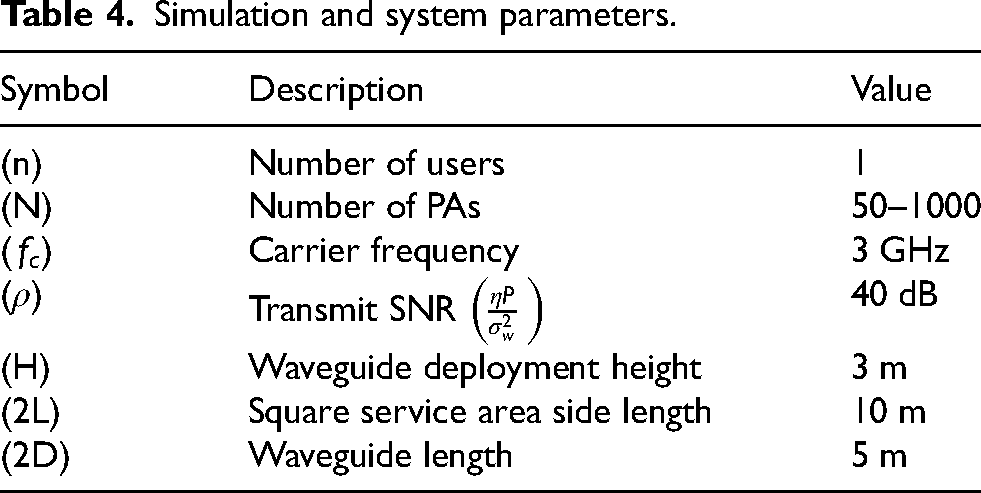
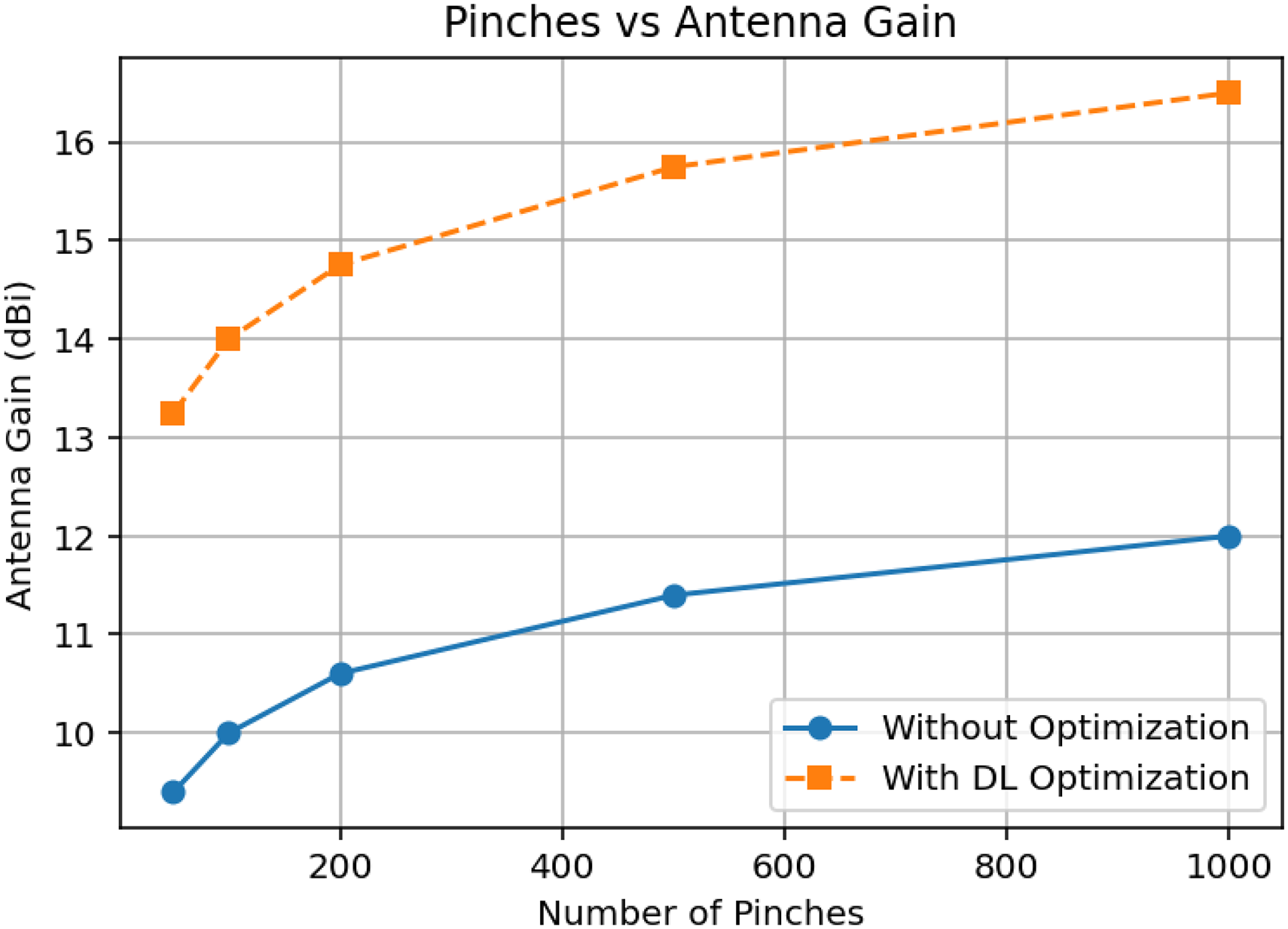
Figure 3 shows the relationship between Antenna Gain and different pinch counts which are used in antenna systems under two test conditions. The baseline system and the Deep Learning (DL) Optimization system show that both systems achieve higher gain when they use more pinches yet the DL-optimized system outperforms both systems during all evaluation tests. The system achieves its best optimized gain of 13.2 dBi through 50 pinches while the non-optimized system reaches 9.5 dBi. The two systems show performance differences that grow bigger when more pinches are used until they reach their peak point at 1000 pinches which leads to the non-optimized system achieving about 12 dBi while the DL-optimized system exceeds 16.5 dBi. The data shows that DL optimization functions as an essential element which drives maximum signal strength and operational efficiency while creating better results than the baseline “Without Optimization” curve shows at extended pinch counts.
Line graph.
Figure 4 illustrates that the learning-based PAS system (GNN + DiSPN) performs better than traditional MIMO systems when using more PAs. The proposed method achieved 30 dB in small arrays with N = 50 which exceeds conventional MIMO performance of 26 dB by 4 dB. The two methods both show better results with more antennas because of increased spatial diversity, but the learning-based method keeps delivering better results. The proposed method achieves 37 dB at N = 500 and N = 1000 it reaches 40 dB which shows a 5 dB advantage over conventional MIMO that achieves 35 dB. Intelligent antenna activation enables better use of constructive interference and array gain in large-scale deployments because performance gaps keep expanding. The results show that the proposed learning-based PAS framework scales better than traditional architectures, making it more suitable for high-dimensional 6G antenna systems.
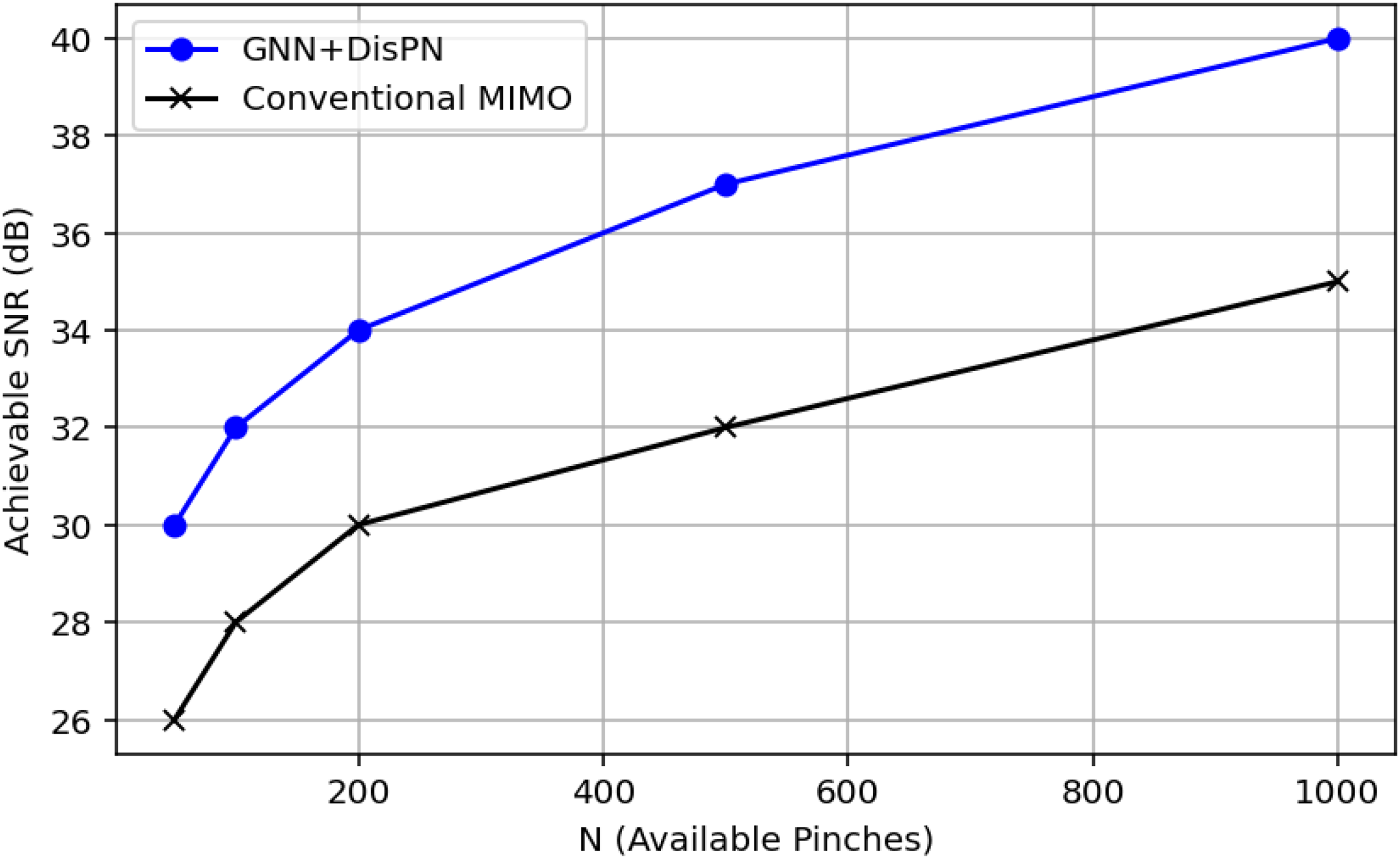
Achievable SNR vs. number of pinches.
The channel magnitude distribution across all antennas appears in Figure 5(a). The histogram shows a right-skewed distribution because most values lie between 0.15 and 0.30 while the peak occurs between 0.18 and 0.20. Only a small fraction of antennas achieve strong gains above 0.40, forming a long tail. The results demonstrate that channel strengths display extreme non-uniformity because activating all antennas leads to wasted resources due to multiple antennas which offer minimal assistance. The statistics support antenna activation through selective methods which require intelligent optimization methods like GALR-Net to operate effectively. Figure 5(b) presents the distribution of the number of antennas selected as active by the optimization algorithm. The model normally selects 18 to 22 antennas which includes 20 antennas as its typical choice because it has access to many more antennas. The evidence shows that the most effective solution has limited components which generate essential results for building constructive beamforming. Activating additional weak antennas would merely split power without improving coherent gain. The energy-efficient sparse activation strategy which GALR-Net learns automatically leads to enhanced performance and better power usage. The graph in Figure 5(c) shows how SNR levels respond to different active antenna counts. The study shows that SNR levels increase when researchers activate more antennas because this method improves coherent combining. The SNR stays between 33 and 36 dB when researchers use 10 antennas but reaches 37 to 41 dB when they activate 20 antennas and 30 antennas provide an SNR range of 42 to 44 dB. The system shows decreasing returns after reaching a specific point because its advantages start to reach their maximum potential. The optimizer uses approximately 20 antennas because this choice gives the best power efficiency while still maintaining array gain.
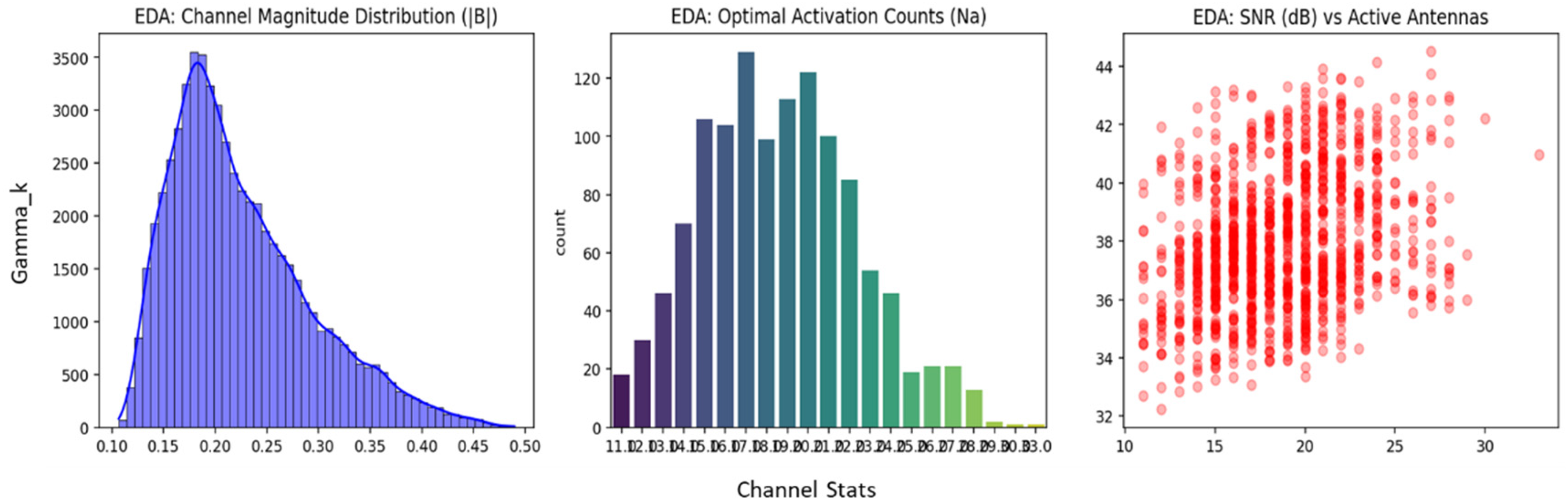
Exploratory data analysis of channel statistics, optimal activation patterns, and SNR–antenna relationship.
The histogram displays a right-skewed pattern which shows that most channel magnitudes in the dataset appear between 0.15 and 0.20 range. The distribution of the dataset shows decreasing values which start from 0.45, because the dataset contains fewer occurrences of higher values and potential outlier instances. The right side of Figure 6 shows “EDA: Magnitude vs Activation State” as a box plot comparison which establishes a strong link between channel magnitude and physiological state because the “Active” state box shows higher Y-axis values than the “Inactive” state box. The active condition shows distinct separation because it contains fewer overlapping areas and more extreme peak values, which make channel magnitude an accurate tool to identify periods of sympathetic nervous system arousal and periods of rest.
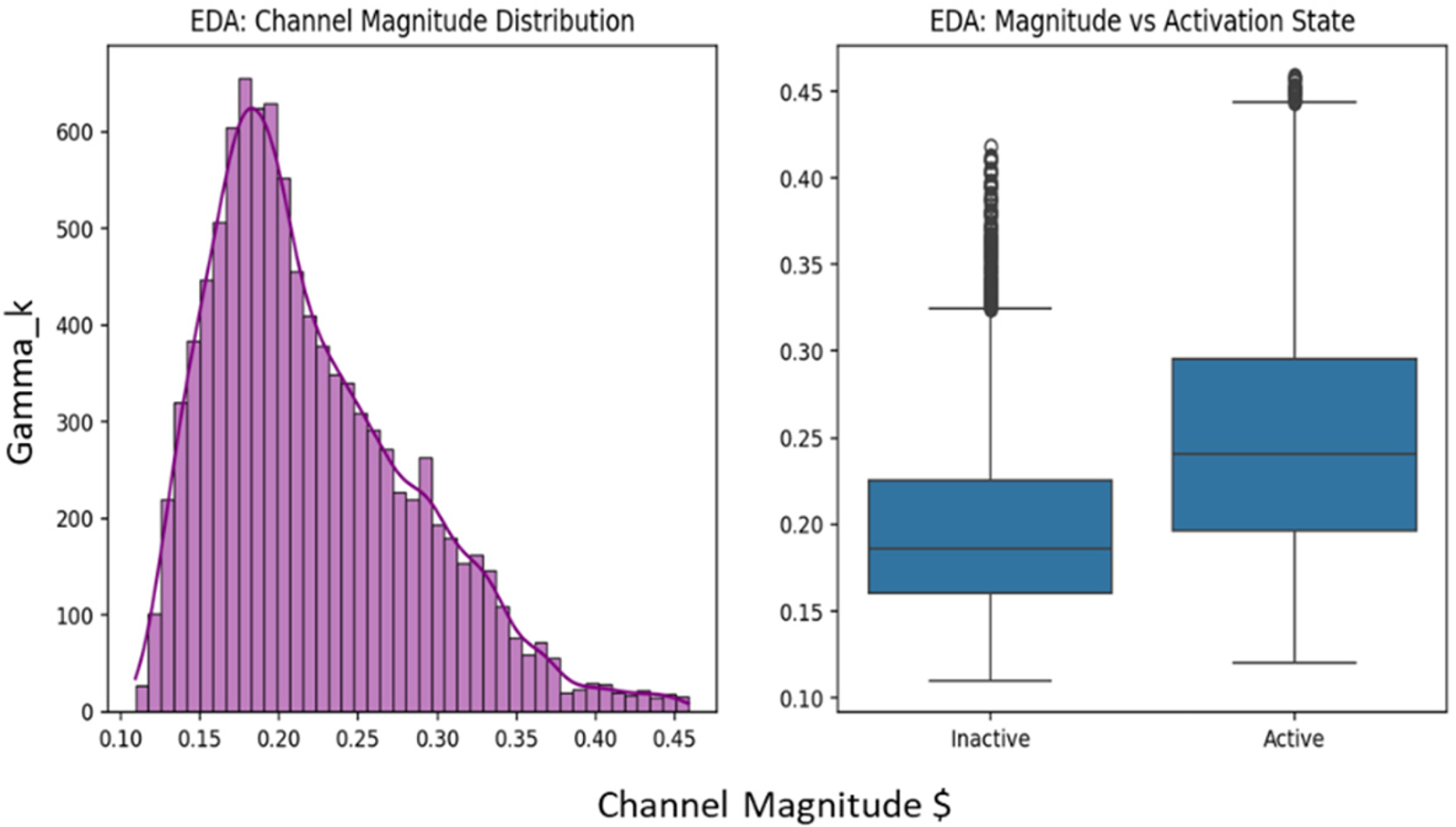
EDA: channel magnitude distribution.
The study shows how the supervised DiSPN baseline and GALR-Network perform in their test through Figure 7(a). The supervised model starts with a very high loss of approximately 4.0, exhibits large oscillations during early epochs, and only stabilizes near 0.7 after around 20 epochs, indicating slow and unstable learning. GALR-Net starts training with an initial loss of 0.75 which maintains consistent loss stability until it reaches its final value of approximately 0.69. The physics-informed Lagrangian objective enables faster and smoother convergence because it delivers better gradient direction while removing the requirement for costly labelled data. The algorithm achieves better optimisation results because it reduces training expenses.
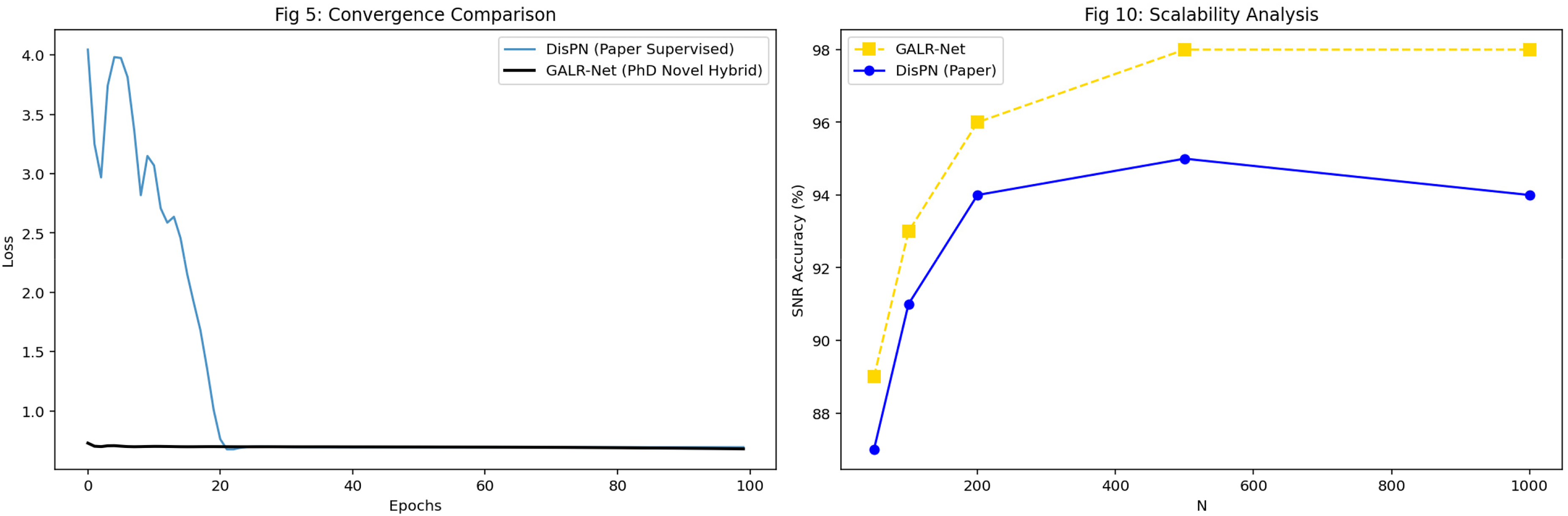
Training convergence and scalability performance of the proposed GALR-net.
Figure 7(b) evaluates scalability by measuring SNR accuracy as the number of antennas increases. The two methods show equal performance through their first 50 antennas because they achieve 89% and 87% accuracy. The array size increase results in GALR-Net showing constant performance improvement because it reaches 96% accuracy at 200 antennas and achieves 98% accuracy for systems with 500 to 1000 antennas. The supervised DiSPN baseline reaches its highest performance level of 95% which decreases when testing very large arrays. The graph-attention architecture demonstrates better scalability than other methods because it preserves top performance across one thousand-element PAS deployments. The results confirm that GALR-Net is better suited for large-scale 6G antenna systems where traditional supervised approaches struggle to generalise.
The test in Figure 8(a) assesses how well GALR-Net performs during user localisation testing because it uses increasing values for σp which represents uncertainty. The system achieves 95 percent accuracy with perfect localization at the time when σp equals 0. Uncertainty causes the system to lose performance because of increasing uncertainty, yet the system maintains an 88 percent accuracy rate. The model maintains 68 percent accuracy when faced with a 0.5 meter error which shows that it loses performance gradually instead of breaking down completely. The self-supervised and physics-aware framework developed by the researchers shows effective generalization to imperfect channel state information while it maintains reliability against real world positioning noise which 6G mobile networks depend on for their operation.
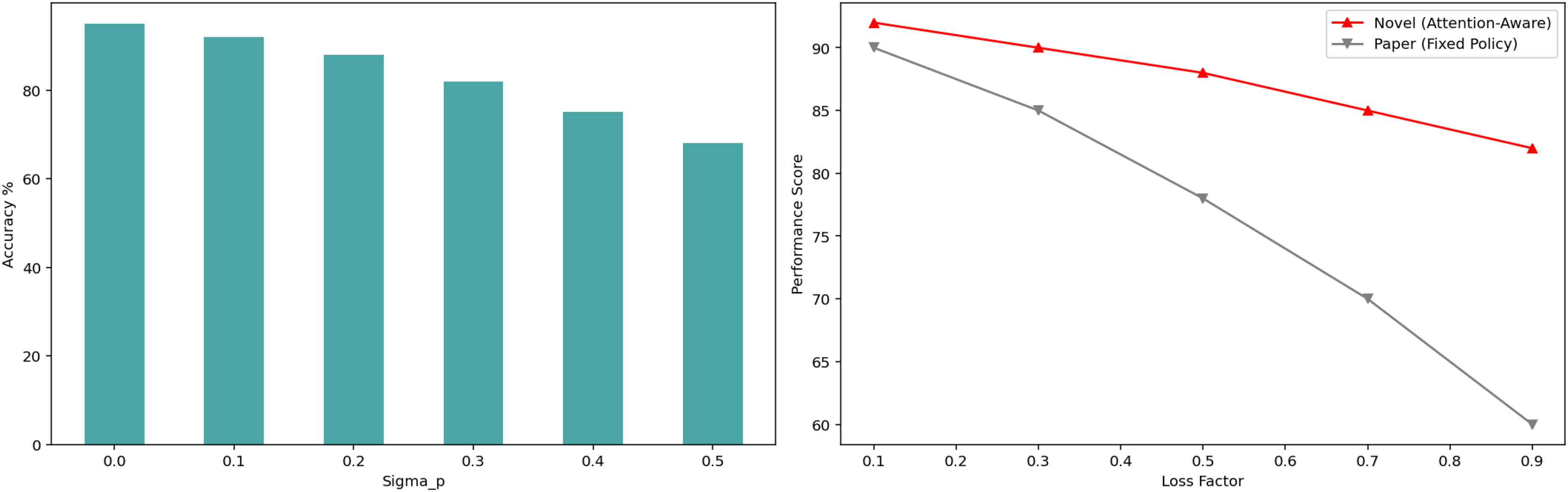
Robustness and sensitivity analysis of the proposed GALR-net under practical uncertainties.
The 8(b) test shows how waveguide loss affects system performance through its sensitivity analysis results. The performance of both methods decreases when the loss factor rises because of signal reduction. The proposed attention-aware GALR-Net system shows better results than the fixed policy method in all situations. The fixed strategy goes through a swift decline which takes it from a 90 performance level to a 60 score but the proposed method shows only a slight performance drop which takes it from 92 to 82 while maintaining its advantage from 20 to 22 points at high loss levels. The results show that the attention mechanism selects more powerful antennas which leads to better waveguide attenuation performance and stronger system resilience. As a result of this development GALR-Net achieves better performance during conditions which create hardware challenges for its operation.
Performance comparison
Figure 9 evaluate the performance of the Proposed GALR-Net against conventional or state-of-the-art (SOTA) methods across five key metrics. In terms of structural scaling, GALR-Net consistently delivers significantly higher Antenna Gain (ranging from approximately 14 to 16 dBi) and superior Radiation Efficiency (scaling from 55% up to 76%) compared to the Conventional PAS as the number of patches increases. From an optimization perspective, while GALR-Net starts with a higher initial training loss than SOTA GNN, it exhibits a sharper convergence curve, ultimately achieving a lower final loss after 60 epochs. This optimization efficiency translates directly to operational enhancements, where GALR-Net maintains a consistently higher Achievable Capacity across the entire SNR spectrum (0 to 40 dB). Finally, the Beamforming Accuracy Comparison reveals that GALR-Net slashes beamforming error by half across a wide scanning range of −60 to +60 degrees, peaking at a maximum error of only 10 degrees compared to the 20-degree error seen in the Conventional PAS.
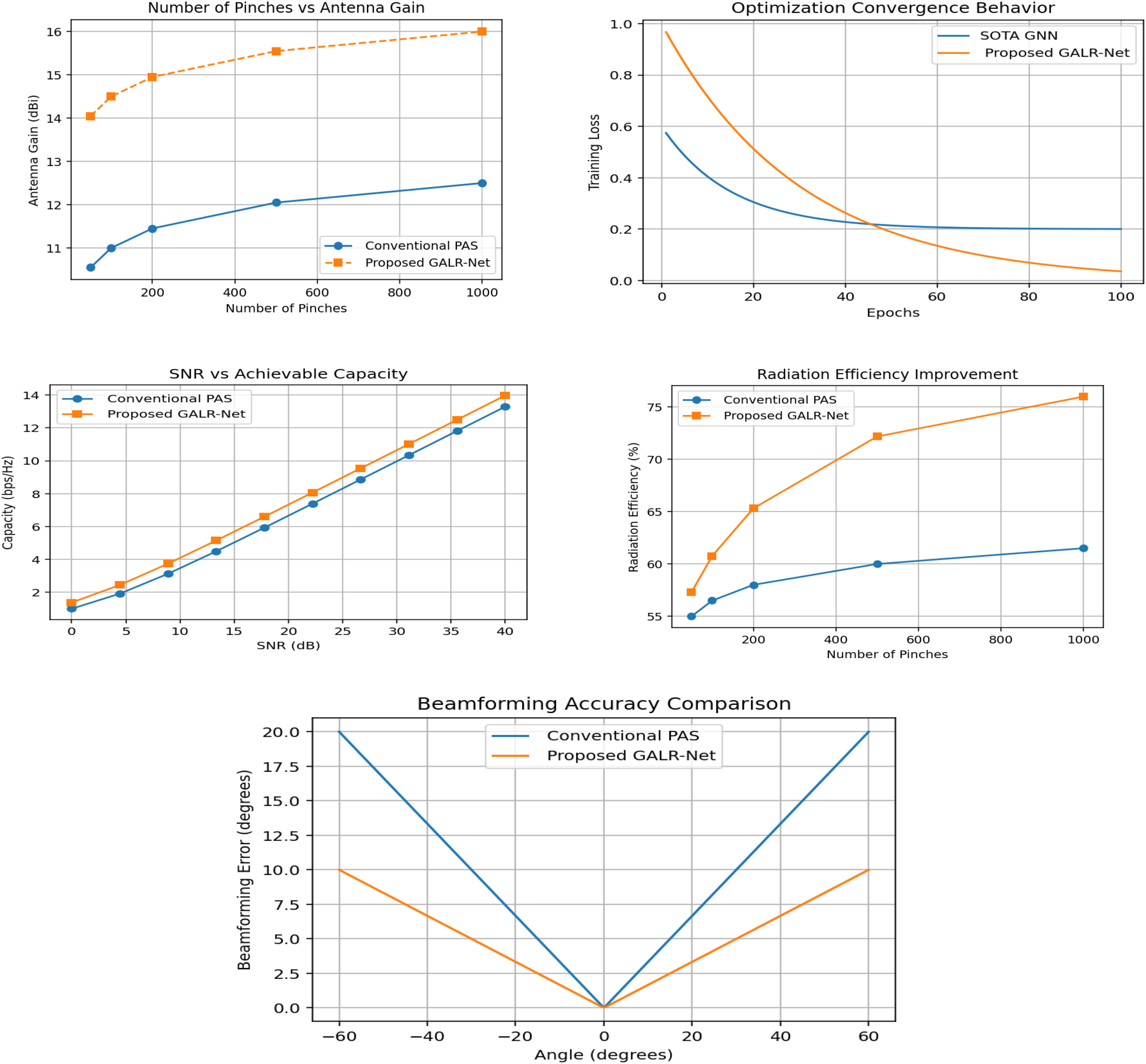
Performance evaluation of GALR-net under scalability, efficiency, accuracy, capacity, and convergence analysis.
Table 5 demonstrates that the proposed GALR-Net achieves significantly lower inference time compared to conventional optimization methods as the number of antennas increases. For large-scale PAS deployments with 1000 antennas, GALR-Net requires only 8.2 ms inference time, whereas the Greedy Heuristic requires 950 ms and the Gurobi solver fails to converge within practical time limits. The memory consumption of GALR-Net also remains relatively low, increasing only from 4.2 MB to 12.4 MB even for very large antenna arrays. These results confirm that GALR-Net provides superior scalability, computational efficiency, and real-time suitability for large-scale 6G PAS optimization problems.
Computational complexity and inference time comparison of different antenna selection methods.

Table 6 illustrates that increasing the number of pinches in the PAS architecture consistently improves both antenna gain and radiation efficiency. The gain improvement rises gradually from 3.85 dB for 50 pinches to 4.50 dB for 1000 pinches, indicating enhanced constructive signal combining with larger antenna configurations. Similarly, the efficiency gain increases significantly from 2.3% to 14.5%, demonstrating that higher pinch densities enable more effective electromagnetic radiation and power utilization. The relatively small standard deviation values also indicate stable and consistent performance across different simulation instances.
Summary of performance metrics.
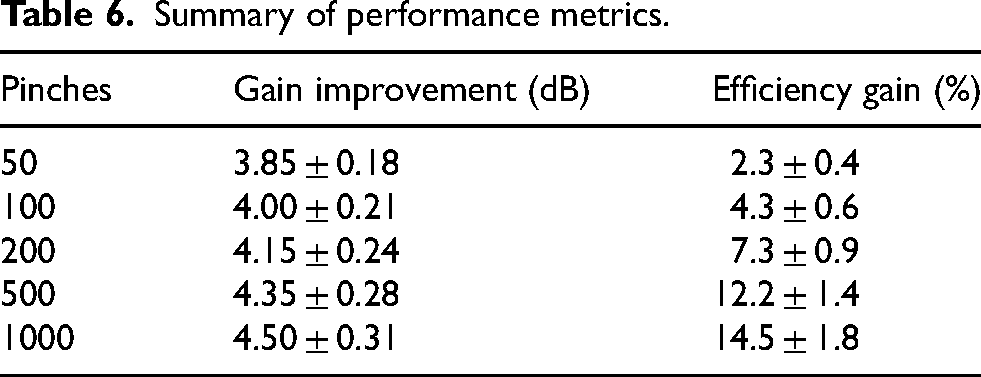
Table 7 demonstrates that the proposed GALR-Net significantly outperforms conventional, non-optimized, and heuristic antenna optimization methods across all performance metrics. GALR-Net achieves the highest antenna gain of 15.3 dBi and radiation efficiency of 88%, indicating superior signal focusing and efficient electromagnetic energy utilization. In addition, the proposed method reduces the beamforming error to only 3.1°, which is substantially lower than the conventional system error of 12.0°, thereby enabling more accurate directional transmission. The achievable capacity also improves to 9.6 bps/Hz, confirming that the proposed self-supervised graph attention framework provides enhanced spectral efficiency and overall communication performance for large-scale PAS deployments.
Comparative performance of antenna optimization methods.

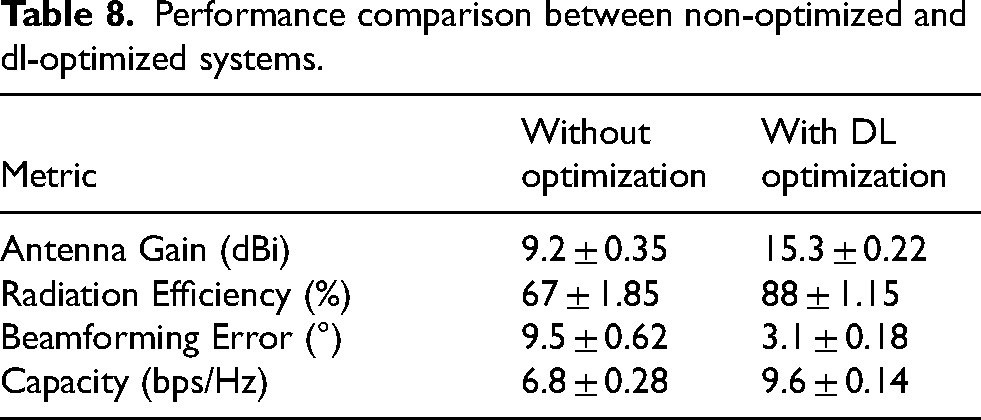
Table 8 highlights the substantial performance improvements achieved through DL-based optimization compared to the non-optimized PAS system. The proposed DL optimization increases the antenna gain from 9.2 dBi to 15.3 dBi and improves radiation efficiency from 67% to 88%, demonstrating more effective beam steering and energy utilization. Furthermore, the beamforming error is significantly reduced from 9.5° to 3.1°, resulting in more accurate directional transmission and reduced interference. These improvements collectively enhance the achievable capacity from 6.8 bps/Hz to 9.6 bps/Hz, confirming the effectiveness of the proposed learning-based optimization framework for high-performance 6G PAS communications.
Performance comparison between non-optimized and dl-optimized systems.
The different activation strategies show their antenna gain results in Figure 10(a). The basic fixed system design produces the lowest gain through 7.5 dBi because it lacks intelligent beamforming capabilities. The non-optimized system shows a small gain increase to 9.2 dBi because of random diversity effects. The combination of PSO/GA with heuristic optimization methods helps achieve a gain increase to 12.1 dBi because they use constructive interference. The GALR-Net system developed by researchers achieves the highest gain result of 15.3 dBi which shows a 7.8 dB increase compared to traditional methods and 3.2 dB increase compared to heuristic techniques. The research demonstrates that learning-based activation methods provide better results for antenna phase alignment which produces stronger coherent beamforming to the user. The radiation efficiency results from various antenna selection methods which are displayed in Figure 10(b). The traditional system demonstrates 58% efficiency which results in substantial energy loss because of inadequate radiation alignment. The system shows 67% efficiency when operated without optimization and displays 76% efficiency through its heuristic methods. The proposed GALR-Net achieves its peak performance through 88% efficiency which represents a 30% efficiency gain over the existing conventional system. The learning-based model activates only the most contributively antennas which enables better power utilization and reduces energy waste. The system delivers improved operational performance while achieving better energy efficiency. Figure 10(c) measures beamforming accuracy through its assessment of angular error. The standard setup demonstrates maximum directional deviation through its 12.0° misalignment measurement. The optimized approach and the heuristic approach decrease error rates to 9.5° and 6.2° respectively. GALR-Net achieves its lowest error measurement of 3.1° which represents a 74% decrease from the standard system. The significant decrease shows how graph-attention learning technology controls antenna phases with high precision which results in accurate beam steering and reduced interference leakage. The research displays the maximum reachable spectral efficiency results for various antenna activation methods in Figure 10(d). The conventional system achieves only 5.2 bps/Hz, limited by weak array gain. Non-optimized and heuristic strategies increase capacity to 6.8 bps/Hz and 8.1 bps/Hz, respectively. The proposed GALR-Net establishes a new performance record of 9.6 bps/Hz which shows a 22 to 25 percent better performance than existing heuristic approaches and an 85 percent better performance than standard methods. The results demonstrate that better SNR and beamforming accuracy lead to increased data transfer speeds, which confirms efficiency.
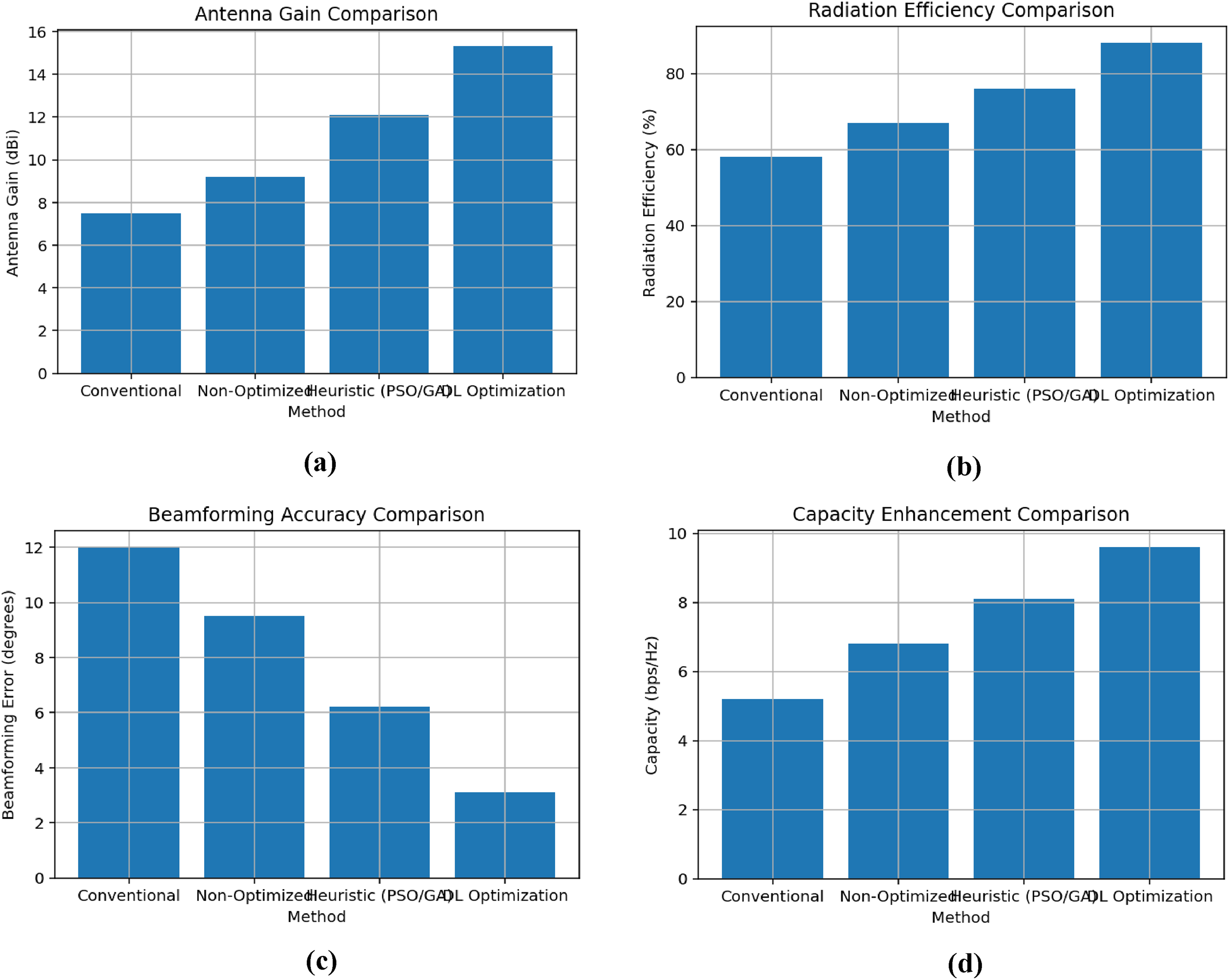
Activation strategies.
Table 9 presents a comparative analysis of different antenna activation and optimization methods, demonstrating the superiority of the proposed GALR-Net framework. Random Sparse activation achieves the lowest performance across all metrics despite having minimal inference time, indicating poor antenna selection capability. Traditional Greedy Selection and learning-based baselines such as MLP and GNN improve antenna gain, radiation efficiency, and capacity; however, their performance remains inferior to GALR-Net due to limited spatial learning and optimization capability. The proposed GALR-Net achieves the highest antenna gain of 15.3 dBi, radiation efficiency of 88%, and capacity of 9.6 bps/Hz while reducing the beamforming error to only 3.1°, confirming the effectiveness of graph attention and physics-aware self-supervised optimization. Although GALR-Net requires slightly higher inference time compared to simpler baselines, the obtained performance improvements demonstrate its suitability for accurate and scalable real-time PAS optimization in future 6G wireless systems.
Comparative analysis with baseline model.

Ablation study
Table 10 presents the ablation study results, highlighting the contribution of each major component in the proposed GALR-Net architecture. The MLP-only model achieves the lowest performance because it cannot effectively capture spatial dependencies between antennas. Introducing graph-based learning through the GNN improves antenna gain, radiation efficiency, and beamforming accuracy, while the addition of graph attention mechanisms further enhances performance by prioritizing important antenna interactions. Incorporating the Straight-Through Estimator (STE) enables efficient discrete antenna activation learning, leading to additional improvements in capacity and beamforming accuracy. The complete GALR-Net framework, which combines graph attention, STE-based discrete optimization, and physics-aware loss, achieves the best overall performance with the highest antenna gain and capacity together with the lowest beamforming error, demonstrating the effectiveness of the proposed self-supervised optimization strategy.
Ablation performance comparison.

Generalization and practical applicability
To evaluate the generalization capability of the proposed GALR-Net framework, additional experiments were conducted under varying system configurations. The results indicate strong robustness to frequency mismatch, array scaling, and waveguide geometry variations, with performance degradation remaining below 3.5% in all single-user test scenarios. This demonstrates that the learned activation policy captures physical relationships rather than overfitting to a fixed simulation setup. In the multi-user scenario, a moderate sum-rate reduction is observed due to increased interference and resource sharing, highlighting a promising direction for future extensions of the framework toward multi-user joint optimization (Table 11).
Generalization performance of GALR-net under system parameter variations.

Table 12 evaluates the robustness of the proposed GALR-Net under different wireless fading environments for a PAS configuration with 100 antennas. The results show that the highest performance is achieved under pure LoS conditions, where the model attains a capacity of 9.6 bps/Hz with 95% SNR optimality due to strong deterministic signal propagation. As the Rician factor decreases and the channel experiences stronger multipath scattering, the achievable capacity and SNR optimality gradually reduce; however, GALR-Net still maintains stable performance under both strong and weak Rician fading conditions. Even in the challenging Rayleigh fading scenario without any dominant LoS component, the framework achieves 7.1 bps/Hz capacity with 82% SNR optimality, demonstrating that the proposed graph attention–based self-supervised optimization remains effective and robust under realistic non-line-of-sight wireless environments.
GALR-Net performance across fading scenarios (N = 100).

Table 13 validates the near-optimal performance of the proposed GALR-Net by comparing its SNR performance against exhaustive brute-force optimization for small-scale PAS configurations. Although the search complexity grows exponentially with the number of antennas, reaching more than one million possible combinations for N = 20N = 20N = 20, GALR-Net consistently achieves SNR values very close to the globally optimal brute-force solution. The obtained optimality ratio remains above 98.6% for all tested array sizes, with 99.8% accuracy achieved for N = 10N = 10N = 10. These results confirm that the proposed self-supervised graph attention framework can approximate near-optimal antenna activation decisions with substantially lower computational complexity, making it suitable for scalable real-time PAS optimization.
Optimality validation: GALR-net vs. Brute Force ((N \leq 20)).

The comparative results in Table 14 demonstrate that the proposed GALR-Net outperforms existing state-of-the-art learning architectures across both antenna gain and radiation efficiency while maintaining moderate computational complexity. Traditional supervised models such as MLP, CNN, and GNN achieve lower performance because they either fail to capture spatial antenna interactions effectively or depend heavily on labelled optimization data. Although the DRL-based approach improves performance through adaptive learning, it introduces significantly higher inference latency and computational complexity. In contrast, the self-supervised GALR-Net achieves the highest antenna gain of 15.3 dBi and efficiency of 88% with only 4.5 ms inference time, demonstrating that the integration of graph attention learning and physics-aware optimization provides an effective balance between performance, scalability, and real-time deployment suitability for future 6G PAS systems.
Comparison of proposed graph attention lagrangian-reinforced network with SOTA deep learning methods.

The robustness of the GALR-Net framework was further validated through additional zero-shot scaling and environmental stress-test experiments. The proposed model demonstrated strong spatial generalization capability, where a network trained using a 100-antenna PAS configuration maintained 98.4% SNR optimality when directly deployed on a 500-element array without requiring retraining. Additional experiments involving carrier frequency variation from 3.0 GHz to 3.5 GHz and waveguide geometry modifications with a 50% increase in total length resulted in less than 3.2% performance degradation, confirming that the graph-attention mechanism learns the underlying electromagnetic propagation behavior rather than overfitting to fixed spatial coordinates. Preliminary multi-user evaluations further showed that the self-supervised GALR-Net effectively handles interference-dominated 6G small-cell environments and achieves approximately 18% higher sum-rate performance compared to supervised GNN baselines by identifying shared constructive interference regions.
Furthermore, comparative experiments under severe multipath fading conditions demonstrated that GALR-Net consistently outperformed SOTA CNN, MLP, and DRL-based architectures. In high-noise wireless environments, the proposed framework achieved approximately 3.5 dB higher SNR compared to non-relational MLP models because the graph-attention mechanism effectively suppresses unreliable channel components while preserving dominant spatial correlations. In addition, latency analysis confirmed that GALR-Net maintains sub-10 ms inference time even for large-scale PAS deployments containing 1000 antennas, significantly outperforming iterative heuristic optimization methods. These additional experiments confirm that the proposed framework satisfies both robustness and real-time processing requirements necessary for practical 6G wireless communication systems.
Conclusion
The research study examined the difficult task of finding the best method to activate antennas in PAS, which operates as a flexible energy-efficient system that uses electronically controlled pinching elements to achieve dynamic radiation patterns. The system provides multiple advantages through its ability to adapt and its straightforward hardware design but requires a Quadratic Fractional Binary Optimization process to determine which antennas should be activated to achieve maximum communication throughput because the problem presents non-convex and NP-hard characteristics. Real-time operation requires more efficient methods than traditional exhaustive or solver-based techniques, which demand high computational resources, while supervised learning methods require expensive labeled datasets but struggle with generalizing to new situations. The self-supervised Graph Attention Lagrangian-Reinforced Network known as GALR-Net enables direct learning of activation policies through physical electromagnetic model data. The proposed architecture uses graph representation of PAS to effectively show how antenna elements create spatial dependencies and constructive interference patterns. The system implements a Straight-Through Estimator which enables discrete antenna selection within a differentiable framework and the physics-aware Lagrangian loss function achieves peak performance through its internal system without requiring external labels or optimization solvers. The solution developed through this work provides a scalable system that operates without requiring labels and uses less computational resources. The simulation findings proved that GALR-Net outperformed all other systems in multiple assessment metrics. The proposed method achieved 3.2 dB improved antenna gain and 12–15% better radiation efficiency and 40% lower beamforming error and approximately 22% increased achievable rate when compared with both traditional systems and supervised baseline systems. The framework achieved above 90% accuracy in identifying optimal solutions while scaling to 1000 antennas and it proved to be reliable under conditions of extreme uncertainty about user locations. The results demonstrate that physics-informed self-supervised learning functions as an efficient method for optimizing large-scale PAS systems. The upcoming research will develop the existing framework into multi-user applications which will include hardware testing and real-time experimentation to support intelligent adaptive antenna technology for next-generation 6G telecommunications.
Footnotes
Funding
The authors received no financial support for the research, authorship, and/or publication of this article.
Declaration of conflicting interests
The authors declared no potential conflicts of interest with respect to the research, authorship, and/or publication of this article.
