






Abstract
Background
Apolipoprotein E (APOE) ɛ4 carriage is the strongest genetic risk factor for sporadic Alzheimer's disease dementia. Clinical guidelines discourage APOE disclosure, but therapeutic advances are changing this. Limited work has assessed knowledge and interest in APOE disclosure in Australian adults, and it remains unclear which characteristics are associated with interest within this sample.
Objective
This study examines knowledge and interest in APOE disclosure among Australian adults. Based on previous estimates, it was hypothesized that ≥50% would be interested in APOE disclosure.
Methods
Cognitively unimpaired middle- and older-aged adults (N = 1421) completed the Knowledge, Interest and Preferences for APOE Testing and Disclosure survey, measuring APOE knowledge, interest in APOE disclosure, and perceived benefits/concerns. Participants completed online assessments measuring demographic, mood, subjective cognitive, Alzheimer's disease literacy, and perceived risk characteristics. Participants were categorized into four groups based on their interest: 1) want to know, 2) interested but need more information to decide, 3) unsure, 4) do not want to know).
Results
Almost half of participants (44.2%) indicated that they had heard of APOE previously. Most participants (82%) were interested in knowing their APOE genotype or wanting more information. Compared to individuals who did not want to know their APOE genotype (114, 7.9%), individuals who wanted to know were younger, female, more likely to report dementia family history, and had greater perceived cognitive and Alzheimer's disease risk.
Conclusions
Interest in APOE disclosure is high among Australian adults, consistent with international estimates. Findings will inform APOE disclosure protocols for Australian adults at-risk of dementia.
Introduction
Apolipoprotein E (APOE) ɛ4 allele carriage is the strongest genetic risk factor for sporadic Alzheimer's disease (AD) dementia. 1 Compared to ɛ4 non-carriers, ɛ4 heterozygotes and homozygotes are 3 and 12 times more likely to develop AD dementia, respectively. 1 Despite this, APOE testing and disclosure has been discouraged, 2 with some medical professionals, policy experts, and people with AD expressing concerns about unintended psychological and sociolegal harms and a lack of ‘clinical actionability’.2–4 However, drug developments have rapidly changed the therapeutic landscape of AD. Brain amyloid-β (Aβ) lowering therapies aducanumab, 5 lecanemab, 6 and donanemab 7 have recently been approved by regulators, including the US Food and Drug Administration, as disease-modifying therapies for early AD dementia. Importantly, however, associated phase 3 trials have demonstrated clear associations between ε4 carriage and higher risk of brain microhemorrhages and edema, along with reduced treatment efficacy.5,6,8 In addition, ε4 carriers represent a critical at-risk group in lifestyle and pharmacological trials9–11 given their greater risk of progression to dementia 12 and increased Aβ accumulation. 13 As APOE affects therapeutic safety and efficacy, and because ε4 carriers may benefit most from early and targeted intervention, APOE testing and disclosure will become routine clinically, 14 and trial stratification by APOE genotype will become increasingly common. 15 As such, investigating public understanding and interest in APOE disclosure is crucial.
Despite initial concerns, a careful approach to APOE disclosure is well-tolerated, even among cognitively unimpaired (CU) ε4 carriers.16–18 The Risk Evaluation and Education for Alzheimer's Disease (REVEAL) trial showed no significant differences in anxiety, depression, and event-related distress between carriers and non-carriers at 6-weeks, 6- and 12-months.16,17 Another study reported increased depression and distress in only a small percentage of carriers, 19 while another described initial disappointment in carriers, neutralized by sentiments of acceptance and empowerment over time. 20 Additionally, changing attitudes, particularly in high-income countries, have centered the right to know one's health risks,21,22 which has increased interest in APOE disclosure even when disease-modifying therapies were unavailable. For example, in the US, 50% of CU individuals with a family history of AD were interested in APOE disclosure,23–25 with interest as high as 80% provided testing is paid for by insurance. 26
Several factors have been associated with interest in APOE disclosure previously, 27 including subjective memory, 28 desire to prepare family for a possible AD diagnosis,29,30 age, 24 sex,23,24 and perceived AD risk. 31 While previous insights are informative, many originate from two large US-based studies (REVEAL I 16 /II 17 ). Interest in APOE disclosure may be culturally specific and influenced by US healthcare and insurance systems, which differ considerably to those in Australia. 27 An important step in developing culturally-appropriate APOE disclosure programs is to describe interest, investigate the factors that influence interest, and to understand perceived benefits and concerns associated with disclosure in an Australian context. Finally, understanding interest in middle-aged adults is important, as prevention and treatment efforts increasingly target adults in earlier life stages.
The first aim of this study was to determine knowledge of APOE, including perceived benefits and concerns associated with APOE disclosure in CU middle- to older-aged Australian adults. The second aim was to describe interest in APOE disclosure in a research setting in this same sample. Based on previous findings,23–26,32 it was hypothesized that ≥50% will be interested in APOE disclosure. The final aim was to describe and compare demographic, mood, subjective cognition, AD literacy, and perceived AD risk characteristics between individuals with varying interest in APOE disclosure.
Methods
Design and participants
This cross-sectional online survey study included 1421 CU adults aged 40–70 at initial registration. Of these, 976 were recruited from the Healthy Brain Project (HBP), and 445 from the BetterBrains Trial (BBT). The HBP is an observational cohort of CU community-dwelling Australian adults. 33 Individuals with self-reported dementia family history were targeted for enrolment. The BBT is an ongoing randomized controlled trial to determine whether a personalized risk factor management program can prevent cognitive decline in CU community-dwelling Australian adults with a family history of dementia. 34 Participants with a diagnosis of mild cognitive impairment or dementia, including those reporting use of any Therapeutic Goods Administration (TGA) approved treatment for AD or Parkinson's disease were excluded, as determined at eligibility screening for either the HBP or BBT. Full inclusion/exclusion criteria have been detailed previously (Supplemental Table 1).33,34
Procedure
Participants complete online assessments of demographic, health, and lifestyle characteristics. Existing data assessing demographics (age, sex, ethnicity, education), dementia family history, subjective cognition, mood, and AD literacy and risk characteristics were obtained. BBT data was blinded to randomization status and from the baseline timepoint, prior to randomization and any intervention. Participants were invited to complete the Knowledge, Interest and Preferences for APOE Testing and Disclosure (KNOW-APOE) survey via email between July-August 2023, with data collected between July-December 2023. The HBP (approval number: 26855), BBT (25221), and KNOW-APOE (38453) studies received approval from the Monash University Human Research Ethics Committee in accordance with the ethical standards of the Declaration of Helsinki. Electronic informed consent was obtained prior to survey commencement. HBP participants completed the KNOW-APOE survey on the HBP platform and BBT participants completed the survey via Qualtrics (Supplemental Figure 1).
Measures
Knowledge, interest and preferences for APOE testing and disclosure (KNOW-APOE)
The KNOW-APOE survey, comprising 46 questions, assessed (1) knowledge about APOE, AD risk contributors, and the ɛ4 allele, (2) interest in APOE testing and disclosure, and (3) preferences for the APOE testing and disclosure process (Supplemental Table 2). This study utilizes data from thirteen questions, relating to pre-existing knowledge about APOE, AD risk contributors and ε4, interest in APOE disclosure, and perceived benefits/concerns about APOE disclosure. The KNOW-APOE survey and associated data is available from the corresponding author upon reasonable request.
Data collated from the HBP and BBT
Demographic characteristics and mood
Demographics included age, sex, ethnicity, education (years), and dementia family history (first-/second-degree), assessed by online questionnaires. The Hospital Anxiety and Depression Scale (HADS) assessed mood symptomatology, comprising seven questions assessing anxiety and seven questions assessing depression. 35 Items are summed separately to form two subscales (HADS-Anxiety/Depression), and higher scores (range: 0–21) indicate greater anxiety or depressive symptoms, respectively.
Subjective cognition
Subjective cognition was assessed using a modified Cognitive Function Instrument (CFI), a 22-item questionnaire evaluating individuals’ subjective ratings of their cognition. 36 The CFI was designed for older adults and some items were modified for midlife to include ecologically valid questions about cognition at work and other relevant settings. 33 Total CFI score (sum of all responses) was used as the outcome reflecting subjective cognitive concerns, with higher scores (range: 0–44) indicating greater concerns.
AD literacy and perceived risk characteristics
AD literacy, including knowledge about APOE ɛ4 and AD risk was assessed first within the KNOW-APOE survey. A knowledge of AD risk score was computed by summing four items rated on a 5-point Likert scale ranging from 1 (strongly disagree) to 5 (strongly agree). Two items were reverse scored for interpretability, with higher scores indicating greater AD risk knowledge. A knowledge of APOE ɛ4 score was computed by summing two items rated on a 5-point Likert scale ranging from 1 (strongly disagree) to 5 (strongly agree), with 0 assigned if the participant had never heard of ɛ4. One item was reverse scored for interpretability, with higher scores indicating greater ɛ4 knowledge. Other components of AD literacy and perceived risk were assessed using a modified Perceived Threat of AD questionnaire, consisting of eight subscales measuring (1) perceived risk of AD, (2) AD knowledge, (3) negative aging stereotypes, (4) beliefs about benefits of engaging in protective health behaviors to modify AD risk, (5) hope for an AD cure, (6) perceived mortality risk as a result of AD, (7) control over risk of developing AD, and (8) importance of genetics in determining AD risk (for scoring details, see Supplemental Methods 1). 37
Data analysis
Analyses were conducted in RStudio (v.2023.06.1 + 524).
Frequency proportions (number (N), percentage (%)) were computed for responses to explore knowledge of AD and APOE, interest in APOE disclosure, and perceived benefits and concerns associated with APOE disclosure. Frequency proportions for participants who reported knowing their APOE genotype (N = 22) were not computed for perceived benefits and concerns.
Descriptive statistics described demographics across each cohort and the pooled sample, summarized using the mean (M) and standard deviation (SD) for continuous variables, and N/% for categorical variables. Descriptive statistics were not computed for participants who reported knowing their APOE genotype (N = 22) and these participants were excluded from all other analyses thereafter, resulting in 1399 participants total for the below analyses.
Next, to describe and compare demographics, mood, subjective cognition, AD literacy, and perceived risk characteristics across participants with differing interest in APOE disclosure, participants were categorized into four groups: (1) individuals who want to know their APOE genotype, (2) individuals who were interested but want to know more about APOE before deciding, (3) individuals who are unsure, and (4) individuals who do not want to know their APOE genotype. Participants who indicated that they “know what APOE is and would not like to know their gene” or that they “don’t know enough about APOE and are not interested in finding out” were combined to form group 4. Characteristics were summarized using the mean and standard deviation for continuous variables and N/% for categorical variables. Shapiro-Wilk tests indicated that all variables significantly deviated from a normal distribution and a non-parametric test was used.
Kruskal-Wallis tests determined whether characteristics (continuous variables only) differed significantly between groups. Planned comparisons (Dunn's tests with Bonferroni correction) determined differences on each continuous outcome between groups: (1) individuals who want to know their APOE genotype versus (2) individuals who were interested but want to know more about APOE before deciding; (1) versus (3) individuals who are unsure; and (1) versus (4) individuals who do not want to know their APOE genotype. Chi-square tests determined whether demographics (categorical) differed significantly between groups and planned comparisons (described above) were conducted. Odds ratios characterized the magnitude of difference on each outcome between groups.
Statistical significance for initial tests was set at p < 0.05 as this is novel research in an Australian context that was largely exploratory and descriptive, while planned comparisons corrected for multiple comparisons using the Bonferroni method.
Results
Knowledge of APOE, AD risk, and ε4
Of 1437 participants who responded to the question asking if they had heard of APOE, 44% (N = 636) indicated that they had heard of APOE previously. Most participants (68.1%) heard about APOE from research participation (e.g., HBP, BBT), whereas very few (2.0%) heard about APOE from their general practitioner (Table 1).
Participant endorsed sources of learning about the APOE gene.
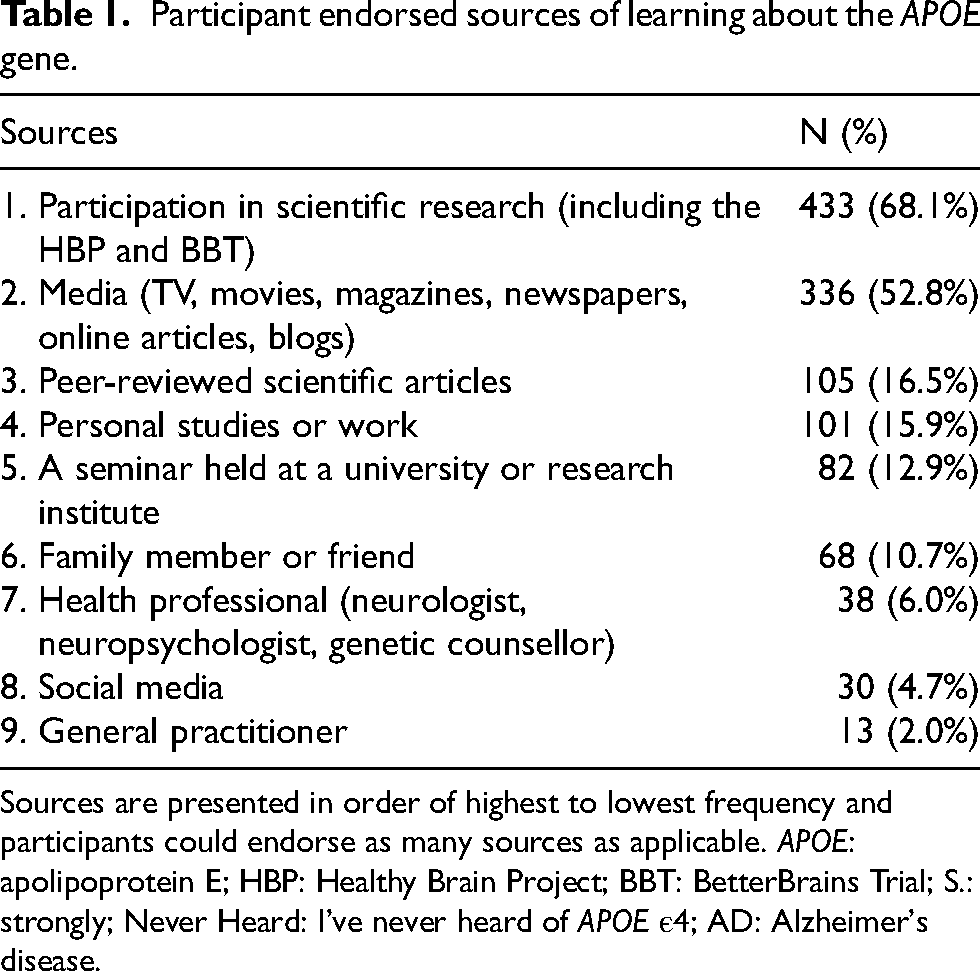
Sources are presented in order of highest to lowest frequency and participants could endorse as many sources as applicable. APOE: apolipoprotein E; HBP: Healthy Brain Project; BBT: BetterBrains Trial; S.: strongly; Never Heard: I’ve never heard of APOE ε4; AD: Alzheimer's disease.
Table 2 summarizes the responses of 1383 participants who rated their agreement with a series of statements assessing evidence-based knowledge of AD risk and ε4. Generally, responses indicated that participants recognized that AD risk is influenced by a variety of factors. However, the most common response to questions assessing ε4 knowledge was “I’ve never heard of APOE ε4” (Table 2).
Participant rating/endorsement of statements assessing evidence-based pre-existing knowledge of AD risk and the APOE ε4 allele.

S.: strongly; AD: Alzheimer's disease; Never Heard: I’ve never heard of APOE ε4; APOE: apolipoprotein E.
Interest in APOE disclosure
Of 1421 participants who responded to the question asking about interest in APOE disclosure, most participants (82%) expressed an interest in knowing their APOE genotype or wanting more information (Figure 1). Few participants (16%) were unsure or indicated no interest in learning their APOE genotype (Figure 1).
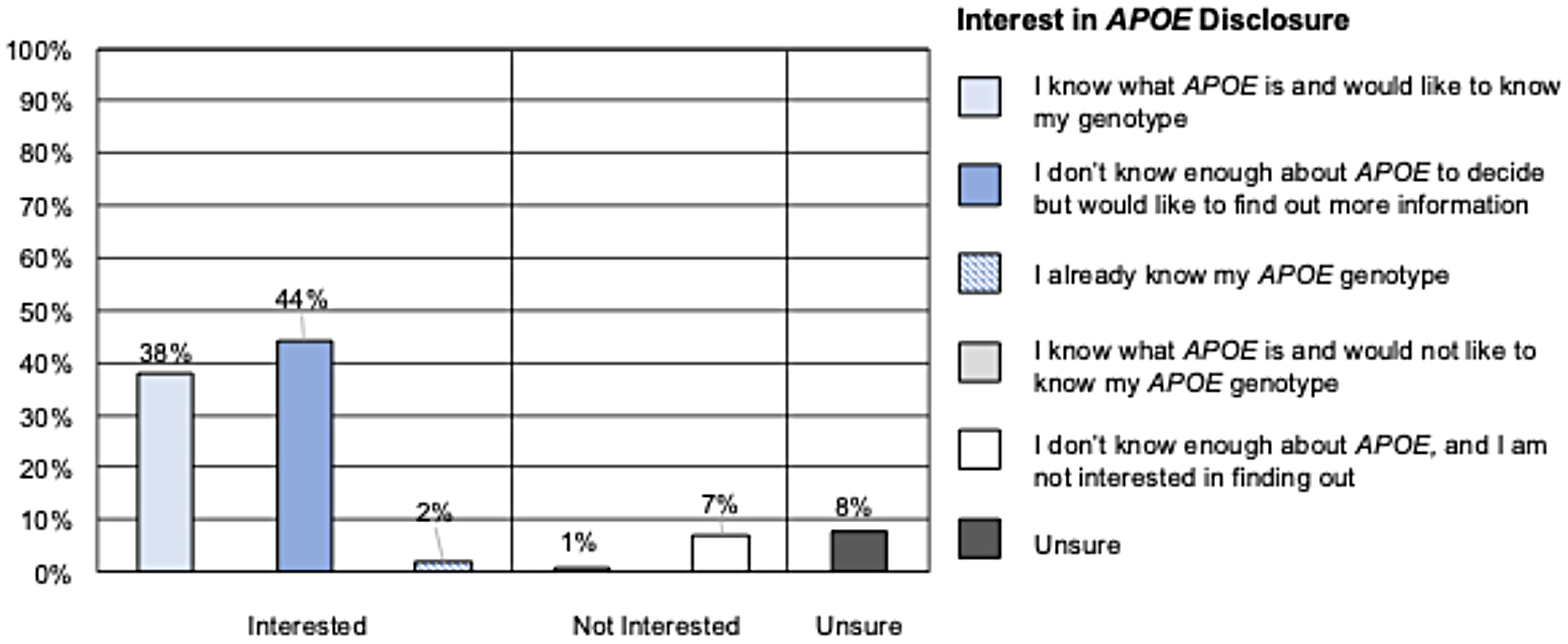
Proportion of participants (%) interested in APOE disclosure.
Perceived benefits and concerns associated with APOE disclosure
Table 3 summarizes participant endorsement of perceived benefits and concerns associated with APOE disclosure. In individuals who reported wanting to know their APOE genotype and in individuals who were interested but wanting to know more about APOE before deciding, the most common perceived benefit related to health motivation (e.g., making lifestyle changes to reduce AD risk) (Table 3). They were most likely to express no concerns about disclosure, although some expressed concerns related to fixating on perceived memory and thinking changes (Table 3).
Frequency of endorsement of perceived benefits and concerns of undertaking APOE testing and disclosure.

N = number of participants in that group who endorsed the perceived benefit or concern and (%) = proportion of participants in that group who endorsed the perceived benefit or concern. Participants could endorse as many of the above benefits and concerns as desired. NA: not applicable.
Similarly, in individuals who did not want to know their APOE genotype, the most common perceived benefit related to health autonomy (e.g., taking control of their health) (Table 3). The most common concern related to fixating on perceived memory and thinking changes (Table 3). In individuals who were unsure about learning their APOE genotype, the most common perceived benefit related to future treatments, such as if a preventative therapy for AD were to become available (Table 3), and the most common concern was becoming preoccupied with the test result (Table 3).
Demographic characteristics
Table 4 summarizes the demographic characteristics of the 1399 participants included in this analysis (N = 22 excluded for knowing their APOE genotype). Age, sex, and education were similar across cohorts (Table 4). A greater proportion of Caucasian participants was observed among HBP participants compared to the BBT. A greater proportion of participants with a first- or second-degree dementia family history was observed among BBT participants compared to the HBP.
Demographic characteristics across cohorts and the pooled sample.
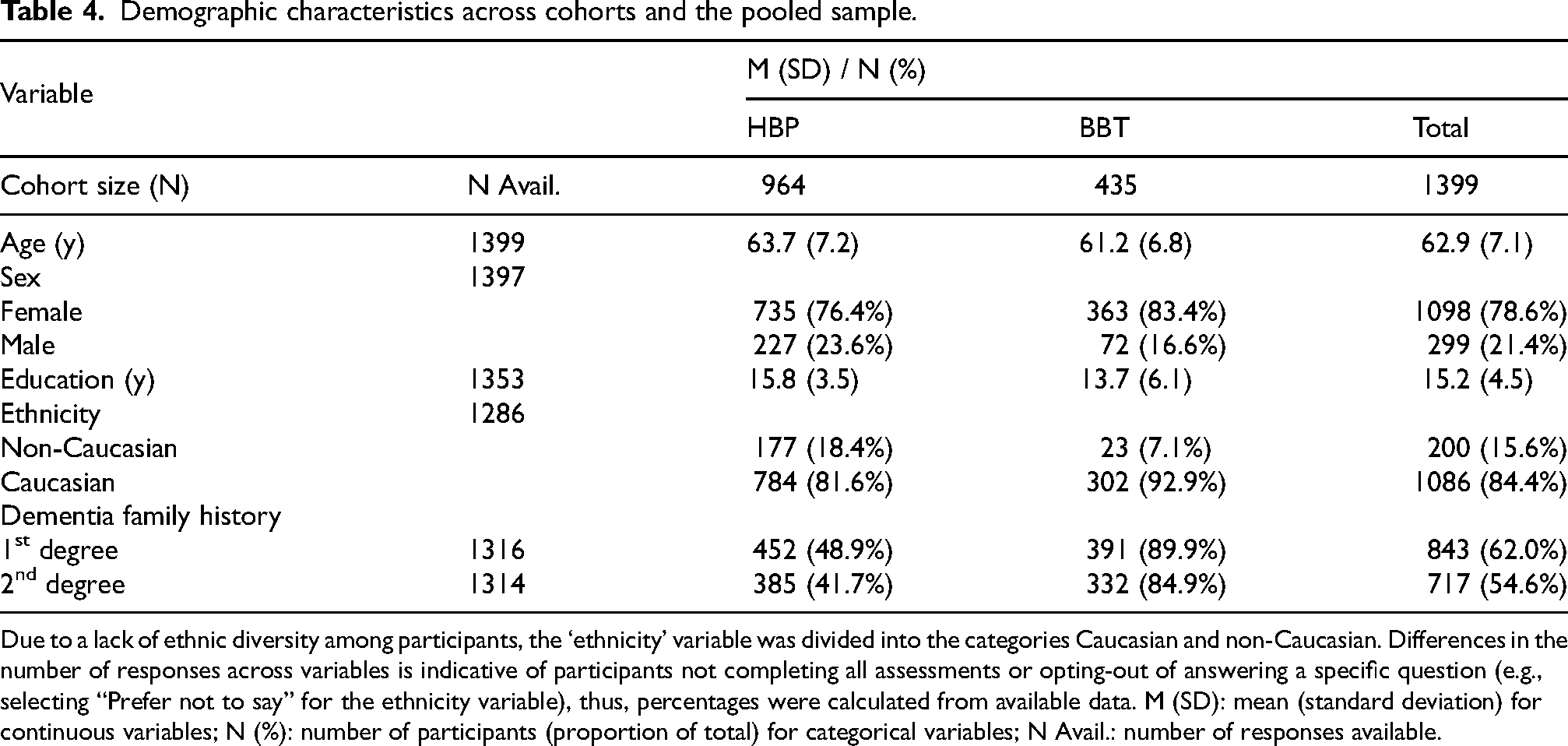
Due to a lack of ethnic diversity among participants, the ‘ethnicity’ variable was divided into the categories Caucasian and non-Caucasian. Differences in the number of responses across variables is indicative of participants not completing all assessments or opting-out of answering a specific question (e.g., selecting “Prefer not to say” for the ethnicity variable), thus, percentages were calculated from available data. M (SD): mean (standard deviation) for continuous variables; N (%): number of participants (proportion of total) for categorical variables; N Avail.: number of responses available.
Group differences in demographic, mood, subjective cognitive, AD literacy and perceived risk characteristics
Groups with varying interest in APOE disclosure differed significantly on age, AD risk and ε4 knowledge, beliefs about benefits of engaging in protective health behaviors, perceived mortality risk as a result of AD, perceived control over risk for AD, belief in the importance of genetics in determining AD risk, subjective cognition, and self-perceived AD risk (Table 5). Specifically, compared to individuals who reported wanting to know their APOE genotype, individuals who were interested but want to know more about APOE before deciding were significantly older, less knowledgeable about AD risk and ε4, had weaker beliefs in benefits of engaging in protective health behaviors to modify AD risk, had weaker beliefs about AD increasing mortality risk, and had greater self-perceived risk of developing AD (Table 5).
Demographic, mood, subjective cognitive and AD literacy and perceived risk characteristics across groups with varying interest in APOE disclosure.
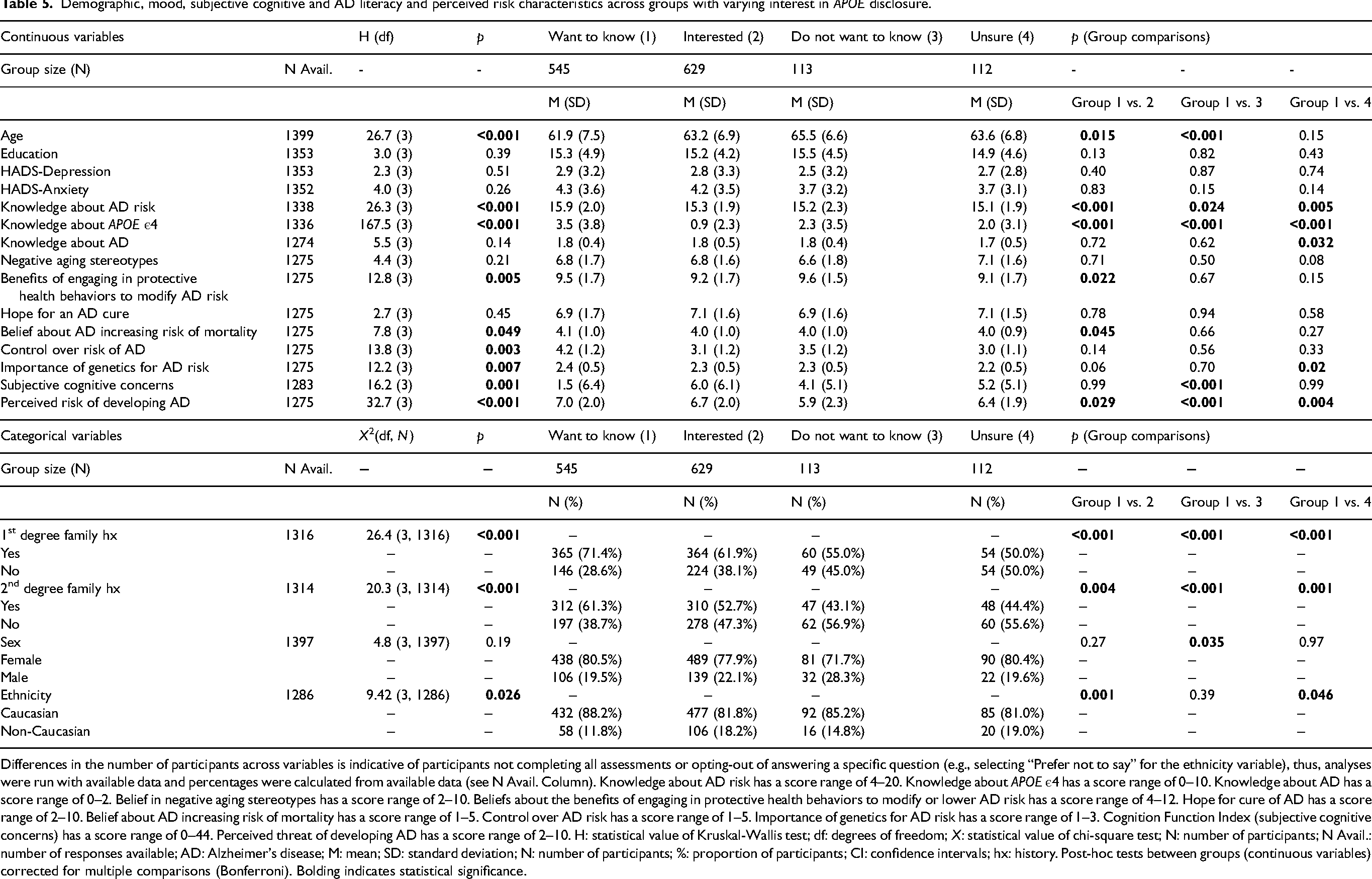
Differences in the number of participants across variables is indicative of participants not completing all assessments or opting-out of answering a specific question (e.g., selecting “Prefer not to say” for the ethnicity variable), thus, analyses were run with available data and percentages were calculated from available data (see N Avail. Column). Knowledge about AD risk has a score range of 4–20. Knowledge about APOE ε4 has a score range of 0–10. Knowledge about AD has a score range of 0–2. Belief in negative aging stereotypes has a score range of 2–10. Beliefs about the benefits of engaging in protective health behaviors to modify or lower AD risk has a score range of 4–12. Hope for cure of AD has a score range of 2–10. Belief about AD increasing risk of mortality has a score range of 1–5. Control over AD risk has a score range of 1–5. Importance of genetics for AD risk has a score range of 1–3. Cognition Function Index (subjective cognitive concerns) has a score range of 0–44. Perceived threat of developing AD has a score range of 2–10. H: statistical value of Kruskal-Wallis test; df: degrees of freedom; X: statistical value of chi-square test; N: number of participants; N Avail.: number of responses available; AD: Alzheimer's disease; M: mean; SD: standard deviation; N: number of participants; %: proportion of participants; CI: confidence intervals; hx: history. Post-hoc tests between groups (continuous variables) corrected for multiple comparisons (Bonferroni). Bolding indicates statistical significance.
Compared to individuals who reported wanting to know their APOE genotype, individuals who did not want to know their APOE genotype were significantly older, less knowledgeable about AD risk and ε4, reported fewer subjective cognitive concerns, and had lower self-perceived AD risk (Table 5). Finally, compared to individuals who reported wanting to know their APOE genotype, individuals who were unsure were significantly less knowledgeable about AD, AD risk and ε4, had weaker beliefs in the importance of genetics in determining AD risk, and had lower self-perceived risk of developing AD (Table 5). No group differences were observed for education, HADS depression/anxiety, negative aging stereotypes, hope for an AD cure, and control over risk for AD (Table 5).
The proportion of participants reporting dementia family history, ethnicity and sex differed significantly between groups (Table 5). Specifically, compared to individuals who were interested but want to know more about APOE before deciding, individuals who reported wanting to know their APOE genotype were more likely to report a first- (OR = 1.54, 95%CI = [1.19–1.98]) or second-degree dementia family history (OR = 1.42, 95%CI = [1.12–1.81]) and be Caucasian (OR = 1.66, 95%CI = [1.17–2.34]) (Table 5). Similarly, compared to individuals who did not want to know their APOE genotype, individuals who reported wanting to know their APOE genotype were more likely to report a first- (OR = 2.04, 95%CI = [1.34–3.12]) or second-degree dementia family history (OR = 2.09, 95%CI = [1.37–3.18]) and be female (OR = 1.63, 95%CI = [1.03–2.59]) (Table 5). Finally, compared to individuals who were unsure, individuals who reported wanting to know their APOE genotype were more likely to report a first- (OR = 2.50, 95%CI = [1.64–3.82]) or second-degree dementia family history (OR = 1.98, 95%CI = [1.30–3.01]) and be Caucasian (OR = 1.75, 95%CI = [1.00–3.06]) (Table 5).
Discussion
In CU Australian adults, the primary hypothesis, that ≥50% would be interested in APOE disclosure, was supported. Most participants (82%) were interested in APOE disclosure, with 38% indicating that they know what APOE is and would like to know their genotype, and a further 44% indicating interest but wanting more information. To the best of our knowledge, no studies have examined interest in APOE disclosure in Australia, however, this observation aligns with US23,26,28,30,32 and European 38 estimates. For example, a recent study in CU Dutch adults aged 49–75 reported 81% interest in APOE disclosure, with interest particularly high if dementia risk was presented as “50% at age 85”, based on estimates of cumulative dementia incidence in ε4 homozygotes.38,39 A US-based survey of 4036 adults in the Alzheimer's Prevention Initiative (API) reported >80% interest in APOE disclosure, provided testing was covered by insurance. 26 Together, these findings suggest that interest in APOE disclosure is fairly consistent across countries, despite differences in healthcare, insurance, and legal systems.
Knowledge of APOE, ε4, and AD risk contributors
In this study, only 44% of participants had heard of APOE previously, with fewer having heard of ε4, and the majority learning of it from research participation. A moderate proportion (15%) endorsed the statement that AD risk is completely genetically determined. While very few (2%) believed that ε4 is deterministic of AD, only a quarter (24%) recognized ε4 carriage as increasing AD risk. Few studies have assessed APOE-specific knowledge in the context of AD risk. Nevertheless, these findings are at odds with a US-based survey of participants in the Rhode Island Alzheimer Prevention Registry (RIPR), whereby >70% correctly answered at least four out of five questions about APOE without receiving education. 30 Similarly, another large US survey including 4036 adults in the API Alzheimer's Prevention Registry (APR) reported that 87% correctly recognized ε4 carriage as a genetic risk for AD not indicative of the current presence (or absence) of AD. 26 However, RIPR and APR participants are heavily involved in research in memory clinics. 40 Findings may therefore be less generalizable compared to our more community-based sample, who, despite prior research participation, are not based within a tertiary hospital or memory-clinic setting. In Australian and US surveys assessing community knowledge about dementia risk factors, APOE knowledge has not been examined explicitly.41–44 For example, while 95% of 596 Australian adults aged 18–78 broadly recognized ‘genetics’ as important to dementia development, knowledge of specific risk genes was not assessed. 41
Large international surveys have instead examined modifiable dementia risk factor knowledge, and dementia misconceptions,41–43,45 showing that evidence-based knowledge about AD risk remains low, with few participants believing AD risk is modifiable and only 3.1% recognizing not smoking as a brain healthy behaviour. 42 Conversely, most (93%) participants in this study endorsed the evidence-based statement that genetics, lifestyle, and demographics influence AD risk, aligning with studies reporting high participant agreement that genetics only partially account for the development of dementia.46,47 In addition, most participants in our study perceived moderate control over their AD risk (M = 3.2, max=5), and held moderately strong beliefs about engaging in protective behaviors (e.g., exercise) to modify this risk (M = 9.4, max=12). This is unsurprising given participants’ prior involvement in research, which likely enhances their knowledge, perceived control, and belief in lifestyle modification compared to the general population. However, despite greater awareness, participants still moderately endorsed aging stereotypes, consistent with recent review findings showing that 50% of participants endorsed dementia as a normal part of aging. 45 We extend previous research by showing that even among individuals with greater AD awareness, very few recognize ε4 carriage as a key AD risk factor, and aging misconceptions persist.
Characteristics associated with interest
A variety of demographic, clinical, and psychosocial characteristics were associated with interest in APOE disclosure. Compared to participants who did not want to know their APOE genotype, those who wanted to know were younger, female, more likely to report dementia family history, more knowledgeable about AD risk and ε4, had greater memory concerns, and perceived themselves at greater AD risk. Other US and European studies have assessed characteristics associated with interest with inconsistent results.23,24,28,38,48–51 Others have shown that interest is higher among males and those with greater educational attainment, but that interest does not differ by age, dementia family history, subjective memory, or self-perceived dementia risk. 38 Older studies report no differences in interest by education, 23 greater interest among men, 23 younger (aged <60) 24 and older (aged 65–74) adults, 48 and people with 50 and without48,50 a family history of AD, showcasing the variability of results. However, perhaps the most robust predictor of interest is self-perceived AD risk, also observed in this study, and replicated consistently across studies spanning countries, age, and family history characteristics.28,30,48,51 Self-perceived AD risk may be closely related to subjective cognition, which may drive interest in APOE disclosure. 28 However, given that subjective cognition associates strongly with depression, 52 it is surprising that no studies have assessed whether interest differs by mood. In the current study, interest did not differ by anxiety or depressive symptoms, although those with poorer mood may be less likely to opt-in to participate. Finally, compared to participants who were unsure or interested but want more information before deciding, individuals who want to know their APOE genotype reported stronger beliefs about engaging in protective behaviors, that AD would increase mortality risk, and the importance of genetics in determining AD risk. Participants with stronger belief in the effect of lifestyle modification, AD-associated mortality, and genetic contributions may feel greater urgency to act upon their risk and may therefore be more receptive to acquiring additional information (e.g., APOE test results) to better inform that risk, particularly if the information is considered helpful or motivating. One study showed that participants with higher mastery, defined as a greater sense that fate is in one's hands, demonstrated greater interest in APOE disclosure. 28 Heterogenous results hinder our ability to generalize our findings. However, when considered broadly, results suggest that greater AD-specific knowledge, stronger dementia family history, self-perceptions of risk and health behaviors, but not mood, are associated with greater interest in APOE disclosure in an Australian sample.
Benefits and concerns associated with APOE disclosure
Benefits associated with APOE disclosure centered health motivation and autonomy, including engagement in healthy lifestyle behaviors to reduce AD risk, greater perceived control over health, and in case an AD therapy becomes available. This is consistent with US-based studies showing that interest in APOE disclosure is often driven by perceived motivation to adopt healthier lifestyles if found to be at higher genetic risk, 31 the hope of effective treatments,29,53 and information-seeking preferences to increase situational control. 51 Conversely, other common benefits in US studies include research participation 30 and arranging personal affairs, including financial planning.29,30,51 While participants endorsed similar benefits, research participation and future planning (e.g., finances, care) were not the most common benefits in this study. Differences may reflect country-specific healthcare contexts, including navigating and accessing medical and insurance systems. In the present study, common concerns were worry about fixating on results or perceiving any future cognitive changes as indicative of imminent dementia. These results differ slightly to those observed previously, whereby concerns relate mostly to experiencing anxiety or depression if found to carry an ε4 allele.29,30 It is possible, however, that worry about results and cognitive changes reflects an element of mood symptomatology, including anxiety, rumination, and depression, although this was not explicitly reflected in this study.
Limitations, future directions, and implications
Study limitations must be considered when contextualizing results. Firstly, cognitive normality was determined from self-reported absence of an MCI or dementia diagnosis and reported non-use of any TGA-approved treatment for AD or Parkinson's disease, rather than from objective neuropsychological testing. While this approach is consistent with the approach used in the parent studies from which our sample was recruited, it limits certainty regarding participants’ cognitive status. Second, public knowledge of AD and APOE and therefore interest in APOE disclosure may be lower than estimated in this study, as most participants had a strong family history of dementia, and all were recruited from two existing AD risk and prevention studies, which regularly distribute dementia psychoeducation to participants. At the same time, that most participants in this study self-report a dementia family history provides valuable insights into interest in APOE disclosure among an at-risk group who may be more likely to encounter APOE testing and disclosure in future clinical and research contexts, due to their heightened genetic risk for AD. Nevertheless, results may be less generalizable to the general Australian population, and future studies should assess knowledge and interest in APOE disclosure in broader and more diverse samples. Next, participants were not educated about APOE nor test limitations prior to survey completion and some participants were more likely to express no concerns about APOE disclosure. Other studies have shown that psychoeducation can change interest,31,54 which may, in turn, influence benefits and concerns. Future studies should examine the effects of psychoeducation on interest and testing perceptions in Australian adults, including investigating the characteristics of individuals who change their mind. Similarly, benefits and concerns may change post-disclosure, and as such, may be better understood as perceived, rather than realized. Lastly, results from this study suggest that clinical and research-based APOE disclosure protocols should incorporate structured pre-disclosure education and post-disclosure monitoring and support that addresses common concerns identified in this study, including potential psychological impacts associated with perceived memory changes and fixating on test results, and concerns regarding genetic discrimination. Careful tailoring of recruitment and risk communication strategies to engage men and older adults, who may be less inclined to pursue APOE testing, will further enhance the relevance and acceptability of APOE disclosure programs as they become more commonplace.
Conclusions
Despite demonstrating limited knowledge of APOE ε4 as a key genetic risk factor for AD, interest in APOE disclosure among Australian adults was high, consistent with international estimates.23,26,28,30,32,38 These findings highlight the need for psychoeducation to improve understanding of AD genetic risk factors and will guide the development of culturally-appropriate disclosure protocols in an Australian context.
Supplemental Material
sj-docx-1-alz-10.1177_13872877251393714 - Supplemental material for Interest in apolipoprotein E (APOE) disclosure among at-risk, cognitively unimpaired, community-dwelling Australian adults
Supplemental material, sj-docx-1-alz-10.1177_13872877251393714 for Interest in apolipoprotein E (APOE) disclosure among at-risk, cognitively unimpaired, community-dwelling Australian adults by Emily Rosenich, Hannah Olver, Hannah Cummins, Jason Karlawish and Yen Ying Lim in Journal of Alzheimer's Disease
Footnotes
Acknowledgements
We thank T Foreman for her assistance with initial survey questions. We thank all participants involved in this study for their time, dedication, and commitment to advancing Alzheimer's disease research.

Ethical considerations
The HBP (approval number: 26855), BBT (25221), and KNOW-APOE (38453) studies all received approval from the Monash University Human Research Ethics Committee in accordance with the ethical standards of the Declaration of Helsinki.
Consent to participate
Electronic written informed consent was obtained prior to survey commencement.
Author contribution(s)
Funding
The authors disclosed receipt of the following financial support for the research, authorship, and/or publication of this article: E Rosenich is supported by an Alzheimer's Association Research Fellowship (23AARF-1025519). YY Lim is supported by a National Health and Medical Research Council Investigator Grant (GNT2009550). The funders had no role in the study design, collection, analysis or interpretation of data, in the writing of the report, and in the decision to submit the article for publication.
Declaration of conflicting interests
The authors declared the following potential conflicts of interest with respect to the research, authorship, and/or publication of this article: J Karlawish reported serving on the data safety monitoring board for Linus Health (received personal fees) and board of directors for the Greenwall Foundation. YY Lim is an Editorial Board Member of this journal but was not involved in the peer-review process of this article nor had access to any information regarding its peer-review. The remaining authors declared no potential conflicts of interest with respect to the research, authorship, and/or publication of this article.
Data availability statement
The data supporting the findings of this study are available on reasonable request from the corresponding author and due to ethical restrictions, will only be shared after an approved data sharing agreement is in place.
Supplemental material
Supplemental material for this article is available online.
References
Supplementary Material
Please find the following supplemental material available below.
For Open Access articles published under a Creative Commons License, all supplemental material carries the same license as the article it is associated with.
For non-Open Access articles published, all supplemental material carries a non-exclusive license, and permission requests for re-use of supplemental material or any part of supplemental material shall be sent directly to the copyright owner as specified in the copyright notice associated with the article.
