







Abstract
In Spain, the so-called ‘non-employment traineeships’ are regulated by dispersed and varied legislation, depending on the specific area of the placement. Compounding this difficulty in determining the applicable regulations, some of the rules governing traineeships without a contract of employment in Spain have, over the last 15 years, been declared null or unconstitutional by various court judgments. Therefore, to define the regulatory framework for non-work placements, it is first necessary to define what we understand by this term and then to specify the type of placement.
Once this initial conceptual and regulatory framework has been established, we can conduct a thorough analysis and also determine whether it complies with the relevant international and European frameworks.
Setting out the issue
According to the dictionary of the Royal Spanish Academy (RSA), a traineeship can be defined as ‘an exercise that, under the direction of a master and for a certain period, someone must undertake to become qualified and to be able to publicly practise their profession’. This definition is not sufficiently clear as to the meaning of the term ‘exercise’, but such a set period is essential for a person to obtain professional accreditation and thus move on in their profession with complete freedom and independence. During this period, however, under the direction of an expert (‘master’), as the RSA definition states, what specifically does the person on a traineeship do?
With only basic knowledge, we could say: they perform an activity (without going into details); which is practical and, where applicable, theoretical; on a voluntary basis; under the direction of another hierarchically superior person; within a larger or smaller organisation; without appropriating the work or the fruits of that activity (alienation); and with or without economic compensation. Surely, however, these elements are practically identical to the basic premises of an employment relationship in Spain?
Spain has numerous normative modalities of traineeships in companies. Some of these are considered non-employment traineeships and others labour-related, even when they combine training with the exercise of a profession.
In the EU, the landscape of non-employment traineeships in companies is complex (Howe, 2021: 208–212), with some scenarios, such as those in the free or open market, being more susceptible to fraud. The modalities of non-employment traineeships in Spain create a confusing web of typologies and sub-typologies; this paper will examine whether they are aligned with the relevant EU legal framework.
Additionally, the paper aims to analyse the most prominent forms of non-employment traineeships in Spain, to explain the differences between them, if any. It also seeks to clarify the social protection available to trainees within the Social Security system, and whether this social protection, with or without justification, covers all risks or only some.
There is not always a clear distinction between a person on a non-employment traineeship and a person on an employment traineeship within a company. The practice of colloquially designating interns as ‘scholarship holders’ may conceal a genuine employment relationship (Hernández de Luz, 2017: 209). This is one of the main problems highlighted in the European Parliament's 2023 resolution to combat the phenomenon of ‘bogus trainees(ships)’. Is it an issue in Spain? This paper seeks to delve into this point, given that, although not all regulations explicitly state it, non-employment traineeships in public or private companies have always subjectively targeted young people. The young are a vulnerable group in Spain, which has a high youth unemployment rate; the EU has also paid special attention to young people, as they can be exploited when undertaking non-employment traineeships in business environments. Currently, Spain is in the process of approving a Trainee Statute, which we will examine to check if it addresses – in line with EU recommendations – the current challenges related to non-employment traineeships, regarding social protection and other rights.
Types of traineeships: Employment-related versus non-employment
Traineeships can be categorised in different ways. At the European level, the clearest classification differentiates between traineeships undertaken within a formal training system or curriculum, traineeships as an employment policy measure for unemployed individuals, and ‘open market’ traineeships (Stewart, 2021: 24).
The ‘open market’ traineeships are covered by a Quality Framework for Traineeships (QFT), promulgated in 2014 by the Council of the EU, which emphasises the need to determine the regime of rights and obligations for parties involved in these non-employment placements. It also attempts to limit their duration, and suggests a reasonable maximum duration of six months. 1
The Recommendation also acknowledges traineeships as an employment policy measure, given the significant impact of the 2014 crisis on youth unemployment. However, this appears to be a secondary characteristic, as the Recommendation primarily focuses on reinforcing the didactic and training nature of non-employment traineeships.
In Spain, the classification can be more confusing. One primary classification distinguishes between employment-related traineeships and non-employment traineeships. A second classification differentiates between intra-academic and extra-academic traineeships; the ‘extra-academic’ category includes both employment-related and non-employment traineeships.
It' is important not to confuse these traineeships with apprenticeships, which the ILO defines in its 1962 Vocational Training Recommendation (No. 117) as ‘systematic long-term training for a recognized occupation taking place substantially within an undertaking’ (Eleveld et al., 2022: 270). However, following Helme (2024: 683), there is no clear definition of a trainee, and there is regulatory confusion in the European Member States between three overlapping concepts: apprenticeships, traineeships and internships.
The proposal for a Directive clearly distinguishes between two concepts: a traineeship period and a trainee worker. In the current Spanish legal framework, these are intermingled. Hence, the decision was made in this article to study the two existing typologies of intra-academic, non-employment traineeships (‘traineeships within a training system’, in European terminology, which we will describe as formative traineeships that lead to a university degree or vocational training qualification). We will also examine a third group of extra-academic, non-employment traineeships used as an employment policy measure (a hybrid between APLM and open market traineeships), where the contrast and the risk of fraud can be more clearly appreciated.
Academic traineeships for university students: The excuse of comprehensive training
External academic traineeships for university students are a right for undergraduate students and a possibility for master's students. During these traineeships, students must have ‘effective, academic, and professional tutelage’. The purpose of these traineeships, according to the regulations, is to boost the employability of future professionals.
Only students enrolled in a Spanish university, including those enrolled in a foreign university by virtue of a mobility programme, may opt for these traineeships. These students, as a general rule, should not enter into a contractual relationship – meaning an employment relationship.
A training plan is required, developed by the university, clearly establishing the educational objectives and the activities to be carried out, with the practical content directly related to the competencies students are to acquire, based on their studies. Alongside this guarantee, intermediate and final reports are required from both institutions, as a safeguard for these non-employment traineeships, to ensure that they are genuinely formative and not in fact an employment contract.
This framework regulates two types of non-employment traineeships: curricular and extracurricular traineeships. The extracurricular traineeships are not subject to the same monitoring and tutoring rules as curricular traineeships; a more open framework is allowed, as they are not included in the study plan.
The conditions attached to the practical activity also differ between curricular and non-curricular traineeships. The duration of a curricular traineeship is established in the corresponding study plan: it cannot exceed 60 credits. For non-curricular traineeships, there is no absolute limit, as the rules state that ‘preferably’ they should not exceed 50% of the academic year. However, by not limiting but only recommending, the door is left open to possible abuse.
Students may receive, if agreed between the entities, economic compensation, which the regulation calls ‘scholarship or study aid’. No specific amount is established.
These non-employment traineeships cannot be counted towards seniority or merit for entry into public entities, given their formative nature. This acts as an incentive for companies to enter into collaboration agreements, but, from our perspective, runs counter to an employment policy aimed at the professional insertion of university students, who are generally young. Consequently, it discourages young people from undertaking non-employment traineeships.
It can be inferred that these non-employment traineeships do not give rise to obligations typical of an employment relationship and cannot be used to replace actual workers. Clearly, applying theoretical knowledge acquired at university is a way of providing a service or activity, not so far removed from an employment relationship; it can often be equated to an employment contract for ‘assistant’ categories or professional groups, which also have a formative character. Even if the entities running the non-employment traineeships are not committing abuse or fraud, a student can be taking on part of the workload of that entity. This is why, even if the regulatory framework is respected – although without mandatory economic compensation – it is often in practice not possible to differentiate between the practical activity carried out by a university student and that of a recent university graduate. And the recent university graduate can be employed under a training contract for obtaining professional practice (Article 11.3 of the Workers’ Statute, ET) with all guarantees and rights, including restrictions on working hours, a salary and full social protection.
As Helme (2024: 699) states, learning and training do not necessarily preclude rights such as remuneration and limits on working time. This is all because, in accordance with the CJEU's jurisprudence on the concept of a ‘worker’, the work performed by a trainee must be genuine and real – as in any traineeship that involves the provision of a service.
Non-employment traineeships as part of vocational training. The vocational training system involves, among other things, the participation of students in workplaces. 2
Dual vocational training is imparted either through a general scheme, or via an intensive scheme, with both requiring the completion of a training module in companies.
For the general scheme, there is no employment contract with the company, and it is explicitly stated that the legal nature of the relationship is not an employment relationship, even though some form of financial assistance may be provided for transport or similar. The intensive scheme, on the other hand, involves alternating training at the vocational training centre and in the company, with this productive activity being remunerated through a training employment contract with the company.
Is there a difference between the practical activity (productive in both cases) carried out under the general vocational training scheme and under the intensive scheme? A reading of the Law suggests that this is an artificial difference, based on time and location. That is, the time dedicated to practical activity under the general scheme is understood to be shorter; and, while in both cases the practical training is imparted in companies, in the intensive vocational training scheme, theoretical training is also delivered within the company. In our view, the legislator has sought to offer greater guarantees to individuals pursuing intensive vocational training, by making them eligible for an employment contract. This may be because it is felt that as these trainees spend more hours per day within the scope of a company's organisation and under its direction, and have less connection with the educational centre, they may have more contact and mingle with the company’s regular workers.
The detriment to the rights and guarantees of individuals training under the general scheme does not appear justified, as can be seen in three examples. First, the general scheme trainees are present in the company and are also subject to its organisation and direction, carrying out the ‘non-employment traineeship’ activity in the same manner as trainees on the intensive vocational training scheme. Second, as they spend less time in the company, their knowledge of it, for example regarding occupational risks, may be less, making them more vulnerable to health risks. Third, they will also have greater travel requirements between the educational institution and the company.
In the two types of vocational training, the practical activity carried out may be exactly the same, of greater or lesser duration, with no significant difference in the training plan. There are insufficient indicators to assert that the traineeship under the general vocational training scheme is not an employment contract, while the traineeship under the intensive vocational training scheme is an employment contract. This is a random difference, legally established, but not sustainable in the light of the basic requirements of an employment relationship: it involves practical activity in companies, carried out by natural persons, on a voluntary basis, with greater or lesser dependence depending on the case, but subject to organisation by an employer, without appropriation of either the profits or the risks of the work and, in the case of the general scheme, not necessarily remunerated.
This distinction is made even more random by the fact that the previous system, known as the ‘scholarship for dual vocational training’, with no employment contract, can be applied under the intensive scheme until 31 December 2028. From that date onwards, participation in the intensive scheme will require an employment contract for training.
In other words, from 1 January 2029, employment training within the dual system (intensive scheme) will necessarily be carried out on the basis of an alternating training employment contract. What social security protection will these students enjoy during their practical activity in companies, under this type of contract? In accordance with Art. 11.4 ET, it will comprise all protected contingencies and all benefits, including unemployment and coverage by the Wage Guarantee Fund. However, despite the expansion of social protection for these traineeships, trainees on the general vocational training scheme will still have no unemployment benefit coverage, and those in unpaid traineeships – the most common scenario – will also lack protection against temporary incapacity in case of non-occupational illnesses or accidents. This is an unjustified difference between traineeships working towards the same vocational training qualification.
In this regard, the proposal for a Traineeships Directive insists on the vulnerable position of trainees and the need to standardise rights, ensuring they do not receive less favourable treatment than comparable regular workers in the same workplace, unless there is an objective justification for such different treatment.
In the Spanish case described, there is no objective justification for the difference in social protection between two categories of vocational training students in traineeships, depending on whether they are in a general scheme or an intensive scheme. Spain must therefore establish uniform treatment, i.e. total coverage of all social security contingencies across all vocational training traineeship schemes. The non-granting of employment status significantly affects young people, and, as discussed, fails to address the contractual inequality between the company and the trainees. This continues a trend towards fragmentation in Spain’s basic labour law, which López López (2014: 46, 47) already noted as detrimental and seemingly only justified by market requirements.
Non-employment traineeships in companies outside an educational institution: Ranging between employment promotion measure and fraud
In this section, we focus on the system of non-employment traineeships in companies established by Royal Decree 1543/2011, of 31 October 2011. The purpose of the regulation is (preamble) to address serious youth unemployment in the Spanish labour market, regulating non-employment traineeships for young people with employability problems. When the text first appeared, youth unemployment in Spain (16–24 years) stood at 43.5%, leading the EU-27, reaching 48.8% in 2011 (Eurostat, 2012). The regulation is therefore focused on young people aged between 18 and 25, who are unemployed, have a professional qualification in any field (labour or educational), but lack experience in the world of work.
The fundamental difference between the traineeships regulated in this Law and those previously described is that these are not linked to any training programme. The objective of this system relates to youth unemployment, but is it an adequate framework today? We analyse the characteristics of this type of traineeship.
First, we consider the personal scope: age. The regulation aims to promote the labour integration of young people. Young people are aged between 18 and 25, but the age range here is extended, equating it with people included in the Youth Guarantee System (YG), through the National Youth Guarantee System file. Initially, the YG system was aimed at individuals aged 16–24, or persons under 30 with a degree of disability of 33% or above – an exception which applied while youth unemployment in Spain was 20% or more. Since 2019, the age range has been generally established as between 16 and 30.
Regarding this issue, the following observations can be made.
First, the RSA defines ‘young’ as an adjective describing a person who is in youth, ‘of young age’; ‘youth’ is defined as the ‘period of human life that immediately precedes maturity’.
In Spain, we frequently find the word ‘young’ used to define a situation of precariousness. In Spanish legislation, the definitions of youth are increasingly broad and heterogeneous: there is no single criterion used in employment policies, with criteria differing even for the same measure. Along with this, moreover, this concept covers a very heterogeneous social group: people in the age ranges of 16–18, 18-24, or 24 years onwards are not the same.
In 2024 in Spain, people between 16 and 29 years old made up 23.5% of the population, approximately 7 million people.
We shall next consider the unemployment rate. In Spain, this began to rise dramatically in late 2007, coinciding with the increase in unemployment across the EU triggered by the economic crisis. However, the ‘rule of 2’ – whereby youth unemployment in Europe was typically double the general unemployment rate – ceased to be the norm in Spain. Youth unemployment soared past 30% in 2010, and then hit 50% in 2013.
Unemployment has declined somewhat in recent years. In February 2025 (Eurostat), the unemployment rate in the EU stood at 5.7% (12.677 million), with the youth unemployment rate (ages 15–25) at 14.5%. In Spain, the fall in the overall unemployment rate in January 2025, to 10.4% (Eurostat), is considered a significant milestone; however, the youth unemployment rate (ages 16–25) is 25.3%. This remains one of the highest in the EU, though it is lower than the figure for January 2024 (28.1%) (Figure 1).
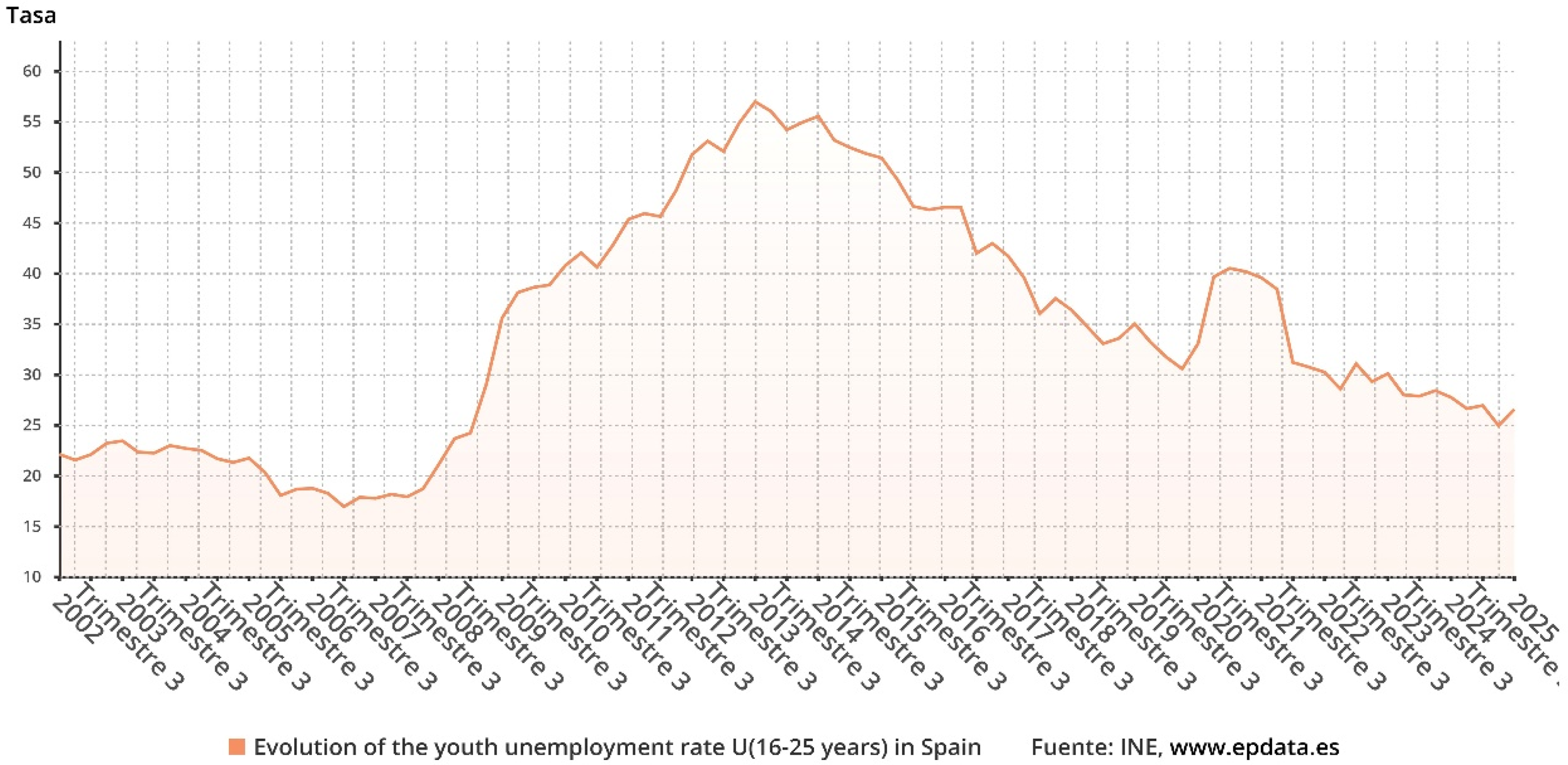
Trends in the youth unemployment rate (16–25 years) in Spain.
This situation places an increasing strain on the Spanish Social Security system, which faces a significant deficit. The pressure on the system is due to many factors, including the increase in life expectancy and the ageing population: more people are living longer and require pensions. This ‘baby boom’ impact would not be as concerning if young people were entering the workforce fully and earlier, and if their working lives were not riddled with precariousness.
The Europe 2020 Strategy set the following objectives: achieve an employment rate of 75% for people aged 20 to 64; reduce the school dropout rate to below 10%; ensure that at least 40% of people aged 30 to 34 have completed higher education; and lift 20 million people out of poverty and social exclusion. The European Commission emphasised the urgent need to combat high youth unemployment and improve skill levels, structured around three principles: smart growth (promoting knowledge, innovation, education and the digital society), sustainable growth (making production more resource-efficient while boosting competitiveness) and inclusive growth (encouraging labour participation, skill acquisition and the fight against poverty).
Spain has not met these objectives. The problem regarding youth unemployment is its persistence and its limited correlation with the economic cycle over the last 15 years. Among young people, unemployment rates do not decrease as education levels increase: while the highest unemployment rates are observed among young people who have not completed secondary education (lower level), the unemployment rate is also very high among university graduates. The supply of qualified workers is not necessarily creating demand (Burriel Rodríguez-Diosdado, 2013: 483), and the situation is not helped by employment policies that create no jobs, but, instead, alternative systems lacking social protection.
The extremely high poverty rate in Spain for the 16–29 age group is of great concern; the underground economy is also very significant, at over 24% (the third highest in the EU), with informal labour accounting for a significant portion of this. Labour informality can take various forms, including the use of non-employment internships, when a proper employment contract, with a salary and full social security contributions, should be in place.
The proliferation of precarious jobs among young people also has a social cost, as the loss of young human resources, including highly qualified individuals, reduces growth prospects and expands the risks of poverty and income inequality within and between generations, with high budgetary costs related to lower tax revenues and increased social spending (Burriel Rodríguez-Diosdado, 2013: 486).
Requirements for non-employment traineeships in companies. In addition to the personal scope, there are two fundamental requirements for participation in these traineeships.
The first criterion is possession of a qualification. The academic qualifications required for access to these non-employment traineeships can be a university degree, vocational training qualification, or equivalent, including artistic or sports training, but also the so-called ‘professional certificate’.
The second essential, and cumulative, requirement to be met is a lack of work or professional experience in the same activity. This criterion is not absolute; young people with no more than three months of work or professional experience may access this type of internship, so limited experience – of any type and in any form – is permitted.
Importantly, these two requirements do not apply to academic internships carried out by university students, both curricular and extracurricular. However, these internships must not form part of the training needed to obtain the corresponding qualifications or certificates. Ultimately, this is a way to broaden the range of internships available to young people through a formula that is, as we will see, quite open-ended and may undermine their rights.
Furthermore, according to the regulations, companies offering non-employment traineeships must enter into an agreement with the competent Public Employment Service (PES). This is an arrangement established by the legislator to ensure that these traineeships are utilised as an employment policy, aimed at improving the employability of young people. When an agreement is signed between the company and the young person regarding the specific development of the non-employment traineeship, there is an imbalance of power between the company and the young person. The public employment service does not supply a tutor, although it carries out monitoring and checks; instead, the tutor is supplied by the workplace where the practical activity takes place. And this tutoring activity is not truly monitored by the public services, which, incidentally, do not have sufficient staff to adequately manage non-employment traineeships in companies.
The established right to economic compensation, which the regulation calls a ‘scholarship’, consists of a monthly payment equivalent to 80% of the IPREM. 3 However, what is not made clear, and can be interpreted in different ways, is whether this amount is full-time equivalent, to be reduced proportionally for fewer hours. This vagueness leads, in practice, to companies, based on experience, stipulating that 80% is the maximum cap for a working day comparable to a maximum working day at the workplace, and on that basis, applying the corresponding reduction.
Recapitulation. Are these traineeships contrary to European recommendations? These regulated non-employment traineeships in no way constitute an employment relationship between the company and the young person. This contravenes the presumption established in Art. 1.1 ET, as well as the principle of irrelevance of the nomen juris, or the primacy of reality. Furthermore, this statutory presumption established in the 2011 regulation would not be necessary if the activity performed during the non-employment traineeships genuinely fulfilled the requirements of a training traineeship and not of an employment relationship. If the activity is performed voluntarily, dependently, on behalf of an employer, and is remunerated – even if some of the characteristic features lack intensity – or, in other words, if the activity carried out by the young person could genuinely be performed by a person with an employment contract, or if their activity is indistinguishable from and intermingles with that of other workers in the same workplace, then it is an employment relationship in puritatem.
The underlying issue with these traineeships is the absence of an institution or educational centre to guarantee a dedicated training programme or content, separate from the company's own productive activity. While the regulation (a brief one, incidentally) does provide for supervision by the PES, as analysed, this supervision is not sufficiently guaranteed to prevent potential abuse. This is because the specific content of the traineeship, its duration, the time or working hours allocated to it, the schedule, the assigned workplace, and, ultimately, the fundamental conditions which apply are left to the agreement between the company and the young person undertaking the non-employment traineeship. Clearly, the company is in a superior hierarchical position compared to the young person, which facilitates abuse.
The stipulated obligation to communicate the non-employment traineeship agreements to the workers’ representatives is insufficient. Not all companies are legally required to have statutory worker representatives; even when these do exist, they are merely informed of the agreements – they are not present during negotiations, are not involved in drafting a preliminary report prior to the young person's incorporation, or creating a model agreement, nor do they know the specific content of the agreement. The PES is overburdened with regular work, making it difficult for this service to monitor the real content and training nature of these traineeships.
This traineeship system introduces an exception to employment contracts for qualified individuals in Spain. A type of contract already exists that fits this situation: the practical experience contract (Art.11.3 ET). If that regulation is currently ineffective, the solution should be to modify it (Hernández de Luz, 2017: 218–223), and not to deprive young people of their labour and social protection rights under the guise of improved employability and as a temporary solution to their unemployment or inactivity.
Collective bargaining plays an important role in this regard, which should be reflected in collective agreements. Collective agreements could determine the number of traineeship agreements that can be concluded, and which activities are suitable for this type of non-employment traineeship.
For its part, the proposal for a Council Recommendation on a reinforced Quality Framework for Traineeships 4 highlights two key issues in this matter: Member States must ensure that the duration of traineeships does not exceed six months, and that students or trainees receive fair remuneration.
The maximum duration of the traineeships covered by the Spanish regulation analysed above can be nine months, which runs contrary to European recommendations for a limited and reasonable duration. Furthermore, the amount of €480 does not seem to fit the concept of ‘fair remuneration’. This is especially true given the cost of housing in Spain, the late age at which young people tend to leave home, and the constant increase in prices.
The evolution of social protection for non-employment traineeships in Spain
The regulation of non-employment traineeships in professional settings has long been a complex and multifaceted issue in the Spanish legal system. Traditionally, these traineeships have operated in a ‘grey area’ between training and employment relationships, which has often led to abuse and situations of lack of protection for young people in the EU (Escudero Rodríguez, 2016: 64). The absence of a common definition and specific legislation has created a blurred line between scholarships, formative traineeships and employment contracts, sometimes enabling genuine employment relationships to be concealed under non-contractual arrangements, depriving beneficiaries of labour rights and, in many cases, due social protection.
In this context, the wish to dignify traineeships and guarantee a contribution record for young people has been a constant in the political and social debate, as previously indicated. In Spain, this debate has been closely linked to the ‘Trainee Statute’ initiative, as we will analyse later.
Various regulations have been developed to include training programme participants in the Social Security system, the most important being in 2011, and, more recently, DA 52 of the General Social Security Law (LGSS).
A first step towards inclusion
Royal Decree 1493/2011, of 24 October, was adopted with the aim of establishing the terms and conditions for inclusion in the General Social Security Scheme of individuals participating in training programmes.
Its main characteristics are detailed below:
The decree aimed to cover those participating in training programmes financed by public or private entities or organisations, linked to university studies or vocational training which were not exclusively teaching-based and included formative traineeships in companies. A crucial requirement was that the trainees should receive economic compensation, but without an employment relationship, although they were assimilated to employed workers.
Protection was provided against all the contingencies of the General Regime, with the express exclusion of unemployment, the Wage Guarantee Fund, and vocational training. The contribution rules for training and apprenticeship contracts applied. At that time, trainees benefited from a 100% bonus on their contributions.
The entity financing the training programme acquired the status of employer, with the corresponding social security obligations.
The regulation referred to the possibility of signing a one-off special agreement stating that training periods undertaken before its entry into force would count as contributory, with a maximum limit of two years. This measure sought to mitigate the impact of training periods without coverage on the trainee’s future contribution record (an issue for so-called ‘research scholarships’ for doctoral theses in Spanish universities). The deadline for applying was extended until 31 December 2014.
The fifty-second additional provision of the General Social Security Law: A comprehensive and updated regulation, but is it sufficient?
Despite the progress made, the regulation of social protection for formative traineeships remained insufficient. The main issues were unpaid traineeships, and the lack of a basic legal framework to avoid the need for regulatory developments which, at times, failed to materialise (Vela Díaz, 2023: 71).
This situation led to the adoption of Royal Decree-Law 2/2023, of 16 March, which added DA 52 to the LGSS. The entry into force of this provision, foreseen for 1 October 2023, was delayed until 1 January 2024; it forms a more complete and robust legal framework for the inclusion of students on traineeships in the Social Security system.
Firstly, it expands the scope of application. It stipulates the inclusion in the Social Security regime of individuals undertaking formative traineeships, regardless of whether or not these are remunerated. This is one of the fundamental and most significant differences compared to the previous regulations, as the Law now covers traineeships related to any training module, and which are included in the trainees’ study plan. It therefore excludes traineeships for qualified individuals, or those traineeships which are part of training not included in the study plan or not leading to a qualification. This is a crucial step forward in the protection of a group historically unprotected by the regulation. Nevertheless, the guideline (CDGOSS) issued by the General Directorate for Social Security Management (DGOSS) requires those on unpaid traineeships also to pay social security contributions.
Secondly, the protection provided corresponds to the applicable Social Security regime, excluding the same benefits as the previous one, plus the intergenerational equity mechanism. An important new feature is that those on unpaid traineeships are not eligible for temporary incapacity benefit for common contingencies; in our view, this is not progress, but rather a reduction in protection with no objective justification.
Economic benefits for giving birth and care of a minor, risk during pregnancy, and risk during natural breastfeeding are included. With regard to the exclusion of unemployment protection, as De le Court (2021: 273) states, it seems the legislator is justifying this act by appealing to a strict and formal application of the Law, choosing not to refer to the fear of the financial burden that this protection would entail – and, I add, the disincentive for companies to offer non-employment traineeships.
For remunerated traineeships, contributions are adjusted as per the regulations. For unpaid traineeships, each day of formative practical traineeship is considered as 1.61 days of contributions for benefit purposes. This is an important new measure to strengthen the contribution record of these students; however, by continuing to rule out unemployment protection, the regulation is only thinking in terms of long-term social protection, such as retirement or permanent incapacity, and social protection for child care (formerly maternity/paternity). Furthermore, there is a 95% cut in contributions for common contingencies – a significant advantage for the company where the traineeships take place. The cost for companies is now less than €3, which does not justify the furore surrounding the regulation regarding who should bear the economic and administrative management costs of the traineeships (Moreno Gené, 2024a, 2024b: 246, 247). Despite complaints from educational centres, the consolidated practice is that the centres, not the companies, cover the costs of the traineeships.
A special agreement may also be signed to compute periods of formative or non-employment traineeships and academic traineeships carried out before its entry into force, with a maximum term of five years. The main objective is to improve potential access to Social Security benefits, especially the retirement pension, given the late entry of young people into the labour market. A complex system has been established, allowing a special agreement to be signed only once, an arrangement which remains unsatisfactory (Moreno Gené, 2024a, 2024b: 3).
We highlight the emphasis on the role of public administrations in eradicating fraud through specific plans. Despite the existence of previous plans and programmes, such as the 2012 Anti-Fraud Plan, the Master Plan for Decent Work 2018–2020, and the Strategic Plan 2021–2023, this legal specification is important.
However, the 2011 regulation remains in force, and according to the latest CDGOSS, it applies to cases not covered by DA 52, such as non-regulated training. Are some non-labour traineeships outside the scope of the regulations? Yes. The following are not included in any regulation as non-employment traineeships, for registration and contribution purposes: non-remunerated traineeships falling under Royal Decree 1493/2011; traineeships included in vocational training for employment programmes not deemed to lead to any vocational training qualification or certificate; traineeships associated with unregulated training processes for unqualified individuals or not linked to a qualification; traineeships which are not regulated, linked to, or included in any training process; also, according to Moreno (2024a, 2024b: 230), extracurricular traineeships, despite the ambiguity of the regulation and the lacuna in the CDGOSS; and anyone who has a contract with the company for training purposes or otherwise.
In summary, the 2023 regulation represents a significant improvement and expands the social protection of non-employment traineeships in Spain, seeking to remedy historical deficiencies and dignify the situation of young people in training, with, according to some authors (Vela Díaz, 2023: 77), the prospect of facilitating their future integration into the labour market,, as well as their access to social security benefits.
However, this expansion is insufficient to bring Spain into line with the European framework. The Charter of Fundamental Rights of the European Union includes the right to fair working conditions (Art. 31), the protection of young people at work (Art. 32), access to adequate social protection (Art. 34), and the protection of health (Art. 35). Moreover, both the proposal for a Directive and the reinforced Council Recommendation (2024) insist on the need for Member States to guarantee necessary measures to protect against unfavourable treatment with detrimental consequences in non-employment traineeships, and to ensure that students or trainees have access to adequate social protection. The expression ‘adequate social protection’ must be understood in light of the Council Recommendation of 8 November 2019 on access to social protection for workers and the self-employed. 5 This document specifies that the social protection offered should include the following, provided Member States possess such schemes: unemployment benefits; sickness and healthcare benefits; assimilated maternity and paternity benefits; invalidity benefits; old-age and survivors’ benefits; and benefits related to occupational accidents and diseases.
In Spain, individuals with an employment contract are eligible for protection against unemployment, sickness, and old age, but this protection has not been extended to trainees. This means that: (a) they are still not eligible for unemployment benefit; (b) while there is universal healthcare coverage, no sickness or common accident benefit can be paid to individuals in unpaid traineeships, who are thus deprived of social security coverage for their health protection and recovery; (c) they cannot receive financial support from the Wage Guarantee Fund in situations of company insolvency, as there seems to be no recognition that the company might owe wages to its trainees (which can indeed happen in reality); (d) no contributions are made for vocational training, implying a lack of access to employment training, whether inside or outside the company; and, (e) lastly, no contributions are made to the intergenerational equity mechanism, an earmarked contribution mechanism intended to strengthen the pension system.
Some of these exclusions may have an objective justification (such as avoiding a greater economic burden on traineeships), but others certainly constitute unfavourable treatment of trainees, built upon a legal artifice, since EU case law considers trainees also to be workers, in certain employment conditions.
The real problem underlying traineeships is not addressed: the loss of human capital and the wear and tear faced by the over-qualified young people of the country, with one of the highest unemployment rates in the EU. This is a real problem for the State, and a resounding political, human social, and even moral failure, as such a situation is absolutely unacceptable ethically (Escudero Rodríguez, 2016: 62).
The proposed traineeship statute in Spain: A critical analysis
Spain's current central government pledged in its electoral programme to adopt a ‘Trainee Statute’, aiming to establish a single regulation for all those undertaking non-employment traineeships within companies. This initiative, political in nature and discussed in social dialogue, is a text likely influenced, according to Bini (2023: 145–146), by the European Parliament's 2023 Resolution on Quality Traineeships.
As of June 2025, this Statute has not yet been approved, and the latest draft, in the form of a Preliminary Bill, was published in December 2024. Would the current content of this draft really radically change the current system of non-employment traineeships in companies? We will briefly analyse its most relevant content, with regard to social protection.
First, not all non-employment traineeships would be included. Non-employment traineeships that can be carried out in companies are excluded, apart from those linked to employment policies, as we saw in previous sections: those that can result in greater abuse.
Second, the right to adequate social protection is recognised. What is this protection, according to the future regulation? It is the same as currently contemplated in the LGSS, i.e. no change compared to the current regulation. It is truly disappointing that social protection coverage for employment traineeships has not been expanded, especially since companies also receive bonuses and subsidies for hosting students receiving practical training.
Third, students would have a right to economic compensation for formative non-employment traineeships. The amount must be sufficient to cover all expenses incurred by the trainee, such as – the provision states – travel, accommodation, or maintenance. This aligns with European recommendations, given that, as these traineeships are linked to a training or study programme, the students are already paying a fee for them. Furthermore, they generate a financial burden, which should be compensated. The regulation stipulates that the company or centre where the practical training activity is carried out will not have to compensate the trainee if other scholarships or aid exist for that purpose. It would have been desirable – and this can perhaps still be introduced during parliamentary procedures – to establish a minimum compensatory amount as a reference, to avoid broad interpretations (of a ‘sufficient minimum amount’). This is especially important given that the proposal for a Directive prohibits trainees from being treated less favourably regarding remuneration than comparable ordinary workers in the same company. However, the Commission's proposal seems to exclude trainees who are not considered workers under EU law, and the Parliament's proposal seems to exclude what we refer to as ‘formative’ traineeships. 6
Fourth, the proposal gives the Labour Inspectorate a leading role in monitoring practical activities. It also establishes, in addition to existing provisions, that the training plans for non-employment traineeships must be made available to it. While this facilitates the Inspectorate's work, the regulation could be further developed, Thus, it is more closely aligned with the proposal for a Directive, which urges Member States to establish effective controls and inspections primarily to detect lower levels of protection – including working conditions and remuneration – for trainees compared to those with an employment contract. The overall purpose of this is to detect concealment of an employment relationship through non-employment traineeships, by means of certain indicators (including absence of a training component, excessive duration of traineeships, equivalence of tasks and responsibilities, or a high number of trainees for the same employer). To facilitate this assessment, the draft directive requires a time limit to be set, after which a traineeship period is considered excessive, as well as preventing the repetition of traineeship periods.
In short, the draft preliminary bill of the Statute for individuals in non-employment training within companies has reignited concerns about non-employment traineeships. Despite some new provisions and improvements to the current scattered and confusing system, it still fails to introduce some of the main features required by the EU, despite the Youth Guarantee Plan and the commitments made by the Spanish Government.
In this regard, to date, the Youth Guarantee System has been a failure, as various EU audits have revealed. And there are many doubts about the effectiveness of non- employment traineeships as a form of transition to employment, even within educational systems (Eleveld et al., 2022: 298; Stewart et al., 2021: 335–336).
Currently, there are clear improvements in the Youth Guarantee Plus Plan (2021–2027 Decent Work Plan for Young People). This is part of a global investment plan, the ‘Strategic Youth Advance Plan’, grouping all youth employment measures and earmarking €4.95 billion to that end, the largest amount allocated to date by a government for youth employment actions. Of all the measures incorporated, youth training incentives stand out (given the high early school leaving rate of 13% in 2024 and the NEET rate of 18% in 2024 for those who neither work nor study), with a focus on incentives for youth employment contracts.
A positive point is the focus not on strengthening non-employment traineeships, but rather on employment contracts, which are ultimately necessary to achieve the full rights of young people in the ill-named ‘labour market’. However, we must consider the impact on the young population of the COVID-19 pandemic. According to the important September 2020 report from the State Secretariat for Employment and Social Economy, the young population has been particularly affected by the decrease in activity and is one of the groups hardest hit by the negative effects of the crisis (Ministerio de Trabajo y Economía Social, Secretaría de Estado de Empleo y Economía Social, Subdirección General de Estadística y Análisis Sociolaboral, 2020). The anticipated improvement has not been forthcoming. Similarly, as indicated by the ILO Observatory in the fourth edition of its analysis on ‘COVID-19 and the World of Work’ (2020: 2–3), students and workers have been severely affected by the interruption of their education or training, as well as by job losses and greater difficulties in finding work.
Since the widespread impact of the pandemic on employment and training expectations has been greater for young people, we must, five years down the line, rethink our actions, to avoid losing an entire generation of full citizens.
Final reflections
The absence of a single and common regulatory framework for non-employment traineeships in Spain makes it difficult to define them and to know what is covered by this term. This situation has been partly provoked by the legislative history of our country, in which the two arrangements – traineeships with employment contracts, and non-employment traineeships – have been used for the same activities, thus distorting their purpose and use.
In recent years, as has been observed, Spain has made considerable progress in extending social protection to individuals in traineeships with no employment contract.
However, this progress has been insufficient, as highlighted in the text. Not all non-employment traineeships are included. For some of these traineeships, social security contributions are not paid, on an arbitrary basis, and without contributions, trainees are not covered for all possible social security benefits, such as, for instance, unemployment benefit.
This leads us to two fundamental questions addressed in this text and shared with other countries in the European Union. Firstly, does youth unemployment, and the difficulty young people face in entering the labour market, justify the existence of non-employment traineeships, including formative traineeships? Secondly, is there any justification for the differing social rights situation between trainees and those with an employment contract?
The salient jurisprudential criterion in our highest court (Supreme Court, Judgment 508/2022 of 1 June, appeal 1063/2020, inter alia) is the theory of predominant interest, according to which, in the Court's view, two elements of the employment relationship are missing: ‘alienness’ and dependency. The Court goes so far as to assert that the key factor is the assistance provided to the trainee in their training.
From our point of view, this criterion is obsolete, since, whether we like it or not, there will always be a benefit, however small, for the company where the traineeship takes place. This benefit is compounded when no compensation whatsoever is provided for carrying out the non-employment traineeship and, furthermore, grants are awarded to companies to host individuals on these traineeships.
Spain is not in line with some European recommendations regarding the creation of a quality framework for non-employment traineeships. This is due firstly to the lack of comprehensive social protection, as has been analysed, but also to the lack of sufficient remuneration when a productive activity is being carried out. Secondly, the use of non-employment traineeships in place of employment contracts – specifically, the Social Security-subsidised ‘practical experience contract’ – results in non-existent or very low remuneration and, ultimately, a lower cost for the company.
An examination of the draft Trainee Statute reveals areas that are still not aligned with European directives. The most significant shortcomings are that not all non-employment traineeships are included, there is no adequate definition of what constitutes sufficient remuneration, and no expansion of social protection.
The debate that arises, therefore, does not merely concern aligning with the European Union's legal framework in those aspects where Spanish legislation still falls short, but rather, as previously suggested by López López (2014: 11), the need to reconsider the use of the concept of ‘employee’ instead of ‘worker’. Non-employment traineeships should thus become the exception, to be used only in cases where an employment contract is not possible. What is the difference between the two if both render a productive activity for a company? In agreement with Helme (2024: 698–699), the current problems in the EU, from which Spain is not exempt, stem from the fact that the purpose of non-employment traineeships, even those focused on training, cannot be achieved by other existing categories that do entail an employment contract. This is compounded by the fact that a learning period exists at the beginning of any employment relationship. There seems to be no objective justification for this situation, particularly given the difference in rights and protections between the two legal forms. Moreover, given that both ‘learning’ scenarios (with and without an employment contract) are focused on the transition from education to employment, we find that non-employment traineeships can in fact hinder the professional integration of these individuals, without granting them social protection such as unemployment benefit. Such protection would be essential to allow the leap from traineeship to an employment contract in any company, considering the high level of youth unemployment in Spain.
In this sense, the proposed Traineeships Directive also fails to resolve the current problem of non-employment traineeships, and appears to diverge from the CJEU's jurisprudence on the status of ‘worker’, which trainees must have in order to benefit from the same rights (safety or limits on working time). The proposal, without sufficient justification, differentiates between a trainee with an employment contract and a trainee without an employment contract. Is it possible to be a trainee without being a worker?
Non-employment traineeships must become the exception in our poorly named ‘labour market’ (as labour is not a commodity: as stated in the ILO's 1944 Philadelphia Declaration). Should such traineeships be permitted as part of a training programme? This is one of the most problematic questions arising in the present investigation, given the existence of the alternating training employment contract (formerly known as the apprenticeship contract). In any case, if such non-employment traineeships are to be permitted, inspections of these placements must be stepped up. Everything else should be channelled through employment contracts.
Considering the high level of youth unemployment in Spain, it is important, as an employment policy measure, to fully extend the protection of the Social Security system to non-employment traineeships. Since careers are increasingly uncertain and start later, and given that Spain operates a pay-as-you-go system, the pressure on the Social Security system would be reduced. This is particularly relevant because, due to the baby boom generation, the number of pensioners is increasing while the active population is not rising proportionally.
A new social contract is urgently needed to prevent the loss of human capital.
Footnotes
Acknowledgment
We are grateful to two anonymous referees for comments and suggestions. All remaining errors and shortcomings are our own.
Declaration of conflicting interests
The authors declared no potential conflicts of interest with respect to the research, authorship and/or publication of this article.
Funding
The author received no financial support for the research, authorship and/or publication of this article.
