







Abstract
Developing members at the WTO face a shrinkage in policy space for supporting their agricultural sector due to the limited room available under the provisions of the Agreement on Agriculture (AoA). Contrastingly, most developed members can provide high levels of product-specific support without breaching their commitments on account of their support entitlements. For some of these members, the so-called ‘Blue Box’ under the AoA, plays a pivotal role in expanding the policy space with respect to domestic support to agricultural products. Though a lot of scholarship has discussed and examined other support provisions under the AoA, the ‘Blue Box’ remains relatively shrouded in mystery. Testimony to this is the fact that although the Blue Box has found use amongst developed members, no developing member, except for China in 2016, has ever used the Blue Box to support their producers. Given the impasse in the Doha Round of negotiations and limited flexibilities available under the AoA, this paper examines the feasibility and compatibility Blue Box measures with developing members’ socio-economic situation. Findings of this paper bring to fore the variations in member practice and the operational flexibilities available in implementing Blue Box programmes to support agriculture.
Keywords
Introduction
Domestic support to agriculture has undoubtedly been the most sensitive and contentious issue in the Doha Round negotiations. For a long time, developing members have demanded the removal of the existing inequities and asymmetries from the Agreement on Agriculture (AoA). Under the AoA, developing members are increasingly faced with shrinking policy space to support their agricultural sector (Musselli, 2016; Sharma, 2016), which is often replete with challenges such as poverty, price fluctuations, food insecurity, inadequate infrastructure, etc. Despite these obstacles, the agriculture sector continues to play a vital role in achieving the United Nations’ Sustainable Development Goals (SDGs) of ‘eradication of poverty’ (Goal 1) and ‘zero hunger’ and ‘doubling agricultural productivity’ (Goal 2) for these members. To support their producers, the developing members implement various domestic support measures under the AoA. These measures, especially those under the Amber Box, have been increasingly questioned at various sessions of the Committee on Agriculture (CoA), with dispute proceedings also being initiated in some cases (WTO, 2019b, 2019c).
Asymmetry under the AoA is most clearly discerned in aggregate measurement of support (AMS) ‘entitlements’ for some selected members. However, most developing members lack this entitlement and therefore can extend product-specific support only up to 10% of the value of production (VoP) of a given product. Members with AMS entitlements, on the other hand, are not bound by any such limit and have the additional flexibility to concentrate their entire AMS entitlement in a few products (Sharma et al., 2019; WTO, 2017). The United States providing massive product-specific support (as a percentage of the VoP) to coffee (189%), banana (64%) and sugar (64%) in 2017—exponentially higher than the applicable limit of 10% for most of the developing members—is an example of the additional flexibilities available on account of these AMS entitlements.
In contrast to the situation of developed members, several studies have found that developing members are facing grave challenges in implementing product-specific support under the Amber Box (Thow et al., 2019). China-Agricultural Producers and India-Sugar and Sugarcane disputes highlight the increasing challenges faced by developing members at the WTO. Further, members such as Jordan, Turkey and China face a policy space deficit under the Amber Box, as reflected in their notifications.
In this context, it becomes pertinent to mention that product-specific support can be provided only under Amber and Blue boxes. Given the restrictive provisions of the Amber Box and impasse in the Doha Development Round, the only remaining option to extend product-specific support is the Blue Box. Under this Box, WTO members may provide support without limits provided they comply with the associated conditions laid under Article 6.5 of the AoA. For a long time, only a few developed members such as the European Union, United States, Japan, Iceland and Norway have used this Box to support their producers. It was thought that the provisions of Blue Box are incompatible with the need of the developing members as they needed to stimulate production, rather than limiting it (UNCTAD, 2003). Therefore, unsurprisingly, developing members have rarely explored the provisions of Article 6.5 to support their producers. It was only in 2016 that China introduced Blue Box measures for supporting corn and in 2017 for cotton.
Given this background, it is pertinent to explore the compatibility of the Blue Box provisions in light of the agricultural realities in developing members. Another critical issue that merits examination is whether Blue Box provides flexibilities to these members in implementing support programmes without breaching their commitments under the AoA. Considering these issues, the paper’s main objective is to examine the viability and compatibility of Blue Box provisions with the prevailing socio-economic situation of developing members in the context of shrinking policy space under the Amber Box. To this end, the article analyses the provisions of Blue Box and evaluates the practices of members over the years.
This article is divided into eight sections. The second section explains the methodology. The third section traces the history of the Blue Box, and the fourth section details the Blue Box policies that have been utilized by members over time. The fifth section explores the various issues under Article 6.5, and the sixth section examines the negotiations on the Blue Box. The seventh section explores the viability of Blue Box support for the developing countries, whereas the eighth section concludes the article.
Methodology and Provisions for Domestic Support
This article examines provisions of Article 6.5 or the ‘Blue Box’ as prescribed in the AoA, and the respective practice of WTO members in this regard. By undertaking a qualitative analysis of the available literature, the paper traces the history of the Blue Box and its incorporation into the AoA. Through an examination of the AoA, domestic support notifications submitted to the WTO, and policy documents of selected members, the authors attempt to demystify the provisions of Article 6.5 in order to highlight the various outstanding issues. For this purpose, policies of the EU, Japan, the US, Iceland, Norway, and China have been analysed. The authors also examine the domestic support notification of these members for relevant years to demonstrate the trend in Blue Box support and its implications for domestic support commitments. The negotiating position of members over the years on this Box has also been examined and to this end, the authors have analysed various proposals concerning Blue Box. Finally, drawing from the practices of members and provisions of the AoA, this article assesses the operational viability of Blue Box measures for developing members. Descriptive statistics have been used in relevant places to strengthen the analysis.
Provisions for Domestic Support Under the AOA
Amongst the three pillars of AoA, viz., domestic support, export competition and market access, the first is undoubtedly the most contentious and sensitive facet of the agreement for all members. Articles 6 and 7 of the AoA along with Annex 2 and 3, deal with the provisions on domestic support. Based on the nature of the measure and its effect on production and prices, domestic support may be classified as trade-distorting support such as Amber Box and non- or minimally trade-distorting support like Green Box. Further, the support may also be classified based on whether it is exempted from reduction commitments under the AoA. Exempted support includes Green Box, Article 6.2 support or Development Box, Blue Box, and non-exempted support comprises the Amber Box.
Green Box measures such as general services, food aid, direct payments, etc., are exempt from reduction commitments as these are presumed to be either not trade-distorting or causing ‘at most minimal trade distortion’ or ‘effect on production’. Available to all members, Green Box measures are not subject to any financial limit. As a special and differential treatment provision under Article 6.2, developing members can provide investment subsidies generally available to agriculture and input subsidies generally available to low income or resource-poor farmers without any financial ceilings.
Amber Box measures are not inclusively defined under Article 6.1 of the AoA; rather they cover those measures that are not exempted, like the Green Box, Blue Box and Article 6.2, from reduction commitments. The Amber Box comprises product-specific support and non-product specific support. The former includes market price support (MPS) or budgetary outlays and is implemented for specific products. The latter is available for agricultural products in general, an example of this being input subsidy. All agricultural producers may potentially benefit from non-product specific support. The de minimis limit is the minimum permissible trade-distorting support a member may provide under the Amber Box. This limit for product-specific support is fixed at 5% and 10% of the VoP for a concerned agricultural product, for developed and developing members, respectively. In a situation where the product-specific support or the non-product specific support is below the set de minimis level, it is not subject to inclusion in the current AMS calculation.
It is noteworthy that many members did not provide Amber Box support above the de minimis level during the base period 1986–1988 and therefore, their flexibility to provide future Amber Box support was capped at the applicable de minimis level (Sharma, 2018). On the other hand, members that had provided Amber Box support above the applicable de minimis level secured the flexibility to provide support above this limit in the form of AMS entitlements. For instance, the bound AMS for the European Union and the United States is capped at 72 billion euro and US$19 billion, respectively, whereas, for most developing members, this entitlement is zero. Out of the global AMS entitlement, more than 95 percent is shared by the developed members and the rest by developing members (Sharma et al. 2020).
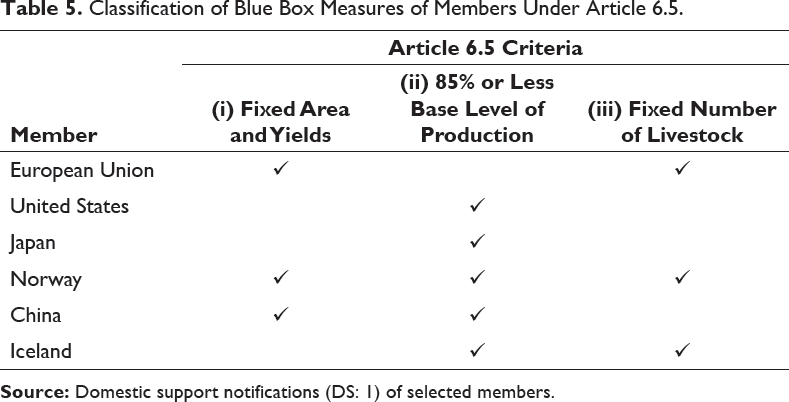
Measures under Article 6.5 of the AoA, also called ‘Blue Box’ measures, are exempt from reduction commitments, provided they fulfil the prerequisites laid down in the Article. For any domestic support to be termed as ‘Blue Box’, it must take the form of ‘direct payments made under production limiting programme’ with such payments being based on either ‘(a) fixed areas and yields or (b) up to 85% or less base level of production or (c) fixed number of livestock’. Unlike the Green Box, Blue Box measures are linked to production. Despite being trade-distorting, these payments are exempt due to their production-limiting nature and are not subject to financial limits. Over the years, several members have instituted measures under Article 6.5 of the AoA. However, there is considerable ambiguity and variations in the implementation of Blue Box measures, as evidenced by the practice of members. These have been elaborated in the subsequent sections.
History of the Blue Box
The origin of Blue Box can be traced back to the agricultural policies of European Community (EC) and the United States, which were aimed at increasing agricultural production, ensuring remunerative prices for producers, price stabilization and achieving self-sufficiency (Garzon, 2006). Some of the developed contracting parties of GATT, including the United States and the European Community, adopted a plethora of trade-distorting support measures and policy instruments such as MPS and export subsidies (SC, 2015; WTO, 1995b, 1995c). Due to such measures, not only did these members become self-sufficient but also net exporters in many agricultural products (Arovuori & Yrjölä, 2015). The exports of surplus production took place at the expense of the world market stability (Ackrill et al., 2008), undermining the farmer’s interest across developing countries. As a result of these measures, the producer support estimate in OECD members had reached an astounding $300 billion by 1990 (OECD, 1991).
In the 1980s, massive support to agriculture by OECD members triggered a demand for the comprehensive reform of the global agricultural system under the Uruguay Round, seeking to establish international trade rules for the sector (Anderson et al., 1999). During this round, the EC overhauled its agricultural policy under the Common Agriculture Policy (CAP) through the ‘MacSharry Reforms’ of 1992. These reforms made significant changes such as reducing the guaranteed support prices on cereal and livestock products and introducing direct payments to farmers (Garzon, 2006).
On domestic support, the European Community wanted to ensure that compensatory payment under the reformed CAP (1992) be exempt from any reduction commitments at the Uruguay Round (Josling & Swinbank, 2011). Compensatory payments were direct payments made to producers of certain products such as cereals, dairy, beef, etc., to stabilize their income and recompense them for the reduction of price support and lowered import tariff (Garzon, 2006). These payments had set-aside conditions for cereals, under which some portion of land was required to be taken out of production (EC, 1993). Moreover, since the payments were linked to current production levels, they did not satisfy the criteria of the Green Box subsidies under the Dunkel Draft (1991) of the Uruguay Round. Without a carve-out, the EC feared that its trade-distorting support would exceed its bound AMS under the proposed disciplines in agriculture negotiations. To avoid being at the receiving end of additional reforms, European Community re-negotiated the Blair House Accord with the United States in 1993, resulting in a new Box creation, called the ‘Blue Box’ (Stewart, 1999). It exempted direct payments under production limiting programmes such as compensatory payments from reduction commitments under the proposed Amber Box (Murphy & Suppan, 2005).
Other GATT members agreed to the inclusion of the Blue Box in the Final Agreement arising from Uruguay Round negotiations because these payments were perceived as less trade-distorting due to the attached production-limiting conditions (Hooda & Gulati, 2007). The Blue Box, thus, was a compromise between the European Community and the United States, which allowed the European Community to continue compensatory payments under the 1992 CAP reforms, and the United States to exempt deficiency payments.
Examining Blue Box Measures of WTO Members
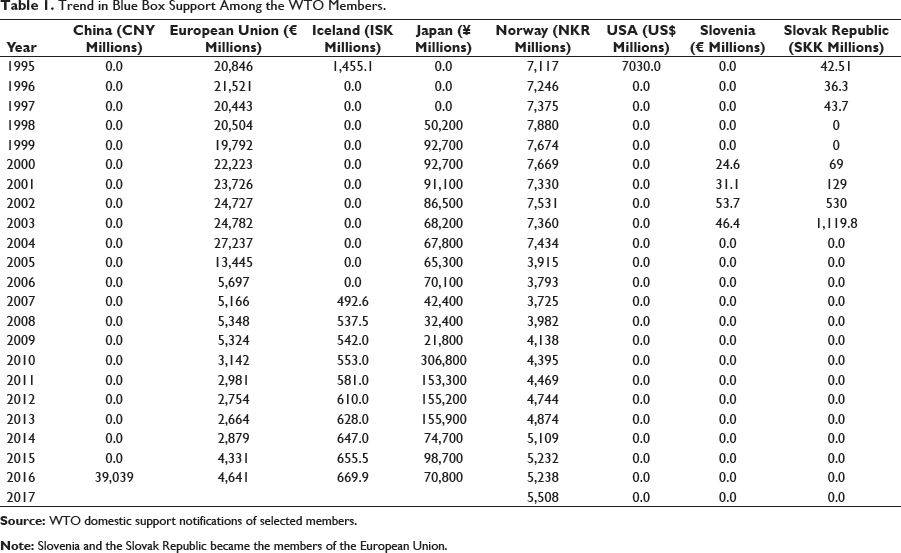
Trend in Blue Box Support Among the WTO Members.
European Union
Following the MacSharry Reforms of 1992, the EC sought to exempt compensatory payments from the reduction commitments and successfully introduced the Blue Box provisions in the AoA that were compatible with these payments (Josling and Swinbank, 2011). Since 1995, the EU has been consistently providing support to producers for many products under various iterations of the CAP. Many have criticized the CAP for disproportionately favouring farmers with large areas over small farmers. This has widened the gap between subsidy received by large and small farmers in the EU (Guth et al., 2020) leading to calls for future CAP to be need-based than area-based. Currently, the European Union implements voluntary coupled support (VCS) as a Blue Box programme covering 21 agricultural sectors such as beef, dairy products, sugar beet, etc., under CAP 2013 for the years 2015–2020 (EC, 2017). The support under VCS is granted as direct payments based on fixed area and yield or a fixed number of animals in a targeted region or sector. The eligible area and yield are fixed based on the reference period (2009–2013), and the support rate is also estimated using this period. The actual payment per hectare/animal is lowered if there is an increase in the eligible area/animals. This, along with strict financial outlay for members, ensures that VCS is a production-limiting scheme (WTO, 2019e, 2019f). Thus, it can be observed that direct payment under the VCS is based on predetermined variables, rather than explicit conditions of acreage reduction.
Besides VCS, the European Union also implements a Blue Box programme for cotton in Bulgaria, Greece, Spain and Portugal on the fixed area and yield basis. The payment is made subject to member specific statutory bases set for area and yields (EU, 2013). There is no explicit acreage reduction condition attached to the programme. However, this payment is reduced if the production exceeds the set base and the reduction in payment is in proportion to the increase in the base area.
United States of America
The United States has used the provisions of Article 6.5 only in 1995 for implementing deficiency payments to certain products such as cereals, wheat, rice, sorghum, etc. Based on up to 85% or less of base-level production, these direct payments were provided on the difference between a set target price and the market price and only farmers who participated in an acreage reduction programme were eligible to receive these payments (Schnepf, 2019). Under the 1996 Farm Bill, these payments were replaced with price flexibility contract (PFC) based on historical areas and yields and were classified as decoupled income support under the Green Box. Although the United States has not utilized the Blue Box after 1995, it did try to make changes to the Blue Box to make it compatible with its domestic counter-cyclical payments under Doha Round negotiations (Murphy, 2005; Ratna et al., 2011).
Japan
Japan started a Blue Box support programme for rice in 1998. Under this, direct payment contingent on output was paid to the producers as a compensatory payment for loss of income incurred when market prices fell compared to the 3-year average prices of rice during 1995–1997 (OECD, 2000; WTO, 2001a). It was replaced by another Blue Box programme named ‘direct payment for rice’ in 2010, which was also based on less than 85% of the base level of production (WTO, 2014a). Operationally, this programme comprises two components, that is, a fixed and variable component. The fixed component is calculated based on the historical gap between the national average cost of production (2002–2008) and farm gate price (2006–2008) (WTO, 2014b, 2014c). On the other hand, the variable component is paid only in the year when current farm gate price falls below a fixed threshold. This threshold has been determined as the average farm gate price for 2006–2008 (WTO, 2014d). It can thus be observed that the programme has elements of price support as it protects farmers from losses due to price fluctuations.
Under the programme, the government set the production-limiting conditions in terms of a target level of rice production to avoid overproduction and stabilize the supply–demand and price of rice. Japan has maintained that the payment was only made to farmers who ‘abided by the target and limited production’ (WTO, 2019a). However, no explicit acreage reduction condition has been mentioned for this programme under Japan’s domestic support notifications. This programme was phased out after payment to rice produced in 2017.
Norway
Akin to the European Union and Japan, Norway has also been consistently using Blue Box provisions to provide support for multiple products such as milk, meat and beef. Over the years, it has provided Blue Box support under all the sub-headings of Article 6.5, viz. (a) fixed areas and yields or (b) up to 85% or less base level of production or (c) fixed number of livestock. Since 2014, Norway has been implementing the ‘Quality Incentive Support Programme for Beef’. The payments under this programme are direct and based on ‘85% or less of the base level of production’ during 2010–2012 and are made on per kg basis of beef meeting the required quality standards (WTO, 2015). The base level of production was 59.4 million kg, and the maximum quantity of beef eligible for support was 50.49 million kg. However, no production-limiting feature requiring reduction of beef production can be discerned from Norway’s domestic support notification for the programme.
In January 2019, Norway introduced a new Blue Box programme for milk, the ‘Support to Small and Medium Size Dairy Farms’ under which payments are made on ‘85% or less of the base level of production’, with this base being set at levels during 2015–2017 (WTO, 2019g). Under the scheme, a fixed amount per cow is paid to farms, increasing till the 23rd cow. After the 23rd cow, the payments decrease on every additional cow till the 50th cow, exceeding which no payments are made (WTO, 2019d). However, the scheme applies to farms with more than six cows and not more than 50 cows, therefore establishing farm limits for eligibility under the programme. The decrease in payments after the 23rd cow suggests that incentives reduce, thereby limiting production. It is interesting to note that rather than payments based on milk production during the base period, the programme provides payments to eligible producers based on the number of milk cows.
Besides, Norway also implements structural income support to dairy farmers and regional deficiency payments to milk and meat production (WTO, 1999). It also provides headage payments for bovine animals, pigs, goats, hens, horses, rabbits and sheep (OECD, 2016). These payments are made per animal and are regressive, reducing with the increase in the number of animals.
China
A Blue Box programme for corn called the ‘corn producer subsidy’ was initiated in 2016 for 2 years on a fixed area and yield basis. The programme covered three provinces and one region and had 2014 as the base year (WTO, 2018a). China undertook corn acreage reduction in arid and cold areas and had capped the production that was eligible for support in furtherance of the production-limiting condition of Article 6.5. Production over and above the prescribed ceiling was ineligible for support under the Blue Box programme (Wei, 2017).
For cotton, China started ‘deepening the target price policy reform of cotton’ for 2017–2019, based on 85% or less of the base level of production during 2012–2014 (WTO, 2018b). However, the programme does not seem to have a mention of any explicit production-limiting condition. The support is computed on the difference between the market price and the target price for cotton. Interestingly, this programme bears resemblance in function to that of a price deficiency payment while also meeting the conditions of Blue Box.
Iceland
Iceland had first utilized the provisions of the Blue Box in 1995 to extend support to dairy and sheep farmers based on up to 85% or less of the base level of production with the base year being 1986–1988. Direct payments were made under the programme to farmers for the production under individually allocated quotas. The production above the yearly quota was disciplined; however, modalities for the same remain unclear (WTO, 1995a). It is also unclear if the programme had production-limiting conditions in place. After 1995, Iceland discontinued this Blue Box support and reclassified its support to sheep meat as decoupled payment under Annex 2 (UNCTAD, 2003). The Blue Box payments were restarted in 2006 for dairy and beef based on a fixed number of heads (WTO, 2016a). However, there are no domestic support notifications for these new Blue Box programmes; therefore, details regarding base period and production-limiting conditions remain unclear.
From the programmes of the members as described above, it is observed that the production-limiting condition has been implemented differently. Some members such as the United States and China had specific acreage reduction conditions for their Blue Box programmes, while others such as Norway and European Union had regressive payments with an increase in production as a condition to limit production.
Deciphering the Blue Box Issues
By examining Blue Box measures implemented by members over the years, and concerns raised in the CoA, various outstanding issues related to this Box have been examined in this section.
Policy Space and Blue Box
Comparison of Support Under Amber and Blue Box with Bound AMS.
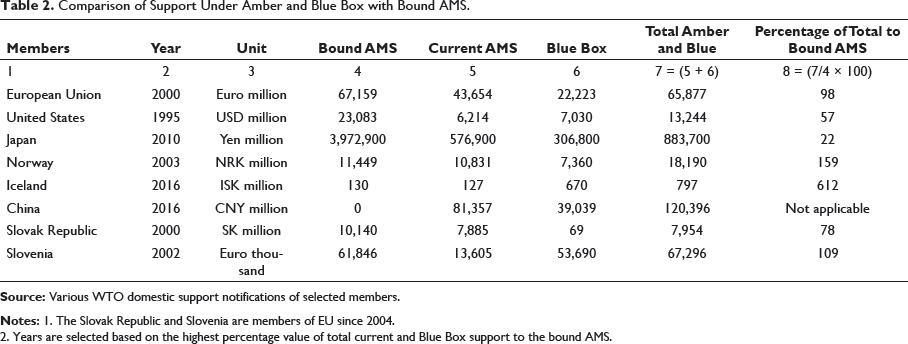
2. Years are selected based on the highest percentage value of total current and Blue Box support to the bound AMS.
Even for members such as the US and Japan, the amount of Blue Box support is significant (Table 2). For the US, Iceland and Slovenia in specific years, the Blue Box support was more than the Current AMS. This box has provided flexibility to countries for providing product-specific support and thus, its role in expanding the policy space for these members cannot be underestimated.
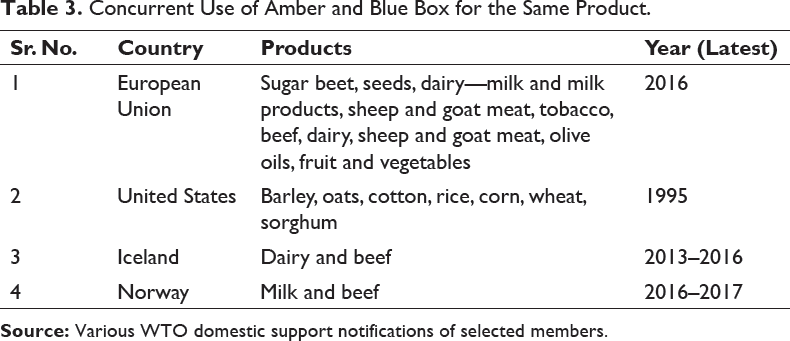
Simultaneous Application of Blue and Amber Boxes
Concurrent Use of Amber and Blue Box for the Same Product.
Production-limiting Condition: Standalone or Not?
Under the Blue Box, direct payment for product-specific support must be made pursuant to a ‘production-limiting’ programme. However, apart from this, the AoA provides no further understanding as to what this condition entails, or what form the production-limiting programme might take. It remains ambiguous if the condition to limit production is a standalone requirement or whether it is implicitly covered under the sub-conditions of fixed area and yield or, a base level of production or, a fixed number of heads, attached with Article 6.5. 1 Some members such as China (for corn) and the United States have had explicit production-limiting conditions for Blue Box programmes in the form of acreage reduction (Schnepf, 2019; Wei, 2017). In contrast, the European Union initially had held the view that a programme complying with the attached sub-conditions of Article 6.5 also automatically complies with the production-limiting criteria (WTO, 2009). By this reasoning, any member implementing a direct payment programme for any product based on sub-conditions of Article 6.5, would comply with the production-limiting condition as well. Practises of members such as Norway and China for certain products also bolster this interpretation. These members have been implementing Blue Box programmes for beef and cotton, respectively, which are only based on 85% or less of the base level of production, with no explicit production-limiting condition (WTO, 2015; WTO, 2018b). In sum, the Blue Box practices of members seem to be diverse when it comes to the production-limiting aspect.
‘Production-limiting’ or ‘Production Reducing’
It has been a general assumption that a Blue Box measure is implemented to limit the surplus production (UNCTAD, 2003). However, under Article 6.5, members are not required to reduce the area or production; instead, only the payment must be on ‘limited’ production. The reduction in production is a stricter requirement than limiting production. Moreover, production may be limited without actually being reduced, that is, maintaining it at consistent levels. Therefore, reducing production does not seem to be a prerequisite under this Article, if it is restricted to base levels.
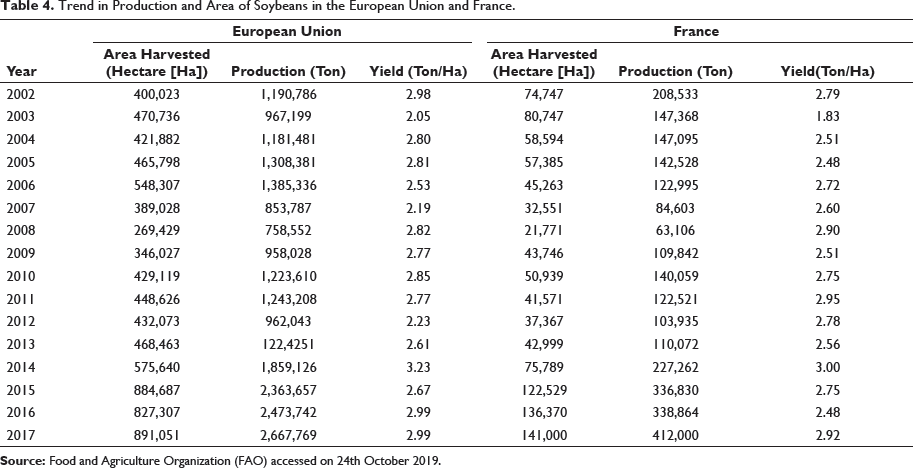
Trend in Production and Area of Soybeans in the European Union and France.
Interestingly, in the Draft Modalities of 2006, it had been proposed that members using Blue Box would need to demonstrate that the production of individual products under it had not increased (WTO, 2006). Although this proposed obligation failed to get consensus and was subsequently dropped from the 2008 text, it would have helped to test whether the Blue Box support was indeed less distorting than Amber Box (Das & Sharma, 2011).
Base Period Updation
Article 6.5 does not impose any restriction on updating the base period for a Blue Box measure. However, such updation of the base period during the tenure of a Blue Box programme may not be permissible under Article 6.5. This is because updating base periods may serve as a possible incentive for farmers to increase production for securing higher payments since these payments would be linked to past performance. Updating base periods would also allow members to increase the coverage and entitlement under the programme. However, it has been observed that members have updated these periods by instituting new Blue Box measures, replacing the old ones. For instance, Japan seems to have updated the base period to support the rice farmers by implementing a new Blue Box programme ‘Direct payment to rice’, as discerned from its WTO notifications (WTO, 2001b; WTO, 2014a).
Quantity Eligible for Blue Box Support
Article 6.5 prescribes that payment for a covered product may be made based on either fixed area and yield or up to 85% of base-level production or livestock payments on a fixed number of head. However, a situation is possible wherein the actual area or production or livestock exceeds the prescribed limit or set base. What happens in such a situation is not envisaged by the AoA. In a stricter interpretation, the excess quantity would most likely not be entitled to support under a Blue Box programme, and only the quantity that was fixed would receive payments. However, this interpretation of eligible quantity for Blue Box support may vary, as found in some members’ practice. It may happen that excess quantity remains eligible, but the payment rate is reduced proportionally, as found dairy and milk payments of Norway (WTO, 2019a).
Level of Implementation
A Blue Box programme may be implemented at the national, regional or farm level since the AoA does not set any criteria for the same. Members have adopted different implementation level according to their prevailing socio-economic situation. For instance, Norway has set limits at national level for its Blue Box programmes concerning dairy and beef. On the other hand, China implemented the programme at the regional level for its corn producers, whereas the programme for cotton was on a national level. To support its producers, Iceland had individually allocated quotas that applied at the farm level (WTO, 1995a).
Type of Support Mechanism
Classification of Blue Box Measures of Members Under Article 6.5.
Blue Box Measures: Transitory?
Blue Box measures have repeatedly been touted as transitory measures that facilitate a shift from trade-distorting Amber Box subsidies and are necessary for reforming agriculture. However, many members have made continued use of this Box to extend domestic support, and over the years many new members have also joined this bandwagon. Members such as the EU, Norway and Japan have been consistent users of the Blue Box since the start, while China is the latest member and first developing country to take recourse to this provision in 2016 (Table 1).
Unlike the restrictive provisions of the Amber Box, from provisions of Blue Box and the practices of members, it is evident that Article 6.5 may provide a member with the much-needed flexibilities to support their farmers, provided attached sub-conditions are satisfied.
Tracing ‘Blue Box’ in Agriculture Negotiations
Agriculture negotiations in the WTO have always remained particularly contentious. Since the Doha Round Declaration in 2001, several members have submitted proposals to undertake reform on various pillars of the AoA. On the market access pillar, developing members sought a Special Safeguard Measure (SSM) based on the Special Safeguards (SSG) under the AoA to tackle the issue of import surges (Das et al., 2020). On domestic support, reduction of trade distorting support in agriculture was a key demand by the developing members. Through high domestic support, many developed members enjoyed artificial comparative advantage in agriculture for years at the cost of developing members (Sharma, 2020). Sometimes even subsidised agricultural products was exported as food aid to developing countries that displaced several farmers in developing members. Therefore, calls were made by members to discipline domestic support in general, and Blue Box in particular. However, given the divergent views and interests of members, no consensus was achieved.
Opponents of the Blue Box claim that it provides unlimited policy space to provide trade-distorting support to agriculture, resulting in an increase in production and shifting of support from Amber to Blue Box. Thereby, it offered a window to evade domestic support reforms (Murphy & Suppan 2005). Further, it was also argued that Blue Box was a temporary measure to shift support from Amber Box to Green Box, and that time had come to eliminate or prescribe limits to this Box. 2 Cairns Group 3 (2000, 2002), Canada 4 (2000, 2002), Jordan 5 (2001, 2002), Mexico 6 (2001), India 7 (2001, 2002), China 8 (2002), the United States 9 (2002), the Philippines 10 (2002), the Dominican Republic 11 (2002) and the Kyrgyz Republic 12 (2002) called for either limiting, reducing or eliminating Blue Box support in future agriculture negotiations in order to discipline domestic support.
On the other hand, proponents argue that payments under this Box are less trade-distorting due to production limiting conditions attached to Article 6.5. Norway 13 (2001) demanded that Blue Box should be maintained to address the non-trade concerns such as rural development, food security, environment, etc. Other members such as the European Community 14 (2000, 2003), Japan 15 (2000, 2002), Korea 16 (2001) and Poland 17 (2001) claimed that Blue Box is less trade-distorting than Amber Box and indispensable in facilitating the shift from Amber Box to Green Box. On the issue of Blue Box being a temporary measure, it was maintained that Article 6.5 was a permanent provision of the AoA and nothing in the article suggested that it was temporary.
Based on various proposals and consultation with the members, the General Council adopted a decision known as the ‘July Framework’ for establishing modalities in agriculture in 2004. 18 On Blue Box, the July Framework provided for its capping, as well as modification of its definition. This Framework was provided for the Overall Trade Distorting Support (OTDS) limit, which covered the expenditure under the Bound Total AMS, Blue Box and the permitted de minimis. Further, Blue Box was capped at 5% of member’s average total VoP during a historical period. These proposed disciplines were further refined in the agricultural modalities under which overall Blue Box expenditure was capped at 2.5% of the member’s average total value of agricultural production during 1995–2000. 19 The July Framework also addressed the issue of updating the base period or base production under the Blue Box by making these payments contingent on fixed and unchanging variables. Further, these modalities introduced product-specific Blue Box limits. 20
Surprisingly, the Framework broadened the definition of Blue Box to accommodate the specific interests of the United States (Das & Sharma, 2011; Hart & Beghin, 2015) by making direct payments not requiring production also eligible for Blue Box. Under the Farm Act 2002, the United States had introduced counter-cyclical payments (CCPs) to protect its farmers from price fluctuations and categorized it as Green Box. However, the Appellate Body upholding the Panel’s finding in US-Upland Cotton 21 observed that CCPs did not satisfy the criteria of decoupled income support under Annex 2 of the AoA and, thus, were Amber Box supported. In the backdrop of Doha negotiations on domestic support, especially on Amber Box, the United States feared that it would cross its AMS limit owing to CCP payments (Murphy & Suppan, 2005) and sought a carve-out to classify the CCP as Blue Box. However, since the CCPs did not require production to receive the payments, they were incompatible with the provisions of Article 6.5 as they existed. Actual production, unlike the Green Box, is a requisite for Blue Box payments (Josling et al., 1996). This new and broadened definition of Article 6.5 under the July Framework was against the spirit of Doha Development Round (DDR), which sought to achieve a substantial reduction in trade-distorting support.
The DDR witnessed a stalemate due to the divergent views of members on various elements of the agriculture negotiations. Post the Bali Ministerial Conference in 2013, members submitted various proposals on domestic support. Before the 11th Ministerial Conference in Buenos Aries (2017), some proposals explicitly demanded the capping or elimination of Blue Box support. ACP 22 proposed the capping of Amber and Blue boxes support at the de minimis level given under Article 6.4 of the AoA. Similarly, in 2017, Brazil and others, 23 Argentina, 24 Mexico, 25 the Philippines 26 and Russia 27 demanded the capping or substantial reduction in Blue Box support. On the other hand, proposals by G-10, 28 Japan, 29 India and China did not touch provisions of Blue Box and called the members to focus on existing AMS entitlement and de minimis limit as a starting point for negotiating new disciplines on domestic support. However, even after 19 years of negotiations since the Doha Declaration, there remains a bleak chance to achieve consensus in the near future. Owing to China’s recent Blue Box measures, there has been a renewed debate regarding Article 6.5, as reflected from the questions raised in recent sessions of the CoA. Interestingly, the European Union, which had arguably been the most vocal advocate and user of the Blue Box, recently expressed its intent to move from Blue Box to Amber Box support citing red-tapism and corruption in payments as issues (WTO, 2019h).
Results and Discussion: Shrinking Policy Space for Developing Members and ‘Blue Box’ Support
The AoA was primarily structured to accommodate the vested interests of industrialized countries, ignoring the need of developing members to promote and support their agriculture (Wolf, 2005). The AMS entitlement for most developed members remains a prime example of this bias. For many developing members, the policy space to provide Amber Box support is restricted by the de minimis limit. Further, many of these members provide product-specific support in the form of MPS. Under the AoA, MPS is covered by the Amber Box and is calculated in accordance with the provisions laid down in Annex 3, that is, multiplying the difference between the applied administered price (AAP) and the fixed external reference price (FERP) with the quantity of eligible production. The FERP is based on the export or import price of the product concerned during the base period, that is, 1986–1988. Without factoring inflation, the gap between AAP and FERP tends to increase over time, ultimately resulting in exaggerated support levels, without capturing the existing ground realities prevalent for developing members. Due to the outdated FERP and lack of AMS entitlement, the policy space for many developing members has considerably shrunk.
The systemic issue of shrinking policy space faced by the developing members has become a matter of grave concern. Members such as China, India, Pakistan, Indonesia, now face a space crunch for implementing policies due to the restrictive provisions of the AoA (Sharma, 2016; Thow et al., 2019). A review of domestic support notifications of Jordan, Turkey and China shows that they have also breached their respective AMS limit in some notification years.
Given these constraints and impasse in agricultural negotiations, developing members may explore Article 6.5 to support their agriculture sector. China’s use of Blue Box compliant policies for corn and cotton is noteworthy as it is the first developing member to utilize this Box to extend product-specific support. By instituting programmes for cotton and corn, China has set an example for developing members to use of this otherwise unutilized Box, which has long been enjoyed exclusively by the developed members.
Unlike the Amber Box, members can provide product-specific support under Blue Box without any prescribed financial limits; however, members must remain mindful that agricultural subsidies are subject to the disciplines of the agreement on subsidies and countervailing measures. Further, the AoA does not restrict members from simultaneously using Blue and Amber Box measures for the same product. Additionally, members may provide product-specific support to its farmers based on either fixed area and yield or up to 85% of base production or fixed head. Depending on the existing agricultural situation, developing members have an array of options under which they may initiate Blue Box measures. For instance, a developing member may implement an EU-like policy based on fixed area and yield; or price deficiency payments based on output, similar to those implemented by the United States and Japan; or on a fixed head basis like Norway and European Union. In contrast to MPS, where a fixed base period must be maintained for the FERP, Article 6.5 does not restrict members from updating their base periods. Further, Blue Box measures can be implemented at the individual farm, regional or national levels. Given these flexibilities under the Article, developing members may find it useful to frame Blue Box measures compatible with their extant socio-economic conditions and requirements.
Traditionally, MPS measures find more acceptability amongst the developing members because they do not require the significant financial commitment and administrative capabilities that are otherwise involved in implementing price deficiency payments. However, for the reasons detailed above, many developing members face policy space constraints under the Amber Box on account of their MPS programmes. As one of the problems for farmers is steep fluctuation in prices, support based on output might be more relevant for developing members. Since there are no restrictions on the ‘type’ of programmes under Article 6.5, developing members may implement MPS or deficiency payments by providing direct payments based on up to 85% of base production. Till date, no member has initiated an MPS-type Blue Box measure under the AoA. However, members such as China, Japan, Norway and the United States have used Blue Box measures to provide price deficiency payments.
Some important points need to be considered while framing a Blue Box programme. Payments under the MPS-type Blue Box measure must be ‘direct’ in nature. In case the government or any of its agencies makes payments to the producers, it may be classified as a ‘direct payment’. Another challenge for developing members in implementing Blue Box measures is that they should be under a ‘production-limiting programme’. Due to this condition, it was believed that Blue Box would not be compatible with the policy objectives of developing members, which are typically aimed at achieving self-sufficiency (UNCTAD, 2003). However, as discussed in the fifth section, members have interpreted the production-limiting conditions differently. Some members have explicit production-limiting conditions such as acreage reduction, while some simply base the measure on the conditions under Article 6.5 (a) (i-iii). Developing members can benefit from the fact that Article 6.5 does not provide any guidance on how the production-limiting condition can be achieved and thus can adopt methods suitable to them. Though the payment would be limited to a fixed quantity, the covered products actual production may increase. For instance, in case of payments made based on fixed area and yield, it may practically be impossible to keep the yield constant as it may vary with weather conditions, fertilizer use, infrastructure facilities, etc. Besides, as has been mentioned in the fifth section, the Article does not suggest a reduction in actual production, nonetheless, the payment must be limited as per the conditions laid under the Article.
Conclusion
Blue Box resulted from a compromise between the United States and the European Community during the Uruguay Round of negotiations to create a carve-out from reduction commitments under the Amber Box. For years, only the developed members have exclusively used the provisions of Article 6.5 to support their producers, and without this Box, some members such as Norway, Iceland and the EU would have breached their AMS commitments. It was widely understood that the measures under this Box are not compatible with the need of the developing members. However, by examining the provisions of Article 6.5 and the practices of members, this article brings to fore the issues and ambiguities in the Blue Box. It shows that members have interpreted Blue Box provisions with a varying degree of pliancy as per their needs. Given the operational flexibilities under Article 6.5, as elucidated in this article, developing members may initiate Blue Box programmes to support their agriculture.
Under the Doha Round, several proposals were floated to discipline the Blue Box support. Developing members have consistently demanded the limiting or elimination of expenditure under Article 6.5. On the other hand, members such as European Union, Norway, Japan and the United States have defended this Box for various reasons, including non-trade concerns such as rural development. However, as this article finds, the negotiating position of some members on this Box has changed over the years. China, which had initially called for the elimination of Blue Box, has now implemented Blue Box programmes for corn and cotton. Contrastingly, the European Union, which was a major proponent and user of this Box, has expressed its inclination to move away from Blue Box to Amber Box for future CAP programs in the CoA.
The absence of consensus under the Doha Round has left no option for developing members but to utilize the existing flexibilities under the AoA to support their farmers. An analysis of the Blue Box indicates the flexibilities available to developing members for framing a measure according to their socio-economic conditions. Although no member has initiated MPS-type payments under this Box, no restriction is placed by the AoA preventing members from initiating price support programmes, provided the payments are direct and conform to the production-limiting conditions as laid down under Article 6.5. Developing members may explore this otherwise unutilized Box to extend product-specific support to their producers. This will provide the developing members with considerable policy space to implement their agricultural policies without breaching their commitments.
