







Abstract
Industrialization has been validated, tested and predicted as a reliable and sustainable route to development. Being late industrializers, the developing world started small on this journey. As a result, the industrial sector in these nations grew as a cluster of micro, small and medium enterprises (MSMEs). Over the years, MSMEs have grown to become the face of industry in the developing world, including India. Within India, the MSME sector has organically been bifurcated into the formal and the informal sub-sectors. The present study is an attempt to analyze and evaluate the growth of the formal sector industrialization in the northern region of Jammu and Kashmir (J&K). The study covering 15 years explores the firm-level efficiency of the formal sector firms in J&K. The analysis validates a labour-intensive nature of the local industry and identifies the factors contributing towards its dim levels of efficiency. The analysis is concluded by making relevant and timely policy interventions.
Introduction
The global developmental process sped up after the first industrial revolution. It brought with itself mass production, skilling of labour, specialization and diversification (Lucas, 2002). The nations to experience the first industrial revolution earlier developed a research and development temper. Over time, this process cumulated, and some nations developed earlier while others lagged behind. By the end of the twentieth century, empirical evaluations validated that some nations had developed, some were developing, and others were yet to endeavour on the process of development (Mantoux, 2013). The nations that lagged behind during the first two to three waves of industrialization began catching up with the end of the colonialization process worldwide (Dirlik, 2005). This is a process defined in the economic literature as late industrialization (Hikino & Amsden, 1994). Nations like Japan and East Asia started late as compared to the USA, Europe and the UK but caught up in a speedy manner (Burris, 1992; Fajnzylber, 1990). The South Asian nations have lagged behind as compared to these nations, but have endeavoured upon the process of catching up in contemporary times.
India in itself has a long history of growth and development. The initiation of colonialization marked a century of developmental deceleration in India. During the colonial time period, the developmental outcomes of India deteriorated, and those of the UK, at the cost of India, accelerated (Arnold, 1980). On the eve of independence, India embarked upon a process of individualistic and inward-looking developmental process. The then policies were designed in a manner that both small and large industrialization processes could be targeted (Panagariya, 2024). Over the following decades, the public sector-led industry grew in one direction, the big corporations grew in another, and the small-scale industries (SSIs) kept on mushrooming across the lengths and breadths of the country.
The SSIs over the period of time were renamed as the micro, small and medium enterprises (MSMEs, henceforth). The steady growth of the MSME sector in India has made it the face of industrialization process. The Indian MSME sector, however, has evolved into two sub-sectors. The primary being the formal sector and the subsidiary being the informal sector (Majeed, Owais et al., 2022). This bifurcation is often made on the basis of the status of the registration of the unit. A business unit registered with the designated state authorities is classified as a formal sector unit (The Factories Act, 1948). Contrarily, the units or establishments failing to register themselves are categorized as informal sector units. Pertinent here is to mention the fact that the Indian industry has come to grow equally within both these segments (Majeed & Mushtaq, 2022b). The MSME sector, with its bifurcated parts, has been a major contributor to GDP and economic growth in India (Majeed & Mushtaq, 2022a). As validated by the Confederation of Indian Industries in their latest estimates, this sector has sustained an average of 10% overall growth rate over the years. The sector contributes 6.11% of manufacturing GDP and 33.4% of Indian manufacturing output, having 63.4 million units across the country (Kaur et al., 2022). While the nature of the informal sector is mostly hidden, the parameters of the formal industrial sector of India can well be estimated and quantified. For achieving a sustainable process of economic development backed by industrial growth, knowing the contemporary nature and characteristics of the formal industrial sector is a necessary condition.
The region of Jammu and Kashmir (J&K, henceforth) is the northern extreme region of the Indian sub-continent (Romshoo et al., 2020). Being remotely located, the developmental outcomes of the region have been dim (Mushtaq et al., 2022). The process of industrial development has simultaneously lagged behind (Khan et al., 2021). The present study is motivated by the basic research question: What is the nature of the formal sector industrialization process in J&K? What are the empirical characteristics of the aggregate production process in J&K? What is the level of firm technical efficiency? What are the factors influencing the technical efficiency of the firms? How can the overall firm-level technical efficiency be enhanced?
Some relevant and informed empirical strategies and methodologies are employed to answer these questions throughout the manuscript. The descriptive statistics validate that the micro units are the most common type of MSMEs existing in J&K. The small sector has steadily been increasing, but the medium enterprises continue to be scanty on the industrial map of J&K. The inferential analysis validates that the industrialization process in J&K is highly labour-intensive. Panel data analysis reveals that the constant returns to scale have been accruing over one and a half decades. The efficiency scores estimated from the production function identify a low level of firm technical efficiency across J&K over time. Tobit regression analysis identifies the factors contributing towards firm technical efficiency. Based on these coefficients, informed policy interventions are prescribed.
To structurally unfold the context and answer the questions raised above, the present manuscript is divided into five parts. The second section reviews the existing literature, identifies the research gap and relates it to the questions raised in the first section. The data and methodology are discussed in the third section. The results and discussions are summed up in the fourth section. The study is concluded in the fifth section, and informed recommendations are made to make the formal industrialization process of J&K sustainable.
The Industrial Map of India and J&K
The Indian industry has been subjected to multiple policy interventions since the eve of independence in 1947. Based on the existing data and information and using the advice of the best possible economists from within and outside the country, industrial policies have been thought of, designed, implemented, revised and re-implemented (Dey, 2014). This has led to a diversification of the Indian industry over the period of time. The large and small sectors have grown across the country. Some regions have industrialized heavily, while some scantily (Majeed et al., 2022). Some potential entrepreneurs decided to enter the formal sector, while others found themselves operating within the informal sector (Majeed et al., 2024). All of this has been realized as India’s indigenous way of industrializing in an equitable manner. While the information on the Indian informal sector is scanty, data and empirics are available for the formal sector. As such, as a first step towards a better understanding of the Indian industry, detailed region-level analysis of the formal industry is the need of the hour.
The firms referred to as the formal sector firms in the present analysis are defined as per the Factories Act of 1948. The Act is a part of the Indian Constitution. A ‘factory’ (as per the Factories Act, 1948) is a business establishment, which is registered under Sections 2m(i) and 2m(ii) of the Factories Act, 1948. Sections 2m(i) and 2m(ii) refer to any premises, including the precinct thereof, (a) wherein 10 or more workers are working, or were working on any day of the preceding 12 months, and in any part of which a manufacturing process is being carried on with the aid of power, or is ordinarily so carried on, or (b) wherein 20 or more workers are working, or were working on any day of the preceding 12 months, and in any part of which a manufacturing process is being carried on without the aid of power, or is ordinarily so carried on. ‘Power’ means ‘any motive power used to drive the plant and machinery of the factory except animal and human power’ as per the Factories Act, 1948 (Instruction Manual Annual Survey of Industries (Concept, Definition and Procedures), 2016). Therefore, any firm falling outside the scope of this definition and the Annual Survey of Industries (ASI) frame falls outside the scope of this manuscript.
The empirical work concerning the J&K economy has been scanty. A few studies have been coming lately that explore some aspects and dimensions of the J&K economy. A study on the identical nature between the J&K economy and that of Himachal Pradesh (HP) reveals that the J&K economy has a larger potential than that of the HP economy (Majeed, Khan, & Mushtaq, 2021). However, it is the policy limitation that has limited this potential from being achieved (Majeed, 2024). The income levels of people living in the region have been measured vis-à-vis the rest of the country (Mushtaq et al., 2024). Findings from this analysis validate that the average levels of poverty in J&K are significantly lower than the rest of the country. Some industry-level analysis identifies the presence of industries like corrugation, cold-store and timber across the industrial map of J&K (Majeed, 2023; Majeed & Kataria, 2023; Majeed & Wali, 2025). The presence of the informal sub-sector has been well validated and established by a few studies (Majeed, 2022; Majeed & Rashid, 2023). Altogether, it can be understood from the existing literature that the industrial scenario in J&K is not strong enough to be characterized as the engine of economic development.
Archival data and documents identify the nature and aim of the industrial policies that have been extended to the region of J&K over the period of time. A major industrial policy was extended to J&K in 1995. In response to the then fragility shocks, the policy aimed at employing the youth in gainful economic activities. While the policy targeted indigenous trades and occupations, it happened due to multiple implementation failures and uncertainty existing during that time. This was followed by another industrial policy announced in 1998. Its aim was to plan the grounds for an industrial base that is twenty-first-century-centric. This industrial policy ended up being more of a vision document, with the least visible implementation possible. The very first comprehensive, detailed and informed industrial policy in J&K was announced and implemented in 2004. Strong in appeal, the policy focused on skill development and the growth of the private sector. This policy logically publicized the lack of feasibility of inviting big business houses to invest in J&K. It strongly settled a tone for locally led industrial development in J&K. One of the major industrial policies of J&K was announced in 2016 following a fragility shock. This policy brought industrial incentives in the form of subsidized industrial endorsements. The concurrent industrial policy was announced in 2021 and remains valid till 2030. The policy culminates all previous ones in terms of being informed and targeted. There is a considerable scope that, by the end of 2030, this policy might have altered the industrial map of J&K for good.
The present study, by answering the questions above, will make a strong contribution towards a better understanding of the J&K industry. It is expected that the findings will aid policymakers in designing informed and relevant policies for strengthening the formal industrial sector of J&K.
Data and Methodology
In order to answer the questions raised in the first section of the manuscript, the present analysis is based on the ASI data. The data are disseminated by the Ministry of Statistics and Programme Implementation. The present study is a 15-year (2002–2003 to 2015–2016) pooled-panel investigation of a sample of 4,347 firms located across the region of J&K. The MSME classification is based on the MSME Act 2006 for the sake of simplicity.
The stochastic frontier analysis (SFA, henceforth) is used as the inferential empirical strategy to further the understanding of firms under analysis. The genesis of this methodology dates back to the independent works by Aigner et al. (1977) and Meeusen and Broeck (1977). There have been considerable improvements and extensive use of this methodology to analyze the industrial sector pan-globe in the academic sector. The present study is based on the Battese and Coelli (1995) model for panel data. The basic function of the model used for the current panel data analysis is:


Yit in Equation (1) refers to the production of the ‘ith’ firm in the time period ‘t’. xit is the vector (1 × k) of the inputs associated with the output produced by the firms. β refers to the vector of the coefficients to be estimated. The composed error term ‘
The technical efficiency of a (given) firm in the Battese and Coelli model is defined as the ratio of the mean production of the firm (in original units) to the corresponding mean production if the firm effect
1
is zero. As such, the technical efficiency in the model is defined as:

Here, Yit* denotes (in original units) the value of production of the ith firm in the tth time period, and the equation explains the firm’s technical efficiency. The value of TE ranges between zero and one, with 1 signifying full efficiency and 0 indicating total inefficiency.
The stochastic frontier production function specified for the MSMEs of J&K is defined by:

In Equation (4), ln signifies the natural logarithm, that is, log to the base ‘e’. lnyit is the gross output of the ith firm at the tth time period, measured in years. lnkit signifies the log of capital used in the production process, measured in terms of rupees. lnlit is the labour variable explained as the log of wages of employees of the ith firm in the tth time period. It covers the total number of staff members the ith firm has in the corresponding time period, including the workers and non-workers. lnfit represents the log of total fuel used in the production process by the ith firm in the corresponding time period t. βs are the parameters to be estimated. Vit is the random error term that is independently and identically distributed. Vit has a normal distribution with zero mean and unknown variance ơv2. The most important term in the efficiency analysis is the Uit. It is associated with the technical inefficiency of production pertaining to the firm i in time period t. The Uit is a non-negative random variable obtained by a truncation (at zero) of the normal distribution with µit mean and ơ2 variance.
The technical efficiency model is given by:

where,
The empirical estimation of the current study is validated by the use of the log-likelihood tests. The tests are carried out to ascertain (a) the presence of the inefficiency in the production process and the eventual biasness of ordinary least squares (OLS) estimation, (b) validation of the half-normal truncated distribution of the inefficiency component, (c) confirmation of the stochastic nature of the technical efficiency associated with the production process and (d) specification of the appreciate functional form of the production function. Following this, the Wald test of joint significance is carried out to validate the explanatory variables contributing to the technical efficiency levels of the firms. The results of the tests are presented in the following section.
Results and Discussions
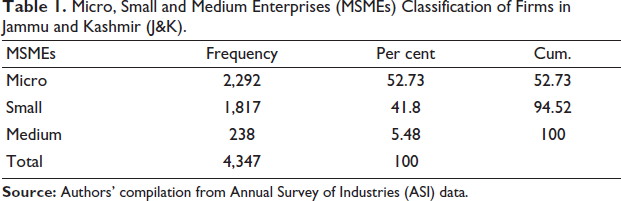
The total sample size of 4,347 firms is analyzed over a 15-year current answer the questions raised in the first section. The MSME classification of the units is presented in Table 1 as per the MSME Act of 2006. Findings from the table reveal that 53% of the units in J&K fall in the micro units category, thus dominating the industrial map of J&K. The small units hold a share of 42%. The presence of the medium sector is limited to 6%. As a result of factors like geography, topography and climate, the footing of large firms and multinational corporations is absent in the region (Majeed & Mushtaq, 2024). Indigenously, the region of J&K has not been able to develop any large sector units. Neither has there been any interest visible on the part of the national and international business organizations to establish their business extensions in J&K. As a result, the industrial map of J&K has been limited to the MSME sector.
Micro, Small and Medium Enterprises (MSMEs) Classification of Firms in Jammu and Kashmir (J&K).
To proceed forth in the direction of inferential estimation, Table 2 presents the decisions of tests on the null hypothesis. A hypothesis is conducted to identify the appropriate methodology of analysis to relevantly answer the questions raised in the first section of the manuscript. The first null hypothesis tests the absence of skewness in the ASI data under analysis. The Schmidt and Lin (1984)
Hypothesis Testing.
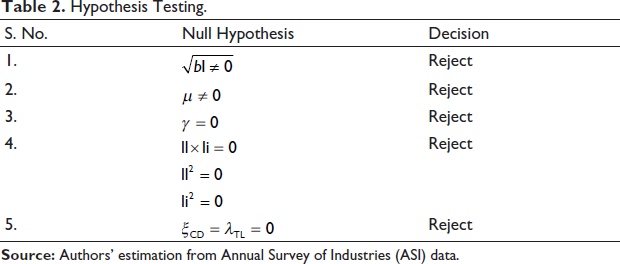
The third hypothesis tests the stochastic nature of the technical. It corresponds to the validation of the gamma value in a range between 0 and 1. Confirming from the frontier results, it is observed that the value of gamma is significantly different from 0, thus rejecting the null hypothesis. The fourth and fifth null hypotheses relate to the functional specification of the production function. It checks the parameters of the trans-log function and rejects its fit for the model. The final hypothesis compares the two model specifications and validates the superiority of the Cobb–Douglas production over the trans-log. The values derived from the testing have been cross-checked with the Kodde and Palm (1986) table. As such, the empirical estimation for the current research has been validated and thus proceeded forth with.
The broad descriptive statistics used to estimate the stochastic frontier production function are presented in Table 3. The variables under analysis are taken in monetary terms and deflated accordingly. The dependent variable is the output produced by the firms. Independent variables used in the analysis include capital, labour and fuel, as used for the conversion of inputs into output by the firms under discussion.
Descriptive Statistics of Stochastic Frontier Production Function.
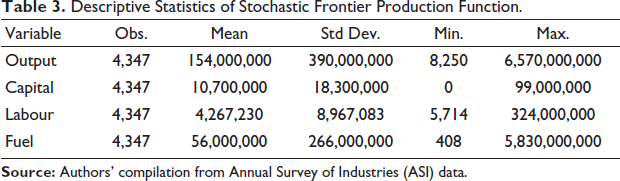
Findings embedded in Table 3 present a broader yet clear picture of the nature of the J&K industry. The mean value of capital is significantly higher than the average value of labour. Yet some firms existing within the formal industrial set-up of J&K do not use any capital at all. There is a considerable number of firms in J&K that rely on labour and raw materials for producing the end product. The use of technology and capital is highly limited in many cases. The average fuel consumption of the firms located in J&K is visibly higher than that of the rest of the country, increasing the average cost of production. The innovation and improvisation part has been found missing from the industrial space of north India in general and J&K in particular (Majeed et al., 2021; Mushtaq et al., 2021). As a result of which the data presented in Table 3 hint towards the existence of firm-level inefficiency within the J&K industry.
The determinants of the production function with their elasticities are presented in Table 4. The partial slope coefficient of labour, measured in terms of wages, is estimated to be around 0.75, holding other explanatory variables constant. With a 1% change in the labour input, the elasticity of output increases by 75%, validating the labour insensitivity of the industrialization process across the formal sector of J&K’s industry. The argument of demographic dividend 2 applies equally to J&K as it applies to the rest of the country. The coefficient of capital derived from the stochastic frontier production function equals 0.06. A 1% increase in the use of capital in the production process increases the elasticity of output by 6%. The capital intensity of the production process across the region is very low. Use of capital is associated with an enhanced efficiency level and thus every firm aspires to be as capita-intensive as possible. Given the underdevelopment and weak institutional constraints in the region of J&K, there is a lack of feasibility and absence of prerequisites to set in place a mechanized industrialization process. Given the two complementing facts, the MSME sector in J&K has adjusted with the current labour abundance till exogenous and endogenous factors play a role in altering the status quo.
Stochastic Production Frontier Results.
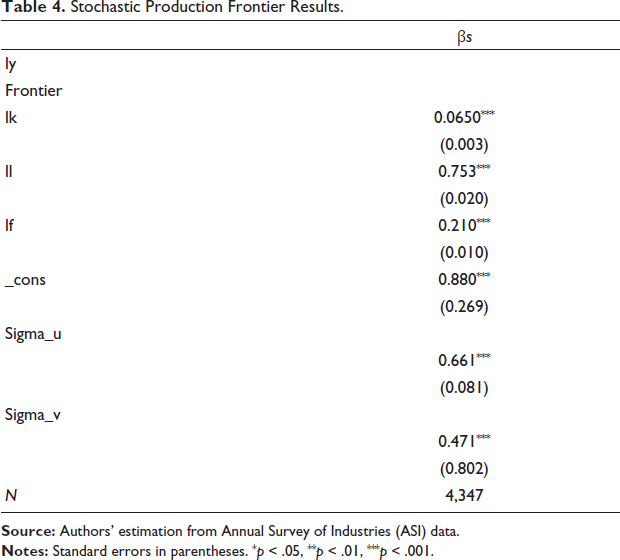
Another important variable of interest in the understanding of the MSME sector is fuel consumption. Fuel is a fundamental variable input that keeps the production process going. Accessible and cheap fuel enhances the industrialization process. The current study takes fuel as a proxy for the variable operational costs of the firm. As per the results of Table 4, with a 1% increase in the use of fuel, the output elasticity increases by around 21%, pointing to a positive relationship between the output production of the MSME sector and the fuel availability and consumption. Figure 1 also depicts the trend.
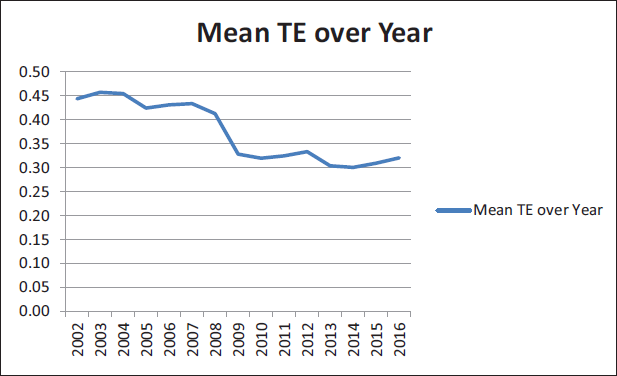
The returns to scale are an imperative long-run consideration pertaining to the dynamics of the firm. In the long run, all factors of production are variable, and the scale of production tends to change. Statistically, returns to scale are calculated by summing up the coefficients of the production function. Given the frontier estimated above and the corresponding coefficients β1, β2 and β3, the returns to scale in the current model equal 1.02, pointing towards constant returns to scale. Over the course of the study period, the increase in output has responded proportionally to the increase in inputs, making the process of production gainful.
Technical Efficiency
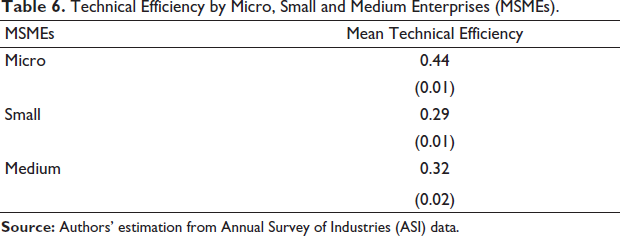
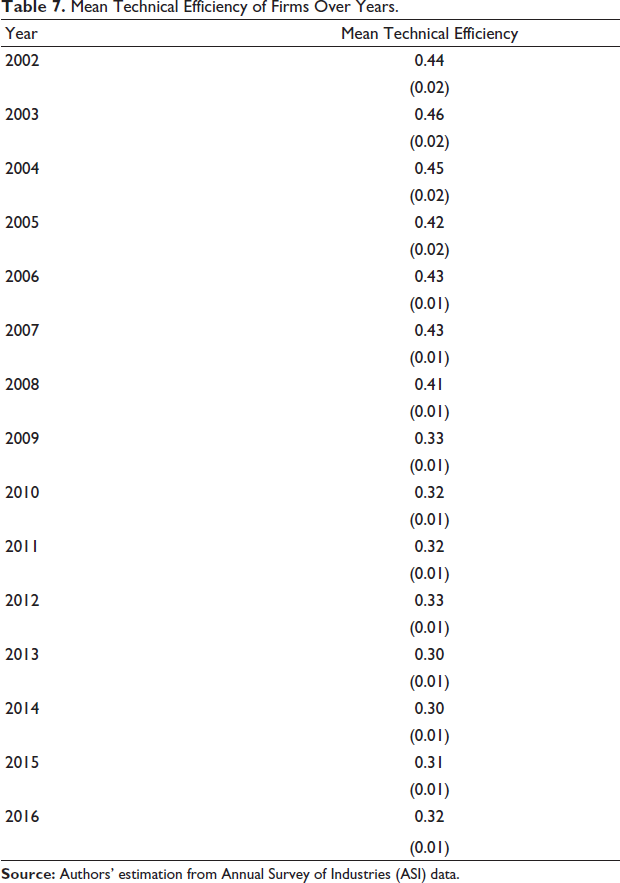
After estimating the stochastic frontier production frontier, the post-estimation is carried out to predict the average technical efficiency of the firms. The overall technical efficiency of the firms in the MSME sector in J&K, as depicted in Table 8, stands at 36%. It can be argued that the technical efficiency of the firms in the formal sector is quite low across J&K. The production process of the firms using various input–output mixes is not technically sound. The waste of inputs is rampant, and the possibility of enhanced profits is very dim. Low levels of technical efficiency over a longer period of time infuse inefficiency and stagnation in the production processes (Raman, 1979). As such, the formal MSME sector in J&K has been losing the prospective to attract new and potential entrepreneurs into the sector. Table 5 sums up the mean technical efficiency scores of the firms by MSME enterprises in J&K.
Mean Technical Efficiency of Firms.

As depicted in Table 6, the mean technical efficiency of the micro units is 44%, while the small units are 29% efficient, and the medium units have a technical efficiency score of 32%. The micro units are comparatively the most efficient units operating in the MSME sector in J&K. There exists a vast empirical literature in the economic analysis of the firms that validates the relative efficiency of micro unit firms across the world in general, and the developing nations in particular. Nelson (1981) studies the firms as entities making production bets highly based on the resource and technology availability. Given the basic characteristics of small scale of operational and marginalized production, the production decisions of the micro units are well calculated. The micro units utilize the existing information to the best of their capabilities as they do not have the capacity to bear shocks and high-level inefficiencies (Nomani & Sen, 2019). Consequently, these units are necessitated by their circumstances and characteristics to undertake the production process in the most feasible manner, making the least mistakes and wasting limited resources (Kane, 2012). Analogously, in the region of J&K, given the already existent firm endogenous and exogenous constraints and problems, micro units are necessitated to give their best while undertaking a production process. This fact is further validated by Khan et al. (2021). Their study empirically validates the efficiency of the micro sector in the region of J&K over the MSME sector in general.
Technical Efficiency by Micro, Small and Medium Enterprises (MSMEs).
The 2015 Enterprise Survey of the World Bank establishes the fact that the firms in the backward and underdeveloped regions produce an output that is categorically below their actual potential (Speakman & Rysova, 2015). Due to the lack of appropriate technology, inadequate policies, institutional failure and infrastructural bottlenecks, firms in these areas tend to be technically inefficient. The regulatory systems are weak in the underdeveloped and backward pockets of the world. Similarly, in the case of J&K, apart from being poor, the corruption at the state level is very high, and the public administration is incompetent. As such, the whole regulatory system becomes dysfunctional, decreasing the overall efficiency of the industrial sector operational in the region.
Mean Technical Efficiency of Firms Over Years.
Major studies analyzing firms across different regions in India, including S. Nanjundan (1994), Prasad et al. (2015), Bhullar and Mohan (2014) and Singh (2016) among others, point to the following major factors while explaining the inefficiency in the MSME sector in the Indian context; poor supply chains, obsolete and inferior techniques of production, lack of marketing channels, lack of financial support, small/marginal firm size, lack of appropriate government policies and support. However, in the case of J&K, these reasons are fuelled by geographic remoteness, climatic harshness, bad credit conditions and fragility. Same can be explained in terms of poor road connectivity, inadequate transportation system, extreme weather conditions, weak institutions, shortage of infrastructure, corruption and red-tape-ism, instable and unpredicted business environment, damaged assets and utilities, low rates of innovation, low desire for risk and super-normal profits, under-realized firm capacities due to declining in demand, smaller and shrinking size of enterprises. These studies associate firm-level inefficiency with backwardness and underdevelopment, leading to and being caused by institutional failure and other factors, including the disruption of the general business environment, lack of access to formal financing, shortage of infrastructure and damaged utilities and assets (Speakman & Rysova, 2015). Since there is widespread uncertainty associated with backwardness and weak institutions, 3 the entrepreneurs (both existing and potential) hesitate to make investments in production capacities. All these factors contribute negatively, keeping the size of enterprises constant and the goal of firms’ mere survival.
Sector-wise Efficiency.
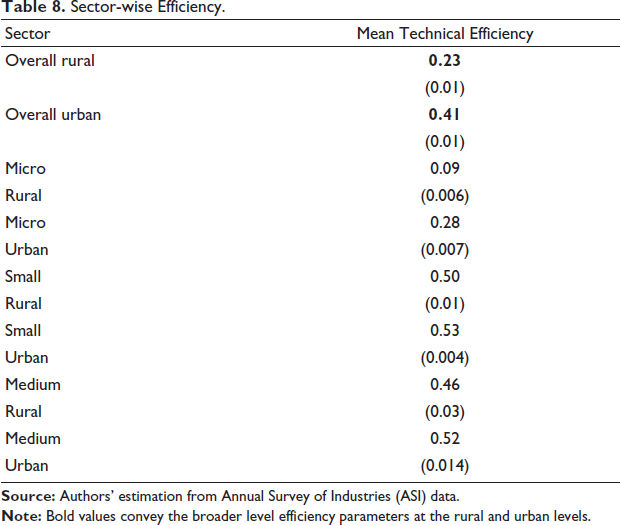
The panel data show that the MSMEs located in urban areas tend to be more efficient than the MSMEs located in rural areas. However, there is a need for MSME growth and spanning across urban areas, given the fact that India predominantly lives in its rural areas (Saxena, 2012). Ajit Kanitkar (1994) in his paper informs that the rural registered and unregistered sectors have been growing and, to a great extent, are the household-level units. While some of the raw materials used by the firms are locally available in the rural areas, but the overall rural viability of industrialization is very dim across the country and dimmer in the mountainous recessive areas like J&K. Information asymmetry, lack of infrastructure and proper connectivity with broken supply chains have been counted as the persistent problems with rural industrialization. In the region of J&K, only 28% of firms are located in the rural areas; the rest of the firms have been established in the urban areas, given access to industrial necessities and prerequisites.
The efficiency of the firms varies from ownership to ownership, as is clearly depicted in Table 9. As established by the coefficients, joint sector firms tend to be efficient at the state level. The private sector firms that are 88% of the total firms under study show an efficiency level of 39%, which revolves around the mean technical efficiency score of the firms in general. The firms owned and managed by the central government in the region of J&K are very low in number and, at the same time, highly inefficient, so much so that the firms are not meeting their break-even point. The limited sample size for the central government firms limits the capacity of this research to explain the correct efficiency of the firms owned and managed by the central government.
Type of Ownership and Technical Efficiency (TE).
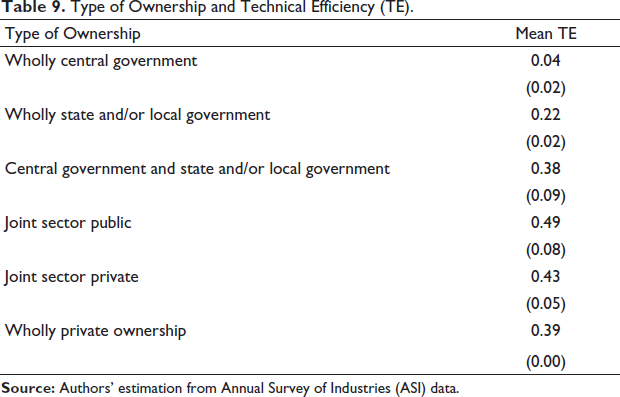
The firms owned and managed by the state government have an efficiency level of 22%. With the signing of the instrument of accession, the Sheikh Abdullah Government in J&K unfolded the process of development with a socialist model (Bose, 1999). A number of firms were set in place by the state government itself, and the plan of mass employment in the public industrial sector was launched. Over the course of the years, as governments were made and broken, elections were rigged and power politics were assisted by the constantly interfering central government, the public sector firms became sick. The same is reflected by the low levels of efficiency demonstrated by these firms over the years.
Tobit Regression Analysis
The reasons behind the low levels of technical efficiency amongst the firms can be many, both endogenous and exogenous. For a better policy target, it is feasible to empirically evaluate as many factors as possible. Based on the predicted value of firm efficiency, the Tobit regression analysis is carried out to study the impact of the factors affecting the efficiency level of the firms. The current research uses only the firm-specific variables to identify the factors affecting the technical efficiency levels of the firms. The variables of interest following the ASI are used to construct certain ratio scales in order to assess the factors causing efficiency/inefficiency in the firms under study. The independent ratios of interest used to determine the causal effects of the predicted mean efficiency level in the current analysis include (a) the ratio of plant-machinery over fixed capital, (b) the ratio of liabilities and total assets, (c) ratio of loan and liability, and (d) the ratio of supervisory staff over total staff. In order to validate the significance of these explanatory variables affecting the technical efficiency levels of the firms located in J&K across various points in time, the Wald test of joint significance by Kodde and Palm (1986) is carried out. The results are presented in Table 10.
Hypothesis Testing for Inefficiency Parameters.

The joint significance of the explanatory variables in the model is determined using the Wald test. The test determines a set of variables that contribute jointly to the explanation of the dependent variable. A set of parameters is tested using the null hypothesis by setting the explanatory variables equal to zero. The chi-square value obtained from the test is validated considering the Kodde and Palm (1986) table. If the parameter for an explanatory variable is equal to zero, the variable can be removed from the model without affecting the overall outcomes. Based on the chi-square and the subsequent p values as reported in Table 10, the null hypothesis is rejected, validating the statistical significance of the explanatory ratio-scale variables used in the current analysis.
Table 11 sums up the results of Tobit regression. Four ratio variables are used to determine the factors affecting technical (in)efficiency amongst the firms located in the region of J&K. One of the fundamental indicators of a firm’s efficiency level is the ratio of ‘Plant and Machinery’ to the total fixed capital of the firm. It is an indicator of productivity and improvement in the production of the firm. The panel analysis depicts a highly significant and positive relationship between this ratio and the overall technical efficiency of the firms in J&K. The positive relationship between the technical efficiency of the firms and the ratio of ‘Plant and Machinery’ to the total fixed capital of the firm signifies its positive contribution in enhancing the technical efficiency level of the firms.
Tobit Regression Results.
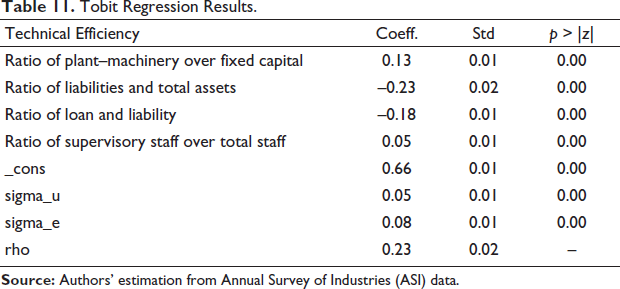
The ratio of the liabilities and assets of a firm, or the solvency ratio, depicts the proportion of a firm’s assets financed through equity. The Tobit estimation from the panel data shows that there is a negative relationship between the technical efficiency of the firms in the region and their solvency ratio. Most of the assets belonging to these firms are financed through loans, pointing towards the risk of high solvency and higher levels of technical inefficiency. When the firm’s assets are highly financed by loans and equity, a great portion of the retained profits goes into the payment of interest. The firm becomes unable to invest more in technology, machines and other ways of reaching higher efficiency levels. As the analysis shows, the significant and negative relationship between the solvency ratio and the mean technical efficiency points to one of the major causes of inefficiency among the firms in J&K. The relationship between technical efficiency and the ratio of loans to liabilities is also negative. This signifies another important determinant of firm-level inefficiency amongst the firms in J&K. Loans form a major part of the liabilities accruing to the firm in the region and thus hamper the profitability of the firm over time. This decreases the efficiency of the firm both directly and indirectly. As a result, borrowing is not a feasible option for diversification and growth among the firms in J&K.
The regression result also shows a significant and positive relationship between the ratio of the supervisory staff to total staff and the technical efficiency of the firms. The ratio reflects the impact of management on the efficiency level of the firms. In the case of MSMEs located across J&K, the supervisors, for the most part, themselves are the owners of the firm. This is validated by the dominance of individual proprietorship and partnership type of ownership in the region. The coefficient depicts the fact that the management of the firm is positively able to contribute to increasing the efficiency of the firm. And over time, the management of the firms in the region has been getting better.
Conclusion and Policy Recommendations
The knowledge and informed empirical understanding concerning the industrial map and outcomes of J&K’s secondary sector has been scanty. A limited number of studies exist that highlight the nature and characteristics of the J&K industry. In light of this considerably important gap in the literature, the present study is an attempt to identify the basic nature and characteristics of the J&K industry consistent over a decade and a half. Based on a pooled panel data made from the ASI database, the analysis answers the questions raised in the first section. As such, the detailed analysis covers the whole industrial scenario of J&K at a broader level. The analysis validates that the MSME sector is the face of the J&K industry and continues to be so to date. Based on the analyzed trend, the MSME sector is expected to continue dominating the industrial map of J&K.
The inferential analysis conducted pinpoints some of the issues and challenges faced by the MSME sector in J&K. Based on the frontier analysis, the labour-intensive nature of the J&K industry has been confirmed. Yet, the polices and interventions to train industrial labour remain scanty. It follows that there is an immediate need to boost the industrial training and awareness among the youth of J&K in the direction of entrepreneurship. The low levels of technical efficiency pinpoint the need for government intervention in the provision of public industrial intermediary goods. Financial requirements of the firms in J&K call for subsidized programmes and interventions. Strengthening of the local markets is also an immediate need of the hour in order to sustainably boost the industrial profile of J&K.
Footnotes
Declaration of Conflicting Interests
The authors declared no potential conflicts of interest with respect to the research, authorship and/or publication of this article.
Funding
The authors received no financial support for the research, authorship and/or publication of this article.
