






Abstract
Conditional cash transfer (CCT) programmes are aimed at improving human capital outcomes by linking financial incentives to behaviours, such as school enrolment and early marriage. This article evaluates the causal impact of Kanyashree Prakalpa—a large-scale CCT in West Bengal, India, intended to reduce early marriage by encouraging girls’ secondary education and above. Using data from the National Family Health Survey and a difference-in-differences design exploiting geographic and temporal variation in programme exposure, we find no evidence that the programme reduced early marriage rates. Instead, the probability of marriage before age 18 increased by 8 percentage points in the post-Kanyashree Prakalpa period, rising to 13 percentage points among girls from poorer households. These findings suggest that, in the absence of structural change, standalone financial incentives may have limited effectiveness in delaying early marriage. The results highlight the limits of CCTs when sociocultural norms and economic precarity distort programme incentives.
Introduction
Conditional cash transfers (henceforth, CCTs) have emerged as critical instruments in promoting gender equity and female empowerment by alleviating household credit constraints and increasing the opportunity cost of early marriage (Baird et al., 2013; Rubio-Codina, 2010). Early marriage, a key driver of the feminization of poverty (Otoo-Oyortey & Pobi, 2003), is inversely related to female educational attainment (Kalamar et al., 2016). This relationship appears bi-directional, as early marriage truncates schooling, which, in turn, raises the likelihood of early marriage (Delprato et al., 2015). Given this nexus, incentivizing female education through CCTs may augment welfare by improving girls’ ability to make autonomous life choices. CCTs are grounded in the collective household model, which departs from the unitary framework by allowing for intra-household bargaining among individuals with distinct preferences (Chiappori, 1992). This framework enables targeted transfers to enhance individual agency within households, particularly for adolescent girls.
In India, several girl-focused CCT programmes condition the final benefits on delaying marriage beyond the age of 18 (Sekher, 2010). While intended to promote education and postpone marriage, the effectiveness of these schemes remains context-sensitive. In poor households where daughters are seen as financial liabilities, transfers may fund marriage expenses rather than support long-term human capital investments, especially when education yields limited labour market returns. 1 Consequently, families may time marriage to coincide with benefit eligibility, undermining programme objectives (Chae & Ngo, 2017; Nanda et al., 2022). Further, when educational infrastructure is weak, transfers often yield enrolment gains without commensurate improvements in learning. In such cases, complementary investments in school quality and teacher training may produce greater social returns. We examine the Kanyashree Prakalpa (henceforth, KP), a CCT initiative launched in West Bengal, India, in 2013, designed to promote girls’ education and delay marriage. Our contribution is twofold. First, we assess whether CCTs induce long-term behavioural changes. Our study leverages a cohort of beneficiaries who have reached the legal age of marriage since the programme’s 2013 launch, thus offering a more definitive assessment of its long-term impact on early marriage. Second, we explore heterogeneity in impact across household economic conditions, geographic contexts and social groups. The findings indicate that while KP increased school enrolment, it failed to prevent early marriage. To achieve transformative change, CCT programmes must be embedded in multidimensional strategies that strengthen educational quality, promote gender-equitable norms, and ensure effective programme implementation and targeting (Harper et al., 2020). Furthermore, effective on-the-ground implementation is crucial, with mechanisms to ensure proper administration and prevention of fund misuse and disbursements to ineligible recipients. These insights carry broader implications for the design of social protection policies aimed at improving gender outcomes in low-income settings.
The rest of the study is organized as follows: ‘Background and Programme Description’ section outlines the context and describes the programme under discussion in this article. The ‘Review of Literature’ section reviews the relevant literature. The ‘Data Source and Choice of Controls’ section discusses the data sources and study variables. The ‘Empirical Approach’ section describes the empirical framework. The ‘Results: Impact on Early Marriage’ section presents the results and subsequent discussion. The ‘Robustness Checks’ section elaborates on the robustness checks for the study. Lastly, the conclusion is contained in the ‘Conclusion’ section.
Background and Programme Description
Despite the Child Marriage Act of 2006, which set the legal minimum age of marriage for girls at 18, early marriage remains widespread in West Bengal. According to the District Level Household Survey-3 conducted in 2007–2008, the state ranked fifth nationally in child marriage prevalence, with 54.7% of girls married before 18. Educational attrition is also stark: female school attendance fell from 85% among 6–10-year-olds to just 33% among those aged 15–17, as reported by the National Family Health Survey-3 (NFHS-3), conducted in 2005–2006. The transition from free elementary to fee-based secondary education imposes financial burdens on poor households, incentivizing early marriage as a form of perceived economic security. This dynamic reinforces intergenerational poverty and limits women’s labour market participation, contributing to the feminization of poverty. Efforts by various policymaking units to prevent early marriage through legal prohibition and social communication remained ineffective.
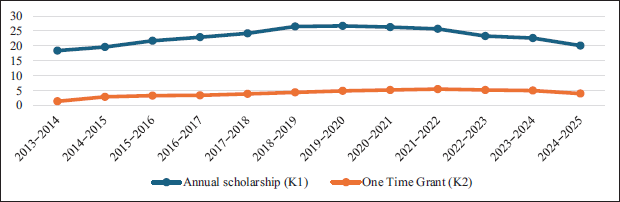
Realizing the need for concrete actions for social transformation, the West Bengal Government launched KP in August 2013, with the primary objectives of ensuring girls’ retention in schools and postponing their marriages till they reach 18 years of age. The programme consists of two CCT elements: first, a yearly scholarship of ₹750 allocated to girls aged between 13 and 18, enrolled in Class VIII and equivalent or higher, subject to their being unmarried. Second, a one-time grant of ₹25,000 is to be paid when girls reach the age of 18, given that they are engaged in either academic or vocational institutes and remain unmarried. Comparing KP’s one-time grant with the average monthly household consumer expenditure in West Bengal emphasizes its financial significance. Data from the Household Consumer Expenditure Survey (2011–2012) conducted by the National Sample Survey Office reveal that the average monthly expenditure in rural areas of West Bengal is ₹5,295 and ₹9,844 in its urban areas. This grant amounts to approximately 4.7 months of expenditure for rural households and 2.5 months for urban ones. This amount, given when girls turn 18 years of age, aims to ease economic pressures that could otherwise drive early marriage. Moreover, a new component was introduced in July 2017 to further motivate girls towards higher education and self-reliance. Regardless of marital status or annual family income, those pursuing postgraduate degrees at any university would receive a monthly stipend of ₹2,500/- for the science stream and ₹2,000/- for the arts stream. However, prior enrolment in this programme’s first and second components and securing at least 45% marks in their undergraduate degrees are required to be eligible. The funds are directly deposited into the enrolled student’s bank account. The programme was initially meant for families with a yearly income of ₹120,000 and less; however, this income limit was removed in August 2018, enabling girls of all economic backgrounds to benefit from this programme. A review of the K1 and K2 sanction records from the Management Information System shows that programme uptake began increasing noticeably from 2014 to 2015, indicating an early and growing participation soon after the scheme’s launch. Figure 1 shows a non-decreasing trend in stipend claims till 2021. 2
KP’s national and international recognition reflects its scale and reach. National assessments support these findings: the Annual Status of Education Reports (ASER Centre, 2014–2022) exhibit a consistent increase in girls’ secondary school enrolment in West Bengal since KP’s launch in 2013. However, despite these educational gains, early marriage remains entrenched. Data from NFHS-4 (2015–2016) and NFHS-5 (2019–2021) show little change in early marriage prevalence, with West Bengal registering the highest incidence nationwide in NFHS-5. The Sample Registration System (SRS) Statistical Report (2020) corroborates this, showing a continued rise in the effective marriage rate among girls under 18 since 2018.
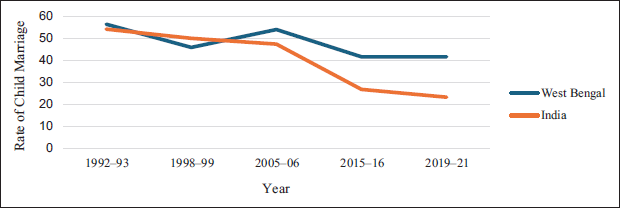
The comparative trends in the rate of early marriage in India and West Bengal, highlighting the state’s persistent underperformance in combating early marriage, are evident in Figure 2. With the sole exception occurring in 1998–1999, West Bengal’s rates have always remained higher than the national average. Remarkably, these findings show a discrepancy between the rising number of females enrolled in schools and the persistent prevalence of early marriage. The assumptions upon which KP was built are called into question by this inconsistency. It draws attention to the urgent need for a comprehensive assessment of the actual effectiveness of this programme in addressing the issue of early marriage in the state.
Review of Literature
Girls’ Education, Work Participation and Marriage
The relationship between girls’ education, labour force participation, and marriage outcomes is often nonlinear. Literature shows a U-shaped or J-shaped relationship between women’s education and their labour force participation, where participation is relatively high among illiterate women, decreases at moderate levels of education, and increases again at higher levels (Chatterjee et al., 2018; Kingdon & Unni, 2001; Klasen & Pieters, 2015). Income effects within households partially explain this pattern. Educated women tend to marry more educated men with high incomes. This reduces the incentive for their own labour force participation (England et al., 2012; Goldin, 1990). In such settings, the returns to female education are realized through improved marriage prospects, resulting in low perceived private returns to female education (Adams & Andrew, 2019). This perception of education as a means to enhance marriage prospects links with prevailing social norms, such as dowry. Evidence suggests that dowry payments, which tend to increase with age (Maertens & Chari, 2020), potentially incentivize parents to marry daughters earlier, while Munshi (2012) found that higher levels of female education may be associated with an increase in dowry. These findings highlight that though education is often expected to improve labour market opportunities and consequently delay marriage, these effects may not materialize in settings where job opportunities for women remain limited. Therefore, when educational gains do not result in labour market opportunities, these are instead translated into better marriage prospects, shaped by dowry and social norms.
Documented Impacts of CCT Programmes
Effect of CCTs on Education
Given the objective of linking educational attainment to delayed marriage, reviewing the broader evidence on CCTs and school enrolment is critical for contextualizing this analysis. CCTs are widely recognized as effective in improving educational outcomes among adolescent girls (World Bank, 2015). Filmer and Schady (2008) report that a cash transfer in Cambodia increased enrolment and attendance by 30%–43% among girls transitioning to secondary school. García and Saavedra’s (2017) meta-analysis of 94 studies across 47 programmes confirms consistent positive effects on school attendance and secondary enrolment. CCTs may also shift intra-household investment patterns: Azam and Kingdon (2013) find that when sons are enrolled in private schools and daughters are excluded from secondary education, CCTs can incentivize households to prioritize girls’ education. While the magnitude of impact varies by setting, the literature broadly supports the conclusion that CCTs improve girls’ educational participation and reduce their vulnerability to early marriage.
While CCTs explicitly link school participation to human capital accumulation (Lindert et al., 2007; Soares, 2012), increased enrolment does not necessarily translate into improved learning (Hanushek, 2010). A growing body of evidence shows that although CCTs are effective in boosting school attendance, their impact on learning outcomes is mixed and context-dependent (Glewwe & Kassouf, 2012). In the case of KP, Das and Sarkhel (2023) documented a rise in enrolment alongside a decline in learning outcomes, attributing this to insufficient improvements in school infrastructure relative to rising student numbers. Sen and Thamarapani (2023) found that KP significantly reduced school dropout rates among girls, particularly in the poorest households, by incentivizing education and delaying early marriage. Other studies suggest that CCTs can enhance learning when the income effect leads to increased household investment in educational materials and a stronger valuation of female education (García et al., 2019). These findings underscore a key limitation: gains in school participation under CCTs may not yield proportional improvements in cognitive skills, academic achievement or long-term labour market outcomes.
Effect of Conditional Cash Transfers on Early Marriage
Given the mixed evidence on learning outcomes, examining the impact of CCTs on early marriage becomes particularly relevant. These programmes are often designed to delay marriage among adolescent girls by incentivizing continued schooling. Evidence on the effectiveness of CCTs in delaying early marriage is mixed and context-specific. For instance, Bangladesh’s Female Secondary School Stipend Programme significantly postponed marriage among participants (Field & Ambrus, 2008), while the Punjab Female School Stipend Programme in Pakistan yielded similar results, with participating girls delaying marriage by over a year (Alam et al., 2011). In contrast, Nanda et al. (2022) reported that India’s Apni Beti, Apna Dhan programme failed to improve educational outcomes or delay marriage, as transfers were often used to finance wedding expenses, highlighting a disconnect between policy design and household-level implementation. This variation suggests that the effectiveness of CCTs in reducing early marriage is highly sensitive to regional socio-economic and cultural contexts. A one-size-fits-all approach is unlikely to succeed. In West Bengal, the KP programme has expanded girls’ school enrolment but has made limited progress in reducing child marriage. Banerjee and Sen (2024) further documented KP’s impact on enhancing women’s autonomy, noting improvements in independent mobility and lower tolerance for domestic violence. These outcomes underscore the broader social returns of CCTs, where education and financial inclusion serve as critical mediating channels.
Data Source and Choice of Controls
This study uses data from the NFHS, a nationally representative household survey conducted by India’s Ministry of Health and Family Welfare. Specifically, it draws on NFHS-3 (2005–2006) as the baseline and NFHS-5 (2019–2021) as the endline. The choice of these two rounds is motivated by the 2013 launch of KP, with NFHS-5 preferred over NFHS-4 to allow for a longer post-intervention window to assess long-term impacts on early marriage. NFHS-3 surveyed 124,385 women aged 15–49 across 109,041 households, while NFHS-5 included 699,686 women in the same age group from 724,115 households. Given the absence of a panel structure, the analysis treats these data sets as repeated cross-sections.
To evaluate the impact of KP on early marriage, we compare outcomes between a treatment group—girls from West Bengal and a control group comprising girls from neighbouring states with broadly similar socio-economic characteristics. 3 Five metrics were used to assess comparability: (a) percentage of women with 10+ years of schooling, (b) percentage of women aged 20–24 married before age 18, (c) sex ratio, (d) a women’s empowerment index, and (e) the Social Progress Index. 4 Sikkim was excluded due to its markedly higher performance across these key indicators. Odisha and Jharkhand were also excluded, as their NFHS-5 data were collected during the COVID-19 pandemic (Phase II: 2 January 2020–30 April 2021), potentially biasing key outcomes.
Tripura was included despite not sharing a direct border with West Bengal, due to its sociocultural proximity and linguistic similarity—approximately 65% of its population speaks Bengali (Census, 2011). Assam and Bihar, surveyed in Phase I of NFHS-5 (June 2019–January 2020), were also included. All control states were selected to ensure that their data predated the pandemic and shared structural similarities with West Bengal. Although Assam, Tripura and Bihar operate other CCT programmes targeting girls, these differ significantly from KP in design, timing and eligibility criteria. Given the 19–24 age cohort analyzed, these alternate schemes are unlikely to confound the results, thereby preserving the validity of the control group.
Treatment Group and Study Variables
In 2013, the year KP was launched, it specifically targeted girls aged between 13 and 18 years. Accordingly, this study uses the launch year of KP implementation and the age of girls as proxy indicators for its identification strategy. With NFHS-5 serving as the endline data set, women aged 19–24 years (as they were between 13 and 18 years of age in 2013) from West Bengal comprise the treated group for this analysis. Conversely, women of the same age range from Assam, Tripura and Bihar who are not being exposed to the programme are considered the control group. In the sample, the inclusion of both married and unmarried women allows a more in-depth analysis of the likelihood of early marriage and facilitates a more precise assessment of the KP’s effectiveness in preventing early marriages while removing the sample selection bias.
The incidence of early marriage, which is the primary outcome variable of this study, is binary and coded as 1 if the age at first cohabitation is less than 18 years and 0 otherwise. This study incorporates individual and household-level factors, such as the level of educational attainment among girls, caste, religion, place of residence, household wealth index, and sex and the level of educational attainment of the head of the household to account for observable variations and achieve less biased outcomes. The summary statistics for all the variables analyzed are shown in Appendix A (Table A1).
Empirical Approach
To identify the causal impact of KP on early marriage, we employ a difference-in-differences (DID) approach using repeated cross-sectional data from NFHS-3 (2005–2006) and NFHS-5 (2019–2021). This method compares changes in early marriage rates over time between the treated group (girls in West Bengal) and the control group (girls in comparable neighbouring states). The first difference captures the change in early marriage prevalence within each group over time, and the second difference isolates the programme effect by netting out the change observed in the control group from that in the treatment group.
DID accounts for unobserved, time-invariant heterogeneity between treatment and control states, as well as common time trends affecting both groups. This approach thus strengthens causal inference by controlling for potential confounders that are constant over time, thus attributing any differential change in early marriage rates to the KP intervention. The DID equation to be analyzed is as follows:

Where Y represents the dependent variable, that is, early marriage for girl i at time t. Here, t denotes the time periods in the data set, which correspond to two NFHS rounds—NFHS-3 (pre-treatment period) and NFHS-5 (post-treatment period). Treatment is a binary indicator that is coded as 1 for the treated group and 0 for the control group. The Post variable, which is also a binary indicator, equals 1 for data from the endline survey, that is, NFHS-5, and 0 for data from the baseline survey, that is, NFHS-3. Confounding individual and household-level factors that could affect the dependent variable are included in the matrix
Test of Parallel Trends Assumption for Difference-in-Difference
The double-difference estimate can be claimed as causal if the outcomes of the treated group and the control group had followed the same trends had the programme not been implemented. This ‘parallel trends’ assumption is essential to support the claim that girls in the control group provide a suitable counterfactual had the girls in West Bengal not been treated. The validity of this assumption can be verified by comparing the changes in outcome for the treated and control groups before the programme was implemented. Hence, the first (1992–1993), second (1998–1999) and third (2005–2006) rounds of NFHS data before the implementation of KP are used to check the ‘parallel trends’ assumption. NFHS-3 is used as the reference period for the pre-intervention period. The analyses, presented in Appendix A (Table A2), confirm that the null hypothesis of ‘parallel trends’ cannot be rejected. It reflects that there were no significant pre-treatment differences in early marriage trends between the treatment and control groups before the implementation of KP.
Results: Impact on Early Marriage
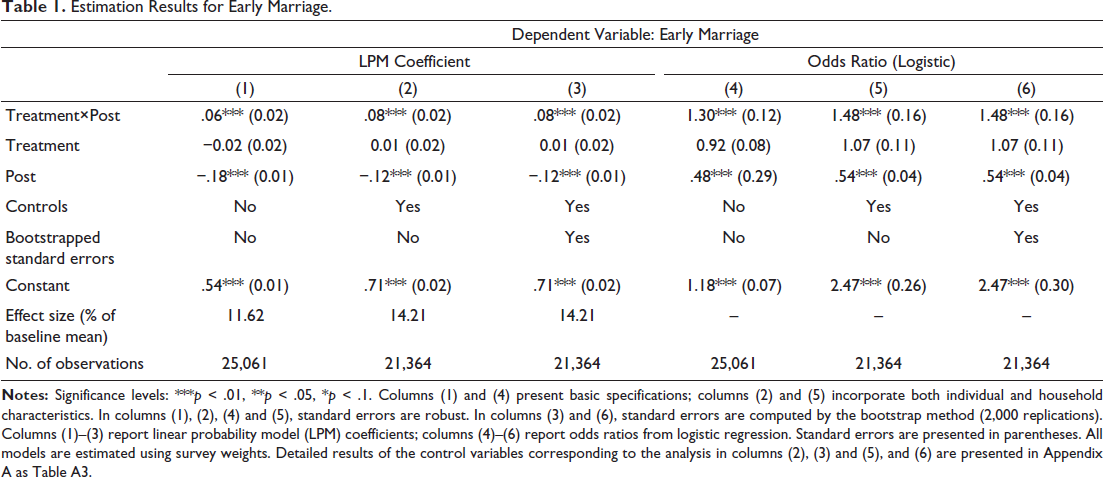
Table 1 represents the DID regression results assessing the impact of KP on the prevalence of early marriage among girls, using three different specifications. The first specification addresses the main variable of interest, that is, early marriage, without any additional controls. The second specification includes additional individual and household-level control variables. The third specification, which is the preferred approach, uses the bootstrap method to compute standard errors. In all specifications, the coefficient for the time indicator (Post) is negative and statistically significant, reflecting a reduction in the rate of early marriage over time among the control states. In all the specifications, this interaction term is positive and highly significant, implying a relative increase in early marriages in the treated group post-intervention. The inclusion of individual and household-level controls in the second specification improves the accuracy of these estimates. With bootstrapped standard errors, the probability of early marriage in West Bengal rises by 8 pp during the post-KP period. Given a baseline mean of 54% in the control group, this corresponds to an effect size of 14% of the baseline mean. Considering that the scheme’s primary objective was to curb early marriage, this outcome shows substantially paradoxical results.
Estimation Results for Early Marriage.
Girls from richer households have a lower likelihood of marrying early, suggesting that families with economic stability and better financial conditions have alternatives to early marriage for their daughters, such as continued education and career opportunities (see Appendix A, Table A3). Girls who had the means and opportunity to obtain higher levels of education are significantly less likely to marry before 18. Further, girls residing in rural regions are more likely to marry early compared to those residing in urban regions. Differences also emerge across religious and social groups. The education level of the household head is also associated with early marriage outcomes. Girls from households with an educated head show a higher probability of delayed marriage compared to those from households with no formal education of the head.
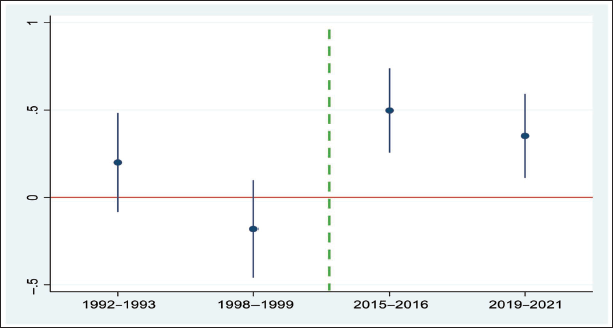
To further support the main findings, an event study framework is used to assess the dynamics of treatment effects over time and to validate the assumption of parallel trends. This analysis utilized data from the first (1992–1993), second (1998–1999), third (2005–2006), fourth (2015–2016) and fifth (2019–2021) rounds of the NFHS, with the third round serving as the baseline period. Although the sample from NFHS-4 includes girls aged 19–24, most of whom (aged between 21 and 24) were not exposed to the programme, as they had already crossed the eligible age by the time of the scheme’s launch in 2013, this round is nonetheless included to capture transitional effects among partially exposed cohorts. The results, illustrated in Figure 3 through a coefficient plot, show no statistically significant effects during the pre-treatment periods, that is, NFHS-1 and NFHS-2, confirming that the parallel trends assumption holds. The post-treatment periods clearly show an increase in the prevalence of early marriage, indicating a paradoxical post-intervention pattern. Moreover, the higher estimated effect observed in NFHS-4 may be due to the age-based heterogeneity within the sample. In contrast, by NFHS-5, the 19–24 age group consisted entirely of cohorts exposed to the programme, leading to a uniform treatment effect.
The prevalence of early marriage increases by 13 pp when eligible girls from the poorer wealth quintiles are studied (see Appendix A, Table A4), indicating that the effects are concentrated among economically disadvantaged households. 7 This is likely because of a non-trivial effect of the associated one-time grant (component K2 of the scheme) of ₹25,000, which is paid to the girls upon turning 18 years of age. Possibly, this amount is used to fund the ‘dowry’ for the girls. 8 Although dowry practices are not confined to economically disadvantaged groups only, for households living at the margin, the transfer may provide a crucial means to meet dowry-related expenses. As a robustness check for the main analysis, we also examine the effects among girls from richer wealth quintiles, where we expect no or minimal impact of the programme, given that the dowry channel is less relevant and the one-time grant of KP is unlikely to substantially influence marriage decisions (see ‘Placebo Treatment Effect Test’ section).
The perceived limited economic opportunities for women and the lack of return from education may influence household decisions regarding early marriage, even when conditional financial incentives are provided. Parents might view the KP grant less as a scholarship for education and more as financial support for their daughters’ eventual marriage, given the grim employment opportunities for women in West Bengal, where female labour market participation is noticeably low and declining. Further, the general deterioration in learning outcomes observed in West Bengal post-KP implementation (Das & Sarkhel, 2023) might reinforce the perception. Thus, with grim employment opportunities and faltering learning outcomes, positive returns from higher education are unlikely. Coupled with this, an increase in the age of the girls would only cause the dowry amount to go up. This highlights the possibility that financial incentives meant to encourage education and postpone marriage could instead be redirected to increase the affordability of dowries and weddings for the resource-constrained households. The potential misuse of the KP funds for facilitating marriages is not without precedent in similar schemes. For example, the ‘Bhagyalakshmi Scheme’ in Karnataka observed that 76.7% of its recipients used financial assistance for marriage-related expenditures (Prabhu, 2020).
Contrary to the scheme’s intended objective, the observed outcomes suggest limited success in preventing early marriage and coincide with an increase in these rates. As Anukriti (2018) suggests, the design of financial incentive schemes needs careful consideration to prevent unintended consequences, such as worsening existing gender disparities. The West Bengal scenario adds complexity to this narrative. Recent national reports corroborate a more nuanced picture. Data from NFHS-5 (2019–2021) and SRS (2020) reveal that West Bengal continues to have one of the highest rates of early marriage in the country, with no discernible decrease from NFHS-4 (2015–2016). In fact, reports from the SRS point to a gradual increase in underage marriages since 2018. Interestingly, a study by Das and Sarkhel (2023) found that KP has successfully increased school enrolment rates among girls, there has been no remarkable impact on the likelihood of attaining a secondary or higher secondary level of education. Higher educational attainment is traditionally considered a key factor in preventing early marriage by improving labour market outcomes and increasing the opportunity cost of marriage (Kirdar et al., 2018). According to the Unified District Information System for Education Plus Report (2018–2019), despite a high gross enrolment rate of 91.1% in secondary education among girls, enrolment in higher secondary education is relatively low at 56.6%, indicating a significant gap in the transition from secondary to higher secondary education. This trend is both alarming and surprising, given that KP requires girls to remain enrolled in either educational or vocational institutes and unmarried until they turn 18 years old.
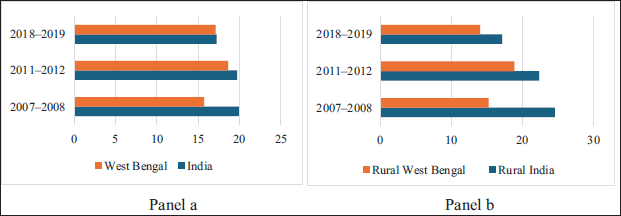
This gap can have two possible explanations. First, a decline in learning outcomes among females following the implementation of KP (Das & Sarkhel, 2023). This decline can be explained by higher enrolment rates without corresponding improvements in school infrastructure. Parents may initially enrol their daughters in schools for financial incentives, but later withdraw them due to limited educational benefits. Second, the increase in school enrolment fails to translate into higher female workforce participation, given the poor quality of education and the lack of employment opportunities in the state. Based on data from the Employment and Unemployment Survey (2007–2008, 2011–2012) and the Periodic Labour Force Survey (2018–2019), West Bengal’s female worker population ratio (FWPR) remains lower than the national average (Panel a of Figure 4). In 2011–2012, West Bengal’s FWPR for females aged 15 and above was 24.6%, dropping to 21.7% by 2018–2019, when the national averages were 30.5% and 23.3%, respectively. Panel b of Figure 4, based on these surveys, confirms that this gap is more pronounced in rural West Bengal, where the FWPR for women with secondary or higher education is persistently below the national rural average. This pattern is consistent with the existing evidence, which suggests that educational attainment does not necessarily translate into labour force participation for women (Chatterjee et al., 2018). This implies that, without human capital accumulation through significant learning and a lack of subsequent employment opportunities, KP’s positive effect on school enrolment alone offers little incentive for delaying marriage. Thus, merely incentivizing school enrolment is insufficient to make the girls suitable for the labour market and, therefore, does nothing to influence their marriage decisions significantly.
In resource-constrained settings, where the design of CCTs often favours immediate gains from tangible assets over long-term investments, the difficulties faced by the KP scheme highlight the larger implications for development policies. Due to the expensive screening processes required to ensure educational quality, this preference may result in underinvestment in quality education, thereby subverting the intended goals (Das & Sarkhel, 2023). As Ghatak and Muralidharan (2019) noted, the issue lies not in welfare spending per se, but rather in the poor targeting and implementation of such spending, which leads to major distortions. This creates a vicious cycle of low state capacity and poor spending quality, requiring more funds to gain any impact, and this ultimately leads to a state that is chronically underinvested. This cycle can force the government to opt for visible transfer mechanisms, like CCTs, to minimize the political costs of restructuring the complicated systems controlled by unions and political leaders, which often lead to poor human capital formation, threatening broader developmental objectives (Reimers et al., 2006).
The unintended outcome strongly suggests a high possibility that the conditions set for the scheme are being circumvented on a large scale. The local officials might engage in malpractices such as the disbursement of grants to girls who do not meet the eligibility criteria to reach the annual targets set for each district by the District Project Management Unit, which are based on the Unified Districts Information System for Education Plus reports. These malpractices include providing grants to girls who are already married or not enrolled in any educational or vocational institute, thus undermining the objectives of the programme. This is consistent with Lipsky’s (2010) theory of street-level bureaucracy, which holds that the discretion and pressure faced by local officials might lead to the prioritization of quantity over quality when awarding one-time grants. This interpretation is supported by evidence from the sanction records of K2, obtained from the management information system data. With 53,701 applications approved under the K2 category of the scheme, the district of Murshidabad had the highest number of sanctioned applications for the one-time grant of ₹25,000 during the 2019–2020 fiscal year. This was followed by South 24-Parganas and North 24-Parganas, with 44,511 and 44,022 approved applications, respectively. The annual KP report (2019–2020) has recognized the districts of North 24 Parganas, Murshidabad, South 24 Parganas and West Midnapore as high achievers in terms of overall performance since the inception of KP. However, NFHS-5 (2019–2021) shows that the percentage of women aged between 20 and 24 who were married before turning 18 years of age in Murshidabad and West Midnapore exceeded 55%, an increase from NFHS-4 (2015–2016). This rate is even higher than the state average of 41.6%. Additionally, in a district like Hooghly, despite the approval of over 25,000 K2 applications, the number of early marriages has significantly increased from 31.9% in NFHS-4 to 40.8% in NFHS-5. These statistics indicate a likely correlation between high rates of sanctioned KP applications and increased rates of early marriage. This issue is further illustrated by Putnam’s (1994) Social Capital Theory, which highlights the importance of norms, networks and social trust in promoting cooperation for mutual gain. A high level of social capital can ensure appropriate implementation of the KP programme by enhancing community involvement and accountability. There is a greater possibility of funds being misused in places with poorer community networks.
Again, in the absence of any educational schemes for boys, parents may be reluctant to continue their daughters’ education, fearing it will be difficult to find suitable grooms, especially in places with low literacy rates (Sen & Dutta, 2018). Given that the amount of dowry tends to rise with age (Maertens & Chari, 2020), these dynamics pose a troubling possibility that parents marry off their daughters before the age of 18 and claim the one-time KP grant for purposes contrary to the objectives of the programme. 9 The scheme does not fully address the underlying structural concerns, which are indicated by the possible misuse of KP funds. This underscores the programme’s limitations and reflects the need for complementary measures, such as better education quality, awareness campaigns and sex education, to address these emerging challenges (Dutta & Sen, 2020). Further, a secular decline in employment opportunities in the state (PLFS, 2021) disincentivizes investment in higher education of daughters, leaving open the only alternative of marriage, as reduced labour market returns are known to prepone women’s marriage and fertility (Jensen, 2012). These facets alter the effectiveness of monetary incentives designed to discourage early marriage and imply that KP, while well-intentioned, functions within a complex socio-economic framework that is limiting its impact.
We also considered the possibility of families migrating to West Bengal to access the benefits of KP. However, the programme has stringent residency requirements, limiting eligibility to only households residing in West Bengal. The beneficiaries are also required to be enrolled in academic or vocational institutes located within the state. Additionally, the social and economic costs associated with migration make it unlikely that households from neighbouring states would relocate to access the programme. These factors substantially limit the potential for migration to confound the findings of the study.
Robustness Checks
Placebo Treatment Effect Test
A placebo test is conducted using the top two wealth quintiles as a fake treatment group. These households are less likely to have been exposed to the programme due to income ineligibility restrictions in the initial years (till July 2018). Moreover, even if dowry is practised among them, the transfer amount from the programme is unlikely to influence the marriage decisions of these households significantly. As shown in Appendix A (Table A5), the programme had no effect on early marriage among rich households. This supports our proposed mechanism that the impact is more pronounced among economically vulnerable households, where the transfer may help offset marriage-related expenses, such as dowry.
Birth-year Cohort Specific Effects
To examine cohort-specific effects of KP, we divide birth cohorts based on the scheme’s launch year (2013) and the NFHS survey years. The pre-treatment cohort includes girls born between 1968 and 1994 (with 1968 marking the birth year of women aged 24 in the first NFHS round), who were 19–24 years old during the NFHS rounds before KP’s implementation. All five rounds of NFHS are used to capture cohort variations across periods. The post-treatment cohort includes those born between 1995 and 2000, who were exposed to the scheme by the time they reached eligibility age. The interaction term between the treatment group and the post-KP cohort is positive and statistically significant, indicating a 5 pp increase in the probability of early marriage (Appendix A, Table A6). This corresponds to an effect size of 8.26% relative to the baseline mean. This result reinforces the core finding that the KP scheme was ineffective in delaying the age at marriage for the targeted cohorts.
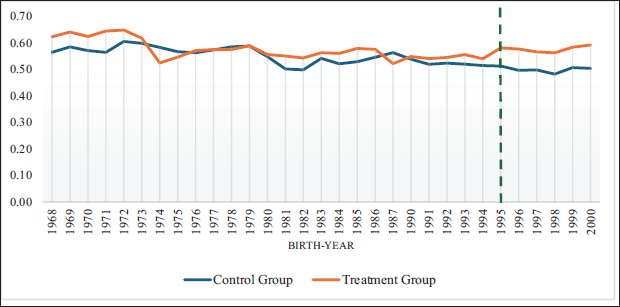
Figure 5 presents the predicted probabilities of early marriage by each birth year for West Bengal (treated group) and control states. The green vertical line marks the birth year from which onward girls in West Bengal were exposed to the treatment. Prior to the programme, a continuous high prevalence of early marriage was not observed among the treatment group compared to the control group. However, after the introduction of KP, the probability of early marriage for the treatment group not only remains continuously higher but also shows an upward trend. In contrast, the probability for the control group remains stable or declines slightly. This widening gap post-intervention suggests that exposure to KP did not lessen the likelihood of early marriage among targeted girls; rather, the probability increased relative to the control group. These birth-year specific patterns, observed across all five rounds of NFHS data, align with the main finding of higher early marriage prevalence among its intended beneficiaries.
Sensitivity to Exclusion of Control States
To further assess the robustness of the findings, additional analyses are performed by excluding individual control states (Assam, Tripura and Bihar). When Assam and Tripura are omitted individually, the coefficients remain positive and statistically significant, suggesting that the treatment is not sensitive to the exclusion of these states. However, when Bihar is excluded, the coefficient remains positive but becomes statistically insignificant, indicating the crucial role of Bihar as a control state. When only Bihar is retained as the sole control state, the coefficient remains positive and statistically significant, further validating its role in the analysis. Moreover, the parallel trends assumption also holds when only Bihar is used as a control state. This confirms its suitability as a valid comparison state. The detailed results for these robustness checks are presented in Appendix A (Tables A7 and A8).
Age at Marriage as an Alternative Outcome
To validate the robustness of our findings, age at marriage is used as an alternative outcome to the primary binary indicator of early marriage. Since age at marriage is only observed for those who are married, estimating its determinants without accounting for selection could bias the results. To address this, we implement a Heckman two-step selection model. Column 1 in Table A9 (see Appendix A) shows that the programme significantly decreases age at marriage by 0.4 years for the treated individuals in the post-KP period. These findings are consistent with the observed increase in the early marriage trend among the treated group.
Conclusion
This study evaluates the impact of KP, a CCT programme designed to delay early marriage in West Bengal. Using a DID regression analysis, we find that KP has not significantly reduced early marriage rates. While programmes like the ‘Dhanlakshmi Scheme’ in Punjab successfully increased the number of girl childbirths (Biswas et al., 2023), the effectiveness of some initiatives may be influenced by complex socio-economic dynamics and entrenched cultural practices, much like the case with KP. Though KP has effectively increased girls’ school enrolment, its ability to delay marriage seems constrained by entrenched sociocultural norms and economic pressures that prioritize marriage over career opportunities for young women. These findings suggest that the programme’s design needs re-evaluation to address broader socio-economic factors and improve the quality of education to better align with labour market demands. Moreover, stricter compliance monitoring and financial oversight are essential to prevent misuse of funds in regions where early marriage remains culturally entrenched.
This study, however, has a few limitations. First, our reliance on nationally representative survey data introduces potential biases, such as recall errors and respondent ambiguity. Additionally, the lack of unique identifiers for KP beneficiaries in the NFHS data necessitated using age as a proxy for potential recipients, which may not fully capture programme participation. A limitation of the analysis is that the NFHS does not distinguish between government and private school attendance. Consequently, it is not possible to directly verify exposure to the schooling-related eligibility conditions of the programme. Our analysis also includes both never-married and ever-married women, but for the latter, we cannot capture the conditions of the households deciding to marry off young girls. This is a significant limitation, as early marriage decisions typically involve both the bride’s and groom’s families. Furthermore, the absence of district-level identifiers in NFHS-3 restricts our ability to control for district-specific unobservables through fixed effects. Finally, unobserved socio-economic and cultural factors may be influencing the prevalence of early marriage and the effectiveness of KP, pointing to the need for further research that integrates these factors into the analysis.
Data Availability Statement
Publicly available data sets were used in this study. These data can be found in the following link:
Footnotes
Declaration of Conflicting Interests
The authors declared no potential conflicts of interest regarding the research, authorship and/or publication of this article.
Ethical Approval and Informed Consent
The study is based on secondary data from the National Family Health Survey (NFHS), which is publicly available and anonymized. Ethical approval and informed consent were obtained by the original data collectors.
Funding
The authors received no financial support for the research, authorship and/or publication of this article.
