






Abstract
This study investigates the impact of external assistance and government expenditure on climate resilience in the agriculture sector of India, Sri Lanka, Bangladesh, Pakistan, Bhutan and Nepal from 2001 to 2021. Climate resilience is evaluated using a composite index constructed from normalized values of three key indicators. The index incorporates crop yield stability (computed from crop yield data in kg per hectare), irrigation infrastructure (measured as the percentage of cultivated land equipped for irrigation) and the ND-GAIN (Notre Dame Global Adaptation Initiative) score, which assesses a country’s vulnerability to climate change and its adaptive capacity. In this analysis, the climate resilience index serves as the dependent variable, while the independent variables include external assistance (measured in dollars) and government expenditure (expressed as a percentage). The dynamic ordinary least squares (DOLS) results show that external assistance significantly and positively affects climate resilience in India, Bhutan, Sri Lanka and Nepal, while its impact is negative and statistically insignificant in Bangladesh and Pakistan. Government expenditure, on the other hand, supports climate resilience in India, Bangladesh, Bhutan and Pakistan, but does not have a meaningful effect in Sri Lanka and Nepal. Moreover, the DOLS findings are further supported by fully modified ordinary least squares and canonical cointegration regression. Overall, the study emphasizes the need for stronger governance, better policy coordination and efficient resource allocation to maximize the impact of external assistance and government spending on climate resilience in South Asia.
Introduction
Climate change is one of the most significant challenges facing the global economy, with particularly severe consequences for the agricultural sector (IPCC, 2022). South Asian countries, where a large portion of the population depends on agriculture for their livelihoods, are highly vulnerable to climate-related risks (FAO, 2021). Rising temperatures, erratic rainfall, increasing frequency of extreme weather events and depleting natural resources threaten agricultural productivity, food security and rural economies (World Bank, 2020). Without effective adaptation measures, these challenges will continue to undermine economic stability and social well-being in the region (United Nations Development Programme [UNDP], 2021).
To mitigate these adverse effects, governments and international organizations have been providing financial and technical assistance to strengthen climate resilience in agriculture. External assistance, in the form of foreign aid, grants, technological innovations and capacity-building initiatives, plays a crucial role in enabling farmers and policymakers to implement climate adaptation strategies (Organisation for Economic Co-operation and Development [OECD], 2019; United Nations Environment Programme [UNEP], 2022). Such support helps improve irrigation infrastructure, develop climate-resilient crop varieties, enhance disaster preparedness and promote sustainable agricultural practices (Food and Agriculture Organization [FAO] & International Fund for Agricultural Development [IFAD], 2020). However, the extent to which external assistance contributes to actual improvements in climate resilience remains an area of ongoing research (Asian Development Bank, 2023).
This study investigates the relationship between external assistance, government expenditure and climate resilience in the agricultural sector of South Asian countries. By employing a quantitative research approach, it analyses time-series data from six South Asian nations to assess how financial support and policy interventions impact adaptation outcomes. The research focuses on key indicators, including cultivated land equipped for irrigation, crop yield stability and vulnerability assessments measured through ND-GAIN scores (Notre Dame Global Adaptation Initiative [ND-GAIN], 2023). A composite index is developed to quantify resilience, and econometric models are used to evaluate the effectiveness of external assistance in fostering sustainable agricultural adaptation.
Given this background, the present study aims to explore how external assistance and government expenditure affect climate resilience and adaptation in the agricultural sector of South Asian countries. By analyzing these relationships, the study aims to provide useful direction for policymakers by emphasizing the role of external assistance and government expenditure for agriculture on climate resilience and adaptation for the agricultural sector and their broader impact on long-term growth.
Literature Review
The role of external assistance in fostering climate resilience and adaptation within the agricultural sector remains a central focus in existing literature. Scholars have extensively explored the necessity of financial aid, technological interventions and institutional support for enhancing agricultural sustainability, especially in climate-vulnerable regions like South Asia. South Asian countries, primarily agrarian economies, face severe climate-induced challenges such as erratic rainfall, droughts and rising temperatures. Nelson et al. (2009) established that climate variability directly affects crop yields, posing a threat to food security. Ahmed et al. (2009) argued that agricultural productivity in the region would decline without robust adaptation strategies, intensifying rural poverty. Lobell et al. (2011) and Schmidhuber and Tubiello (2007) further confirmed the adverse effects of climate change on food security due to reduced crop yields and increased production volatility. External assistance plays a crucial role in addressing climate-related risks through financial support, capacity building and policy guidance. Multilateral organizations, such as the World Bank and the Asian Development Bank, introduced climate-smart agriculture programmes to build resilience. Thornton et al. (2014) highlighted the importance of targeted funding for promoting drought-resistant crops, efficient irrigation systems and climate-resilient infrastructure. Kates et al. (2012) suggested that external funding yields better outcomes when aligned with local adaptation needs. Pelling (2011) and Adger et al. (2005) emphasized that sustainable adaptation demands a combination of financial resources, institutional strengthening and technological interventions. Technological innovations, including precision agriculture, drought-resistant crop varieties and climate information systems, emerged as vital adaptation strategies (Food and Agriculture Organization [FAO], 2016; Intergovernmental Panel on Climate Change [IPCC], 2014). Wheeler and von Braun (2013) underlined the role of technology transfer and international collaboration in expanding climate-resilient practices. Howden et al. (2007) and Vermeulen et al. (2012) observed that adaptation strategies require regional customization for effective implementation.
The effectiveness of external assistance largely depends on governance mechanisms and policy frameworks. Studies indicated that South Asian governments need to integrate international funding with national adaptation strategies to maximize impact. Institutions like the Global Climate Fund (GCF) provide essential resources, but their success relies on transparent governance and active stakeholder participation (Mendelsohn, 2009). Agrawal (2008) highlighted that decentralized governance models strengthen the efficiency of adaptation efforts, while Ostrom (2010) considered community-based adaptation approaches as effective in building resilience through localized solutions. Despite the availability of international support, challenges persist due to inadequate financial allocation, bureaucratic constraints and limited farmer awareness. Dercon et al. (2014) pointed out that financial barriers restrict smallholder farmers’ access to adaptation resources. Smit and Skinner (2002) advocated for a participatory approach that integrates local knowledge with global expertise to improve resilience. Biesbroek et al. (2013) and Brooks et al. (2005) stressed the significance of adaptive governance and long-term policy commitment to overcome institutional barriers. Klein et al. (2014), Eriksen et al. (2011) and O’Brien et al. (2006) argued that the integration of scientific research with policy interventions remains essential to enhance agricultural resilience.
Although the literature provides substantial evidence on the role of external assistance in promoting climate adaptation in agriculture, a significant gap persists in the assessment of its region-specific effectiveness, particularly in the context of South Asia, where diverse socio-economic conditions require localized and inclusive adaptation frameworks. Therefore, this study applies econometric tools to evaluate the impact of external assistance on climate-resilient agriculture in South Asia and seeks to provide empirical evidence for designing more targeted and effective adaptation strategies.
Research Methodology
The present study examined the impact of external assistance and government expenditure on climate resilience and adaptation in the agricultural sector among South Asian countries. It is based on time-series analysis of six South Asian countries and compares them with each other. The study inculcates five key variables. The data for the analysis have been gathered from various sources. The data related to the percentage of cultivated area equipped for irrigation, crop yield (kg per hectare) used to compute crop yield stability, external assistance for agriculture and percentage of government expenditure on agriculture are gathered from the website of the Food and Agriculture Organization (FAO). Crop yield stability has been computed using the coefficient of variation (CV) of major cereal crop yield over the study period, and is expressed as 100 minus the CV. The ND-GAIN score is taken from ND-GAIN.
The study is based on five indicators. First, a composite index is computed using the first three indicators. To assess infrastructure support for climate adaptation, we selected the percentage of cultivated area equipped for irrigation. Second, we used the ND-GAIN score to assess the country’s vulnerability to climate change as well as its adaptation capability. Third, to capture fluctuations in agricultural production over time, we used the crop yield stability variable, calculated using the following formula:

For calculating the composite index, we employed an equal-weighted composite index to provide a simple and transparent method for measuring climate resilience and adaptation in the agricultural sector. It ensures equal representation of key indicators and maintains stability over time. It is best suited for the interpretability of the results. The dependent variable is a composite index named Climate Resilience and Adaptation for Agriculture Sector (CRAAS). In contrast, the variables ‘External Assistance for the Agriculture Sector’ and ‘Percentage Share of Government Expenditure on Agriculture’ are treated as independent variables. The composite index has been calculated using the following expression:
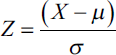
where X = original value,
Stationarity and Cointegration Tests
The next step is to ascertain the stationarity order of the selected variables after the data have been identified and collected. The Kwiatkowski–Phillips–Schmidt–Shin (KPSS) test, as suggested by Kwiatkowski et al. (1992), is used in the study to accomplish this since it offers a more reliable framework for evaluating stationarity and figuring out the proper sequence of integration for the variables under discussion. After confirming the stationarity properties of the variables, the study proceeds to examine the presence of long-run relationships among them. In this regard, a popular residual-based Engle–Granger (EG) cointegration test is applied. In order to determine if residuals from an estimated regression are stationary, Engle and Granger (1987) developed the EG cointegration approach. The variables are considered cointegrated when the residuals are stationary at the level. The test results show that the chosen variables have a stable long-term relationship, which supports the use of the dynamic ordinary least squares (DOLS) method to estimate long-term coefficients.
Model Selection
Long-run estimations are obtained using Stock and Watson’s (1993) DOLS technique based on stationarity and cointegration outcomes. By incorporating lags and leads of the first-order differenced values of the independent variables, the DOLS estimator improves the reliability of long-run coefficient estimates by addressing problems with autocorrelation and endogeneity (Aigheyisi & Egbon, 2020). The long-run models follow the equation given below:

where CRAAS, EA and GE are the dependent and independent variables for all selected countries.
This approach ensures robust and reliable estimation of long-run relationships under the assumption that external assistance as well as government spending significantly impact agricultural resilience and adaptation. The study uses an error correction model (ECM) to analyse short-run dynamics and modifications to the long-run equilibrium, in accordance with Engle and Granger (1987). The ECM representation is essential when variables are cointegrated, as it captures the level of disequilibrium in the cointegrating relationship through the error correction term (ECT). A negative ECT indicates convergence to equilibrium, whereas a positive ECT suggests divergence. Given that the Engle–Granger test suggests the presence of a single co-integration equation, the study applies the ECM approach to model short-run adjustments using the following equation:

Previous empirical studies, such as those by Hawdon and Al-Azzam (1997), Alimi (2014), Ola (2017) and Qasim et al. (2025), estimated short-run dynamics using the ECM and long-run dynamics using the DOLS method. The fully modified ordinary least squares (FMOLS) approach, developed by Phillips and Hansen (1990), and the canonical cointegration regression (CCR) technique, proposed by Park (1992), are also applied in this study to further confirm the reliability of the DOLS estimates. Econometric problems, including endogeneity, serial correlation and small-sample bias, can be addressed by these estimating techniques. Consequently, the outcomes obtained from FMOLS and CCR serve as benchmark measures for evaluating the robustness and consistency of the DOLS findings.
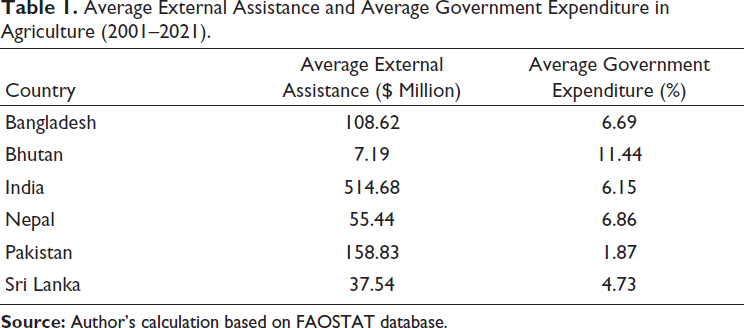
Table 1 presents the average external assistance (in million US dollars) and government expenditure (as a percentage of total expenditure) for the chosen South Asian nations over the study period (2001–2021).
Average External Assistance and Average Government Expenditure in Agriculture (2001–2021).
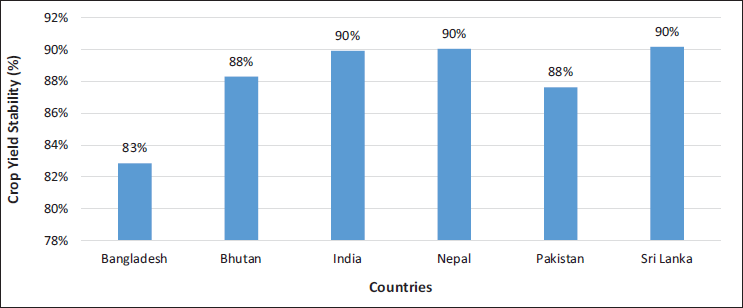
Before conducting the empirical analysis, the study presents a graphical representation of crop yield stability for the selected countries. Figure 1 shows that Sri Lanka, India and Nepal exhibit greater stability in crop yields, followed by Pakistan and Bhutan. In contrast, Bangladesh records the most unstable crop yields among the selected countries.
Crop Yield Stability (%) Across Selected South Asian Countries.
Results and Discussion
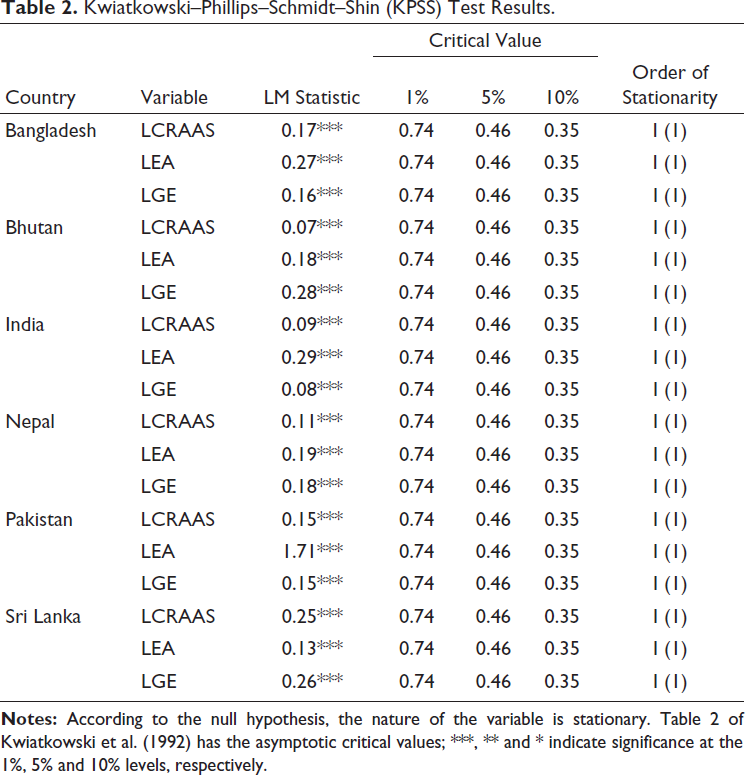
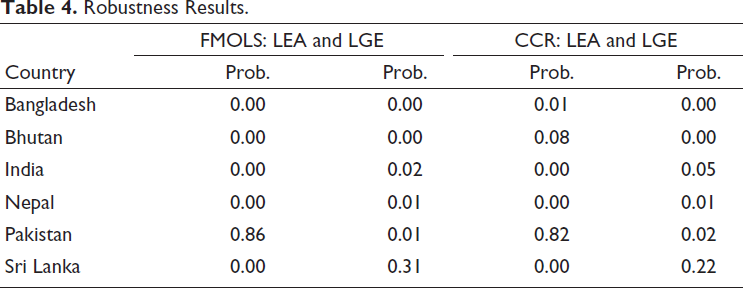
Based on the aforementioned econometric models, the empirical analysis has been carried out. The summary statistics for the DOLS model appear in Table 3, while the robustness check results using FMOLS and CCR models are presented in Table 4. Additionally, the stationarity test results are provided in Table 2.
Kwiatkowski–Phillips–Schmidt–Shin (KPSS) Test Results.
Dynamic Ordinary Least Squares (DOLS) Results.
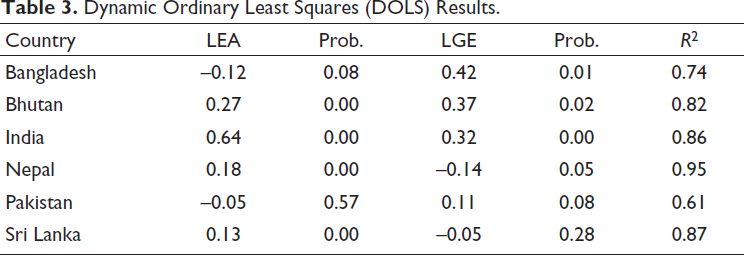
Table 2 reports the results of the KPSS unit root test. The LM statistics indicate that LCRAAS, LEA and LGE are non-stationary at their level form; however, they attain stationarity after taking the first difference.
Long-run Coefficients
The DOLS results provide important evidence regarding the relationship between external assistance, government expenditure and climate resilience across South Asian countries. The findings indicate that external assistance has a strong, positive and statistically significant impact on climate resilience in India, Bhutan, Sri Lanka and Nepal. This suggests that external funding in these countries has been effectively channelled towards supporting sustainable agricultural practices, facilitating technology transfer and promoting climate-smart adaptation initiatives.
However, the scenario is different in Bangladesh and Pakistan, where the results are either insignificant or negative. In Bangladesh, external assistance is negatively associated with resilience, while in Pakistan, its impact remains statistically insignificant. These results point towards possible governance challenges, institutional inefficiencies or misallocation of external resources, which may hinder the effectiveness of aid in these countries.
Similarly, government expenditure plays a crucial role in enhancing climate resilience, although its effectiveness varies across countries. The results show that government spending significantly improves resilience in Bangladesh, Bhutan and India, indicating that domestic investments in these countries have been more targeted and impactful. In contrast, government expenditure shows a negative influence in Nepal and Sri Lanka, while its impact in Pakistan is weak and statistically insignificant. These variations highlight the importance of how public resources are allocated and utilized for climate adaptation.
Furthermore, the reliability of the model, as reflected by the R2 values, is notably higher in Nepal, India, Sri Lanka and Bhutan, suggesting a better model fit and stronger explanatory power. In contrast, moderate R2 values in Bangladesh and Pakistan imply the presence of other unobserved factors influencing climate resilience.
Overall, these findings emphasize that while external assistance can significantly contribute to climate resilience, its success largely depends on country-specific governance structures and policy implementation. Moreover, domestic government expenditure appears to have a more consistent and reliable role in strengthening resilience across most of the South Asian countries studied.
Robustness Tests
Table 4 presents the p values from both FMOLS and CCR models for external assistance (LEA) and government expenditure (LGE) on climate resilience. The results of these models show consistency with the DOLS estimates. The stability and significance of the coefficients across FMOLS and CCR models confirm the robustness of the DOLS findings. This consistency strengthens the reliability of the analysis and supports the validity of the study’s conclusions.
Robustness Results.
Short-run Dynamics and Error Correction Model
The results confirm the existence of cointegration among all selected countries, indicating a stable long-term relationship between external assistance, government expenditure and climate resilience, as shown in Table 5. Bangladesh, India and Nepal display strong evidence of cointegration, reflected through significant and negative ECT, which indicate a faster speed of adjustment towards the long-run equilibrium following any short-term shocks.
Residual-based Cointegration Results and Error Correction Term.
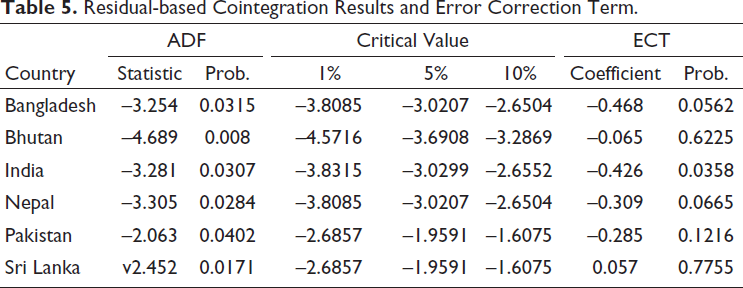
In contrast, Bhutan, Pakistan and Sri Lanka show weak or statistically insignificant ECT coefficients. This outcome suggests that these countries adjust slowly, or in some cases fail to adjust, to restore long-term equilibrium. The positive and insignificant ECT coefficient in Sri Lanka further indicates the absence of any meaningful correction mechanism. Similarly, the high p values of ECT coefficients for Pakistan and Bhutan reflect poor short-run adjustment, possibly due to institutional inefficiencies or gaps in policy execution.
Overall, the analysis highlights that the short-run dynamics vary considerably across countries. The evidence suggests that Bangladesh, India and Nepal possess stronger mechanisms to correct short-term deviations, whereas Bhutan, Pakistan and Sri Lanka require improvements in governance, institutional capacity and targeted policy measures to enhance the effectiveness of external assistance and government spending in building climate resilience.
Concluding Remarks
This study provides valuable evidence on the role of external assistance as well as government spending in fostering climate resilience and adaptation within the agricultural sector of the chosen South Asian nations. By developing a composite resilience index based on crop yield stability, irrigation coverage and the ND-GAIN score, the study captures a broader perspective of resilience across diverse country contexts.
The results clearly suggest that the impact of external assistance is not uniform across the region. While Bhutan, India, Nepal and Sri Lanka have gained positively from external aid, Bangladesh has faced adverse effects, and Pakistan has shown no significant response. This uneven impact highlights that the effectiveness of aid largely depends on country-specific factors such as governance structures, institutional quality and policy orientation. Likewise, government expenditure has emerged as a critical driver of resilience, particularly in Bangladesh, Bhutan and India, where it contributes positively. However, in Nepal and Sri Lanka, the negative influence of government spending points towards possible inefficiencies, misallocation of resources or limited adaptation-centric investments. In the case of Pakistan, the weak and insignificant impact of public expenditure reflects structural limitations within governance and agricultural policies.
Moreover, the cointegration analysis confirms a stable long-term relationship between external assistance, government expenditure and climate resilience in all six countries, although the speed of adjustment towards equilibrium differs. Bangladesh, India and Nepal exhibit faster correction mechanisms, reflecting their ability to utilize external and internal resources effectively over time. Conversely, Bhutan, Pakistan and Sri Lanka demonstrate a slower or insignificant adjustment, indicating that policy interventions in these countries require longer durations to produce tangible resilience outcomes.
Despite these important findings, certain limitations should be acknowledged. The composite index, although comprehensive, may not fully reflect other critical dimensions of resilience, such as socio-economic characteristics or behavioural responses at the farmer level. Additionally, inconsistencies in data availability and quality across countries may influence the robustness of the results. The study is also limited to macro-level analysis, overlooking potential local or regional disparities within countries. Furthermore, establishing causality between external assistance and climate resilience remains complex, as multiple interrelated factors, including governance quality, market dynamics and domestic policies, shape resilience outcomes.
In light of these observations, it becomes crucial for policymakers to design tailored strategies that align external assistance with national development priorities while ensuring transparency and effective resource utilization. Enhancing governance capacity, strengthening institutional frameworks and focusing on long-term capacity-building rather than short-term solutions remain essential to strengthening climate resilience in the agricultural sector of South Asia.
Footnotes
Declaration of Conflicting Interests
The authors declared no potential conflicts of interest with respect to the research, authorship and/or publication of this article.
Funding
The authors received no financial support for the research, authorship and/or publication of this article.
