






Abstract
Aims: The incidence rates of cutaneous malignant melanoma (CMM) increase throughout the world, in spite of introduction of strategies for prevention. However, a decrease in incidence rates is observed in some countries. If the reason for this could be found, it might be useful to transfer the knowledge to other fields of medicine. Methods: CMM age-standardized incidence rates in different age groups in Norway were obtained from NORDCAN for the years 1970–1989 and 1990–2009. Results: Until 1990, the CMM rates increased, but after that time a stabilization or a decrease was observed for young age groups (15–54 years old), while in older generations (>55 years old) the rates continued to increase.
Introduction
Increasing incidence trends of cutaneous malignant melanoma (CMM) in fair-skinned populations have been observed in many countries [1–5]. It is debated if this increase represents a real melanoma increase or this might have been caused by overdiagnosis or diagnostic drift [6–8]. It has been claimed that the diagnosis of CMM has become more inclusive [7–11]. An increasing fraction of CMM diagnoses, previously diagnosed as simple or dysplastic nevi, may now being diagnosed as CMM [7,9]. CMM increase may be also due to changing habits of sunbathing and sunbeds [12–14].
In 2009, 1405 new cases of CMM and 295 deaths from CMM were reported in Norway [15]. In young age groups (<50 years old), CMM is among the three most-frequent cancers [15]. Our objective was to present CMM time trends for different age groups in Norway. The same diagnostic procedures are used in the whole country, and possible changes of these procedures should influence the epidemiology similarly for all age groups. However, sun exposure patterns, and changes in these patterns, are certainly different for different age groups.
Materials and methods
CMM age-standardized (world population) incidence rates (per 100,000 person-years) by different age groups for males and females in Norway (1970–2009) were obtained from the online database NORDCAN [15]. Age groups were selected as follows: 15–24, 25–34, 35–44, 45–54, 55–64, 65–74 years old, and older than 75 years. Data are represented in logarithmic scale (Figure 1).
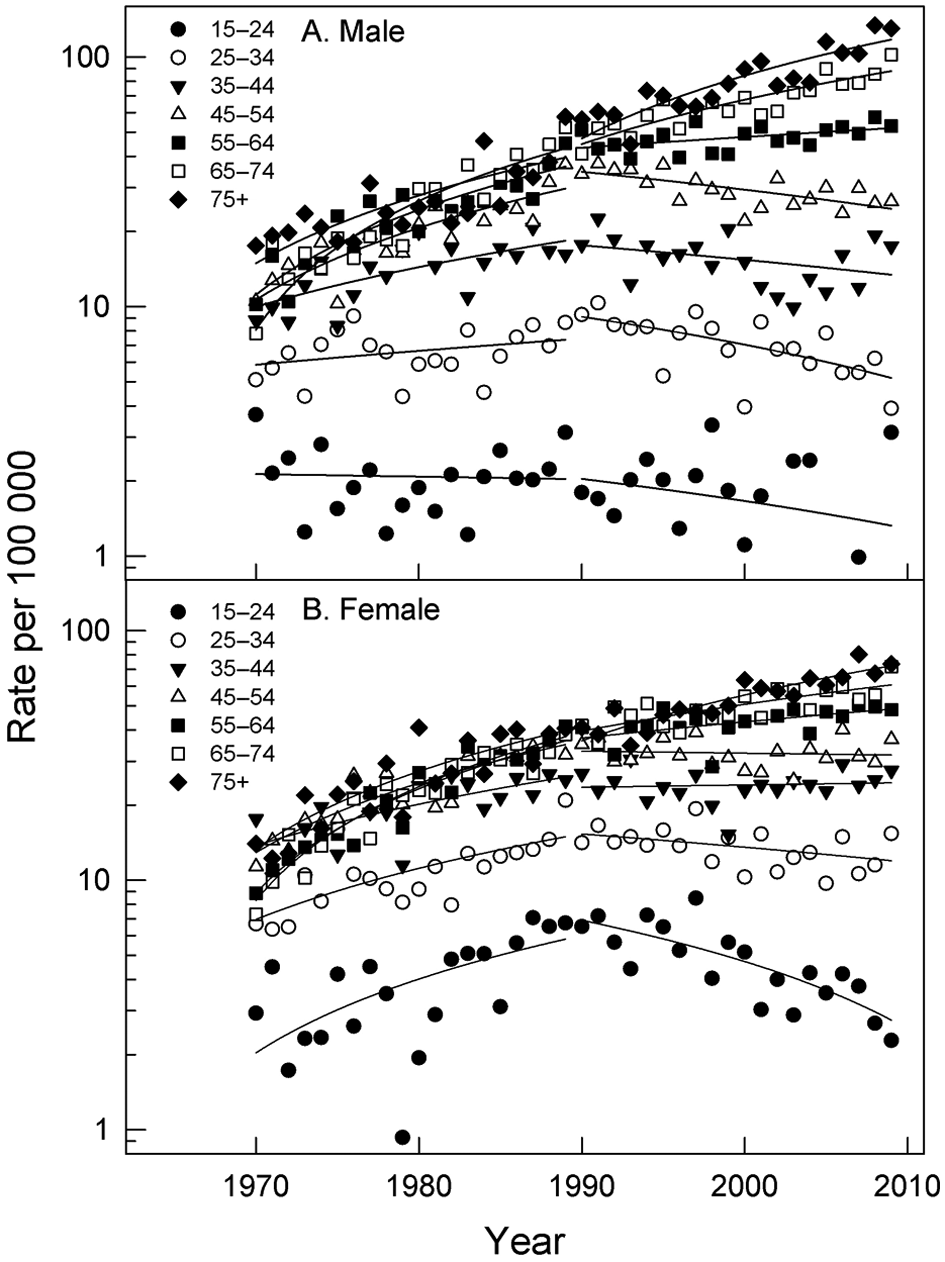
Age-standardized (world population) incidence rates per 100,000 persons for different age groups for males (A) and females (B) in Norway (1970–2009).
For statistical reasons, only two periods, 1970–1989 and 1990–2009, were chosen to evaluate time trends. Slopes of polynomial regression functions were determined for different age groups (Figure 2). The data were analysed using SigmaPlot 11.0 software from Systat Software, Inc. (Richmond, CA, USA). Significant p-value was considered below 0.05.
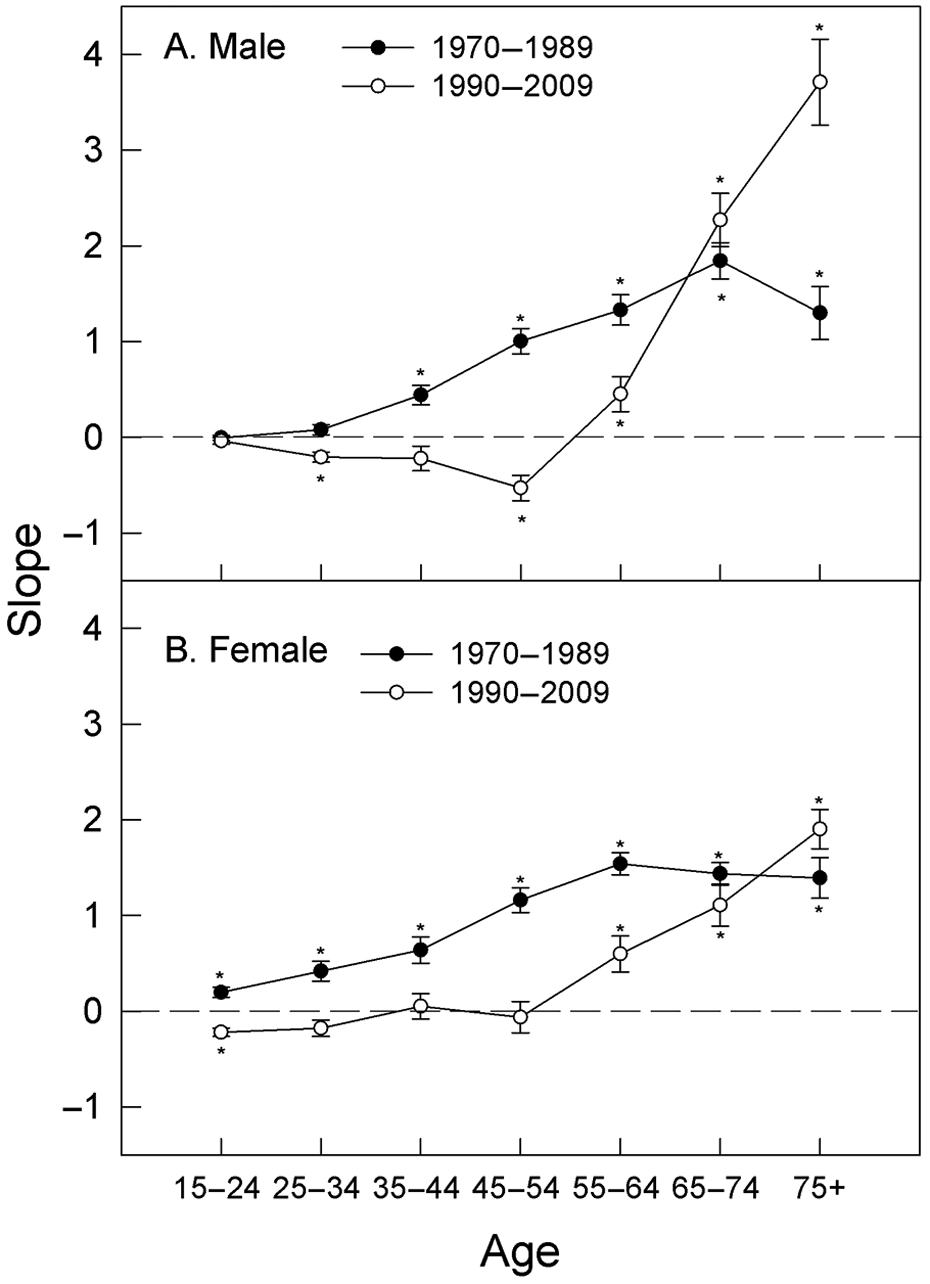
Slopes of CMM incidence rates, as given in Figure 1, for different age groups and gender, males (A) and females (B), in Norway in two periods: 1970–1989 and 1990–2009. Significant p-values are marked with ٭.
Results
The time trends of CMM incidence rates are different for different age groups in Norway (Figure 1). Slopes were calculated to get more information about differences in time trends for the two periods (1970–1989 and 1990–2009) separately (Figure 2). All slopes in the first period (1970–1989) are positive, showing significantly increasing (p <0.05) trends for both sexes and all age groups, except the youngest (15–24 years old) male group. However, for the second period (1990–2009), all slopes are negative or close to zero for age groups up to 45–54 years, indicating decreasing or constant CMM incidence rates (Figure 2). A statistically significant decrease of CMM was found for males in the 25–34 and 45–54 age groups and for females in the 15–24 year-group. For men and women older than 55 years, the incidence rates are increasing (p <0.05) in the whole period (1970–2009).
In the first period, the slopes are increasing with age up to 55–75 years and then reach a constant level. For the oldest age group, the slopes are larger in the late (1990–2009) than in the early (1970–1989) period.
Discussion
The present work indicates that the time trends of CMM in Norway are different for young (15–54 years old) and for old (>54 years old) persons: after about 1990, the rates among young persons (≤ 54 years old) are stable or decrease. Such trends have been observed earlier, not only in Norway, but also in Australia, New Zealand, Canada and Sweden of predominantly fair-skinned populations [10,16–21].
Several studies indicate interaction between environmental, genetic and individual behavior-related factors in melanomagenesis [22,23]. Sunbeds play a role for CMM risk [12,24–26]. Sunbed use has increased since 1980 for all age groups in Norway, from 1% of the population in 1980 to about 30% in 2011 [27], while a significant decrease or stabilization in CMM rates among persons younger than 54 years of age are observed (Figures 1–2). This decrease can be explained by several campaigns against excessive exposure to sun and use of sunbeds. Public health campaigns encourage people to protect themselves against skin cancer by using sunscreens and avoiding sun. However, one would think that such campaigns should have a larger impact on the behaviour on adults than on young persons. This is not supported by the present data which show a much larger change in the CMM trends around 1990 for young than for older persons (Figures 1–2). Two other factors should be considered in the future: increasing living standards and leisure time may lead to more vacational and outdoor activities, notably among middle-aged and older persons. Among young persons, there is an increasing popularity of indoor activities. Both of these factors may definitely lead to less outdoor activities for young persons and may explain our data. Support of this view comes from the observation that the vitamin D-levels among teenagers in Norway are low [28]. A major source of vitamin D is exposure to sunlight, even at the high latitudes [29]. Unfortunately, no data concerning the time trends of the vitamin D status are available so far.
The changes of the slopes from about 55 years are largest for the 1990–2009 period. For the 1970–1989 period, the slopes are large but remain almost unchanged with age after 55 years. This is again supporting the assumption that the improvement of living standard plays a role. It is likely that the effect of the living standard increase with age, just in agreement with Figure 2. Elderly persons have increased their time spent outdoors more in the latest two decades than they did earlier. Vacations to southern latitudes are linked to living standard and may be involved in this.
Footnotes
Funding
The present work was supported by the South-Eastern Norway Regional Health Authority and by Oslo University Hospital.