







Abstract
Aims: Health examination surveys (HES) provide important information about population health and health-related factors, but declining participation rates threaten the representativeness of collected data. It is hard to conduct national HESs at examination clinics near to every sampled individual. Thus, it is interesting to look into the possible association between the distance from home to the examination clinic and non-participation, and whether there is a certain distance after which the participation activity decreases considerably. Methods: Data from two national HESs conducted in Finland in 2011 and 2012 were used and a logistic regression model was fitted to investigate how distance was related to non-participation. Results: We found out that non-participation modestly increased with distance to the examination clinic. An additional analysis indicated that the option of having an examination at home may decrease the effect of distance to participation.
Introduction
Health examination surveys (HES) provide information about population health and health-related factors, but declining participation rates threaten the representativeness of collected data. When regional comparisons of health indicators are conducted to investigate possible regional health differences in the study population, it is important that the used data are equally representative in all regions.
Fieldwork in HESs is expensive, so it is hard to conduct national HESs at examination clinics that are near to every sampled individual. This is especially true in Finland, which is a sparsely populated but geographically relatively large country. Thus, it is interesting to look into associations between the distance from home to the examination clinic and non-participation, and whether there is a certain distance after which participation activity decreases considerably. These findings have relevance when interpreting regional differences in HES results and planning future surveys.
There is no previous literature about the association between distance and non-participation in HESs. It has been reported that women with long distances to mammography screening centres have higher non-participation than those who live close to the centres [1–3].
Methods
In these analyses, data from two national HESs conducted in Finland were used. The Health 2011 study was conducted among adult population (≥29 years) living in the mainland Finland [4]. It was a follow-up study for the Health 2000 study conducted 11 years earlier. The national FINRISK 2012 study among adult population aged 25–74 years was conducted in five large geographical areas [5]. FINRISK 2012 belongs to a series of cross-sectional FINRISK studies conducted at five-year intervals from 1972. Data collection of the Health 2011 and FINRISK 2012 surveys was based on questionnaires and a health examination including physical measures and biological samples.
We restricted the data sets to the common age range 29–74 years. Individuals who had participated at a different examination clinic where they had been invited were removed from the data (six individuals). This resulted in the sample sizes of 6816 and 9109, of which 55% and 59% participated in the health examination at examination clinics in the Health 2011 study and the FINRISK 2012 study, respectively. In Health 2011, 4% of invited individuals had the examination at home because it was not possible for them to participate at the examination clinic.
In both surveys, a sample was drawn from the National Population Register. The sample data included information about sex, age and geocodes for home.
Logistic regression models were used to model non-participation. Explanatory variables were distance from home to the examination clinic, age, sex, information on whether the individual belonged to the Health 2011 or FINRISK 2012 sample and information on whether an individual had participated in an earlier HES. Distance and age were used as continuous variables. Restricted cubic splines [6] were used in logistic models to take possible non-linear associations into account. The selection of covariates and their possible non-linearities modelled by splines and first-order interactions was based on the Bayesian information criterion (BIC) [7]. In addition to the main effects of the above-mentioned variables, the best model included interactions of age with sex, study and earlier participation and an interaction of study with earlier participation. Analyses were carried out using the R statistical software v3.1.2 [8]. Distances between homes and examination sites were calculated as the shortest routes along the road network using the Digiroad database of the Finnish Transport Agency (see www.liikennevirasto.fi/web/en/open-data/digiroad). Dijkstra’s algorithm [9] and ArcGIS software [10] were used in the calculation of the distances.
Results
The sample sizes and participation rates are presented in Table I. Participation was usually higher among those living close to the examination clinics than among those with long distances to travel. Women had higher participation rates than men, older individuals participated more actively than younger and participation was clearly higher among those who had already participated in an earlier HESs than among those who had not.
Sample sizes (N) and rates of participation at an examination clinic (%) in Health 2011 and FINRISK 2012 studies.
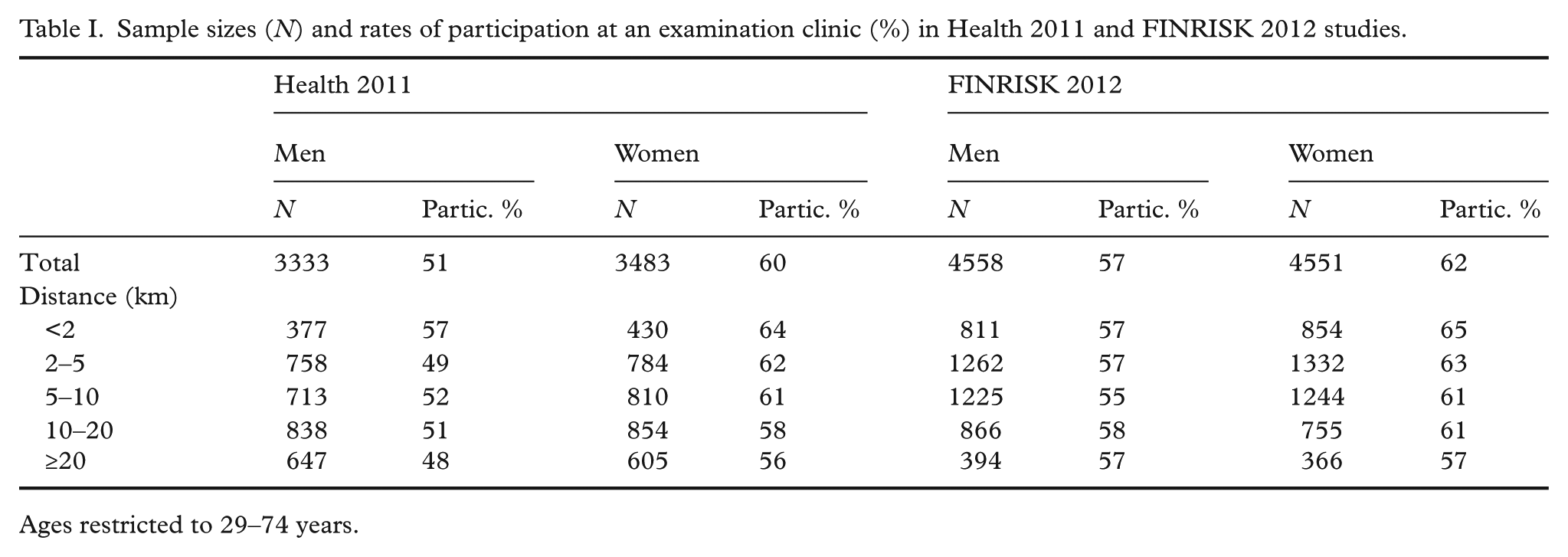
Ages restricted to 29–74 years.
The odds ratio (OR) of distance per 10 km for non-participation was 1.08 (95% confidence interval [CI] 1.05–1.11). Thus, non-participation was greater for those living far from the examination clinics than for those living close to them. Non-linear associations between distance and participation were not found, so there does not seem to be a certain distance after which the participation activity would change notably. Distance was not found to be associated differently with participation among different sexes or in different studies. Figure 1 illustrates the predicted participation probabilities for distances from 0 to 30 km. For a 10 km change in distance, absolute changes in probabilities are slightly less than two percentage points.
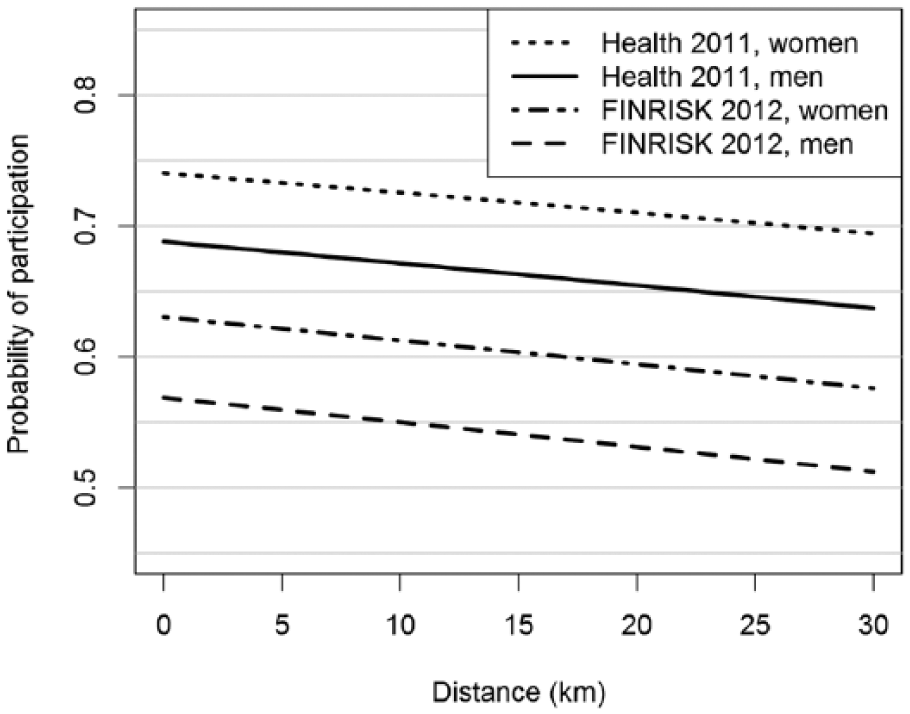
Predicted participation probabilities by sex and study for distances from 0 to 30 km. For Health 2011, predictions are for those who have participated in an earlier HES, and for FINRISK 2012, predictions are for those for those who have not. Age is fixed to 50 years.
We also estimated how participation activity would have changed if the distances had been a maximum of 10 km for all individuals invited to the survey. The distances >10 km were set to 10 km, and participation probabilities were predicted using the same model as above. The effect would not have been substantial, as the predicted participation rates would have increased from 55% to 56% in Health 2011 and from 59% to 60% in FINRISK 2012.
To analyse how the option to have the examination at home affected the association between distance and participation, we fitted two further models for the Health 2011 data, similarly as for combined data. When the response was participation at the examination clinic, the OR of distance per 10 km for non-participation was 1.09 (95% CI 1.05–1.12) in Health 2011. When participation to home examination was also counted as participation, the OR of distance declined to 1.05 (95% CI 1.02–1.08). This can be interpreted as an indication that providing the option of a home examination could decrease the effect of distance to participation.
Discussion
This study showed that the distance between home and the examination clinic along the road network modestly predicted non-participation among adults in Finnish HESs. It is not clear if making the network of examination clinics denser would be a cost-efficient way to reduce non-participation. This cannot, however, be interpreted so that increasing the distances in these kinds of studies would not cause a considerable decrease in participation rates. People who have long distances to travel to examination sites are likely to live in areas where they are used to travelling long distances from home to work places and services. A limitation of this study is that we could not take into account the means of transportation or topographic characteristics which may substantially affect travel time. Time spent travelling might be an even more important predictor of participation than the distance itself. The lack of information about the means of transportation could also be the reason no non-linear associations were found. Our study also gave an indication that the option of having an examination at home may decrease the effect of distance to participation and thus decrease the possible bias caused by regional differences in participation.
Footnotes
Declaration of conflicting interests
The authors declare that there is no conflict of interest.
Funding
This work was supported by the Academy of Finland (grant number 266251).