






Abstract
Aims: This study aimed to examine the population-based Skåne Health-care Register (SHR) regarding feasibility for scientific research and also strengths and weaknesses. Methods: To analyse the feasibility of the SHR, we performed a bibliographic search for peer-reviewed articles based on SHR data from 2000 to 2018. To analyse strengths and weaknesses, we used original SHR data about coverage and validity. Results: We identified 58 articles based on SHR data, covering different study designs and disorders. Most studies focused on musculoskeletal disorders with a cohort design. The majority of all consultations recorded in the SHR have an assigned diagnosis. However, this differs between the levels of care and between types of consultation. For inpatient care, the proportion of consultations with an assigned diagnosis was close to 100% between 1998 and 2017. The proportion of consultations with an assigned diagnosis was lowest within primary care, although the proportion markedly increased in 2004 when the prerequisite for consultation reimbursement was linked to the requirement for an assigned diagnosis. Limitations are that the SHR does not cover health-care provided within nursing homes and equivalent facilities or treatments received by the population of Skåne outside the region.
Introduction
Recently, a publication in the New England Journal of Medicine [1] reinforced the increasing knowledge that results from observational research might constitute stronger evidence, compared to randomised clinical trials, than previously thought. Contributing reasons to this include the possibility of long follow-up, a heterogeneous study population and a real-world setting.
Sweden and the other Nordic countries have a long tradition of routinely collecting data in health-care registers, as well as using such data for research. However, one large drawback has been the lack of data from primary care on a national level, which is due to legislation. Since the health-care system in Sweden is organised, governed and financed at a regional level, there are administrative health-care databases regionally. These data may, to different extents, be available for research. One prominent example is the regional database of the southern county of Sweden (the region of Skåne): the Skåne Health-care Register (SHR). The SHR covers the entire population and has been used for descriptive, aetiological and health economic research since early 2000.
The aims of this paper are to examine the SHR in terms of its feasibility for scientific research and to set out the strengths and weaknesses of this regional health-care register.
The Swedish health-care system
In Sweden, the responsibility for providing health-care is decentralised to 21 regions of different sizes. In 2017, the health-care proportion of the gross national product (GNP) was 11% which was unchanged from the previous two years [2].
Health-care is predominately tax financed (84%), with user fees (including user fees for health-care, prescribed drugs and over-the-counter drugs) and private insurance covering 15% and 0.6% of the total health-care expenditure, respectively [2].
Some of the health-care is privately organised but publicly financed (i.e. for the patient, the same allowance applies). Regardless of the type of health-care, a small user fee is paid by the patient until this reaches the total sum of approximately €112 during a 12-month period. After that, all out-of-pocket payment is waived for the remaining time in the 12-month period following the first consultation.
The Skåne region is the southernmost region in the country and accounts for 13% (1.3 million in 2017) of the Swedish population, and it has both rural and urban areas. All levels of health-care – that is, from primary care to highly specialised care – are represented in the region. Residents can actively enrol themselves at a primary care centre, and those who do not are automatically enrolled at a primary care centre closest to their residence.
The usual path into health-care is by a visit to a general practitioner, but patients can also access secondary care directly. Health-care provision at the consultant level outside the region normally requires a restricted permission procedure. Thus, it is believed that a negligible volume of health-care is provided outside the region for Skåne residents.
The SHR
The SHR is an administrative health-care register, and it holds information transferred from both computerised medical records and administrative application sources on all health-care consultations in the Skåne region from 1998 onwards. Each single health-care consultation (public and private), both somatic and psychiatric, to all types of health-care professionals (physician, nurse, physiotherapists, etc.) generates data entries by the health-care provider that are then automatically transferred to the SHR. These entries constitute the basis for economic reimbursement to the health-care provider. Hence, the vast majority of all delivered health-care is assumed to be included in the SHR. However, a small proportion of health-care in Sweden is delivered by the municipalities, for example care given in special housing and home care in ordinary housing, and is not registered in the SHR.
In the register, individual-level data on all primary care, secondary outpatient care and tertiary inpatient care are thus continuously collected for all residents in the Skåne region. Private and public organised care is registered in the same way in the SHR, except for the diagnostic codes in private care which are not transferred to the SHR. Table I presents a selection of the variables available in SHR.
Key variables for individual-level data in the Skåne Health-care Register (SHR).
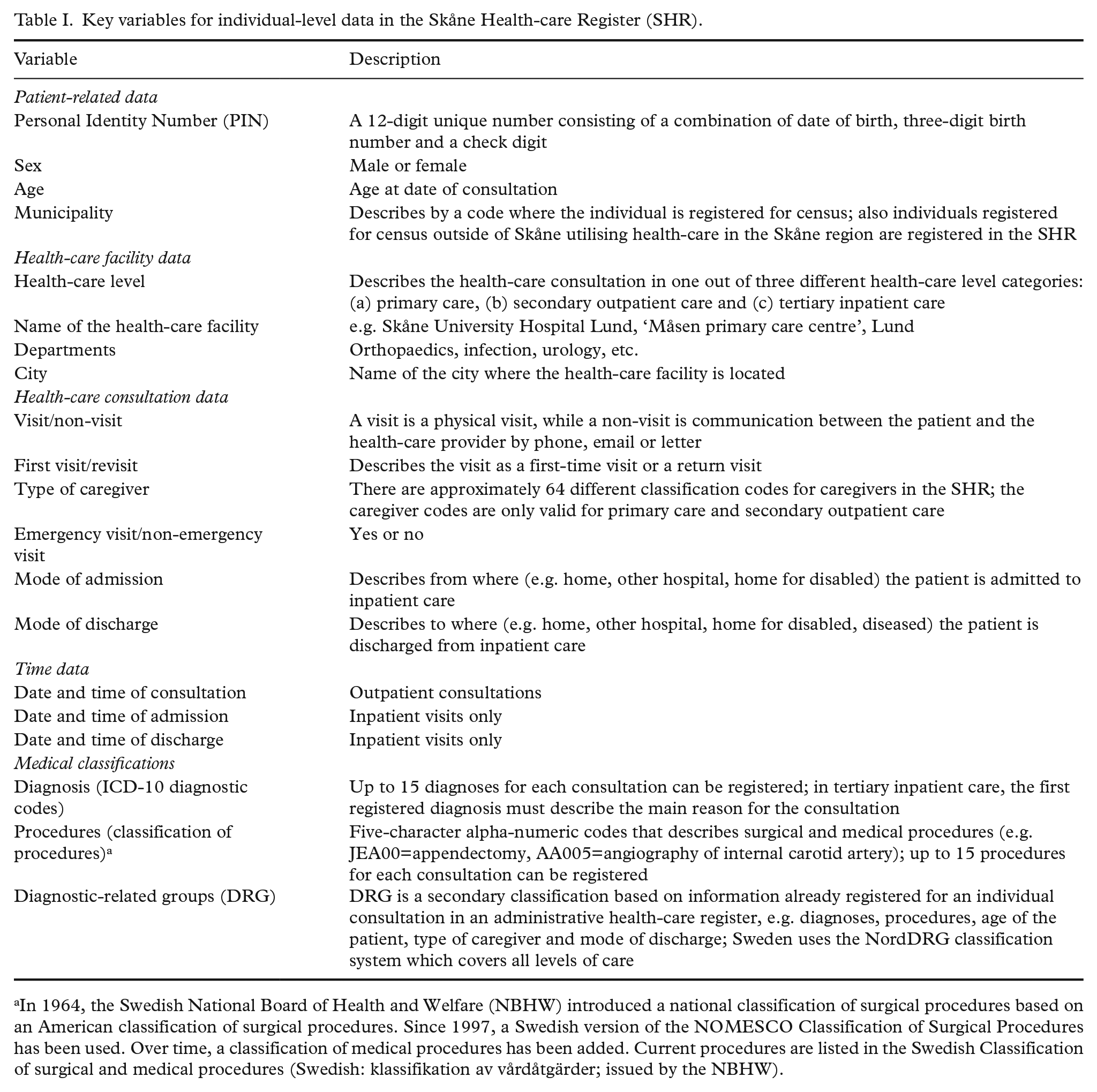
In 1964, the Swedish National Board of Health and Welfare (NBHW) introduced a national classification of surgical procedures based on an American classification of surgical procedures. Since 1997, a Swedish version of the NOMESCO Classification of Surgical Procedures has been used. Over time, a classification of medical procedures has been added. Current procedures are listed in the Swedish Classification of surgical and medical procedures (Swedish: klassifikation av vårdåtgärder; issued by the NBHW).
Population, coverage and validity
Since the SHR covers all levels of care delivered in the region, almost all individuals within the geographic area are included. During the five-year period 2012–2016, 97% of the general population consulted some type of health-care at least once. Since 1998, more than 143 million consultations have been registered in the SHR by almost 1.9 million unique individuals.
The vast majority of all consultations recorded in the SHR have an assigned diagnosis, and the proportion of missing diagnosis has decreased over time (for trends over time, see Figure 1). It differs, however, between the levels of care and between types of consultation (e.g. physical visit or telephone/email). For inpatient care, the proportion of consultations that have an assigned diagnosis has been close to 100% over the whole period. This probably has much to do with the fact that it is also mandatory for the same data to be transferred to the National Patient Register, administrated by the National Board of Health and Welfare (Socialstyrelsen) that covers all inpatient care provided in Sweden. For secondary outpatient care, the proportion of consultations has been high and increasing, starting in the early 2000 when these data were also required by the National Patient Register, and when reimbursements were linked to diagnostic settings. The proportion of consultations with an assigned diagnosis is lowest within primary care, although this proportion markedly increased in 2004 when the prerequisite for consultation reimbursement was linked to the requirement for an assigned diagnosis. In 2017, the proportion of all consultations with an assigned diagnosis in primary care was 63% (Figure 1, A1). The corresponding figure for the proportion of physician visits with an assigned diagnosis was nearly100% (Figure 1, B1). There may also be other factors, such as central policy or attitudes towards hospitals and primary care, influencing the proportion of consultations with an assigned diagnosis.
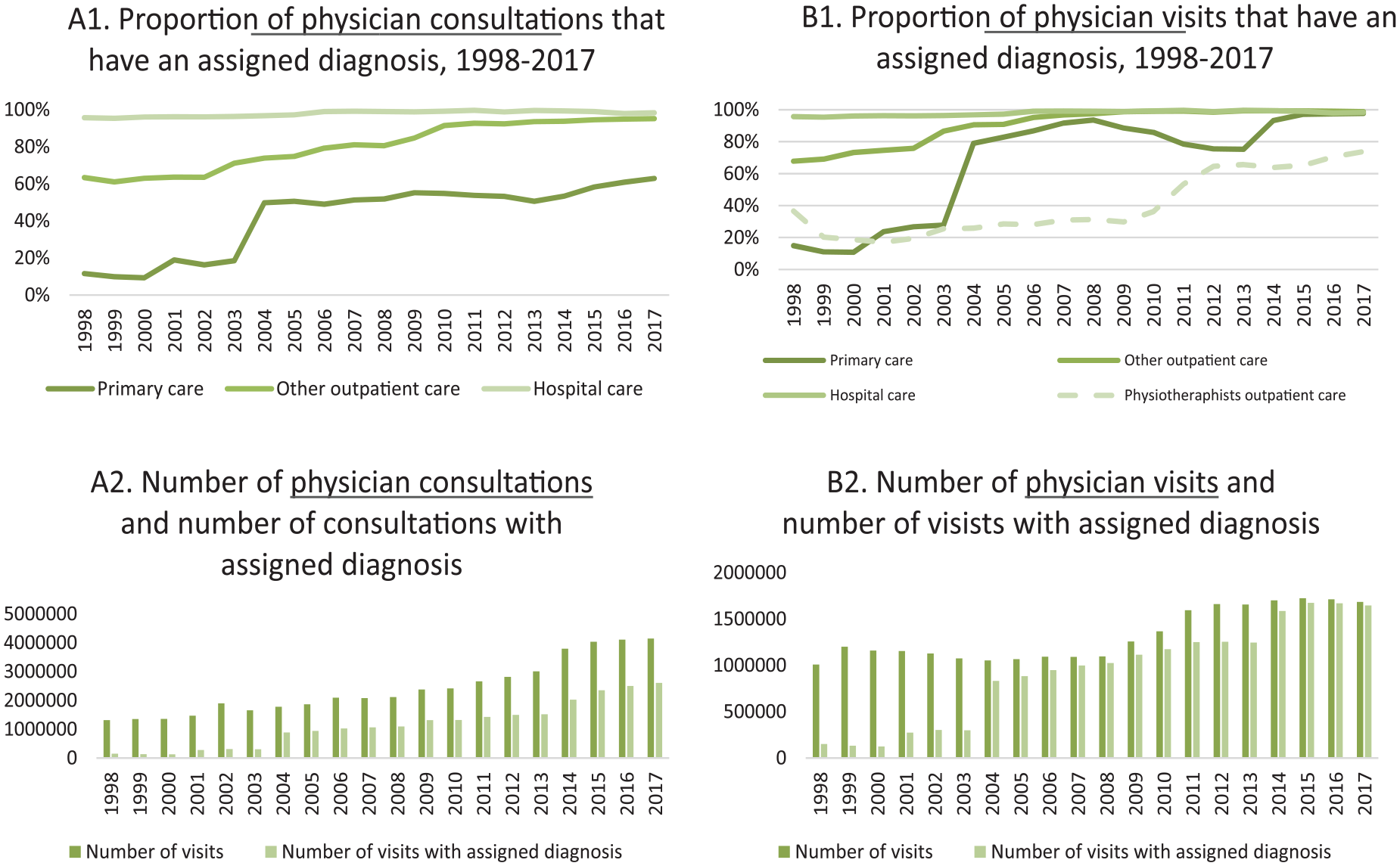
A1. Proportion of physician consultations (visits, phone, email, etc.) that have an assigned diagnosis, per year and level of care. B1. Proportion of physician visits that have an assigned diagnosis, per year and level of care. Dash line: proportion of all physiotherapist visits that have an assigned diagnosis. A2. Actual number of physician consultations and actual number of physician consultations that have an assigned diagnosis. B2. Actual number of physician visits and actual number of physician visits that have an assigned diagnosis, where the total number of visits increases more rapidly than the diagnostic recordings after 2009 after the structural change in health-care organisation in the region.
Another important structural change affecting the diagnostic coding was when health professionals other than physicians were allowed to register a diagnosis. This led to increased validity, especially for musculoskeletal disorders where physiotherapists, who handle many of the patients with back pain, previously did not assign diagnostic codes at all. A further structural change occurred in Sweden in 2009 when Health and Care Choices (‘Vårdvalet’ or ‘Hälsovalet’) was introduced. The policy ‘Hälsovalet in Skåne’ means that a person living in Skåne can choose which primary health-care unit – public or private – they would like to be treated in. All health-care providers included in ‘Hälsovalet’ must meet special requirements set by Region Skåne. In effect, from 2009, many former private caregivers were now treated as public, and thus the diagnostic codes originating from former private care now also transferred to the public data storage of the SHR. In reality, however, this did not change overnight but quite gradually. This is clearly seen in Figure 1, where the actual number of consultations increased around 2009, while the proportion of consultations with an assigned diagnosis decreased initially before later increasing.
The recorded diagnoses are automatically transferred from the medical setting. However, validity in terms of the accuracy in relation to different classification criterion might differ depending on the disease that is of interest. Several validation studies have been performed on specific diagnosis, such as rheumatoid arthritis [3], scleroderma [4], and psoriasis and psoriatic arthritis [5]. In the latter case, although the diagnosis differed in terms of validity depending on the level of care (e.g. lower positive predictive value in primary care compared to secondary care), the overall indication is that the validity in the SHR is good. This has also been confirmed by up-to-date prevalence figures of common diseases in line with what could be expected [3–8]. However, we encourage more validity studies within the SHR, specifically in fields other than musculoskeletal disorders.
Application areas and study designs
Besides the original purpose of reimbursement, the SHR has been useful as a source of structured data for analysis regarding, for example, the implementation of new treatments/guidelines, resource allocation, health economic outcomes and health-care inequity. For research purposes, the SHR has the capacity for a number of designs. At its simplest, it can be used to select patients with a certain condition for medical records studies or interviews, but cohort studies and case-control studies have also been performed.
In order to identify and present published articles that have used the SHR as a data source we performed a structural bibliographic search (see Appendix A) for peer-review articles based on SHR data from early 2000 to May 2018. In total, 58 articles were identified (Figure 2). The research includes different types of study designs and diseases and linkage to other registers (Table II). The majority of all published studies focus on musculoskeletal disorders (n=50; 86%) and use a cohort design (n=35; 60%). However, we also note studies using the SHR for case identification, selection of population-based controls, register-based randomised clinical trials and studies using case-crossover designs. For a list of the 58 publications using data from the SHR, see Appendix A.
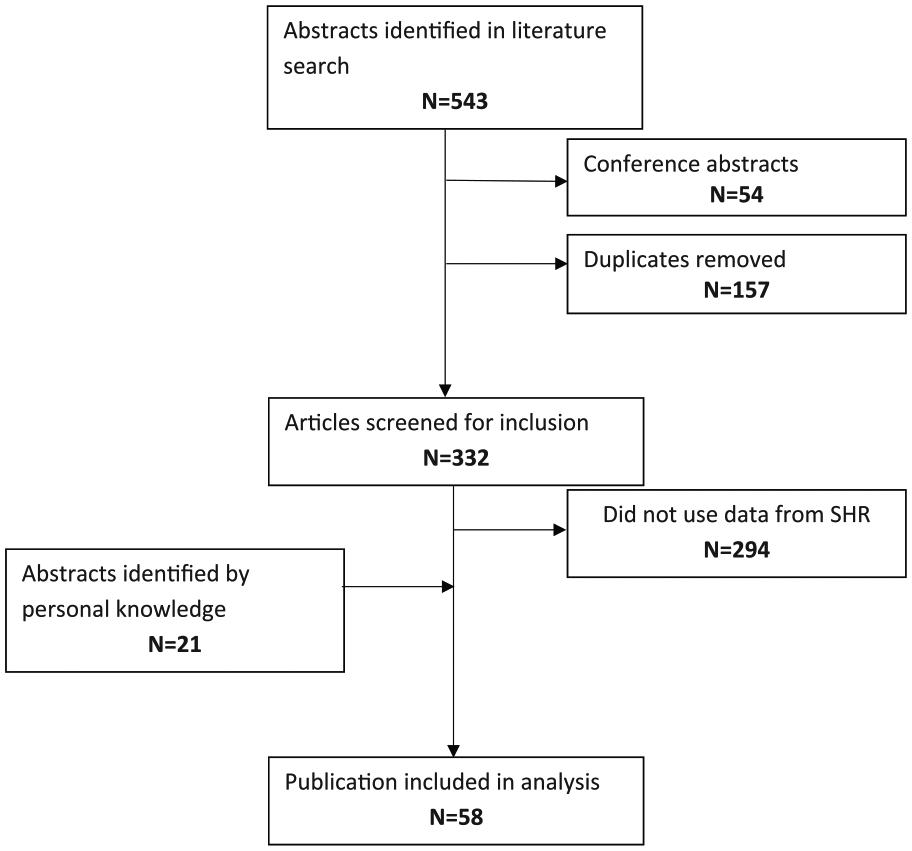
Flow chart of the process of identifying relevant articles.
Summary of types of publications based on data from the SHR from 2003 to May 2018 (n=58).
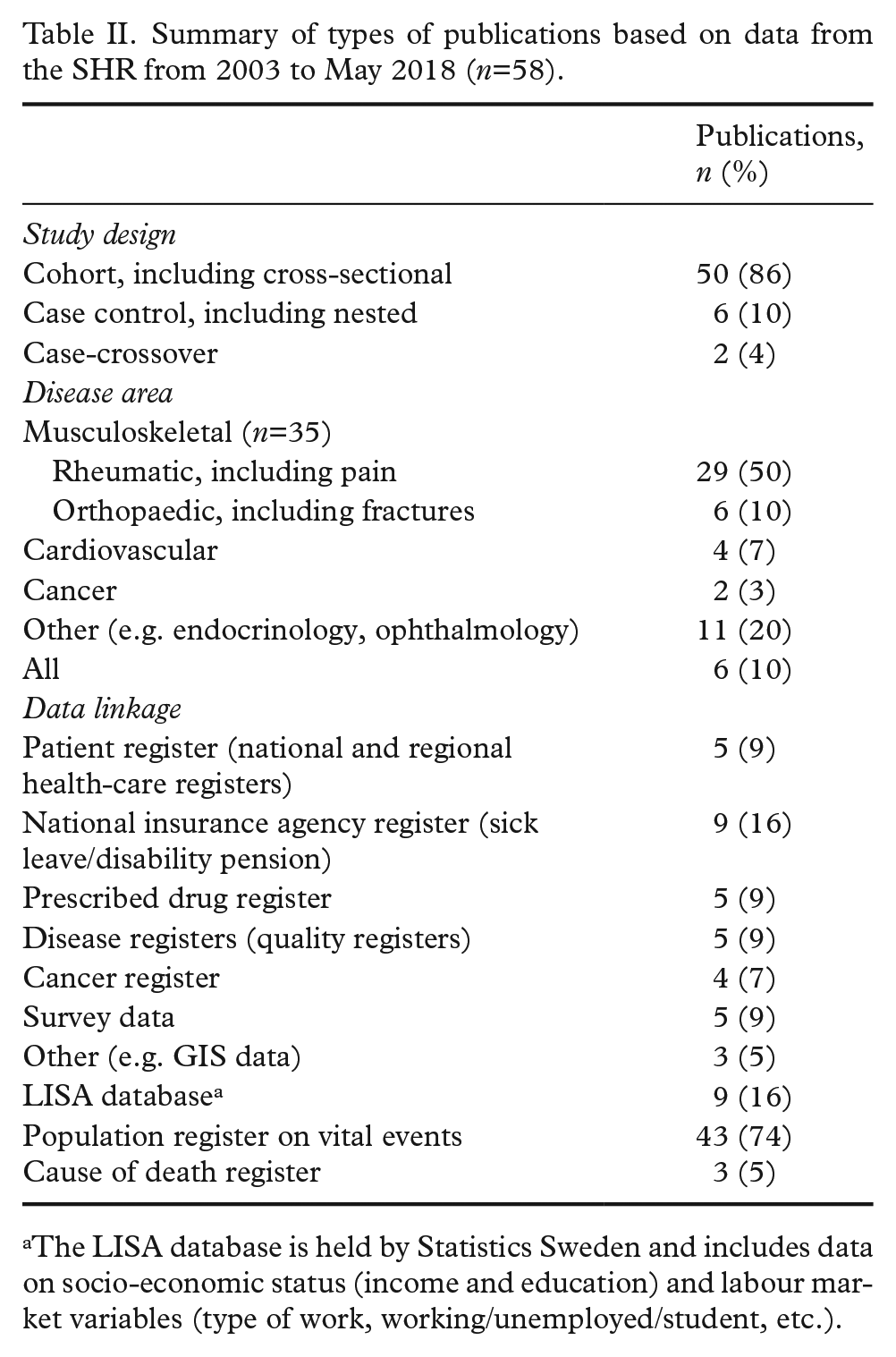
The LISA database is held by Statistics Sweden and includes data on socio-economic status (income and education) and labour market variables (type of work, working/unemployed/student, etc.).
Opportunity for linkage with other data sources
One of the advantages with register epidemiology in the Nordic countries is the ample opportunity to link between registers using the personal identification number (PIN) [9]. This is a unique 12-digit identifier given to all residents at birth and to immigrants staying longer than one year in Sweden.
The SHR uses a unique identifier that for integrity reasons is a transformed version of the PIN. The algorithm used for the transformation is kept by a third party and is not available in the normal usage of the SHR, but it can be unlocked for research purposes after ethical approval. In principal, any other register can be linked with the SHR. To date, we are aware of links to Statistics Sweden’s database on employment, income and education (LISA) which also hold information on civil status, family status, socioeconomic status and immigration/emigration; the National Board on Health and Welfare’s register on cause of death and on prescribed drugs; the Swedish Social Insurance Agency register on sick leave; and several national disease-specific registers (‘quality registers’) and cancer quality registers. Further, and without reverse transforming the PIN, the SHR is available for links with other regional health-care databases containing, for example, X-ray results, laboratory results for blood, cytology and pathology, and medical records. Given the PIN, the SHR is, however, suitable for linking to any other data source that also includes the PIN, whether it is a register, medical journal, survey data, administrative data including school grade, family linkage and national quality registers for specific disease for lifestyle factors.
Ethical aspects
A prerequisite for the use of SHR data for research purpose is approval from an ethical review board in Sweden. For details on the ethical review process, see Ludvigsson et al. [10]. Access to SHR data for research purpose also requires approval from the administrative body of Region Skåne that is the data controller for the SHR.
Discussion
Since health-care is virtually free of charge for the patient, the SHR covers practically all delivered care in a well-defined and large geographic area. An important strength of the SHR is the inclusion of all levels of care and all types of health-care professionals. To date, 64 different groups of professionals are identified in the register, including physicians (i.e. interns, residents and fellows), nurses, physiotherapists, social workers, chiropractors, orthopaedic technicians and so on. This facilitates studies of specific health-care events handled by different professionals, and it also enables studies of the full health-care process for a specific patient group. It is also an important aspect in studies of incidence and prevalence, since not all patients are handled by a physician, for example in Sweden people with different types of musculoskeletal pain are triaged to a physiotherapist and (after screening) only a few are referred to a physician. Another example would be patients with well-controlled diabetes whose health-care needs may be handled only by nurses for long periods of time. These are patients who would be missed in an incidence/prevalence study only including health-care delivered by a physician.
Depending on the study question, this population-based data source, without selection phenomenon, allows for generalisability of the results. One important reason for the good coverage and reliable data is the transferability between health-care systems. No extra registration is needed. Instead, the SHR grows prospectively by automatic transfer. Another strength is that the SHR includes all health-care: both actual visits and consultations by phone, email and video. The delivery of health-care assumes new forms at a rapid pace, and the share of consultations other than actual visits is growing rapidly. As a consequence of this, the SHR continuously add new variables to accommodate information about the evolving health-care system.
There are some limitations in using the SHR, and the severity varies depending on the study question and design. For example, the SHR does not cover health-care provided within nursing homes and equivalent facilities, since the municipality and not the county council is medically responsible for this type of care. This is particularly a problem when studying outcomes among the older population and also among people with special needs who need to live in specialist housing where in-house medical professionals are available. However, there are both disease registers focusing on geriatric care (e.g. ‘SeniorAlert’ and The Swedish Palliative Care Register) and Swedish national registers covering interventions within municipality-delivered health-care. Further, specific specialised procedures targeting small patient groups (e.g. different transplantations) are not delivered in every region in Sweden but instead are organised at a national level. As a consequence, these treatments received by the population of Skåne outside the region are not registered in the SHR. On the other hand, for procedures Skåne handles within the national health-care scheme, the SHR also contains information on residents from outside the region.
The special features of the SHR include routinely collected health-care data from all levels of care for a whole population in a well-defined geographic area. When working with real-world data, it is important to acknowledge and be aware of structural changes in the surrounding society that influence the content of the register. These changes can occur due to political changes, but also due to changes in health-care organisation or within treatment strategies. To today, the SHR has been important as a data source for clinical changes and improvements, and extended use of the SHR in a research context has highlighted important shortcomings within the register, which has since been improved. Research is thus a way of indirect quality control.
To enhance the use of the SHR further, better harmonisation between registers, within and outside of the region and internationally, is of crucial importance. Use of Systematized Nomenclature of Medicine (SNOMED) terminology and direct transfer between disease registers and national health registers would facilitate this and thus improve the basis for solid epidemiological research, increasing the use of the SHR further.
Footnotes
Appendix A: Search strategy and list of publications
Acknowledgements
The authors are very grateful to Eva-Karin Karlsson, librarian at the unit of Health Technology Assessment Skåne, Skåne University Hospital, Lund, Sweden, who performed the structural bibliographic search for peer-reviewed articles based on SHR data.
Declaration of conflicting interests
The authors declare that there is no conflict of interest.
Funding
The authors disclosed receipt of the following financial support for the research, authorship and/or publication of this article: this study was funded by unrestricted grants from Region Skåne and Lund University, Sweden.
