







Abstract
Aims: The Swedish public support system for the integration and establishment of newly arrived refugees includes an individualized introduction plan, containing language, civic and health information classes. As the plan requires active involvement, the simultaneous establishment of childcare and school start for children risks creating additional challenges and frustrations. The aim of the study was to explore the experience of adjustment among newly arrived refugee parents in the resettlement process, so as to understand how this risk may be mitigated. Methods: This paper presents findings from a qualitative study conducted with 24 Syrian refugee parents participating in the resettlement process and having received asylum status. Results: Parents experienced stress due to long waiting times for residence permits and the struggle to find stable housing. The parents established themselves by enrolling in language studies and looking for employment. They also faced challenges adjusting socially since they were mainly meeting people from their own country and, therefore, felt excluded from the Swedish society.
Background
According to the World Health Organization, health is a state of complete physical, mental and social well-being and not merely the absence of disease or infirmity [1]. In Sweden, the general public health strategy is to work towards reaching equal health for all inhabitants, which is in line with the EU Agenda 2030 [2]. Although this is a goal in Sweden, we still see unequal health in different groups in society, including amongst newly arrived migrants [2]. Migration and escaping from a native country is well known to cause mental stress [3]. The circumstances that surrounded families while escaping their native countries often contribute many stress factors [4]. Moreover, after the arrival in the host country, the social environment might affect how well families adjust during the resettlement process. Refugees could suffer from social stress through problems with finances, experiences of discrimination as well as due to the challenges of learning a new language [5]. Stress in different forms is associated with both mental and physical health [6].
Earlier studies on integration in Sweden have shown that newly arrived migrants coming during the 1990s were facing challenges such as missing family members from the home countries, trying to establish new contacts in Sweden, as well as striving towards finding employment after arrival [7]. Later, Samarasinghe and Arvidsson [8] shed light on how the health of newly arrived refugee (NAR) families in Sweden was affected during the resettlement process. Families described a struggle to establish themselves, not only because they possessed resources that could be used but were discriminated against when it came to obtaining jobs in line with their educational level [8], but also because they felt they had another kind of war to fight in Sweden: a battle against disrespect, poor jobs and futility.
The concept of transition is of interest because of its emotional and psychological impact on health for the NAR parents [9]. In order to facilitate a healthy transition for the NAR parents, it is of importance to identify health issues regarding this group. Schumacher and Meleis [9] have identified three indicators of a healthy transition: a subjective sense of well-being, mastery of new behaviours and the well-being of interpersonal relationships. In order to promote health among NAR parents, there needs to be a focus on preventing unhealthy transitions by uncovering internal and external environmental conditions that could create constraining forces towards the achievement of a health transition [10].
The support system in Sweden means that all refugees that have received asylum status are enrolled into the establishment process by getting an individually developed introduction plan. The employment service in Sweden is in charge of the program that gives the refugees approximately two years of support, including studies in the Swedish language, preparation for employment as well as civic and society information. The aim of this plan is to offer support for a more rapid entrance to the job market. The main idea is to utilize the individual`s resources, such as education and work experience [11]. As the introduction plan requires active participation in order to receive social allowance, the simultaneous establishment of childcare and school start requires navigation across systems and could cause frustration and have a negative impact on the introduction process [12]. These issues are important not only for the individual, but also for the community [12]. The well-being of the parents is important for effective integration and is an essential part in order for NAR parents to be able to enter the labour market in the host country.
Aim
The aim of the study was to explore the experience of adjustment amongst NAR parents in the resettlement process.
Method
This was a qualitative descriptive study conducted by interviews with NAR parents who were granted asylum status and had received residence permits. The rationale for this methodological choice is a consequence of a recently conducted quantitative study suggesting that NARs suffer from physical, mental and different social issues [13]. A qualitative approach enhances our understanding of the issue of resettlement. The analytical approach chosen was thematic network analysis recognized as a robust and sensitive method for systematizing and presenting qualitative data [14].
Selection process
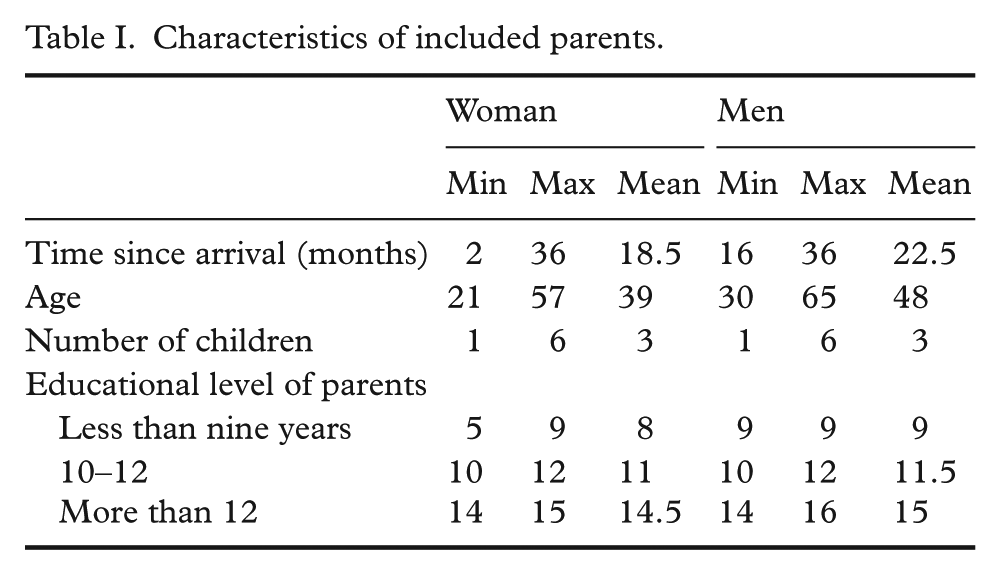
The inclusion criteria were refugee parents that have recently arrived and successfully applied for asylum, being granted refugee status, received residence permits and were enrolled in the Swedish introduction plan. Extended family members as well as children were excluded. The researcher worked with civic and health officials in the local community [15] who acted as gatekeepers recruiting families. Approximately 400 parents were approached for the study through both oral and written information. The oral information was given by the civic and health officials during the civic and health classes, and around 30–40 NARs were present during each class. In total, 24 Syrian parents volunteered (see Table I for the characteristics of included families).
Characteristics of included parents.
Data collection
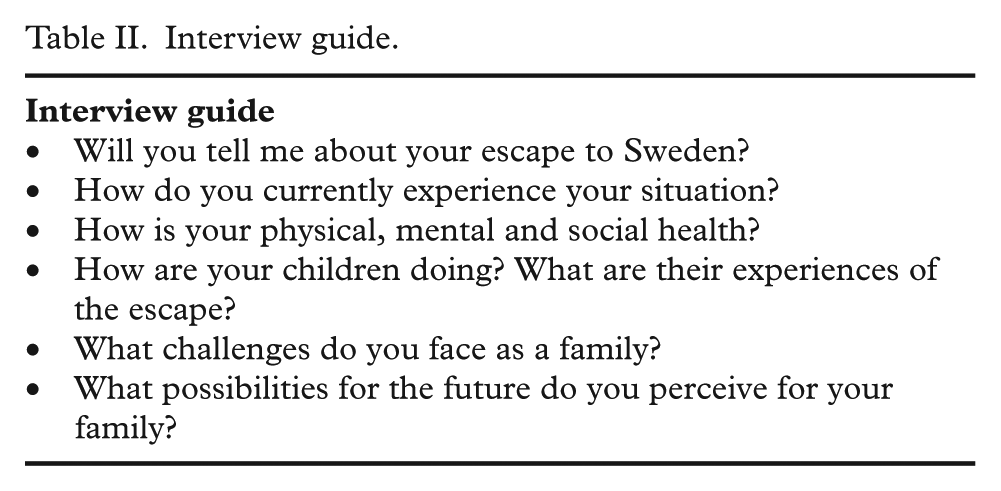
The interviews were conducted with both parents present in nine out of 15 interviews. For the remaining six interviews only one of the parents was interviewed, which resulted in 24 parents being interviewed. All interviews were conducted by the first author carried out in the homes of the interviewees or at the school facilities. A semi-structured interview guide was used for covering various aspects of the family`s experience of being in the resettlement process. The inspiration for the interview guide was drawn from the content of earlier research focusing on refugees in resettlement [8, 16]. The (Table II) interviews were recorded and transcribed verbatim shortly afterwards and the interviews averaged 36 min (range 17–60 min) including interpretation. Thirteen interviews were conducted with an authorized Arabic interpreter translating simultaneously via telephone. The remaining two interviews were conducted without an interpreter, one in English and one in Swedish.
Interview guide.
Data analysis
Data were thematically analysed using Attride-Stirling’s [14] approach and illustrated as thematic networks. First, the transcripts were read, reread and coded by the first author (EM). Next, the coded material was read by the second author (EC) and feedback about the coding ensured credibility. After the coding was completed, basic themes were clustered into organizing themes, illustrating similar findings. Then a group of organizational themes constitute a global theme that comprehend principal metaphors of the data (see Figure 1).
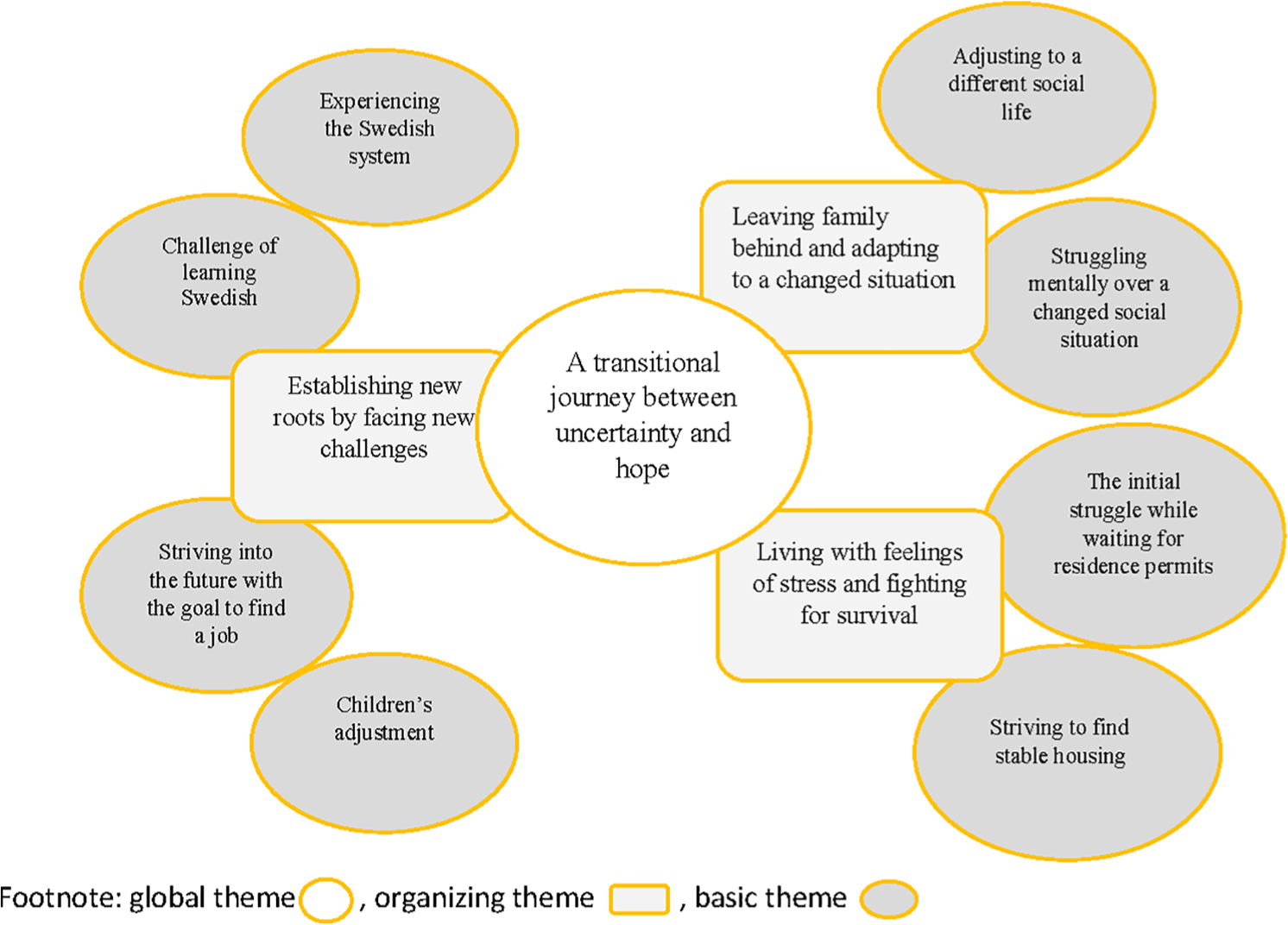
Thematic network of the journey between uncertainty and hope.
Ethical issues
The participants were given both written and oral information about the study, and before conducting the interviews, the informants had to sign a written consent. Approval was received from the Ethical Review Board in Lund before conducting the interviews (registration number 2016/785).
Results
The results are ordered into three organizational themes: 1) living with feelings of stress and struggling for survival, which is constituted by two basic themes – the initial struggle while waiting for residence permits and trying to find stable housing; 2) striking roots by facing new challenges, which is constituted by four basic themes – experiencing the Swedish system, children’s adjustment, striving toward the future with the goal of finding a job and challenge of learning Swedish; and 3) leaving family members behind and adjusting to a new situation, which is constituted by two basic themes – adjusting to a different kind of social life and mental struggle with a new social situation. First the basic themes will be presented, followed by the corresponding organizational themes. The global theme will be presented at the end of the results section, summarizing the results.
Basic theme: the initial struggle while waiting for residence permits
Several of the parents mentioned long waiting times in order to obtain residence permits. One father and his family had waited 19 months to get a permanent residence permit and he mentioned that this period was stressful because they did not know whether the authorities would ever approve their applications and he thought it would be better to go back home than to sit and wait here for a residence permit.
A five-month-old infant had not received any identification papers, which was a major stress factor: “[w]hat also worries me is the situation for my baby and the fact that he could be seen as stateless since he does not have any Syrian or Swedish registration papers” (Interviewee 7).
A father who arrived on his own two years ago and reunited with his family five months ago mentioned that it took a long time to obtain even a temporary residence permit. He did not want to bring his family along on the dangerous and risky passage across the ocean and, therefore, applied for visas based on family ties instead.
Basic theme: trying to find stable housing
Participants talked about the challenges they faced trying to find stable housing. One parent mentioned that they initially had to live in residential housing through the Migration Board, where they had to share space with many others and did not feel safe. After finally arriving in another town, they had to move five times during the first year. Two parents shared the experience of living in a small apartment with insufficient space and the lack of a lease. They doubted that they could find an apartment on their own in the near future: “Swedish landlords do not want to rent to families like us, since we do not have an employment contract yet and it will take a long time before we do, since we just recently started to study the language” (Interviewee 3). Participants said that they struggled mainly with their housing situation, had moved to a new apartment every other month and were currently staying at a hotel. In addition, they had to live without leases and pay a lot of their money to landlords:
When you do not have a lease, you cannot receive any government subsidies. We had not brought much money with us, and there was hardly anything left at the end of the month. Sixty percent of monthly support goes to a one-room apartment, where there isn’t enough room for our children to play and do their homework. (Interviewee 13)
Organizational theme: living with feelings of stress and struggling for survival
Living with feelings of stress and struggling for survival relates to how refugees experience a difficult period while waiting for residence permits. This is further aggravated by uncertain living conditions that stand in the way of adjustment.
Basic theme: experiencing the Swedish system
Several of the interviewees mentioned feelings of gratitude toward Swedish society and its system. Some of them said that Sweden was a better country than the rest of Europe and that many people helped refugees: “It would be great if I could go back in time and be younger in order to work in this country and give something back” (Interviewee 9). Participants expressed gratitude to the Swedish system and said they were very grateful for the schools, as well as for the financial support they received. One participant mentioned that since you can get everything you need here, you have a sense of stability, which leads to a sense of mental health well-being and the ability to enjoy life here.
Basic theme: children’s adjustment
Several of the interviewees mentioned how they appreciated that their children could start school shortly after arrival. One father said: “our children really like school here and say that everyone is treated equally; we did not have the same rights where we came from” (Interviewee 6). Many parents mentioned that their children liked being in Sweden and that it was good for them to come here. Although all the interviewees had left a country at war, some of their children did not remember the hostilities in Syria. One father stated that it was a shock for his children to watch the news on TV about the war in Syria, since the children did not remember anything about it. He also mentioned that parents sometimes try to hide the struggle they are experiencing but that their children often notice it anyway. Some parents mentioned that Sweden had a different culture and views on how to raise children and that they had to strike a balance between retaining old customs and adjusting to new ones.
Basic theme: striving towards the future with the goal of finding a job
Several of the interviewees mentioned how hard it was to find work in Sweden and the effort they had to put into it. One couple that had trained as dentists in Syria talked about their struggle to find employment in Sweden. A lot of preparatory courses and difficult tests were required and many had simply given up and left the country. One participant that was trained as a teacher, with employment experience in Syria, said: “I will try my best to complete the establishment process here in Sweden and then find a job so that I don’t have to rely on the terrible social welfare net and low benefits” (Interviewee 8).
Basic theme: the challenge of learning Swedish
Many of the interviewees focused primarily on learning the language during their first year in Sweden. Children learned very quickly and could soon communicate well. Parents faced more of a challenge going back to school and learning a new language: “it’s a slow process of adjusting to being back in school” (Interviewee 10). One mother who was illiterate, with only five years of schooling in Syria, said that she wanted to learn the language quickly in order to be able to find a job.
Organizational theme: striking roots by facing new challenges
Striking roots by facing new challenges relates to how NARs could identify such roots during the resettlement process. Learning the language was regarded as the most important task for integrating and becoming part of society.
Basic theme: adjusting to a different kind of social life
Several of the interviewees mentioned that they led a different kind of social life in Sweden. Some of the families made friends with others but mainly their compatriots. One woman said: “we have gotten to know people here in Sweden whom we did not know before, and we go visit them and they come visit us. They are mostly from Syria and Palestine” (Interviewee 15). Two parents told about their teenage girl who wanted to integrate by making friends among native Swedes, but most of her classmates were from Syria. Several of the interviewees said that having left family members behind made it more difficult to adjust to life in Sweden. A few women had to deal with all the practical issues of having a newly arrived family while missing their partner. Other interviewees who still had parents or siblings in their native country with an ongoing war, mentioned that they always had to be prepared for something to happen to them.
Further, one man talked about losing his family on the way from Syria and being by himself. Although two of his adult children had come to Sweden a year ago, they had settled in another town. It was expensive to visit them and he had seen them just twice during the past year. His wife and the rest of his children were in Turkey, waiting to see if they would be able to come to Sweden to join him.
Basic theme: mental struggle with a new social situation
The interviewees mentioned that they were struggling mentally due to changes in their social situation. One family said that the woman had struggled during delivery of their last baby, since she was away from her parents and siblings. She experienced post-partum depression as a result. Participants mentioned that they experienced stress, mental struggle and grief over a son who had been killed in Damascus during the war.
Another participant talked about the mental struggle of having to wait for the rest of his family to arrive in Sweden: “I have been stressed out and depressed because I couldn’t see my family in Turkey and had to wait 13 months before they could arrive” (Interviewee 14). He said he is still worn out but that things are improving. Another parent said that he struggled mentally because he was on his own, away from the rest of his family and he missed them during the nights.
Organizational theme: leaving family members behind and adjusting to a new situation
This organizational theme covers changes in social situation and family members left behind. Participants also mentioned stress related to not having the same social get-togethers as they were used to in Syria, causing a feeling of loneliness and estrangement from society.
Global theme: journey between uncertainty and hope
The journey between uncertainty and hope describes the experiences of having escaped from a war-torn country and arrived in new surroundings. Feelings of uncertainty arise as families struggle with daily life while waiting for residence permits, finding stable housing, learning a language and adjusting to new social circumstances. Stories of hope reflect new educational opportunities for children and the desire to find a job and contribute to Swedish society.
Discussion
The parents in the current study talked about looking for employment and the demand put on them by learning a new language. The issue of learning a new language is also mentioned in the synthesis of qualitative studies regarding parenthood during migration by Merry et al., where the parents considered learning a new language as empowering for themselves as well as important for their children’s futures [17]. Hou and Beiser [18] found that proficiency in the language of the new country greatly improves the economic and social integration, as well as the well-being, of migrants. Lack of language skills compromises economic opportunity, access to social resources and empowerment in resettlement countries. Hou and Beiser [18] also found that the first years in a new country are the most critical for learning the language and that the odds grow increasingly remote after that period. Based on the results from the current study, we stress that learning a new language in general is a vital key to integration, which will increase the opportunities for a speedier access to the employment market. This is of special importance in Sweden, since we have recently seen that only 4% of the NARs that have been in the establishment process gained employment [12], which could be seen as a failure from the Swedish authorities, since the aim of the establishment process is to speed up the entrance into the Swedish labour market.
Almost all families mentioned stress related to finding stable housing, and the reason for this is mainly that Swedish landlords require a stable income and the participants did not have a positive outlook on their possibilities of finding a job. A stable housing situation can facilitate many aspects of integration, while unaffordable, crowded, unsafe conditions can disrupt the entre process. This is in line with the results of a study by Phillips [19], concluding that housing conditions clearly play an important role in shaping the sense of security and belonging, which have a bearing on access to healthcare, education and employment [19]. Housing is a well-known social determinant of health that largely affects a person’s mental health [20]. A public health strategy in Sweden could, therefore, be to continue working on finding solutions for enabling NARs to find suitable housing and, therefore, minimize the risk of mental illness [21].
The interviewees in the present study said that they missed family members who had been left behind and that they suffered mentally as a result. This is in line with the findings from the study by Merry et al., which concludes that the parents were torn between their family members living in the receiving country and those back home [17]. Our findings are also consistent with Miller et al. [22], who explored the impact of family separation on the mental health of refugees, as well as consistent with earlier findings in Sweden [7]. They found that refugees who missed family members had higher scores on anxiety, depression and post-traumatic stress disorder scales, and significantly lower scores when it came to psychological quality of life. In addition, Strang and Ager [23] mention that for many refugees it is of primary urgency to be united with close family members after the flight. Therefore, stakeholders in general need to consider this matter in order to properly help and support refugees in successful integration since the absence of ties to people can serve as an explanation for a lack of bridging capital or lack of integration [24]. This is of special importance and application into the Swedish society, since lately in Sweden there has been a restriction in the right to reunite as a family after flight [25]. Since mental health issues have been associated with family separation, it is of great importance for the Swedish society to consider the impact that these separations could have on the mental health regarding NARs, as well as how it could affect the public health goal in Sweden that aims at reaching equal health for all [2].
The results in the current study could be relevant for the theoretical concept of transition presented in the background [9, 10]. According to Schumacher and Meleis [9], a healthy transition consists of a subjective sense of well-being, a mastery of new behaviours and the well-being of interpersonal relationships. In the current study, the transition can be explained as the NAR parents managing new complex skills while learning Swedish, as well as the fact that the subjective sense of well-being was related to how fast NARs found stable housing. Further, in the current study, the third indicator for successful transition – the well-being of interpersonal relationships – was related to the importance the NARs placed on to what extent they were able to be together as a family after the flight. All these indicators are important to consider in order to enable a healthy transition into the Swedish society. The support that could be offered from the society during this period of transition could be language training, considering the needs of the individuals, opportunities for social gatherings, offering of stable housing, as well as the possibility to be reunited as a family after arrival in Sweden.
The interviews were conducted mostly in Swedish, with Arabic interpretation via telephone, and we are aware that a power imbalance could occur since interpretation could be affected by the way that participants and interpreters perceive each other [26]. This needs to be considered when analysing the results of this study [26]. The authors chose to do interviews with both parents present if possible, and were aware that this could have interfered with the interviews and could have affected the willingness to be open about sensitive issues.
The participants in the present study had higher educational levels than the average for refugees in Sweden [27]. This could have influenced the results since health and well-being is affected by the educational level that the person holds [28]. Apparently, some informants in the current study had a good and more pleasant experience of the resettlement process compared to others. This could be influenced by factors such as length of waiting time, family situation, as well as housing difficulties, all of which need to be considered while interpreting the results. The interviews were fairly short when considering that interpretation was included in the time, but the researcher that conducted the interviews perceived the interviewees to be given plenty of time to go deep during the interviews and did not perceive that the interpretation counteracted the depth of the interviews.
To ensure credibility, the coded material were read independently and the coding was discussed and compared until we reached agreement on the final version of the analysis [29, 30]. Further, credibility could be seen as a conclusion to what extent judgements about similarities and differences have been consistent over the interview process and in order to ensure that an open dialogue between the authors have occurred during the research process [31]. Dependability was ensured by an external expert on migration issues following our research process, in line with what Lincoln describes as the inquiry audit [29]; it was also ensured by the process of data analysis and allowing the steps of the chosen method to be followed closely [31]. According to Lincoln, transferability is related to the decision-making process of those researchers or practitioners that are seeking to transfer the study findings to their own settings [29]. Transferability of our results is limited, since we only have characteristics and background information of the 24 informants in the current study and not on the total population of 400 parents.
Conclusions
Experience in relation to adjustment among NAR families could be seen as a journey between uncertainty and hope. The major adjustment-related factors were living conditions and language barriers, making social interaction as well as employment difficult. Therefore, support with stable housing as well as with quicker language training from the Swedish authorities is needed. Swedish authorities should continue to emphasize the ability of families to reunite. Stable housing will also enable the children to stay in the same location for a longer time and, therefore, be able to establish themselves in school. The implication of the findings presented could enhance the well-being of the whole family, thus leading to effective integration.
Footnotes
Acknowledgements
We would like to acknowledge all the newly arrived refugees for taking part in the interviews.
Declaration of conflicting interests
The authors have no conflicts of interest to declare.
Funding
The authors disclosed receipt of the following financial support for the research, authorship, and/or publication of this article: This work was supported by the Asylum, Migration and Integration Fund (AMIF) (number 2.2.2.2-2016-27207).
