







Abstract
Aims: To investigate the effects of objectively measured smartphone interactions on indicators of mental well-being among men and women in a population of young adults. Methods: A total of 816 young adults (mean±SD age 21.6±2.6 years; 77% men) from the Copenhagen Network Study were followed with objective recordings of smartphone interactions from calls, texts and social media. Participants self-reported on loneliness, depressive symptoms and disturbed sleep at baseline and in a four-month (interquartile range 75–163 days) follow-up survey. Multiple linear regression was used to analyse the association between smartphone interactions and mental well-being separately for men and women. Results: A higher number of smartphone interactions was associated with lower levels of loneliness at baseline and the same pattern appeared for depressive symptoms, although this was less pronounced. A high level of smartphone interaction was associated with lower levels of disturbed sleep for men, but not for women. In follow-up analyses, a high versus low level of smartphone interaction was associated with an increase in loneliness and depressive symptoms over time for women, but not for men.
Keywords
Introduction
Smartphone technology is an important aspect of interacting with friends, family and extended social networks. Engaging in social interactions has consistently been shown to be beneficial to mental well-being [1]. Nevertheless, highly intensive and around the clock social interactions via smartphones may have detrimental effects on mental well-being, possibly overriding the positive health effects of engaging in social interactions [2–4]. Indeed, the parallel increase in both smartphone use and indicators of poor mental well-being among young adults reported in most western countries [5] draws attention to the excessive use of smartphones as a potential risk factor for poor mental well-being. An increasing number of studies have also suggested a relationship between smartphone use and poor mental well-being [2–4]. Considering the widespread use of smartphones, even small effects on mental well-being can have major public health implications and hence it is important to investigate specifically how using smartphones in social interaction is related to different aspects of mental well-being. Loneliness, depressive symptoms and disturbed sleep are aspects of mental well-being that have suggested to be particularly negatively affected by high levels of smartphone interactions.
Smartphone interactions – such as calls, texts and social media – constitute social contact, but whereas smartphone interaction may make it possible to connect to a wide range of people, it may also make it harder to create intimacy and closeness in interactions carried out using smartphones, potentially increasing feelings of loneliness. Only a few studies have focused specifically on smartphone interactions in relation to loneliness and these studies report inconclusive findings, where smartphone interactions are related to both higher and lower levels of loneliness [6, 7]. Hence the direction of the association between smartphone interactions and feelings of loneliness is not yet established.
Constantly being available to incoming smartphone requests has been suggested to lead to a mental overload, feelings of over-connection and guilt if the demands are not met [3]. If such experiences become long-term, then they might lead to depressive symptoms, which have been suggested in several studies [2, 8–10]. Further, unfavourable social comparisons (i.e. evaluating one’s own quality of life to be poorer than that of others) have been suggested to be a key mechanisms linking social media use to lower life satisfaction and depressive symptoms [11, 12].
Smartphones are easily carried into bed, offering possibilities of engaging in smartphone interaction at bedtime, which may potentially disturb sleep. The blue light emitted from smartphone screens may alter the production of the sleep hormone melatonin [13]. Frequent smartphone interactions can induce mental arousal, leading to difficulties falling asleep around bedtime [14]. Studies predominantly conducted among children and adolescents show that excessive smartphone interaction leads to a deterioration in the quality of sleep [14–16], but only a few studies have investigated smartphone interactions and sleep in adult populations [17].
The current evidence points to negative effects of excessive smartphone interactions on mental well-being, but the majority of studies are based on self-reported data in cross-sectional studies, leaving a risk of reporting bias and reverse causality. A few studies have considered objective measurement of smartphone use in relation to mental well-being [11, 18, 19], but most of these studies are either conducted in small populations or investigated screen time rather than interactions, such as calls or texting, specifically in relation to mental well-being. Few studies in this context have considered the personality traits that are related to smartphone behaviour [4] and are also highly correlated with mental well-being [20]. Gender differences in the effects of smartphone interactions on mental well-being have been suggested [8], but few studies have explored this perspective.
We aimed at exploring the effects of smartphone interactions separately for men and women on three key indicators of mental well-being (loneliness, depressive symptoms and disturbed sleep) in a longitudinal dataset of 816 young adults contributing with >795,000 objectively recorded smartphone interactions from calls, texts and social media.
Materials and methods
Copenhagen Network Study
In 2013, 3329 undergraduate students at the Danish Technical University were invited to participate in the Copenhagen Network Study [21]. A total of 979 (29%) students accepted the invitation (60% freshmen students). All participants signed an informed consent. The students were given a smartphone in which they inserted their personal SIM card and responded to a baseline questionnaire. The smartphone provided ran customized software, which continuously recorded information on call and text message interactions (not content) as well as Facebook activity (Facebook friends, likes and status updates). We used smartphone data collected over a four-week period starting after the participants first activated the smartphone. The objective assessment of smartphone interactions had earlier been shown to be in agreement with self-reports of interactions [22]. After about four months (interquartile range 75–163 days), the participants responded to a follow-up questionnaire. See overview of study design in Figure 1. We excluded participants with no survey baseline information on loneliness, depressive symptoms and disturbed sleep (N=30) and missing phone recordings (N=133), yielding a total baseline sample of 816 participants. Only 785 participants agreed to have their Facebook data collected. A total of 589 participants (72% of the baseline population) responded to the follow-up questionnaire (online Supplemental Figure 7). More men (30%) than women (22%) were lost to follow-up. Loss to follow-up was unrelated to smartphone interactions, mental well-being and age (online Supplemental Table 1).
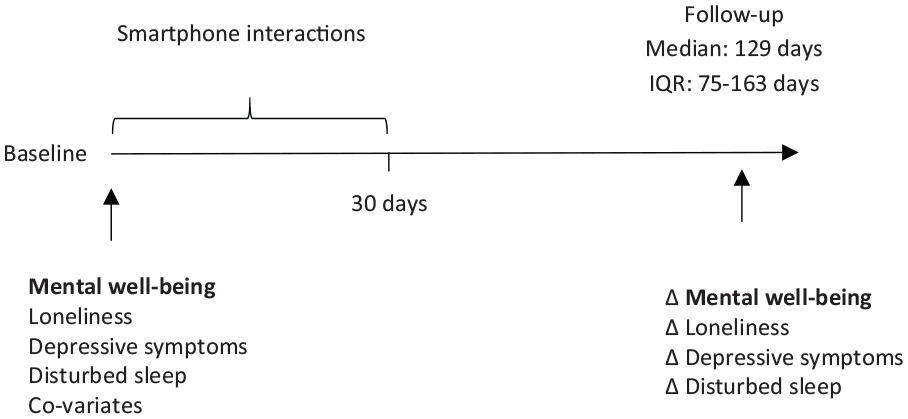
Overview of study design and data collection in the Copenhagen Network Study.
Measures of smartphone interactions
The call and text network size of interactions was calculated by counting the number of unique individuals with whom the participant had interacted using either text messages or phone calls at least three times within four weeks. This variable was categorized in intervals of ten. Facebook network size was calculated by counting the number of existing and obtained ‘Facebook friends’ during the four-week observation period via the social media site Facebook. We categorized the Facebook network variable with a cut-off at 150 connections because Facebook users generally have active interactions on a regular basis with up to 150 individuals from their Facebook network [23]. The frequency of call and text interactions was derived by counting the average number of incoming and outgoing calls and text messages per day during the four-week observation period and was categorized in intervals of ten. The frequency of likes and status update interactions was defined by the number of ‘liking’ and posting ‘status updates’ on Facebook and this variable was grouped in intervals of two. Further, we considered the total call duration in hours during the four-week follow-up period and grouped this variable in two-hour slots.
Measures of mental well-being
Loneliness was evaluated with a Danish version of the UCLA loneliness scale, a 20-item inventory measuring an individual’s subjective feelings of loneliness and social isolation. A score between 0 (least lonely) and 60 (most lonely) was obtained [24]. Depressive symptoms were measured using the Major Depression Inventory [25], which is a self-reported 12-item mood questionnaire evaluating depressive symptoms on a five-point Likert scale yielding a total depressive symptoms severity scale ranging from 0 to 50. Disturbed sleep was assessed by a Danish version of the Karolinska Sleep Questionnaire [26], which covers the frequency (from never=1 to almost every night=5) of four symptoms of disturbed sleep: uneasy sleep, difficulties falling asleep, premature awakenings and repeated awakenings. These four symptoms were combined into a score reflecting the average frequency of symptoms (range 1–5).
Analytical methods
We estimated mean differences with 95% confidence intervals for the associations between smartphone interactions and mental well-being using multiple linear regression adjusting for the confounders age and cohabitation status (living alone/not living alone) identified a priori. In the full population (N=816), cross-sectional associations were estimated between smartphone interactions and the outcome variables loneliness, depressive symptoms and sleep measured at baseline. For participants responding to follow-up (N=571), we then assessed the associations between the smartphone interactions and changes in mental well-being at follow-up about four months later by adjusting for baseline mental well-being in addition to the confounders. All analyses were carried out separately for men (N=633) and women (N=183) and gender differences in effects were evaluated and tested in the final model by including a gender-interaction term. Dose–response relationships were assessed by including the ordinal smartphone variables as linear terms. The disturbed sleep variable showed signs of violations to the assumptions of linear regression and hence we conducted an additional analysis with a log-transformed version of disturbed sleep.
Sensitivity analyses
We restricted the baseline models to the population at follow-up to evaluate whether the observed changes were due to effects of underlying different populations. The personality traits agreeableness, conscientiousness, extroversion, openness and neuroticism were identified as possible confounding variables [4] and these traits were measured at baseline with the 44-item version of the Big Five Inventory [20]. Nevertheless, this instrument is also likely to capture the underlying construct of mental well-being [20]. For example, low scores on the Big Five Inventory extroversion scale evaluate withdrawnness, which is also evaluated in the UCLA loneliness scale, and scoring high on the Big Five Inventory neuroticism evaluates depression and anxiety. To avoid over-adjustment, the models were adjusted for personality traits in sensitivity analyses only. The follow-up time differed between the participants and hence we stratified the analyses in three time bands of follow-up (<75 days, 75–150 days and >150 days) to assess whether the effect differed according to length of follow-up. All analyses were conducted in the statistical software package R.
Results
Population characteristics
We report on 795,980 smartphone interactions (calls, texts and Facebook activity) recorded within a four-week period in a population of 816 young adults. The mean±SD age of the population was 21.6±2.6 years and 77.2% of the population were men, corresponding well to the age and gender distribution at the specific university. The distributions of age, gender and personality characteristics on measures of smartphone interactions can be seen in Table I and in online Supplemental Table 2. In general, the younger participants and women had more smartphone interactions. Personality was associated with smartphone interactions, where it was noticeable that higher levels of extroversion were strongly associated with higher levels of smartphone interactions.
Baseline characteristics distributed on smartphone interactions in a population of young adults.
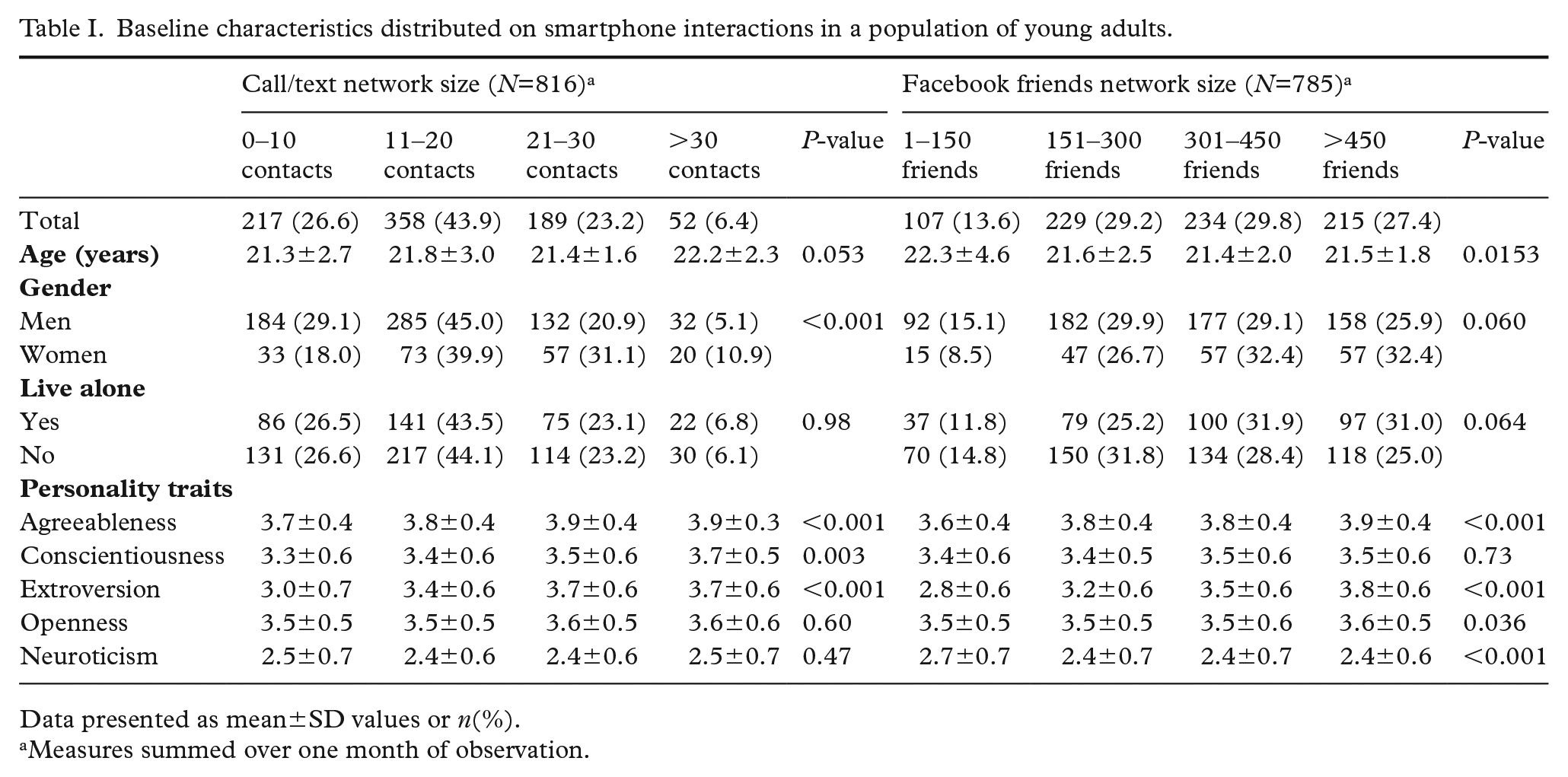
Data presented as mean±SD values or n(%).
Measures summed over one month of observation.
Smartphone interactions and mental well-being
For both men and women, high versus low levels of smartphone interactions were consistently associated with lower levels of baseline loneliness (Figure 2). At follow-up, women with a long call duration and a large Facebook network appeared to have experienced an increase in loneliness (albeit the tendency for a large Facebook network was non-significant), whereas comparable men experienced a decrease in loneliness (P-value for interaction test gender*Facebook=0.042, gender*call duration=0.001).
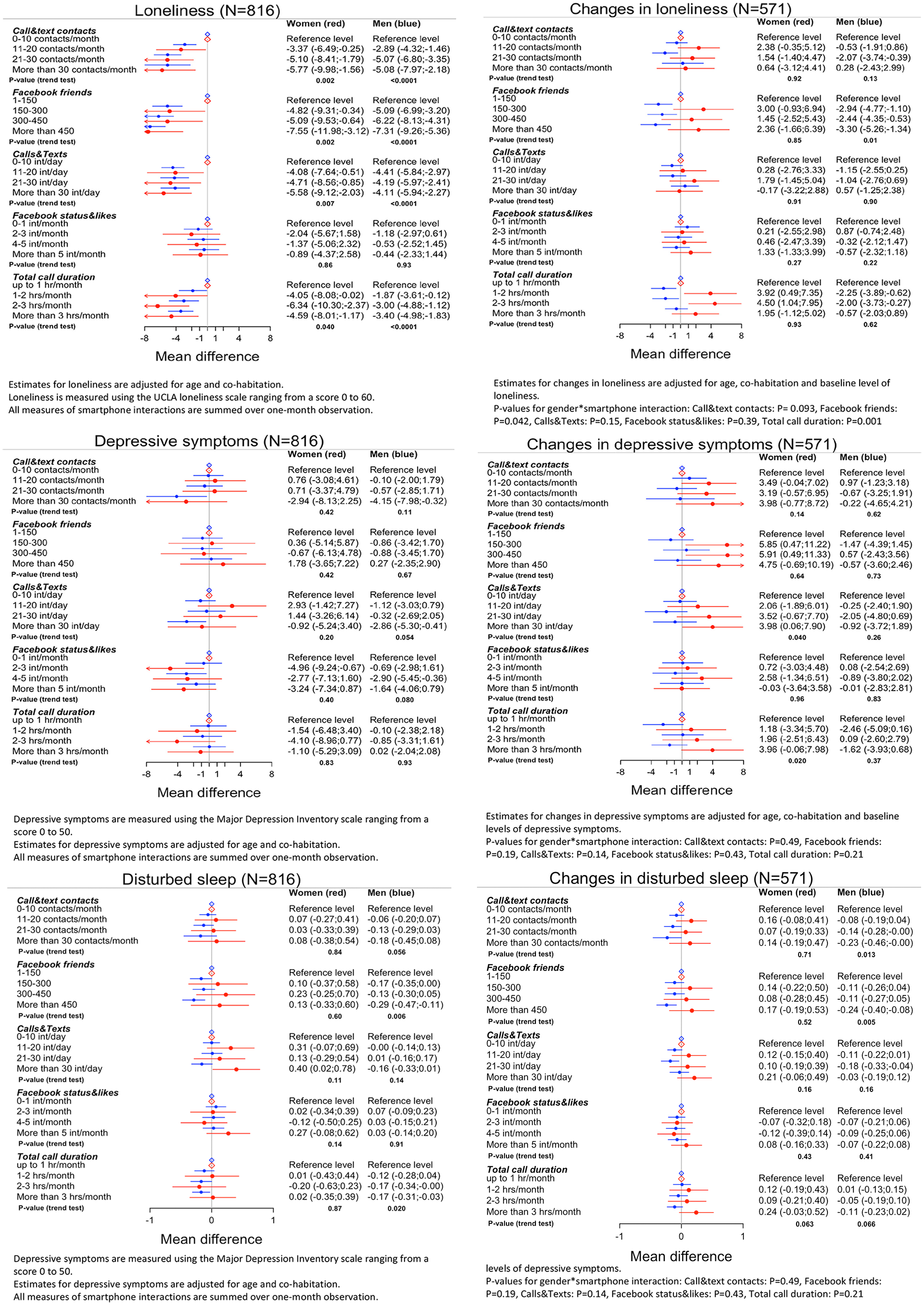
Associations between smartphone interactions, mental well-being and changes in mental well-being.
Although less clear, the same pattern appeared for depressive symptoms (Figure 2). Men and women having a call and text network >30 contacts scored on average 3.88 points lower (95% confidence interval (CI) −6.94 to −0.81) on the baseline depressive symptoms scale than men and women having <10 contacts. At follow-up, the effects for men attenuated, but the women appeared to have experienced an increase in depressive symptoms following a high level of smartphone interactions (Figure 2).
With regards to disturbed sleep, gender differences in effects were also suggested in baseline associations (Figure 2). Women having a high level of call and text interactions (>30 per day) reported on average 0.40 points (95% CI 0.02–0.78) higher on the disturbed sleep scale compared with women with a low level of call and text interactions, but men with a large Facebook network scored on average 0.29 point lower (95% CI −0.47 to −0.11) on the disturbed sleep scale than men having a small Facebook network. Larger networks (call and texts, Facebook) were associated with decreases in disturbed sleep for men at follow-up, but other associations were attenuated. Conducting the analyses using a log-transformed version of disturbed sleep did not change the results (online Supplemental Table 3).
In general, the estimates did not change considerably when adjusting for identified confounders. When adjusting for personality traits, call and Facebook networks were no longer associated with lower levels of loneliness among men, whereas the same measures were associated with an increase of depressive symptoms in men. The results from follow-up were largely unchanged when adjusting for personality (online Supplemental Table 4). The estimated effects did not appear to differ considerably according to follow-up time (online Supplemental Table 5). Restricting the baseline population to responders at follow-up did not change the baseline results (online Supplemental Table 6).
Discussion
In this large study based on >795,000 objectively measured smartphone interactions in a population of young adults, we found that a higher level of smartphone interaction was related to lower levels of loneliness and fewer depressive symptoms among both men and women at baseline. A high versus low level of smartphone interaction was also associated with less disturbed sleep at baseline for men, but not for women. In longitudinal analyses, high levels of smartphone interaction were associated with a decrease in loneliness over time in men, whereas it seemed to be associated with an increase in loneliness and depressive symptoms in women.
The results suggest that higher levels of smartphone interactions are generally associated with better mental well-being, which was contrary to our hypothesis. This may be attributed to the fact that the considered smartphone interactions reflect sociability and it is especially compatible with the finding that the measure of loneliness, which capture aspects of sociability [24], was strongly associated with smartphone interactions, but also for the findings regarding depressive symptoms for which social networks have positive effects [1]. A high level of smartphone interaction may indicate a generally high level of social interaction, both face-to-face and via smartphones [22], which, in turn, is related to better mental well-being. In a longitudinal study, it was found that the objectively measured number of friends on Facebook was associated with better mental health, but that use of Facebook features were related to poorer mental health [11]. In another study using objective data from >12 million Facebook profiles, it was found that the number of friend requests and other activities indicating real-world face-to-face activity was linked to lower mortality [27]. This finding is somewhat comparable with our findings regarding men and points to the fact that smartphone interactions reflecting real-world interactions might bear positive effects.
It should be noted that other studies have consistently found measures of addictive smartphone use to be linked to poor mental health [9, 10]. In the present study, measures of non-problematic smartphone interactions were considered (e.g. network size and frequency), which may explain the differences in findings. It has been shown elsewhere that problematic, but not non-problematic, mobile phone use is related to high stress [3]. The present study adds to the current evidence by showing that objectively measured non-problematic smartphone interactions are related to higher mental well-being among men.
A large Facebook network, a high level of call and text interactions and long call durations was longitudinally associated with an increase in depressive symptoms for women, but not men. We hypothesized that having a high level of social interaction level via smartphones would constitute a strain, leading to depressive symptoms over time. It has been suggested previously that women in particular are sensitive to social demands from large and fragmented social networks [28]. Women’s use of smartphones is typically related to sociability [4] and it is possible that accommodating a large network via smartphones in the long run might have a larger negative impact on women than on men. In a Swedish study it was found that a high frequency of calls and texts was associated with a higher level of perceived stress and depressive symptoms for women when a depression measure of high specificity was used [8]. Social comparison mechanisms have been suggested as another large contributor to the negative effects of social media [12] and it has been shown that women carry out unfavourable social comparisons more often than men [29]. As our study included only a smaller number of women, we cannot exclude the possibility of chance findings for women. We suggest that future research in the area should further explore gender perspectives.
The network size of smartphone interactions was associated with a decrease in disturbed sleep for men. Studies have identified mobile behaviours around bedtime (e.g. using a phone after lights out or being awakened by the phone during night) as detrimental for sleep quality among both adolescents [14, 15] and adults [17] and it is likely that it is the specific timing of the smartphone interaction (day versus night) rather than an overall high level of smartphone interaction that drives the negative effects on sleep quality. It is possible that the considered measures of smartphone network size reflect an active social life, which in itself may be protective and override the hypothesized negative effects of smartphone interactions on sleep quality.
Strengths and limitations
To the best of our knowledge, this is the first study to investigate associations of smartphone interactions with mental well-being using objective measures of smartphone interactions from a variety of different communication channels in a large group of young adults followed over time. This approach advances previous studies, which mainly rely on cross-sectional and self-reported data. Some limitations deserve mentioning. As a result of practical constraints, interactions carried out on other platforms, such as email and messenger services, were not recorded and hence the level of smartphone interaction is likely to be underestimated. When we conducted the data collection in 2013, we assessed call, text messages and Facebook as the predominant interaction platforms among young adults in Denmark. The relatively low response rate could have resulted in selection mechanism into the study. Unfortunately, we did not have data available to examine factors related to non-participation at baseline, but non-response to follow-up showed to be unrelated to both smartphone interactions and mental well-being, which is reassuring. Further, we cannot exclude confounding from parental socio-economic position. However, income or education are not likely to be strong factors determining the level of smartphone interactions [30]. Further, the study population consists of young adults in higher education, who are expected to have a somewhat equal family background compared with the general population. Lastly, as the study population consisted of students at a higher education institution, the results may be less generalizable to socially disadvantaged young adults.
A high level of smartphone interactions is related to better mental well-being, which may be attributed to the beneficial effects of an underlying large social network. Nevertheless, accommodating a large network via smartphone communication might have negative effects on mental well-being over time for women.
Supplemental Material
SJP920418_Supplemental_Material – Supplemental material for Smartphone interactions and mental well-being in young adults: A longitudinal study based on objective high-resolution smartphone data
Supplemental material, SJP920418_Supplemental_Material for Smartphone interactions and mental well-being in young adults: A longitudinal study based on objective high-resolution smartphone data by Agnete Skovlund Dissing, Naja Hulvej Rod, Thomas A. Gerds and Rikke Lund in Scandinavian Journal of Public Health
Footnotes
Conflict of interest
The authors declared no potential conflicts of interest with respect to the research, authorship, and/or publication of this article.
Funding
The authors disclosed receipt of the following financial support for the research, authorship, and/or publication of this article. The Copenhagen Network Study was financially supported by the University of Copenhagen 2016-initiative.

Supplemental material
Supplemental material for this article is available online.
References
Supplementary Material
Please find the following supplemental material available below.
For Open Access articles published under a Creative Commons License, all supplemental material carries the same license as the article it is associated with.
For non-Open Access articles published, all supplemental material carries a non-exclusive license, and permission requests for re-use of supplemental material or any part of supplemental material shall be sent directly to the copyright owner as specified in the copyright notice associated with the article.
