







Abstract
It has been suggested that it would be more appropriate to term the COVID-19 pandemic a syndemic, as the infection interacts synergistically with pre-existing chronic conditions such as obesity. Both conditions occur with steep socio-economic inequalities, and Brazil is suffering a heavy burden from both. What and who drives the clustering and interaction of these disorders? In this commentary, we examine the pathways leading to the COVID-19 syndemic. Deforestation, declining biodiversity and factory farming are promoting the emergence of new pathogens. Widespread use of pesticides influences immune, endocrine and metabolic systems. The ingestion of ultra-processed food promotes malnutrition and obesity in a country where at the same time poverty and food insecurity is rising. Brazilian agribusiness is focused on the production and global export of agricultural commodities, mainly for animal food and meat production. It is made possible through a combination of expanded land use, with deforestation in Amazonas and other Brazilian biomes, and the intensification of land use and cultivation of genetically modified crops with fertilizers and pesticides. This development is not sustainable for either population health or the environment.
A COVID-19 and malnutrition syndemic in Brazil
In this century alone, we have experienced a surge in new emerging and re-emerging viral diseases, most of them zoonosis: SARS-COV-1 in China 2002, swine flu in North America in 2009, MERS in the Middle East in 2012, Ebola in West Africa in 2013 and Zika in Latin America in 2015 with particularly serious teratogenic consequences in Brazil. In 2019, we then had the SARS-COV-2 pandemic [1].
Brazil has been particularly hard hit by COVID-19, with more than 699,000 registered deaths and 37 million registered cases (as of February 2023). The accumulated all-cause excess mortality rate during the pandemic is 40% higher in Brazil than the world average according to Ourworldindata.org. The infection and its mortality have hit disadvantaged areas and groups disproportionally in Brazil [2].
The other major public health challenge in Brazil is the double burden of malnutrition combined with obesity and undernutrition [3]. The prevalence of adult obesity in Brazil has increased unusually quickly from 6% in 1975 to 26% in 2019, and the pandemic has probably added further to that number [4]. There is a gradually steeper social gradient of obesity among women. On the other hand, in 1975, 11% of the adult population was underweight. That figure reduced to 3% in 2014, when the trend then turned upwards. Severe food insecurity (i.e. hunger) rose from 5% to 16% in 2022.
The syndemic perspective
Data from all over the world show clearly that the course and consequences of SARS-COV-2 infection are modified by co-morbid non-communicable diseases such as obesity, diabetes, chronic obstructive lung disorder and cardiovascular disorders [5]. In other words, there is a synergetic interaction between the virus infection and pre-existing chronic disorders. As they all cluster among disadvantaged people, it has been suggested that it would be more appropriate to term the COVID-19 pandemic a syndemic [6].
The term ‘syndemic’ – synergy of co-occurring epidemics – refers to adverse health events that comprises three elements: (a) clustering diseases, (b) interactions between the diseases and (c) social/environmental factors that cause or exacerbate vulnerability or disease interaction. A context of socio-economic inequalities is key to understanding the syndemic clustering of disorders and the differential vulnerability to environmental conditions and differential consequences of diseases. The perspective rests on the recognition that a syndemic is shaped by the local context, but even in the overall burden of disease, the impact on the burden of disease is clearly visible [7].
The question remains, however, what and who drives the clustering and interaction of diseases – in this case, COVID-19 and malnutrition – and through what pathways, not only in a context of structural inequalities but also more specific economic, commercial and political drivers. In this commentary, we shall examine the role played by one such economic, commercial and political driver – agribusiness, including agriculture and the broader food systems in Brazil.
The fast expansion of corporate agribusiness at the expense of local farming with agriculture, livestock and the food industry is enforcing deforestation, loss of biodiversity and displacement of rural populations to urban areas [8]. We focus here on three pathways: how deforestation, biodiversity and factory farms promote emerging pathogens; how the widespread use of pesticides influences immune, endocrine and metabolic systems; and how the industrialised production and marketing of ultra-processed food promote obesity in a country where at the same time poverty and food insecurity are rising.
The Brazilian context
Brazil is outstanding in terms of the role that agribusiness plays in society and its international trade. Agribusiness represent nearly a third of Brazil’s GDP and employment and 44% of its export [9]. Brazil is the biggest exporter in the world of soybean, coffee and sugar and the second biggest exporter of beef and poultry.
Brazil never had proper agrarian reform, and ownership and access to land is extremely unequal. Just 1.5% of landowners own 53% of the arable land. Inadequate access to land by the poor and insecure tenure for them are both factors contributing to the degradation of the land, the destruction of forests and rural poverty that has forced millions to move to the slum areas around the big cities, where housing conditions favour the spread of infectious diseases.
It is not only landownership but also household income that is very unequal in Brazil. The 1% with the highest income in 2019 earned 33.7 times more than the 50% with lowest income. Income inequality was reduced from 2000 to 2014 thanks to several policies, including the Brazilian income transfer programme Bolsa Familia. Since 2014, however, these programmes have been gradually cut back, the minimum monthly wage legislation has been devaluated, and labour protection laws have been rolled back, with a sharp increase in informal employment and job insecurity as a result. The rise in severe food insecurity in recent years is primarily due to these policy changes rather than the pandemic.
Hunger in Brazil is, as elsewhere, not due to a lack of food. Agrarian production in Brazil has increased steeply in the last 60 years. The production of cereals (including corn, rice, soybean and wheat) has increased seven-fold, partly due to a doubling of the area cultivated. One third of world deforestation is happening in Brazil. Production per area has also intensified from 1.3 tonnes per hectare to 4.8 tonnes per hectare [9]. Introduction of genetically modified crops and the subsequent increase in the use of pesticides allowed the spread of large monocultures of soybean, sugarcane and corn. Soybean production, of which 80% is used for animal food, has increased from 0.14 million tonnes in 1961 to 35.5 million tonnes. This has made it possible to increase meat production sharply. In 2018, 39.6 million cattle were slaughtered in Brazil compared to 7.1 million in 1961. This would not have been possible without a rapid increase (4% annually) in the use of pesticides and fertilizers.
Agribusiness has long since had a strong impact on politics in Brazil. The 2019–2022 federal administration in Brazil have enacted several deregulations aimed at weakening not only environmental protection and institutions, but also labour rights and social protection. In 2019, more than 300 new pesticides were allowed into the Brazilian market. The pandemic has been used as an opportunity for further deregulation and deforestation when public attention was elsewhere.
A framework of pathways
In the following, we illustrate the pathways by which agribusiness may influence the syndemic (see #1–#12 in Figure 1).
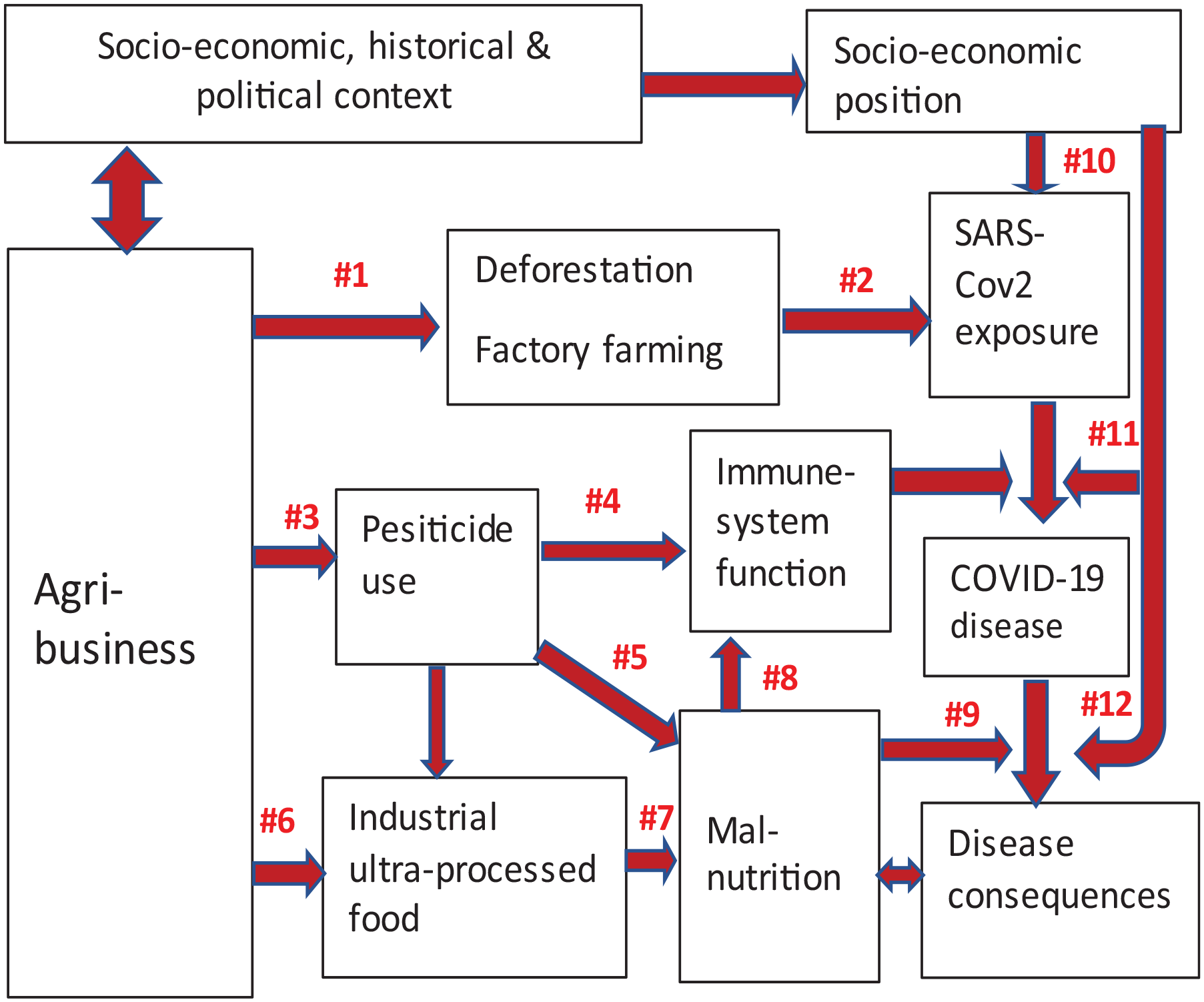
Pathways linking agribusiness with the COVID-19 syndemic.
The emergence of the SARS-COV-2 virus
Many details on the origin of the SARS-COV-2 virus are still poorly understood, but evidence is accumulating for a strong link to deforestation and the loss of biodiversity [1,10]. China, Brazil and many other places have suffered a loss of biodiversity of the primary forests enforced by deforestation, logging, mining, intensive plantation and cattle breeding (see #1 in Figure 1). This process may bring an overflow of wildlife pathogens to farmed animals, the workers who care for them and the surrounding population. Historically, many pathogens in the wild forest died off with their hosts, and new hosts were not in abundance nearby. With deforestation and intensive agriculture, however, such pathogens may come into direct contact with susceptible human populations, be brought to big cities and then travel across the world [10,11].
The animal source of SARS-COV-2 is still not known. Since bats are a major reservoir of many different coronaviruses, they have been proposed as the primary host, but their exact role is not clear. Bats can host a huge number of different viruses without themselves becoming sick [12], but it is not known how bats, while naturally maintaining a high burden of viruses and the oxidative stressors of their fast flight, are able to regulate the immunological response and avoid hyperactivation of immune pro-inflammatory pathways [13]. Bats do not have many natural enemies, but in recent years, a fungus generating ‘white nose syndrome’ has killed millions of bats. When bats are infected with this fungus, they spread more coronaviruses. Deforestation destroys their habitat, and the use of insecticides kill or contaminate the insects they are feeding on, which might make them more stressed, increasing virus shedding too. Destabilising the ecological balance may thus promote emerging pathogens (see #2 in Figure 1).
Food production has undergone a huge transformation towards intensification and industrialization after World War II [14]. Industrial production of poultry, eggs, pork and so on is now often organised in factory farms, with thousands of animals living in close proximity. Animal breeding in vast monocultures removes the immunological barriers that would normally stop outbreaks in more diverse populations [15]. Overcrowding and poor hygiene increase the stress on the animals, impairing their immune system. Factory farms hence act as incubators, amplifiers and transmission ports of zoonotic pathogens [15].
The expanding use of pesticides
Brazil is one of the biggest consumers of pesticides worldwide, and the proportion of pesticides used that are classified as highly hazardous (HHP) is 50% in Brazil compared to 10–20% in Europe [16]. (HHP meet the criteria of classes 1a and 1b in the World Health Organization’s Classification of Pesticides by Hazard, including cancerogenic, mutagenic and reproductive effects). The majority of pesticides sold in Brazil are considered carcinogenic endocrine disruptors by the International Agency for Research on Cancer, the US Environmental Protection Agency and the European Union [17].
The predominant agricultural model in Brazil is based on cultivation with genetically modified crops and use of pesticides (see #3 in Figure 1). This model of agriculture started in the 1960s when the political climate in Brazil already strongly favoured agribusiness. After democratisation in 1985, a broad range of laws were implemented to protect the environment and health, including a law regulating the use of pesticides. Intensive lobbying in subsequent years and particularly recently has, however, resulted in gradual deregulation [17] and a sharp increase in the use of pesticides.
Interest in the immunotoxicity of pesticides dates back to the 1980s. The immunotoxicity of pesticides is associated with their interference with the survival, proliferation and differentiation of immune cells as well as the signalling pathways (see #4 in Figure 1). HHP-type pesticides have inhibitory effects on different types of immune cells, some of which are particularly important for COVID-19 defence [18,19]. Most studies on immunotoxicity use animals or cell cultures experimentally exposed to only one type of high-dose active substance of pesticides with a high grade of purity. In actual crop production, several types of pesticides are used simultaneously and may interact.
A growing volume of research indicates that organophosphorus and other endocrine-disrupting pesticides influence glucose and lipid metabolism [20] and thereby may influence obesity and type 2 diabetes (see #5 in Figure 1).
Food industry and malnutrition
The third major avenue by which agribusiness influences the syndemic is through industrial food production and its focus on ultra-processed food. The global increase in obesity is driven by a shift in diets, with a growing consumption of food and beverages with added sugars, added sodium and refined carbohydrates, as well grain-based desserts and savoury snacks (see #6 in Figure 1). Latin America experienced this development earlier than most other middle-income countries [21]. This development is driven by a food industry focusing on cheap, energy-dense, micronutrient-poor processed food that promotes obesity increasingly clustering among low-income women in Brazil (see #7 in Figure 1). The public health authorities are no longer major influencers on diet. Agribusiness, including retailers and global food companies, has a dominating impact on both local farmers and population diets [3].
A largely animal-based food production system is not only unhealthy, with increased risks of cancer and cardiovascular disease, but also a highly inefficient way to produce nutritious food. Further it leads to the production of a large amount of greenhouse gases. Food habits are influenced by sociocultural values and attitudes, but the changes are to a large extent driven by product development and marketing of the food industry [22]. During the pandemic, the food industry intensified the marketing of ultra-processed food [23], and the increasing poverty pushed people into cheap energy-dense diets.
Obesity increases susceptibility to infectious diseases such as influenza and COVID-19, whereas tuberculosis, on the other hand, might have a more favourable course among patients who are overweight. Obesity is a metabolic disorder with increased insulin resistance, serum glucose and chronic low-grade inflammation. Obesity also impairs the immune response (see #8 in Figure 1) by increasing the frequency of anti-inflammatory T cells, while the low-grade inflammation increases the pro-inflammatory cells and cytokines [24]. The other side of malnutrition – that is, undernutrition – has a well-known impact on the resistance to tuberculosis and many childhood infections with other RNA viruses causing severe respiratory and gastrointestinal disease. Studies indicate an association between undernutrition [25] as well as with vitamin D deficiency [26], and both susceptibility to and severity of COVID-19, but results are heterogeneous.
Finally, obesity diminishes lung function through greater resistance in the airways and difficulties in expanding the lungs (see #9 in Figure 1). These are all changes that complicate the course of COVID-19 [27]. Most people exposed to SARS-COV-2 do not become seriously ill. Several co-morbidities modify both the risk of contracting and the worsening course of COVID-19 [5]. In Brazil, like in other countries, it has been found that 84% of hospitalized COVID-19 patients had co-morbidities [28]. Obesity is the most prevalent of those co-morbidities. A recent review and meta-analysis indicated that the relative risk of contracting COVID-19n is 1.97 for people with obesity [27]. The risk of dying among patients infected with COVID-19 increases by 48% among obese patients. This means that more than one third of COVID-19 mortality in Brazil can be attributed to obesity.
Differential exposure, susceptibility and consequences of COVID-19
It is a basic element of a syndemic that the interacting disorders are strongly linked to socio-economic position, as is the case for both COVID-19 and obesity in Brazil. Exposure to SARS-COV-2 is unevenly distributed across both occupations and housing conditions (see #10 in Figure 1) [29]. Brazilian studies show, as mentioned, huge inequalities in COVID-19 incidence between rich and poor communities [2]. Occupations with close contact with the public such as transportation and health care have particularly high rates, but those involved in food production, factory farming and the wildlife industry and others working in confined spaces are highly exposed as well.
The unequal burden of COVID-19 is not only caused by unequal exposure to the virus but also by differential susceptibility (see #11 in Figure 1) to the infection [29]. We have already mentioned the effects that exposure to pesticides (see #4 in Figure 1) and obesity (see #8 in Figure 1) have on immunity. Both exposures are unequally distributed and may generate a socially differentiated immune response to the virus. The unequal course and survival in COVID-19 (see #12 in Figure 1) is as mentioned strongly related to the unequal prevalence of pre-existing co-morbidities (#9). The dual health-care system in Brazil, where more than half of health-care spending is private, generates considerable social inequities in terms of access to and quality of care. Public health-care resources have been weakened by budget cuts in recent years, particularly in the poorer states where the incidence of COVID-19 was highest.
The unsustainable pathways
We have now discussed the potential mechanisms creating three pathways from agribusiness to the syndemic of COVID-19 and obesity. There is in addition a fourth pathway between agribusiness and health linked to climate change. Food production, including agriculture and livestock, is responsible for about 70% of all greenhouse gas emissions in Brazil. The ensuing climate crisis with increasingly large areas of drought is at the same time a threat both to human health and to food production [30]. Climate change is aggravated by deforestation and the resulting reduction in CO2 absorption.
Brazilian agribusiness is focused on increased meat production and agriculture for animal food. It is made possible through a combination of expanded land use with deforestation in Amazonas and other parts of Brazil, combined with intensification of land use with the use of genetically modified crops, fertilizers and pesticides. The crops grown in Brazil are mainly used as animal food [30]. This development is not sustainable for population health or the environment.
The four pathways illustrate how diets link human health and environmental sustainability. Since agribusiness, including the food industry, is a major driver of the consumption of both unhealthy food and environmental degradation, global efforts are urgently needed to change food production and diets [31]. The targets for healthy diets proposed in 2019 by the Lancet Commission for Healthy Diets from Sustainable Food Systems represent a win–win solution, as they are both healthy and environmentally sustainable [32]. They entail a dramatic change in dietary patterns – not least in Brazil where meat consumption is high. The Lancet Commission showed that it is possible to feed the global population with a diet that is both much healthier than today’s diet and compatible with a sustainable climate policy [32]. The proposed diets have adequate caloric intake with a diversity of plant-based foods, low amounts of animal source foods, unsaturated rather than saturated fats and small amounts of refined grains, highly processed foods and added sugars. The changes in diet will be dramatic, as in Brazil on average they will require a 75% reduction in consumption of red meat, 50% reduction in poultry and more than a doubling of the consumption of fruits, nuts, vegetables and legumes. The implications are, however, different across income strata.
The unsustainable pathways discussed here can look daunting, but the important point is that they all originate and point back to the central role played by agribusiness. The regulation of agribusiness can act through all four pathways to improve population health and to protect the environment. Stopping deforestation, regulating pesticide use and factory farming and reforming taxes with more tax on CO2 emission and unhealthy food and with less tax on the healthy alternatives are all policy measures that may have synergetic health effects because they modify all four pathways driving the syndemic. The syndemic we have described here is not yet high on the political agenda in Brazil. The infrastructure created with Unified Health System may provide opportunities to support intensified efforts to combat malnutrition and encourage a healthier diet. Better health surveillance of populations exposed to pesticides may be another important tool. Nonetheless, without major regulation of agribusiness, health-care policies will have limited impact on emerging infections and non-communicable diseases [33].
Footnotes
Declaration of conflicting interests
The authors declared no potential conflicts of interest with respect to the research, authorship and/or publication of this article.
Funding
The authors received no financial support for the research, authorship and/or publication of this article.
