






Abstract
Aims:
This study aimed to assess associations between online gaming with others, online socialising and depressive symptoms among adolescents, and whether these associations changed before, during and after the COVID-19 pandemic (2018, 2021 and 2023).
Methods:
Cross-sectional data among Norwegian adolescents aged 13–19 years in 2018, 2021 and 2023, comprising a total sample of 83,453 adolescents (Oslo: n=69,164; Møre og Romsdal: n=14,289), were used in the analyses. Multivariable binary logistic regression models, stratified by sex, were used to examine associations between online gaming with others, online socialising and depressive symptoms separately for each study year. The models were adjusted for school level, having trusted friends and perceived family economy.
Results:
Among girls, the results showed slightly higher odds of depressive symptoms during the pandemic than before the pandemic (odds ratio (OR)=1.1; 95% confidence interval (CI): 1.1–1.2). Frequent online gaming with others and online socialising were associated with increased odds of depressive symptoms among boys (OR=1.2; 95% CI 1.1–1.4 and OR=1.5; 95% CI 1.3–1.6) and girls (OR=1.8; 95% CI 1.6–2.0 and OR=1.7; 95% CI 1.5–1.8). Among girls, weekly online gaming with others was associated with higher odds of depressive symptoms in 2021 (OR=1.4; 95% CI 1.2–1.6). Among boys with no online socialising, frequent online gaming with others was associated with increased odds of depressive symptoms (OR=1.8; 95% CI 1.3–2.3).
Conclusions:
Introduction
Children and adolescents spend a substantial portion of their time at home and at school using screens [1,2]. When schools shifted to online teaching during the COVID-19 pandemic, many social interactions moved to digital platforms, and recreational screen use became one of the primary sources of entertainment and connection, leading to a marked increase in adolescents’ screen use [3,4]. This increase heightened concerns about the impact of screen time on youth mental health [5], as researchers had already noted that increasing rates of depression and anxiety among adolescents in recent decades coincided with the growth of digital technology and increased screen use [6,7].
Although mental health problems among youth are a concern in their own right, poor mental health during adolescence has also been shown to increase the risk of mental health problems in adulthood [8 –10] and carries significant health and socio-economic consequences [11,12]. As screen use became increasingly central to adolescents’ daily lives during the pandemic, researchers, parents and policymakers were concerned about a potential increase in mental health problems [4,13].
However, the evidence regarding the association between screen time and mental health problems is mixed. Some studies report negative associations [10,14,15], whereas others find weak or negligible effects [10,16 –18]. There are reasons to believe that such discrepancies may reflect differences in how screen time is measured and conceptualised, particularly in the context of rapidly evolving digital technologies [10]. Research has often grouped all forms of screen time together, overlooking the unique functions of different screen-based activities and the contexts in which they are used [19]. Furthermore, the development of modern multi-functional devices such as smartphones, game consoles and PCs further complicates the relationship between screen time and mental health, as these devices serve as channels for social interaction, entertainment and information. As some researchers have argued, different activities facilitated by these devices may have distinct psychological impacts, influenced by factors such as the purpose of use, the type of device, the time spent on screen-based activities and the type of content consumed [10,20].
Evidence suggests that screen-based activities may have distinct impacts on health and health-related behaviours among adolescents. For example, Qi et al. [19] reported that time spent on social media and the Internet was more strongly associated with self-harm behaviours, depressive symptoms, low life satisfaction and low self-esteem than time spent on electronic gaming or watching television. They also found that the use of newer forms of technology, such as mobile phones and the Internet, is more strongly associated with depressive symptoms than the use of older technologies, such as television and video games.
These findings suggest that the relationship between screen use and mental health may vary according to the type of activity and its context. It is therefore important to distinguish between more passive, individual forms of screen use (e.g. solitary video watching or browsing) and more active, socially interactive forms of digital engagement [21,22]. Activities such as online gaming with others and online socialising with friends are inherently interactive and relational, often involving real-time communication and shared experiences. As such, they may be more closely tied to adolescents’ social support, sense of belonging and peer dynamics.
The pandemic created a unique context in which adolescents’ screen use surged while in-person social settings were restricted, making digital platforms one of the few available spaces for maintaining social ties. This exceptional reliance on digital socialisation highlights the need to examine how different online activities supported or undermined mental health during this period.
Although prior research has examined associations between adolescents’ screen use and mental health, several gaps remain. Many studies relied on broad, undifferentiated measures of ‘screen time’ or focused on single platforms, limiting conclusions about specific types of digital activities. In addition, the COVID-19 pandemic accelerated adolescents’ use of a wider range of screen-based platforms, as they increasingly relied on digital channels to meet social, educational and recreational needs during pandemic-related restrictions.
This study investigated the associations between time spent on online gaming with others, online socialising and depressive symptoms among adolescents in 2018, 2021 and 2023. By focusing on specific, socially oriented digital activities and using repeated cross-sectional data across multiple time points, the study aimed to offer a more nuanced understanding of how these screen-based activities are associated with depressive symptoms among adolescents before, during and after the COVID-19 pandemic.
Methods
Study participants and data collection
This study utilised data from the Ungdata surveys conducted in 2018, 2021 and 2023 [23] in the municipalities of Oslo and Møre og Romsdal, representing predominantly urban and rural settings in Norway. These three time points correspond to periods before, during and after the COVID-19 pandemic. More information about the Ungdata surveys is available at www.ungdata.no.
The study sample consisted of adolescents attending junior and senior high schools. Participants were drawn from three separate survey waves conducted in 2018 (n=28,339), 2021 (n=24,890) and 2023 (n=30,224), yielding a total sample of 83,453 adolescents (Oslo: n=69,164; Møre og Romsdal: n=14,289). In Oslo, response rates among junior high school students were 83% in 2018, 65% in 2021 and 79% in 2023, whereas those among senior high school students were 65%, 43% and 60%, respectively. In Møre og Romsdal, response rates for junior high school students were 87% in 2018, 88% in 2021 and 80% in 2023; for senior high school students, the corresponding rates were 76%, 70% and 62%, respectively.
Adolescents in the target group and their parents received written information about the Ungdata study, emphasising that participation was voluntary. Participants were informed that they could withdraw from the study at any time and skip any questions they did not wish to answer. Data collection was anonymous, and the adolescents completed a self-administered online questionnaire during school hours. The survey took approximately 30–45 minutes to complete and was conducted in the presence of a teacher or school administrator, who was available to answer questions about the survey. The Ungdata survey was approved by the Norwegian Centre for Research Data (NSD), and the current study was approved by the research ethics committee at the University of Inland Norway (ref. 24/09643).
Measurements
Screen socialising
Separate analyses were conducted for online gaming with others and online socialising. Online socialising was measured with the question: ‘During the past week, how often have you socialised online or on a mobile phone for most of the evening (talking, chatting or similar)?’ Online gaming with others was measured with the question: ‘During the past week, how often have you played online games with others for most of the evening?’ Both questions shared the same four response options: 1, ‘never’; 2, ‘once’; 3, ‘two to five times’; and 4, ‘six times or more’.
Depressive symptoms
Depressive symptoms were measured using a six-item scale adapted from the Hopkins Symptom Checklist [24]. Adolescents were asked whether they had experienced specific emotional or physical symptoms during the past week. The items included: 1, ‘felt that everything is a struggle’; 2, ‘had sleep problems’; 3, ‘felt unhappy, sad or depressed’; 4, ‘felt hopeless about the future’; 5, ‘felt stiff or tense’; and 6, ‘worried too much about things’. For each item, participants rated how much they had been affected on a four-point scale: 1, ‘not been affected at all’; 2, ‘not been affected much’; 3, ‘been affected quite a lot’; and 4, ‘been affected a great deal’. For analyses, the mean response score for each participant was computed, and the results were dichotomised using a cut-off score of ⩾3 to classify participants with higher levels of depressive symptoms (1) versus lower levels of depressive symptoms (0). The depressive symptom scale has been psychometrically validated among Norwegian adolescents, and the scale has been shown to perform reasonably well overall, with acceptable reliability (Person Separation Index=0.802) [24].
Covariates
Age was approximated using school year as a proxy measure. Participants reported their sex by selecting either ‘girl’ or ‘boy’.
Having trusted friends was measured with the item: ‘Do you have at least one friend who you trust completely and can tell absolutely anything?’ The response options were: 1, ‘yes, I am sure’; 2, ‘yes, I think so’; 3, ‘I do not think so’; and 4, ‘I have no one I could call a friend right now’. For the analyses, the response alternatives ‘yes, I am sure’ and ‘yes, I think so’ were used to identify participants with higher social support from friends, whereas the remaining response options indicated lower social support.
Perceived family economy was assessed through the question: ‘Financially, has your family been well off or badly off over the past two years?’ Participants could choose from five response options: 1, ‘We have been well off the whole time’; 2, ‘We have generally been well off’; 3, ‘We have been neither well off nor badly off’; 4, ‘We have generally been badly off’; and 5, ‘We have been badly off the whole time’. For the analyses, the response options ‘We have been well off the whole time’ and ‘We have generally been well off’ were collapsed to represent ‘good’ family economy; the middle category (3) represented an ‘intermediate’ level of family economy, whereas the response options ‘We have generally been badly off’ and ‘We have been badly off the whole time’ were collapsed to represent ‘poor’ family economy.
Analyses
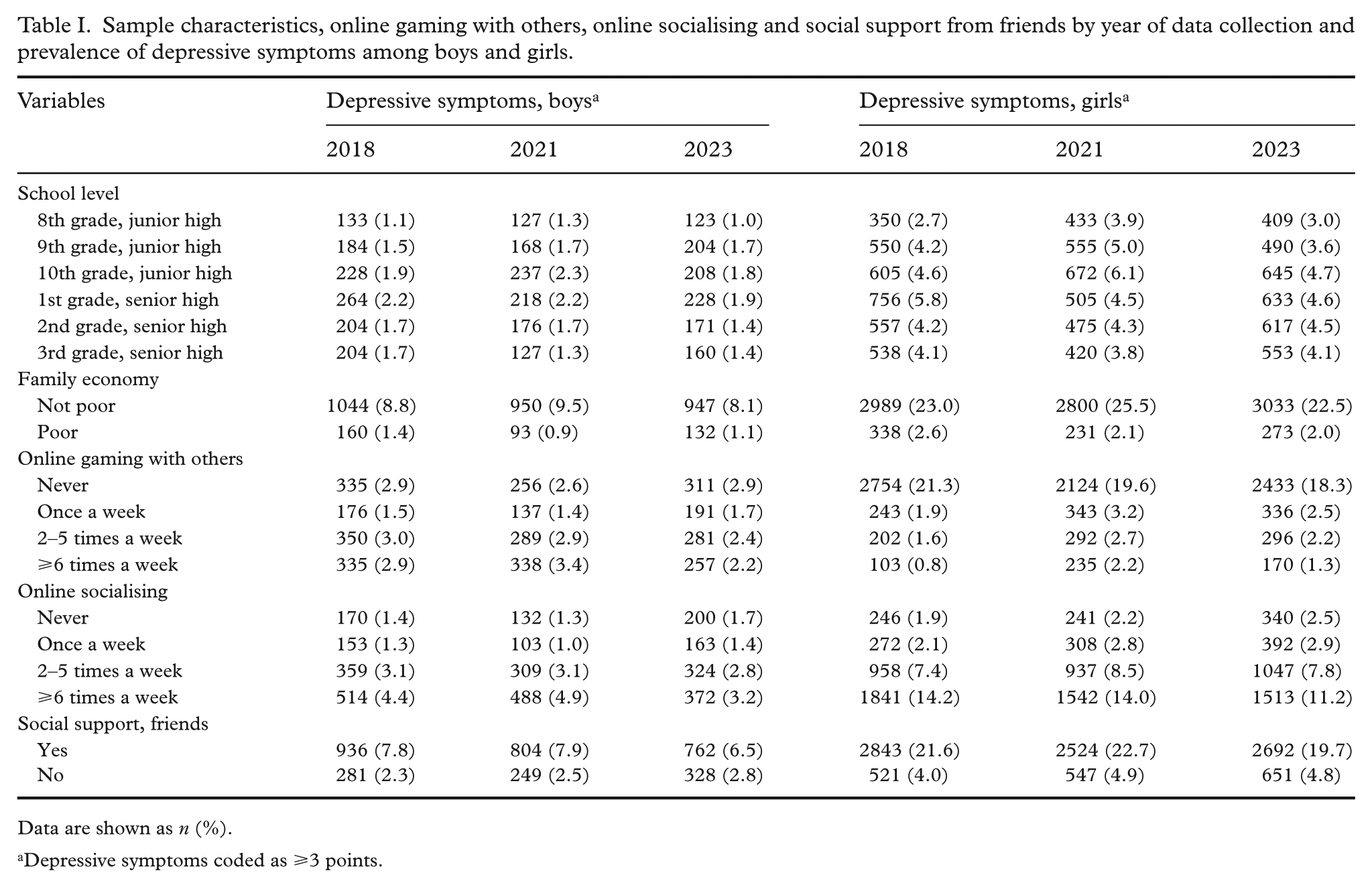
Descriptive statistics are presented in Table I and show the prevalence of depressive symptoms among boys and girls in 2018, 2021 and 2023 according to school year, family economy, online gaming with others, online socialising and support from friends.
Sample characteristics, online gaming with others, online socialising and social support from friends by year of data collection and prevalence of depressive symptoms among boys and girls.
Data are shown as n (%).
Depressive symptoms coded as ⩾3 points.
One-way analysis of variance and Bonferroni post hoc tests were used to examine possible differences in depressive symptoms across the study waves, representing periods before, during and after the pandemic.
Logistic regression analyses, adjusted for social support from friends, school level and perceived family economy, were conducted separately for boys and girls to examine associations between depressive symptoms and potential predictors, including study year, online gaming with others and online socialising. Results were reported as odds ratios (ORs) and 95% confidence intervals (CIs), together with corresponding p-values, with the significance level set to p<0.05.
Interaction analyses examined whether study year modified the associations between online gaming with others, online socialising and depressive symptoms. Likelihood ratio (LR) tests were used to compare models with and without interaction terms.
The main effects model included study year, online gaming with others, online socialising, social support from friends, school level and family economy as independent variables. This model was compared with models including interaction terms between study year (2021 and 2023) and online gaming with others, as well as between study year and online socialising. Differences in log-likelihood between models were used to assess the presence of interaction effects. Where significant interactions were identified, stratified by the relevant moderator. Only statistically significant interaction effects are reported in the results.
All analyses were performed using statistical software IBM SPSS Statistics for Windows, version 25.
Results
The proportion of adolescents with depressive symptoms varied slightly between the data collection periods, representing periods before, during and after the pandemic. Details are presented in Table I.
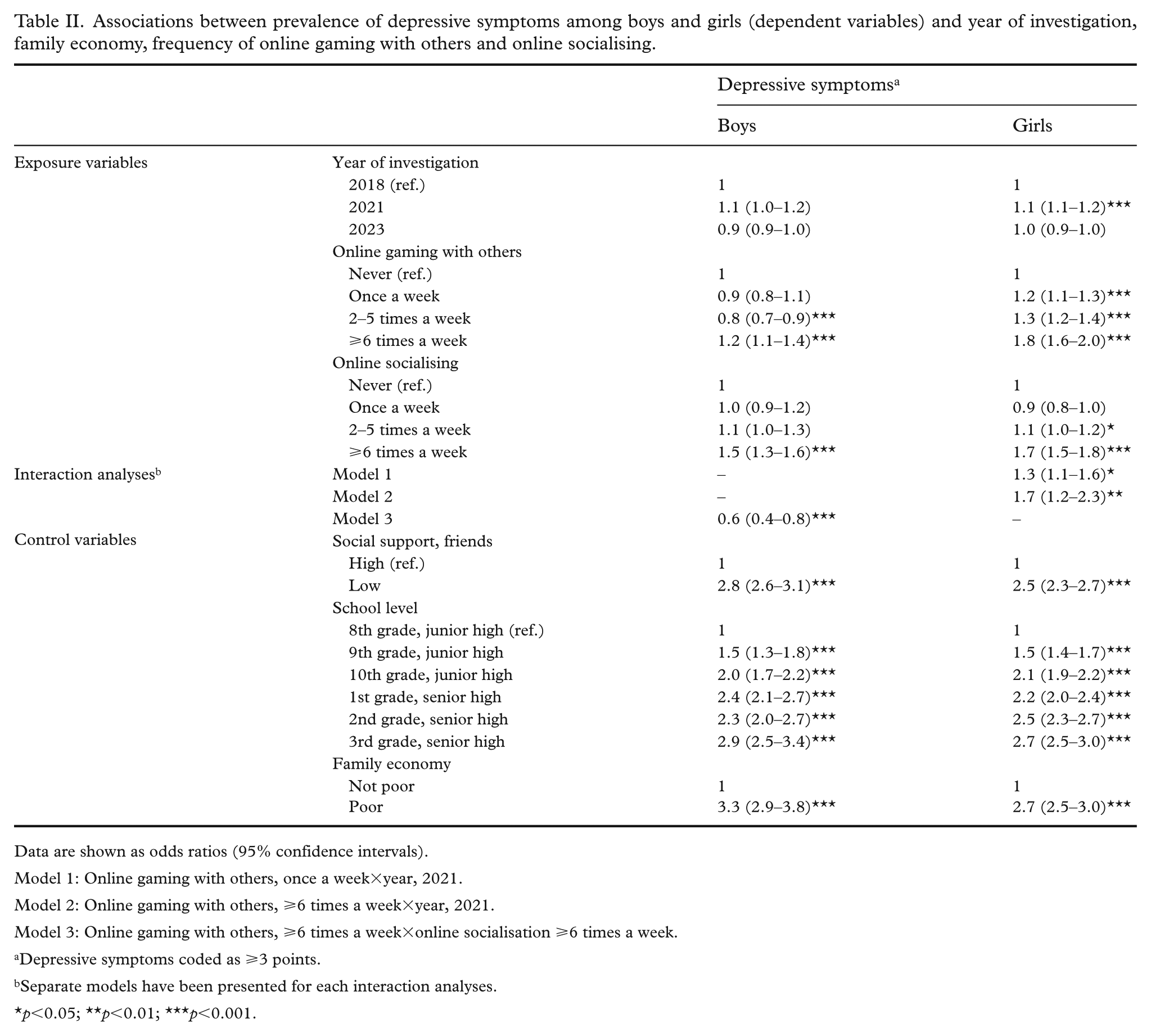
Adjusted logistic regression models (Table II) showed a slight increase in the odds of depressive symptoms among girls during the pandemic compared with before the pandemic (OR=1.1; 95% CI 1.1–1.2). No corresponding increase was observed among boys.
Associations between prevalence of depressive symptoms among boys and girls (dependent variables) and year of investigation, family economy, frequency of online gaming with others and online socialising.
Data are shown as odds ratios (95% confidence intervals).
Model 1: Online gaming with others, once a week×year, 2021.
Model 2: Online gaming with others, ⩾6 times a week×year, 2021.
Model 3: Online gaming with others, ⩾6 times a week×online socialisation ⩾6 times a week.
Depressive symptoms coded as ⩾3 points.
Separate models have been presented for each interaction analyses.
p<0.05; **p<0.01; ***p<0.001.
Among boys, engaging in online gaming with others two to five times a week was associated with reduced odds of depressive symptoms (OR=0.8; 95% CI 0.7–0.9). In contrast, higher frequencies of both online gaming with others and online socialisation were associated with increased odds of depressive symptoms (OR=1.2; 95% CI 1.1–1.4 and OR=1.5; 95% CI 1.3–1.6), respectively.
Among girls, online gaming with others showed a dose–response association with depressive symptoms, with increasing odds at higher frequencies (from OR=1.2; 95% CI 1.1–1.3 to OR=1.8; 95% CI 1.6–2.0). Online socialising two to five times a week was associated with a slight increase in the odds of depressive symptoms (OR=1.1; 95% CI 1.0–1.2), whereas online socialising six times a week or more was associated with substantially higher odds (OR=1.7; 95% CI 1.5–1.8).
Low support from friends was associated with increased odds of depressive symptoms in both boys (OR=2.8; 95% CI 2.6–3.1) and girls (OR=2.5; 95% CI 2.3–2.7). The odds of depressive symptoms also increased with higher school levels in both boys (OR=1.5; 95% CI 1.3–1.8 to OR=2.9; 95% CI 2.5–3.4) and girls (OR=1.5; 95% CI 1.4–1.7 to OR=2.7; 95% CI 2.5–3.0). In addition, poor family economy was associated with higher odds of depressive symptoms among both boys (OR=3.3; 95% CI 2.9–3.8) and girls (OR=2.7; 95% CI 2.5–3.0) compared with those who did not report poor family economy.
Interaction analyses based on the model adjusted for social support from friends, school level and family economy indicated that the association between online gaming with others and depressive symptoms varied by study year and sex.
For girls, a significant interaction between online gaming with others and study year was observed. In 2021, the association between online gaming with others once a week and depressive symptoms was significantly stronger compared with other years (OR=1.3; 95% CI 1.1–1.6). A similar pattern was found for high-frequency online gaming with others (⩾6 times per week), where the association with depressive symptoms was also stronger in 2021 (OR=1.7; 95% CI 1.2–2.3). The same association was not found among boys.
Moreover, stratified analyses according to study year supported these findings. Among girls, online gaming with others once a week was associated with depressive symptoms in 2021 (OR=1.4; 95% CI 1.2–1.6), but not in 2018 (OR=1.1; 95% CI 0.9–1.2). The association in 2021 was also stronger than in both 2018 (OR=1.3; 95% CI 1.0–1.7) and 2023 (OR=1.6; 95% CI 1.3–1.9). Similarly, online gaming with others six times per week or more showed a stronger association with depressive symptoms in 2021 (OR=2.3; 95% CI 1.9–2.7) than in 2018 (OR=1.3; 95% CI 1.0–1.7). No corresponding interaction with study year was observed for boys.
However, a significant interaction emerged between online gaming with others and online socialising, as boys who reported both frequent online gaming with others (⩾6 times per week) and frequent online socialising (⩾6 times per week) had lower odds of depressive symptoms compared with boy reporting lower levels of engagement in these activities (OR=0.60; 95% CI 0.4–0.8).
Furthermore, for boys, analyses stratified according to online socialising showed a significant association between online gaming with others six times a week and depressive symptoms for those reporting never socialising online (OR=1.8; 95% CI 1.3–2.3), but this association was not significant among those reporting the highest frequency of online socialising (⩾6 times per week).
Discussion
The aims of this study were to examine associations between online gaming with others, online socialising and depressive symptoms among adolescents, and to assess whether these associations differed before, during and after the pandemic, thereby providing insight into how changes in social behaviour during the pandemic may have influenced adolescent mental health.
Among girls, the prevalence of depressive symptoms increased during the pandemic, and stronger associations were observed between online gaming with others and depressive symptoms. Previous studies have also linked excessive online gaming to elevated levels of depression and anxiety among adolescents during the pandemic [25]. To better understand these patterns, several mechanisms may help explain the observed associations. First, replacing face-to-face interactions with digital communication during the pandemic may not have provided the same emotional depth or quality of social support. As a result, these interactions may have been experienced as less meaningful, potentially contributing to poorer mental health among adolescents, a possibility consistent with previous research [26]. Second, increased online engagement may have heightened exposure to negative aspects of digital socialisation, such as harassment, exclusion and performance pressure. In addition, prolonged or compulsive use, particularly in the absence of offline alternatives, may have disrupted sleep and daily routines, further affecting mental health. Online socialisation may therefore have represented a double-edged phenomenon during the pandemic. Although it enabled adolescents to maintain some social connectedness during lockdown, it may also have increased exposure to harmful experiences that contribute to higher levels of depressive symptoms.
The present study found that the association between online gaming with others and depressive symptoms was stronger among girls during the pandemic, whereas no such association was observed among boys. This finding may be partly explained by gendered experiences in gaming environments, as previous research suggests that girls who play online games are more likely to encounter harassment and reduced social support [27]. In addition, adolescent girls may be more sensitive to interpersonal stress and social evaluation, potentially amplifying the emotional impact of negative online interactions. Differences in the types of games played and the social contexts in which gaming occurs may also contribute to these gender-specific associations.
Additionally, the stronger associations observed during the pandemic may also reflect shifts in the social function of online gaming with others. In 2021, when opportunities for in-person interaction were limited, gaming likely became a more central arena for peer interaction and social connection. This increased reliance may have heightened the psychological relevance of gaming experiences, making both positive and negative peer dynamics more salient, particularly for girls.
For some adolescents, gaming may have served as a compensatory mechanism for reduced offline contact, potentially linking it more closely to feelings of loneliness or emotional distress. As social life normalised in the post-pandemic period, online gaming with others may have reverted to being one of several leisure activities rather than a primary social context, which could explain the weaker associations observed outside the pandemic period.
As noted above, no similar temporal pattern was observed among boys. Instead, the findings suggest that the mental health correlates of online gaming with others depended on the broader context of digital social engagement. Specifically, frequent online gaming with others combined with frequent online socialising was associated with lower odds of depressive symptoms, suggesting a potentially protective role of socially integrated gaming.
This pattern suggests that when gaming is embedded within broader peer communication networks, it may function as a form of social connection rather than contributing to social displacement or isolation. Stratified analyses supported this interpretation. Gaming was associated with higher odds of depressive symptoms among boys with low levels of online socialising, whereas no such association was observed among those with high levels of online interaction.
Taken together, these findings underscore that the relationship between online gaming with others and depressive symptoms is not uniform, but instead depends on both temporal context and the social nature of adolescents’ digital engagement.
Overall, these results suggest that pandemic-related stressors, such as social isolation, disrupted routines and increased reliance on digital communication, may have amplified the emotional impact of adolescents’ digital behaviours. As restrictions eased and offline social interactions and support systems resumed, the link between online socialisation and depressive symptoms appeared to weaken, indicating that the association between digital engagement and depressive symptoms may be influenced by the broader social and emotional context. This pattern suggests that the mental health impact of online socialisation may be contingent on the availability of alternative, offline sources of support.
These findings are consistent with the notion that online modes of communication may not fully meet individuals’ interpersonal needs for connection and belonging, a limitation that may be particularly relevant for girls. In the context of similar crises, this suggests that adolescents may benefit from access to alternative forms of social connection beyond digital environments, as well as guidance on the potential benefits and limitations of online gaming and online social interactions.
However, it is important to acknowledge the bidirectional nature of these associations, as also noted by previous researchers [10]. On one hand, excessive or unfulfilling screen use, such as passive scrolling or exposure to negative online content, may contribute to symptoms of depression and anxiety. On the other hand, adolescents experiencing psychological distress may increase their screen time as a coping strategy, using digital platforms for distraction or emotional support.
This perspective suggests that associations between screen use and mental health may depend on the individual’s underlying motives. Although motives for screen use were not directly assessed in the current study, research has shown that interpersonal motives for social media use are associated with better mental health, whereas motives related to entertainment and reducing loneliness have been associated with poorer mental health [28]. Thus, the associations observed in this study may reflect complexities that were not fully captured by the available measures.
A key strength of this study is the use of data from three distinct time points, which enabled comparisons before, during and after the pandemic. The large, population-based sample supports the generalisability of the findings, and the inclusion of interaction terms allowed for a more nuanced examination of how timing moderated the relationship between digital behaviours and mental health.
However, several limitations should be noted. First, the repeated cross-sectional design prevents causal inference; it is unclear whether digital socialisation patterns contribute to depressive symptoms or whether distressed adolescents experiencing psychological distress are more likely to engage in certain digital behaviours. Thus, future longitudinal studies are warranted. Second, reliance on self-report measures may introduce recall bias or social desirability bias, particularly when reporting mental health symptoms. Third, the study did not distinguish between different types of digital engagement, such as competitive versus cooperative gaming, which may have different associations with mental health. In addition, the study did not capture the content, context and motives underlying screen use, which may influence whether online interactions are experienced as supportive, stressful, passive or actively sought for coping purposes. Fourth, although the large sample provided substantial statistical power and reduced the risk of type II errors, it also increased the likelihood that small effect sizes would reach statistical significance. Consequently, statistical significance should be interpreted alongside the magnitude of the observed effects. Fifth, although the sample included adolescents from both urban and rural areas, the predominance of participants from urban areas may limit the generalisability of the findings. Finally, the analyses did not fully account for offline factors such as family stress, peer dynamics or pre-existing mental health conditions, which may have confounded the observed associations.
Conclusions
Frequent online gaming with others and online socialising were associated with higher levels of depressive symptoms in both boys and girls, with stronger associations observed among girls, particularly during the pandemic. Future research should prioritise longitudinal and mixed-methods designs to clarify how different forms of screen-based socialisation relate to depressive symptoms among adolescents. Such research could inform more targeted prevention and intervention strategies aimed at promoting healthy digital engagement and emotional well-being among young people, particularly during periods of societal disruption.
Footnotes
Acknowledgements
We would like to thank the adolescents participating in the study, NOVA and KoRus for collecting data and SIKT for granting access to data.
Declaration of conflicting interests
The authors declared no potential conflicts of interest with respect to the research, authorship and/or publication of this article.
Funding
The authors disclosed receipt of the following financial support for the research, authorship and/or publication of this article: This study is part of a study funded by NordForsk (project number: 156778).
