






Abstract
Aims:
The YouthViolence surveys were conducted to retrospectively map young Norwegians’ (age 16–19 years) exposure to violence and abuse, both within their families and in their peer relations. The aim was to provide high-quality data for victimisation research and policy development and for monitoring and evaluating prevention work. This study design article outlines the relevance of the YouthViolence study and its characteristics.
Methods:
Data were obtained from three repeated cross-sectional surveys conducted in 2007 (N = 7,103), 2015 (N = 4,530) and 2023 (N = 16,081) with national samples of Norwegian senior high school students. The first two surveys included students in their final year of senior high school, while the 2023 survey sampled students from all three senior high school levels. A subsample of the 2007 participants (n = 3,319) was followed longitudinally until 2021 (age 32–33 years) based on linked survey-administrative data.
Results:
The YouthViolence survey findings provide important knowledge on topics such as direct and indirect parental violence, physical and digital sexual violence, and polyvictimisation, as well as on procedures for mapping violence and abuse among youth and have led to the publication of over 25 scientific papers. The study also provides extensive knowledge inputs for governmental whitepapers and strategies on the prevention and handling of violence and abuse and to non-governmental organisations that offer victim support.
Conclusions:
Keywords
Introduction
Supranational policy agreements recognise that background knowledge on the extent of a social problem is important for developing both preventive measures and support services. The Council of Europe Convention on preventing and combating violence against women and domestic violence (the Istanbul Convention) highlights continuous data collection and research (Article 11) as an important measure. Specifically, the signed parties ‘shall endeavour to conduct population-based surveys at regular intervals to assess the prevalence of and trends in all forms of violence covered by the scope of this Convention’ [1]. Furthermore, Article 12 of the UN Convention on the Rights of the Child states that all children have the right to be heard, and Article 19 states that they have the right to live a life free from violence and abuse [2]. The need to monitor exposure to violence and abuse in childhood and youth emerges from these obligations.
Youth is an ideal period of life to ask about violent victimisation, as people in this age group are mature enough to respond to questions on violence and abuse as well as close enough in time to childhood situations to avoid recall bias. In Norway, the school-based, cross-sectional YouthViolence surveys [3–5], were conducted at three time points (2007, 2015 and 2023) by NOVA – Norwegian Social Research to map exposure to violence and abuse among national samples of Norwegian youth. They provide important data for both research and the development of national policies and preventive measures.
In this study design article, we detail the key methodological aspects of the YouthViolence surveys, including the procedures and participants, questionnaires and data quality, and discuss the ethical issues related to collecting data on violence and abuse among children and youth. To provide background, we first review the history of national survey studies on violence and abuse among young people in the Scandinavian countries.
National youth surveys on violence and abuse in Scandinavian countries
The history of surveys on exposure to violence and abuse with national youth samples can be traced back to the 1990s in Scandinavian countries. Smaller, nonrepresentative, local studies on the topic and studies with parents as informants have been conducted throughout the region both before and after the 1990s. Although these studies have provided important knowledge, their findings do not necessarily highlight young people’s own experiences with violence and abuse or translate to the youth population at large. There is also a long tradition for assessing violence and abuse through general crime victimisation surveys and omnibus youth surveys on health and wellbeing in Scandinavian countries. Compared with these, designated victim surveys provide detailed data on different types of violence and abuse and the possibility of studying the linkages between them.
Sweden is a pioneering Scandinavian country in designing national victim surveys among youth. The SAM73-90 study was an important starting point; it was aimed at mapping sexuality, sexual violence and sexual exploitation in a national sample of 17-year-olds in 1990 [6]. Subsequent national mappings that involved students in their final year of senior high school were conducted in 2009, 2014 and 2021 [7–9], as well as a large-scale (but not national) victimisation survey in 2004 [10]. Sweden has an almost equally long tradition of national youth surveys on parental violence, with the first study on these topics dating back to a school-based survey of 16- and 18-year-olds in 1995 [11]. This survey was followed by comparable national mappings in 2000, 2006, 2011, 2016 and 2022 [12–16]. The 2022 mapping involved only 16-year-olds. The survey topics have been expanded over time to include direct and indirect parental violence, emotional abuse, neglect and, since 2016, sexual violence.
In Norway, young people’s experiences with direct and indirect parental violence and sexual violence were first mapped using national samples in the YouthViolence survey in 2007, with subsequent mappings in 2015 and 2023. In 2013, the Norwegian Centre for Studies on Violence and Traumatic Stress (NKVTS) conducted a national survey of 16- to 17-year-olds’ exposure to violence and abuse from both parents and people outside of the family [17]. NKVTS then conducted the first national Norwegian survey on this topic with students in junior high school (12- to 16-year-olds) in 2019 that provided information on direct and indirect parental violence, neglect and sexual abuse both within and outside of the family setting [18]. A subsample of the participating schools also participated in a survey on exposure to violence and abuse during the Covid pandemic [19].
Among the Scandinavian countries, Denmark has used designated victim surveys to systematically map violence and abuse among national samples of youth to the least degree. Two national surveys were conducted in 2002 and 2008 with 15-year-olds, which contained questions on direct and indirect parental violence and sexual abuse both within and outside of the family [20,21]. These surveys were followed by mappings of violence and abuse within the family and other contexts, first among a national sample of 15-year-olds in 2010 [22], and then among students in the same age group in 2015 [23]. To our knowledge, no national youth surveys specifically focusing on violence and abuse have been conducted in Denmark since 2015, but these topics are assessed in general crime victimisation surveys.
Even though the national Scandinavian studies on violence and abuse are in many respects comparable, for example, by being governmental-commissioned projects, collecting data in schools and by containing comprehensive mappings of the same forms of violence and abuse, items on social background, and indicators of somatic and psychological health, the surveyed age groups and the questionnaires differ quite substantially. Accordingly, the degree of direct comparability between findings from the different surveys is limited. To date, no national comparative youth victimisation survey has been conducted in Scandinavia. Worth mentioning, however, is ‘The Baltic Sea Regional Study on Adolescents’ Sexuality’ from 2007, with more than 20,000 participants in the final year of senior high school in Norway, Sweden, Poland, Lithuania, Estonia and Russia [24]. The Swedish contribution to this study was a 2003–2004 phone-based survey to students in five selected cities throughout the country. The Norwegian part of the study was a school-based survey to students from nine of the largest town regions in Norway.
The YouthViolence survey series
Procedures and participants
The YouthViolence data were collected using school-based surveys in winter/spring of the respective survey years. The participating students filled out the questionnaires during school hours. The survey designs and procedures were built on NOVA researchers’ extensive experience of conducting school-based youth surveys since the 1980s as well as comparable studies from other countries. The 2007 survey was conducted on paper, while the 2015 and 2023 surveys were e-questionnaires. The 2007 and 2015 questionnaires were filled out during two school hours (1.5 clock hours), while the 2023 survey was shortened to one school hour (45 min).
An initial school sample was drawn by Statistics Norway for the 2007 survey, and all students from the sampled schools were invited to take part in the study. The sampling of schools was stratified according to the geographical region (north, centre, west, south and east) and school type (general studies, vocational studies and combined schools), resulting in 15 strata. The sampling probability for each school was proportional to the number of students enrolled in the school; thus, larger schools within a stratum were favoured over smaller schools. Access to the schools was granted by the county as the school owner and the school headmasters in 2007, whereas only the headmasters were asked for the final two surveys. The schools from the initial survey sample were invited to take part in the 2015 and 2023 surveys. Schools that were closed or declined to participate were replaced by comparable schools from the same stratum. An increase in the average school size over time led to a decline in the number of schools required to obtain the desired sample size; 67 schools participated in the 2007 survey, while the numbers were 48 in 2015 and 40 in 2023.
Students were sampled from the final year of senior high school (18+ years) for the 2007 and 2015 surveys and from all three senior high school levels (16+ years) for the 2023 survey. The reason for the first two surveys’ sampling approach was that participants over the age of 18 could consent to take part in the study, whereas including participants under the age of 18 in social scientific studies necessitated parental consent. Asking for parental consent for surveys that mapped parental violence and abuse, among others, was considered unethical and a threat to data quality, so the surveys were restricted to participants over 18. A regulation added to the Norwegian Health Research Act in 2017 now allows children above the age of 12 to consent to participate in health research. This regulation did not pertain to the YouthViolence study, as it was a social science study, not health research. Nevertheless, between the 2015 and 2023 data collection periods, ethical boards relaxed their considerations regarding children’s right to consent to participate in social scientific research.
The students consented to take part in the study by responding to the questionnaires. The number of respondents were 7,033 in 2007 (response rate 77), 4,033 in 2015 (response rate 66) and 16,081 in 2023 (response rate 61). The reduction in response rate over time corresponds to general trends in the willingness to participate in survey studies. In addition to the repeated cross-sectional samples, a subsample of the 2007 participants (n = 3,319) consented to having their survey responses merged with their administrative data on income, education, family, housing, social security benefits and crime, which made it possible to follow their paths into young adulthood (32–33 years old in 2021). Figure 1 provides an overview of the YouthViolence study samples.
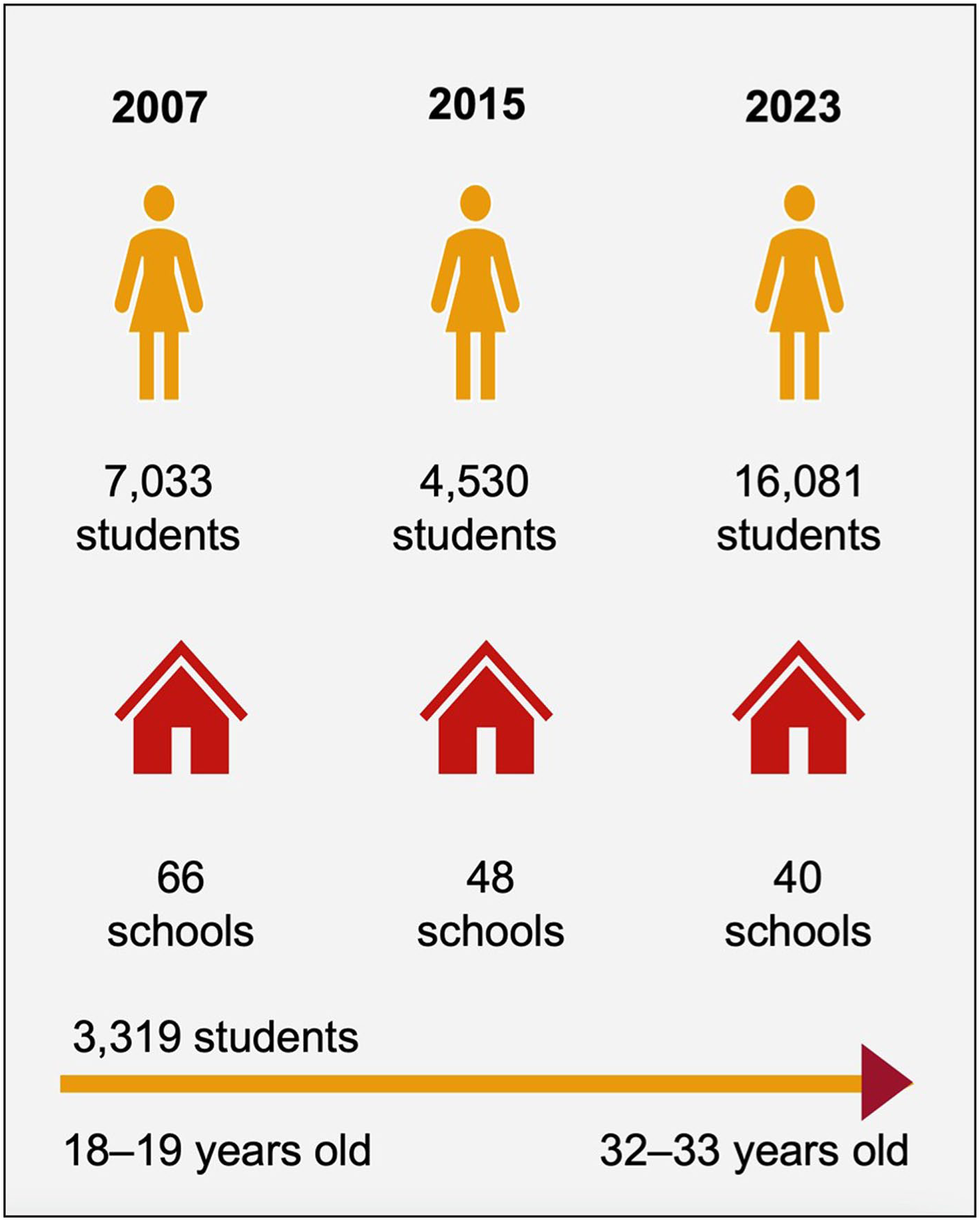
Samples for the YouthViolence surveys.
The participating schools were instructed to treat the surveys as examinations so that the participants would not be able to see others’ responses to any sensitive questions on violence and abuse. They were also asked to ensure that the students had other schoolwork to do after responding to the survey, or during the survey for those not participating, so that everyone would be present in the room for the entire period. The students were thoroughly informed about the contents of the surveys using age-appropriate language before consenting to participate—both in writing a week before the survey and verbally on the day of the survey—and on the first page of the questionnaire. This information was also provided to the teacher present in the room and to the school health nurse. The participants were instructed to skip any questions they did not want to answer. The final page of the questionnaire contained the contact details of several anonymous help services, and it also mentioned that the school health nurse had been briefed on the survey if the participants wanted to talk to someone.
The survey procedures were approved by the Regional Committees for Medical and Health Research Ethics and the Norwegian Data Protection Authority in 2007 and by the Norwegian Agency for Shared Services in Education and Research (SIKT) at all time points.
Questionnaires
The YouthViolence survey questionnaires comprised questions mainly on exposure to violence and abuse. The 2007 survey focused on mapping exposure to violence in the family and sexual violence; peer violence was given increasing attention over time. Technology-facilitated sexual violence was mapped in 2007 and 2023. The 2023 study also included questions on neglect, social control, youth intimate partner violence and violence and assault in the context of organised sports. The surveys adhered to recommendations on using behaviourally specific questions to assess violence and abuse [25]. The assessments were informed by renowned survey instruments such as the Conflict Tactics Scale [26] and the Sexual Experiences Survey [27] and were adapted to the age group and the Norwegian context. Necessary adjustments on language and clarity were made to the instruments between the survey periods, even though questions should ideally remain identical when measuring time trends. The questionnaires also covered topics such as social background, health, sexuality, social relations, substance use and problem behaviours. In all three surveys, the fixed-response questions on victimisation were accompanied by open text items so that participants could describe their experiences in their own words. Analysing these descriptions of unwanted touching, intoxicated sexual assault and sports-related sexual harassment and assault provided important context for the answers to the fixed-response items.
The longitudinal subsample of linked survey and administrative data from 2007 included yearly data from several Statistics Norway registers: the National Educational Database (NUDB), which contains data on educational attainment, school grades and absences during the period from junior high school to the potential completion of higher education; the FD-Trygd Database, which contains data on the reception of every welfare benefit available from the Norwegian state; the Income Database, which contains data on income and tax sources; the Population Database, which contains information on social background, siblings, children and the household (both the parental household during childhood and one’s own); the Living Conditions Database, which contains information on the household and potentially adverse living conditions during adulthood; and the Crime Database, which contains information on criminal charges, sentences and crime victimisation. At present, the survey data have been linked with administrative data from the participants’ birth until 2020/2021 (variation in accessible data between the databases) and are planned to be updated regularly in the future. At the time of writing this article, two studies had been published using the data—one on the associations between violence in childhood and adolescence and educational attainment in adulthood and the other on associations between childhood maltreatment and violent revictimisation in young adulthood.
A complete list of all peer-reviewed publications from the YouthViolence study up to June 2026 is included in the Supplemental material.
Data quality
The YouthViolence surveys’ national samples and large sample size are its two main strengths, which enabled analyses of phenomena of low prevalence. The large sample size also facilitated survey experiments, such as on measuring rape using a single item versus behaviourally specific questions. However, sampling students in their final year of senior high school for the first two surveys has affected the representativeness of the findings. School dropout increases during the senior high school years and is socially skewed, and many students in vocational studies are not present in school due to apprenticeships. Accordingly, the 2007 and 2015 samples are representative of students close to completing a 3-year track in general studies and not for Norwegian youth in general. The 2023 sample is representative of those enrolled in senior high school, with similar drawbacks for students in the final senior high school year as the previous surveys. The retrospective nature of the survey assessments also threatens data quality. The respondents may have misrepresented or not remembered their past experiences, or they may have offered post hoc interpretations of childhood situations. Nevertheless, retrospective research is recommended by the World Health Organisation for these topics and is considered to produce fairly accurate results among adolescents and young adults [28].
Data availability
Data from the 2007 and 2015 YouthViolence surveys are freely available to researchers and students via Sikt – Norwegian Agency for Shared Services in Education and Research [29,30]. The 2023 survey will be released on the same platform after an embargo but can be accessed upon request to the first author. Linked survey–administrative data are not shared openly due to privacy concerns.
Ethical considerations
A prime ethical obligation in all research is to cause no harm. This obligation is elevated when investigating sensitive topics, such as violence and abuse, due to the risk of retraumatisation. Therefore, providing research participants with age-appropriate information for their informed and free consent as well as the opportunity to talk to someone after their participation are minimum requirements. Children also have the right to be heard. This means that limiting children’s opportunities to participate in research could be considered an ethical violation of their rights. Qualitative studies involving adult victims of intimate partner violence and sexual violence have highlighted that researchers are ethically obliged to let participants tell their stories and that victims can see participation as both a form of validation and a way of helping others [31].
In all three YouthViolence surveys, a five-item instrument was used to evaluate the participants’ reactions to the questions on violence and abuse. Figure 2 presents the participants’ responses to this instrument; the results are limited to students in their final year of senior high school to enable comparisons over time. More than 90% of the respondents found the study topic important at all three time points, although almost half found the questions too private and unpleasant to respond to. Almost one-third of the respondents conveyed that the questions could impact them in negative ways. The percentage of respondents who stated that the questions made them think about things they had previously not thought about increased somewhat over time, which does not align with the fact that education on violence and abuse has become increasingly embedded in the school curriculum over time [32]. Overall, the respondents deemed it important to study violence and abuse among youth, but researchers have an important ethical job in handling the potential harm of surveys in this area.
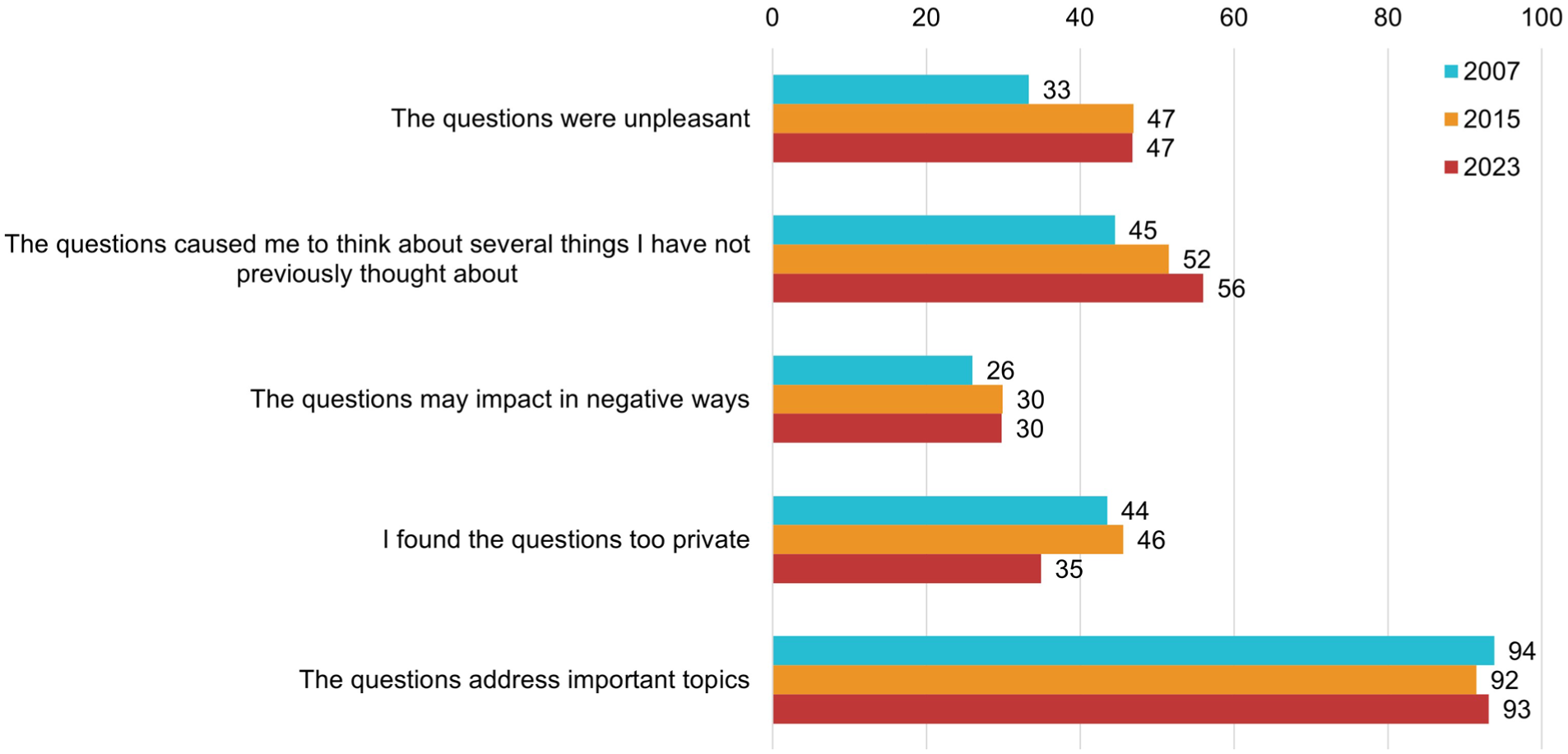
Percentages of respondents who completely or somewhat agreed to different statements on violence and abuse in the YouthViolence Surveys.
Conclusions
Mapping exposure to violence and abuse among children and youth are important from both the state and researcher perspectives. Without updated knowledge on the scope and characteristics of social issues, especially time-trend data, the development of effective preventive measures is difficult. Designing and conducting research that can yield high-quality representative data on violence and abuse requires extensive resources. However, funding for youth victimisation studies is provided in an ad hoc manner in all Scandinavian countries. Policymakers should prioritise the issue of how current research infrastructure and competence can be preserved and further developed for countries’ understanding and handling of violence and abuse.
Supplemental Material
sj-docx-1-sjp-10.1177_14034948261460127 – Supplemental material for Mapping exposure to violence and abuse among young people: the Norwegian YouthViolence surveys
Supplemental material, sj-docx-1-sjp-10.1177_14034948261460127 for Mapping exposure to violence and abuse among young people: the Norwegian YouthViolence surveys by Lars Roar Frøyland, Kari Stefansen, Mette Løvgren and Svein Mossige in Scandinavian Journal of Public Health
Footnotes
Declaration of conflicting interests
The authors declared no potential conflicts of interest with respect to the research, authorship and/or publication of this article.
Funding
The authors disclosed receipt of the following financial support for the research, authorship and/or publication of this article: this research was supported by grants from the Research Council of Norway (grant no: 353510).

Supplemental material
Supplemental material for this article is available online.
References
Supplementary Material
Please find the following supplemental material available below.
For Open Access articles published under a Creative Commons License, all supplemental material carries the same license as the article it is associated with.
For non-Open Access articles published, all supplemental material carries a non-exclusive license, and permission requests for re-use of supplemental material or any part of supplemental material shall be sent directly to the copyright owner as specified in the copyright notice associated with the article.
