







Abstract
Based on the data from the breadth of Canada (∼4300 km), one-third of Canadian homes have ventilation rates below the recommended standard of 0.3 air changes per hour and are at risk for moisture problems. For the purposes of this investigation, a literature review was performed on the health risks associated with exposure to living and drying marijuana plants and the fungi associated with large numbers of indoor plantings. Analysis was made of the impact on Canadian homes if used to grow marijuana. These are commonly called “marijuana grow operations” based on measured ventilation rates from homes in Windsor, Ontario and Regina, Saskatchewan (representing diverse climates) and derived moisture loadings from published data. The growing and drying of marijuana plants contributes considerable amounts of water vapour to the indoor environment. Depending on the scale of production, considerable mould damage in the building can result. There are also a number of abiotic hazards resulting from marijuana production including pesticides, carbon monoxide, and products of unvented combustion appliances. Both indirect and direct evidence are described for the health impact of living in these conditions. This has a number of implications in terms of documentation and personal protection for industrial hygienists, home inspectors, and public health officials.
Introduction
Canada is second to the USA among industrialized nations in marijuana production, although it is illegal to produce and sell this plant in both nations. This demand has caused an increase in the number of illegal “marijuana grow operations” (MGOs) in homes [1,2]. To 2003, the average number of seized plants in Ontario MGOs was ca. 340. The exposed population to these conditions is not well defined. As a proxy for the total, ca. 1000 children were found in a 3-year period in MGOs in Ontario and the estimated total number might be considerably larger, 10,000 [3]. A study from the greater Vancouver area indicated many MGOs are “guarded” by immigrant families including young children (ca. 20%), and that these families are accessing the health care system [4]. Across Canada, there is an increasing number of former MGOs that were not detected by the police. These homes are often purchased by unsuspecting people who face both health and legal challenges, although the exact number of affected people is not known [5,6].
In 2001, the Canadian Medical Marijuana Access Regulation (MMAR) [7] came into effect. In terms of population size, there were 4900 license holders of whom 3600 grow between 2 and 292 marijuana plants for personal use in January 2010 (http://www.hc-sc.gc.ca/dhp-mps/marihuana/stat/index-eng.php). This option is not available in the USA. The percentage of licensees that grow their own plants has been stable at ∼70% for some years; the remaining individuals pool their permits to a maximum of three. The average number of plants grown by individuals is 25. Approximately, 2000 physicians issue permits under these regulations. The larger, legal MGOs in Canada potentially pose many of the same risks as illegal MGOs.
There are two main sources of moisture associated with the cultivation of marijuana indoors (1) moisture from the cultivation of the plant and (2) moisture arising from the drying of the plant. These sources are additional to those associated with the normal operation of the house or apartment building. These may include occupant sources, water leaks and ventilation failure leading to condensation [8–11]. Increased moisture results in growth of the saprophytic fungi characteristic of damp building materials [12,13]. Such growth is a function of internal moisture source strength [9]. Cultivation and drying of marijuana in residential dwellings may result in extensive environmental contamination and damage to the building. A study of illegal MGOs across Canada found that 11 of 12 had serious mould and moisture damage and evidence of the use of large amounts of pesticides and fertilizers. An attempt is made to keep grow operations warm and humid, and the odour of growing marijuana is distinctive, i.e. detected by authorities and/or neighbours. For both these reasons, efforts are made to seal the buildings to avoid detection [6]. This reduces the designed ventilation rate for the homes and hence moisture removal.
The purpose of this paper is to describe the potential damage and public health consequences of the input of additional moisture to the air within residential housing from the growth and drying of different numbers of large plants indoors in the existing housing stock in representative cities in Canada. We calculated the moisture load that a typical marijuana plant adds to a house. This is interpreted in relation to how this relates to mould growth on the building fabric and the effects of saprophytic mould on population health. Except under controlled conditions, the dominant fungus on drying plants is Aspergillus fumigatus, an allergenic species and a facultative pathogen. Additional literature reviews were conducted in order to evaluate the health risks more specific to the conditions associated with marijuana production in residential environments.
Methods
Moisture release of potted plants varies from 7 to 15 g·h−1 [14]. Based on the moisture release rate of a related plant [15] and scaled for mass after Kaa [16], a full-grown marijuana plant was calculated to release 18 g·h−1 of water vapour (432 g·day−1). This value is consistent with an estimate by Christian [17].
Typically, moulds require a water activity (aw) of at least 0.80–0.85 to promote rapid growth [13,14]. Like all “medicinal” plants, marijuana is at a much increased risk of mould growth during the drying period after harvest unless appropriate equipment is used. During this time, water previously bound to cells becomes available to fungi as the plant begins to decay. Dead and drying plant material with moisture contents above ∼12% has an aw sufficient to promote fungal growth. Moisture content >20% in drying plant material promotes rapid fungal growth [18]. This formed the indirect evidence to exposure from moulds on the plants, which were more directly answered by looking at concentrations of moulds on the marijuana and from patient reactions to smoking it.
Measured ventilation rates in winter were obtained from CMHC and Health Canada for 59 homes in Windsor and 103 in Regina (Wheeler, Heroux, Fugler, unpublished data). This was done by the Oak Ridge National Laboratory method; also, see Ref. [19] for an explanation of the method. Conditions in Windsor, Ontario (hot and humid in summer, moderate in winter) and Regina, Saskatchewan (moderate in summer; cold and dry in winter) were calculated and measured data were obtained for Ottawa (hot, often cold in winter) [20,21]. These cities represent communities with different climates in Canada. Growth of fungi on drying plants was assessed from the literature and from objective data.
Information on health effects of dampness and housing was taken from recent cognizant authority reviews [22–27]. A literature search of published peer reviewed journal articles was conducted in early 2009 for additional hazards that might relate to marijuana production in houses. The following databases were included: Web of Science, PubMed, EMBASE, MEDLINE, the Cochrane Library, Sci Finder, government documents and those of professional groups. The search included publications from 1978. Boolean searching was used to combine up to 20 keywords and/or MESH headings. Keywords were classified as fungal (e.g. fungi, mould, A. fumigatus), environmental hazard (e.g. pesticides, herbicides, defoliant), relating to marijuana grow operations (e.g. marijuana, cannabis, MGOs), health (e.g. rhinitis, dermatitis, lung function), and moisture. Studies were assessed for relevance and whether they met all the Klimisch criteria [28]. The primary screening process involved one reviewer screening ca. 5000 articles. Two reviewers conducted the secondary screening process applying the relevance and quality criteria independently for the 300 studies selected. Biological and chemical contaminants arising from medium to large-scale cultivation of marijuana were identified during this process.
Results
Moisture Burdens
As plants are added to an MGO, moisture release will overwhelm home ventilation capacity and/or worsen the situation, if ventilation failure already exists. In Canada, the recommended combined infiltration and mechanical ventilation is 0.3 air changes per hour (ac·h−1) for a household of typical occupancy [20]. Air change rates are a function of outside air infiltration and mechanical ventilation in comparison to house volume. The recommended rate is meant to handle the daily moisture load produced by a typical family, prevent mould growth and reduce other airborne contaminants. A five person family releases 15 kg·day−1 water vapour [29].
Maximum tolerable number of marijuana plants for houses in Windsor, ON
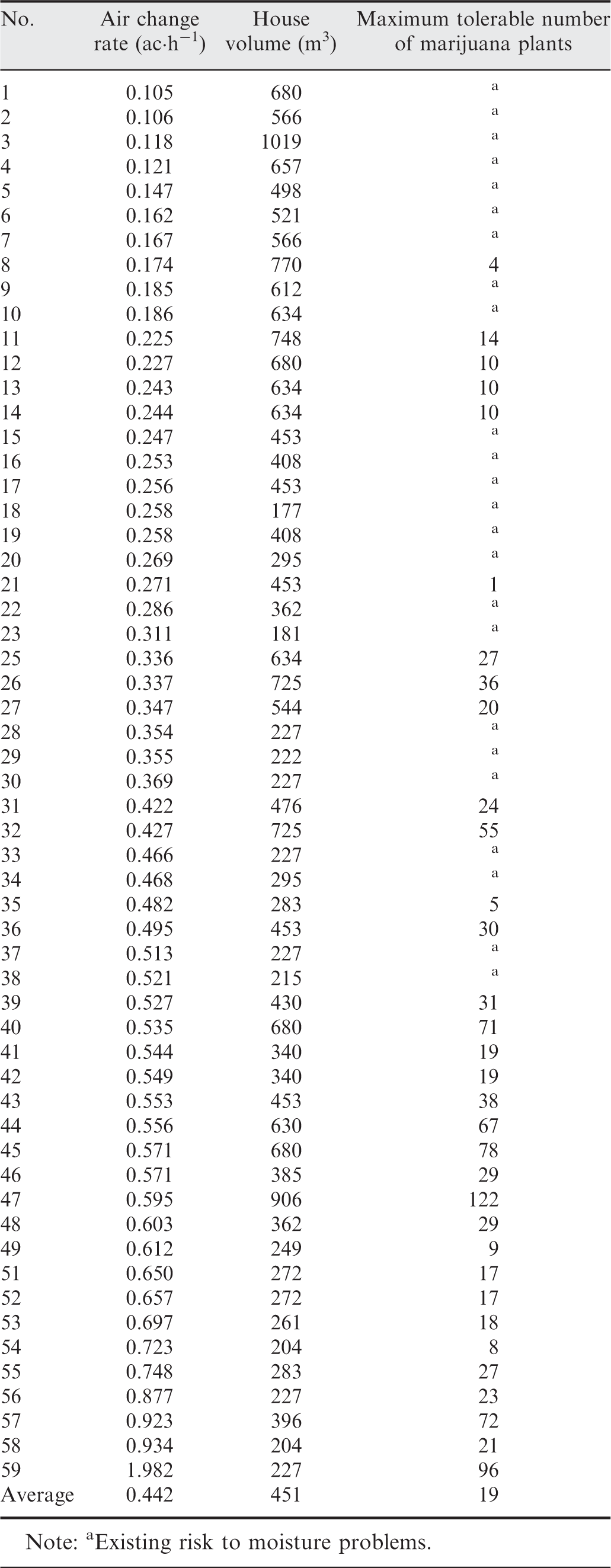
Note: aExisting risk to moisture problems.
These estimates cannot include the moisture released from drying. To assess this, the presence of mould on the product was used as an indicator of the percentage that is not dried properly (which would demonstrate the use of an appropriate drier indoors). Most samples (>90%) of dried marijuana test showed evidence growth of the allergenic and opportunistic pathogens such as Aspergillus fumigatus, Aspergillus flavus, Aspergillus niger, Mucor species, and various Penicillium species. In most samples tested, mould contamination was high (104–107 CFU·g−1) [30–33].
Discussion
Infiltration was essentially the sole source of air change within Canadian homes built before World War II (WWII). These poorly insulated, air leaky homes have (or had) air change rates well above 0.3 ac·h−1. Since WWII, however, there has been a need for greater energy efficiency and hence better insulation in homes. To maintain air change rates, mechanical ventilation was developed; however, many new homes have been left with inadequate ventilation [20].
Leaves of all plants bear various phylloplane fungi. The spores of these dominate outdoor air during the growing season and primarily comprise the fungus Alternaria alternata and a number of species of Cladosporium, but mainly Cladosporium herbarum and Cladosporium cladosporioides. A large percentage of the population is allergic to these fungi [34]. A. fumigatus grows and dominates on decaying vegetation under warm conditions or where biological heating has taken place, including piles of leaves or compost. It is cellulolytic on delignified materials including leaves as well as paper and fabrics. The prevalence of A. fumigatus contamination of marijuana resulting from growing, harvesting, or smoking marijuana poses a health risk. These risks include allergic reactions [13,35]. Aside from respiratory disease, those allergic individuals with chronic high exposure may also develop allergic bronchopulmonary aspergillosis or ABPA [35,36]. A. fumigatus infections have also been reported in marijuana-exposed populations [37–41].
Dales et al. [8] note that apart from floods, there are four major sources of mould growth in residences: leaks in building fabric (rare in Canada because it is cold to very cold in winter and for the particular reason noted previously, uncommon in MGOs), ventilation failure leading to condensation, unattended plumbing leaks and household mould (e.g. mould growth on kitchen and bathroom surfaces, hidden food spills, etc.). Some degree of mould damage is present in ∼30% of Canadian homes [42,43]. Inadequate ventilation for the internal moisture sources in a house accounts for most mould growth [9,10]. As noted, field experience indicates that mould damage in MGOs is often extensive [3–6].
Reviews by cognizant authorities, Health Canada (2004) [22], INSPQ (2002) [23], the Institute of Medicine, US National Academy of Sciences [24,25], an expert panel of the United States Centers for Disease Control/National Center for Healthy Homes [26] and the World Health Organization [26] emphasize the effects on population health of mould in the context of building dampness. These include increased allergic and upper respiratory disease. Health Canada [44] and Krieger et al. [26] state that there is sufficient evidence for health benefit from remediation of mould and dampness. Fungi are associated with new onset asthma in both adults and children and with non-atopic asthma [45,46].
The field data that exist reveal a number of poorly quantified abiotic factors. The cultivation of marijuana requires the large-scale use of liquid fertilizers, insecticides and fungicides [3,4,6] not authorized for indoor use. Residues of the pesticides are detected on marijuana [33]. It is common for operators of detected MGOs in Vancouver to disconnect the furnace and re-vent the exhaust into the grow area to increase the carbon dioxide concentration (60% of detected MGOs) [4]. Virtually, all these houses had illegal wiring, and by-passes to the electrical meters [3,4]. Aside from the potential for CO poisoning, heating is also done with unvented combustion appliances thus increasing NO2 and particulate exposures which are harmful to respiratory health [8]. There has been little systematic study of these contaminants.
From Ontario to British Columbia, the large majority of MGOs are occupied by families including children [3,4,47]. It is reasonable to anticipate that this is also the case in the USA. In response, Alberta enacted the Drug-Endangered Children Act. This legislation states that children exposed to an environment where manufacturing occurs, may need protection on health grounds. In the rest of Canada, Medical Officers of Health, the Provincial Health Department, and other authorities can act to protect child health. Documenting the environmental conditions is required before taking any legal action.
Of particular concern is that at least one-third of Canadian homes could not theoretically tolerate the additional water vapour released by marijuana plants. Considering the number of plants found at illegal MGOs (and MMAR), few, if any, homes in the cities examined would be able to tolerate additional moisture. There are few data on ventilation rates in multi-unit apartment buildings. However, the available data suggest that they are likely lower than assumed and that odour transfer problems are not uncommon [48,49]. Again, this assumes that the home or apartment does not have an existing mould problem, which is an uncertain assumption. Both US and Canadian studies indicate that the attributable risk for asthma and respiratory disease from mould growth in homes is on the order of 20% [50,51]. Some risk to population health is associated with exposure to A. fumigatus and is related to the extent of marijuana drying that is done in a MGO. In the case of marijuana production under MMAR, houses and apartments would have to be evaluated on a case by case basis and special rooms built to permit the cultivation of the plant indoors.
It is important to note that well-maintained house plants (which are much smaller than marijuana plants) are not a particular risk. The assumption has been made that homes have fewer than three plants [29]. However, as the number increases and if the plants are not well maintained, this can increase both moisture burdens and the growth of A. fumigatus [52].
Conclusion
When addressing situations where families are discovered living in MGOs resulting from police action as well as public concerns of the inadvertent purchaser of undetected former MGOs, primary care physicians and municipal public health officials need to be aware of the issues discussed in this paper. These include (1) the cultivation of marijuana typically leading to moisture and mould problems, (2) risk of unusual exposures to A. fumigatus and, potentially, (3) chemical residues. Similarly, more information on these hazards may be needed for industrial hygienists, home inspectors, police and other first responders and public health officials in Canada and the USA.
Footnotes
Acknowledgments
This review was funded by Health Canada and an NSERC IRC to JDM. Helpful reviews were provided by Don Fugler PEng, Mark Lawton PEng, Morrison Hershfield, Ltd., and Richard Summerbell PhD (University of Toronto, Sporometrics, Ltd.). It is based on a larger report for Health Canada. Comments from two anonymous reviewers are appreciated.