







Abstract
This study aims to evaluate the optimal illuminance for each lighting colour of light-emitting diode (LED) light sources among the seven major lighting colours (red, green, blue, cyan, magenta, yellow and white); the focus was on the optimal combination of these colours for enhancement of occupant comfort and communication indoors. The evaluation of optimal illuminance for LED lighting colours found that the occupants felt the cyan LED light source was similar to a white light source, and that the relative brightness of the green lighting colour was higher than that for other colours. The evaluation of the permissible range of illuminance for LED lighting colours found that occupants believed the red lighting colours to be relatively darker; again, the relative brightness of green lighting was considered to be higher. An experiment with subjects for LED lighting colours (consisting of 19 patterns of 7 colours in the living room of a house) found that the optimal illuminance for occupants’ comfort was 32[lx]–119[lx], and for occupants’ communication was 107[lx]–584[lx]. These results satisfied the illuminance criteria of Korean Standards as the optimal illuminance for occupants’ comfort and communication in the living room.
Keywords
Introduction
With the recent development of lighting sources, the long life, energy-saving characteristics, and space-saving advantages of light-emitting diode (LED) lights are in the spotlight. Since the commercialisation of blue diodes, the three primary colours of light, red, green and blue, have become available in LED light sources, and a diverse set of lighting colours can be attained by controlling the brightness of each colour. This technical development opened the possibility of replacing conventional light sources based on black-body radiation. As the use of LEDs is rapidly spreading, evaluation of LED as a light source is critical for evaluation of indoor lighting environments.
Many previous studies on lighting colours focus on colour temperature. Studies on body reaction to colour temperature and brightness of light sources have shown that high colour temperature could cause excitement and blue light contracts the pupil [1–4]. Furthermore, studies on the relationship between colour temperature and visibility found that cyan fluorescent lamps have high colour discrimination rates in the Landolt ring array, and that character legibility is high in a lighting environment of high colour temperature rather than low colour temperature. The reason for this appears to be that blue lighting colours with high colour temperature contract the pupil, thus effectively improving the discrimination of characters [5,6].
According to a study on the brightness of lighting colours, green colours can increase the tolerance for glare because they do not cause glare, even though they have high brightness [7]. Furthermore, in the lighting environment of a fluorescent lamp, red and yellow colours offer higher visibility, red colours offer better colour identification, and blue colours offer higher brightness [8–11]. On the other hand, in LED lighting, blue is sensed as being brightest, and white and orange colours are good for colour discrimination. The reason for this is that blue and green emit only frequencies of a narrow spectral band distribution, and are not favourable for colour discrimination [12–14].
In the living room of a house, fluorescent lamps and LED lights do not show big difference in optimal illuminance and proper colour temperature. For VDT (Visual Display Terminal) work, the difference in lighting colours has a greater effect on visual fatigue than does the difference in spectrum distribution between fluorescent lamps and LED lighting [15–17].
Previous studies mainly use white colour for conventional fluorescent lamps and LED lights. It has been recently found that lighting colours can affect visibility [5,6,8–11], brightness [3,13,18] and glare [7], but studies on the effect of the impact on occupants of an indoor space with different lighting colours in LED light sources have to date been sparse.
This study evaluates the optimal illuminance for each of seven major lighting colours in LED light sources (red, green, blue, cyan, magenta, yellow and white) with respect to the comfort levels and communication levels among occupants in an indoor space.
Outline of Experiments
As shown in Figure 1, an apparatus with an LED light source at the top (910 mm × 775 mm × 820 mm) was fabricated, and model experiments were performed with the inside of the apparatus. The purpose of these experiments was to evaluate the lighting colours in an abstract space. Therefore, white Kent paper manufactured by Kokuyo with 85% or more whiteness was bent in a half circle and placed at the front of the view (that is, the aperture in the apparatus that allowed light to escape) so that the subjects would feel no distance in the space when looking inside the model. Whiteness is a one-dimensional number indicating the degree of white of the surface colour. The formula for assessing the whiteness of surface colour was created by Commission Internationale de l’Eclairage (CIE). For the standard illuminant for assessment, CIE Standard Illuminant D65 was used.
Configuration of the experimental apparatus (left) and a subject undergoing the experiment (right).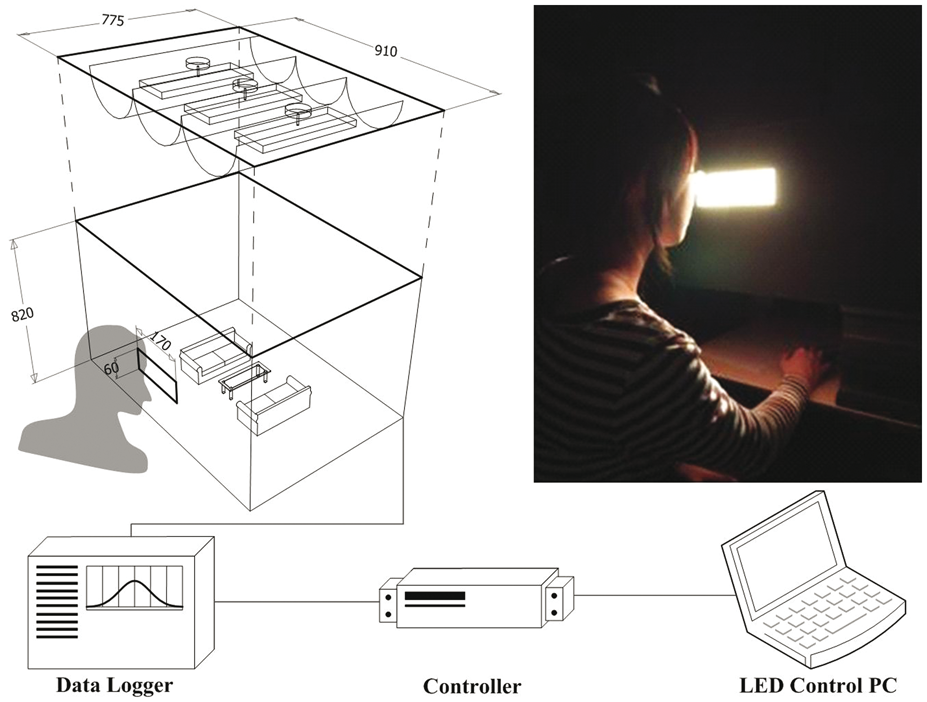
The outside of the experimental apparatus (Figure 1) was made with matte black paper manufactured by Kokuyo to prevent light reflection. The size of the window for observing the lighting colours (hereafter referred to as “window”) inside the experimental space from the outside was 170 mm × 60 mm (width × height) and did not affect the critical angle of colour discrimination by subjects [7]. The height from the bottom to the centre of the window for the experimental apparatus was 280 mm, and the chair height of the subject was adjusted so the level of the subject’s eyes would equal this value. Furthermore, the distance between the subject’s eyes and the window was set at 50–150 mm so that the LED light source at the top of the experimental apparatus would not be directly within the view of the subject during the experiments.
The lighting colours of the LED light source used in the experiments were the three primary colours, red, green and blue; their complementary colours, yellow, cyan and magenta; and white, which is the standard lighting colour. When the distance to the main wavelength colour of the maximum purity emitted by each lighting colour is divided into four parts, the purity of colour becomes 25%, 50% and 75%. Considering the results of one study that showed that annoyance among occupants of a room increased with purity of colour, it was reasonable to use lighting colours with low purity values in this study [18]. Thus, considering the fact that the main wavelength colour of the maximum purity of each colour emitted from the standard white lighting fixture was 100%, 19 colours were chosen for these experiments, including the lighting colours at the excitation purities of 20%, 40% and 60% for the six colours plus white.
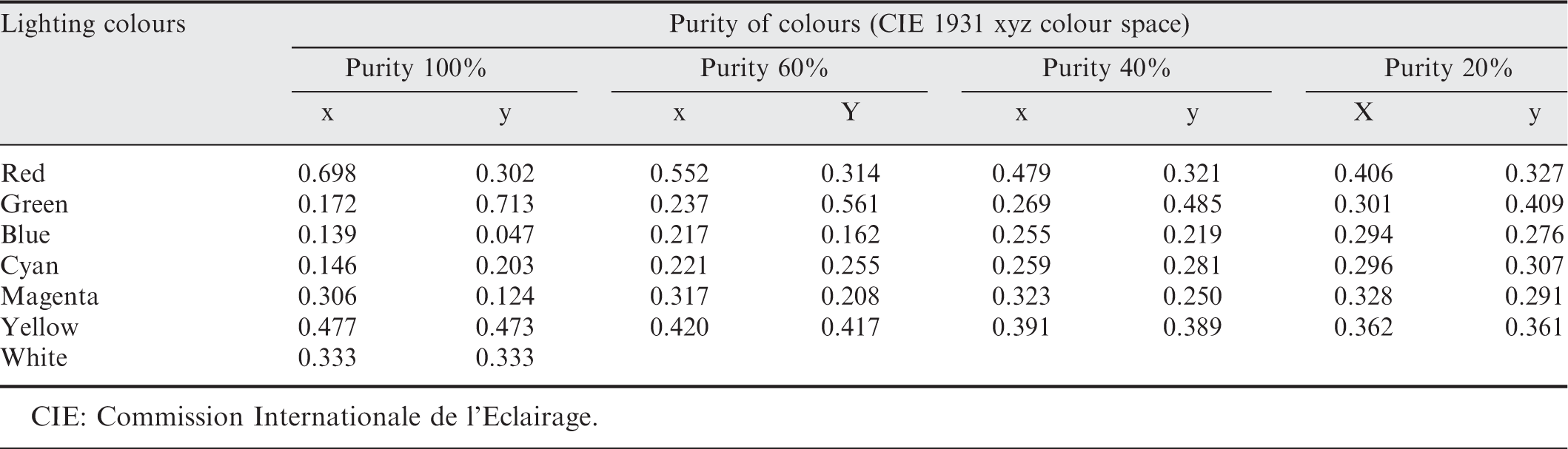
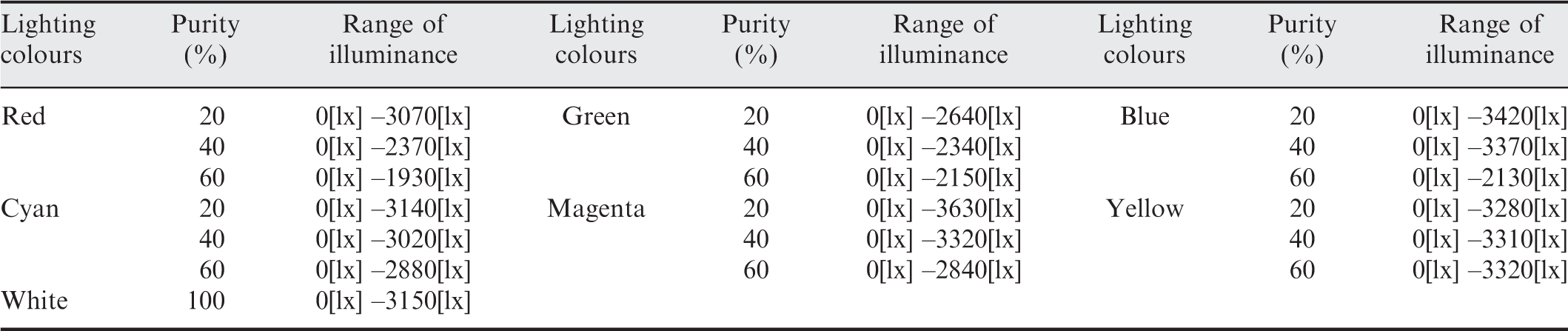
The lighting colours used in the study, reported in this paper are indicated by R (red), G (green), B (blue), Y (yellow), C (cyan) and M (magenta), and the purity of colour as 20 (20% purity), 40 (40% purity), and 60 (60% purity). Figure 2 shows the CIE 1931 xy chromaticity diagram plot for the 19 colours of the LED light used in these experiments. Both horizontal and vertical illuminances were measured. The measurement points of the horizontal surface were above the bottom of the experimental apparatus, and the measurement points of the vertical surface were below the right-side plate. The xy chromaticity value of each lighting colour and the maximum ranges of the presented illuminance are shown in Tables 1 and 2, respectively.
Lighting colours plotted on the Commission Internationale de l’Eclairage (CIE) 1931 xy chromaticity diagram. xy Chromacity values of 19 lighting colours expressed by light-emitting diode (LED) CIE: Commission Internationale de l’Eclairage. Average range of illuminance for each light-emitting diode (LED) lighting colour installed in the experimental apparatus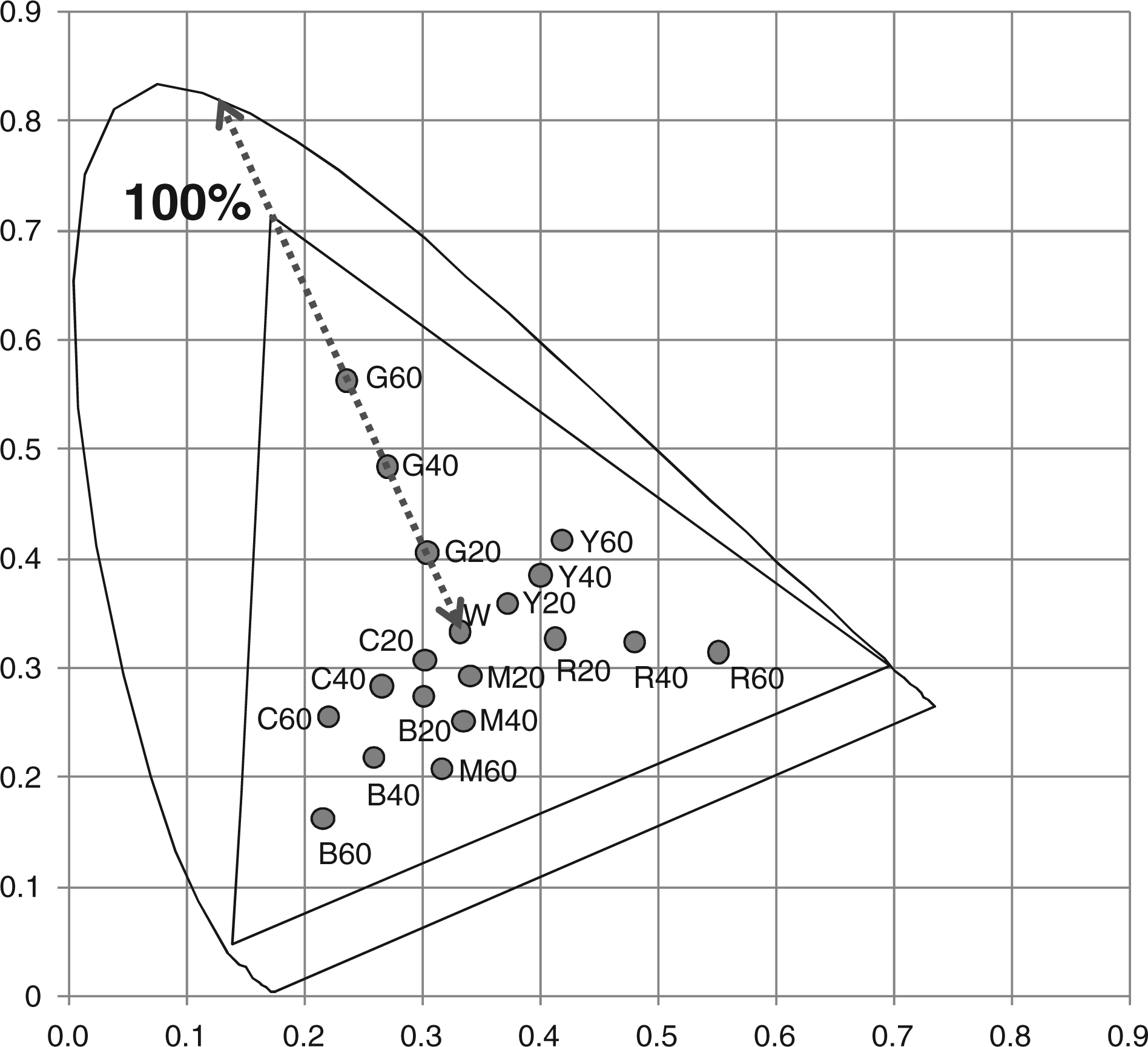
The experiment was conducted in the light environment laboratory in the basement of the T college building from October 11–29, 2010, with 22 students (13 males and 9 females) in their 20 s and 30 s (age range 23–37) who have normal colour vision.
For the experiment, the subject was asked to adjust illuminance for each lighting colour pattern so as to find optimal and permissible illuminances of the LED light source with respect to what occupants of an indoor space feel is appropriate for comfort and communication. During the experiment, 19 patterns were randomly provided, and the average experiment time was 60 min.
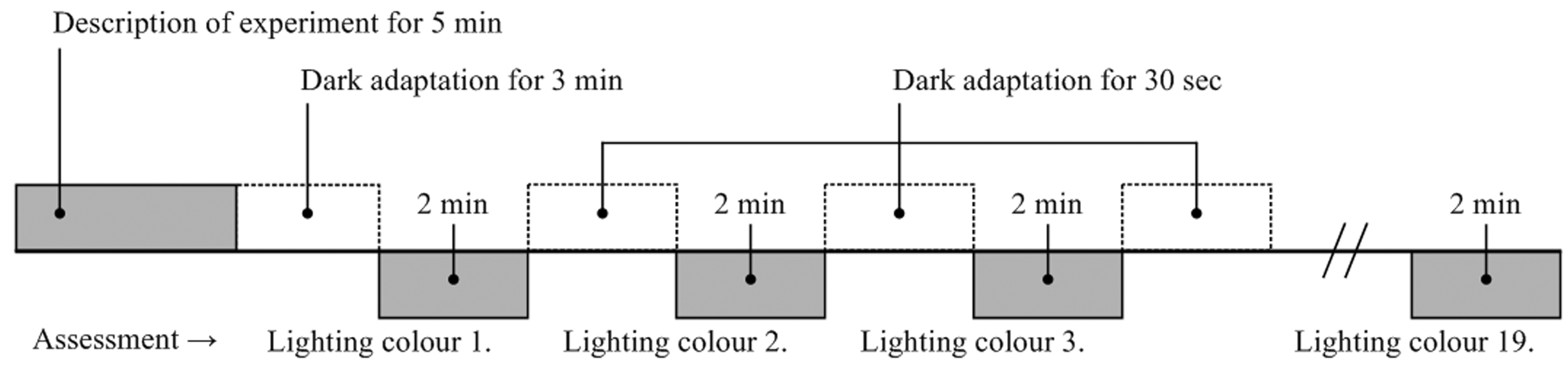
For each pattern, the experiment started in dark conditions and progressed as follows (Figure 3):
Lighting control was set to optimal brightness (optimum illuminance) as indicated by the subject, then to the brightest condition. Lighting control was set to optimal illuminance (again, as noted by the subject), and then to the lower limit of the permissible range of brightness. Lighting control was set to optimal illuminance again and then to the upper limit of the permissible range of brightness. From step c, lighting control was set to optimal illuminance. Answer the questions when each lighting colour is finished (6 colours and white). Sequence of the experiment.
Results
Experiment for Occupants’ Comfort
Reasonable range of illuminance, permissible range of illuminance and annoyance ratio for comfort with lightemitting diode (LED) lighting colours
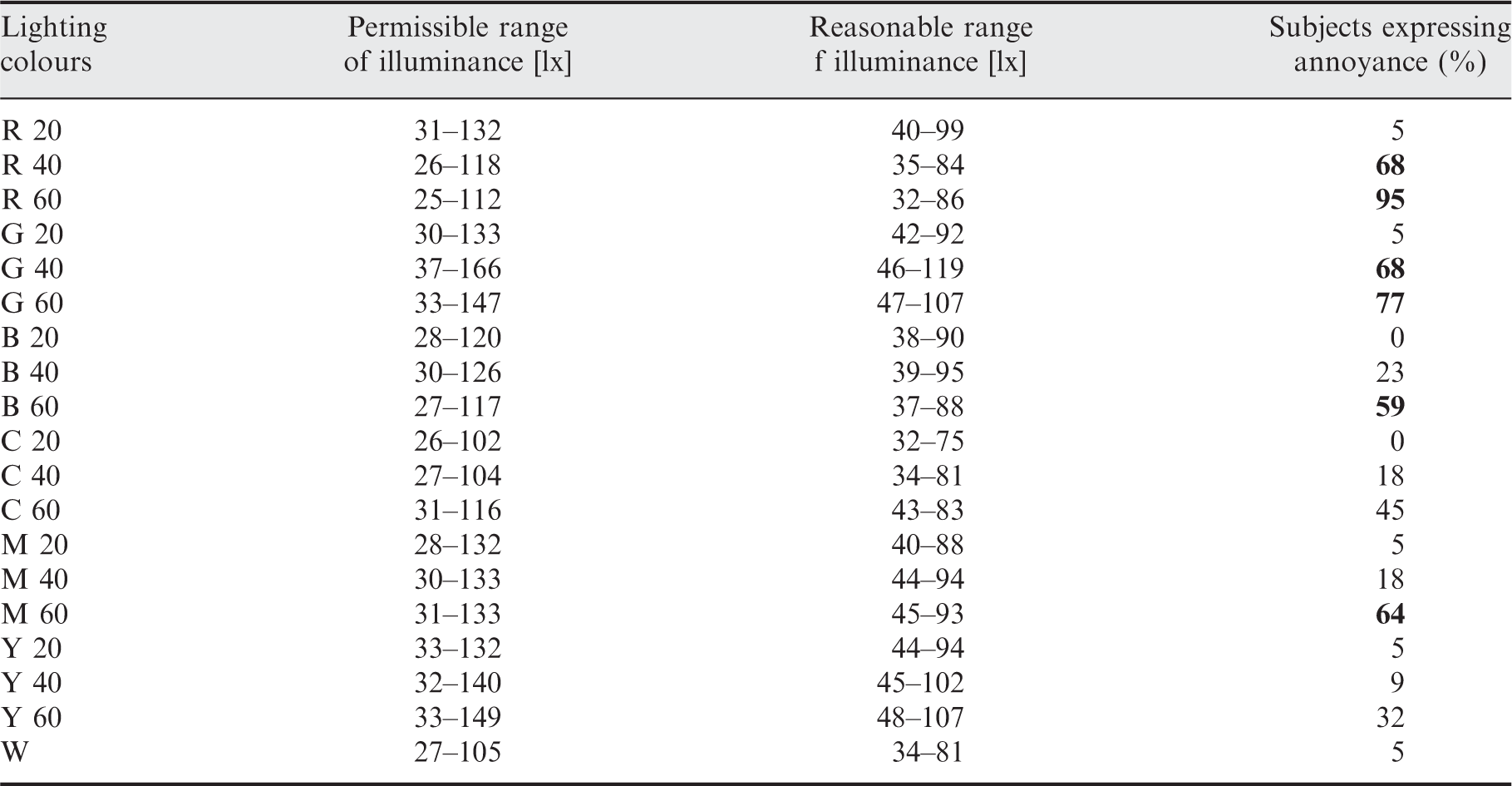
For the lower limit of the permissible range of illuminance, the minimum illuminance was 25[lx] of R60 and the maximum illuminance was 37[lx] of G40. For the upper limit of the permissible range of illuminance, the minimum illuminance was 102[lx] of C20 and the maximum illuminance was 166[lx] of G40.
To compare the optimal illuminance and permissible range of illuminance for each lighting colour, the ratio of the illuminance of each lighting colour to the optimal illuminance of white (which was set at 1) is shown in Figure 4. The optimal illuminances of C20 and C40 were identical to that of white. The optimal illuminances of G40, G60 and Y60 showed a relatively high difference from that of white. Compared to white, it appears that the lighting colours presented in this study require higher illuminances.
The evaluation of annoyance for LED lighting colours showed that the percentage of subjects who felt annoyance even at optimal illuminance was highest for R60, followed by G60, R40, G40, M60 and B60 (Table 3). According to the illuminance criteria of Korean Standards, the general working surface illuminance in the living room for comfort and relaxation was 30–40–60[lx], which is similar to the experimental results for optimal illuminance in this study [19].
Ratio of optimal illuminance for comfort to white light-emitting diode (LED).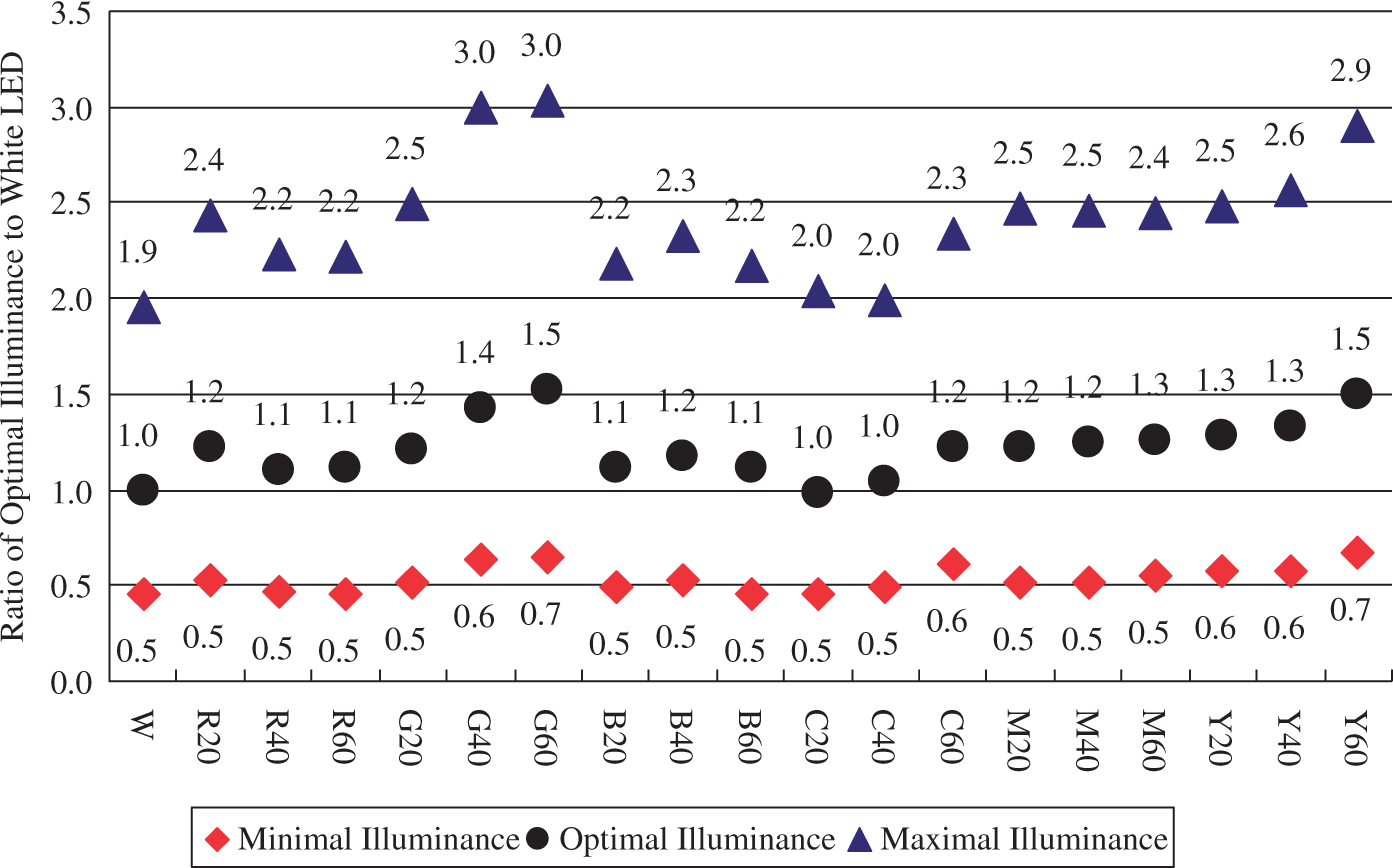
Experiment for Occupants’ Communication
The optimal illuminance and the permissible range of illuminance of LED light sources were also evaluated with respect to what occupants feel is appropriate for communication in an indoor space.
Reasonable range of illuminance, permissible range of illuminance and annoyance ratio for occupant communication for light-emitting diode (LED) lighting colours
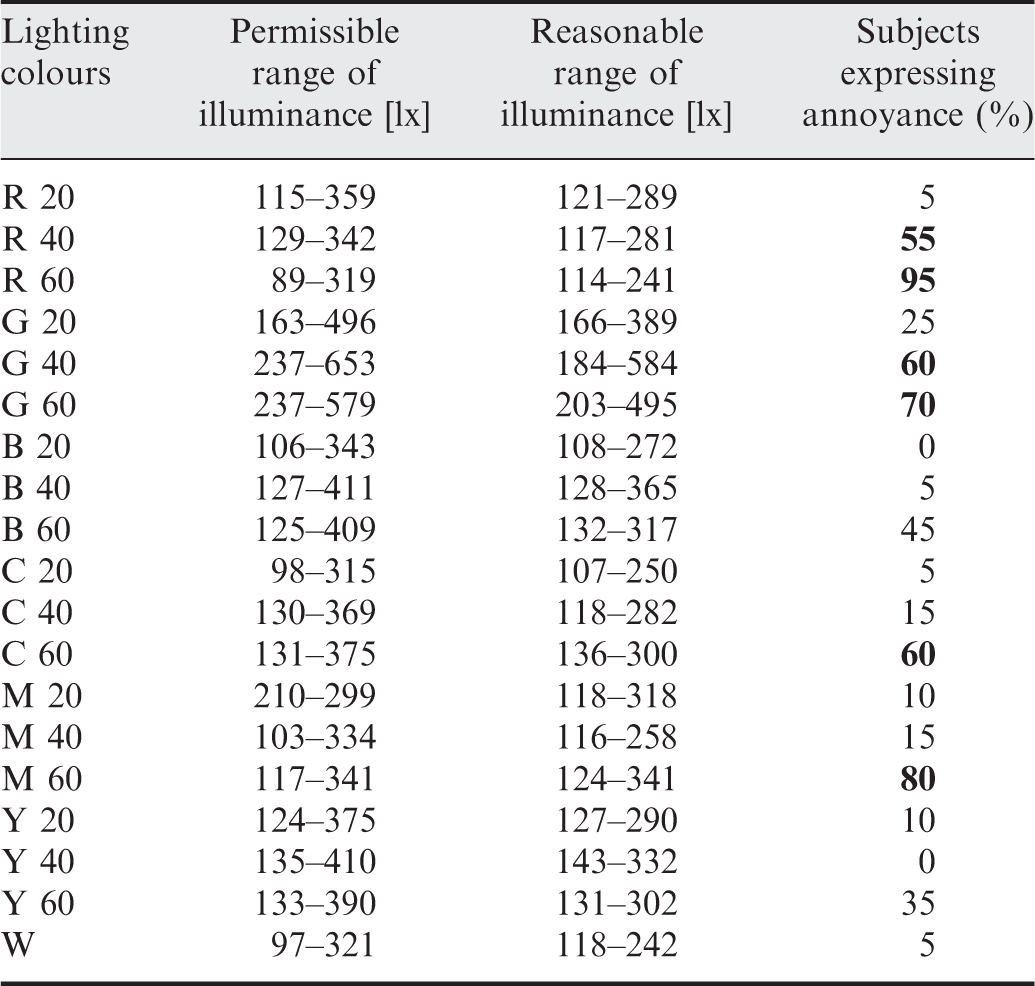
For the lower limit of the permissible range of illuminance, the minimum illuminance was 89[lx] of R60 and the maximum illuminance was 237[lx] of G40. For the upper limit of the allowable range of illuminance, the minimum illuminance was 299[lx] of C20 and the maximum illuminance was 653[lx] of G40.
Figure 5 shows the comparison of the optimal illuminance and permissible range of illuminance of each lighting colour. For this comparison, the ratio was obtained for the illuminance of each lighting colour to the optimal illuminance of white, which was set at 1. The optimal illuminance of C20 was identical to that of white and the optimal illuminances of other lighting colours were higher than that of white. In particular, the optimal illuminance was considerably higher for green LED light sources, and it appears that the lighting colours presented in this study require higher illuminance than white does.
Ratio of optimal illuminance for occupant communication to white light-emitting diode (LED).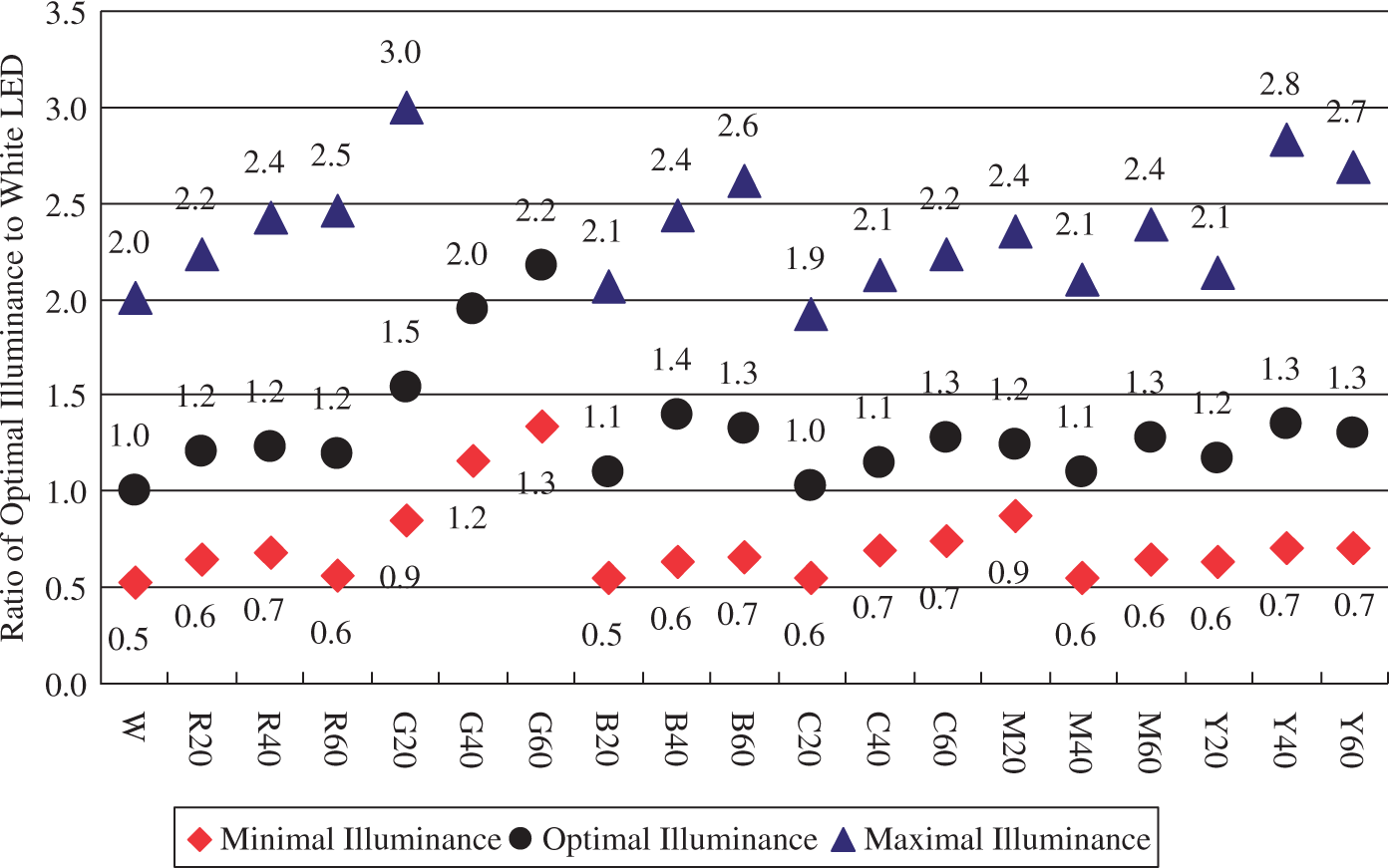
The evaluation of annoyance for LED lighting colours showed that the percentage of subjects who felt annoyance even at the optimal illuminance was the highest for R60, followed by M60, G60, G40, C60 and R40 (Table 4).
According to the illuminance criteria of Korean Standards, the general working surface illuminance in the living room for communication was 150–200–300[lx], which is similar to the experiment results for optimal illuminance in this study [19].
Conclusions
This study intended to evaluate the proper illuminance of each lighting colour of LED light sources, with a focus on the comfort and the desire for communication that individuals feel in an indoor space. The seven major lighting colours for LED light sources were studied (red, green, blue, cyan, magenta, yellow and white).
The findings of the research are as follows.
The evaluation of optimal illuminance for LED lighting colours found that occupants felt that the cyan LED light source was similar to white light source, and the relative brightness of green lighting colour was measured as being higher than that of the other colours. These results agreed with those of previous studies. The evaluation of the permissible range of illuminance for LED lighting colours found that occupants felt that red lighting colours were relatively darker; once again, green lighting colours were considered relatively brighter, in another result that agreed with those from previous studies. An experiment with subjects for LED lighting colours consisting of 19 patterns of 7 colours in the living room of a house found that the optimal illuminance for occupants’ comfort was 32[lx]–119[lx], which generally satisfied the illuminance criteria of Korean Standards in 30[lx]–40[lx]–60[lx]. The optimal illuminance of LED lighting colours for occupants’ communication was 107[lx]–584[lx], which generally satisfied the the illuminance criteria of Korean Standards in 150[lx]–200[lx]–300[lx].
Footnotes
Acknowledgement
This Work was supported by the National Research Foundation of Korea (NRF) grant funded by the Korea government (MEST) (No. 2011-0001031).