







Abstract
In this paper, the natural radioactivity levels in a total of 117 samples of 14 different building materials collected from building construction sites and from the retailers in Adana were studied by means of gamma-ray spectrometer with HPGe detector. The mean activity concentrations of 226Ra, 232Th and 40K measured in the studied building material samples ranged from 2.1 to 88.2 Bq kg−1, 1.8 to 52.7 Bq kg−1 and 68.1 to 847.5 Bq kg−1 for 226Ra, 232Th and 40K radionuclide, respectively. The external and internal index, the indoor absorbed dose rate and the corresponding annual effective dose were evaluated for potential exposure risks from the usage of the building material samples. The evaluated values of the external and internal index were below the recommended upper level. All the values of effective annual dose determined were lower than recommended exemption level of 0.3 mSv. The results suggest that the use of the studied building material samples in the construction of buildings is unlikely to give rise to any significant radiation exposure to the residents.
Keywords
Introduction
The natural occurring radionuclides such as uranium-radium (238U-226Ra) and thorium (232Th) and their decay products and the radioactive isotope of potassium (40K) in building materials are the main sources of radiation. These radiations bring about external and internal exposure to the occupants. The external exposure is caused by direct gamma radiation emitting these radionuclides while the internal exposure is caused by the inhalation of the radioactive inert gas radon (222Rn) and its short-lived decay products. As a consequence of the possible radiological hazards to human health caused by external and internal exposures of people of buildings, many countries, especially European countries, and international organizations such as NEA-OECD, ICRP, UNSCEAR etc. have adopted strong measures for minimizing such exposures.
The study of the natural radioactivity levels in building materials is not only needed to assess the possible radiological hazards to human health but also to develop standards and guidelines for the use and management of these materials. 1 In recent years, there has been an increasing interest in the study of the radioactivity in various building materials,2–25 although there are a few studies on the radioactivity of building materials used. Some cities in Turkey26–29 require detailed information of the activity concentrations of 226Ra, 232Th and 40K in building materials used but these are not available in literature.
The purpose of the present paper is to study the natural radioactivity level in commonly used building materials in Adana, which is a city in Mediterranean region of Turkey and a major agricultural and commercial centre. Adana is the Turkey's fifth largest city (a population of 1,630,710) and has 250,447 buildings. 30 The studied radioactivity levels of 226Ra, 232Th and 40K were compared with the reported data of other countries and the median values measured in the earth’s crust. The results of the activity concentrations of these radionuclides were used to evaluate the potential exposure risks from the usage of the building material samples by calculating the external (radium equivalent activity and the radiation index) and internal (alpha index) hazard indices, the indoor absorbed dose rate and the corresponding annual effective dose.
Materials and methods
Sample collection and preparation
A total of one hundred seventeen building material samples used in the construction sectors in Adana were collected randomly from different building construction sites and from the retailers. Building material samples studied include structural (cement, concrete, gas concrete, clay brick, pumice brick, sand and aggregate) and covering (granite tile, marble tile, ceramic floor tile, lime-limestone, gypsum, grouting and adhesive) materials. The masses of the samples ranged from to 0.5 to 1 kg. The samples were catalogued and coded properly. The samples were grounded and crushed to a fine dust size. The samples were then dried at 110℃ for 15–20 h to ensure that moisture is completely removed. Each powdered sample was then packed in cylindrical plastic containers (5 × 6 cm), weighed and hermetically sealed. The geometrical dimensions of the samples were kept identical to those of the reference materials which were used for the efficiency calibration of the gamma spectrometry system. The sealed samples and the reference materials were stored for more than 4 weeks before counting by gamma spectrometer to allow 226Ra and its short-lived decay products to reach the secular equilibrium.
Sample counting system
The natural radioactivity levels of 226Ra, 232Th and 40K in the studied samples were determined with a gamma-ray spectrometry system equipped with a coaxial p-type HPGe detector (GX5020) with a relative efficiency of 50% relative to a 7.62 cm (diam.) × 7.62 cm cylindrical NaI (Tl) detector, with an energy resolution of 2.0 keV at 1332.5 keV and a peak-to-Compton ratio of 60:1. For gamma-ray shielding, a front opening split-top shield (Canberra Model 767) was used to reduce the background. It features 100 mm lead thickness, which is jacketed by a 9.5 mm steel outer housing. The graded liner comprises 1-mm-thick tin layer and 1.5-mm-thick copper layer to prevent interference by lead X-rays. To minimize scattered radiation from the shield, the detector was centred in the liner. The detector was interfaced to the digital spectrum analyzer (DSA-1000), which was a full-featured 16K channel multichannel analyzer on advanced digital signal processing (DSP) techniques. DSA-1000 operates through Genie-2000 gamma spectroscopy software including peak searching, peak evaluation, energy/efficiency calculation mode, nuclide identification etc.
The samples containers were placed on top of the detector for counting. The same geometry was used to determine peak area of samples and references. Prior to sample measurement, gamma-ray background at the laboratory was determined with an empty container under the same conditions of sample measurements and subtracted in order to get net counts for the sample.
Efficiency calibration of detector
The efficiency calibration procedure contains the calculation of the absolute efficiency of the HPGe detector as a function of gamma-ray energy. The absolute efficiency for gamma rays is dependent on the source-detector geometry. Therefore, the absolute efficiency calibration needs to be performed for each source-detector combination. In the ideal case, it can be calculated as the ratio of the number of detected photons of a particular energy to the total number emitted by the source at that energy as shown in equation (1):
31
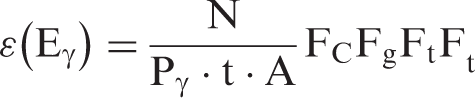
In this paper, the absolute efficiency calibration of the HPGe detector was performed using the radionuclide specific efficiency method in which the efficiency values of gamma-ray lines belonging to the specific radionuclide existing in both the reference material and sample were only used. Thus, the uncertainty in gamma-ray intensities, the influence of coincidence-summing correction and self-absorption effects of the emitting gamma photons were avoided for the close geometry conditions. The reference materials RGU-1 (U-ore), RGTh-1 (Th-ore) and RGK-1 (K2SO4) used for the radionuclide-specific efficiency calibration of the counting system were counted by placing them in the sample position. The measured efficiency values were fitted to function as shown in Equation (2):
Efficiency curve performed for the HPGe detector used in this study.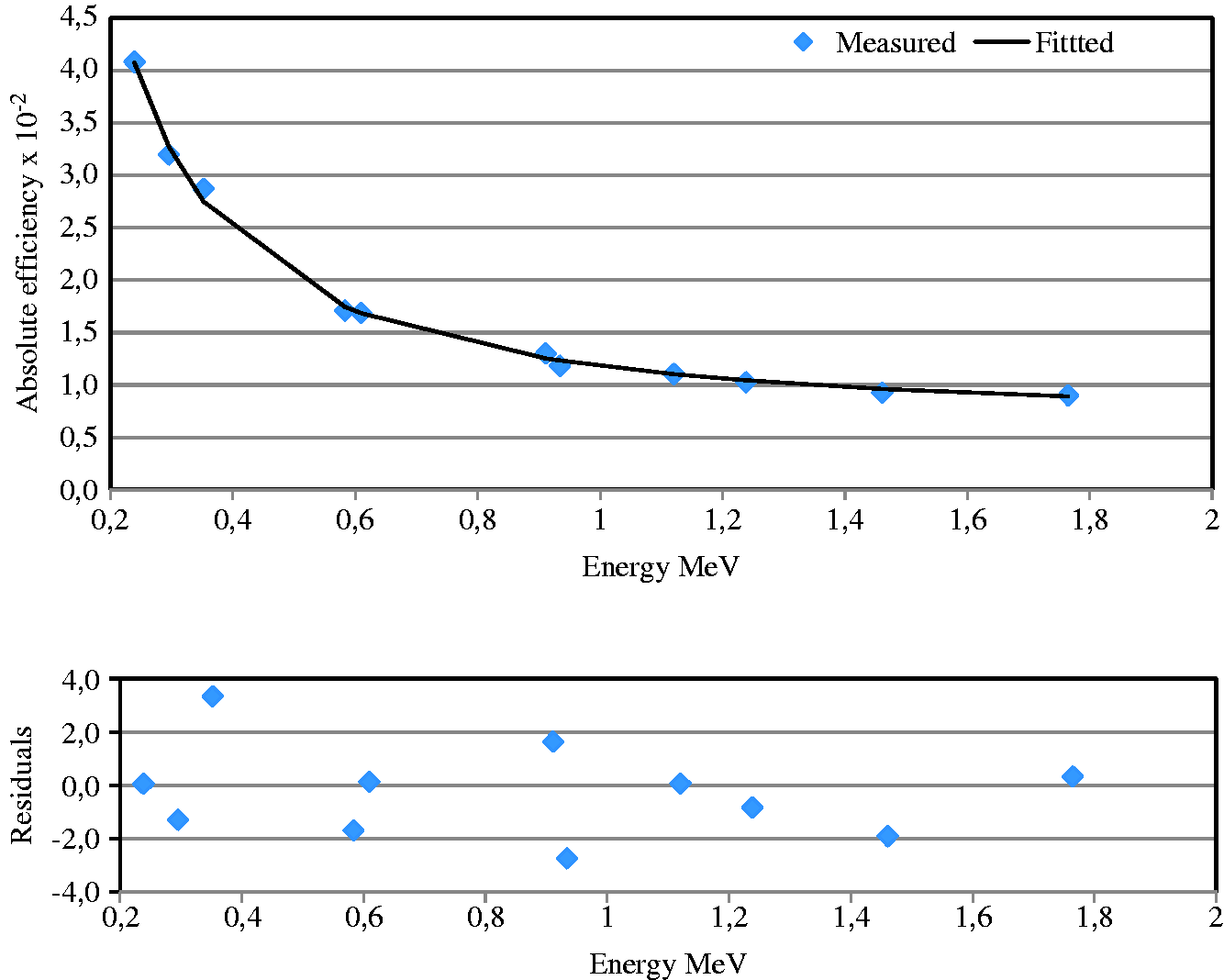

Calculation of the activity concentration
The activity concentration (AC) of a gamma-ray emitting radionuclide in the sample is calculated using equation (3), as:

Gamma spectrum was obtained for each studied building material samples using gamma-ray spectrometer mentioned above. Under the assumption which secular equilibrium was reached between 226Ra and 222Rn and 232Th and 228Ra, the activity concentrations were averaged from gamma-ray photopeaks at several energies. The activity concentration of 226Ra was derived from the average of the activities of the gamma-ray line of 609.3 keV from 214Bi and 351.9 keV from 214Pb, while the gamma-ray lines of 911.2 keV from 228Ac and 583.2 keV from 208Tl were used to determine the activity concentration of 232Th. The activity concentration of 40K was obtained using its 1460.8 keV gamma-ray line.

The mean values of minimum detectable activity measured for 226Ra, 232Th and 40K in the studied building material samples.
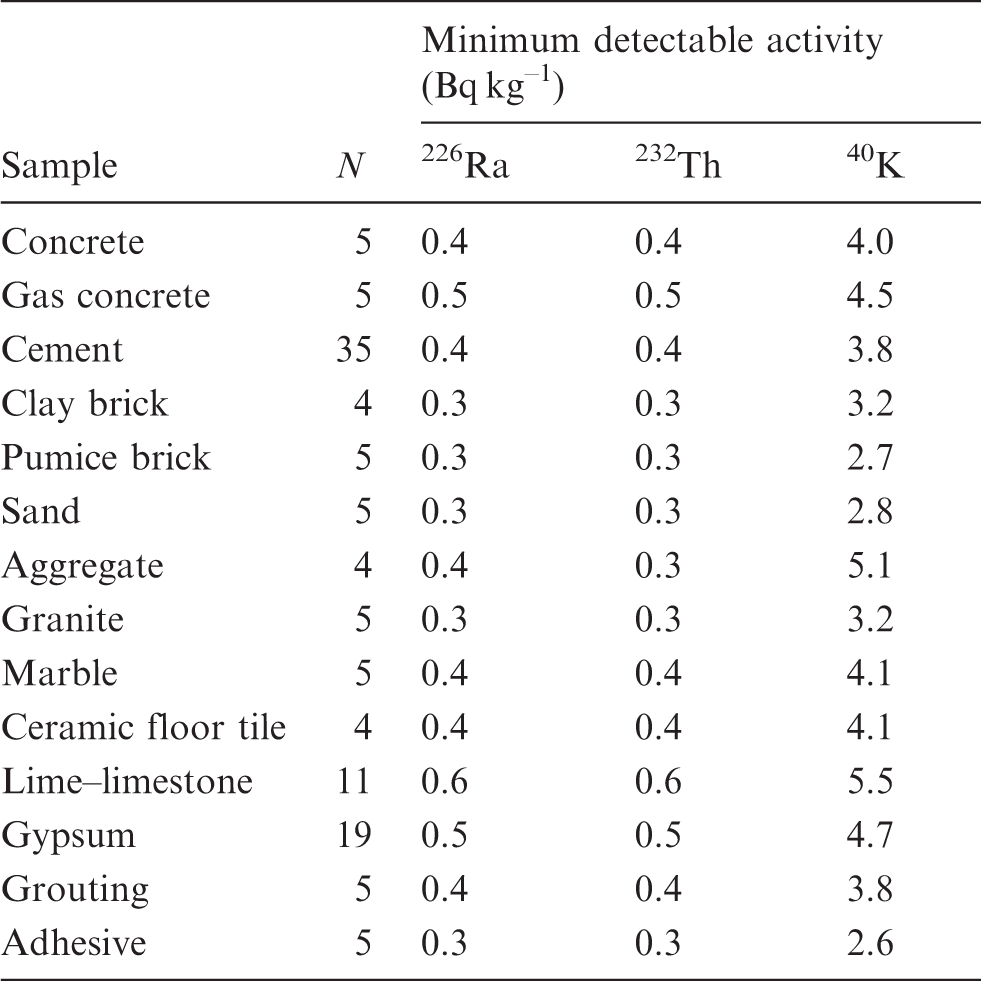
The combined standard uncertainty of the activity concentration ΔAC is calculated by the next formula, shown in equation (5):

Results
Radioactivity levels
The values of the activity concentrations of 226Ra, 232Th and 40K in the structural building material samples.
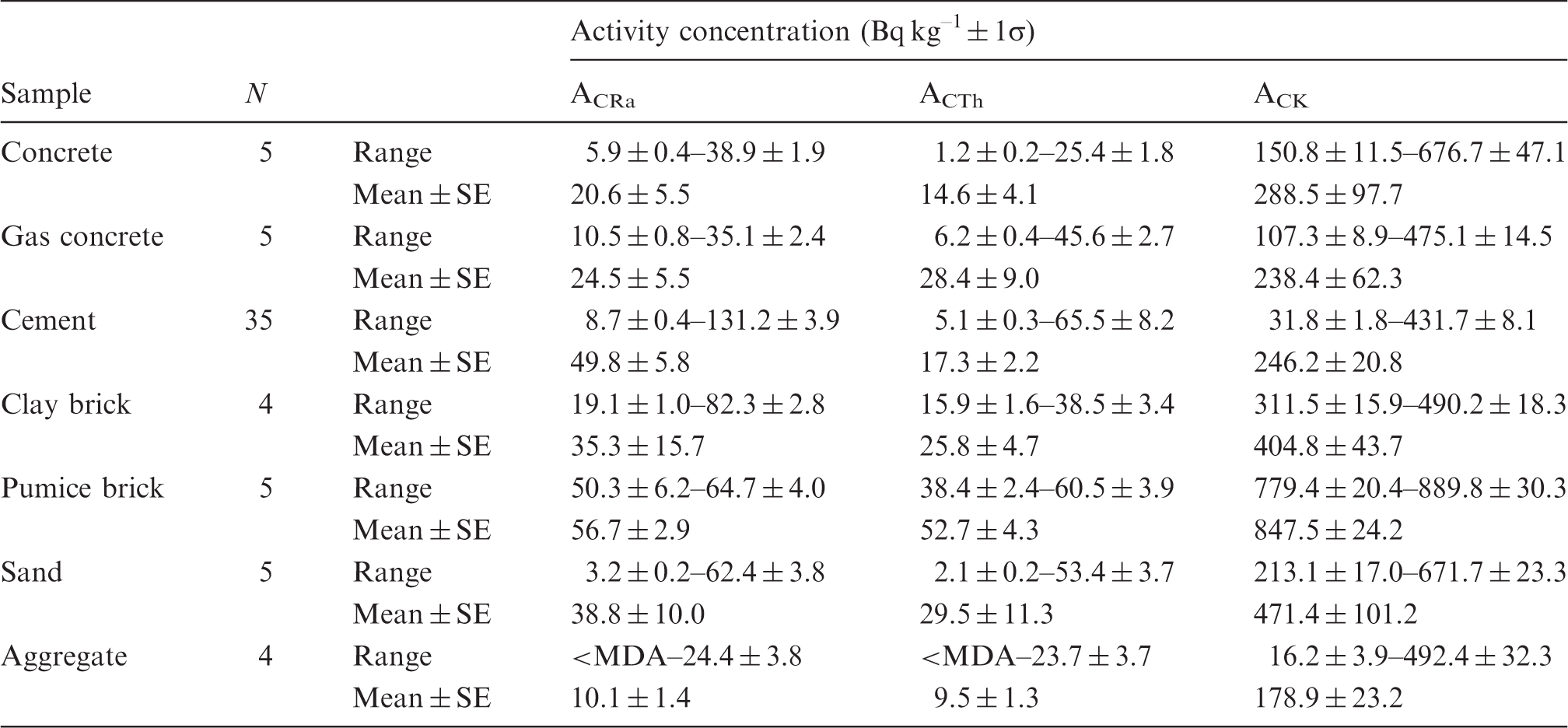
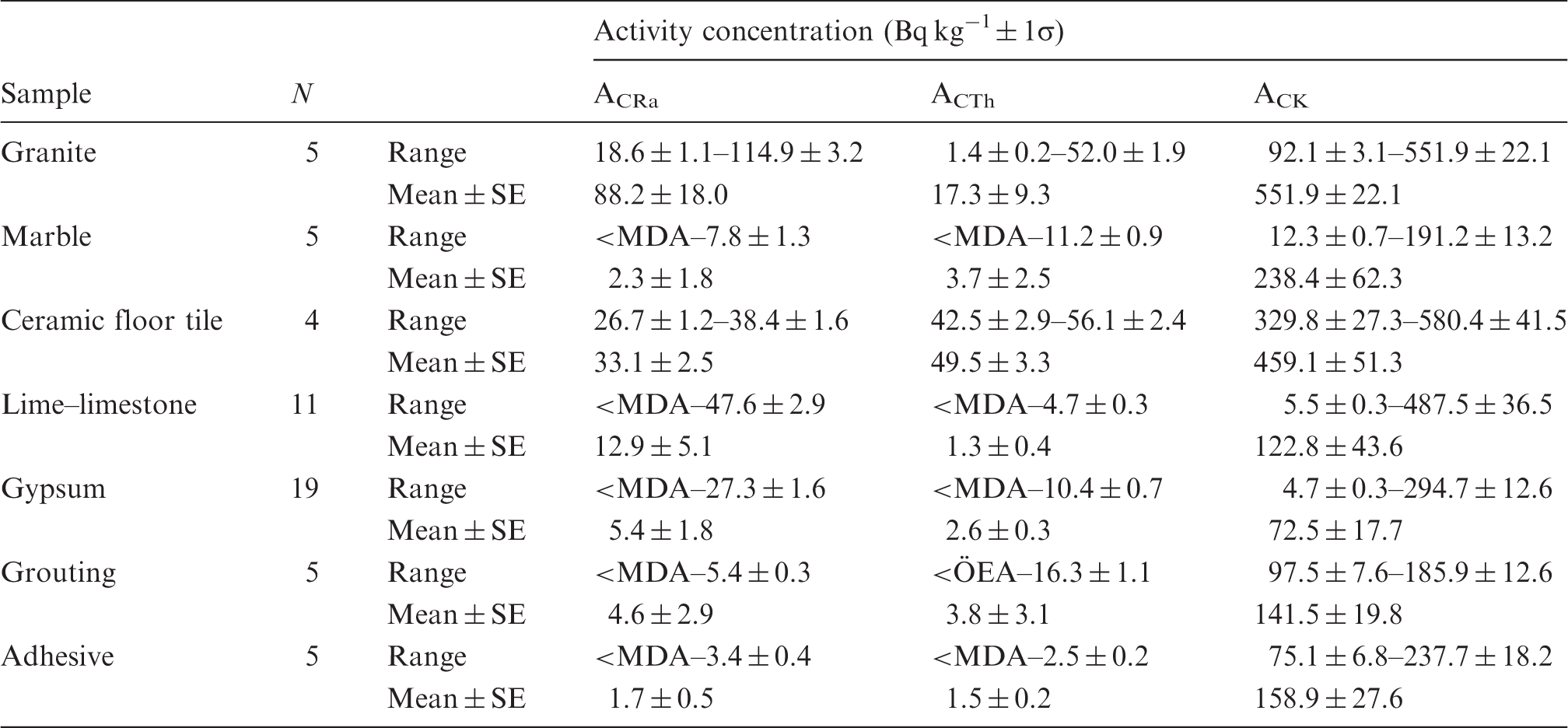
The values of the activity concentrations of 226Ra, 232Th and 40K in the covering building material samples.
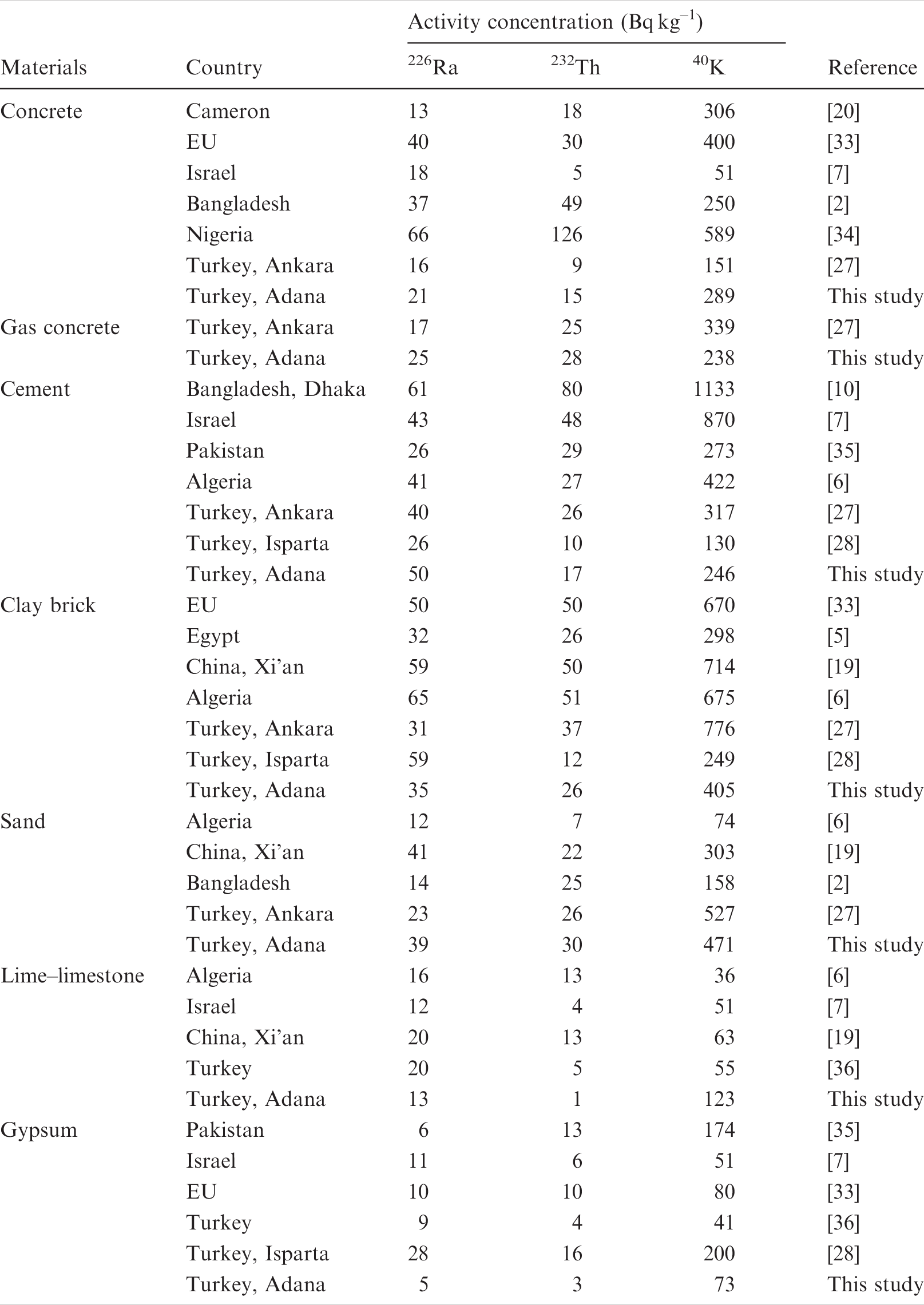
Comparison of the mean values of activity concentrations measured in the present study for the samples examined with those obtained in other countries.
Discussion
Evaluation of potential exposure risks
In the present study, external hazard index (gamma activity concentration), internal hazard index (alpha index), absorbed gamma dose rate in indoor and the corresponding annual effective dose were calculated to evaluate potential exposure risks from usage of the studied building material samples used in Adana.
The external index (gamma activity concentration index)
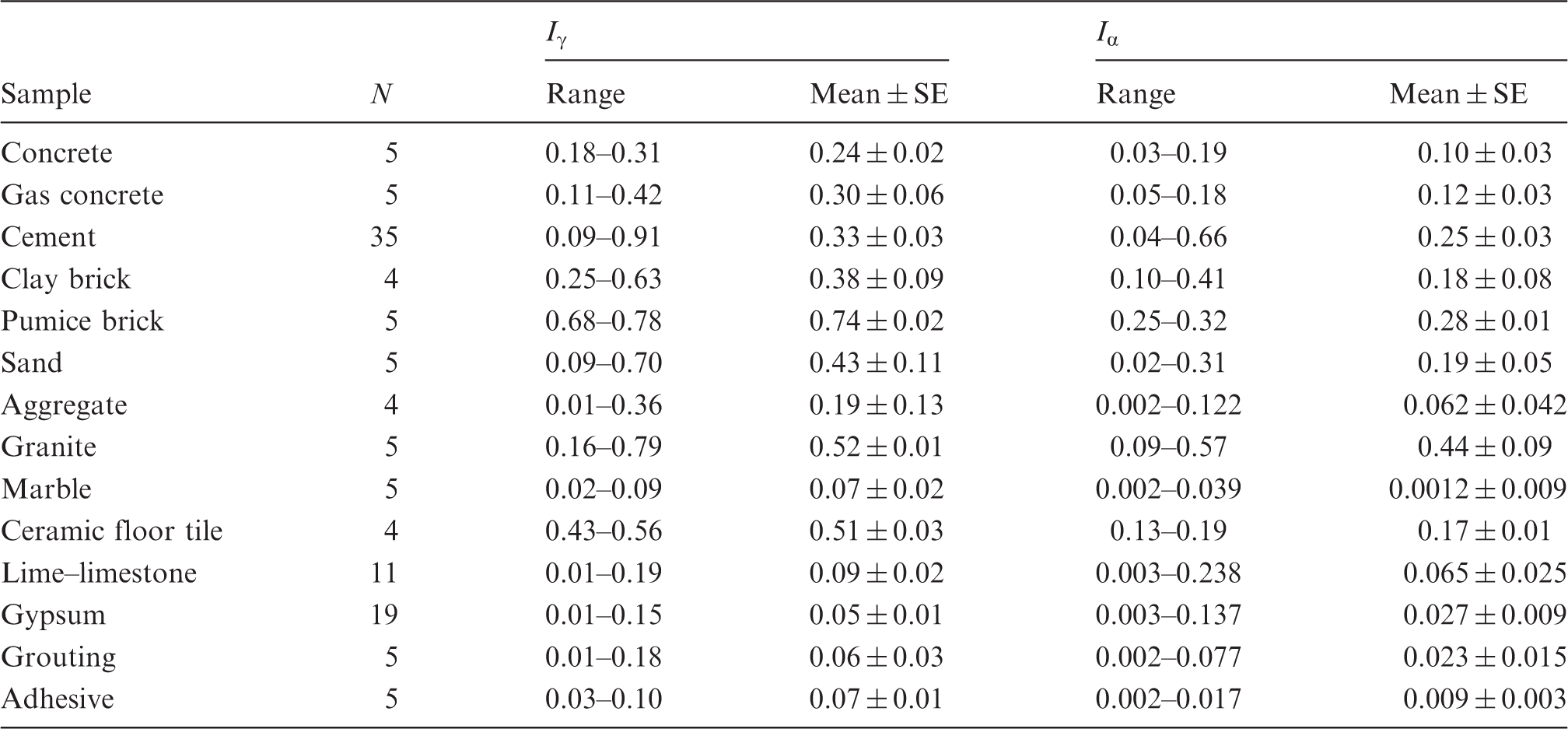
So far, a number of indexes dealing with the assessment of the excess gamma radiation originating from building materials such as radium equivalent activity (Raeq) index, external hazard index (Hex), the representative level index (Iγr) and gamma activity concentration index have been proposed by several investigators.36,37,38 In the present study, the gamma activity concentration index (Iγ) is defined to use only as screening tools for ready-to-use building materials. It was calculated using equation (6) proposed by the European Commission:
33
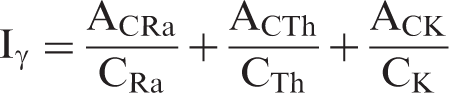
where ACRa, ACTh and ACK are the measured activity concentrations of 226Ra, 232Th and 40K, respectively, in Bq kg−1 and CRa, CTh and CK are the activity concentrations assumed to produce the same annual effective dose, i.e. 300, 200 and 3000 Bq kg−1 for 226Ra, 232Th and 40K, respectively. For structural materials used in bulk amounts, e.g. concrete Iγ ≤ 1 corresponds to an annual effective dose less than or equal to 1 mSv, while Iγ ≤ 0.5 corresponds to an annual effective dose less than or equal to 0.3 mSv. For covering and other materials with restricted use, e.g. tiles Iγ ≤ 61 corresponds to an annual effective dose less than or equal to 1 mSv, while Iγ ≤ 2 corresponds to an annual effective dose less than or equal to 0.3 mSv.
The internal index (alpha index)
A few indexes dealing with the assessment of the excess alpha radiation due to inhalation of radon escaped from building materials such as alpha index and internal health index were developed.
15
In the present study, the alpha index was calculated using equation (7):
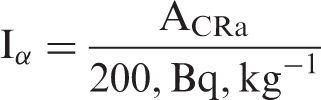
where ACRa is the activity concentration of 226Ra in Bq kg−1. The design level for indoor radon exposure in future buildings set by Turkish Standard TS 12614 39 corresponds to an annual mean radon gas concentration of 200 Bq m−3. When the activity concentration of 226Ra in a building material exceeds the value of 200 Bq kg−1, it is possible that the radon exhalation from this material could cause indoor radon concentration exceeding 200 Bq m−3. It is very important to remark that there is no distinction between materials used in bulk materials and covering and other materials with restricted use in the alpha index determination.15,40
The values of the external (Iγ) and internal (Iα) index calculated for the studied building material samples.
Indoor absorbed gamma dose rate and annual effective dose
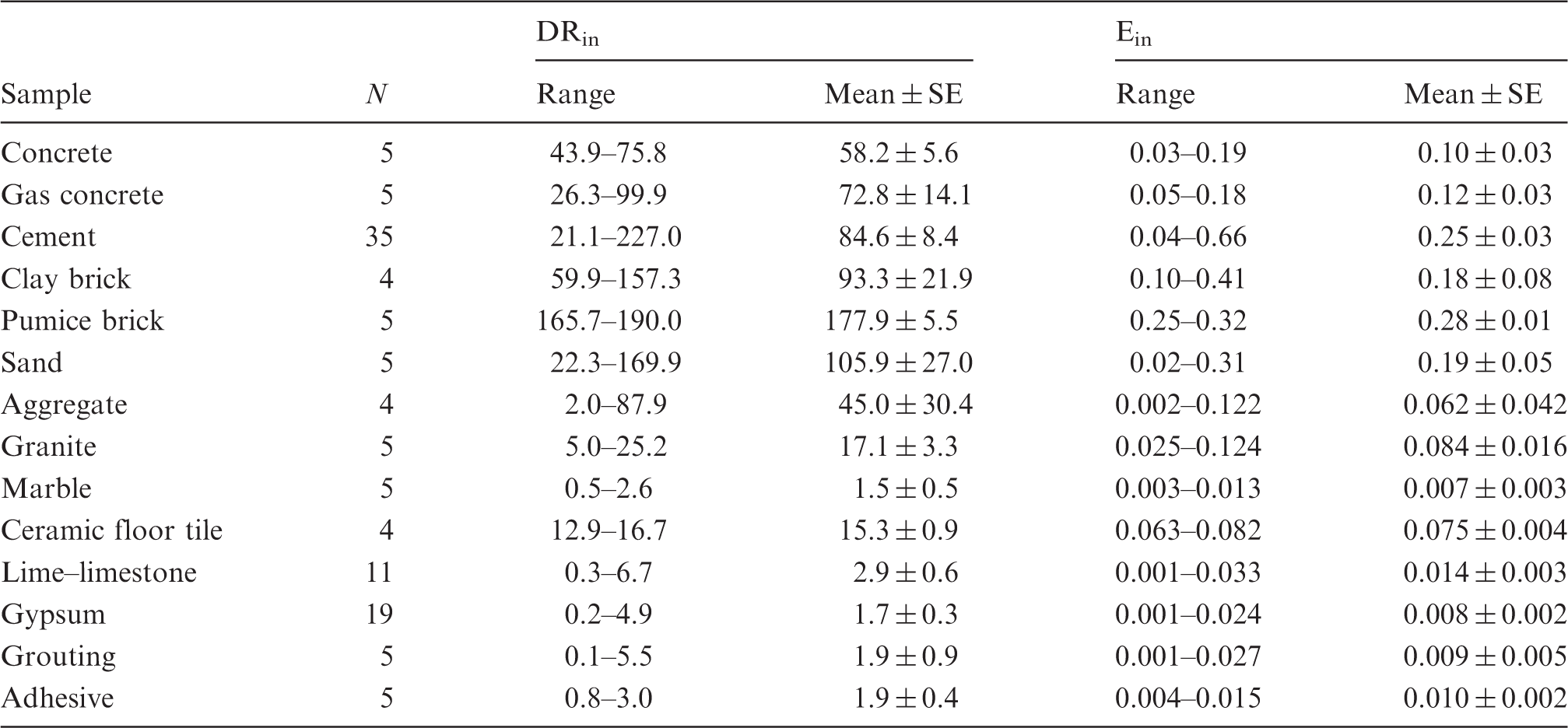
Indoor absorbed gamma dose rates due to gamma-ray emissions from 226Ra, 232Th and 40K in the studied structural and covering building material samples were evaluated using formula provided by European Commission Report.
33
The specific dose rates in nGy h−1 per Bq kg−1 were evaluated for different type of building materials. Indoor absorbed gamma dose rates (DRin) were calculated for:
Structural building materials in a standard room calculated using equation (8) with dimension 4 m × 5 m × 2.8 m, wall thickness 20 cm and a density of 2350 kg m−3 Covering building materials in a standard room calculated using equation (9) with dimension 4 m × 5 m × 2.8 m; 3 cm thickness of tiles on all walls; a density of 2600 kg m–3


where ACRa, ACTh and ACK are the activity concentrations of 226Ra, 232Th and 40K, respectively, in Bq kg−1.
In order to determine the corresponding annual effective dose, a value of 0.7 Sv Gy−1 was used for the conversion factor from absorbed dose in air to effective dose received by adults. The indoor occupancy factor was 0.8, implying that the occupants spent 80% of time indoors.
40
The corresponding annual effective dose (Ein) was calculated using Equation (10):

where DRin is the indoor absorbed gamma dose rate given by equation (9).
The values of the indoor absorbed gamma dose rate (DRin) and the corresponding annual effective dose (Ein) evaluated for the studied building material samples.
Conclusion
The natural radioactivity levels of 226Ra, 232Th and 40K in the studied building material samples used in Adana were measured by means of gamma-ray spectrometer. The obtained activity results were tabulated and compared with the values in other countries for selected building materials. The natural radioactivity levels of 226Ra, 232Th and 40K measured in the samples with the exception of pumice brick and granite tile were compared with the earth’s population-weighted mean values. The external and internal index, the indoor absorbed gamma dose rate and the corresponding annual effective dose were calculated to evaluate the potential exposure risks from the usage of the building material samples. The mean values of Iγ, Iα, DRin and Ein calculated for the structural building material samples are lower than measured in the EU, Bangladesh and China. The calculated values of the external and internal indexes are lower than the recommended upper levels. All values of the annual effective dose were below the criterion limit of the exemption corresponding to 0.3 mSv y−1.
The results show that the building material samples studied can be safely used in construction of dwellings, work place and schools in Adana according to the international and national recommendations.
Footnotes
Acknowledgements
This study was carried out within the framework of a doctorate thesis conducted at Cukurova University and Nevsehir University. The authors remember Prof. Dr. Gülten Günel with respect.