







Abstract

Climate change and global warming are important issues of our time, which have been dominating governments’ strategies, policies, building codes and standards and also research funding of university institutions all over the world. The United Nations Framework Convention on Climate Change (UNFCCC) and its Kyoto Protocol has established a basis of an agreement to cut CO2 emissions to alleviate the adverse effects of global warming [1].
China’s double digits economic growth for the past two decades had resulted in a rapid rise of CO2 emissions and other atmospheric pollution of urban cities. Although China’s CO2 emissions are still low on a per capita basis, China has already become the largest producer of CO2 emissions in the world. In 2007, China exceeded the carbon emissions of USA, with emissions of more than 6Gt [2]. In 2011, China became the largest contributor to the global increase of carbon emissions, rising by 0.72Gt, or 9.3%, primarily due to higher coal consumption [3].
In order to reduce global emissions so as to hold the increase in global temperature below 2°C, the Chinese government pledged a 40–45% reduction in national carbon intensity from 2005 levels by 2020 at the Copenhagen Summit which has formed part of the Copenhagen Accord, 2009 [4]. To realize the above goal, China’s 11th Five-Year Plan set a target to decrease the overall energy intensity of the economy (energy consumption per unit of GDP) by 20% [5]. The 12th Five-Year Plan adopted by the Chinese government in March 2011 pays considerable attention to energy and climate change and establishes a new set of targets for 2011-2015 [6], which include:
A 16% reduction in energy intensity; Increasing non-fossil energy to 11.4% of total energy use; and A 17% reduction in carbon intensity (carbon emissions per unit of GDP).
Since energy consumption of buildings rose from 10% of the national total energy use in the late 1970s to more than 25% in 2006, and is expected to increase further to 35% by 2020 [7,8], building energy efficiency plays an important role in the reduction of CO2 emissions. The increase of energy consumption in buildings comes from two aspects. One is that more and more new buildings are being built. The other is that heating, air conditioning and domestic hot water are more widely needed in China. As we know, nearly half of the world’s new building construction now is in China, which is about two billion square metres of new building floor area per year. Figure 1 shows the breakdowns of the existing and projected floor area of commercial building in China from 2005 to 2020 [8], which reflect the rapid growth of building area. How to maintain a moderate increase of building energy consumption while satisfying the requirements of occupants in such a rapid growth of urbanization has been a great challenge to Chinese government today.
Commercial building floor space in China [8].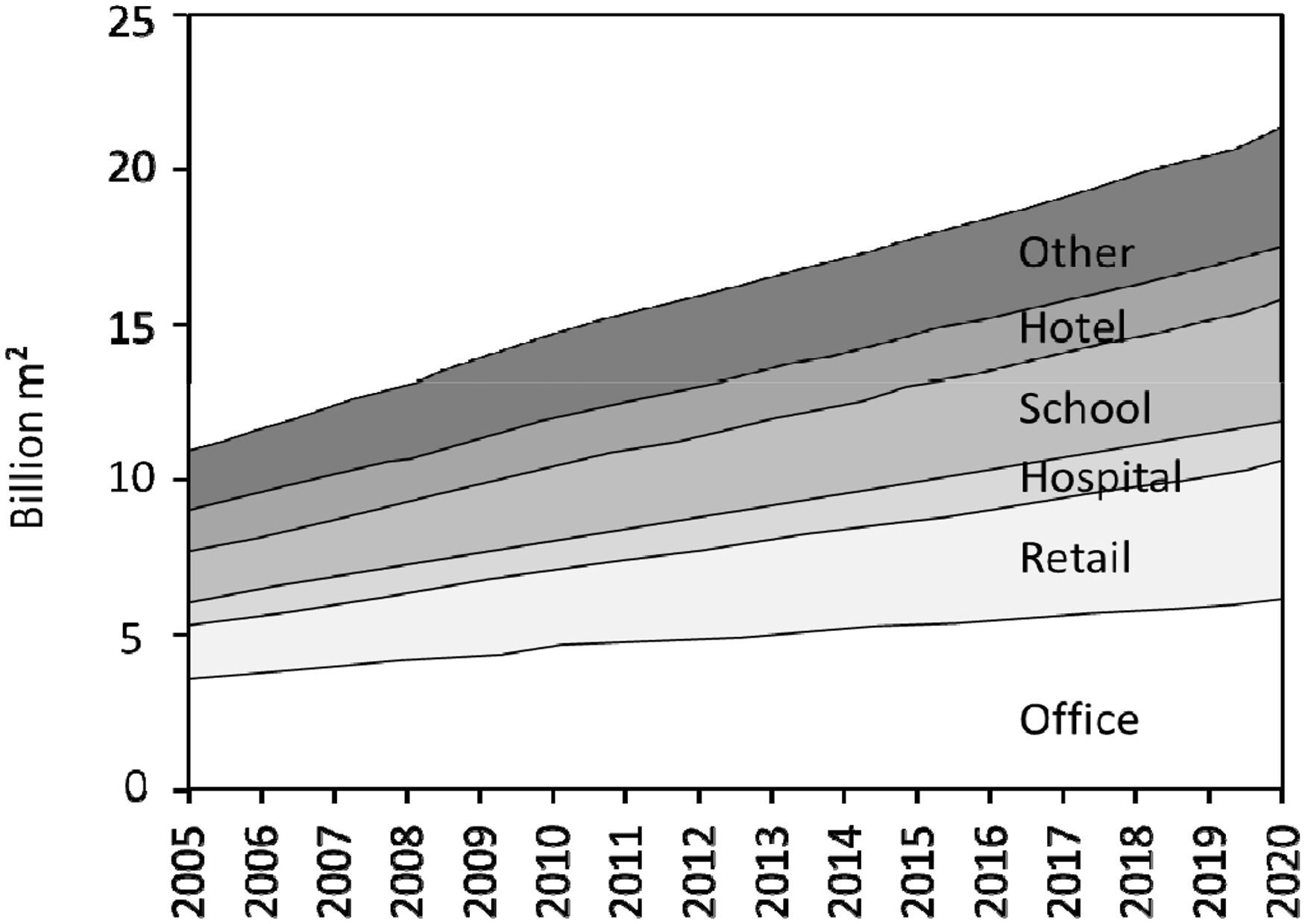
In order to decrease the energy consumption of buildings, a series of national and local codes and regulations have been promulgated in China to promote the energy saving in different types of buildings, such as the Energy Conservation Law of the People’s Republic of China, the Civil Building Energy Efficiency Management Regulations, Building Energy Efficiency Management Regulations etc. A series of design standards for public buildings and residential buildings in different climate zones have been published, in which the thermal characteristics of envelopes and the design of HVAC are required for energy efficiency. The following are some of the representatives of these Chinese standards and regulations:
GB 50189-2005: Design Standard for Energy Efficiency of Public Buildings; DBJ 50-071-2007: Design Code on 65% Energy Efficiency Residential Building; GB 50019-2003: Design Code for Heating and Ventilation and Air Conditioning; GBJ 19-87: Design Standard for Heating and Ventilation and Air Conditioning; JGJ 134-2010: Design Standard for Energy Efficiency of Residential Buildings in Hot Summer and Cold Winter Zone; JGJ 26-2010: Design Standard for Energy Efficiency of Residential Buildings in Severe Cold and Cold Zones; and JGJ 75-2003: Design Standard for Energy Efficiency of Residential Buildings in Hot Summer and Warm Winter Zone.
In addition, the standards for the measurement and evaluation of different kinds of energy saving building have also been approved, such as Evaluation Standard for Green Buildings (GB/T 50378-2006), Standard for Energy Efficient Building Assessment (GB/T 50668-2011), Standard for Energy Efficiency Test of Residential Buildings (JGJ/T 132-2009) and Standard for Energy Efficiency Test of Public Buildings (JGJ/T 177-2009). All these standards and codes can have a great impact on the design, construction and management of buildings in China.
In order to obtain the real data about energy consumption in different kinds of buildings and different climate zones, many surveys on energy consumption of existing buildings have been conducted. For office buildings and commercial buildings, the Ministry of Housing and Urban-Rural Development (MOHURD) has set up a long-term strategic plan to gather and collect real energy use data of governmental office buildings and large-scale commercial buildings in dozens of demonstration provinces, cities and municipalities from 2007 [9]. For urban household-sector, a survey on the actual state of electricity use has been carried out in 13 cities of China from 2003 to 2004 [10]. For rural housing, a large-scale national survey of energy consumption and indoor environmental quality of Chinese rural housing was conducted from 2006 to 2007. The survey covered 15 provinces in northern China and 9 provinces in southern China [11]. Besides, in the last decade, a lot of small-scale surveys of energy consumption in Xi’an City [12], Yunnan Province [13], Loess Hill Region, Gansu Province [14], Huantai County [15] and Nanjing City [16] have been carried out. All these surveys contributed a lot to the understanding of the situations regarding building energy consumption.
In order to develop energy-efficient system or integration technology, Chinese government financially supported several National Key Technology R&D Program in the 11th Five-year plan (2006–2010), such as Research and Demonstration on Renewable Energy and Building Integration Technology, Key Technology Research on Rural Development of New Energy and Energy Efficiency, Research and Demonstration on Key Technology of Building Energy Efficiency etc. The strength of each program is about 100 million Yuan, which is much higher than previous programs. In the 12th Five-year plan (2011–2015), several National Key Technology R&D Program have been launched, such as Research on Technical Support System of Building Energy Efficiency, Research and Demonstration on Key Technology of Energy Efficiency Promotion of Urban Heating System, Research and Demonstration on Energy Efficiency and Seismic Technology of Rural Buildings, Inheritance and Demonstration on Key Technology of Building Energy Efficiency in Hot Summer and Cold Winter Zone, Research and Demonstration on Key Technology of Building Energy Efficiency in Northeast Severe Cold Zone etc. All these programs have benefited and will benefit the improvement of energy efficiency in different kinds of buildings and different climate zones.
In fact, the per capita and per floor area building energy consumption in China now is much lower than other developed countries, as shown in Figure 2 [17]. It can be seen that the building energy consumption per capita in China is about one tenth of that in the United States, and the per floor area energy consumption in China is about one third of that in the US. The reasons for the difference are as follows [17]: (1) Different types of residential buildings – Single or detached houses are widely popular in the US, while apartments are the dominant type in China. (2) Different kinds of heating, ventilation and air conditioning (HVAC) systems – Except the district heating system in northern China, the HVAC systems in other area (including the air conditioning in north China) can only be operated in those occupied zones rather than the whole space. Occupants would shut down the HVAC system when they leave the rooms. (3) Different quality and service level – It is no doubt that the indoor environment on average in China is not as comfortable as that in developed countries. For example, the indoor temperature in winter in Yangtze River and rural area is much lower than traditional comfortable temperature. However, it is acceptable for most of the residents in the area [18]. Therefore, the much lower energy consumption in buildings in China is mainly based on the different life style. If such life style is changed to the same as the USA, the building energy consumption would increase further, more rapidly.
Building primary energy use comparison among main countries [12].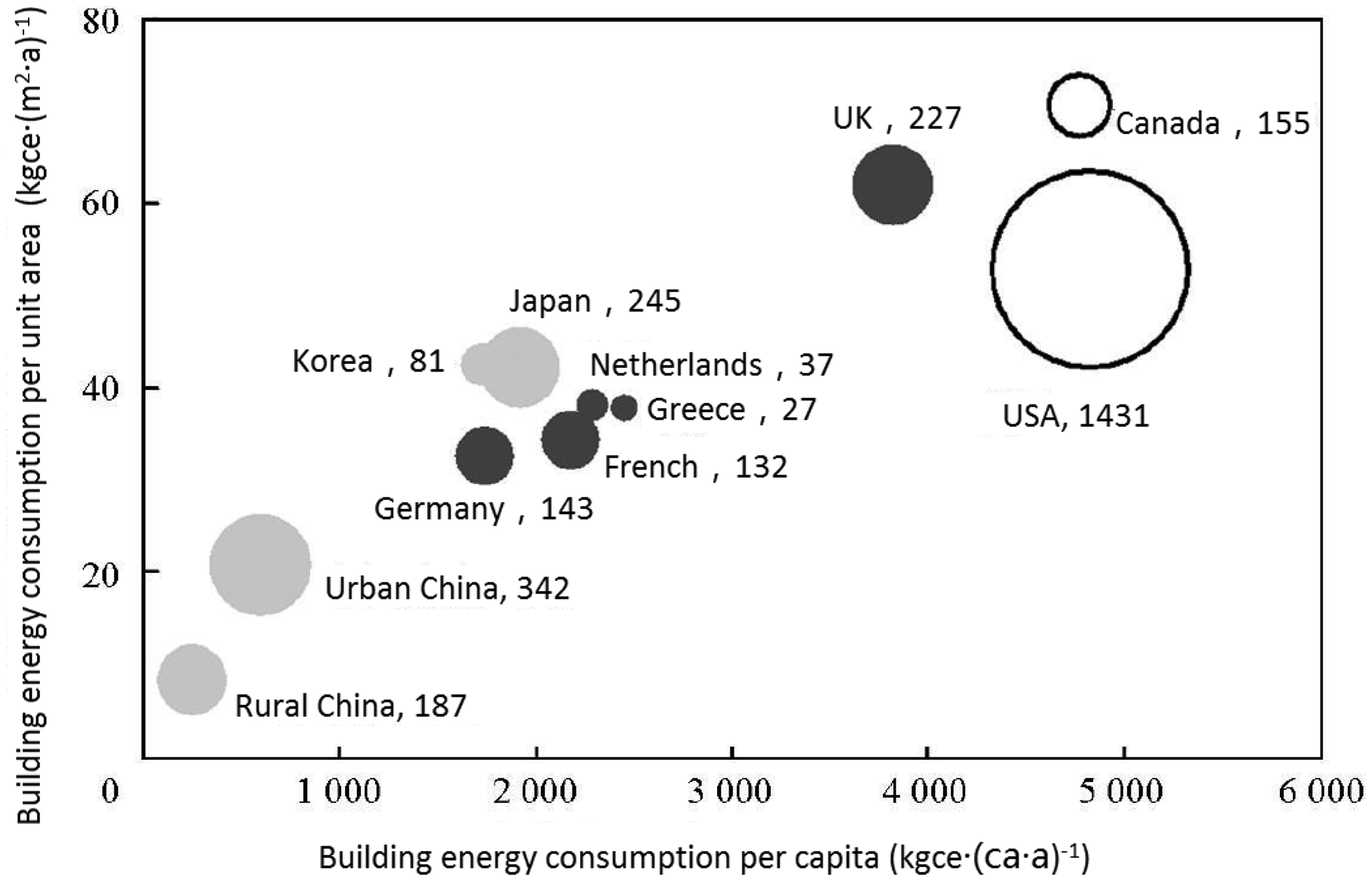
In order to satisfy the improving requirement while maintaining the low level energy consumption in buildings of China, the following measures should be taken in the first priority:
Improving the energy efficiency of existing residential and commercial buildings in Northern China – The energy consumption for heating in North China covers about 40% of the whole building energy consumption in China [19]. Traditionally, boiler is the most commonly used heating system in cold regions. However, boiler is of low energy efficiency as well as high air pollution, which is one of the main sources of particulate matters such as PM2.5 and PM10. Recent investigations show that absorption heat pump technology has a great potential for energy saving in heating, which may play an important role in efficient heating [20–23]. Improving the energy efficiency of large-scale public building – These large-scale public buildings provide primary social service functions in communities. The benefits of improving the large-scale public building’s energy efficiency (especially the government office buildings) are not only related to reducing the operation cost and saving energy but also leading the whole society to pay more attention to energy conservation through demonstration led by the government [24]. Developing new air conditioning system for Yangtze River area – The Yangtze River area is the most populated area in China and the economy is growing much more rapidly there in comparison to other areas. Both heating and air conditioning systems are needed due to the particular climate zone of the region. In recent years, some officials suggest the district heating system which is popular in northern China be installed in this area. If it becomes true, the energy consumption for heating in this area will increase rapidly. Most experts do not think district heating system is a good option for this area. The proper system for both heating in winter and air conditioning in summer should be developed and demonstrated in the future.
From the above analysis, we can see that China’s energy efficiency in buildings should follow its own characteristics and for different regions. However, there is a trend that more and more buildings are adopting the same practices as developed countries, as ASHRAE standards are being used by some institutions. There are several newly built buildings in which many advanced technologies are used in different climate zones. However, the real energy consumption is much higher than the traditional Chinese buildings although they are recognized as energy-efficient buildings by certification of developed countries. As we know, the building energy consumption for 1 billion people in developed countries accounts for about 18% of the global energy, while the building energy consumption for the other 5.7 billion people accounts for only 13% of the global energy [17]. If the other 5.7 billion consume the same energy per capita as the developed countries, the whole global energy supply will not be enough for the building energy consumption in China. Therefore, we must find a new way for the other 5.7 billion people to improve their comfortable requirements and this also applies to other rapidly developing countries, such as India and Brazil. What the Chinese are doing now is trying to use 1/3–1/4 energy of Japanese and European (per capita), or 1/8 energy of US (per capita) demand to maintain an acceptable indoor environment. It is a tough task, but Chinese have no choice. Once a successful way is found, the Chinese experience will benefit the 5.7 billion people; which is not only good news for developing countries but will also contribute towards the energy efficiency practices of developed countries in reducing building energy consumption.
We hope China will succeed.