






Abstract
The anthropogenic developments have been causing a warming phenomenon of city centres called urban heat islands (UHI). The effect is made worse by the urban canopy characteristics of concrete, façade glazing and asphalt surfaces of building and road structures. Buildings would absorb shortwave radiation and store heat during daytime, and release heat into atmosphere at night, thus increasing the ambient temperature. The wide spread use of HVAC air-conditioners in the densely urbanised areas, as well as increasing commercial developments and massive rise in automobile traffics are also important contributing factors, which can lead to formation of ozone and smog. Urban temperatures can be up to 5–12℃ warmer than the surrounding countryside under extreme meteorological conditions of calm and clear anticyclonic weather. High temperatures in cities can exacerbate energy demand for building air conditioning, therefore higher emission of CO2 contributing further to green house warming. There are a number of UHI mitigation strategies including increasing the surface reflectivity and vegetation density in urban areas. This can be achieved by greening the urban environment by planting trees and vegetation; incorporating better roof designs such as cool roofs, greenroofs, reflective roofs and cool pavements. The purpose of this paper is to provide a review of UHI effects in city centres and examine the mitigation strategies and the thermal benefits of greenroofs.
Introduction
The increasing urbanisation of cities has brought with it an increasing trend of rising temperatures caused by anthropological emissions mostly in the urban cities under the urban canopy leading to changes in the ambient atmosphere of land surfaces. The urban heat island (UHI) effect is the cumulative result of the urban impact leading to a rise in temperature within the built environment, resulting in “warm islands” within the city landscape in comparison to rural environments.1–5 There are many environmental and socio-economic consequences to heat island development in urban areas and these are expected to intensify due to global warming.6 Increased daytime temperatures and reduced night time cooling can affect human health and comfort with a possible increase occurrence of respiratory health problems, exhaustion, heat cramps, physiological disruption, heat stroke, organ damage and heat-related mortality.7,8 The UHI phenomenon has been well studied9–12 and is now an important planning consideration for urban sustainability. The previous studies on the urban environment have shown that the UHI were pronounced in some cities reported, which are of comparative intensity.13–16
Anthropogenic heat emission from buildings and road traffics on atmospheric temperature indicated that the amount of heat release was lower at night than during daytime, but air temperature rise was nearly 3 times greater than that during the day.17 The human influence on global warming can take many forms, including the result of human CO2 emissions. What has been well known and established long ago is that urban areas are warmer than rural areas – this human condition on the climate is referred to as the urban heat island effect.4 The robustness of this human effect was confirmed by literature reporting analysis of South Korea's temperatures since 1954.18 The cities with the greatest warming due to urbanisation in Korea were: Daegu, Pohang, Seoul and Incheon with increases of temperature of 1.35℃, 1.17℃, 1.16℃ and 1.10℃, respectively. Chupungnyeong and Mokpo showed less than 0.2℃ urban warming. On average, the total temperature increase over South Korea was about 1.4℃. Temperature increase caused by greenhouse effect was approximately 0.60℃, and the amount caused by urban warming was approximately 0.77℃. South Korea tends to have a humid continental climate and a humid subtropical climate. In Seoul, the average August temperature range is 22℃ to 30℃. Summer can be uncomfortably hot and humid, with temperatures exceeding 30℃ in most parts of the country. So, a rise in temperature in urban areas in the summer can be very uncomfortable for the residents of some major cities.
Anthropogenically generated heat can have an impact on UHI intensity, with its impact being especially strong in winter.19,20 The trends of UHI effects are generally consistent and indicate that rapid urbanisation has a significant influence on surface warming over East Asia.21 Overall, UHI effects can contribute 24.2% to regional average warming trends. The strongest effect of urbanisation on annual mean surface air temperature trends occurs over the metropolis and large city stations, with corresponding contributions of about 44% and 35% to total warming, respectively.22 The rise in ambient temperature could have a potential impact on energy consumption in buildings, and a 1℃ ambient temperature rise could result in an increase of electricity consumption by 9.2%, 3.0% and 2.4% in domestic, commercial and industrial sectors, respectively.23 In addition, other studies on urban air quality, air conditioning energy consumption and heat-related illnesses and mortality have demonstrated the effects of UHI, which contributed to these phenomena and urban symptoms.24–27
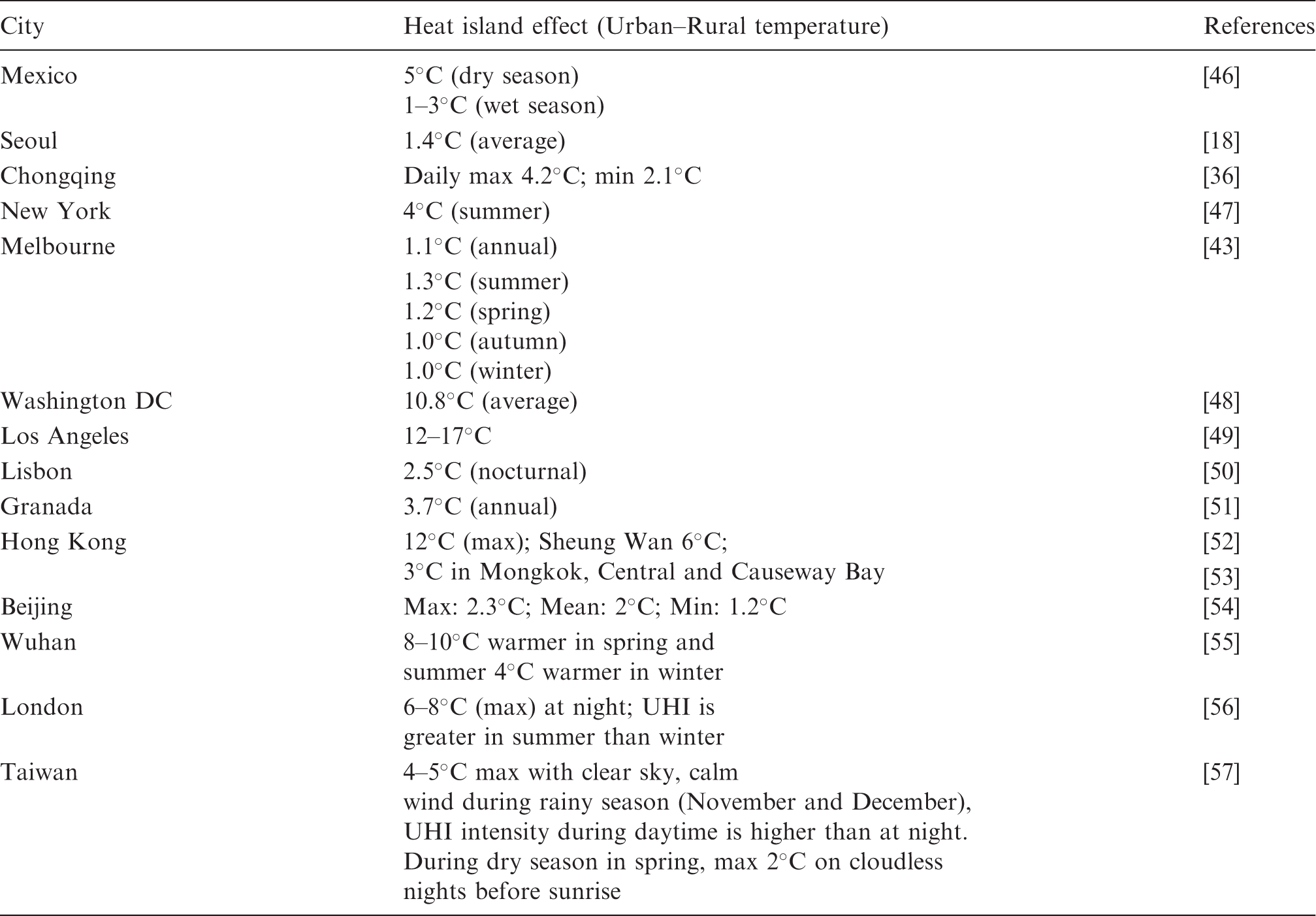
UHI of some major cities reported in literature.
The rapid development of urban environment has reduced the land surfaces of green spaces and water bodies. The loss of green spaces can have a major impact on the warming of urban areas. This paper provides a review on the mitigation strategies including increasing the surface reflectivity and vegetation density in urban areas. This can be achieved by greening the urban environment by planting trees and vegetation; incorporating better roof designs such as cool roofs, greenroofs, reflective roofs and coolpavements. The purpose of this paper is to provide a review of UHI effects in city centres and examine the mitigation strategies and the thermal benefits of greenroofs.
Factors affecting UHI
The main causes of UHI phenomenon are due to the canopy characteristics of urban construction and anthropogenic heat emissions. Urban surfaces are usually consisted of impermeable roads made from concrete and asphalt, which has deep dark colour, with large thermal capacity and high thermal conductivity rates. Consequently these surfaces would absorb solar radiation. Buildings would store heat during daytime by absorbing shortwave radiation and, then, release the heat into the atmosphere at night, increasing the ambient atmospheric temperature.35,44,58 In addition, the sizes of buildings and streets could have an important impact on UHI effect and the thermal environment of the surrounding area.34,59,60 Bretz61 estimated that 20% of the roofs and roads in Sacramento, California are made of asphalt; and if a high solar reflective material is incorporated for these surfaces instead of the normal asphalt, an increase of total solar reflective rate in the urban area by 18% could be achieved, which could lead to mitigation of energy consumption, reducing the UHI effect and improving urban thermal comfort.39
Water body could relieve urban thermal environment, and the effect can be further enhanced by vegetation. The primary characteristic of water bodies for the urban climate is in its influence on the transformation of sensible and latent heat fluxes. On the one hand, the high heat capacity produces the “thermostat effects” of water bodies in comparison to surrounding building materials.62 On the other hand, the high evaporation leads to obvious “cooling effects” of water bodies and plays an important role in reducing surrounding surface air temperature.2 Ishii Akio measured the influence of a 127,000 m2 reservoir on surrounding thermal environment, and found that when fully stored with water, the temperature of the reservoir water surface was 3℃ lower than that of a nearby road.63 Urbanisation has an effect on temperatures in cities. But as well as a temperature increase, urban areas also have an effect on other climatological parameters such as wind flow in urban street canyons or wind corridors.4,38–41
Increase of green areas is an ecological measure to combat UHI effects. Vegetation can absorb solar radiation, which is converted into energy through transpiration and photosynthesis.64 Therefore, the sensible heat flux is consequently lower.65 Besides, vegetation is able to cool and humidify the thermal environment,66 with the direct shading and evapotranspiration.67 Hamada found that shading effects and evapotranspiration of trees that control temperature in the daytime can produce a difference of temperature between the grass area and the urban area.68 Such phenomenon is used in the sustainable urban development of buildings, incorporating green roofs.69 The cooling effect is particularly beneficial in urban city with hot summer climate suffering from UHI effects such as in Chongqing.36 Urban canopies can also have an effect on wind flow and pollution/heat dispersion within an urban environment such as street canyon and re-entrance space.38,70 Vegetation and moisture will have a significant effect on the microclimate of the two sample sites. Any surface planted with vegetation has a different Bowen ratio than a mineral surface since a large proportion of net radiation is converted into energy for evapotranspiration and photosynthesis.71 Urban parks or forests can contribute to form Park Cool Islands (PCI) within cities. These green parks have a lower air and surface temperature and can produce a reported cooling of 5–7℃ in California, USA72 and in Mexico City a cooling of 2–3℃ compared to the adjacent built-up areas.73
UHI effect is influenced not only by different canopy characters, but also by anthropogenic heat emissions. An investigation on the influence of anthropogenic heat emission on atmospheric temperature indicated that the amount of heat release was lower at night than during daytime, but air temperature rise was nearly 3 times greater than that during the day.17 Fung estimated the potential impact of ambient temperature rise on energy consumption in Hong Kong, and the results showed that a 1℃ ambient temperature rise would result in an increase of electricity consumption by 9.2%, 3.0% and 2.4% in domestic, commercial and industrial sectors, respectively.22 In addition, other studies on urban air quality, air conditioning energy consumption and heat-related illness and mortality have demonstrated the effects of UHI which contributed to these phenomena and urban symptoms.23–26 The effects of anthropogenic heat on the urban heat islands are at its strongest during the winter due to high energy use and low amounts of shortwave radiation19; Ichinose (1999) reported that by reducing hot water supply and space cooling by 50% and 100%, the near surface temperature could be reduced by 0.5℃.
The urban heat island can be distinguished in three types and separated by 2 distinct layers:44
the canopy-layer heat island the boundary-layer heat island and the surface heat island.
The urban canopy layer is measured between the ground and up to the mean roof level like a vegetative canopy layer.44 This layer includes the roughness elements and is where the engineered environment has the most pronounced effect.4 This layer is also controlled by microscale, site-specific characteristics.4 The boundary layer is situated above the canopy layer with the lower boundary layer being influenced by the presence of the city beneath and mesoscale phenomena.44 It is also affected by processes operating at larger spatial and temporal scales.44 The surface heat island occurs on hot, sunny days and is caused by the temperature of exposed urban surfaces becoming higher than that of the air temperature. On average the difference between urban and rural surface daytime temperatures is 10–15℃.7 This is usually characterised by the use of airborne or satellite thermal infrared remote sensing.74
Wind flow within city centres and in dense urban areas can be seriously reduced by various building constructions and street canyons. Effective urban planning incorporating suitable wind channels or corridor in street canyons could contribute to lowering of UHI in urban areas. The intensity and occurrence of the UHI can be reduced under windy and cloudy conditions when the air is well mixed and local temperature differences could be removed by the air flow.44 By contrast, low wind speeds with little or no cloud cover can be associated with occurrence of the UHI high intensities.43 Low and thick strata clouds would generate strong downward long wave radiation flux, and these are associated with windy conditions; and can effectively limit UHI development in comparison to equal amounts of high, thin cirrus clouds.2
UHI is affected by the following factors:
Urban geometry, structures or canopies Green spaces and vegetation Presence of water bodies, e.g. lake, river or by the sea Anthropogenic heat generation, e.g. from motor vehicles, heat exhausts from HVAC systems, heat leakages from buildings, industries, power plants, etc. Air pollutants; e.g. suspended particles aerosol, O3 and smog in urban ambient air can absorb and re-radiate heat; inhibiting long-wave radiation at night and therefore cooling in urban areas75 Population growth Climatic conditions, e.g. wind and cloudy overcast Seasons and time (day or night).
Oke76,44 found positive correlation between UHI and population and city sizes, which have a corresponding effect on traffics, buildings and industrial productions. Although cities with a large population would tend to have higher proportion of high rise buildings with various building design and geometries, density, sky view factor, material, etc.; these could contribute to UHI but these variables are not always population dependent, therefore others have found contradictory results with a smaller city having higher UHI value comparing to the more populous one.77 Oke76 and Torok et al.78 showed that even towns with populations of 1000 people could have urban rise of temperature of about 2.2℃ compared to the nearby rural countryside. Oke76 found evidence that the UHI would increase according to Equation (1):
UHI is not a constant condition but fluctuates in strength during a day and typically being strongest at night. In mid-latitude maritime areas, seasonal variation in the heat island effect is expected; the greatest UHI intensity occurs in the warmer seasons especially during summer due to frequent anticyclonic weather.43,44 Typically winter would produce the least intense UHI.43,44 The strongest heat islands develop under calm and clear weather typical of anticyclonic (high atmospheric pressure) conditions and least under windy and cloudy weather typical of cyclonic (depression or low pressure) conditions.43,79,80 Anticyclonic weather conditions would provide the ideal conditions for heat island development as the solar radiation would not be undisturbed by the wind and therefore enhancing the outgoing long-wave radiation.81
Mitigation strategies of UHI
This can be achieved in several ways, including planting trees and vegetation, better roof designs such as cool roofs, green roofs, reflective roofs and cool pavements.47,75,82 Examples of other strategies include reducing anthropogenic heat release and optimising the sky view factor in new developments.75 Controls over the urban heat island have been extensively studied.2 Urban heat islands are generated by factors which can be categorised as controllable and uncontrollable.75 However, as each city is unique and has its own characteristics and climate conditions; therefore there is no general rule as to which parameters would be most important in the influence and control of UHI formation.
Greenroofs
Urban heat islands develop when naturally vegetated surfaces which trap moisture and reduce heat due to evapotranspiration are replaced with non-reflective, water-resistant impervious surfaces that absorb a high percentage of incoming solar radiation.20,79 There are a number of UHI mitigation strategies but the two which are commonly researched and employed are increasing the surface reflectivity (albedo) and increasing the vegetation density in urban areas such as in greenroofs.47,75,82
Greenroofs69 are also known as roof gardens, vegetated roofs, living roofs or eco-roofs. These roofs are incorporated with vegetation forming part of the integral roof design, which can be anything from a roof-top garden with planted flowers, shrubs, grassy swards to patches of mosses and lichens. A green roof can consist of a multilayer system including: a vegetation top layer, soil or a suitable substrate, drainage, protection, waterproofing and insulation layers. There are two types of green roofs, although some buildings have a combination of both in the roofing system:
Extensive greenroofs – typically comprise of a 25–125 mm thick soil layer supporting a variety of drought-tolerant, low and hardy plants covering the entire roof area. Intensive greenroofs – usually are landscaped gardens with deep soil to support trees, plantains and shrubs. Sometimes, water features and storage of rainwater or water harvesting system can also be incorporated.
The vegetation layer can provide protection for the roof and would reduce ageing caused by temperature stresses of summer and winter exposures, and degradation by ultraviolet radiation of sunlight and varying ozone intensity of urban environments. The waterproofing layer would be protected from direct physical stresses of hail, rain and wind as well as wear and tear caused by people walking on roofs.
Greenroofs can save energy for heating and cooling of buildings7 due to their substantial thermal mass and added insulation value. When wet, greenroofs absorb and store large amounts of heat and when dry, the insulation layer of the greenroof would reduce the energy demand for cooling by reducing the heat flow through the roof.7 Therefore less heat would be lost through the building in winter and reducing the ambient roof surface air temperature in the summer, and thus saving energy for cooling.7 An energy saving of 37–48% is possible if a previously non-insulated roof is refurbished to become a greenroof and 4–7% when a moderately insulated roof is upgraded and up to 2% with a well-insulated roof. The indoor thermal comfort conditions with a green roof could be improved by 2℃.7 The advantages of incorporating a greenroof to a building design in an urban area are as follows:
Can moderate internal temperatures within buildings. It provides a heat shield for the roofing system and cools the building by transpiration which is a comfort advantage particularly during hot summers. Can provide good thermal insulation, reduce noise reflection up to 3 dB and improve sound insulation up to 8 dB. Can provide an effective shield to electromagnetic transmission. Can attenuate storm water runoffs by intercepting and retaining rainwater during an early part of a storm, reducing the maximum runoff rate, resulting in reduced pressure on surface water drainage systems. Can retain water in the drainage and substrate layer which would be evaporated later over the surface and cools the ambient urban air. Can reduce ambient temperature by evaporative cooling. The water absorbed by plants through photosynthesis and transpiration, would be released as vapour back into the atmosphere, and thus cools the ambient air. A water retention capacity of between 18% and 50%. In addition the aggregates used on roofs can also absorb and retain water. A total retention capacity of 40–100% of rainwater by various types of green roofs, depending on seasons, is possible. The volume of water that is stored on a green roof and evaporated back into the atmosphere is dependent on the vegetation medium, its depth and the type of plants used. In summer, green roofs can typically retain 70–80% of rainfall whereas in winter they retain approximately 25–40%. Would enhance bio-diversity value providing resting niches for birds and small animals and also provide amenity value to a building development, thus adding interest and social and environmental benefits as well as economic benefits to a building. Can reduce air pollution – a total of approximately 1675 kg of air pollutants can be removed by 19.8 ha of green roofs in one year in Chicago.83 Of this total, O3 accounted for 52%, NO2 for 27%, PM10 for 14% and SO2 for 7%. And if all rooftops in Chicago were covered with intensive green roofs, 2046.89 metric tons of pollutants could be removed. Can reduce energy use and reduce CO2 emissions.
UHI mitigation by greenroofs
A maximum surface temperature reduction of 30℃ measured under the vegetation was possible when incorporating a greenroof to a building.84 The cooling effect by the plants could reduce ambient air temperature by a maximum of 4.2℃. When a non-insulated building is upgraded to include a greenroof, the surface temperature of the extensive greenroofs could range between 28℃ and 40℃ compared to the 42–48℃ of the bare roof.85 A surface temperature reduction of 10℃ was due to the extensive green roof.
Roth et al.86 showed there could be a correlation between the ambient air temperature and roof surface temperature thus illustrating the impact of extensive green roofs on ambient air temperature. Fang87 evaluated the thermal reduction effect of green roofs. Other studies had also illustrated the potential of extensive green roofs as a passive cooling system for improving indoor thermal comfort of occupants in the building.88–91 Rashid et al.92 reported the thermal performance of a greenroof with a reduction of indoor air temperature illustrating cooling energy potential of greenroofs. The maximum indoor air temperature could be reduced by 4.5℃ by incorporating a greenroof to a building, a maximum reduction was observed in peak heating period and minimum in off sunshine period. Also the temperature fluctuation is low for greenroofs as compared to bare roof.
Conclusion
Urban heat island effects are important consideration in city planning and there is a need to review these effects for major cities with high population and building densities to develop effective strategies for their mitigation. Greenroofs can reduce the effects of urban canopies that are contributing to the UHI in cities centres, as well as to provide cooling of the ambient environment and building surfaces to effectively reduce UHI effects; and according to literature a maximum surface temperature reduction of 10℃ and ambient temperature reduction of over 4℃ are possible. Incorporation of greenroofs would provide benefits to urban residents and the much needed greenspace for effective relieve of thermal stresses in the urban environment as well as enhancing the social and amenity value of urban structures.
Footnotes
Acknowledgements
This work was supported by the National Research Foundation of Korea (NRF) grant funded by the Korea government (MEST) (No. 2012-0000609).