







Abstract
Natural radioactivity level, radon exhalation rate and radiation hazard of fly ash used as building materials in Xiangyang, China were determined. The activity concentrations of 226Ra, 232Th and 40K in the investigated fly ash samples range from 90.3 to 1799.4, 59.9 to 145.6 and 309.0 to 906.3 Bq kg−1 with an average of 440.5, 110.3 and 510.1 Bq kg−1, respectively. 226Ra and 40K are the main contributors of total activity concentration in red fly ash and grey fly ash, respectively. Radon exhalation rates of the studied fly ash samples vary from 4.7 to 74.2 Bq m−2 h−1 with the mean of 21.1 Bq m−2 h−1. The relative hazard indexes, i.e. radium equivalent activity, external hazard index, internal hazard index, indoor air absorbed dose rate and annual effective dose, indoor radon exposure dose, outdoor air absorbed dose rate and annual effective dose were calculated to assess the radiation hazard of fly ash when it was used as building materials or piled on the ground. The assessment results show that the studied fly ashes would cause excessive radiation risks to inhabitant and they are not suitable to use as building material. The ash storage pond is a high radiation risk area and the population living around ash pond would be exposed to higher radiation.
Introduction
Coal, an important fossil fuel, contains trace quantities of the primary radionuclides and their decay products, particularly 40K and the decay series headed by 232Th and 238U. These natural radionuclides would enter into the combustion products of coal. Coal is a technologically important material used for power generation. The increasing demand for electricity generation for industrial development and human living standards worldwide is met by combustion of fossil fuels. 1 China depends largely on coal for her energy needs, contributing more than 70% for the total power generation. 2 Coal, burned as fuel material in power plants, produces energy and a large amount of solid waste, i.e. coal ash. Fly ash particles, entrained up the stack in the flue gas stream, have a greater tendency to absorb trace elements such as natural radionuclides during combustion owing to their relatively small size and large surface area.3–6 So, the natural radionuclides may be concentrated in fly ash after coal combustion in a thermal power plant.7–9 Fly ash from coal-fired power plants is spread and distributed in surrounding area by air and may be deposited on the soil surface, thus may increase the radioactivity level of local environment.3,4 Since fly ash contains elevated natural radionuclides compared to raw coal, therefore fly ash is considered as a potential source of radiation exposure to man. Natural radionuclides in fly ashes may pose radiation risks externally due to their gamma-ray emissions and internally due to radon and its progeny that emit alpha particles1,3,4,10 when fly ashes used in building materials or piled on the ground.
Radon, a naturally occurring odourless and colourless α-emitting radioactive noble gas, has three isotopes, i.e. 222R, 220Rn and 219Rn, of which half-lives are 3.82 days, 55.6 and 3.96 s, respectively.11,12 Amongst the three isotopes, 222Rn has the most significant impact on the environment due to its relatively long half-life, enabling it to migrate quite significant distances within the geological environment before decaying. 222Rn is a radioactive extremely inert gas which is derived from the radioactive decay of radium (226Ra), a decay element in 238U series. 222Rn, as an emitter of α-particles with energy 5.48 MeV, is the most crucial and dangerous radioactive gaseous element in the science of environmental radioactivity,13,14 which constitutes the most important natural source of radiation in the environment. 222Rn and its progeny are present in all dwellings, because 226Ra is inherently present in building materials as well as in the soil.14–16 Indoor 222Rn has been recognized as one of the health hazard for mankind. Building materials used for construction of houses are considered as major sources of indoor 222Rn, 10 and thus is important to understand the generation and migration process of radon from building materials, as radon can contribute to 55% of total radiation dose received by the population from the environment. 10
Fly ash is widely used in building materials, e.g. in the production of brick, cement and concrete, and as underground cavity filling material. Therefore, fly ash is of considerable economic and environmental importance. There have been increasing concerns regarding the environmental radioactivity of fly ash during past decades. A large amount of researches on natural radioactivity level and radon exhalation rate have been done all over the world.1,3,4,7,17–23 The relative work in China, however, is limited,2,6 especially the radon exhalation rate of fly ash. In China, coals used in coal-fired power plants are found to have high ash contents, resulting in the production of large amount of fly ashes. In the present work, natural radioactivity, radon exhalation rate and associated radiation hazard of fly ash used in Xiangyang, China have been determined. The results could offer the basic information for safety procedure and disposal of fly ash.
Materials and methods
Sample collection and preparation
Xiangyang, the second biggest city of Hubei province, is located at the northwest of Hubei province (31°54′–32°10′N and 112°00′–112°14′E), with a population of approximately 5.5 million. Seventeen grey fly ash (GFA) samples (numbered GFA1 to GFA17) and seven red fly ash (RFA) samples (numbered RFA1 to RFA7) were collected from brick factories and ash storage ponds of Xiangyang in 2013 and 2014. All collected samples were kept in cleaned and numbered polyethylene bags.
Each sample was homogenized and dried in an oven at 105℃ for 12 h to remove moisture. The dried samples were weighed and sealed in gas-tight, radon impermeable, cylindrical polyethylene containers (7.0 cm height and 6.5 cm diameter). These samples were then left for 4–5 weeks to allow for radium, thorium and their short-lived progenies to reach radioactive equilibrium.5,24
Radioactivity measurement
The activity concentration of 226Ra, 232Th and 40K in fly ash samples was determined using a high-resolution gamma-ray spectrometric system (ORTEC, USA) with a p-type coaxial HPGe detector with a relative efficiency of 50% and an energy resolution of 1.9 keV at 1332.5 keV of 60Co. The detector is maintained in a vertical position in a lead cylindrical shield of 12 cm thickness and 65 cm height to reduce background radiation and kept cool by electric refrigeration system. The detector was coupled to an 8192 multi-channel pulse height analyser and the system was calibrated for the gamma energy range of 40 keV to 10 MeV. The absolute efficiency calibration of the gamma spectrometer was determined using a solid nuclide mixture of gamma reference materials sealed in standard cylindrical polyethylene containers (7.0 cm height and 6.5 cm diameter).
The activity of 232Th was determined by 338.5, 911.1 and 968.9 keV gamma rays emitted from 228Ac and by 583.19 and 860.56 keV from 208Tl, respectively. The activity of 226Ra was measured by 609.4 and 1120.4 keV gamma rays emitted from 214Bi and by 295.21 and 351.92 keV from 214Pb, whereas 40K activity was measured directly through its gamma ray energy peak of 1460.8 keV.25,26 The standard sources for 226Ra and 232Th (in secular equilibrium with 228Th) were prepared using known activity contents and mixing with the matrix material of phthalic acid powder. Analar grade potassium chloride (KCl) of a known amount of the same geometry was used as the standard source of 40K. 24 Each sample was counted for 28,800 s.27,28 Background measurements were taken under the same conditions of sample measurements. The uncertainties of measurements for three radionuclides are all less than 10%.
Radon exhalation rate measurement
The radon exhalation rates of fly ash samples were measured with electrostatic radon sampler-2 (ERS-2) (Tracerlab company, Germany), which is an active and electrostatic monitor equipped with an accumulation chamber and a solid-state alpha detector to measure the radon from materials. The ERS-2 operates with an alpha spectroscopy detector and multi-channel analyser with 256 channels. For determination of radon exhalation rate, ERS-2 was placed on the surface of the measured sample with silicone-sealing ring to avoid air leakage. Then the diffusion mode operation was selected and high voltage was turned on to reach the stable HV 500. Each sample was counted for 6000 s and radon exhalation rate (Bq m−2 h−1) in fly ash was calculated using ERSEval software.27,29
Results and discussion
Specific activity
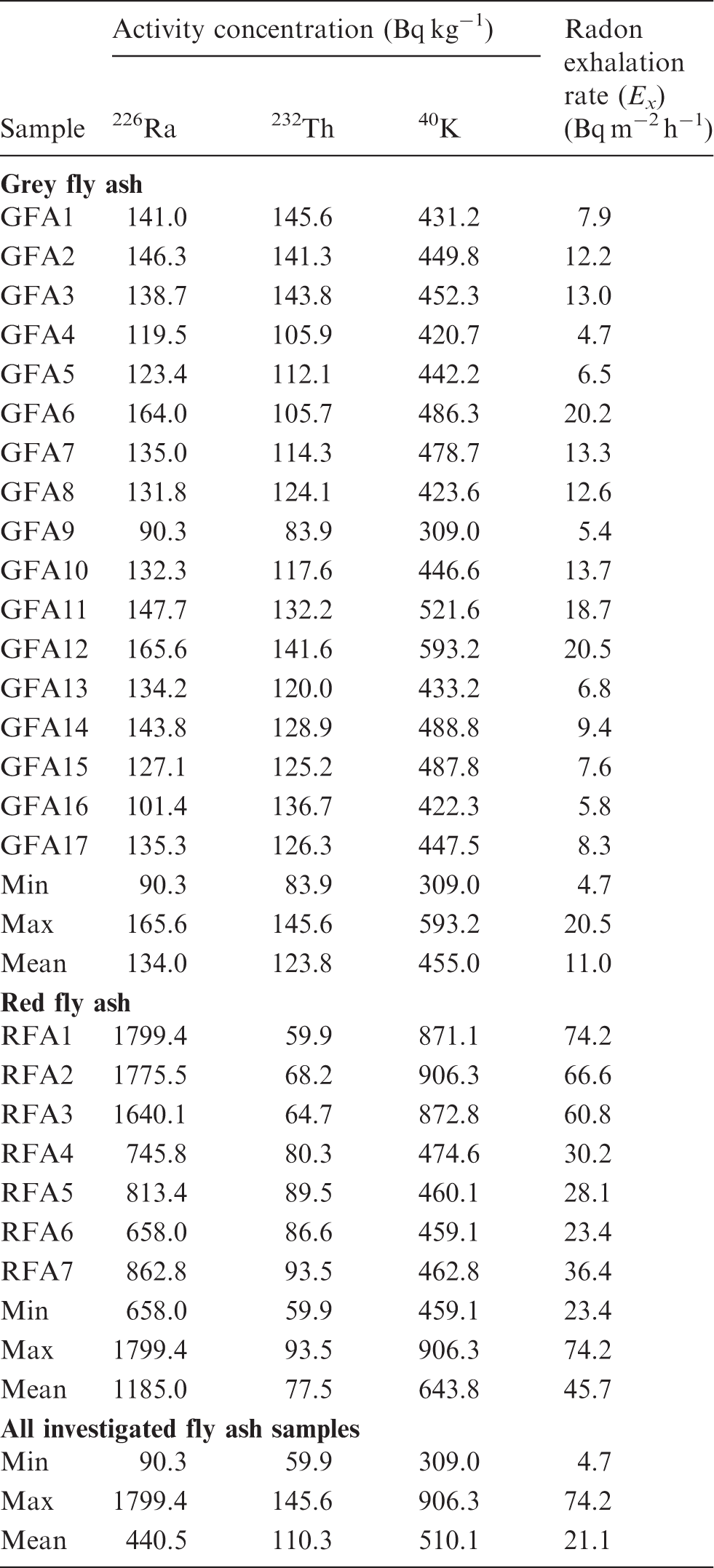
The activity concentrations of 226Ra, 232Th and 40K in the investigated fly ash samples are given in Table 1. As shown in Table 1, the concentrations of 226Ra, 232Th and 40K in GFA samples range from 90.3 to 165.6, 83.9 to 145.6 and 309.0 to 593.2 Bq kg−1 with an average of 134.0, 123.8 and 455.0 Bq kg−1, respectively; while in RFA samples, these radionuclides range from 658.0 to 1799.4, 59.9 to 93.5 and 459.1 to 906.3 Bq kg−1 with an average of 1185.0, 77.5 and 643.8 Bq kg−1, respectively. The concentrations of 226Ra, 232Th and 40K occupy the total activity of 15.4–21.7%, 14.0–20.7% and 60.1–65.7% in GFA samples, respectively, 59.2–65.9%, 2.2–6.6% and 31.9–34.9% in RFA samples, respectively (Figure 1), which indicate that the specific activity due to 40K is the largest contributor to the total activity for GFA samples and 226Ra is the largest contributor to the total activity for RFA samples. The concentrations of 226Ra and 40K in RFA samples are significantly higher than those in GFA samples, while 232Th concentrations in RFA samples are lower than those in GFA samples. The concentrations of 226Ra in all RFA samples are 3.7–10.0 times the typical activity concentration of 226Ra in fly ash (180 Bq kg−1) of European Union countries,
30
while in all GFA samples, the concentrations are less than the typical value given by the European Union. The mean concentration of 226Ra in RFA samples is also larger than the maximum activity concentration of 226Ra in fly ash (1100 Bq kg−1) of European Union countries.
30
The concentrations of 232Th in all RFA samples are lower than, while in most GFA samples (94%) are larger than, the typical activity concentration of 232Th in fly ash (100 Bq kg−1) of European Union countries.
30
The concentrations of 232Th in all samples are lower than the maximum activity concentration of 232Th in fly ash (300 Bq kg−1) of European Union countries.
30
The concentrations of 40K in all GFA samples and four RFA samples (57%) are lower than the typical activity concentration of 40K in fly ash (650 Bq kg−1) of European Union countries.
30
Relative contributor of 226Ra, 232Th and 40K to the total activity concentration. Activity concentrations of 226Ra, 232Th and 40K in fly ash samples and radon exhalation rate.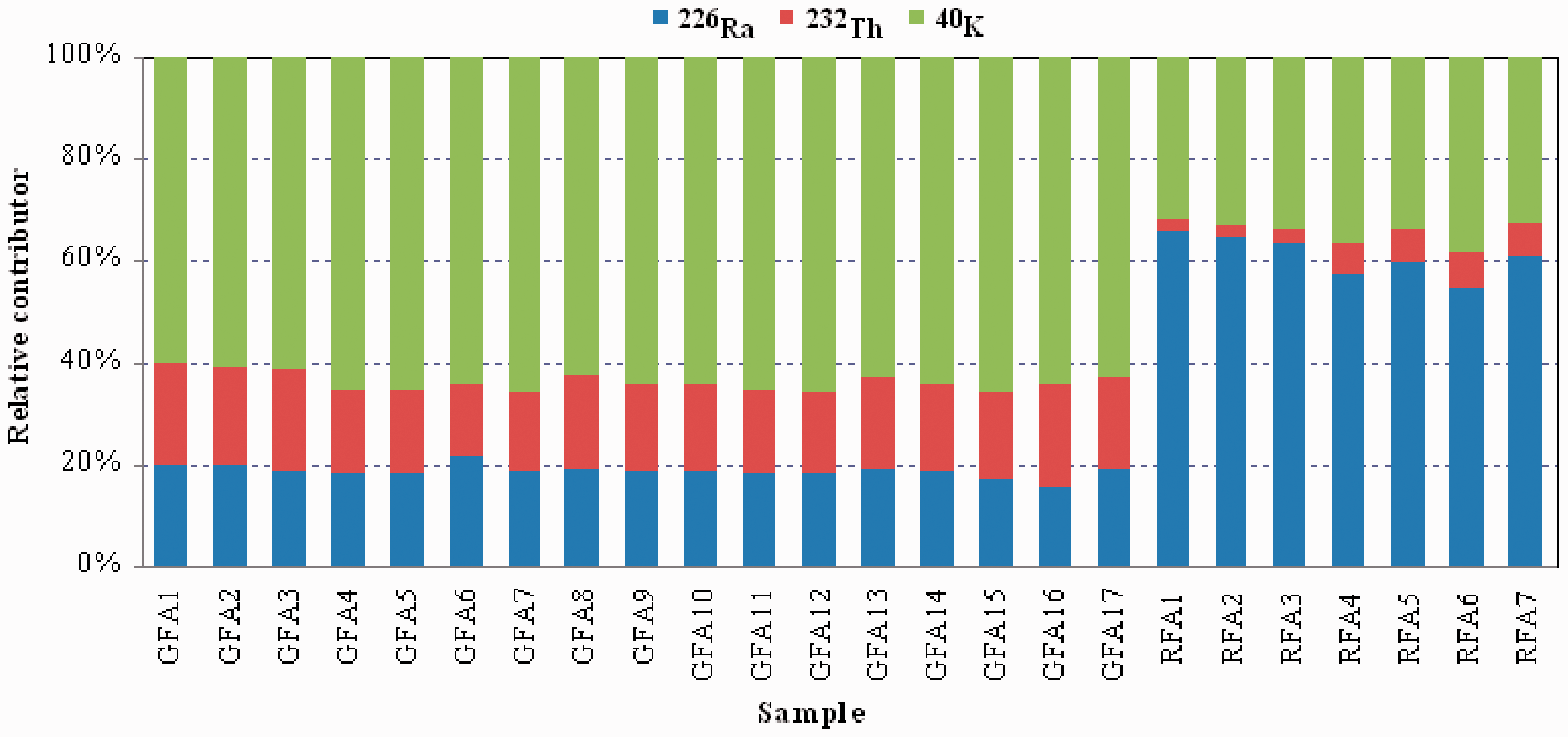
Compared to the natural radioactivity of local soil, the concentrations of 226Ra and 232Th in GFA and RFA samples are significantly higher than in Xiangyang soil (31.3 and 56.5 Bq kg−1 for 226Ra and 232Th, respectively), 31 while 40K concentrations in two types of fly ash samples are lower than found in Xiangyang soil (675.0 Bq kg−1). 31 When fly ash was added to soil with 1:1 ratio to produce brick, the radioactivity concentrations of 226Ra and 232Th in the products produced by using GFA and soil were higher than bricks produced by just using soil by 164% and 60%, respectively. The radioactivities of 226Ra, 232Th as well as the total activity in the products manufactured by using RFA and soil were 1843%, 19% and 75%, respectively, higher compared to the bricks produced just by soil.
Comparison of mean activity concentrations of radionuclides (226Ra, 232Th and 40K) in fly ash of Xiangyang CFPP with other CFPPs (arithmetic mean values are given in parentheses).
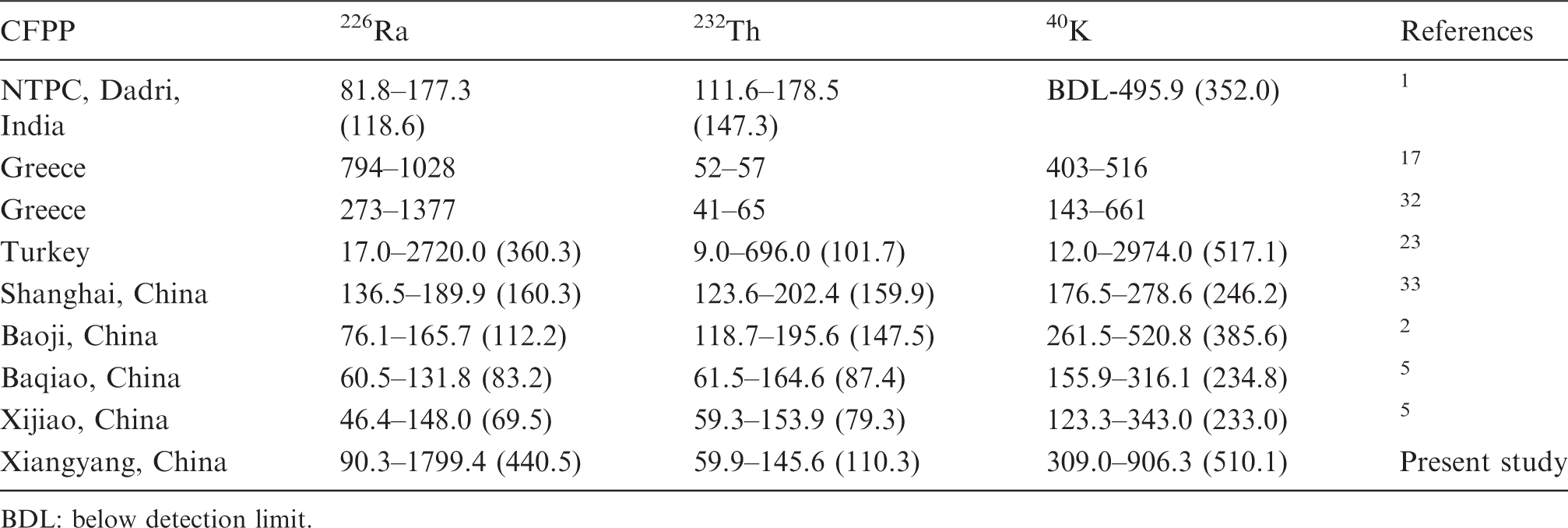
BDL: below detection limit.
Radon exhalation rate
Radon exhalation rates of all analysed fly ash samples are shown in Table 1. Table 1 shows that the radon exhalation rate values of RFA samples are higher than GFA samples. The radon exhalation rate values in all investigated fly ash samples, ranging from 4.7 to 74.2 Bq m−2 h−1 with an average of 21.1 Bq m−2 h−1, are lower than the world average value of 57.6 Bq m−2 h−1 for soil
10
except for three RFA samples (RFA1, RFA2 and RFA3). The radon exhalation rate values in fly ash samples from Xiangyang are higher than those in fly ash samples from NTPC Dadri (U.P.) India ranging from 0.08 to 0.24 Bq m−2 h−1 with a mean of 0.16 Bq m−2 h−1.
1
Figure 2 shows there is a positive correlation (R2 = 0.9497) between radon exhalation rate and 226Ra concentration in the analysed fly ash samples.
Relationship between radon exhalation rate and 226Ra concentration in fly ash samples.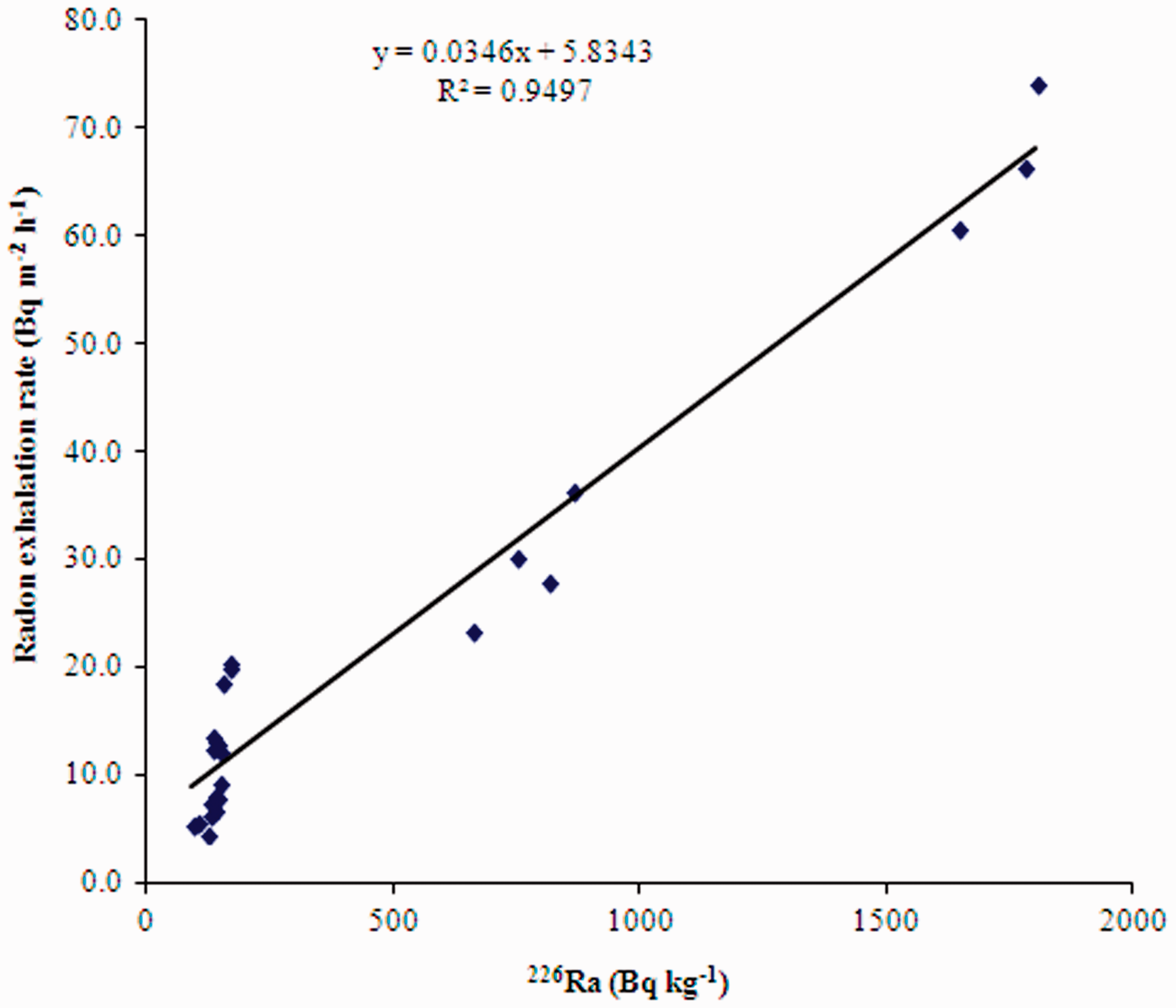
Assessment of radiation hazard
Fly ash is widely used in manufacturing cement, brick, concrete or for filling the underground cavities, construction of road/rail embankments and reinforced earth walls, mine filling and agriculture, etc.18,22,34 To assess the radiological hazard of fly ash used in building materials or piled on the ground, radium equivalent activity (Raeq), external hazard index (Hex), internal hazard index (Hin), indoor air absorbed dose rate (Din) and annual effective dose (AEDin), indoor radon exposure dose (ERn), outdoor air absorbed dose rate (Dout) and annual effective dose (AEDout) were calculated in this study.
Radium equivalent activity

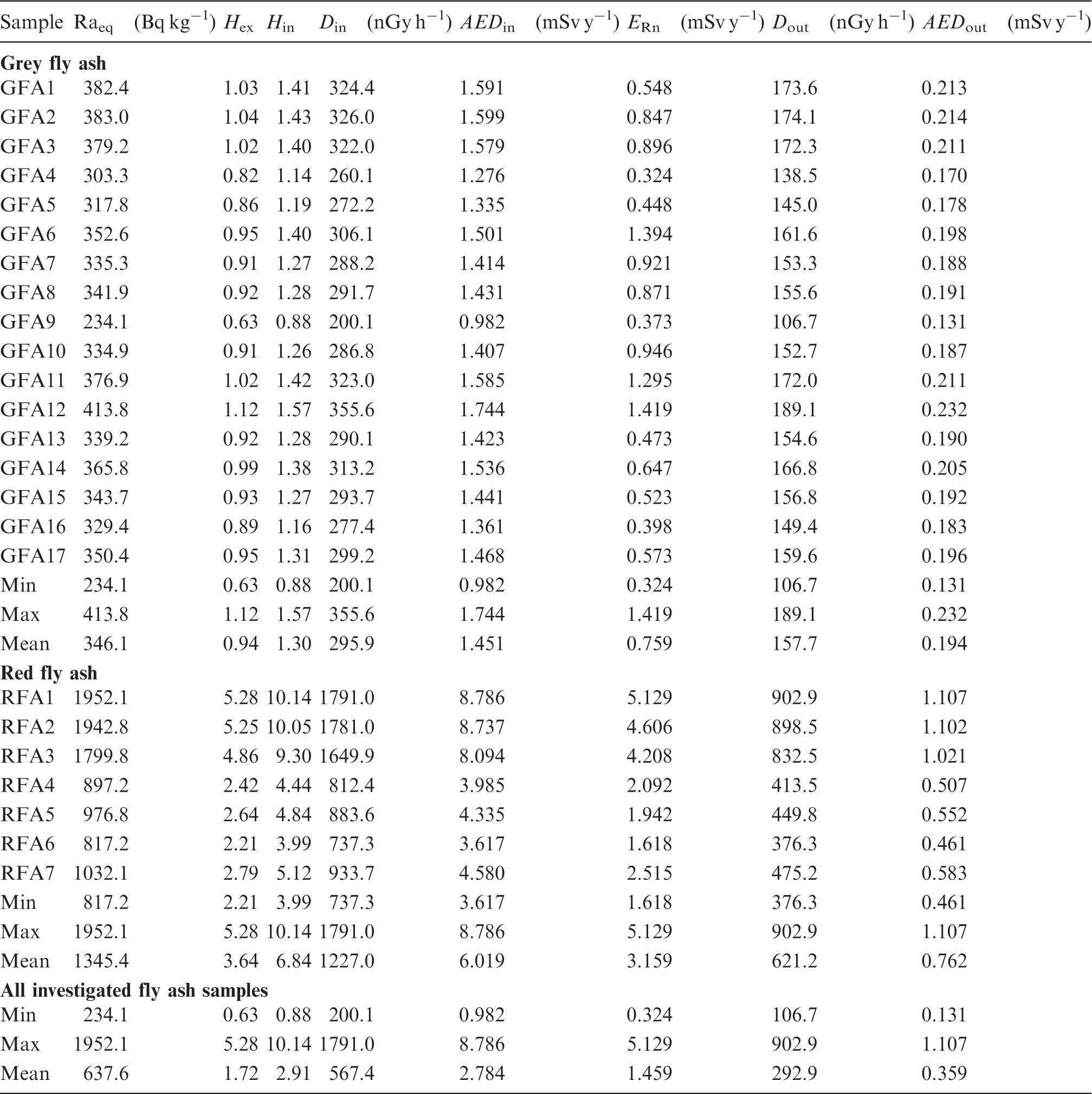
Radium equivalent activity (Raeq), external hazard index (Hex), internal hazard index (Hin), indoor air absorbed dose rate (Din), indoor annual effective dose (AEDin), indoor radon exposure dose (ERn), outdoor air absorbed dose rate (Dout) and outdoor annual effective dose (AEDout) for fly ash samples.
External and internal hazard indexes
To limit the external gamma radiation dose to 1.5 mSv y−1, the external hazard index (Hex) is defined by equation (2).
35

In addition to the external hazard, radon and its short-lived products are also hazardous to the respiratory organs. The internal exposure to radon and its daughter products is quantified by the internal hazard index (Hin) which is defined by equation (3).
35

Indoor external exposure due to gamma radiation
According to the report of European Commission,
30
the indoor air absorbed dose rate (Din) due to gamma ray emission from the natural radionuclides in the fly ash is defined by equation (4).

Indoor internal exposure due to radon
The risk of lung cancer from domestic exposure due to radon and its daughters can be estimated directly from the indoor inhalation exposure effective dose. The contribution of indoor radon concentration from fly ash samples can be calculated using equation (5).1,3,4


A working level month (WLM) is the exposure to the radon short-lived decay products in equilibrium with a concentration of 3700 Bq m−3 of 222Rn during a working month (170 h). 1 Equilibrium factor F quantifies the state of equilibrium between radon and its daughters, taken as 0.4 as suggested by UNSCEAR. 10 From radon exposure, the effective dose equivalents are estimated by using a DCF of 3.88 mSv (WLM)−1.1,37 Table 3 shows that the indoor internal exposure effective dose (ERn) due to radon emitted from fly ash ranges from 0.324 to 5.129 mSv y−1 with an average of 1.459 mSv y−1.
Outdoor external exposure due to gamma radiation
An attempt was made in the present work to evaluate the gamma radiation from the ash pond. Conversion factors were used to transform specific activities, CRa, CTh and CK of 226Ra, 232Th and 40K, respectively, in the air. The absorbed dose rate at 1 m above the ground (nGy h−1 per Bq kg−1) was calculated by using equation (7).
38

The calculated results show that the outdoor air absorbed dose rate (Dout) ranges from 106.7 to 902.9 nGy h−1 with an average of 292.9 nGy h−1 (Table 3), which are significantly higher than the population-weighted average value of the global primordial radiation of 59 nGy h−1. 10 The average natural gamma radiation dose rate of China (62.0 nGy h−1) 10 and the average natural gamma radiation dose rate of Xiangyang (64 nGy h−1). 36 The corresponding annual effective dose rate (AEDout), considering the conversion coefficient from gamma absorbed dose in air to effective dose (0.7 Sv Gy−1) and outdoor occupancy factor (0.2) proposed by UNSCEAR, 10 ranges from 0.131 to 1.107 mSv y−1 with an average of 0.359 mSv y−1 for the studied fly ash samples (Table 3), which exceed the worldwide average (0.07 mSv y−1) for the outdoor annual effective dose rate 10 and the mean Xiangyang outdoor annual effective dose rate of 0.078 mSv y−1.
Conclusion
Comparatively high values of activity concentrations of 226Ra, 232Th and 40K in fly ash samples from Xiangyang were found, particularly RFA samples, which contain extra high 226Ra concentration. Radon exhalation rates are also higher than other reported for fly ash and the radon inhalation exposure effective doses are also high. The radium equivalent activity values of most fly ash samples are higher than the recommended value of 370 Bq kg−1. The external hazard and internal hazard index values of the studied samples are close to or higher than unity. The indoor air absorbed gamma dose rates of the fly ash are significantly higher than the world population-weighted average indoor absorbed gamma dose rate and the corresponding annual effective doses are higher than the recommended limit. Thus, the fly ash of Xiangyang is not suitable to use as building material. The gamma absorbed dose rates around ash pond and the corresponding annual effective dose rate are 2–15 times the world average. The ash storage pond is a high radiation risk area and the population living around ash pond may be exposed to a high level of radiation dose rate. The management of usage and disposal of fly ashes, especially RFAs, and their radioactivity levels measurement should be strengthened by the local government and environmental protection agency.
Footnotes
Authors' contribution
All authors contributed equally in the preparation of this manuscript.
Acknowledgments
All experiments were conducted in the Environmental Science Lab of Shaanxi Normal University. We thank Shigang Chao, Xiang Ding and Ni Zhao for their helps with the experiments. Appreciation is expressed to the Editor-in-Chief, Prof. Chuck Yu and the anonymous reviewers for their insightful suggestions and critical reviews of the manuscript.
Declaration of conflicting interests
The author(s) declared no potential conflicts of interest with respect to the research, authorship and/or publication of this article.
Funding
The author(s) disclosed receipt of the following financial support for the research, authorship, and/or publication of this article: The research was supported by the National Natural Science Foundation of China through Grant 41271510 and the Fundamental Research Funds for the Central University through Grants GK 200901008.