






Abstract
The construction industry is a flourishing business. Demand for ‘sustainable healthy buildings’ is rapidly increasing with the growing population. As the population increases, problems associated with health impacts of a building would also increase. Addressing the health problems of buildings could require raising of construction cost. In order to maintain a reasonable cost, a construction project might possibly have to compromise health performance and cost, which thus illustrates the major dilemmas being faced in the construction industry. Proper building health management is obligatory to reduce and control health problems and to maintain comfort levels throughout a building’s life cycle. To achieve this, a health performance evaluation model has been proposed to measure the level of health performance throughout a building’s life cycle. However, detail solutions of cost issues are not within scope of this paper. The objective of this paper is to propose a health performance and cost management model to achieve satisfactory health performance level within the project budget. The main significance of this model is to establish a decision-making process for decision-makers to improve and identify problems that could affect the health performance of a building throughout a building’s life cycle, thus allowing stakeholders to resolve shortcomings and to apply advanced solutions for building upgrade.
Keywords
Introduction
Sustainable healthy buildings are indispensable consideration for building developers and government’s building standard to reduce negative effects on the environment, and to improve the health and comfort of building occupants.1–4 A building can be called sustainable and healthy when it satisfies all aspects of sustainability 5 : social, environmental and economic. 6 This integrated approach could positively affect all phases of a building’s life cycle, including planning, design, construction, and operation and maintenance. 7 The improving social, economic and environmental indicators of sustainable development are drawing attention to the construction industry, which is a globally emerging sector, and a highly active industry in both developed and developing countries. 8
The presence of numerous unseen building health factors is creating serious problems in the worldwide construction industry. 9 There could be dozens of reasons that could contribute to the failure of a construction project in terms of health and well-being issues related to the completed building. 10 At present, such problems have become a challenge for everyone involved in the construction industry. Hence, actions would need to be taken to reduce these problems.
Much research has been carried out on construction issues. For instance, various scholars have shown that, project clients, projects managers and other stakeholders should work together to achieve the desired level of quality in building projects. 11 No concrete solution has yet been found. However, such studies illustrate the importance of focusing on appropriate management of an entire team to overcome the problems being encountered in buildings. Examination of entity relationships has revealed that responsibilities are not shared equally among those involved in building construction. 11 Moreover, clients’ satisfaction is being recognized as one of the most significant challenges confronting the modern construction industry. 11 In a similar way, several studies have been done on the construction issues such as sustainable building,12–14 building life cycles,15,16 health performance evaluation factors,17,18 management of finishing buildings, 19 hazardous materials 20 and cost and time overruns. 21
Addressing the health and well-being problems of buildings could require a raising of construction cost. In order to maintain a reasonable cost, a construction project might possibly have to compromise health performance and construction quality of a building, which thus illustrates the major dilemmas being faced in the construction industry. The health performance of buildings is quantitatively determined by the functions and factors that support and maintain the occupants’ health in buildings.5,17,18
Proper management of building’s health and well-being performance is obligatory to reduce and control health and well-being problems and to maintain satisfactory comfort levels throughout a building’s life cycle, including planning, design, construction and operation and maintenance. To achieve this, a health performance evaluation model has been proposed to measure the level of health performance throughout a building’s life cycle without providing detail solutions of cost issues.14,17,18 The objective of this paper is to build a health performance and cost management model to ensure acceptable health performance level that is achievable within the project budget throughout a building’s life cycle focusing on stakeholders’ activities. This research was carried out based on the following process: First, to set up the relationship between health performance and cost through literature survey. Second, to propose the management models of health performance throughout a building’s life cycle. Third, to verify the models by a series of examples throughout the building’s life cycle.
The management should be based on the degree of health performance as baseline requirement as stipulated by legal criteria (based on government’s building standards) throughout the building’s life cycle. 14 Using previous studies,5,17,18 the factors affecting the health performance of a building are analysed; to identify and to determine the elements needed to achieve healthy buildings. The management model is proposed by considering the stakeholders’ responsibilities and building health factors such as indoor air quality (IAQ), noise, lighting and heating ventilation and air conditioning (HVAC) that could satisfy the client’s needs. In a similar way, this model has been developed for evaluation to be carried out in the design, construction and operation and maintenance phases to achieve a satisfactory level of health performance. The framework proposed in this study should allow decision-makers to track a project’s progress in each phase and build a strong management system for future projects.
Literature review
Building construction is complex and could pose certain risks to human health and hazards. 20 A wide range of activities are involved during a building’s life cycle, including planning, designing, construction, operation and maintenance and demolition. 14 At each stage of the life cycle, numerous hazards could be inadvertently incorporated into a building that could pose risk to occupants’ health. 17 Among these issues, building cost and time overruns, human health, quality degradation and comfort problems are the most challenging for the construction industry.
Life cycle health performance tree
Life cycle health performance tree (LHT) 5 was proposed as an overall framework scheme to evaluate the health performance of a unit space of a building. 5 A building has several unit spaces that are divided based on the structure and each space can have its own health performance. For each unit space, the materials and facilities that constitute the ceiling, walls and floor are analysed to estimate the health performance. 5 The LHT showed the hierarchical tree of space configuration factors, such as walls, floor and ceiling, and health performance factors, such as IAQ, heating/cooling, noise, lighting, etc. The LHT provides a tool to identify and determine the health performance management factors in the life cycle of a building without considering cost issues. 5
Health performance evaluation
The health performance evaluation (HPE)17,18 model was developed for effective evaluation of the health performance of buildings throughout their life cycle. 18 This study evaluates health performance factors quantitatively, not only the issues relating to IAQ but also noise, temperature, humidity and lighting. And a computing model of health performance evaluation (HPE) was developed to estimate the health performance of a building easily and rapidly. 17 The computing model was proposed to implement the LHT to a computerized system throughout the building’s life cycle. 17 HPE objective data has information on materials, indicators and evaluation factors. When HPE functions are defined, the health performance of a given space can be calculated based on the information and the measured values, which are then recorded and saved in a database. 17 However, the authors of these papers mentioned the needs of cost consideration without providing detail solutions.
Health performance and cost management
The HPE model works for evaluating the health performance at each project stage without maintaining the performance to a certain level sustainably throughout the building’s life cycle. 5 To complement the maintenance of the health performance of a building sustainably, the life cycle health management (LHM) model was proposed. 14
However, most researches are related with sustainability including LHT 5 , HPE17,18 and LHM 14 which have objectives to focus on the health performance of buildings without considering cost or budget issue throughout the building’s life cycle. As improving the health performance of a building would require cost input, it is practically impossible to improve health performance indefinitely. 5 In this regard, this study investigates the influence factors among the health performance and cost of building projects and proposes the health performance and cost management details for evaluation of sustainable healthy buildings.
Life cycle health management
The life cycle health management model is designed to generate a baseline for health performance management to achieve sustainable healthy buildings.
14
The objective is to provide healthy spaces for the healthy lives of building residents. Therefore, the health performance of spaces should be quantitatively evaluated and managed. Figure 1 provides the model management procedure for evaluating the health performance of a building at each phase of a building’s life cycle.
5
The health performance is evaluated at random points during each phase based on the various legal criteria and management target relevant to that phase to determine whether health performance is being maintained. For example, if the health performance of a building is getting worse than the baseline as shown in Figure 1, it should be upgraded by repairs and replacements of space configuration items, such as HVAC systems, finish material and other health-related items at a certain time of operation and maintenance phase. The difference between the baseline and the maximum lowered value of health performance is defined as the priority control target in this paper.
Life cycle health management concept.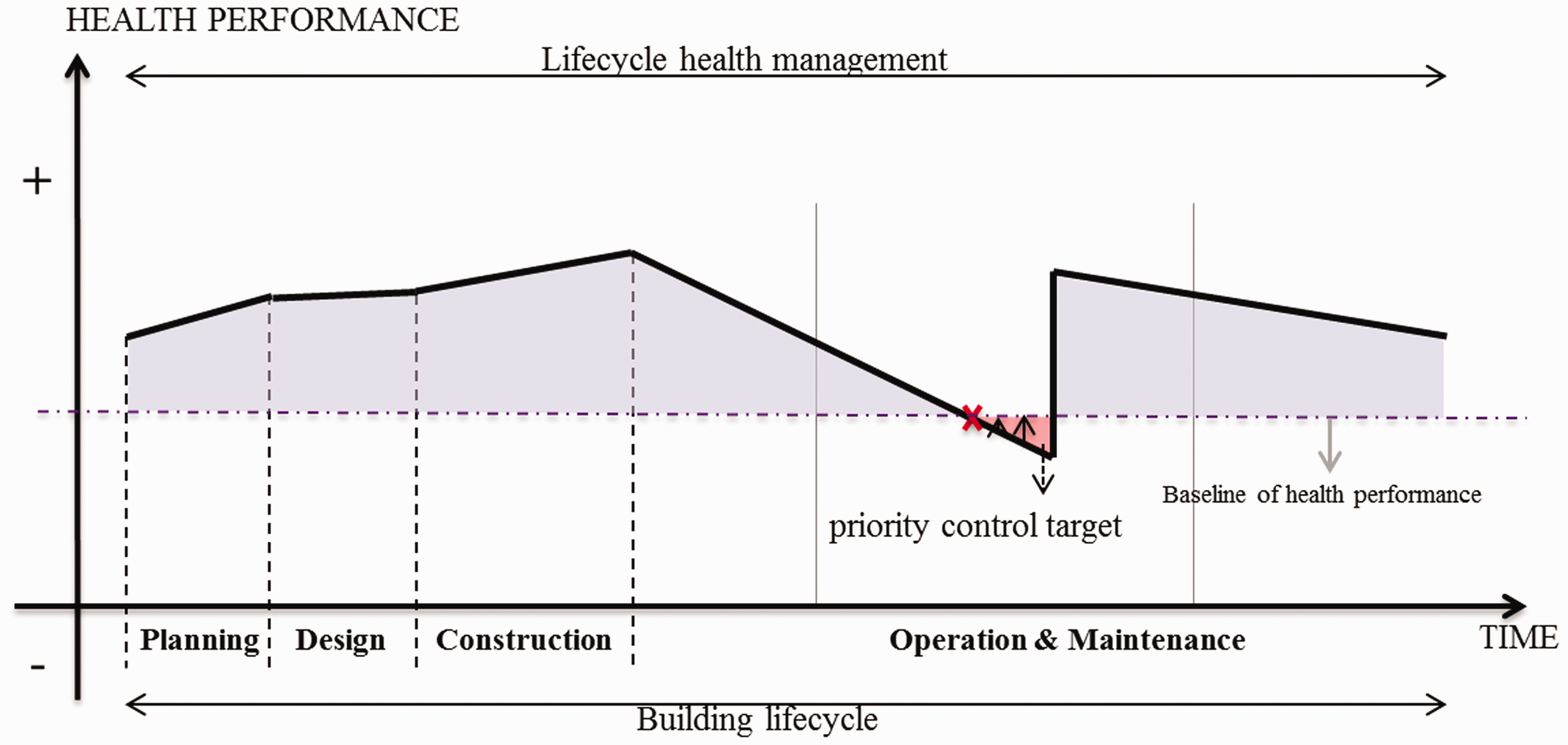
Significant health performance factors within life cycle health management
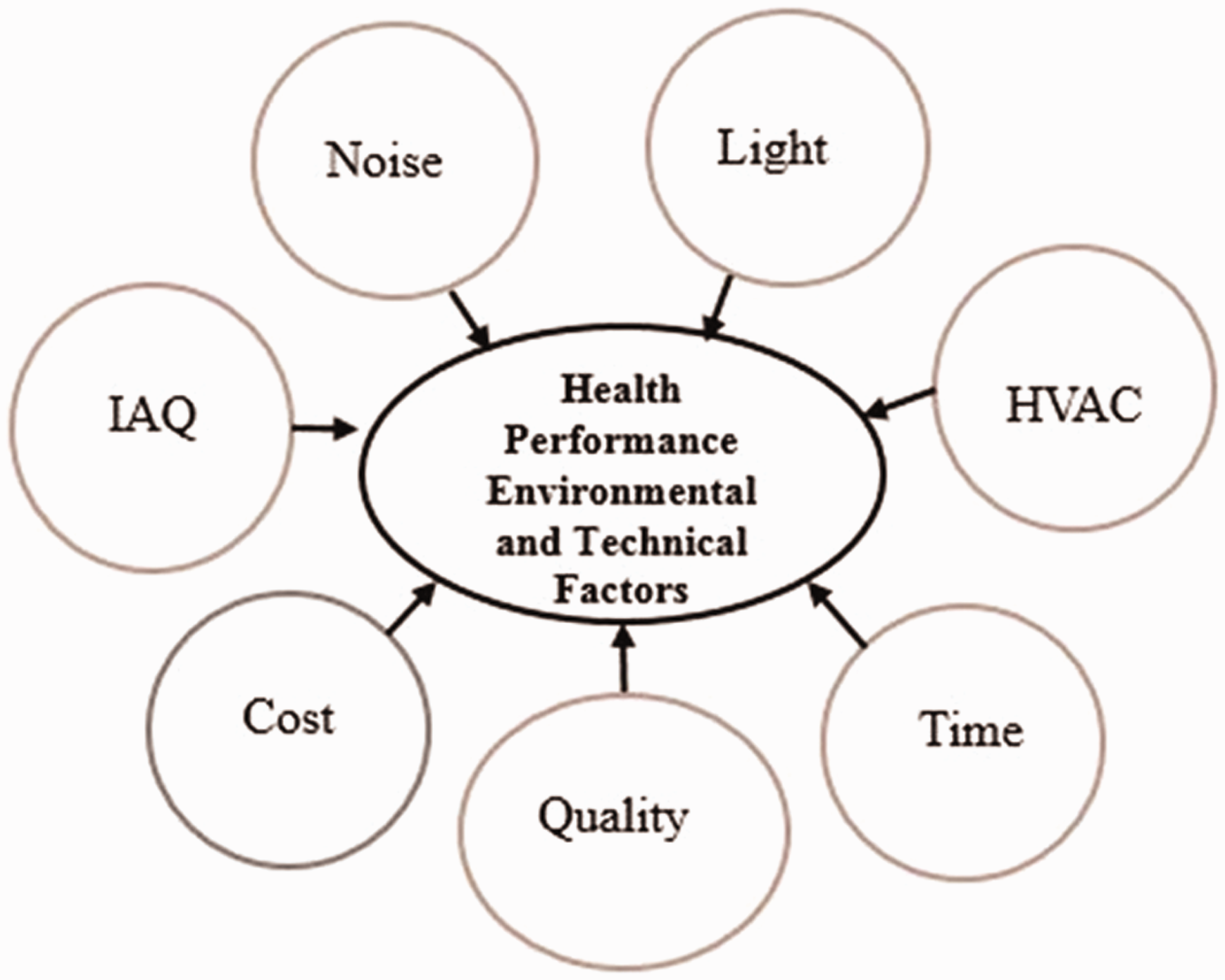
Numerous factors could directly and indirectly affect the health performance of a building during different phases of its life cycle: IAQ, noise, HVAC, and light are environmental health performance factors.
5
IAQ is relevant to human health, and the rest are related to human comfort. Construction cost, quality and time are technical health performance factors, as shown in Figure 2.
14
Building health performance factors.
14
IAQ, among the factors, is a major health problem for building occupants.22,23 Pollutants emitted from various sources such as floors, walls, ceilings and finished materials, could have a major influence on IAQ.9,19,24,25 In a similar way, cost overruns and quality maintenance throughout building construction and timely completion are equally important technical factors.
Management of health performance factors
The management of health performance factors is essential throughout a building’s life cycle to achieve sustainable healthy buildings. Based on the review of previous studies, five major processes compose a building’s life cycle: planning, design, construction, operations and maintenance and decommissioning, as shown in Figure 3.
Stakeholders and activities on each lifecycle phase.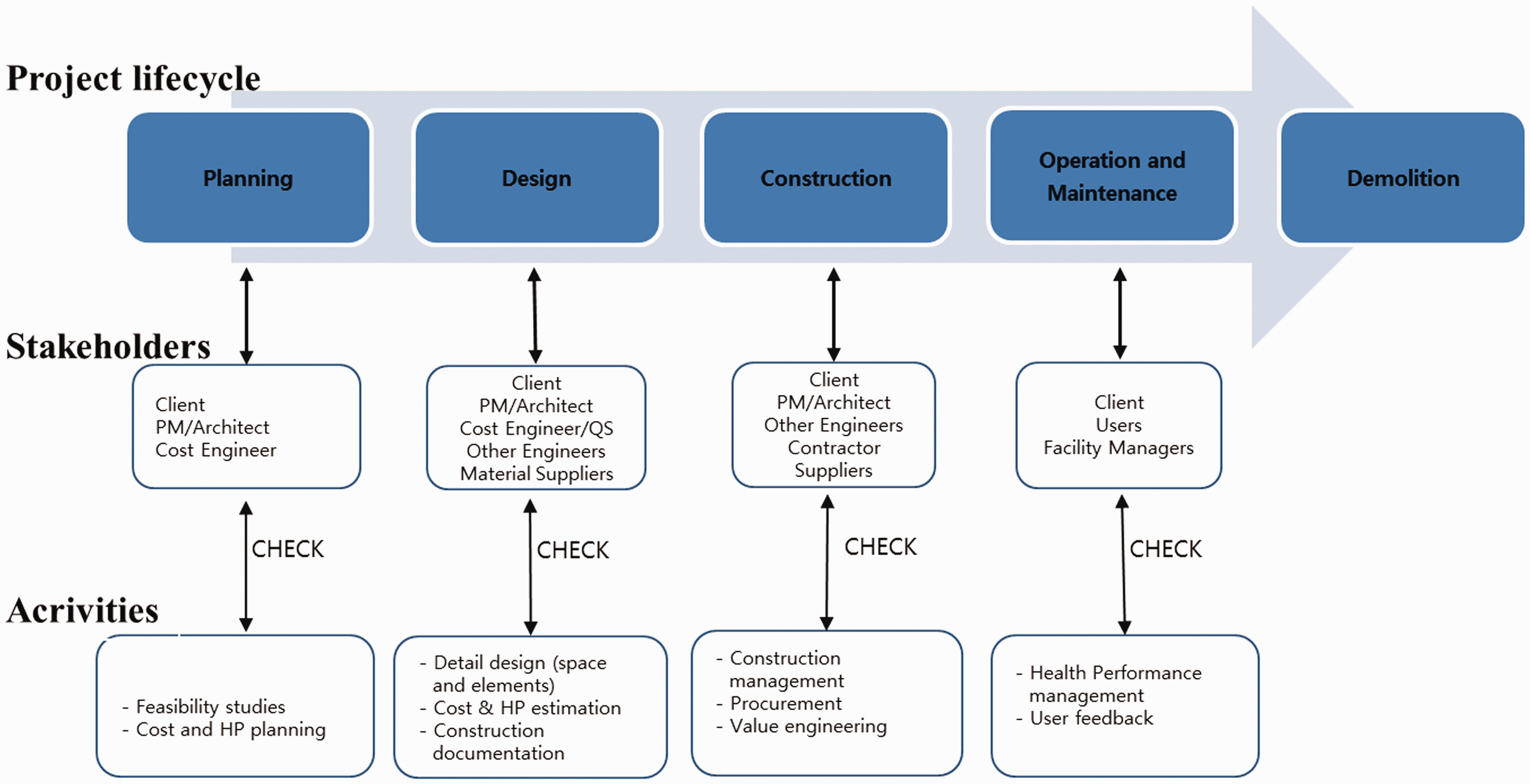
The principle stakeholders of the first process include the client, the project manager, the architect and the cost engineer. Design and documentation stage activities focus on the preparation of initial design schemes, their translation into a construction document and preparation of a database of all building information. Major stakeholders at this stage include the project manager and building designers. In the construction stage, many stakeholders, such as engineers, contractors and others, manage the construction supervision and communication to deliver the completed building. Once the building is finished and handed over to the client, the process would enter the next stage, building operations and maintenance; requiring appropriate matching of operators, facilities and modifications as needed to adapt the building to the client’s need and purpose. Ultimately, every building will come to its end-of-life to be decommissioned. This stage of the building life cycle would usually involve demolition and clearing to prepare for construction of another new building. 26 Therefore, the conceptual LHM model was developed to accommodate each phase by considering its specific stakeholders and activities.
Every phase has its own purpose, stakeholders and operations that need to be completed. Therefore, the conceptual LHM model was developed to accommodate each phase by considering its specific stakeholders and activities.
Classification of building health performance level
The main purpose of categorizing buildings into classes is to provide a guideline of standard based on the health performance of a building as green buildings in the LEED system are classified into ‘Certified’, ‘Silver’, ‘Gold’ and ‘Platinum’. The classification is shown in Figure 4.11,14,20,23 Building classes (Class-A, Class-B and Class-C) define the health performance level of the building, evaluated based on the determination of components and subcomponents introduced in our previous studies on LHT.
5
Components include space classification, health performance, cost, time, construction material and technology. Subcomponents include materials, services, openings, volume, shape and arrangements of space. Health performance includes IAQ, noise, HVAC, lighting, construction cost, time and quality.
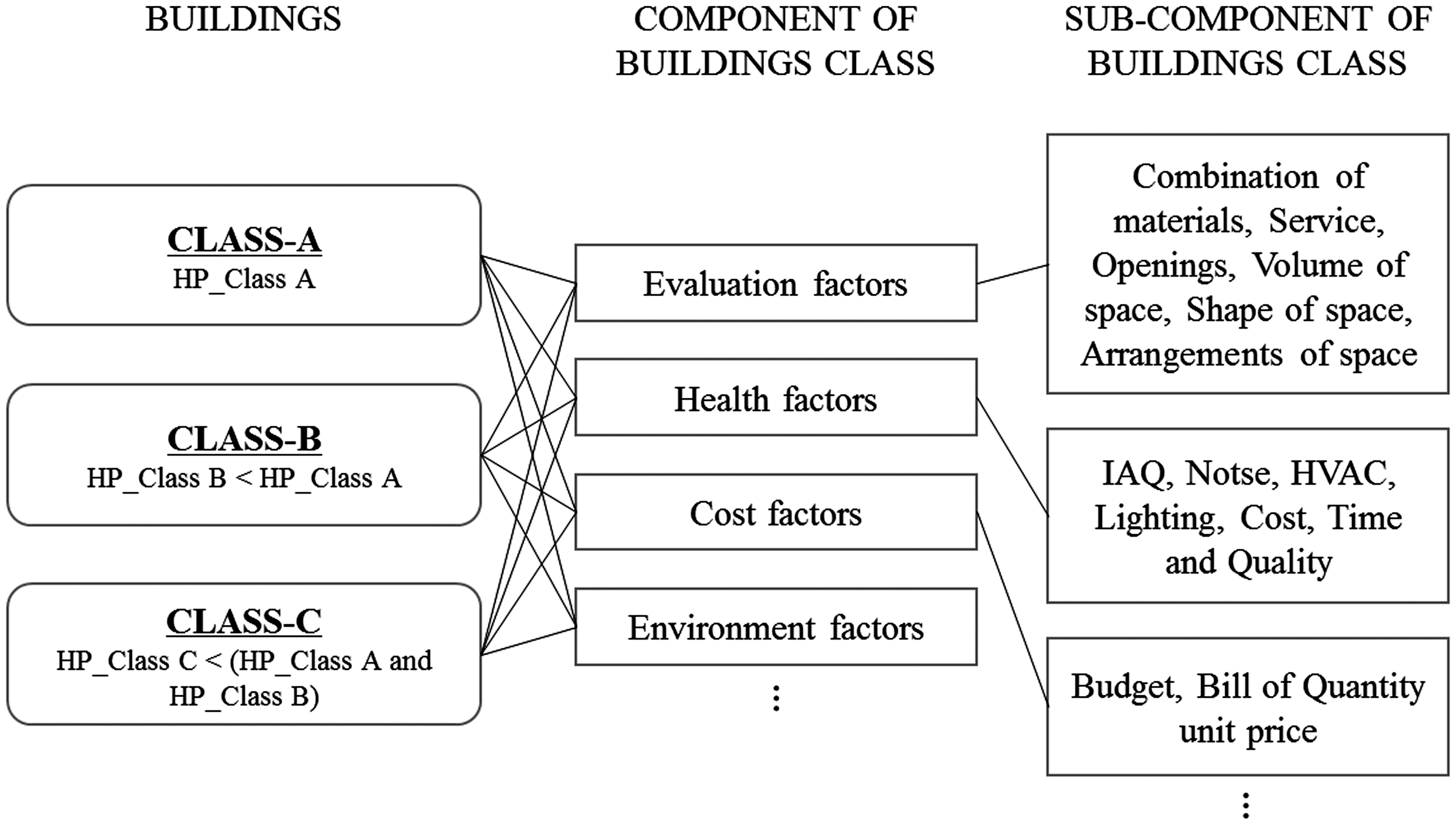
Every building passes through the building life cycle, and its health performance should be evaluated using components and subcomponents analysis, to allow stakeholders to make their appropriate choices easier.
Where,
HP_Class A = health performance of Class A,
HP_Class B = health performance of Class B,
HP_Class C = health performance of Class C.
Health performance and cost management model
Model at the planning phase
The planning should consist of a preliminary feasibility study at an early stage, which could lead to major decisions. The model details the duties of stakeholders to maintain and manage the health performance of a building, which is essential to help clients to decide whether or not to proceed.
At the beginning of the planning phase, the clients should describe their requirement and their concept for the construction project, including issues regarding health performance. The main activities are managed according to clients’ needs with a particular focus on applicability and meeting the legal criteria. IAQ requirements would differ according to a building’s physical and functional properties. Thus, the planning should be as accurate and precise as possible to guide the design process. As illustrated in Figure 5, the clients’ demands should be confirmed and checked for the building-class required, as well as requirements for space and building elements and to assess these against the established legal criteria of the local building code or standard in relation to the health performance of the building (IAQ, noise, HVAC, light). If all the criteria are satisfied at this stage, the project would move forward to the design phase. If the criteria remain unsatisfied, amendments might be needed. Hence, the main purpose of this stage is to discover if there are any possible problems with building health performance which can be most easily corrected in the planning phase.
Model at the planning phase.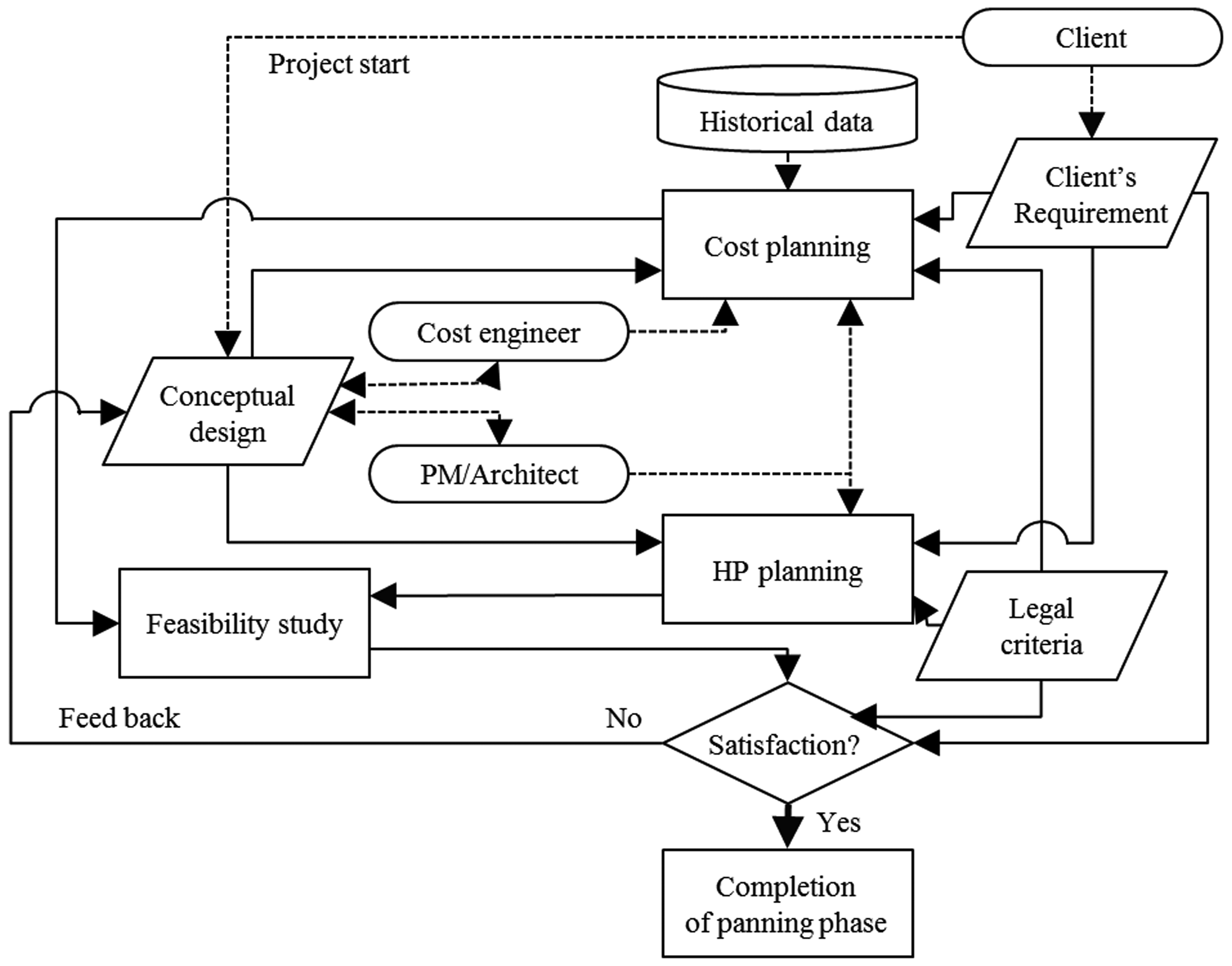
When assuming that a building construction project is planned, the criteria on health performance may change depending on the type or size of a building. For instance, a client wishes to build an office building and as allotting the project budget, the client allots $200k to a ventilation system. Taking into consideration of the building size and historical data, a project manager or an architect predicts that around 88 points of health performance can be ensured with the ventilation system budget of $200k. When a project planning document that includes such information is completed, it is reviewed whether the document meets the client’s requirement and legal criteria. If satisfied, it is moved on to a design phase.
Model at the design phase
The design phase stakeholders should be aware of every material specification, its health performance level and legal criteria to minimize cost and maintain the overall health performance quality of the building. This phase would identify the applications needed by the planning phase.
The model in the design phase, as shown in Figure 6, illustrates the health performance factors that stakeholders should manage properly. At this phase, all the information about preliminary design, technical design and shop drawings are managed and stored in a database as the design documents. When the client is fully satisfied, the project would move forward to the construction phase. If the client is not satisfied, the design should change, but the client’s requirements must always comply with legal criteria. Hence, as shown in Figure 6, if the cost exceeds the project budget or the health performance of building is lower than legal criteria, the design shall be changed to satisfy all the criteria.
Model at the design phase.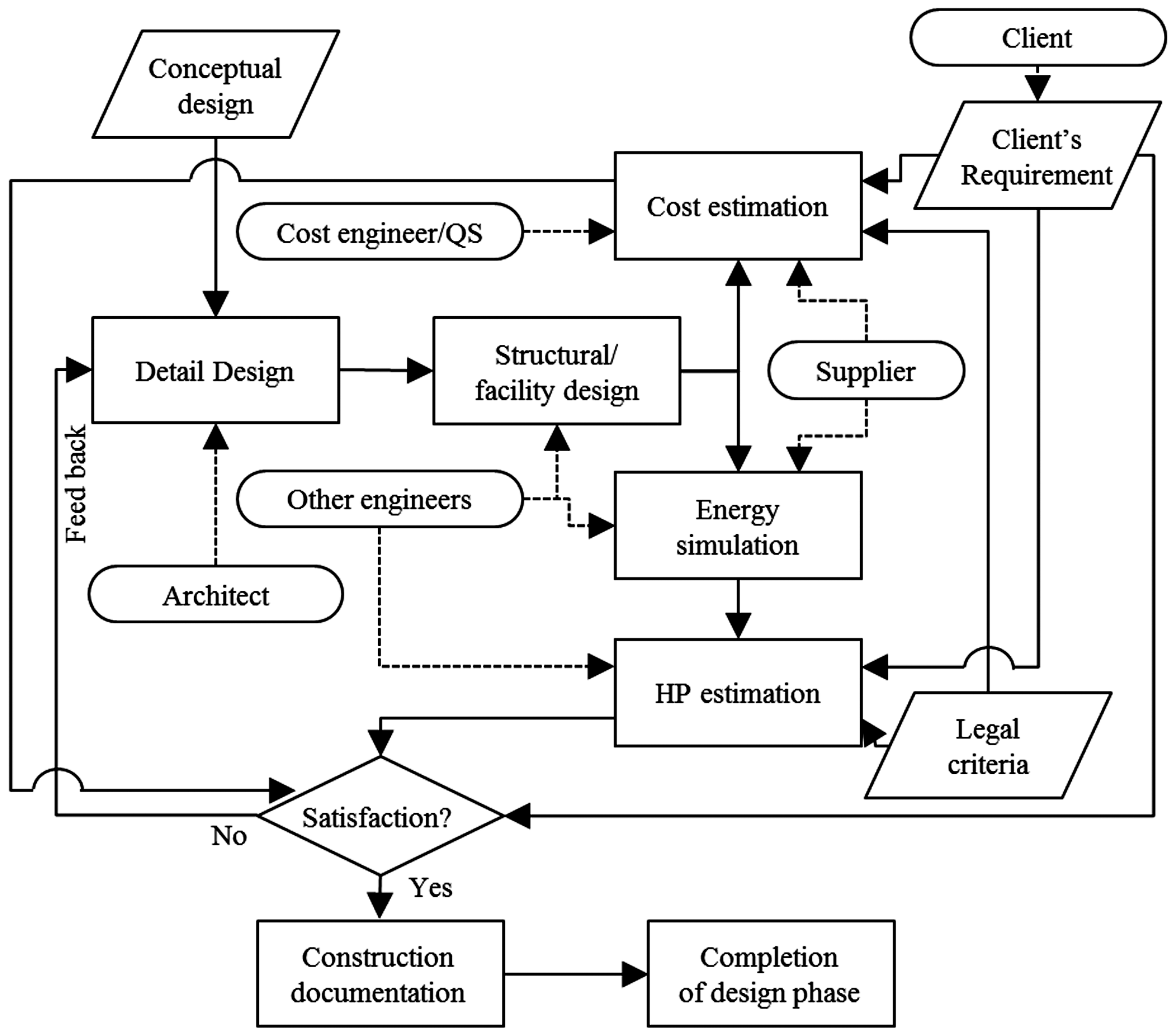
The case project previously mentioned can be explained as follows. The budget allotted to the ventilation system based on the conceptual design and project planning is specified as $200k, and the expected health performance is around 88 points. The performance of 85 points or more is required based on the legal criteria. It implies that if planned as designed, no problem will occur. However, after completing the details of equipment that can actually be used, the estimated cost is $197k, which is within the budget, but the health performance is 84 points for example, which may not meet the legal criteria. In such a case, the design document should be revised so that the cost is within the set budget and the health performance is equivalent to the baseline or above. When it is not possible to satisfy the baseline of health performance within the budget, the budget needs to be increased upon the client’s approval.
Model at the construction phase
The construction phase transforms the building design plans into reality. During construction, as shown in Figure 7, various physical activities are undertaken according to the construction document. All health factors should be included in the consideration to achieve high health performance. Building health factors can be managed, and construction documents should be checked against the legal criteria of the building code or standard to control the cost and quality. During the construction phase, the database started during the design phase would need to grow to include every detail regarding the health factors introduced in the construction phase.
Model at the construction phase.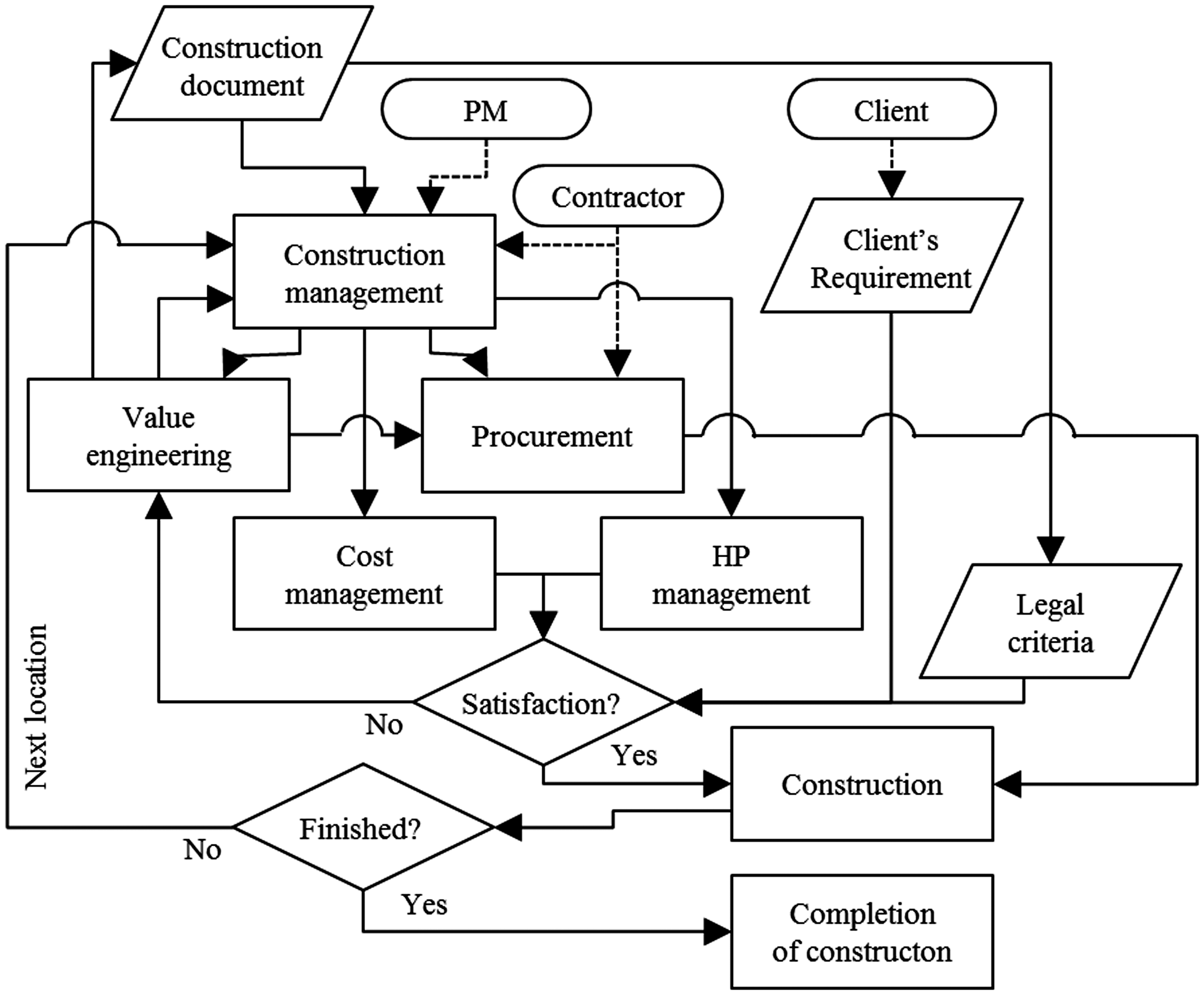
Supervision and communication are part of the construction phase, including regular monitoring by management. When all the criteria are satisfied, the building is ready to hand over to the user or client.
The case project previously mentioned can be explained as follows. The study assumes that the cost of ventilation system finalized in the design phase is $198k and the health performance of 89 points is estimated. However, the cost and health performance may change according to the price fluctuation, technological development or whether the management is successful or not. Thus, the cost and health performance should be continuously observed and forecasted at the construction phase, and if necessary, related construction documents should be revised through value engineering.
Model at the operation and maintenance phase
The operation and maintenance phase of a building’s life cycle has a major effect on building health performance. The model for operation and maintenance can provide a good contribution to the project’s health performance.
The operation and maintenance phase begins at the end of the construction phase. In this phase, the constructed building is handed over to the client and subsequently to the user or client, as shown in Figure 8. Over time, building health performances tend to degrade gradually during the occupation of the building, leading to a reduction in the building value until it is no longer suitable for occupants. When the refurbished building has subsequently achieved the health performance equal to or better than the baseline, the building is returned to its users. Legal criteria of building codes and standards are upgraded continually over time and the health performance of the building must keep pace with these changes by continuously improving the building maintenance and refurbishment when necessary. The main activities of this phase are building monitoring and maintaining the baseline of health factors such as IAQ, noise, light and sound. This is an iterative process that will continue until the demolition of the building.
Model at the operation and maintenance phase.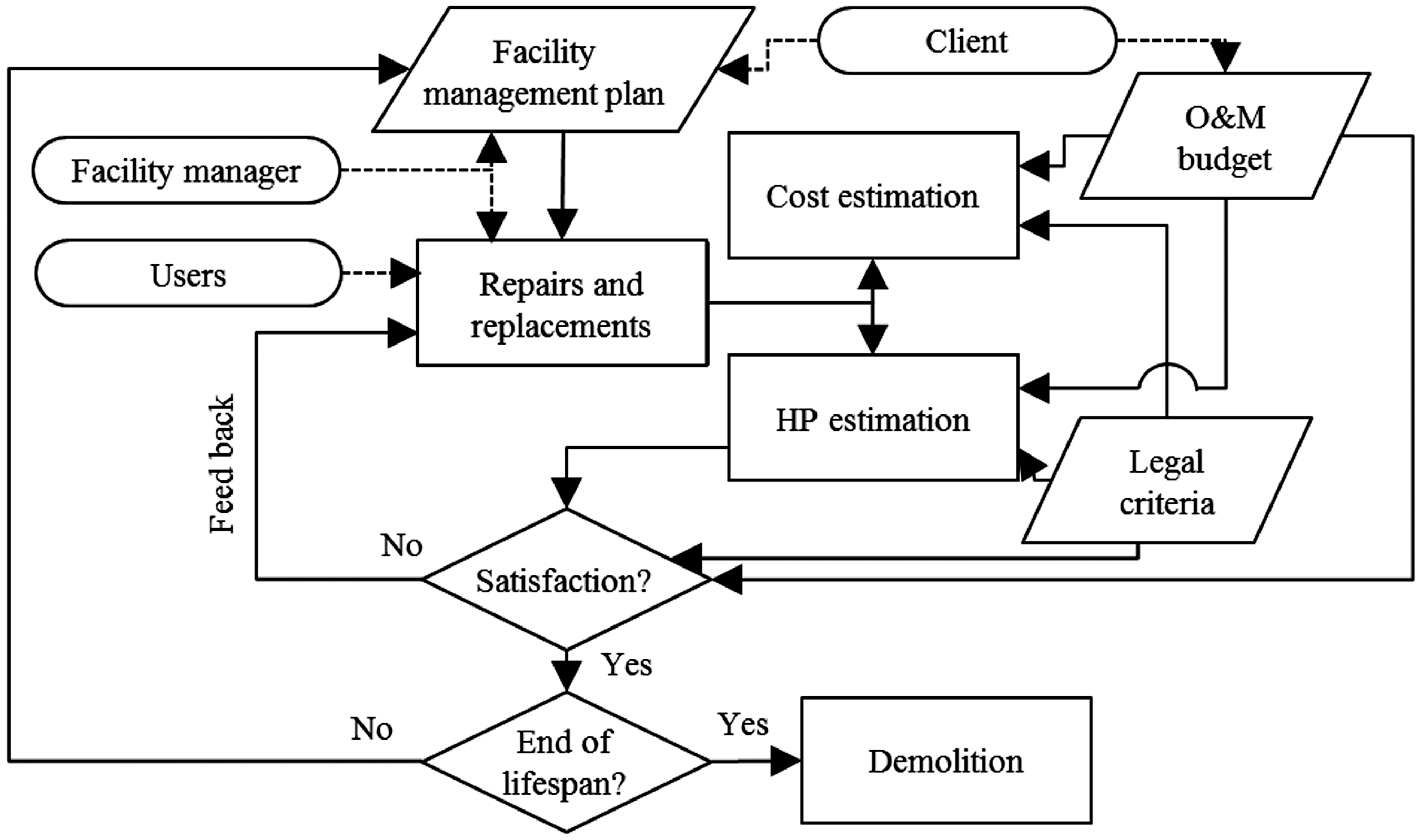
When it comes to the case project mentioned previously, it is assumed that the construction is completed along with the health performance of 88 points. A facility management plan is completed by forecasting the point when the health performance that declines while the building is used reaches the legal baseline of 85. Yet, it should be regularly estimated to confirm that it does not fall below the legal baseline. If the health performance declines faster than the forecasted period, the budget should be reviewed for repairs and replacements.
Discussion and conclusion
An effective procedure for project management with a due consideration of factors affecting the environmental health of a building is necessary to achieve sustainable buildings. However, this process could face many challenges in fulfilling its objective because numerous unseen factors could have a bearing on the planning and building process. Hence, the life cycle health management baseline concept is the first step in a whole process for the project management. The health performance and cost management model would track the building process and assess each phase of its whole life cycle. Periodically, the model will need to be updated and reinterpreted continuously to keep pace with rapid changes in the construction industry and changes in government’s building codes and standards. The greatest limitation of this study is a lack of information about the health performance factors, and determining how to move towards the goal of standard health performance. A future study should separately consider other issues that could influence the health performance of buildings. The main significance of this model is to establish a decision-making process for decision-makers to improve and identify problems that could affect the health performance of a building throughout a building’s life cycle, thus allowing stakeholders to resolve shortcomings and to apply advanced solutions for building upgrade.
This paper has presented a health performance and cost management model for maintaining the health performance throughout the life cycle of a building at each stage: the planning, design, construction, and operation and maintenance phases, to minimize potential health problems for occupants. The main issues currently confounding the construction industry are construction cost and human health factors such as IAQ and human comfort factors. The lack of studies on health performance management is increasingly causing problems for the construction industry. An effective management model would contribute towards minimizing problems and to maintain building health performance, and this would involve all stakeholders in the life cycle of the building, who should have effective knowledge on health factors and understand their respective roles and act on their responsibility towards the upkeep and maintenance of the building. The factors in the checklist should be by no means the ultimate list, but should introduce a consistent approach to establish the health factors in a building. The approach is adaptable and needs to be applied with flexibility to evaluate health performance. In addition, the result of this research can be applied to build the optimization models of health performance and cost management that can maximize the health performance within the budget or minimize the cost with securing better health performance than the baseline.
Footnotes
Authors’ contribution
All authors contributed equally in the preparation of this manuscript.
Declaration of conflicting interests
The author(s) declared no potential conflicts of interest with respect to the research, authorship, and/or publication of this article.
Funding
The author(s) disclosed receipt of the following financial support for the research, authorship, and/or publication of this article: This work was supported by the National Research Foundation of Korea (NRF) grant funded by the Korea government (MSIP) (no. 2008-0061908).