







Abstract
In this study, the exergy analysis method was extended to analyse the building thermal load and related energy flows, aiming to investigate the exergy loss as well as improvement potential for building design and analysis. Five office buildings in five major climate zones in China were taken as case studies for the analysis. The building thermal loads and related energy flows were calculated and analysed using the exergy analysis method. Results show that the building exergy load is relatively low compared to the building thermal energy load. However, it is always met by consuming energy of high exergy value (e.g. electricity), indicating the exergy mismatch between the energy demand and supply. The latent exergy load cannot be disregarded for building thermal load and energy flows analysis, especially for buildings in humid climate. Large exergy loss, which is dominated by solar gain, was found in all five reference buildings across different climate zones. This study provides a comprehensive understanding of building thermal load and related energy flows, and would benefit building evaluation and thermal design of building envelop.
Introduction
The rapid growth in energy use has caused energetic and environmental impact across the globe. Building energy consumption is more than one-third of the world’s primary energy use and this has been the subject of governments’ policies and regulations of different countries with an increasing focus on energy efficiency in buildings. 1 A substantial part of the energy consumption is for building service systems, especially for the heating, ventilation and air conditioning (HVAC) systems. 2 Many efforts have been made to analyse and optimise the HVAC systems, such as the district heating system, 3 evaporative cooling system, 4 solar water heating systems,5,6 ground source heat pump,7,8 building integrated photovoltaic thermal systems, 9 and heat recovery ventilators. 10 However, the energy use for HVAC systems is highly dependent on the building thermal load. Thus, the building thermal load should be considered and analysed in the first place to reduce the building energy use radically.11,12
The exergy is the maximum of work that can be obtained from an energy flow or a system as it proceeds to the final state in equilibrium to the reference state. It does not only represent the quantity but also the quality of the energy. 13 The exergy method by nature is focused on energy utilisation and optimisation. As it is well known, the building thermal load is mainly caused by the energy flows through the building envelope, solar gain, building internal gain (e.g. occupants and lighting), and ventilation and infiltration. Some studies have been reported for analysing the building thermal load by means of energy analysis.11,12 However, the energy analysis concept alone would not be able to understand the nature of the energy flow and utilisation processes.13,14 However, the exergy method combined with energy analysis would provide a better understanding of building thermal design and related energy flows in buildings. 15 A few related studies have been reported. For instance, Shukuya 16 introduced the exergy concept to the built environment for a better understanding of the interaction between the buildings and service systems or biological systems, such as human bodies; Zhou and Gong 17 analysed the building heating and cooling systems used and assessed the heat transmission from the power plant to the building envelope. The study has provided an improved understanding of energy and exergy flow from the energy source to building envelope. The International Energy Agency promoted the rational use of low-exergy system for heating and cooling of buildings.18,19 Schmidt 20 provided a detailed exergy calculation method to evaluate the building design. Sakulpipatsin extended the exergy method to the analysis of buildings and HVAC system. 14 Yucer 15 conducted an exergy analysis of an educational building heated by a conventional boiler. Further improvements are still required for the exergy analysis of buildings. Most studies disregard the exergy for building latent load, which is of vital importance for assessing the building thermal load, especially for buildings in humid areas. 21 There has not yet been agreement on the choice of the reference state, which is crucial for the exergy analysis. Additionally, there are only a few studies that have analysed the building thermal load and related energy flows by means of exergy for buildings in China. Thus, it is essential to conduct energy and exergy analysis of the building thermal loads and the related energy flows to improve the building thermal design and evaluation.
The main objective of this study was to introduce the exergy concept to the building thermal load and related energy flows analysis, and explore the exergy loss and improvement potential for buildings in the major climate zones in China. Due to the great energy consumption for office buildings in China, the office buildings were taken as case studies.22,23 The building thermal design and the building thermal load character may vary greatly because of the climate diversity in China. Therefore, one typical city in each major climate zone in China was selected as the building location for this study. Major building envelope parameters were designed according to the design standard pertinent to the climate zone. The building thermal loads were calculated using the Integrated Environmental Solutions Virtual Environment (IES-VE).24 For the exergy analysis in this study, the indoor air state was taken as the reference state. This study has presented an exergy analysis of building thermal load, which should benefit the design and evaluation of building thermal performance in future.
Methods
This study aims to analyse the building thermal load and related energy flows in buildings by means of exergy. The building thermal load was divided into several components according to the building energy balance developed by this study. The exergy analysis method for building thermal load and related energy flows was then developed for validation.
Building energy balance
A built-up model for the building energy balance is shown in Figure 1. Since this paper focuses on the analysis of building thermal load, the model does not include the HVAC system. Instead, only the energy provided by the HVAC system is considered in the energy balance. As shown in Figure 1, we take the building envelops as the boundary for the building energy balance model. A balance between the thermal energy input and output could be set up for the indoor environment.
Energy balance in buildings.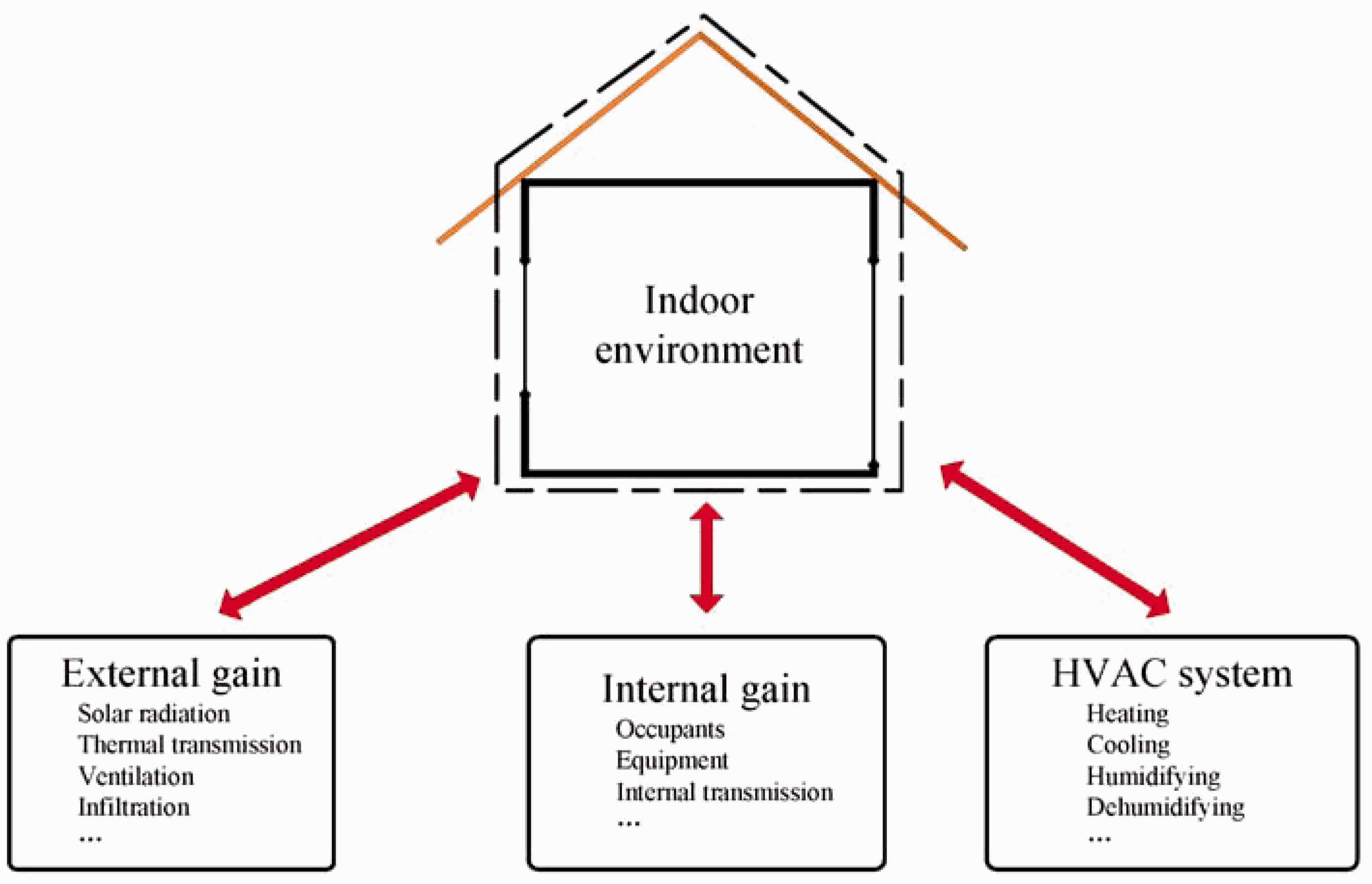
The model shown in Figure 1 consists of two parts: the building thermal load part and the HVAC part. The building thermal load is the sum of the internal thermal gain from occupants, lighting and equipment (e.g. computers), and the external gain from the thermal transmission through building envelopes (such as walls, windows and ceilings), solar gain, ventilation and infiltration. HVAC system provides thermal energy to maintain a desired indoor environment. The building thermal load depends on the net balance between the heat losses and heat gains (including both sensible and latent heat), which can be affected by the outdoor climate condition, the building envelope properties, the occupants, and the lighting and equipment. 24,25
Energy analysis
Based on the energy balance mentioned above, the building thermal load could be divided into several components, such as the internal gain, solar gain and ventilation gain. The building energy balance for a zone can be taken as a non-geometrical balance with one air node per zone, representing the thermal capacity of the zonal air volume. Assuming that any air point in the zone has the same properties (i.e. temperature and humidity), the building energy balance can be represented by equation (1) as
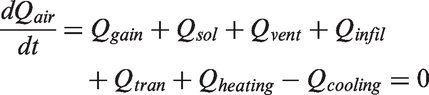
The thermal energy gains by the thermal transmission (


The building thermal load can be divided into two subparts: the sensible part and latent part.26,27 The sensible thermal load is mainly caused by the thermal energy transfer through the building envelopes, solar gain, ventilation and infiltration, as well as the internal thermal gain from the occupants, lighting, and equipment. The latent thermal load is mainly from the moisture generated from the occupants and equipment within buildings and the ventilation and/or infiltration air brought into buildings. Therefore, the building thermal energy balance can be rewritten as equation (4)

In this study, it is assumed that there is no moisture generated by the indoor equipment. The moisture transferred through walls into indoor environment is also neglected. Therefore,


Exergy analysis
Theoretically, there is always an assumption that there is no chemical reaction during the heat and mass transfer through building envelope or within indoor environment. There is no exergy of chemical reaction during the exergy calculation for building thermal load. The thermal exergy during the heat transfer can be described by equation (7) as
13




The exergy of internal thermal energy gain (



For the thermal gain of occupants (


If the moist air is considered as an ideal mixture, its specific exergy (
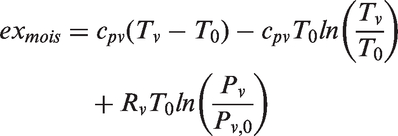

The exergy of thermal energy gain from ventilation are defined by equations (18) to (20).



The exergy for solar gain (

To maintain a desired indoor environment, the thermal energy from HVAC system is required to handle the indoor and fresh air (i.e. heating or cooling; humidifying or dehumidifying). The exergy of heating (


In this study, the hot water temperature was assumed at 45℃/40℃ into and out of fan coils during the heating season, while the chilled water was assumed at 7℃ /12℃ into and out of fan coils.
As mentioned above, the building thermal load includes two parts: the sensible part (



Since no moisture is assumed to be generated from the indoor equipment,

According to the energy balance for the building indoor environment (equation (1)), the exergy balance is given by equation (28).


Reference state for exergy analysis of buildings
Exergy is defined as the maximum work that can be obtained from a system as it proceeds to the reference state. 13 The exergy value of energy or work strongly depends on the reference state, of which the choice is of vital importance. A few studies have reported the sensitivity of exergy analysis to the reference state choice.3,5,17–19,21 The choices of reference state can be divided into two groups. For the first group, the variable environment state is selected as the reference state, such as the hourly environmental temperature and humidity,18,19 and the actual average local temperature. 3 However, this kind of reference state changes with time or places. Therefore, the results are unique and not comparable. For the second group, the constant environment state is selected as the reference state.14,15 For example, the air temperature is usually selected as 25℃ and the air pressure is selected as 101325 Pa.6,21 This provides a universal reference state for the exergy analysis, leading to comparable results and acceptable exergy analysis. But, the constant reference state could be far away from the actual environment, leading to inaccurate results. 21 In sum, there is a lack of a suitable reference state for exergy analysis of buildings.
Figure 1 illustrates the energy balance of the energy flows through and within buildings. As shown in Figure 1, the thermal energy transfers through building envelopes (i.e. walls, windows, and ceilings) into indoor environment, the solar energy transfers through windows into indoor environment, and the heat generated by occupants and equipment finally transfers into the indoor environment. The indoor environment is maintained at a desired level by the HVAC systems. Ultimately, the thermal energy provided by HVAC systems reaches the indoor air state. In sum, all the energy transfer processes, either from the outdoor environment or within the buildings, can be regarded as interactions with the environment, especially with the indoor air. And finally, all the energy reaches the state of indoor environment. The indoor environment could be regarded as the actual environment state for buildings. Indeed, the indoor environment state is not a strict infinite sink. However, the indoor air parameters, such as air temperature and humidity, are maintained at relatively constant level by HVAC systems during the heating or cooling period. Thus, the indoor air state could be regarded as an infinite sink and selected as the reference state for the exergy analysis of building thermal performance. 10 Meanwhile, the exergy of a system or energy flow is regarded as the available energy compared to the reference environment due to the definition of exergy. 13 Taking the indoor environment as the reference state, exergy analysis of the building thermal load could transform all the energy flows through or within buildings into their exergy value, and therefore, evaluate the availability of all the thermal energy compared to the indoor environment. Overall, the indoor environment would be a general reference state for exergy analysis of building thermal performance.
In this study, the indoor air pressure, temperature and humidity content are selected as the reference state parameters. The indoor air temperature and humidity content can be obtained from building simulation program. Additionally, it is assumed that the indoor and outdoor air pressures are identical at 101325 Pa.
Building design and energy simulation
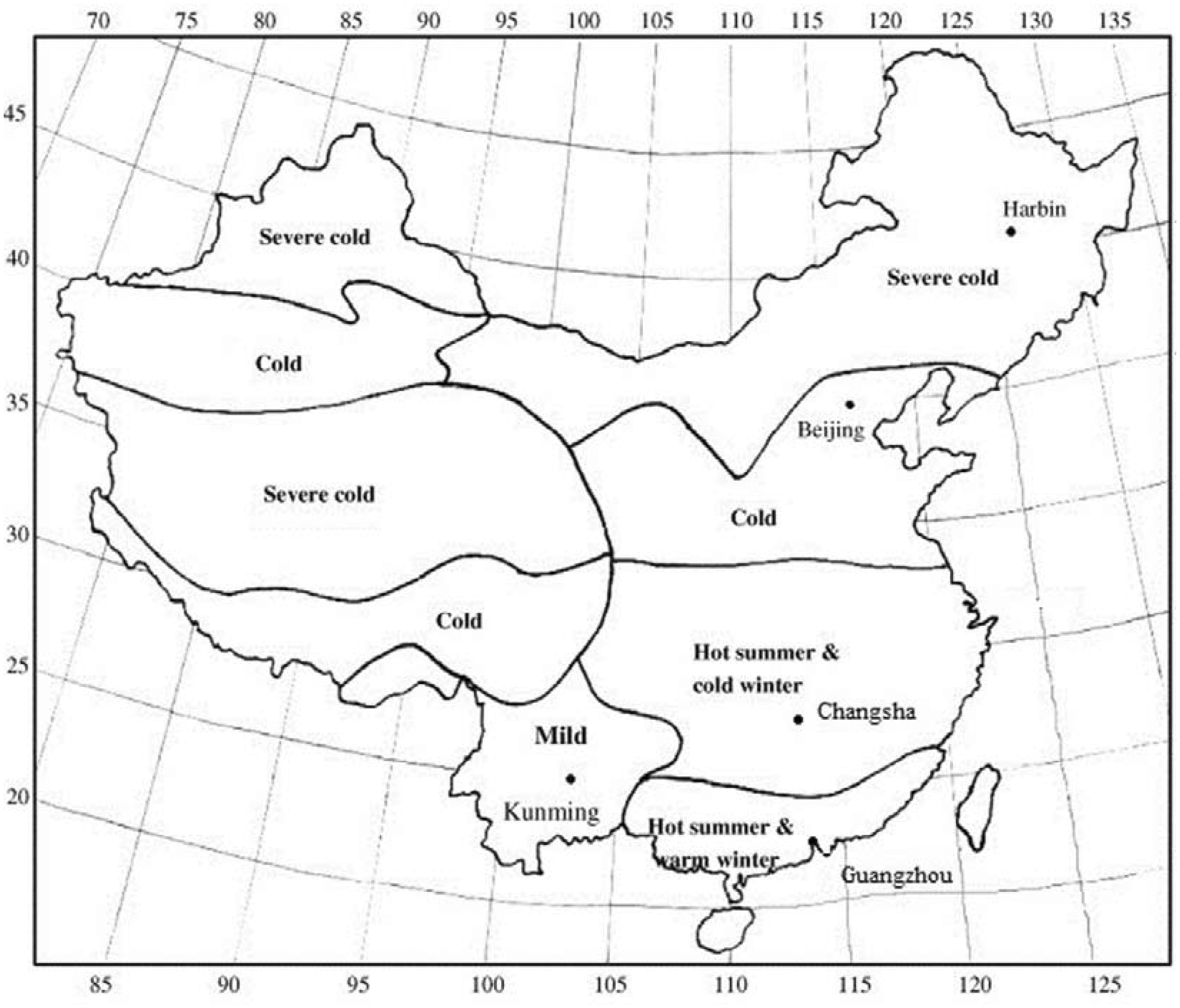
The varied climate in China ranges from subtropical zones in the south to temperate zone in the north. There are five major climate zones for building thermal design, namely severely cold, cold, hot summer and cold winter, mild and hot summer and warm winter zones.26,27 The climate condition varies greatly in the different climate zones and is important consideration for building envelope thermal design. Figure 2 shows an overall layout of the five major climate zones. A typical city within each climate zone was selected as the location for the designed office building, namely Harbin (severely cold, 45°04′N and 125°42′E), Beijing (cold, 39°48′N and 116°28′E), Changsha (hot summer and cold winter, 28°41′N and 114°15′E), Kunming (mild, 26°22′N and 103°40′E), and Guangzhou (hot summer and warm winter, 23°06′N and 113°15′E).
Geographical distribution of typical climate zones and cities in China.
11
Key building envelope design parameters.
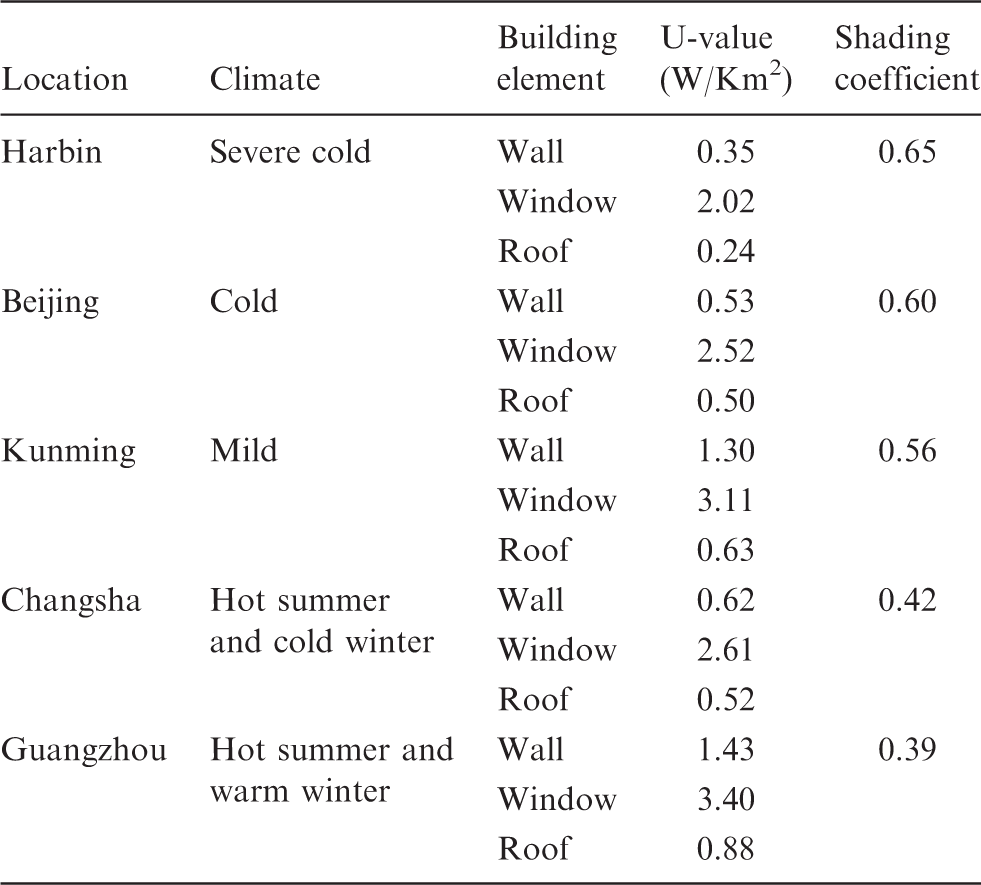
The office hours were from 8:00 am to 6:00 pm from Monday to Friday. Three persons were set in each office, with sensible heat generating rate of 70 W and moisture generating rate of 0.07 kg h−1 for each person. The sensible heat generating rate for equipment was 18 W m−2. We assumed that there is no moisture generated by the indoor equipment. The minimum fresh air demand for each person was 30 m3 h−1 during the office hours.26,27 The infiltration rate was set as constant at 0.5 h−1. The indoor air temperature was set at 20℃ for heating period and 26℃ for cooling period during the working hours, and 12℃ for heating period and 30℃ for cooling period during the closed hours. The relative humidity was maintained at 30–70% for the cooling period. 26 The building was assumed to work on a constant weekly schedule through the whole year.
Building energy simulation is an acceptable technique for estimating building thermal load and assessing the dynamic interactions between the external climates, the building envelopes and the HVAC systems. 11 In this study, IES-VE was employed for the building thermal load calculation. By setting up relative parameters, the thermal load for buildings was calculated. The energy and exergy analysis of the building thermal performance can be obtained accordingly.
Results and discussion
The building thermal loads calculation was conducted for the five cities. The results were analysed and discussed from three aspects – annual thermal load, heating, and cooling load components.
Building annual thermal load
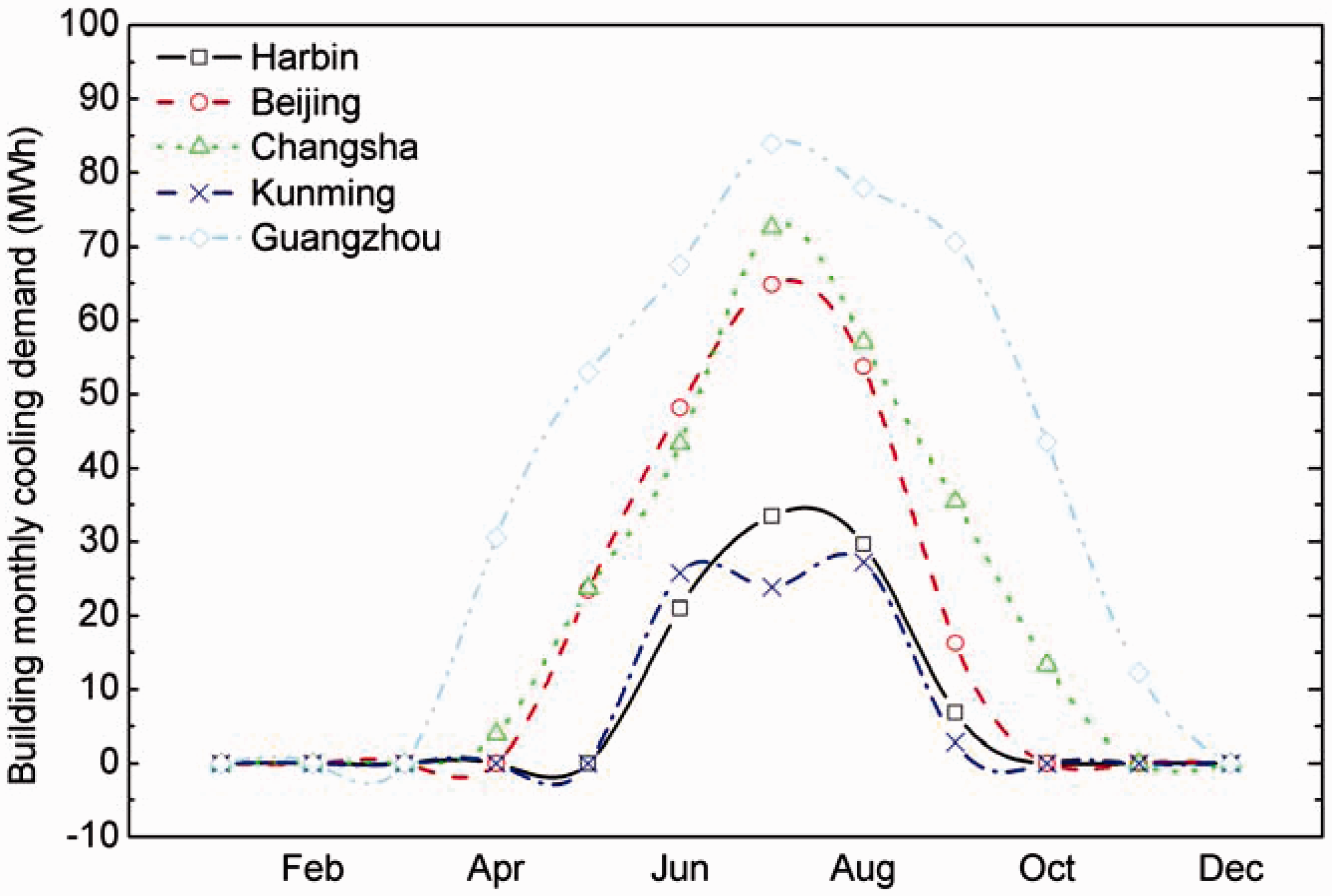
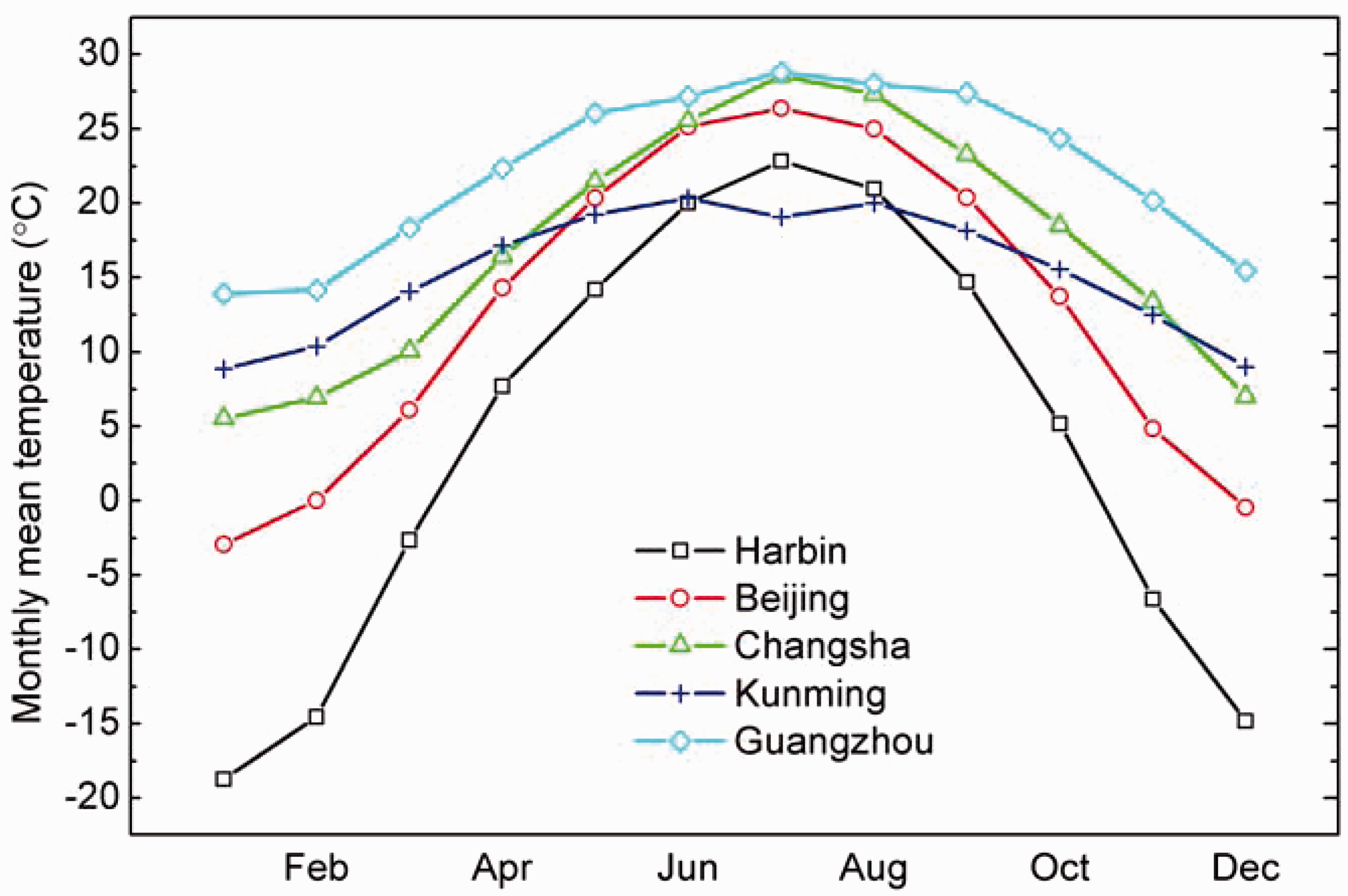
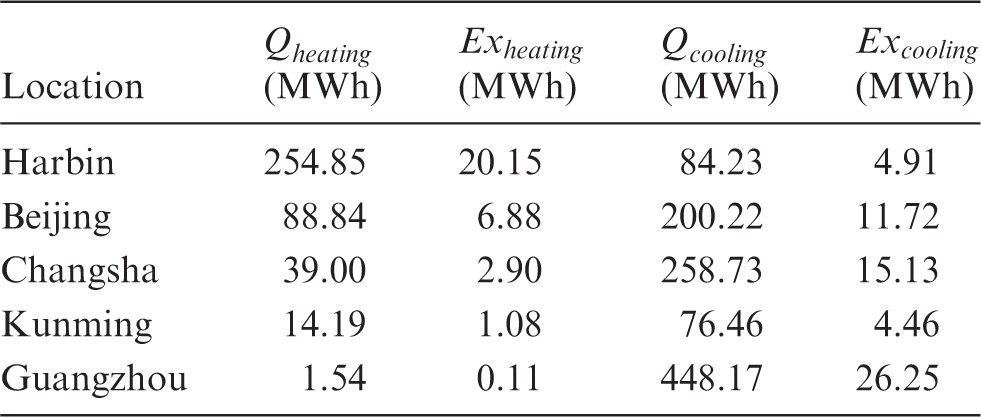
For a better understanding of the seasonal variation of building heating load, the monthly heating and cooling load of the buildings in different cites across the major climate zones are shown in Figures 3 and 4. As shown in Figure 3, the largest monthly heating load for all the buildings in the five cities was shown to occur in January. The largest cooling load was shown to occur in July in four cities except Kunming (Figure 4). Figure 5 is the monthly mean temperature of the reference buildings in five cities. The lowest monthly mean temperature in buildings in all five cities occurs in January, while the highest indoor temperature was found in office buildings in July except for Kunming. This could partially explain why the largest monthly heating and cooling loads in these office buildings were found in January and July, respectively. The largest and lowest monthly heating loads were found in the office building in Harbin (72.18 MWh) and Guangzhou (0.56 MWh), respectively. The office building in Guangzhou was shown to produce the largest monthly cooling load of 83.95 MWh, while the office building in Kunming was shown to produce the lowest one of 27.23 MWh. The office building in Harbin has a certain amount of cooling load in summer despite its severe cold climate.
Monthly heating load in reference buildings in typical cities in different climate zones. Monthly cooling load in reference buildings in typical cities in different climate zones. Monthly mean temperature of reference buildings in typical cities in different climate zones.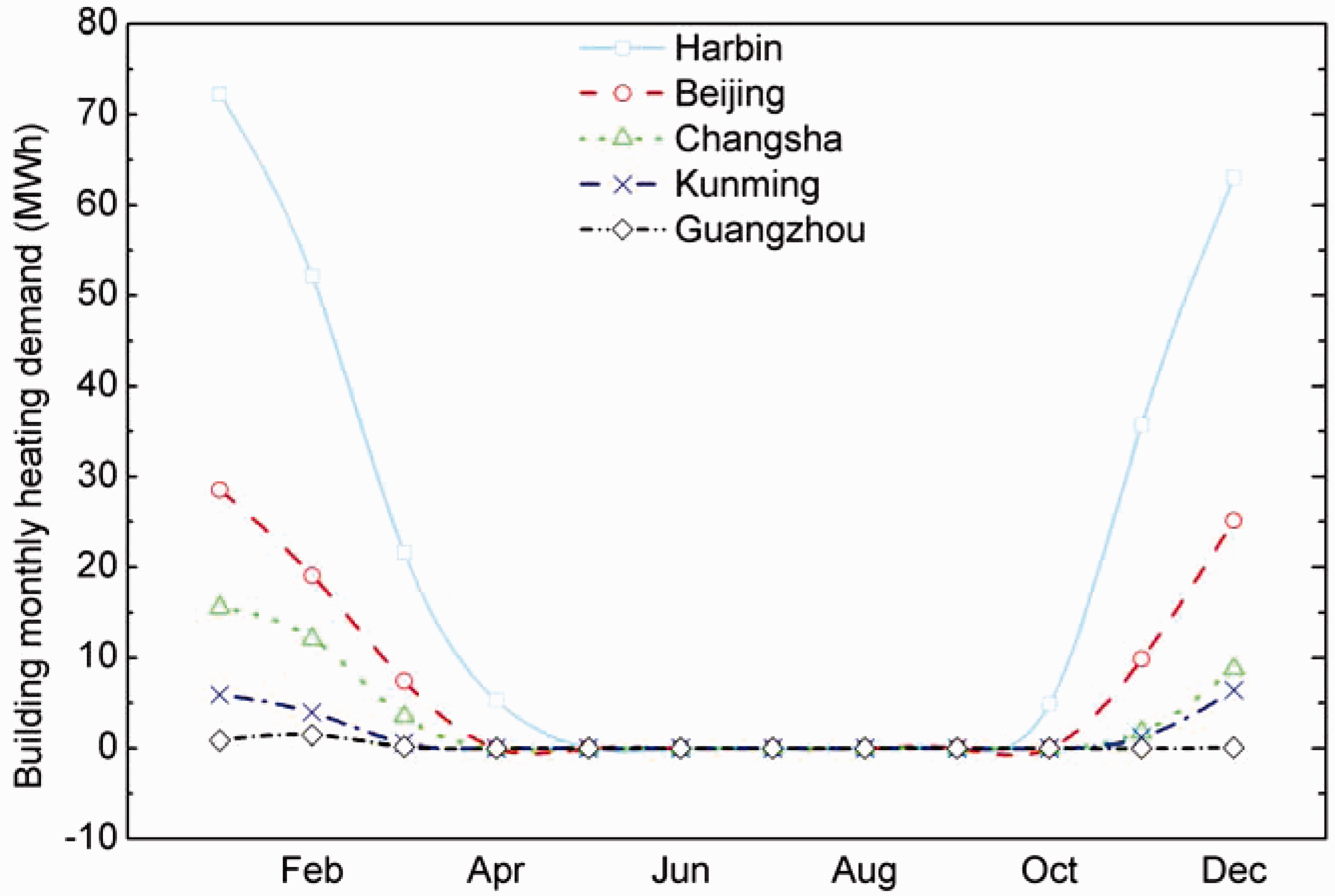
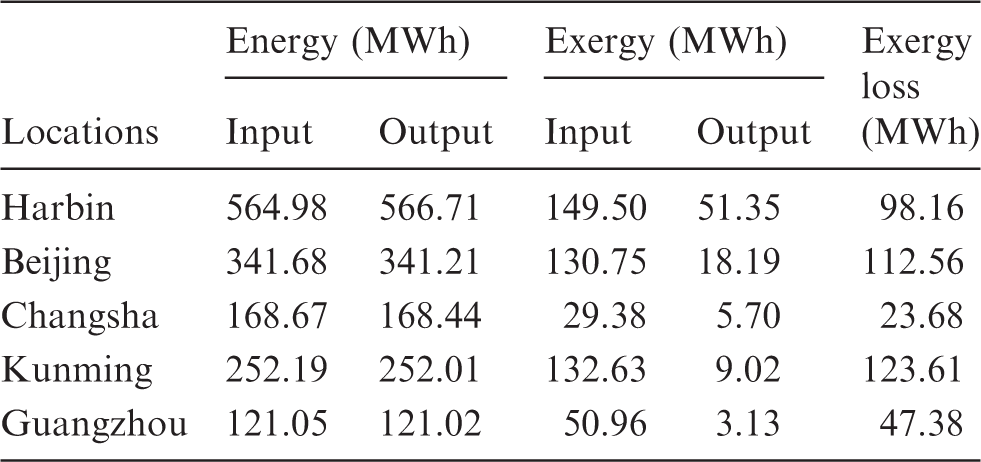
Annual thermal energy input and output in buildings during heating season.
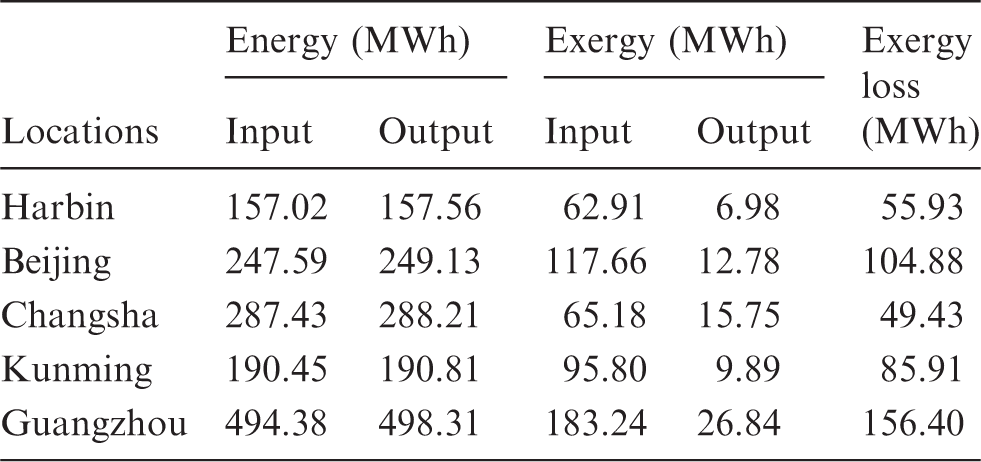
Annual thermal energy input and output in buildings during cooling season.
The thermal energy and exergy loads in reference buildings.
Building annual heating load components
Figure 6 shows the thermal energy and exergy input and output components of heating and cooling loads in the office buildings of each city. As shown in Figure 6, the exergy value of solar gain is very close to the energy value, while the others are much smaller than the energy values. The solar gain is of high exergetic potential due to its surface temperature of 6000 K. Other thermal energy components are of low exergy potential because their temperatures are close to the reference state.
Annual heating load of building components.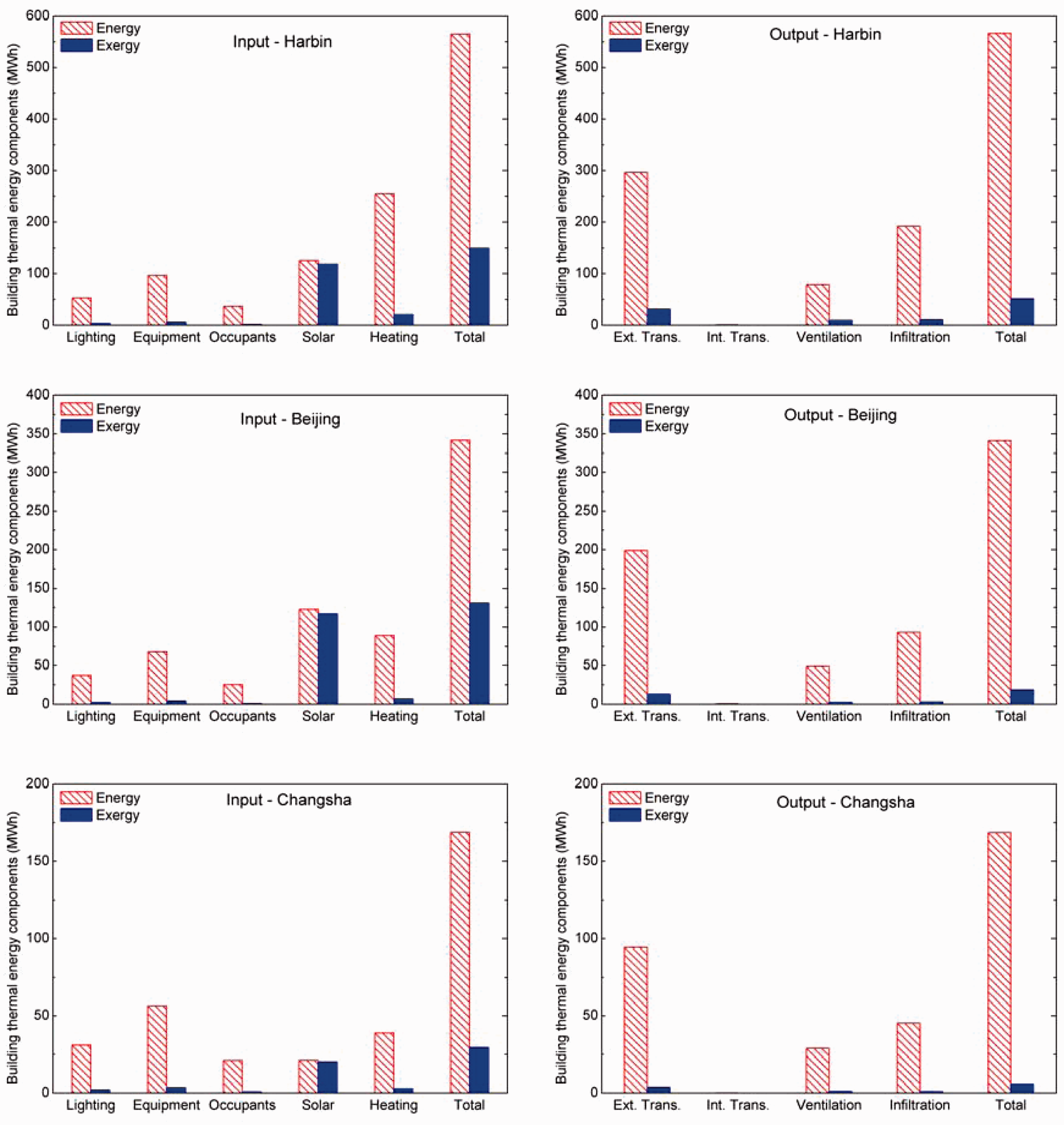
As shown in Figure 6, the total thermal energy and exergy output in the office building in each city are both dominated by the external transmission. Figure 7 shows the main components of external transmission heat loss in the building in each city. As seen in Figure 8, the external transmission heat loss is dominated by the heat loss through windows in the office building of each city. The heat transmission through wall and roof are relatively small. Therefore reducing the heat loss through external transmission, especially windows, could help to reduce the heating thermal energy and exergy load, such as enhancing the insulation of external windows. However, a balance between decreasing the heating load and increasing the cooling load would need to be considered. Especially, the cooling load would need to increase a lot in buildings in Changsha and Guangzhou.
External transmission of building components during heating season. Cooling load of building components.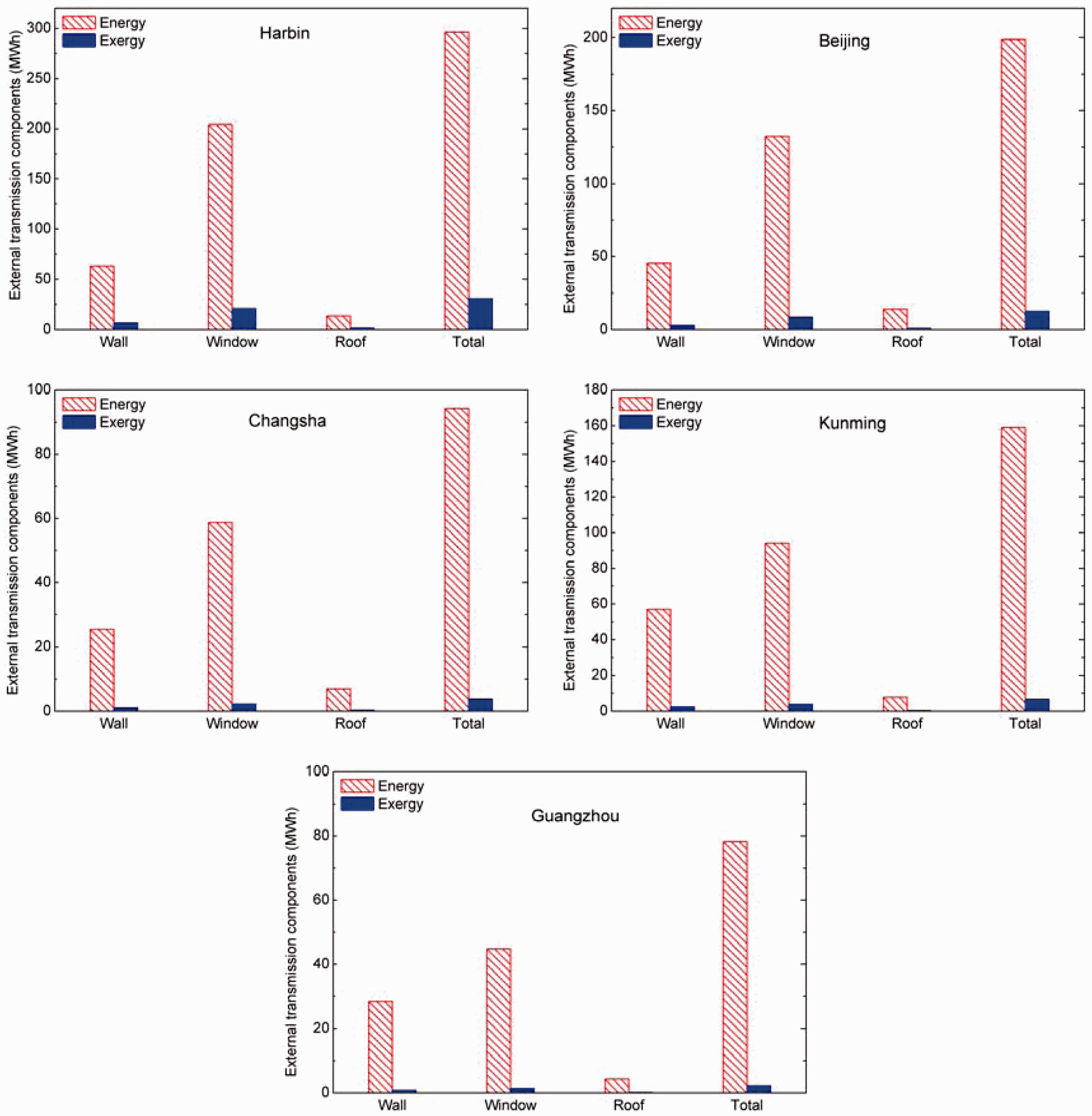
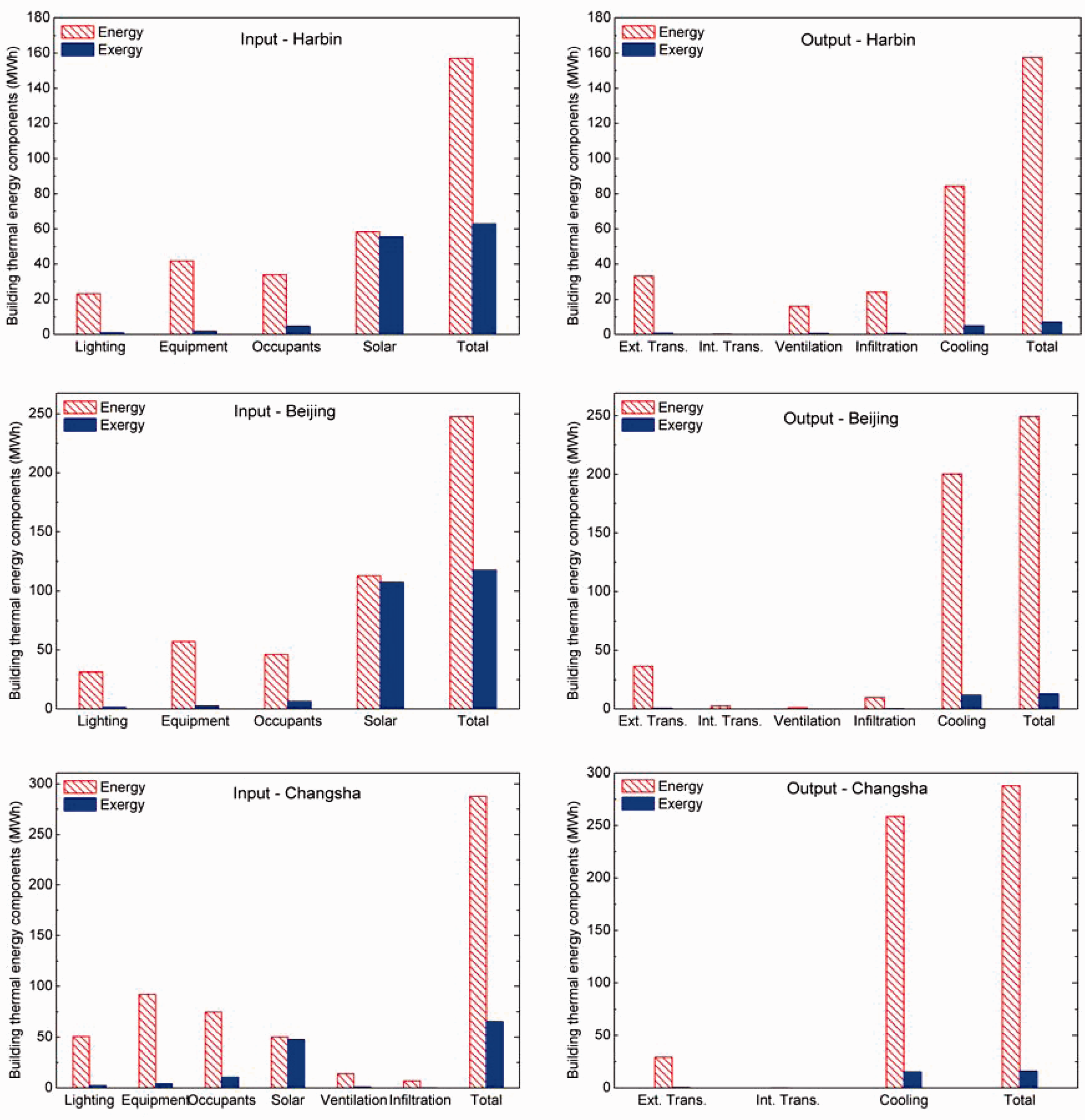
The infiltration and ventilation account for certain amount of the total thermal energy and exergy output in office building in each city. For instance, the infiltration heat loss is 191.69 MWh in the office building in Harbin, which is about one-third of the total thermal output. Thus, a better air tightness (i.e. less than 0.5 air changes per hour) may help to reduce the infiltration heat loss and the thermal energy load. The thermal energy loss by ventilation could be a significant heating source. For example, it could be used to preheat the fresh air. Even though the exergy value of infiltration and ventilation is of low exergy potential, these measures could also help to reduce the thermal energy and exergy load.
As shown in Figure 6, the thermal energy input is dominated by the heating energy in the office building in Harbin and by thermal energy from equipment used in the office building in Changsha, while for office buildings in Beijing, Kunming and Guangzhou, the thermal energy input is dominated by the solar gain. However, all the thermal exergy inputs are dominated by the solar exergy. Solar energy would heat up the indoor environment and help to reduce the building thermal load; however, this is transferred directly into the thermal energy of low exergy potential, resulting in most of the solar exergy loss. Thus, this is not an exergy efficient way to use the solar energy. Additionally, the solar exergy loss would dominate all the total thermal exergy loss within buildings. More energy and exergy efficient measures would be needed to make use of solar energy.
The internal gain, including the thermal energy from lighting, equipment and occupants, is 185.30 MWh in the office building in Harbin, 130.44 MWh in the office building in Beijing, 108.50 MWh in the office building in Changsha, 104.84 MWh in the office building in Kunming, and 69.29 MWh in the office building in Guangzhou, respectively. The internal thermal energy gain could contribute a great deal to the total thermal energy input. However, the exergy of internal gain from lighting, equipment, and occupants is 10.60 MWh in the office building in Harbin, 7.44 MWh in the office building in Beijing, 6.33 MWh in the office building in Changsha, 4.98 MWh in the office building in Kunming, and 3.12 MWh in the office building in Guangzhou, respectively. These are relatively small compared to the thermal energy, indicating that there is not much exergy potential present for the internal gains.
Building annual cooling load components
To get a better understanding of the thermal energy and exergy input and output components of the building cooling load, the major thermal input and output components are calculated and shown in Figure 8. Same as the heating load analysis, the exergy values of all the thermal energy input and output components for the cooling load are shown in Figure 8; these are much smaller than their energy value except the solar gain. Most thermal energy components show their low exergetic potential in the office buildings in all five cities across major climate zones in China.
As shown in Figure 8, the thermal energy input is dominated by the internal gain from lighting, equipment and occupants, which is 259.85 MWh in the office building in Guangzhou, 97.25 MWh in the office building in Kunming, 261.94 MWh in the office building in Changsha, 134.65 MWh in the office building in Beijing, and 98.74 MWh in the office building in Harbin, respectively. The solar gain also contributes a lot to the thermal energy input. However, the exergy value of the internal gain is low. From the energy analysis it could be concluded that cutting down the internal gain is as important as reducing the solar gain, whereas the exergy analysis shows that there is not much potential for the internal gain. Instead, the exergy of solar gain is of high exergy potential and would dominate the thermal exergy input. Meanwhile, the solar exergy loss would cause the main exergy loss. The solar gain should be cut down or captured for other use, such as solar hot water, electricity generation.
The total thermal energy and exergy output are dominated by the cooling energy from HVAC systems. According to equation (27), increasing the chilled water temperature properly would help to reduce the exergy loss of the cooling energy, and also benefit the energy and exergy efficiency of HVAC system.7,17 The exergy of external transmission would also contribute to the total exergy output, although it is relatively small.
Annual cooling load (
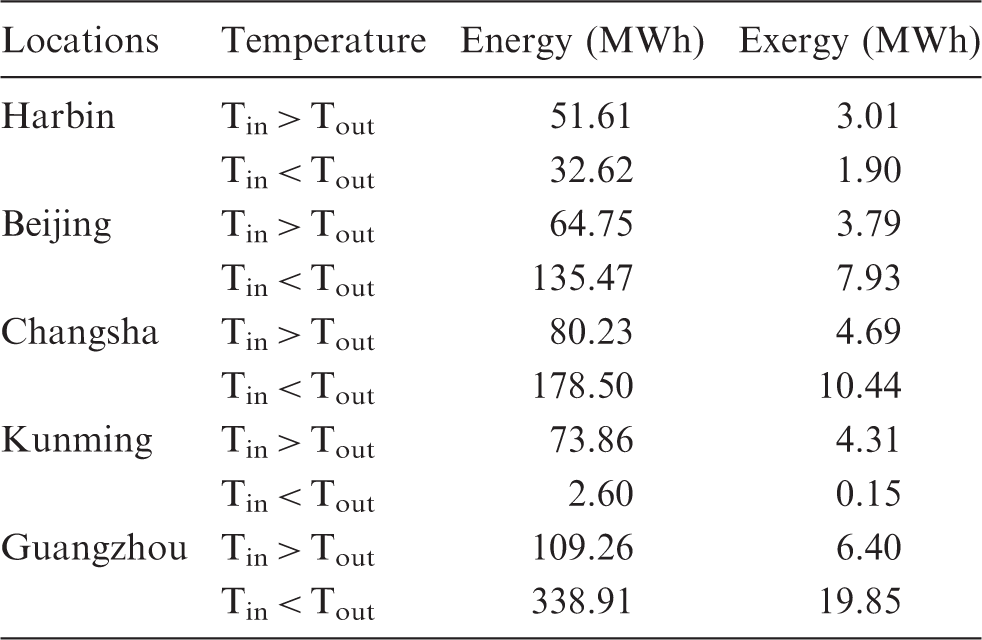
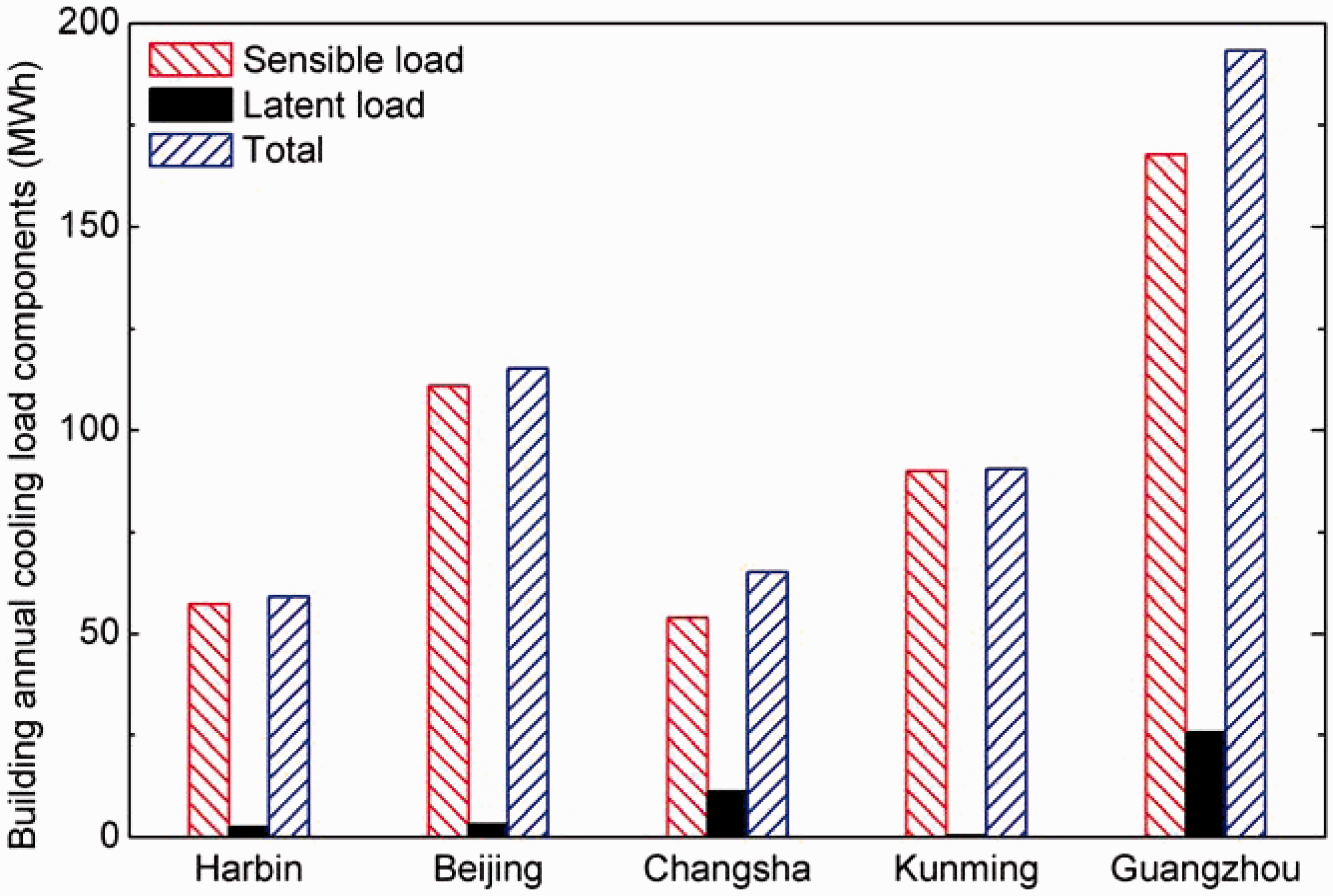
A summary of the sensible and latent energy and exergy loads is shown in Figures 9 and 10. The latent thermal load, both the energy and exergy value, could contribute certain amount to the total thermal load in office buildings in all five cities in different climate zones. The latent loads in office buildings in Harbin and Kunming and Beijing are relatively low compared to office buildings in Changsha and Guangzhou. In office buildings in Changsha and Guangzhou, the latent thermal energy and exergy load contribute significantly to the total building thermal load, which is 29.71% and 26.18% of the total thermal energy load and 17.17% and 13.27% of the total thermal exergy load in office buildings in Changsha and Guangzhou, respectively. This is because of the humid climate in Changsha and Guangzhou during cooling season. Thus, the latent exergy load cannot be disregarded for the thermal load and related energy flow analysis, especially for buildings in the humid climate.
Sensible and latent load during cooling season (energy value). Sensible and latent load during cooling season (exergy value).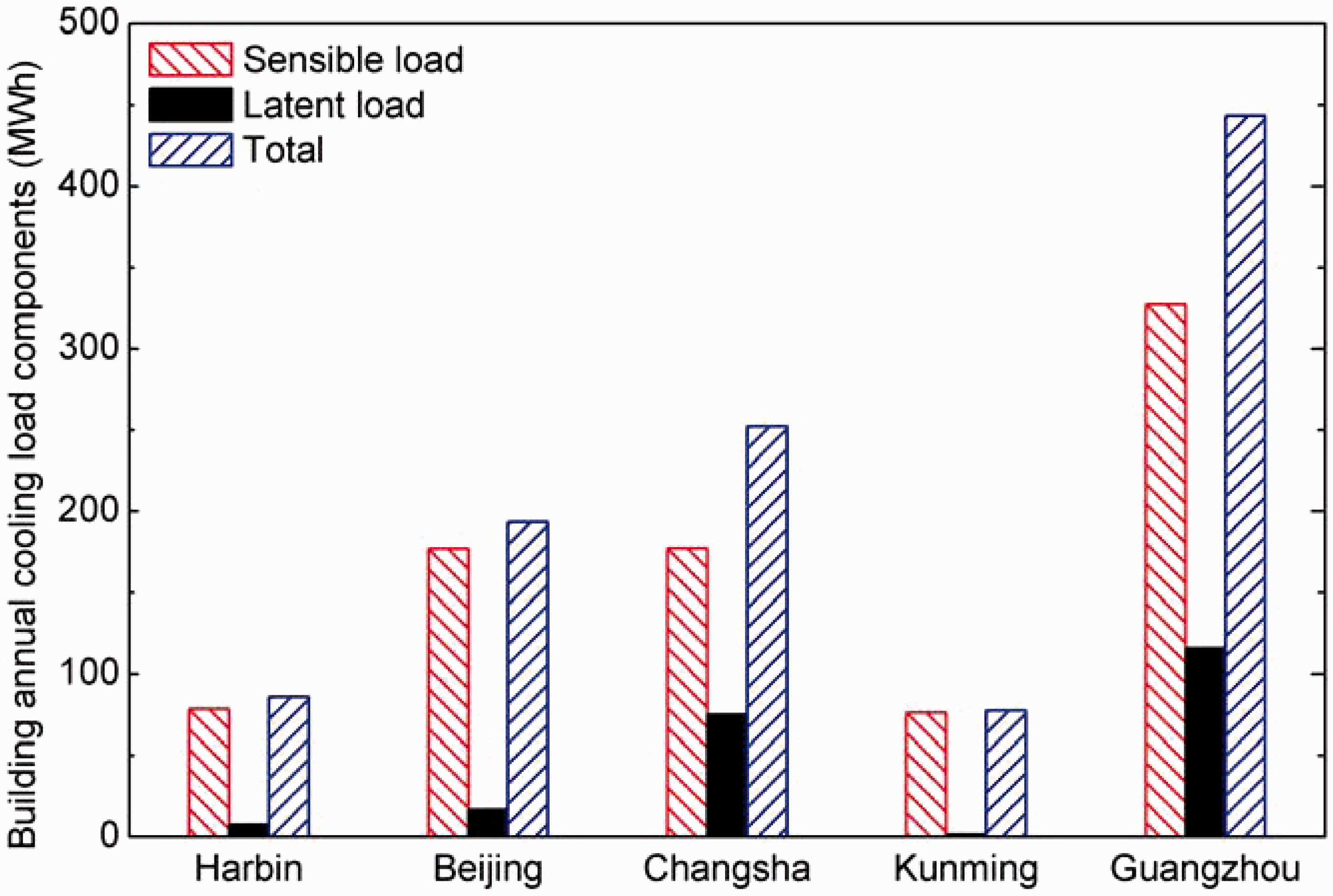
Conclusion
To reduce the building energy use radically, the building thermal load should be considered and optimised. The building thermal load should be quantitatively analysed and qualitatively investigated by the exergy method. The energy and exergy analysis of building thermal loads were conducted for office buildings in major cities in different climate zones in China to investigate the exergy losses. The major findings include:
The exergy load in all buildings across different climate zones is small, but always met by consuming high grade energy sources, indicating the great potential for improving the exergy mismatch between the energy demand and supply. Large exergy loss is noted in buildings in all five cities across different climate zones in China, which could not be observed through energy analysis. The exergy analysis of the building thermal load would help to investigate exergy destruction for related energy flows of building thermal load. The solar exergy loss was shown to dominate the total building exergy loss for both heating and cooling season. More exergy efficient method to utilise the solar energy would need to be considered. The latent exergy load could contribute to the building thermal exergy load, and cannot be disregarded, especially for the building in humid climate. The largest monthly heating load for buildings in major climate zones is found in January, while the largest monthly cooling load is found in July except in the office building in Kunming. The office buildings in Harbin and Guangzhou have the largest monthly heating and cooling load of 72.18 MWh and 83.95 MWh. The office building in Harbin has the largest annual heating load of 254.85 MWh, while the office building in Guangzhou has the largest annual cooling load of 448.17 MWh. However, the annual heating and cooling exergy load in office buildings in all cities are very low. Energy resources of low exergy value should be involved to meet the low building thermal exergy demand. The thermal energy and exergy output is dominated by external transmission heat loss during heating season in office buildings in all five cities. Enhancing the insulation in external surfaces especially windows would help to reduce heating energy and exergy load. However, a balance between heating load and cooling load should be considered. During the cooling season, the thermal energy output is dominated by the internal gain in reference buildings in all five cities. However, there is not much exergy potential present in the internal gain. Instead, the solar exergy would dominate the thermal exergy input during cooling season.
This study provides a comprehensive understanding of building thermal load from the perspective of energy and exergy analysis. Our findings will contribute to future building design to reduce thermal load and therefore reduce energy consumption. Further studies should focus on the impact of changing building envelope parameters on building thermal load. Additionally, how to couple the building envelope design and HVAC system to minimise the total exergy loss and improve the exergy efficiency would be an interesting topic for the future study.
Authors’ contribution
The manuscript was written through contributions by all authors. All authors contributed equally, and have given approval to the final version of the manuscript.
Footnotes
Declaration of conflicting interests
The author(s) declared the following potential conflicts of interest with respect to the research, authorship, and/or publication of this article: The article is an original research paper, and has not been published previously. It is not under consideration for publication elsewhere. The authors are all aware of its content and approve its submission. There is no conflict of interest in the research or in its publication.
Funding
The author(s) disclosed receipt of the following financial support for the research, authorship, and/or publication of this article: The authors appreciate the financial support for this research provided by the Natural Science Foundation of China (grant nos 51378186 and 51178170) and The National Science & Technology Pillar Program (grant no. 2015BAJ03B01).