






Abstract
A new comprehensive evaluation method for assessing the sustainability credential of central air-conditioning systems is proposed in this paper. The method is based on the relative coefficient index (K) of costs and benefits of the air-conditioning system. The paper introduces the concept and defined the parameters of costs (energy consumption costs, economic running costs and environmental impact) and benefits (indoor air quality and thermal comfort) and the mathematical principles for the determination and evaluation of these parameters. The parameters are then ranked with an index value for each component that make up the air-conditioning system, and the total index value would be used for the overall evaluation of the costs and benefits to determine the overall index, K. The feasibility of the method is illustrated by three case studies included in this paper. The evaluation index can identify shortcomings of components in the air-conditioning system and to identify the relative environmental impacts and costs as well as the performance in using the system. The evaluation index would thus allow designers and building managers to target performance improvements and guide designers to optimize functions in terms of costs and benefits to minimize environmental impacts. The index method would provide a rating classification of air-conditioning systems for standard specification and selection in terms of cost effectiveness for appropriate building service required.
Keywords
Introduction
In concomitant with the growing development of economy and technology, the world’s energy consumption has been increasing significantly. Building energy consumption accounts for about 25% of the national total energy consumption in China and many other developing countries. The energy used for air conditioning accounts for about two thirds of this consumption, and this has become an important government policy target to reduce energy intensity and CO2 emission in response to climate change.1,2 There is an urgent need to provide a system that can comprehensively evaluate the sustainability credential of central air-conditioning system, so that we can identify efficient systems to enable energy saving as well as to reduce impact on our environment while still providing affordable air-conditioning function for our social needs such as comfort and air quality in our homes and office environments.3–5
Some scholars have developed evaluation index systems for assessing central air-conditioning system in relation to their national climates and energy consumption costs. Li and Yang 6 used a grey multi-hierarchical evaluation method to establish a mathematical model for optimization selection of an air-conditioning scheme, including a consideration of air-source heat pump system, household gas air-conditioning system, air-cooled chiller unit with gas boiler system, water loop heat-pump system, ground source heat pump system and solar-assisted heat pump system. Sun et al. 7 studied the criterion of validity for large temperature difference between the evaporator and the condenser air-conditioning system. The energy consumption of these air-conditioning systems with large temperature gradient was compared with the conventional air-conditioning systems based on the initial investment. The evaluating indexes were established for these air-conditioning systems, including the basic theory of thermodynamics, the variable condition of the main equipment and the energy consumption rate.
Avgelis and Papadopoulos 8 use energy consumption, thermal comfort of room occupants and indoor air quality (IAQ) to develop a net present value index to evaluate the performance of air-conditioning system for the rating of optimized air-conditioning systems.
The index systems reported so far in the literature have not considered comprehensively all the parameters to combine the criteria into a coherent rating system. Most studies emphasized one parameter such as energy consumption and developed index for the evaluation and did not associate the various parameters and issue criteria for general assessment of their environmental and sustainability credential, especially the social and economic cost issues. However, these reported evaluation indexes have provided the basis and guidance for our comprehensive evaluation method.
As the society in China is becoming more advanced with higher social, economic and environmental expectations, people have a higher requirement on their living standards, demanding better, more comfortable living environment and working space, while saving energy consumption and reducing environmental pollution for a living environment for their families. The heating, ventilating, air-conditioning (HVAC) system is very important for buildings in sub-tropical and tropical climates and is a major contributor to energy consumption,2,9–11 and there have also been reports that air conditioners could have an impact on health of occupants.12–17 As well as the energy consumption and CO2 emission issue that are associated with the use of HVAC system, the use of refrigerant for air cooling would also pose greenhouse warming (global warming potential, GWP) and stratospheric ozone depletion potential (ODP) problems on the global environment.18–23 Therefore, there is a requirement to develop a comprehensive system that could link all the parameters into rating issues for an evaluation of air conditioners, and this evaluation system could become a part of a national standard for HVAC systems.
The establishment of a comprehensive evaluation system
Central air-conditioning system mainly consists of a cold–heat source, dispatch system and terminal equipment. The performance of the air-conditioning system can be assessed by five parameters. The impact of each of these parameters can be considered hierarchically.24,25 The model of the comprehensive evaluation parameters system is illustrated by the diagram given in Figure 1.
Hierarchical assessment of parameters for a comprehensive evaluation index system.
Evaluation of central air-conditioning system
The evaluation of the central air-conditioning system can be divided into costs (C) and benefits (B). The ratio of overall benefits and costs can be used to provide a comprehensive evaluation index for the whole life of the central air-conditioning system. Obviously, the greater the ratio is, the better the overall performance. The integrated comprehensive evaluation index (K) is defined by equation (1) as follows
In equation (1), B refers to the benefits due to an improvement of IAQ and thermal comfort due to the use of the central air-conditioning system; specifically, these benefits are determined by (i) thermal comfort and (ii) IAQ. C is the costs of (a) energy, (b) economic and (c) global environmental impact.
For developing the linkage of indexes, a grading system is required to provide a comprehensive evaluation index for the association of the overall parameters. However, there is a need to evaluate the performances of the five parameters contributing to the index system.
Evaluating the energy consumption cost, economic value and global environmental impact
Coefficient of energy consumption (CEC) has been introduced to evaluate the energy consumption of air-conditioning system.
26
The CEC as defined by equation (2) can be derived The specified CEC for air-conditioning products allowed for use in Japan.
27

The total annual energy consumption of an air-conditioning system (air-conditioning load) includes the equipment’s overall annual energy consumption for cold–heat source, cooling tower, fan, water pump, etc.
29
The hypothetical air-conditioning load consists of solar radiation heat, internal load and fresh-air cooling load. The calculation of the air-conditioning load can be defined by equation (3),
29
and equation (4) provides the annual air-conditioning load
BIN is a method for linear data processing, supposing the building envelope load can be transformed into the linear relationship of outdoor temperature as given by the equation (3), then we can calculate the coefficients a, b, c and by multiplying CL by the corresponding time frequency (m), the annual hypothetical air-conditioning load can be derived as equation (4). The calculation of time frequency should use BIN meteorological parameters, which use the annual outdoor dry-bulb temperature of the location where the air-conditioning system is installed to report the temperature at certain time intervals.
29
The economic cost of the air-conditioning system should include a consideration of the initial investment cost and annual operating cost. Using the dynamic annual cost method would thus link the investment and annual operating cost, which should also include a consideration of the time factor. The cost can be calculated by equation (5),
30
as follows
In this equation, AC is equal to the overall cost; K0 refers to initial investment cost; KL refers to the salvage value after economic life; C is the annual operating cost; i is the benchmark discount rate (depreciation), which generally is about 10%
30
; and n is the total number of years the system would be used throughout its operation life, taking into account the percentage of its operation.
Total Environmental Warming Impact (TEWI) has been used to determine the direct effect (DE) of emission of refrigerant on GWP and the indirect effect (IE) of CO2 emission due to energy consumption of the refrigerator.31,32 The relationship of the GWP with the DE is defined by equation (6), and the energy consumption due to IE is defined by equation (7). Equation (8) defines the combined effect of DE and IE
32
In equation (6), L is the annual amount of refrigerant leakage; N is the number of years (y) of operating the refrigerator; M is the charged volume (m3) of the refrigerant and a is the refrigerant’s loss (or discharge) rate (m3/h) at the end of life when the refrigerator is disposed or discarded.
In equation (7), E refers to the annual power consumption, kWh/a, of the refrigerator; and b is the mass of CO2 emissions due to the consumption of 1 kWh electricity, kgCO2/(kWh).
Evaluating the benefits of thermal comfort and IAQ
There can be many factors that could affect thermal comfort. The predicted mean vote (PMV) and predicted percentage of dissatisfied (PPD) are used in the ISO 7730:2005 standard
33
to describe the thermal environment. The recommended scale of PMV and PPD is −0.5 to +0.5. The related equations (9) and (10) for determining PMV and PPD are as follows
34
IAQ can be determined based on an index model35,36 defined by equation (11), as follows
A new comprehensive evaluation index system
The evaluation of the parameters (energy consumption cost, economic cost, global impact, IAQ and thermal comfort) has been defined above, and these values can be integrated into a comprehensive, mutually associated index system to determine the overall sustainability credential of the central air-conditioning system.
Details of the grading system
Thermal comfort index Table 2 shows the grading of the thermal comfort index based on the ‘architectural classification of human thermal comfort index PMV and PPD’.
34
The thermal comfort index.
34
PMV: predicted mean vote; PPD: predicted percentage of dissatisfied.

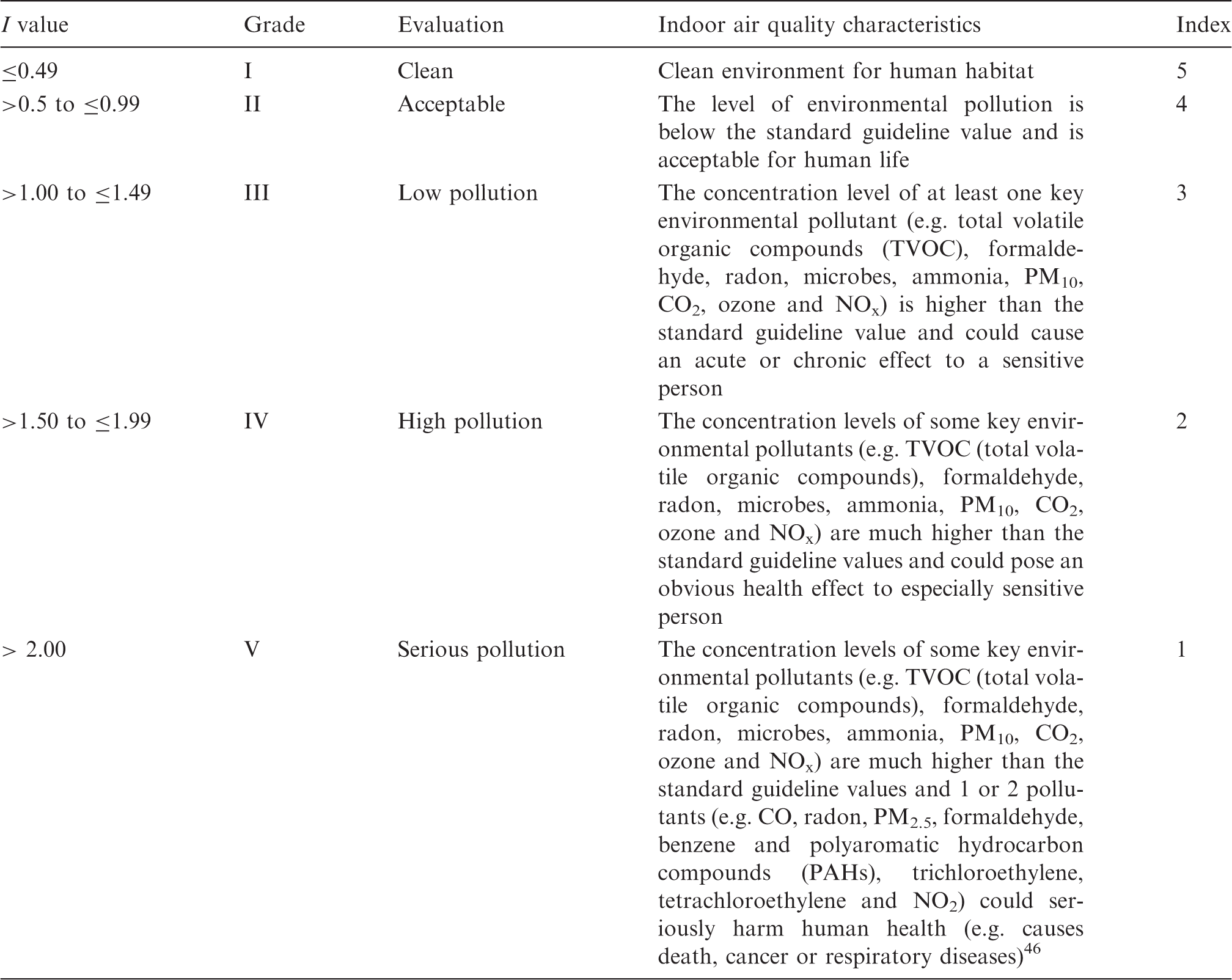
Economic cost index
The energy consumption index.
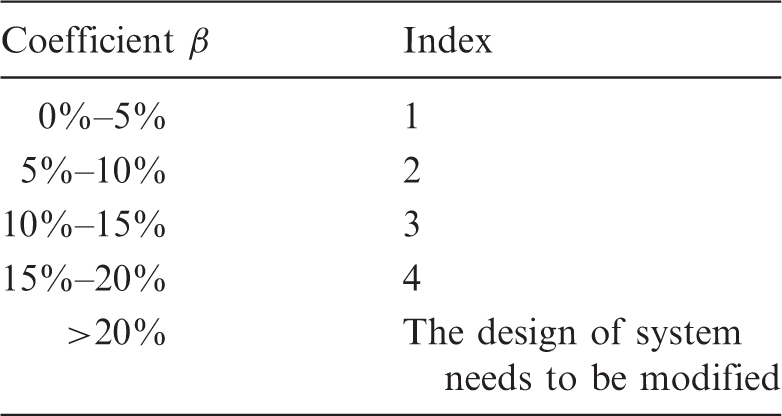
Different systems can correspond to different building areas and air-conditioning loads, so the cost cannot be easily compared. Initial investment and operating cost are often contradictory. In general, an energy efficient central air-conditioning system should have a low operating cost but would often have a large initial investment value. In order to evaluate the cost for equitable comparison, an energy cost coefficient, α is introduced, and this is defined by equation (12), as the ratio of the overall cost (AC) to the total energy consumption (E) per overall areas (A) served by the air-conditioning system
An example of a cost breakdown of the various components of an air-conditioning system. 47

Note: the above costs are converted into the costs of a 10,000 m2 air-conditioning area so that we can calculate the α′.
When α is bigger than the critical value, α′, the index value would be 2, otherwise is 1.
Global environmental costs index The value TEWI is related to the GWP of refrigerants, and the coefficient of performance (COP) of the refrigerator–air conditioner. The bigger the energy consumption coefficient, the smaller would be the performance coefficient. The bigger the performance coefficient of the refrigerator, the smaller the value of TEWI.
32
According to the requirements of the Chinese standard, HJ2531-2012, ‘environmental standard product requirements for industrial and commercial refrigeration equipment’,
48
the ODP and the GWP of any refrigerator should be 0. When meeting this requirement, the value of TEWI is determined by refrigerator’s COP. The requirements of HJ2531-2012 for the refrigeration equipments are shown in Tables 6 to 8.
48
For other countries, the refrigerator’s COP should be defined by their relevant national standard; e.g. in USA, the 2012 and 2015 ASHRAE Handbook on HVAC and HVAC applications49,50 and in UK, CIBSE Guide B.
51
The COP requirements for the LiBr absorption chillers.
48
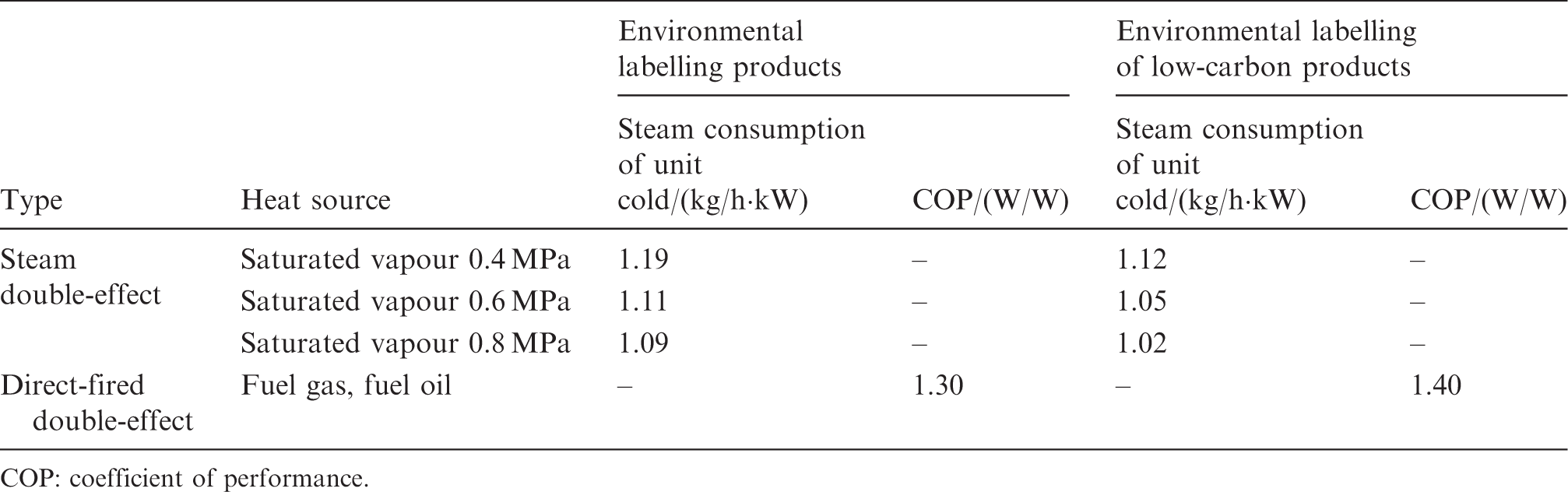
COP: coefficient of performance.
The COP requirements for the air-source heat pump water heater. 48
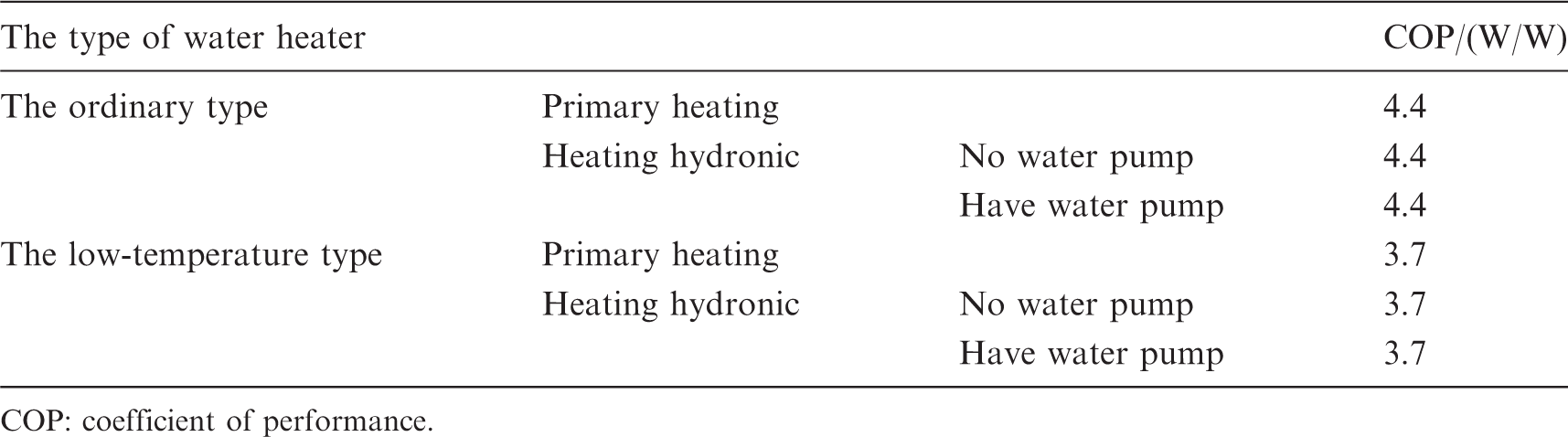
COP: coefficient of performance.
The COP requirements for the water-source heat pump unit. 48
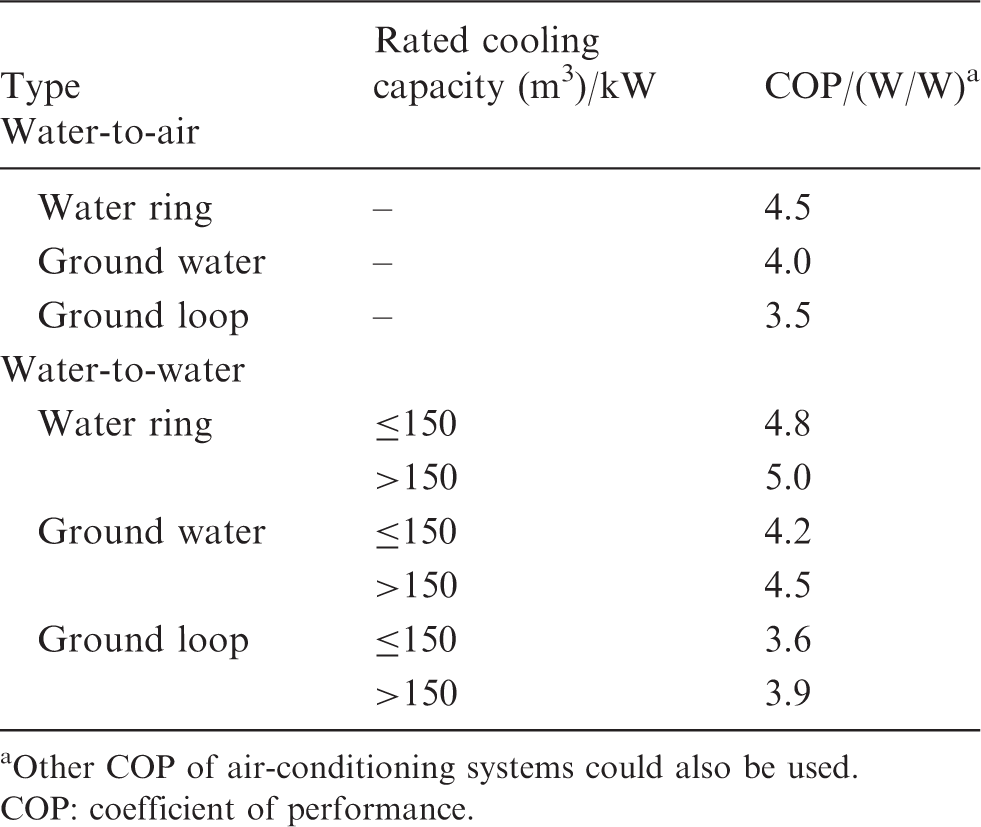
Other COP of air-conditioning systems could also be used.
COP: coefficient of performance.
The index value attributed to the global environmental impact of a central air-conditioning system is as follows: If the ODP and GWP of the refrigerant is 0 and the unit’s COP meets the requirements of HJ2531-2012, the index value is 1. If the unit does not meet either of these requirements, the index value is 2, and if the unit meets neither of these requirements, the index value is 3.
Case studies
Parameters of modular air-cooled heat pump units.

Pollutants concentrations in the central air-conditioned space of project no.1.

IAQ: indoor air quality; TVOC: total volatile organic compounds.
Parameters of the screw water source heat pump unit of KNG-80.

Pollutants concentrations in the central air-conditioned space of project no.2.

TVOC: total volatile organic compounds; IAQ: indoor air quality.
Parameters of the screw water source heat pump unit of LSBLGHP610/M.

Pollutants concentrations in the central air-conditioned space of project no.3.

IAQ: indoor air quality.
Overall index values for the evaluation of the three project case studies.

COP: coefficient of performance; ODP: ozone depletion potential; PMV: predicted mean vote; PPD: predicted percentage of dissatisfied. K1, K2 and K3 are derived from equation (1) as a ratio of the benefits against costs of projects no. 1, 2 and 3.
Discussion
A comparison of the three cases shows that the comprehensive evaluation index (K) of the three projects is greater than 1, that is to say the score index for benefits is greater than the score index for costs. So the comprehensive performances of the central air-conditioning systems for these three projects are satisfactory and would have relatively good sustainability credential.
The K index value of project 1 is greater than project 2 and 3, that is to say, the sustainability credential of the air-conditioning system for project 1 is better than project 2 and 3. However, the economic cost of air conditioning in project 1 would need to be improved in comparison to the system used for project no. 2 and 3, and the IAQ and global environmental impact of the system used in project no. 1 and 3 would need to be improved in comparison to the system used for project no. 2. The IAQ is not within the specified limit of the national standard for benzene and carbon dioxide, showing the relatively lower efficiency of the air-conditioning system used in project no. 1. Although the energy consumption of the air-conditioning system of project no. 1 is less than the system used for project no. 2 and 3; the operation cost is higher and the system is demonstrably less efficient in performance than the system used in project no. 2 and 3.
Conclusion
A comprehensive index system has been developed for the evaluation of central air-conditioning systems. The system combined the parameters relating to costs and benefits of the system by integrating the index value of each of these parameters into a grading coefficient index (K) for the evaluation of the sustainability credential of the air-conditioning system.
The index evaluation can identify shortcomings of components of the air-conditioning system and would also identify the relative environmental impacts and costs as well as providing an insight into the benefits of IAQ and comfort in using the system. The system would thus allow designers and building managers to target improvement in the performance of the conditioning system and guide designers to optimize functions of the central air-conditioning system in terms of costs and benefits to minimize environmental impacts.
The comprehensive index can be used as a grading value for rating classification of air-conditioning system for selection for any building development, where the consumers such as the building owners, designers, and building managers would have the benefit to identify the cost-effective system for the appropriate building service operation for their buildings.
Footnotes
Authors’ contribution
All authors contributed equally to the preparation of this manuscript.
Declaration of Conflicting Interests
The author(s) declared no potential conflicts of interest with respect to the research, authorship, and/or publication of this article.
Funding
The author(s) disclosed receipt of the following financial support for the research, authorship, and/or publication of this article: This project was financially supported by the National Natural Science Foundation of China (Grant no.51274098; 51308206); and the State Key Program of National nature Science of China (Grant no.51134005); and the Natural Science Foundation of Hunan Province, China (Grant no. 12JJ8009).