







Abstract
Innovations in materials, construction techniques and technologies in building construction and refurbishment aim to reduce carbon emissions and produce low-energy buildings. However, in-use performance consistently misses design specifications, particularly those of operational energy use and indoor environmental quality. This performance gap risks reducing design, technology, sustainability, economic, health and well-being benefits. In this paper, we compare settings of the Chinese and the UK buildings sectors and relate their historical context, design, construction and operation issues impacting energy performance, indoor environmental quality, occupant health and well-being. We identify a series of key, common factors of ‘total’ building performance across these two settings: the application of building regulations, the balance between building cost and performance, skills, construction and operation. The dynamic and complex interactions of these factors are currently poorly understood and lead to building performance gaps. We contend that a systems approach in the development of suitable building assessment methods, technologies and tools could enable the formulation and implementation of more effective policies, regulations and practices. The paper illustrates the application of the approach to the UK and Chinese settings. A full application of a systems approach may help to provide a more dynamic understanding of how factor interactions impact the ‘total’ building performance gaps and help address its multiple causes.
Introduction
The transition to a low-carbon economy will see trillions of dollars invested to improve the energy performance of the global building stock, a sector that is estimated to account for over 40% of total global greenhouse gas (GHG) emissions. 1 Developed economies with large historic building stocks and low growth of new buildings, primarily focus on energy demand reduction through retrofit and refurbishment of existing structures. Fast developing economies (e.g. China) focus on reducing the energy requirements of new buildings that both replace and expand their building stock.
Buildings are also part of wider socio-economic activities and cultural practices, and as such, part of the transition to a low-carbon economy. The current drive to reduce carbon emissions, improve environmental conditions and produce low energy use buildings has led to innovations in design, materials, construction techniques and technologies. Additionally, these innovations can help minimise the outdoor environmental impact of new construction and refurbishment of existing buildings. However, despite these innovations, building operational energy use often fails to meet the design performance targets. Furthermore, the energy performance gap alone does not capture the full impact of buildings on occupants and the wider environment. The total performance gap may also impact occupant well-being and indoor environmental quality (IEQ). 2 IEQ is slowly becoming a key driver in the design, development and operation of buildings and is being further emphasised with the rise of the ‘well-being’ agenda. Nevertheless, both energy performance and IEQ lag behind other components of building performance and are not addressed with the same level of emphasis as other topics such as material and construction processes. 3 This is because the present building design, construction, operation and management practices are not well suited to deliver against manifold building performance attributes and to protect occupants’ health. Adaptive design strategies that involve the end-user in the design process and allow for future changes that could potentially assist with this issue are rarely used.4–6
Building construction, policy formulation and policy application processes focus on a limited range of building performance attributes, and they do not account fully for the complex and dynamic inter-relations between them. The combined development pressures of building regulation compliance, along with design and construction industry practices tend to push towards buildings that fall short of the desired outcomes and leave a number of performance ‘gaps’.7,8 It is partly due to our limited understanding of the building stock and its wider context as a dynamic system that makes these processes prone to failure and negative unintended consequences. 9 It is thus imperative to adopt a wider building performance perspective as buildings play a crucial role in many aspects of people’s lives.
Buildings need to provide a safe and comfortable indoor environment and achieve a high level of energy performance. A system approach that encompasses a range of developmental, institutional, operational and socio-cultural facets is urgently required. 10 Many published studies capture household energy consumption and CO2 emissions,11,12 but they focus somewhat narrowly on electricity consumption and emission reduction and miss a truly multi-objectives, systems approach on total building performance. Such an approach is needed to capture the interactions that act on the delivery and operation of high performance buildings. 3
This paper proposes a systems approach to investigate and understand the critical components of the ‘building construction system’ in order to achieve the intended building energy and environmental performance standards. The systems approach has been applied in two different contexts – the UK and China. The current focus in China is on rapid economic development, which drives new building construction. In the UK, new building construction remains a small proportion of the total building stock and instead, investment in refurbishment continues to be the primary means of change. The paper provides a brief review of the historic context of energy and environmental building performance in the UK and China. This illustrates the complexity of the underlying drivers that influence building design, construction and operation in both cases. Institutional and contextual drivers, in particular, are important in order to understand their influence on building performance improvements. Developments in these two building drivers affect building energy performance and IEQ but they are slow and at times fractured. A number of key issues are identified in the UK and China. The combination of drivers and issues in each case can lead to missed carbon emission targets and unintended consequences across a range of outcomes beyond IEQ.2,9
Understanding the impact of these drivers is the goal of the total performance of buildings (TOP) project, 3 which adopts a systems approach to evaluate building performance that spans regulation and its evolution, industry actors and their interactions, building project development and management, and seeks to address the question: Is it possible to both reduce the energy demand of our building stocks and achieve good IEQ? The project includes within various aspects of the ‘total performance gap’ energy-use design shortfalls, and impacts on IEQ, among others. Additionally, the TOP project explores the notion of a dynamic relationship occurring between different factors and that the gap is in fact a socio-technical-economic and regulatory-driven phenomenon. Based on a literature review and workshops carried both in the UK and China, we provide insights into the processes and priorities that have resulted in the current Chinese and UK building stocks and main issues that must be tackled in order to achieve the necessary ‘total’ performance, i.e. reaching energy consumption targets and maintaining IEQ.
Overview of China building stock
China has one of the youngest building stocks in the world due to the rapid growth from the 1970s onwards. China currently has an unprecedented rate of urbanisation, which has increased from 37.7% in 2001 to 55% in 2014. Hundreds of millions of people moved from rural areas to cities, and new buildings construction has resulted in over 1.5 billion m2 being built annually from 2001 to 2014. 13 In 2014 alone, 2.89 billion m2 of floor area were added, 75% of which were residential buildings and 25% were non-domestic buildings. Current estimates show that by 2020, the total floorspace in China could reach 70 billion m2. 13 However, the newly constructed building stock is not necessarily the most energy efficient (EE), nor does it consistently provide a healthy/comfortable indoor environment due to a lack of building efficiency research and construction experience. 14
Traditionally, building materials have followed regional resource availability, having tended towards brick and stone buildings in the central temperate regions, with wood being prevalent along coastal areas. Since the Chinese Economic Reform and Openness programme in the 1970s, the use of concrete, steel and glass became the typical building materials of choice for the majority of construction in growing urban areas.
Regional climate variations are substantial due to China’s large territorial area and have significant impacts on the built environment. China is divided into five climate zones that are related to: the average temperatures in July and January, the annual number of days with daily average temperature higher than 25°C and those lower than 5°C.1,15 Key indicators of each climate region are illustrated in Figure 1. This results in diverse demands for buildings.
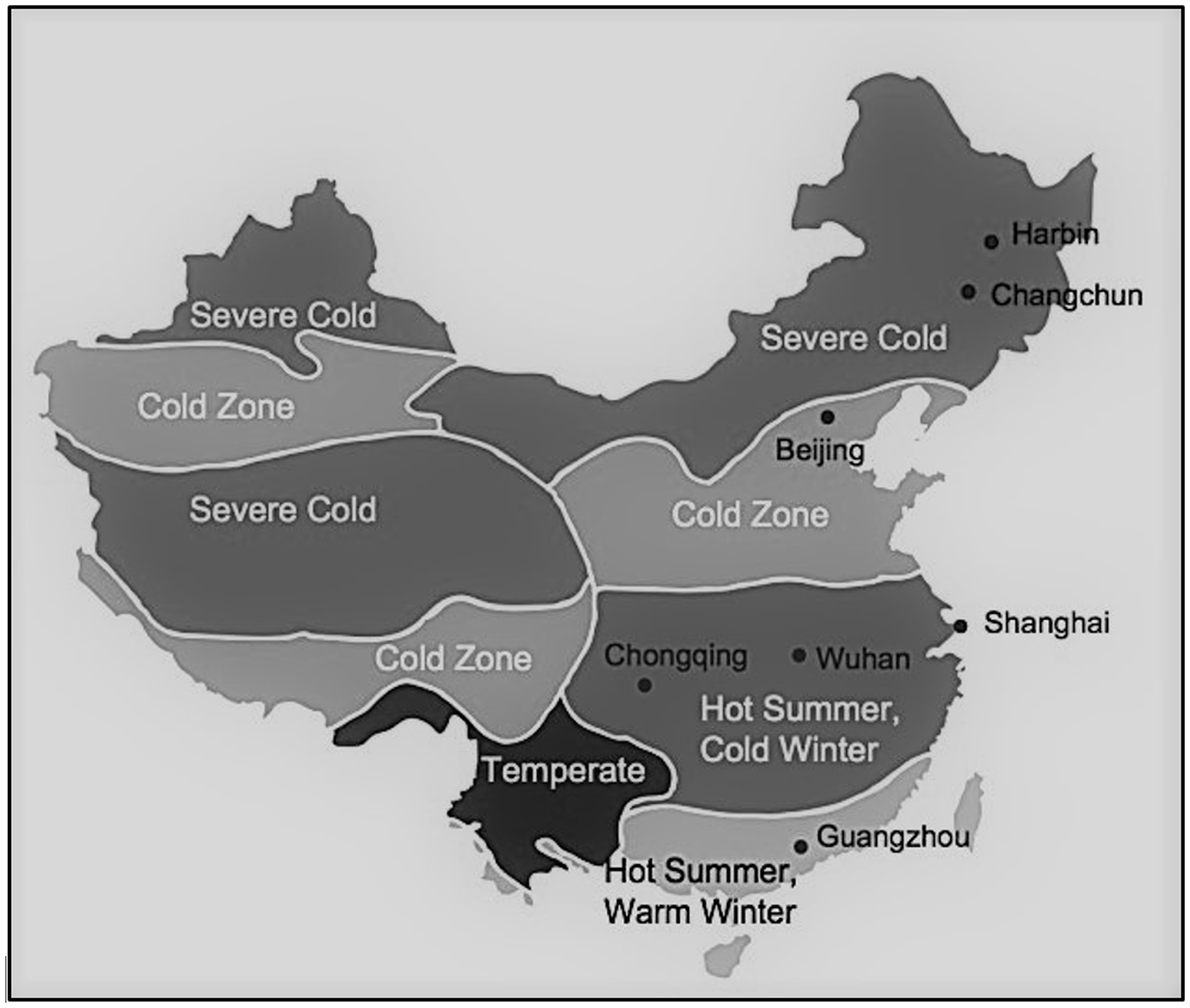
Climate regions in China. 15
Building energy performance is significantly influenced by building type and regional climate conditions. Building energy performance in China is typically divided into four categories to account for variations between urban and rural building types and living styles, differences between residential and non-domestic buildings’ occupant behaviour. Each climate category seen in Figure 1 uses roughly 25% of the total energy consumption. However, due to increasing building stocks and average energy intensity, non-domestic buildings have become the largest energy users. Overall, the building sector accounts for 20% of China’s total energy consumption and 30% of its GHG emissions. 16
China: Institutional/regulatory developments in building energy performance
Policies to reduce building energy consumption and to develop low carbon cities are considered as an important mechanism to curtail Chinese carbon emissions. Government policy and subsidy in China is a primary driver for the development of ‘green’ buildings in China. The term ‘green buildings’ refers to the creation of a comfortable and healthy indoor environment with reduced environmental impact. It encompasses energy and IEQ performance and is rapidly developing in China. President Xi in his speech during the UN Conference on Climate Change 2015 stated that China would adopt new policy measures to develop green buildings 17 and confirmed the launch of a climate-smart/low-carbon cities initiative in the U.S./China Joint Announcement on Climate Change. 18
Historically, standards for building energy efficiency and indoor environmental (IEQ) were developed separately, with little interaction between ventilation control of fresh air, temperature and relative humidity. 19 In 2006, the national standard – Evaluation Standard for Green Buildings (GB/T 50378–2006) came into effect, and for the first time considered both energy efficiency and IEQ. The subsequent 2014 version (GB/T 50378–2014) included construction and operation management factors, in the assessment of operational green buildings, as well as local resources, climate, economic and cultural factors. 20
China: Institutional/regulatory developments in IEQ
Historically, the IEQ of Chinese buildings in both urban and rural areas was dominated by specific pollutants (PM10, SO2, CO, NOx) related to the use of coal for both individual and district heating. 19 In urban areas, households have subsequently transitioned to a greater use of liquefied petroleum gas (LPG), piped gas and electricity for the majority of building service requirements. 19 Outdoor pollutants from industrial processes and transport (e.g. PM10, PM2.5 and NOx) have rapidly increased and currently present the dominant external air pollution source experienced indoors which vary depending on location and time of year. Indoor sources in new buildings and refurbishments include volatile organic compounds (VOCs) emitted from the use of plastics, polymer floors and wall coverings, synthetic wood and cleaning products.20,21 The increased use of mechanical cooling has led to a reduction in ventilation rates in warmer periods that can compound further analysis and impact the problem of indoor sources of pollution and lead to poor IEQ. 21 For example, research shows that concentrations of benzene, toluene and xylene (BTX) can pose serious risks for occupants’ health in renovated and old dwellings in Beijing. 19 The concentration levels of benzene and toluene are notably higher in the renovated dwellings. Another study on 43 newly renovated dwellings in Guangzhou in China also found higher BTX concentrations. 22 However, as these pollutants generally originate in the external air, their presence is likely a function of the ventilation of buildings and not indoor sources. Additionally, BTX are not necessarily the pollutants with the most significant health impacts and an impact assessment is required. 22
China has standards for IEQ and for the use of harmful compounds related to building materials from the Ministry of Health, the China State Quality Supervision-Inspection-Quarantine Administration and the Ministry of Construction, the Labelling Committee. 19 The first regulation for IEQ, primarily dealing with indoor air quality, was launched in 2003 (Code for Design of Heating, Ventilation and Air-conditioning, GB50019–2003). Current standards exist to control IAQ throughout the design, build and operational stages.
China: Current trends of construction and performance drivers
On 1 January 2013, the Green Building Action Plan was issued by China’s State Council setting up short-term goals for green building development: that certified green buildings should reach 1 billion m2 by 2015, accounting for 20% of newly built buildings. 23 On 16 March 2014, the Central Committee of the Communist Party of China and the State Council, issued the National Plan on New Urbanization (2014–2020) and announced that by 2020, more than 50% of newly built buildings should be certified green buildings. 23 Based on these two national plans, local government set up specific short-term (by 2015) and middle-term (by 2020) goals for the development of green buildings in each province. However, various regions within China have vastly different levels of building energy consumption, primarily due to differences in climate (Figure 1). In addition, metering and payment systems for energy vary. This has led to a range of responses to EE products, with some areas, particularly in northern China resistant to new technologies. 24 The transition from a planning economy to a market economy also plays an important role. For example, the government used to pay for the cost of domestic heating in northern China. Currently, payment is determined according to the square floor area that needs to be heated. The current system of energy payments is being changed to the one based on how much heat is consumed, which provides an incentive to reduce the energy consumption. 25
The Chinese government has launched several policies to promote building energy efficiency and green building development to realise the short-term and long-term goals. A financial subsidy programme is in place to address the cost of certification. It subsidises the construction of green buildings with 45 RMB/m2 for two-star buildings and 80 RMB/m2 for three-star buildings. (RMB – Renminbi – ‘the people’s currency’ refers to the Chinese yuan). Originally, the green building standards were recommended standards only; however, certification became compulsory from 2014 for buildings larger than 20,000 m2, all state-owned office buildings, commonwealth buildings, and social housing in municipality cities and provincial capital cities. By June 2014, about 1500 buildings had been certified as ‘green’, with a total floor area of more than 170 million m2. 26 Systematic building energy surveys in addition to energy efficiency monitoring are needed to enlarge the scope of surveyed cities and sampled buildings across different climate zones in order to compare the energy consumption between green and non-green buildings.24,27
The new standards and ratings make building energy efficiency a more prominent issue, but the market has yet to catch-up and the mechanisms, supply chain and skills necessary to bring products to market are currently lacking.23,27 Where such buildings could potentially exist, the market is not clearly formed and a lack of market guidance means that the advantages of EE buildings would be overlooked and remain a low priority among potential buyers, in part because they are not promoted sufficiently. 25 There is a lack of trained personnel able to provide budget estimates for energy efficiency buildings and a lack of effective supervision in the design and construction of buildings. This is compounded by the current lack of skilled construction and installation workers which has led to fewer buildings being rated as EE. This is due in part to a mismatch between design and actual construction that affects the actual energy saving. 25 To compound this, property developers have under-estimated the demand for EE buildings from property buyers and so do not always develop with this criterion in mind.
Advances in building science research and regulation updates constitute further key drivers of building performance. Building regulations, standards and codes for energy performance of buildings in China are typically subject to update in accordance with revisions of the Five-Year Plans. Recently, researchers and policy makers in China have been developing the Standard of Energy Use in Buildings, with the aim to establish an upper limit for operational energy consumption of buildings. 28 This would be an important step indicating a shift from ‘how to do’ to ‘how much energy is used’ in building energy policy in China.
Another driver of building energy consumption is the rise in income and life style changes, which significantly affect demand and expectations for better IEQ. 27 This brought the government under pressure to enforce stricter laws to limit occupant exposure to harmful compounds related to materials used in achieving energy savings. This requires more research on the interaction of low-emission energy and changes in thermal comfort levels on IEQ. 19 Additionally, other emission sources such as cooking, heating and use of cleaning chemicals should be considered as well as impacts of ventilation.
In addition to building pathologies, occupant behaviour and comfort expectations are key determinants of the energy performance gap, especially in new EE buildings.29–32 Comparative studies of building energy performance in contrasting socio-economic contexts provide useful insights about the effect of human behaviour. The ratio of energy prices to per capita income in China has steadily come down in recent years, thanks to the rapid economic growth, and this may lead to a rebound effect on household energy use, similar to what has been identified in North America and Europe. Other factors such as intensive office equipment use and longer working hours may also contribute to the performance gap in the non-domestic sector in China. 33
A review of most recent building codes identified a number of improvement areas for application of standards to improve energy performance: (i) building envelope and heating, ventilation and air conditioning system efficiency requirements, (ii) introduction of a compliance pathway focused on whole-building performance with the aim of narrowing the performance gap and (iii) introduction of inspection and commissioning requirements in the operation phase. 28 A summary of main issues faced by China today that need to be addressed in order to improve building performance follows.14,25,33,34
Key issues for China
Recommended (not enforced) standards exist for green buildings, except for state-owned properties and those above 20,000 m2 floor area. Difference in the degree of acceptance of building EE products in different regions – related factors such as metering and payment system for heating in northern China; the different levels of building energy consumption and varying climate characteristics. The mismatch between design performance of building and actual construction affects the actual energy saving. The lack of proper budget estimation for energy efficiency buildings due to a shortage of trained personnel. The lack of market guidance for EE buildings causes a lack of awareness of benefits of such buildings on the property market as they are not promoted enough. Property developers have under-estimated the demand for EE buildings from property buyers and so do not always develop properties with this criterion in mind. The lack of skilled construction and installation workers has led to few buildings being rated as EE. There is a lack of effective supervision in the design and construction of buildings, lack of skilled persons responsible for this supervision and management, corruption undermines existing supervision and limited legal support to enforce supervision.
These issues taken together point towards a link between the lack of a clear market demand signal for green buildings in Chinese industry and low or no investment in these factors that would improve the value offered by green buildings in Chinese market, such as better training and supervision of personnel involved in green building projects and budget estimation. This forms a closed feedback loop that operates as a vicious circle. The lack of a clear market signal leads to low investments and low value offered in green buildings which keeps market expectations low and reinforces the status quo. The same feedback loop could operate as a virtuous circle as well and the question is how to bring about this transition from vicious to virtuous circle in Chinese Industry. The aggregate effect of this loop is that it is hard to change the industry orientation towards sustainability.
Overview of the UK building stock
Unlike China’s rapid development, the UK has an established building stock, among the least EE in Europe. 35 The UK climate is classed as ‘temperate maritime’ and experiences a seasonal temperature range of 8–11°C across the UK. 36 This has meant building energy performance standards are comparatively not as stringent as in colder European climates.
The building stock is among the oldest in Europe as half of all non-domestic premises were built before the Second World War. New building construction generally remains a small proportion of the total stock and changes in the future building stock are through investment in refurbishment. The number of homes increased from 18.8 million in 1970 to 27.1 in 2016. 37 Of the current stock, 62% of homes were built before 1965 and 35% before 1939. 38 New construction of homes reached an all-time low since the Second World War in 2010 and remains low. There are approximately 1.83 million non-domestic premises and 65% of these were constructed pre-1991 and 24% pre-1940. 35 The vast majority of these properties were >1000 m2.
Building materials have previously varied across the UK, reflecting the local availability of clay, stone and quarried rock, etc. and lead to an overall diversity in older buildings. Over time, these regional building practices and use of materials have converged in general building archetypes and material usage. From the late 20th century onwards, these comprise standard clay cavity brick wall construction and modern reinforced concrete and steel structures and a growing use of glazed fabrics in multi-storey buildings.
UK: Institutional/regulatory developments in building energy performance
In the UK, building control was first initiated for reasons of health and safety through the Public Health Act in 1875 (revised in 1936 and 1961). The first modern set of national building standards were enacted under The Building Regulations in 1965. They focused on health and safety like the previous regulations of 1948 and the Public Health Act in 1961. The 1965 regulations put in place maximum heat loss values for building fabrics and set maximum standards for the allowable glazing area. A major regulation change was introduced with the Building Regulations of 1985 and 1991 that set out functional performance standards (i.e. Approved Documents) and privatised building inspections (Approved Inspectors). Revisions of the fabric performance (Approved Document Part L) occurred in 1990, 1995, 2000 and 2010, in line with energy efficiency policy changes on energy, ventilation, toxic substances and sound insulation. 39
The Sustainable Energy Act of 2003 set out further improvements for energy efficiency of domestic buildings. 40 The Climate Change Act 2008 gave legally binding targets for the UK to cut GHG emissions. 41 Sectoral carbon budgets, including those for buildings, were developed to meet this target by the Committee on Climate Change. The emergence of the now-cancelled zero carbon building agenda,3,42 also influenced government policy in the mid-2000s through the announcement of an ambition for all domestic buildings to become zero carbon by 2016 and non-domestic by 2019. The evolution of European legislation, such as Energy Performance of Buildings Directive (EPBD) (European Commission 2002, updated 2010) has been a key driver in the development of Part L of the Building regulations related to energy for England and Wales since 2002. 43 For example, the requirement to display the energy performance certificate rating of any building purchased or sold. The Energy Efficiency Directive 44 has acted as a further pressure to improve the energy performance standards and reporting of energy performance, promotes energy performance contracting (EPC) in public sector buildings and also encourages the private sector to follow EPC as a means of improving the energy efficiency of building stock.
At arm’s-length from the UK Government, the UK’s system of independent commissions has, at times, also acted as a catalyst of change and has provided Government with a wider sector-led approach to tackling major issues within the construction, operation and performance of buildings. Advisory documents such as the Latham Report, 45 the Egan Report 46 and Construction 2025 47 have all focused at improving construction, materials and sustainability of the building sector. The Construction 2025 strategy 47 sought a 33% reduction in the initial cost of construction and the whole life cost of built assets by 2025; a reduction in the overall time, from inception to completion for new build and refurbished assets of 50% and a reduction of GHG emissions by 50%. The Government construction strategy of May 2011, 48 put these types of programmes in place and made it mandatory from April 2016 for all government procurement to use building information modelling (BIM) level 2 to force collaborative methodologies and cut costs of construction. BIM is a method that involves the generation and management of digital representations of physical and functional characteristics of buildings. 49
UK: Institutional/regulatory developments in IEQ
The climate change policies and regulations from 1960 onwards and the proposed increase in airtightness of buildings reduced ventilation heat loss, impact on indoor temperatures, but also on the balance of the contribution of indoor and outdoor pollutant sources to personal exposure. 50 Buildings are subject to ingress of external pollution (e.g. PM10, PM2.5, NOx, CO and radon) via the building envelope, as well as indoor sourced pollutants, e.g. PM2.5, VOCs, CO and moisture, a precursor for mould. 51 This leads to variations in IEQ from outdoor- and indoor-sourced pollutions and temperature, which also shows locational variation depending on built form and regional metrological conditions. 52 The effect of air pollution and indoor environmental conditions on human health and the need for ‘clean air’ is increasingly documented and begins to drive the need for improvements in IEQ. The introduction of Building Regulations for England and Wales and particularly Part F sought to address the issue of IEQ in buildings.
The subsequent rise of the sustainability agenda has seen changes in material use and the application of new building sustainability rating systems such as BREEAM and suggested protocols for designers from the Green Building Council, plus ventilation guidance such as that provided by ASHRAE and CIBSE.53,54 From 1990 onwards, strategies to enhance human health and well-being have still played a relatively small role in the evolution of building standards.
UK: Current trends of construction and performance drivers
This section considers current trends and performance drivers as they impact on both the energy and IEQ performance gaps. The energy efficiency drivers in UK buildings have largely been studied from three perspectives: health and safety concerns, energy security and consumer protection and climate change. Policy formulation has often followed a single perspective in isolation from others and leads to contradictory and conflicting policy goals.
Energy performance improvements of existing buildings in the UK have primarily been achieved through Building Regulation requirements on refurbishments to meet a minimum standard and through energy supplier or government schemes. 55 Energy supplier obligations were introduced in the 1990s, 56 after the liberalisation of energy suppliers, when the government required that energy suppliers assist low-income customers to reduce their energy demand through schemes that provided energy efficiency retrofits and appliances. 57 In addition to these, government-backed schemes provided retrofits to low-income households as a part of a policy to reduce fuel poverty. 58 Over the course of approximately 15 years, these schemes improved the energy performance of millions of dwellings. 59
In recent years, UK Government policy has changed, and certain retrofit programmes have been removed – such as the Green Deal 60 – which was the primary mechanism for encouraging owner-lead energy efficiency measures on the domestic stock. However, the UK is still currently committed through the EPBD regulations to a single goal of all new buildings being nearly zero energy from 2021 through the UK's National Energy Efficiency Action Plan and Building Renovation Strategy. 61 Despite updates, regulations can still be seen as too rigid in a dynamic environment, where research/onsite experience is not always fed back into policy/design via mechanisms such as post occupancy evaluation (POE) – circular policy – leading to a disconnect/delay between best research and current guidance.62,63
The effect of this disconnect is compounded in two ways. First, many government departments and industry firms appear to have a systematic and large movement/turnover of experienced staff, such that it is difficult to maintain an organizational memory. Without long-term experienced staff, known issues are revisited afresh and possible progress or change can be curtailed or delayed. Second, tools being used to calculate end use energy demand often fail to capture the actual operational building performance, and therefore act to misguide design expectations.
The disconnect produces a performance gap between the actual performance of new and refurbished buildings, and design expectations. 64 The PROBE research programme provided evidence for the performance gap in 20 buildings, featured as exemplar designs in the industry, over the period 1995–2002. 64 The actual energy use of most buildings in the sample was higher than expectations and almost twice the design estimates. 64 A key finding was that the energy use was often poorly specified in briefing and design criteria. There was very little connection between values assumed in design estimations and computer models and actual values found in completed buildings.
A second outcome of the PROBE study was that occupant surveys pointed to downward trends in thermal comfort, acoustic performance, perceived control and the fit between building performance and user expectations. 65 IEQ drivers tended to be related to pollution exposure reduction and occupant health protection. Research has shown that without proper ventilation controls, there may be a trade-off between energy and IEQ as the drive for high energy efficiency can result in insufficient ventilation.2,59,66 For example, highly insulated and airtight new buildings can have overheating problems.67–69 While total VOC levels in low-energy buildings appear to be very close to non-low-energy buildings, more detailed measurements of VOCs have found significant discrepancies between new energy efficient and older buildings. A meta-analysis of several studies in the US and other industrial countries that covered 18,278 old dwellings and 2362 new dwellings, built to energy efficient standards, found concentrations of toluene, ethylbenzene, trichloroethylene and styrene in new dwellings were up to 10 times higher than in old dwellings.70,71
In cases where specific additional mitigation measures are required when pollutant concentrations are at risk of exceeding action or target levels, significant improvements in health can occur in conjunction with energy savings. 72 UK Building Regulations often specify limits for IEQ parameters such as overheating thresholds and limits for indoor air pollutants to ensure energy efficiency does not compromise IEQ. However, this approach does not necessarily provide the best outcomes when viewed from a broader building performance perspective. For example, experiments on effects of classroom temperature and air quality on pupils’ performance in Nordic countries and England have found that classroom temperatures higher than 20–22°C in warm weather and low outdoor air supply rates that cause CO2 concentrations higher than 1000 ppm for prolonged periods can reduce pupils’ performance by as much as 30%. 73 Studies carried out in office buildings also show similar results.74,75 These levels of thermal comfort and indoor air quality are difficult to reconcile, which are more stringent than the regulatory levels prescribed in most countries, with energy efficiency requirements. An understanding of systemic interactions of building performance drivers is therefore required to consider the relation between energy and IEQ.
Attempts have been made to define performance metrics that include both energy and IEQ.70,76 For example, carbon dioxide concentrations are often used as a proxy for indoor air quality (IAQ). While this proxy helps determine ventilation rates and ensure human-induced CO2 emissions are within acceptable limits, it does not necessarily address broader concerns about air quality such as the effect of outdoor air pollution and internal contaminants such as VOCs. 77 Measurement of various contaminants concentrations can provide better insights into air quality in the context of new airtight and EE buildings. 77 Empirical monitoring studies have raised concerns of elevated pollutant concentrations in new UK dwellings, if ventilation systems are not implemented properly in more airtight houses. 59 Onsite monitoring of pre- and post-retrofit properties has shown similar trends, re-emphasizing the trade-off that can occur between airtightening to reduce ventilation heat loss and energy use and impacts on IAQ. 78
Outdoor pollution sources such as nitrogen oxides are of great concern in urban areas with heavy traffic such as central London. 79 It is important to strike the right balance between IAQ and energy efficiency, where outdoor pollution level is high. This could be achieved, for example, by a higher degree of filtration of outdoor air. However, the current energy efficiency requirements generally do not consider implications of regional and local variations in air pollution.
While energy efficiency, emissions reduction and sustainable materials have all become common currency to architects and engineers, recent research on impacts of EE design on the indoor environment has created a new focus around issues of healthy environments, well-being, IEQ impacts on occupant cognitive processes and increased productivity. There is a growing acknowledgement among researchers and some building professionals that these issues are beyond the remit of current building regulations to address. 80
The World Green Building Council has launched the campaign – Building Better Places for People, that ‘aims to create a world in which buildings support healthier and happier lives for those who occupy them’. 80
Over the last decade, green building standards and standard-setting organisations have made significant strides towards the market transformation of the building industry, resulting in a rapid expansion of green buildings and environmentally conscious building practices at least with major design consultancies. 6 The use of BREEAM and the new WELL Standard to inform building design emphasises the importance of IEQ. However, this change has yet to filter down to smaller developments. The WELL Building Certification claims to offer a structured framework against which to optimise design and construction for human health in terms of good IEQ. 81 Although it includes specific requirements for monitoring finished designs post occupancy, it is hard to quantify the change in occupant health between its different certification standards (platinum, gold, etc.) and therefore difficult to quantify any return on investment. The priorities captured through these processes are then translated into a building brief and specification. The change in emphasis on IEQ is driven primarily by innovation and commercial concerns from clients with building designers responding to market forces rather than by regulations. However, it is unclear as to the direction or traction this will achieve and therefore its influence on future IEQ in the absence of clear government policy.
Further drivers, such as building material changes, may produce some cost savings and also impact IEQ. Having numerous subcontracts of package components can involve different actors with very different goals or concerns other than building operation in the delivery process. This can fragment the final building delivery process into smaller and smaller packages that are harder to supervise and monitor their overall performance. Depending on the nature of some building contracts, fragmentation can allow value engineering, a key driver of cost saving. Value engineering allows substituting of cheaper material alternatives and/or improving the function of others by a redesign of elements. The downside of this is that essential components/higher specification materials can be removed/substituted in building construction such that the original design intention is compromised. The increase in modular or offsite construction is a slow but emerging trend towards a greater control of build quality.
Key issues for the UK
The lack of integrative policies (silo thinking) leads to contradictory and conflicting goals. A need for further flexibility from responsive legislation in a dynamic and changing environment. The best research/onsite experience has to feed back into policy design Lack of institutional memory, both in government and the construction industry. The building supply/delivery chains are fragmented. Multiple actors/players with differing goals/concerns other than building operation are involved in the delivery process. Value engineering can reduce key material/element performance. Often a clear, requirements-driven brief is lacking. The complexity of issues shows a clear need for systems thinking
Conflicting goals make it hard to deliver market value in terms of energy performance and IEQ in the UK market. This has three effects: first, it keeps market expectations low in the UK market and it keeps a vicious circle operating as in the case of China. Second, lessons learned and accumulated experience remain low. What compounds their effect is industry fragmentation that adds a further obstacle in consolidating best research/onsite experience back into policy design. Third, even when this is possible, institutional memory can obscure lessons learn and erode momentum in making changes. The aggregate effect of these is that it is hard to change the industry orientation towards sustainability.
Total performance beyond the UK and China
While some of key issues in the UK and China differ, there are commonalities in the focus on energy and IEQ performance and their interactions. These issues are not limited to buildings in China and the UK. The building performance evaluations carried out after implementation of the EPBD in the EU show the challenges of meeting ever-increasingly stringent energy regulations in practice. 82 Several government-funded research programmes have found serious shortcomings in the building procurement process and operation such as the Low Carbon Building programme, 83 the Building Performance Evaluation programme in the UK, 84 and a research and demonstration programme that set out operational performance targets for buildings services in Germany. 85 The problems uncovered in these studies include design issues, poor construction practices, suboptimal control strategies, inadequate and basic commissioning and operational inefficiencies.
A recurring theme emerging from research is the mismatch between the rapidly evolving energy policy landscape in Europe and the UK and the skillset required to meet new performance requirements. For example, a review of the implementation of the energy-related Building Regulations across all EU Member States, Switzerland and Norway identified the shortage of qualified people with appropriate level of technical expertise to undertake the building control function in most European countries. 86 Evidence from other countries corroborates the findings of the PROBE research programme. Examples include discrepancies between actual energy performance of LEED-certified buildings and their design targets in the US and Canada,87,88 and poor correlation between design scores and the operational performance benchmarks used in the Australian Building Greenhouse Rating scheme. 89
These examples show it is necessary to gain an insight into the systemic interactions between energy and IEQ as well as their broader influencing factors situated in organisational path dependencies in the building industry, institutional and regulatory contexts. Thus, there is a need to understand the UK and Chinese building stock and their wider context through a systems approach at and across different levels: (i) regulatory frameworks and their evolution, (ii) the industry level and its actor interactions, (iii) the organisational or institutional level, (iv) the project management level of constructing a building, (v) the building itself that can be understood as a system and (vi) building occupancy that integrates the building with its users and their practices. While building performance can be researched at each of these levels, improvements in total performance require understanding, decisions and actions based on the interconnected nature of these systems. Research, similarly to policy-making, has so far largely followed a siloed approach.
We therefore suggest adopting a systems approach to investigate how building energy efficiency policies, outdoor and indoor sources of pollution, design strategies and construction practices could affect energy efficiency and ventilation in practice without compromising the environmental quality. The use of a systems approach could yield a clearer understanding of these interactions as well as of specific issues that relate to the performance gap in distinct locations. It can also be applied more generally to provide a system view of the building stock in interrelation with socio-techno-economic-regulatory factors.
This paper now examines the intricate relation between the clients’ and the industry’s focus on energy and IEQ in different socio-techno-economic-regulatory contexts of China and the UK as representatives of rapidly developing countries that experience radical urbanisation, and post-industrial economies that face serious challenges in upgrading their existing building stock.
The need for a systems approach to building performance
Policies that focus on building energy efficiency improvements can have positive and negative consequences on other building performance-related areas. 9 Policy formulation processes that are narrowly focused and do not take into account the complex and dynamic inter-relations between objectives and outcomes in the building sector may lead to a range of unintended consequences arising from both policy framing and implementation.2,8 The ‘performance gap’ is a classic example of such a consequence. Moreover, policies can have unintended consequences for housing affordability, fuel poverty, broader economic impact via construction and the property market and health inequity.
The silo-approach taken to develop specific policies towards these goals is a barrier to improved energy and environmental building performance and leads to disjointed efforts when trying to make improvements. Research suggests that effective and successful policy design, both in its formation and application, will have to address the lack of integration and the multiplicity of drivers involved in building performance. 90 This will need methods that integrate qualitative and quantitative knowledge in a collaborative process to generate understanding of the building sector system and the performance of a building from initial design to commission and beyond. The previous sections have highlighted the need to recognise that building energy/IEQ issues are systemic and appropriate tools must be applied to support relevant policy making.
This is the case in the UK where a report from the All Party Group for Excellence in the Built Environment highlighted the lack of integration across government departments as a primary cause for the failure of the Green Deal and conflicting objectives as significant barriers to progress. 90 Such drivers can mitigate against buildings performing as per their design. The design tools available may also undermine efforts to achieve improvements in ‘total’ building performance, for example the available software or guidance to designers or builders. The complexity of the building stock, the importance of buildings in people’s lives and health and the wide spectrum of agents that take decisions all contribute to path dependency and ‘policy resistance’ in the building sector, as observed in the persistence of performance gaps. Policies may fail to achieve their intended objective in the short term, or even worsen desired outcomes because of limitations in our understanding of the building stock. These issues can lead to missed carbon emission targets and unintended consequences across a range of outcomes beyond IEQ.2,8,9
Research on buildings as complex systems
Several authors have recently undertaken pilot work to investigate these issues in relation to the housing stock in the UK, 9 through a system approach. The initial understanding of the building sector developed during investigations formed the basis for participatory system dynamics (SD) modelling. This involved a large team of stakeholders which developed this understanding further and produced detailed, qualitative causal diagrams that linked housing, energy and well-being. This has already improved the qualitative assessment of future policy options across a broad range of outcomes as well as provided initial quantitative results.91–93
The pilot study indicated that there are three major related bodies of work that are required to address the ‘total’ performance gap: (i) research to support the development of relevant building assessment methods, technologies and tools to address the performance gap, (ii) research to support the development of relevant policy and regulations in order to effectively implement such tools and (iii) research to understand the socio-technical interactions of the building system, its organisations, institutions and users. In addition, research is needed to understand the different actor’s business model and motivations, e.g. built environment firms and how their interactions shape the built environment and its performance.
SD can help support decision-making in systems and address challenges central to the policy aims identified in this paper. It can facilitate comparison of the relative strengths and weaknesses of policy options to improve consensus and outcomes. The purpose of SD in this context is to enable decision-makers to understand important trends over time in reference to system structure. SD has the following underlying principles.8,94
Systems include many interacting elements that change over time. The way elements interact over time is a key driver of system behaviour. Interactions may change non-linearly at different rates over time, creating tensions between short- and long-term effects. Interaction between variables is characterised by reinforcing and balancing feedback loops. Systems are also characterised by the accumulation of ‘stocks’ that could include people, information or material resources. All accumulation processes take time to unfold, thus delays are important in system behaviour.
When undertaken with stakeholder participation, the SD modelling process allows to involve stakeholders from every aspect of the building stock system including building design, construction and use, as well as the wider public, i.e. those who affect how different aspects of building performance are implemented and valued. A systems approach could therefore help to develop more robust advice for policy and regulation development that accounts not only for energy and IEQ-related building performance, but include a broad range of economic, environmental, social and health-related policy criteria.
A systems approach to building performance in China and the UK
The aim of applying a system approach is to better understand the reasons for achieving more progress in energy efficiency and IEQ in the case of the UK, and the diffusion of green buildings and related practices in the case of China. To do this, we need to explore relations between clients’ and the industry’s evolving focus on energy and IEQ in the UK and China. In the case of the UK, the list of stakeholders included firms that provided letters of support for the project and were involved in delivering buildings that the project is monitoring. The stakeholders had an active interest in getting a better picture of the total performance of their buildings but also on links to the state of the industry. We mapped these relations following five interviews with stakeholders from the UK building industry. The interviews and the resulting mapping exercise provided an initial understanding of some core mechanisms of the industrial context and the relation between energy and IEQ. After getting a UK-based overview, we chose a participatory approach to investigate whether these mechanisms also represent the Chinese context. This was done through collaboration with project colleagues from Tsinghua University in Beijing in April 2016. It involved a daylong series of presentations and discussions on the TOP project. The output of initial investigation in the UK context was presented in two sessions where participants in small groups had the opportunity to make amendments or illustrate contrasts with China. A second 4-h long workshop with senior management staff from a building specialist firm was held in Shanghai focusing on contrasting differences on project management practices between the UK and China. In this paper, we focus on one diagram depicting some core mechanisms of clients’ and the industry’s uptake of an energy use and IEQ strategy, first, as it relates to the UK context, and second, as it was adapted to relate to the Chinese context.
The relations concerning the evolving focus on energy and IEQ in the UK are mapped out in a causal loop diagram (CLD) (see Figure 2). A CLD depicts qualitatively causal interconnections and feedback loops (Arrows  indicate the relation between variables, with signs next to arrows
  specifying the polarity of the respective causal relation. If X changes, a plus (minus) indicates a change of Y in the same (opposite) direction. A double line perpendicular to an arrow
  indicates a delay. Feedback processes are causal links forming closed loops, with B representing balancing and R representing reinforcing feedback loops. Figure 2 maps the industry’s and clients’ focus on energy and IEQ in four feedback mechanisms. The variable names are derived from the language that interview and workshop participants used when discussing the UK industrial contexts. The reinforcing market growth loop R1 shows that the industry’s orientation towards sustainability increases building performance gains in term of energy, cost and well-being, which lets clients engage with sustainable building design. This increases the sustainable market attractiveness and even further enhances the industry’s orientation towards sustainability, which closes this reinforcing mechanism R1 that moves the market and clients towards sustainable design. Yet, it may also perpetuate a situation of low sustainability orientation because it shows that clients only become interested if the industry already provides energy, cost and well-being gains and the market follows clients as well. We experience this with the only slow uptake of well-being and IEQ considerations in building projects.
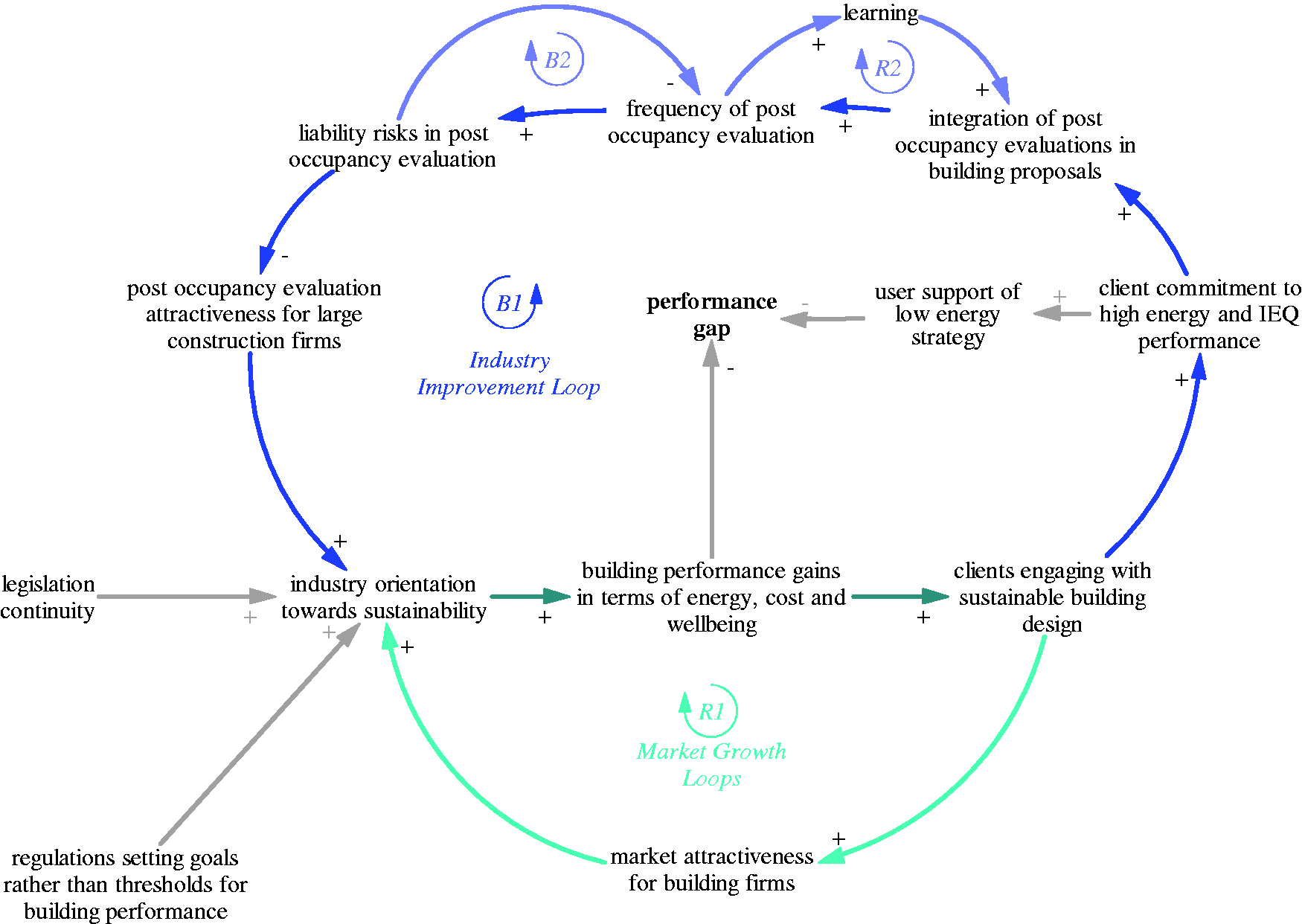
Causal loop diagram of the relation between clients’ and the industry’s focus on energy and indoor environmental quality.
This feedback loop R1 is further affected by a balancing industry improvement loop B1. It reveals how clients engaging with sustainable building design also increase their commitment to high energy and IEQ performance and more strongly demand for the integration of post occupancy evaluations in building proposals, which increases the frequency of post occupancy evaluation. While this diagram leaves out the direct positive effects of POE, it shows the unintended consequence of how POE increases the industry’s liability risks in post occupancy evaluation and thus reduces post occupancy evaluation attractiveness for large construction firms, consequently rather reducing the industry’s orientation towards sustainability.
The balancing industry improvement loop B1 is affected by a further balancing loop B2 by which the liability risk reduces the frequency of post occupancy evaluation. It is also affected by a reinforcing loop of learning R2: frequent post occupancy evaluations force the industry to learn, which supports the integration of post occupancy evaluations in building proposals.
At a participatory SD workshop in Beijing, we showed this CLD to a number of stakeholders from the building industry and real estate companies, sustainable design consultancies, architecture and engineering firms, the respective policy departments and academia. Nine of these stakeholders gave feedback to the CLD shown in Figure 3 in two consecutive groups at the workshop. They were facilitated by Chinese and UK-based team members who explained the mechanisms of the CLD to them and asked them to remove or add structure to make the CLD correspond to the Chinese context. Stakeholders engaged in the task, talking about new links and mechanism and often also showing them in the CLD. They then either drew new links themselves or a facilitator drew suggested links, asking the rest of the team whether the structure represents their shared opinion. This allowed us to discuss similarities and differences in the UK and Chinese context in a structured way and to improve and validate the CLD. The aggregated results from these two group sessions are shown in Figure 3.
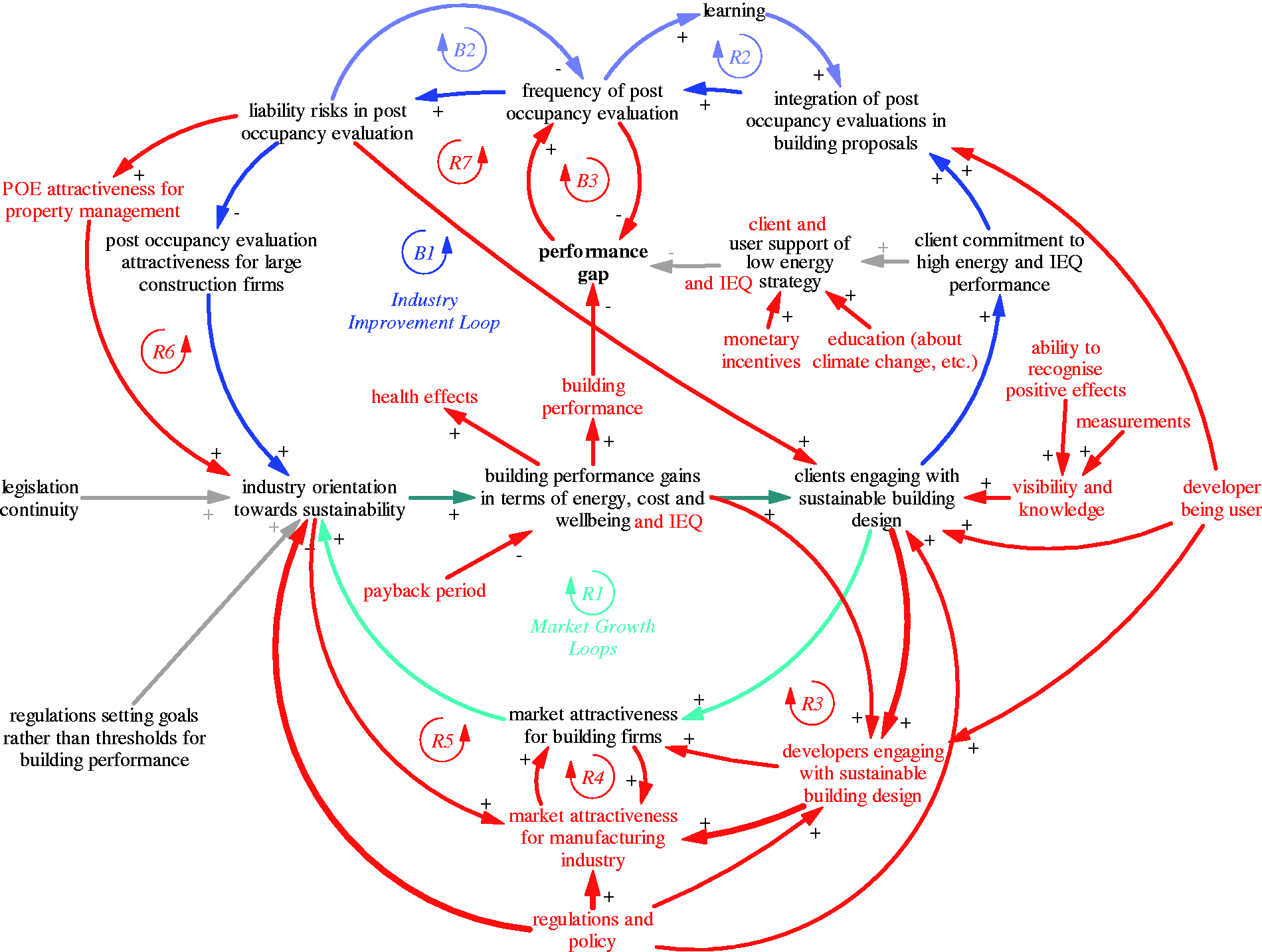
Causal loop diagram amended with stakeholders.
Stakeholders in both groups mentioned the importance of developers engaging with sustainable building design, which creates another market growth dynamic R3. Developers start to engage if they perceive building performance gains through it and if they perceive clients engaging with sustainable building design. When developers engage, they also strongly enhance the sustainable market attractiveness for manufacturing firms. Market attractiveness for building and for manufacturing firms mutually reinforce each other (R4) and increase the whole industry orientation towards sustainability (R5). Stakeholders also mentioned the strong influence of regulations and policy on these mechanisms. In addition, these processes are stronger with visibility and knowledge and with the developer being the user of the building, which also enhances the integration of post occupancy evaluation in building proposals. Stakeholders discovered two reinforcing feedback loops by which the liability risks in POE render POE attractive for property management (R6) and let clients engage with sustainable building design (R7). Yet, the frequency of post occupancy evaluation balances out with a declining performance gap (B3). Stakeholders also captured building performance separately from the performance gap, they emphasized the focus on energy and IEQ, and mentioned external influences such as incentives and education on client and user support and the payback period on building performance gains. Last but not least, they referred to the positive health effects emerging from building performance gains.
This small example already exemplifies how the strong influence attributed to regulations and policy in the CLD can be translated to the importance of setting standards via certified green buildings in China. In addition, the structure around how monetary incentives trigger client and user support of a low energy and IEQ strategy elucidates the underlying structure for China’s move from a surface based to a consumption-based payment for heating. Also for the UK, the market growth loop R1 explains the underlying reinforcing feedback mechanism that supports the still low orientation to well-being and IEQ, but also the leverage of this mechanism for creating a virtuous circle, e.g. when triggered by high standards even beyond BREEAM and WELL. It reveals the promising underlying mechanism but unclear direction when driven primarily by innovation and commercial concerns from clients. Thus, Figures 2 and 3 illustrate interactions between building policy, industry practices, clients and user support and practices, which are particularly important if radically different solutions require the building industry and users to undergo deeper changes to their buildings and practices. It shows how clients, developers and the remaining industry are interconnected in a reinforcing mechanism. Once strongly triggered, it would help move towards more sustainable design and construction. Yet, the diagram also reveals several limiting factors such as the liability risks that may be generated through POE (B1) and the tendency to cease evaluations once performance improves (B3).
It is not surprising that the stakeholders identified more reinforcing than balancing mechanisms because they are usually easier to depict. The CLDs represent the UK and Chinese stakeholders’ understanding of the issue; they are not supposed to represent the state of the art of research in any of these two countries. However, the process of developing them increased stakeholders’ comprehension of these complex issues they are dealing with, and secondly, helping us as a background understanding for the UK and China context in the quantitative models we are currently developing. The current model served its purpose of triggering discussion about complex interrelations and about similarities and differences in China and the UK. The CLD served as a useful object for initiating and structuring the discussion95,96 supporting communication and the development of alignment.
Further research could improve the quality of information that these models are based on. First, it could do so by extending the stakeholder base. We were already able to include stakeholders from policy, industry and academia in these Chinese workshops, but participants could be extended in terms of number and expertise,9,97 e.g. to make sure we include views of developers and building users directly. While we identified more causal mechanisms than we can report in this paper, five UK-based interviews also just gave a first overview over the central issues. Further research could aim at higher diversity among interviewees and apply a participatory process to validation of the UK-based CLDs with stakeholders as well as apply rigorous methods of qualitative research for building simulation models based on interview and workshop data.97–99 Second, further research could ground the identified causalities and causal mechanism in other research and use qualitative as well as quantitative data to evaluate the strengths of identified relationships. The latter would be particularly useful if the purpose was to build a formal, i.e. a quantified simulation model.
While we observe differences in the China and UK context with regard to historical situations and processes and the pace of new construction, we also observe that both countries have been following similar trends. Over time, the importance of energy efficiency has increased. Both countries are now in the process of giving more priority to IEQ and the interaction of energy, IEQ and occupant well-being. As these interactions are not straightforward – even technically – and since they emerge in practice in a socio-technical-economic-regulatory context, both countries require a robust understanding of interactions of these issues, which also requires corresponding methods for both research and policy. Systems thinking, SD and participatory approaches enable the formulation and implementation of more effective policies, regulations and practices, which could enable clearer understanding of factors leading to the ‘performance gap’ and how to address them.
This work takes this proposal forward in the UK and Chinese building stocks. The paper highlights the diversity in historical, political, environmental, social and technical influences in these contexts. It shows how these contexts influenced China and the UK in embracing energy efficiency in their design and retrofit and how they are beginning to emphasise the focus on how this integrates with IEQ and well-being as well. As interactions of the context, energy, IEQ and well-being are complex, the paper illustrates the application of a systems approach in both cases to study the building regulation, design, construction, operation systems and understand their dynamics. This is the first part in the ‘TOP’ project 100 to address the multiple causes of the performance gap and explore ways to reduce it. This project combines traditional ‘building physics’ type approaches with a system thinking and SD approach. This is an ongoing process and, for the purposes of this paper, we have provided the background and discussed the context leading to the current state of the built stock in both locations. The paper provides initial results from the application of SD in the Chinese and UK contexts.
This is a first step to future research that needs to address the interlinked nature of energy/IEQ, as limited research has integrated them. While a number of studies examine the static relation between building energy use, IEQ and occupant health,101–104 they do not address the transient variation in such parameters as well as interrelating dynamics. In addition, they do not allow for the real-time identification of building underperformance on the basis of measured values. Therefore, to avoid the unintended consequences of low-carbon building design and operation and minimise ‘total’ performance gaps, there is an urgent need for appropriate research and the development of tools that can identify when, how and why buildings are underperforming. As our examples illustrate, such approaches benefit from the broader perspective and the involvement of stakeholders who provide further sources for data generation via their practical and problem-related knowledge. 105
Conclusions
Understanding energy/IEQ ‘total’ performance in an integrated way poses a critical and urgent international challenge in developed and developing countries. A high performing building stock is essential to: (i) reduce carbon emissions (ii) enable energy affordability and security and (iii) improve the health and well-being of the population. We argue that to develop buildings that meet these targets, a systems approach that accounts for a range of development, institutional, operational and socio-cultural facets is needed. Such an approach needs to draw from a wider, complex and dynamic system of interacting factors that act on the delivery and operation of high-performance buildings. We propose that the development of suitable building assessment methods, technologies and tools combined with work to understand the complex wider system will enable the formulation and implementation of effective policies, procedures and regulations that will help reduce the ‘total’ performance gap.
The participatory approach establishes a longitudinal process to data generation by stakeholders. Participation also transforms/informs stakeholder knowledge. However, our understanding of information transfer is very unidirectional at the moment without clear recognition of feedback and feedforward loops. Detailed investigation into (i) how participation, communication and commitment to energy and IEQ performance interact, (ii) how interaction develops based on stakeholder alignment and communication and (iii) the development of better strategies for positive stakeholder interaction, which would lead to better alignment and communication and provide valuable avenues for further research. As such, we see potential to further analyse and utilise the participatory systems approach as a process-oriented approach focusing on the interactive processes of information generation (by stakeholders), transfer (from one stakeholder to another) and application. As some detail is inevitably lost when implementing the more holistic perspective that comes with a systems approach, future research also needs to address how different methods – those that aim at an overview of systemic interactions verse those that aim for detail – can be integrated to form richer approaches.
Footnotes
Author contributions
C Shrubsole, IG Hamilton, N Zimmermann, E Burman, M Davies and Y Zhu, supplied the main text, with all other authors contributing. Editing was carried out by C. Shrubsole and N Zimmermann.
Acknowledgements
We also wish to acknowledge the many participating industry partners, without whom the project would not be possible.
Declaration of conflicting interests
The author(s) declared no potential conflicts of interest with respect to the research, authorship, and/or publication of this article.
Funding
The author(s) disclosed receipt of the following financial support for the research, authorship, and/or publication of this article: The authors gratefully acknowledge the financial support from ‘The 'Total Performance' of Low Carbon Buildings in China and the UK’ ('TOP') project funded by the UK EPSRC (Grant number EP/N009703/1) & NSFC China (Grant number 51561135001).