







Abstract
The heat radiation in a residential kitchen was simulated by CFD (Computational-fluid-dynamics) to evaluate the cooling by a radiant cooling ceiling panel and pollution dispersion by the range hood and the air extraction system. The kitchen has a 2-hobs stove and a fume hood for removing waste heat and fumes. The simulation was validated by measurements in a domestic kitchen in a home in Changsha, China, where summer temperature is generally about 33 °C and often over 35–42°C. The simulation results show that the pollutant concentration in the kitchen during cooking was much lower than the Chinese standard criteria of GB/T18883-2002. A standard turbulence model was used, which indicated satisfactory distribution of temperature and airflow in the kitchen. The indoor airflow velocity was low. The airflow temperature when both hobs were used was slightly higher by 3–4°C than when a single hob was used. The temperature in the kitchen during cooking was about 28 °C, which was a degree lower than the living-room temperature, thus maintaining a comfortable thermal and healthy environment. The radiant cooling in the ceiling was shown to be a significant contributing factor. The ring suction type range hood has a sufficient capacity to remove the kitchen fume contaminants.
Keywords
Introduction
The thermal environment of a kitchen is very important for providing a good living experience and an important part of a habitat for residents to obtain a healthy living environment. A kitchen space is one of the core areas of any residential living space, although it is relatively small in comparison to the overall size of a dwelling. 1 People spend at least an hour cooking each day.1,2 High temperatures in the kitchen would cause thermal discomfort and an increase in the indoor pollution leading to consequential adverse health effects. Air-conditioning is not universally available in domestic kitchens in China.
Considerable heat and humidity could be generated in a kitchen due to cooking to cause discomfort for occupants. In summer, the temperature around a kitchen stove could reach above 34 °C and in some local area could be over 40–42°C, 3 particularly in Changsha, which is situated within the Hot Summer and Cold Winter zone in China. 4 This region has a long summer duration with a high temperature, high humidity and low pressure. The hot weather temperature is generally above 35 °C in summer and this would continue for over a month. 5 The maximum temperature could reach 42 °C. 5 Hunan has a high humidity in more than 70% of a year. During rainy days and rainy seasons in summer, the relative humidity (RH) could reach 100%, which could cause people to feel hot and stuffy. Especially during cooking with poor ventilation condition, occupants could feel extreme discomfort in this environment. 3
The pollutant fumes generated in a kitchen could have a serious effect on occupants’ health and thermal comfort and, inevitably lead to a deterioration of quality of life for occupants.1,3,6–18 In a kitchen with poor ventilation, much of the heat produced combined with the high humidity and pollutants generated by cooking, cannot be discharged effectively from indoors to outdoors even though the kitchen is fitted and operated with a range fume hood or fan extractor.2,6,11 The retention of smoke indoors, is a direct result of the increased indoor pollution. Main sources of pollution are the fuel combustion gas and fumes produced due to the cooking process.19–23 There are 4 main gaseous pollutants of particular interest produced during cooking: benzene (C6H6), carbon monoxide (CO), nitrogen oxide (NO) and nitrogen dioxide (NO2).1,24–28 Also, there are airborne particulate matter generated during the cooking. The particles sizes are generally ranged between 0.1 ∼ 10 μm. 15,29–33 Cooking fumes have very complex compositions made up of approximately 99 different ingredients. 34 Some of these pollutants may have a role in promoting cancer and could damage the body’s immune function, which could seriously endanger occupants’ health in homes.2,5–7 At the same time, if the fumes are not expelled outdoors in time, they could be suspended in the air in the kitchen for a long time and spread to other rooms in the apartment. 29 These airborne pollutant, especially fatty oil fumes, could adhere to walls, floors, ceiling, furniture and kitchen surfaces, and form condensed grease on surfaces, which is difficult to remove.
A poorly ventilated dwelling could make the temperature control difficult in the indoor environment. Ventilation has an important role in pollutant removal to provide comfortable and productive working conditions for building occupants, especially the kitchen.3,35 The kitchen needs air-conditioning systems for cooling. 35 However, the air-conditioning is not suitable for the kitchen, due to the adverse effect of the cooking fume and high heat for these types of ventilation air-conditioning system, although appropriate ventilation is important to minimize indoor pollution to reduce risks of undue exposure of occupants to deleterious substances and fumes. 32 Standard requirements and technologies for ventilation in buildings in China have been reviewed. 33
The advantage of using radiant ceiling cooling panel in a kitchen has not been fully appreciated yet for the wide spread application in China. This is despite the radiant ceiling cooling panel system is superior to traditional air conditioning system in both aspects of economy and thermal comfort. The system would provide a better indoor thermal environment, more uniform indoor air distribution, no unpleasant feeling of air draught and do not cause undue noise vibration.36–38 However, typically in a kitchen, natural ventilation is the main ventilation of choice 6 and mechanical ventilation has been a supplementary method for majority of households.3,39
There have been a great deal of research on the environmental control of the indoor environment for thermal comfort and pollution and to improve the indoor air quality in kitchens. Li et al. 3 assessed the impact of typical ventilation systems of four commercial kitchens on indoor thermal environment in China. Gao et al. 40 studied the effect of ventilation type on the efficiency of the exhaust hood and found that the machine working efficiency could vary greatly with different conditions of ventilation. The ventilation system currently being used in most Chinese kitchens cannot effectively eliminate the indoor pollutants and waste heat. 3 Zhou et al. 6 found that with the application of a push-pull ventilation system, the air temperature in a kitchen could be reduced during the summer season. The system could improve occupants’ thermal comfort and reduce the pollutant concentration with an improved air distribution. Singer et al. 24 measured concentrations of combustion pollutants during cooking with natural gas burners in nine homes. Their research suggested that cooking with natural gas burners are an important source of air pollutants in homes. However, the concentration of these pollutants can be controlled with an appropriately-sized venting range hood or other kitchen exhaust ventilation to reduce fumes. Kosonen et al. 35 proposed the use of ventilated ceiling that can guarantee a removal efficiency of contaminants in a kitchen and to prevent pollutants spreading throughout the house. The conducted laboratory evaluation of a ventilated ceiling demonstrated that the capture and containment efficiency can be 85–93% using the concept of a low velocity ceiling supply and centralized capture jet.
The objective of this paper is to evaluate the effectiveness of the radiant ceiling cooling system for the environmental control of cooling in a kitchen during cooking and also the fume extraction by the range hood for removal of pollutants generated by cooking. CFD (Computational fluid dynamics) modelling was used for the evaluation in this study. The pollution generated from cooking was controlled by ring suction type range hood, which is a part of an integrated stove. The cooling of the kitchen was by the radiant ceiling cooling panel system installed in the kitchen. Taking into account of the space in the kitchen, a fan coil was used as an air-conditioning equipment, suspended and embedded in the ceiling, which can meet the need of the radiative ceiling’s function at the same time. The modelling was validated by temperature measurements in an actual kitchen of a home in Changsha in Hunan.
Experiment
Experiments were carried out in August 2017, which is the most torrid period in a year in the Hunan Province and air-conditioning is needed in every household during this period. A kitchen in a home in a multi-storey apartment building located in Changsha was used as a prototype to build the test rig. The size of the kitchen was 4.2 m (L) × 2.7 m (W) × 3.0 m (H). The window connected the kitchen to the ambient environment outside was closed while the kitchen door connected to the living room was open at all times.
An integrated stove was used in the kitchen, which has a cooker combustion system and fume extraction system as a whole. The stove has two-burner cooker hobs and both were used during the experiment. Fumes were exhausted through the range hood. The worktop height for the stove was 0.8 m. A range hood was fitted above the stove and the range hood has a diameter of 400 mm and 25 mm high. The range hood exhaust volume was 10 m3/min. The auxiliary exhaust pipe diameter was 100 mm. A ceiling cooling panel system was installed in the kitchen, which is different to the traditional one. The ceiling cooling panels were made of aluminium plate without capillary inlaid in these panels. The cooling panels were spliced by the 1.2 mm thick aluminium boards with a 300 mm edge. These radiative cooling ceiling panels were installed at a height of 2.5 m. A fan coil was installed in a kitchen, placed on the surface of the ceiling. The inlet air was supplied through the door and the fan coil. The ceiling along the x-axis on the left and right, both have a 300 mm × 500 mm seam that acts as gates for the airflow. A binocular stove was installed in the kitchen. The heat source diameter was 200 mm.
The radiant cooling panel was installed on the ceiling with a fan coil laid on it. The fan coil provides a low temperature airflow at a certain speed, due to Coanda effect.41–46 The cold airflow would transfer heat from the under surface of the aluminium board to allow cooling of the indoor environment to a lower temperature. The low-temperature aluminium plate would then transfer heat by radiation and convection in the kitchen environment. The radiative heat transfer characteristics of the ceiling cooling panel are more important than the air convection for regulating the temperature in the kitchen to improve the thermal comfort of occupants. 36 Moreover, an auxiliary exhaust pipe was installed in the kitchen. The exhaust pipe was equipped with a small fan to exhaust the kitchen waste heat and polluting fumes to the outdoors, thus supplementing the range hood to reduce and minimize airborne pollutants in the kitchen.
The geometry of the kitchen model is shown in Figure 1. Measurements of temperature were taken at nine locations along an intersection line between the horizontal plane at a height z = 2.5 m (ceiling height) and the vertical plane at y = 1.35 m, as shown in Figure 1. The first measurement location was positioned at 0.45 m away from the wall, the other eight measurement locations were positioned at an interval distance of 0.3 m from each other. These measurement locations were denoted as D1–D9. D9 was at an air inlet location, while D1 was at an air outlet location.
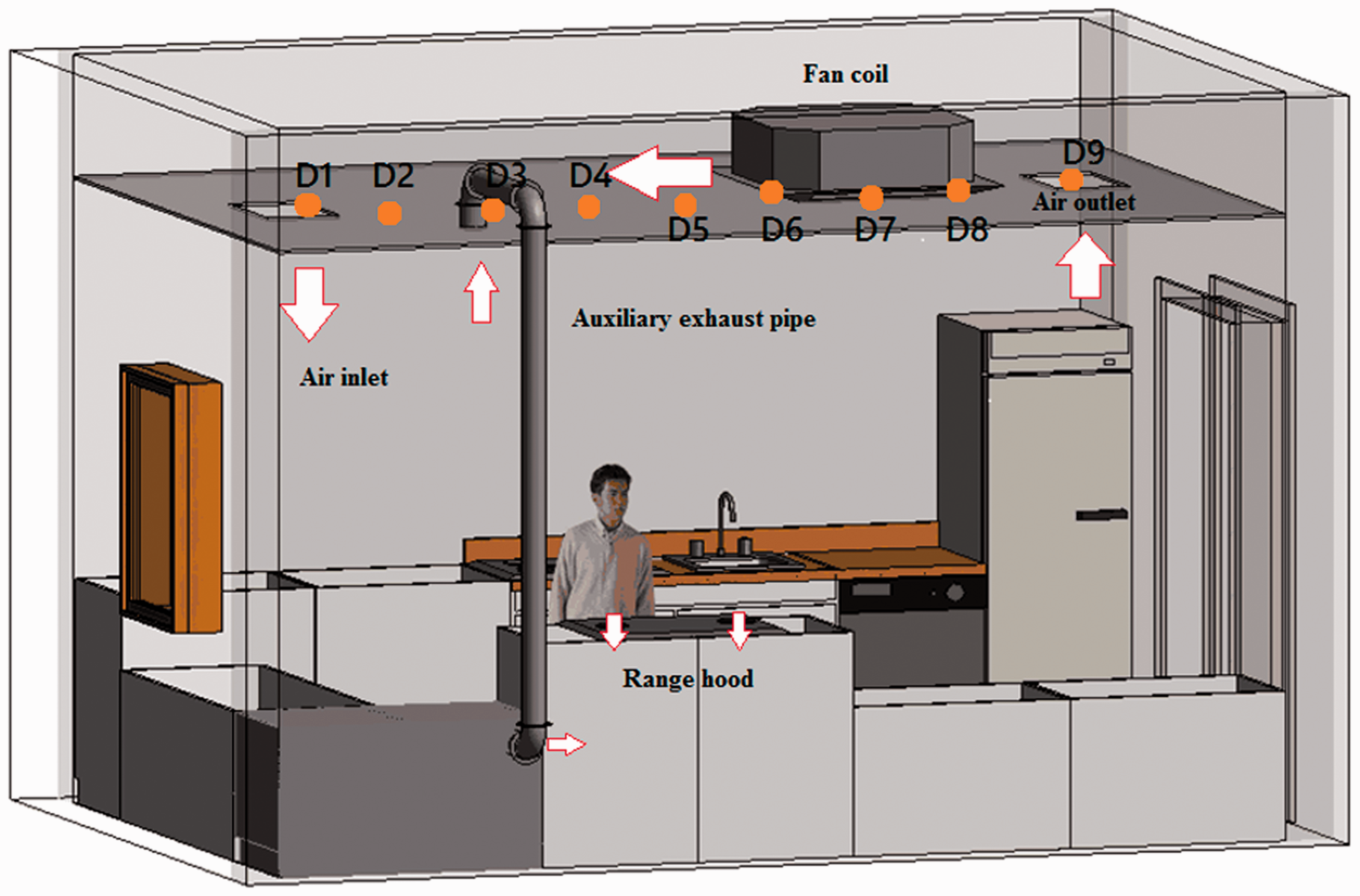
The measurement locations.
The continuous air flow from the fan coil is delivered to the lower part of the kitchen along the air inlet of the ceiling to cool and reduce the indoor temperature. The airflow would return to the fan coil through the air outlet. A part of the high temperature air and pollutants are drawn from the auxiliary exhaust pipe to the range hood and be discharged to outdoors in time.
The pollution control performance of the range hood was studied by the analysis of the temperature and pollutant concentration at different sampling locations as shown in Figure 1, through CFD simulations.
Experimental conditions and measuring instruments
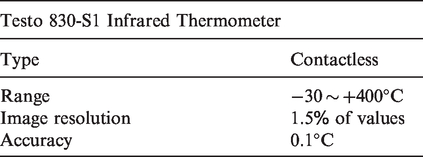
The temperature was measured by using the Testo 830-s1 (Testo, Inc., Germany) temperature measuring equipment. The specific details of the Testo 830-s1 are shown in Table 1. The measurement was done by aiming a laser point at the target location and scanning around this location until the measurement position was matched with the laser point. Real-time data of temperatures were read. Temperatures at these locations were measured three times and the average value at each location was recorded as the measurement result. The two-burner gas stove was turned on and both were used for cooking during measurements. The temperature measurement in the kitchen with the radiative cooling panel is shown in Table 2.
Specific parameters of the instruments.
Temperature measurement results.

CFD modelling of a simulated kitchen
Kitchen model
The numerical model was built on the basis of the actual geometry of the kitchen as shown in Figure 2. The size of the door was 0.9 × 1.9 m. A two-burner gas stove was used in the kitchen and different boundaries were considered in the simulation when two cooking hobs were used. Each burner was defined as a heat source with an area of 0.03 m2 (diameter of 0.2 m). A pan was placed on the burner as the defined pollutant source with an area of 0.07 m2 (diameter of 0.3 m).
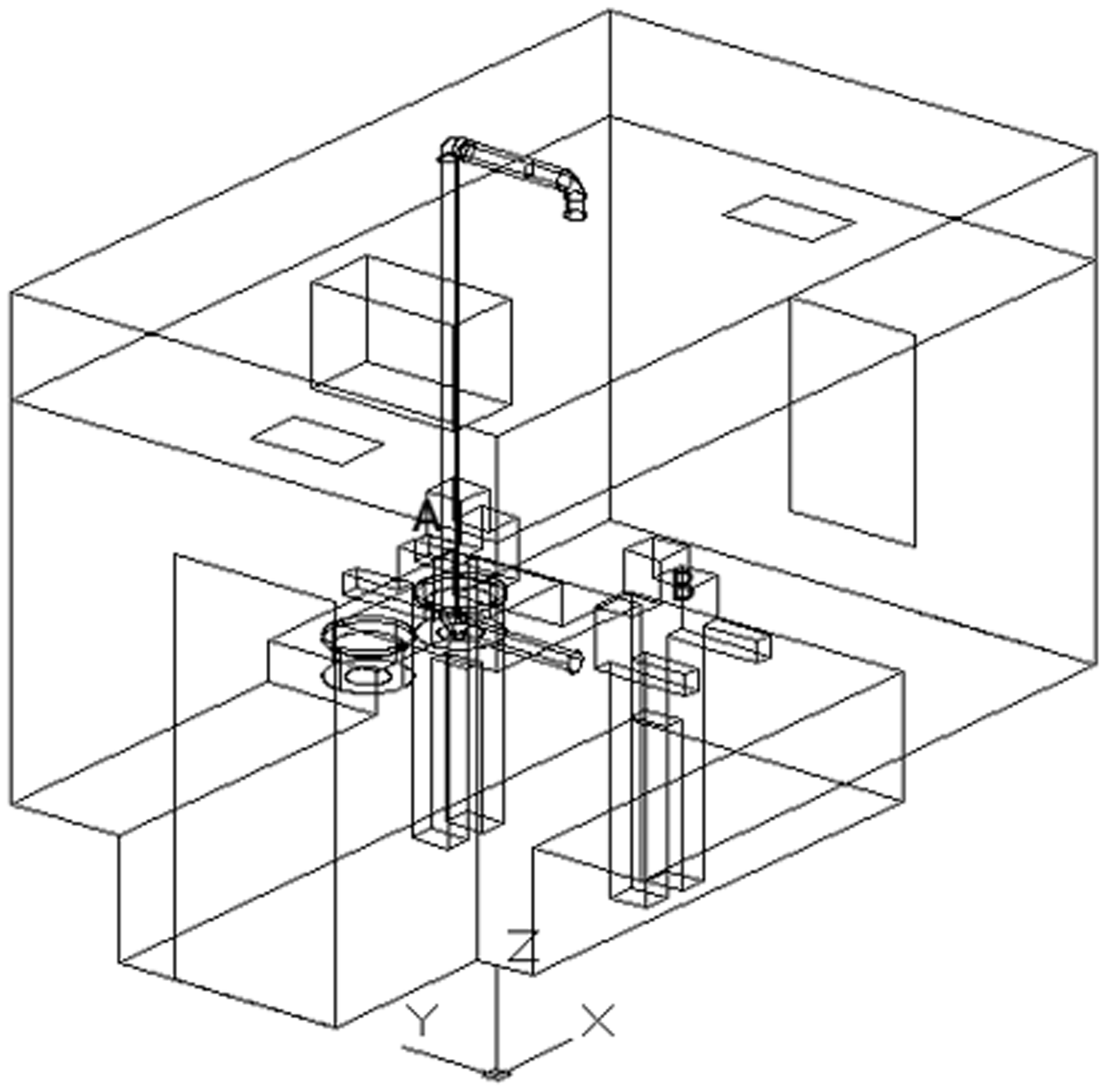
Kitchen model.
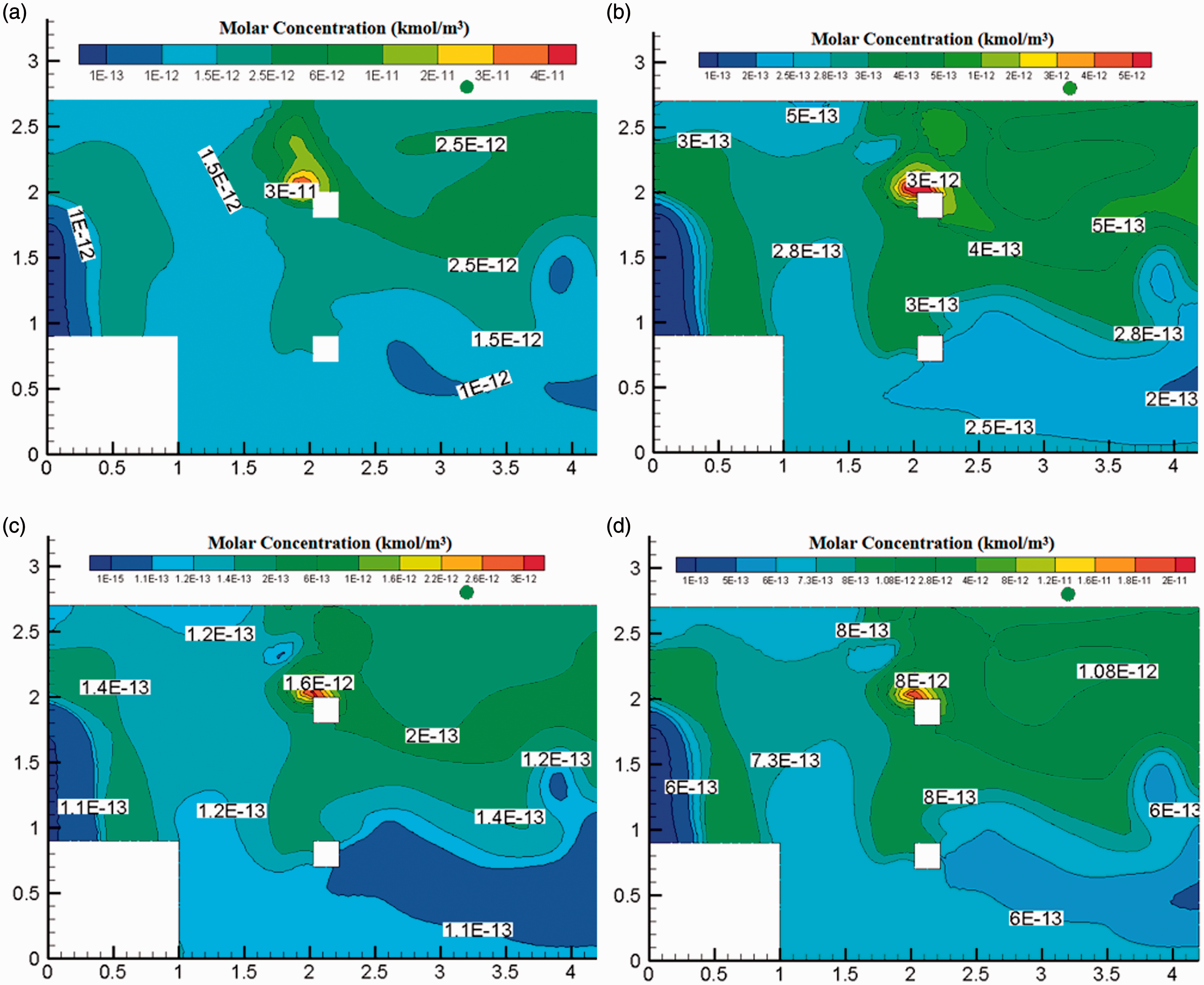
Concentration distribution of z = 1.5 m in the horizontal plane with a single source of pollution due to the use of one cooker hob. (a) C6H6 (b) CO (c) NO (d) NO2.
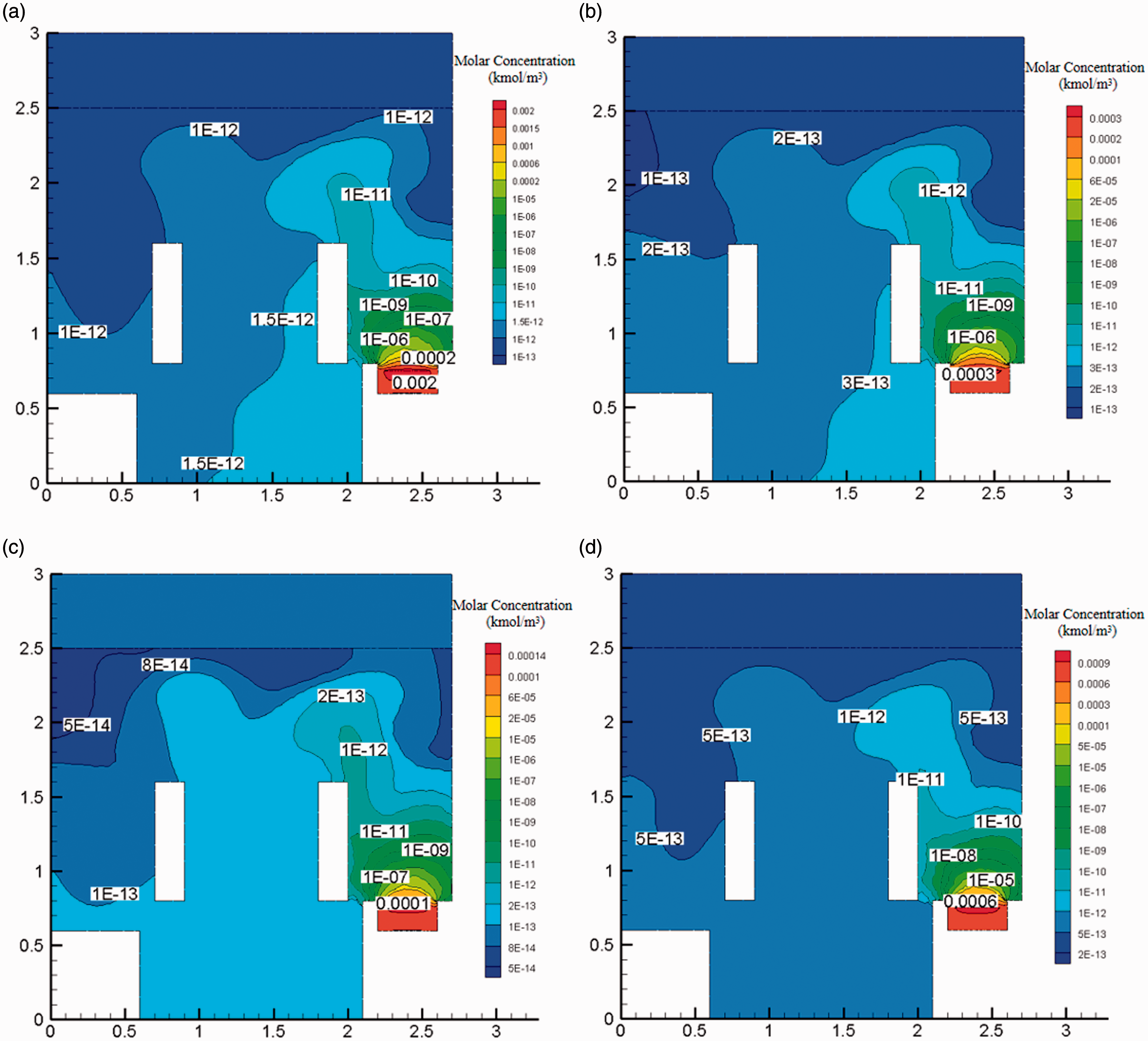
Concentration distribution at x = 2.125 m in the horizontal plane with a single pollution source due to cooking using a single cooker hob. (a) C6H6 (b) CO (c) NO (d) NO2.
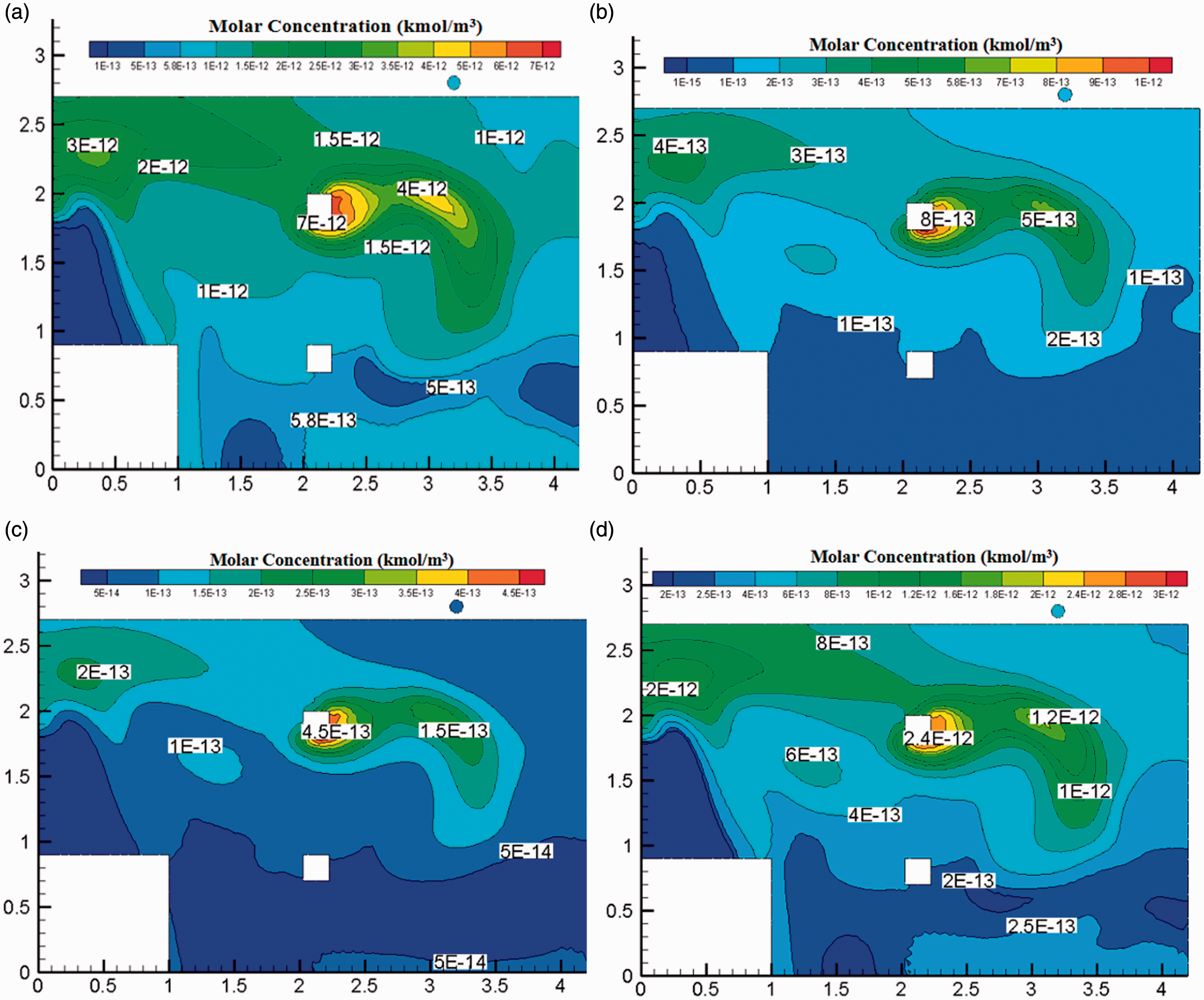
Concentration distribution at z = 1.5 m in the horizontal plane with double pollution sources generated due to cooking using both double cooker hobs. (a) C6H6 (b) CO (c) NO (d) NO2.
The range hood was fitted above the stove. The pollution fume was exhausted to the outside through the range hood by the ring suction. The range hood has a diameter of 400 mm and 25 mm width. The height of the stove and the cook (the person doing the cooking) in the model were 0.8 m and 1.6 m, respectively. The cook stood at about 0.35 m to the cooking bench. The auxiliary exhaust pipe diameter was 100 mm, with an extractor fan installed in the pipe.
Governing equations
The standard k–ε two-equation model of Reynolds averaging method was used as the mathematical model. A steady state was assumed in the simulation by the CFD model.
In dealing with the buoyancy force in the momentum equations, the Boussinesq approach was adopted, i.e. the fluid properties were assumed constant except for the density change with temperature, which gives rise to the buoyancy force, as a linear relationship between the density change and the temperature change. In addition, the dissipation term in the energy equation was neglected due to the low velocity involved. The body weighted average and SIMPLE algorithm were used for space discretization and coupling between pressure and velocity, while the second-order upwind scheme was used to discretize the momentum and other equations in the numerical simulation. 47 The air turbulence flow control equation in the kitchen consists of the continuity equation (equation (1)), 48 the energy equation (equation (2)) 48 and the turbulent flow energy equation (equation (3)). 48
Continuity equation is as follows

Energy equation is as follows

Turbulent energy equation is as follows

Do model
A discrete ordinate (Do) model 47 was used. This was solved from a finite number of stereoscopic angle propagation equations. Each stereoscopic angle corresponds to a fixed direction angle under the coordinate system. The model transforms the equation into the radiation intensity transport equation in the space coordinate system.
Boundary condition
The boundary conditions are presented in Table 3. The kitchen envelope was defined as the solid wall boundary with a heat transfer coefficient of 1.5 W/(m2 K). The window was closed, so it was also set to solid wall boundary. The kitchen was nearly airtight except for the door, so the door was defined as the mass-flow-inlet boundary condition. The standing occupant was regarded as a still block with a heat generation of 150 W, which has a height of 1.6 m and a width of 0.25 m. The burner hobs on the cooker were the source of pollution. The contaminant production rate was 0.2 m/s. The pollution composition includes 20% benzene, 1% CO, 5% NO2 and 0.5% NO.29,40 The exhaust rate of the range hood was 5 m/s.
Boundary condition.

Comparison of results.
Results
Modelling results
From Figure 3, the distribution plume of four different pollutants were similar to each other in the horizontal plane at a height z = 1.5 m (breathing region) with the same pollution source location. The cook could be exposed to the polluted air including C6H6, CO, NO, NO2 in the kitchen. Concentrations of these pollutants were: 3e−10, 1.7e−10, 1.7e−11, and 1e−10 kmol/m3, respectively.
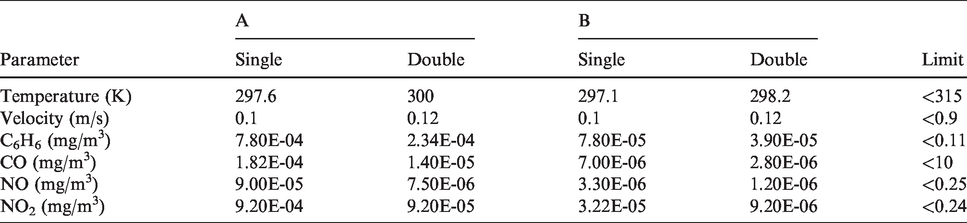
According to the Chinese standard, GB/T18883-2002, 49 the time average concentration of benzene in the indoor air should be less than 0.11 mg/m3 (1.41e−09 kmol/m3 in molar concentration); for CO, less than 10 mg/m3 (3.57e−07 kmol/m3); NO2, less than 0.24 mg/m3 (5.22e−09 kmol/m3) and NO, less than 0.25 mg/m3 (8.33e−09 kmol/m3). Therefore, in the single hob case, at a height z = 1.5 m, our results was less than the Chinese standard. The most polluted location was on the left side in front of the stove, near the source of pollutants. C6H6 was the heaviest of these four pollutants.
The tendency of pollutants in the cross section of the gas hob stove varies with the height as shown in Figure 4, showing the great exhaust ability of the range hood. As the place of the pollution source, the pan on the hob was taken to be the most concentrated spot. Pollutants concentrations were attenuated by 10 to the power of 7 within 0.6 m above the source of pollutants (i.e. 1.3 m). Due to the exhaust extract by the range hood, concentrations of four pollutants being studied were controlled within the acceptable standard at a height of 1.3 m. Similarly, distributions of these four pollutants concentrations were similar to each other.
When both cooker hobs were used for cooking, i.e. when there are two release sources of pollution, the concentration of C6H6 was highest in comparison to other pollutants, followed by NO2, CO and NO as the source proportion distribution. As shown in Figure 5, the cook could be exposed to these concentrations of pollutants: 7e−12, 8e−13, 4.5e−13, 2.4e−12 kmol/m3, respectively. The pollutants near the source of pollution were more concentrated than when the single cooker hob was used. There are two maximum peaks in the pollutant concentration. These were located around the cooker hobs and were attenuated in other places in the 1.5 m plane; however, concentrations of these pollutants were well controlled by the fume extraction of the range hood.
The distribution of pollutants concentrations produced by using double cooker hobs was similar to the case of using one cooker hob, though slightly higher than the concentration generated by using one cooker hob. The concentrations were still less than the specified limits as given by the Chinese standard, GB/T18883-2002. 49 As the graph shows, maximum concentrations of C6H6, CO, NO, NO2 in the pan were attenuated by 10 to the power of 9, from 2e−3, 3e−4, 1e−4, 9e−4 kmol/m3 to 2e−12, 2e−13, 1e−13, 5e−13 kmol/m3, respectively, within 0.6 m above the pan at a height of 1.3 m, showing the great exhaust ability of the range hood.
As shown in Figure 6, the range hood was very efficient in exhausting the cooking fumes. Concentrations of pollutants at a height of 1.3 m were well controlled. Pollutants’ concentrations in the kitchen whilst cooking were much lower than the standard criteria of GB/T18883-2002. 49
Whether single or double cooker hobs were used, pollutants concentrations in the kitchen were controlled well by the ring suction of range hood. Meanwhile, the simulation of temperature field was also conducted as shown in Figure 7. The temperature distribution nephogram at y = 1.35 m zone area and the three-dimensional temperature distribution are, respectively, shown with the single heat source of using a single cooker hob and the double heat source when using both double cooker hobs. The cold airflow was transferred from the fan coil located on the ceiling. The supply air temperature was 294 K (∼21°C), which could cool the kitchen (especially the ceiling) by the radiative heat transfer in combination with the air convection. The return air temperature was higher, about 299 K (∼26°C) when a single hob was used or 301 K (∼28°C) when cooking with both double hobs.
The spatial distribution of temperature in the lower part of the ceiling was more uniform and was between 296 K (∼23°C) and 300 K (∼27°C) when a single cooker hob was used, which was slightly lower than when the double cooker hob was used. The indoor temperature was 3–4°C higher than in the case when the double cooker hobs were used in comparison to when a single cooker hob was used. The temperature of occupants’ activity area whilst cooking was lower than the inlet air temperature and the temperature of the living room. Therefore, the indoor temperature distribution condition was acceptable. The ceiling radiative cooling was efficient to reduce the indoor air temperature to ensure thermal comfort of occupants in the kitchen.
As shown in Figure 8, during cooking using a single cooker hob, the extractor fan in the air duct has no obvious function with the indoor air thermal environmental distribution. During the use of double cooker hobs, the air temperature in the air duct was 296 K (∼23°C), which is higher than the indoor temperature, 294.6 K (21.5 °C), prior to cooking or when using a single hob. So, the extractor fan in the air duct could also promote the exhaust of the hot air flow, cooling the kitchen further. The indoor air temperature in the kitchen was more uniform when using the extractor fan in the air duct than in the case of without the use of a fan. This is because when the fan was not used, the high temperature polluted air could not be discharged sufficiently in time due to the accumulation of the thermal lift force at a certain height position. The cold air would settle to the floor and the hot polluted air and the cold air could not be mixed properly, leading to an uneven temperature distribution and large temperature differences. The higher the heat flux, the more obvious is the unevenness in the air distribution. This could also affect the discharge of pollutants.
As shown in Figure 9, the indoor velocity was uniform and the average air velocity in the kitchen was no more than 0.3 m/s. The velocity was even, and the air temperature in the kitchen has a uniform air flow. The indoor airflow was therefore in good condition. The air flow rate in the fan coil return air grille was up to 2.0 m/s. The air velocity in the human activity area was lower than 0.5 m/s.
With low concentrations of fume pollutants, a suitable indoor temperature and airflow velocity distribution were shown. Therefore, the model was proven to be a healthy and comfortable environment for the kitchen.
Experimental verification and error analysis
Figure 10 shows a comparison of measured values and simulated values. There are two extreme points on the simulated curve. The simulated values of D3 and D8 are greatly different in comparison to measured values. This is because D3 was located at the fan coil, which is not included in the simulation calculation area and no cooling air flow here to cool the ceiling. Therefore, the simulated temperature here is higher than the actual measured temperature value. D8 was located above the cooker stove, a large amount of heat would be generated by the cooker stove and the heat would rise up and gather at that position. The intense heat transferring activity would occur between the high-temperature airflow and the aluminium ceiling in this area. Moreover, the thickness of the aluminium ceiling was not considered in the simulation process, i.e. the heat conduction in the vertical direction of the aluminium ceiling was not considered. While in the actual measurement, the aluminium ceiling has a certain thickness and absorbs heat rising from the cooker stove below. Thus, the measured temperature was higher than the simulated value. The anastomosis results show that the curve trend of the experimental and simulated data are consistent within acceptable error range. The anastomosis is good and the simulation is acceptable and validated.
Discussion
This paper investigated a domestic kitchen environment controlled by a radiant ceiling cooling system and a ring suction type range hood for cooling and removal of pollutants during cooking. The results of our research show the pollutant concentration in the kitchen during cooking was controlled at an acceptable level, and a comfortable thermal environment was maintained at the same time. The radiant cooling by the ceiling system is shown to be a significant contributing factor. The ring suction type range hood has a sufficient capacity to remove the kitchen fume contaminants. The CFD simulation model used would produce good prediction of results comparable to measurements. The model could be used to evaluate the cooling system in the kitchen and the fume extraction system, to improve the kitchen air quality whilst allowing cooling using the radiant ceiling cooling system for the air conditioning. The findings of this paper would provide a useful guide for the kitchen design in buildings in the hot summer and cold winter region in China.
High heat temperature and pollutants concentrations could cause undue adverse health effects and thermal discomfort to occupants without the operation of an appropriate ventilation system during cooking. As is shown in Figure 2, the fumes pollutants in the kitchen was well controlled by the ring suction type range hood and reduced concentrations of four pollutants studied. The range hood is a new type of fume hood with a good performance for fume extraction. The pollutants concentrations was attenuated by 107 (i.e. 10 million) times within 0.6 m above the pollutant source due to the extraction by the range hood. As shown in Table 4, the pollutants concentrations during cooking were shown to be much lower than the criteria of the Chinese standard GB/T18883-2002 for indoor environments. Therefore, a healthy air quality in the kitchen would be maintained.
The airflow velocity in the lower part of the room is low and the distribution is uniform and the maximum airflow velocity was 0.4 m/s. Therefore, the air draught movement was acceptable in the indoor environment. The airflow temperature in the upper zone is higher than in the lower layer. The temperature is low in the occupants’ activity area. The temperature distribution of the indoor airflow is good.
The gas stove, as a heat source, has a great impact on the indoor thermal environment. The indoor average temperature is 1∼3°C higher than when using double cooker hob simultaneously for cooking than when using only a single hob. The temperature of the kitchen during cooking was about 301.5 K (28.35 °C), which therefore would maintain a comfortable thermal environment.
The comparison of the measured temperature in the kitchen installed with the radiative cooling ceiling system, with the simulated model, shows a reasonable consistency and a good agreement was obtained. Therefore, the CFD simulation was validated and illustrates the reliability of the model and the accuracy of measurements.
The radiative cooling of the ceiling panel was shown to have produced acceptable cooling of the indoor thermal environment in the kitchen. The air exhaust system by the fume hood and the air extractor fan in the air duct were shown to be effective to maintain an acceptable indoor air quality during cooking to reduce harmful exposure of occupants to pollutants generated by cooking fumes.
This research is about pollution and temperature control in a modelled kitchen. We will evaluate the occupants’ thermal satisfaction by using the thermal comfort indexes given by the ISO 7730:2005 ‘Ergonomics of the thermal environment’ based on the Predicted Mean Vote (PMV) and the Percentage of People Dissatisfied (PPD) in the future study of various kitchen thermal environments during cooking.
Conclusion
The airflow and temperature distribution in the kitchen were simulated and was validated by experimental measurements. The comparison of the measured with the simulated temperature in the kitchen installed with the radiative cooling ceiling system, show good consistence and agreement. Through the CFD simulation modelling, good thermal and indoor air environment in the kitchen was shown.
The simulation results of the air temperature and airflow distribution in the auxiliary exhaust air duct could lead to a diffusion of the airflow in the upper layer with a higher temperature compared to the vicinity of the range hood and exhaust the waste heat and polluting fume away effectively.
The airflow velocity in the lower part of the room is low and the distribution is uniform and the maximum airflow velocity was 0.4 m/s. Therefore, no draught in the indoor environment. The contaminated air flow temperature in the upper zone is higher than in the lower layer. The temperature is low in the occupants’ activity area. The temperature distribution of the indoor airflow is acceptable.
The cooker stove, as a heat source, has a great impact on the value of the indoor thermal environment. The indoor average temperature is 3–4 K higher than when using double cooker hob simultaneously for cooking than when using only a single hob. The temperature of the kitchen during cooking was about 301.5 K (28.35°C), which therefore would maintain a comfortable thermal environment.
The fume pollutants in the kitchen could be well controlled by the range hood and reduce concentrations of four pollutants studied. The pollutants concentrations could be attenuated by 10 million times within 0.6 m above the pollutant source due to the extraction by the range hood. The pollutants’ concentrations during cooking were shown to be much lower than the criteria of the Chinese standard GB/T18883-2002 for the indoor environment. Therefore, a healthy air quality in the kitchen would be maintained. The ring suction type range hood has a high capacity to remove kitchen fume contaminants.
The radiative cooling of the ceiling panel was shown to have produced acceptable cooling of the indoor thermal environment in the kitchen. The air exhaust system by the fume hood and the air extractor fan in the air duct were shown to be effective to maintain an acceptable indoor air quality during cooking to reduce harmful exposure to pollutants generated by cooking fumes.
The model would produce a good prediction of results. The model could be used to evaluate the cooling system in the kitchen and the fume extraction system, to improve the kitchen air quality whilst allowing cooling using the air conditioning system. The findings of this paper would provide a useful guide for the kitchen design in buildings in the hot summer and cold winter region of China.
Footnotes
Authors’ contribution
All authors contributed equally in the preparation of this manuscript.
Declaration of conflicting interests
The author(s) declared no potential conflicts of interest with respect to the research, authorship, and/or publication of this article.
Funding
The author(s) received no financial support for the research, authorship, and/or publication of this article.
