







Abstract

The building sector accounts for approximately 40% of global energy consumption, with heating, ventilation, and air conditioning (HVAC) systems representing 50% of building energy use and fresh air loads comprising 30% to 70% of HVAC energy consumption.1–3 This energy profile indicates substantial potential for efficiency improvements through advanced heat recovery technologies.
Fresh air heat recovery systems demonstrate proven energy savings capabilities. When sensible heat recovery efficiency reaches 70%, building heating energy consumption can be reduced by 40% to 50%. 2 However, evidence from recent research demonstrates that single-technology approaches often fail to meet the complex requirements of contemporary building performance standards. Analysis of integrated systems suggests that strategic technology combination represents the most viable pathway for achieving comprehensive building energy optimisation.
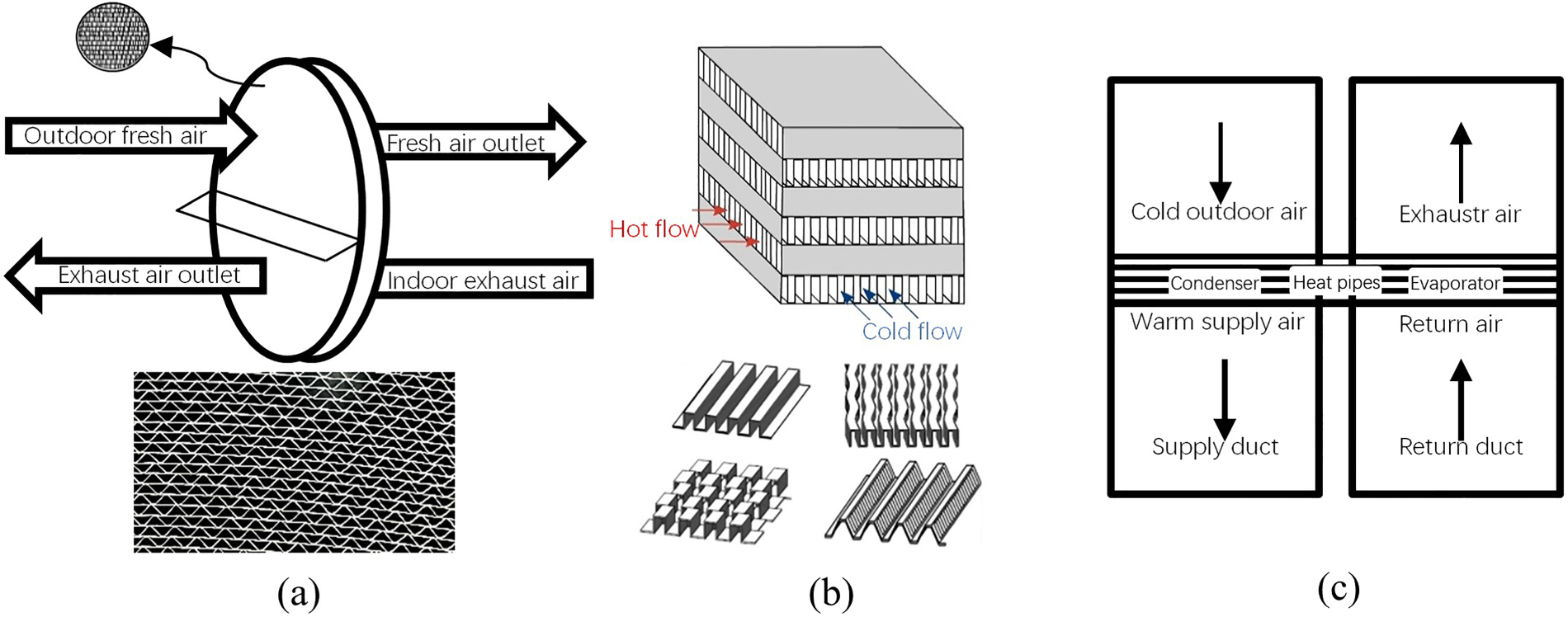
Traditional heat recovery technologies exhibit distinct performance characteristics: rotary wheels (Figure 1(a)) achieve 80% efficiency with total heat recovery capability, plate-fin exchangers (Figure 1(b)) deliver 50% to 80% efficiency with compact design advantages, and heat pipe units (Figure 1(c)) provide 45% to 55% efficiency with zero cross-contamination.4–6 However, these individual systems often fail to meet the increasingly complex energy demands of modern buildings. Through integration with technologies such as phase change materials (PCMs), dehumidification systems, double-skin façades (DSFs) and heat pumps (HPs), composite systems can deliver more efficient and sustainable solutions that address multiple building performance requirements simultaneously.
PCM integration: Enhanced thermal management
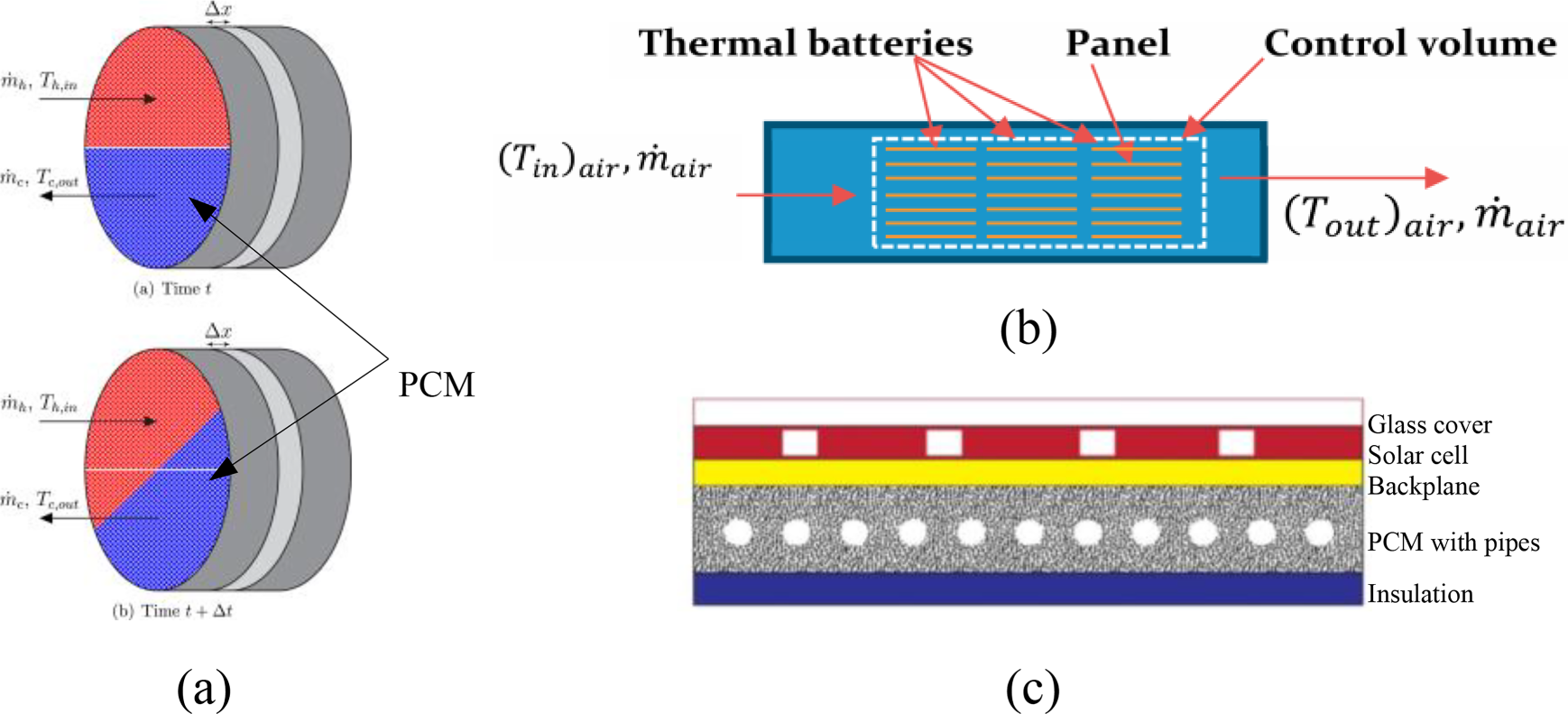
PCM integration with rotary heat recovery wheels provides thermal buffering capabilities during extreme weather conditions and peak load periods. 7 Several representative integration configurations are illustrated in Figure 2. Modified systems can accommodate 13.7% additional PCM whilst extending cooling duration through enhanced thermal storage capacity. 8 This approach transforms heat recovery from a purely instantaneous process to a time-flexible energy management strategy. Building upon this thermal storage capability, photovoltaic-thermal hybrid collector (PTHC) integration with PCM and rotary heat recovery wheels enables continuous heat release for several hours after sunset. 9 This configuration addresses temporal mismatches between solar energy availability and building heating demands. Meanwhile, control strategy optimisation and phase change response time remain technical limitations requiring development. Comprehensive annual monitoring studies are also necessary to validate actual performance under variable operating conditions and establish reliable design parameters for commercial implementation.
Dehumidification system integration
High humidity conditions significantly reduce heat recovery efficiency and compromise indoor air quality. Integrated dehumidification approaches utilise heat pipe-assisted desiccant-coated systems that achieve continuous moisture removal through adsorption and desorption heat recovery, with experimental results showing enthalpy reduction comprising 32.80% sensible heat and 67.20% latent heat. 10 Advanced desiccant materials, particularly metal–organic frameworks, demonstrate 20% to 40% improved dehumidification efficiency compared to traditional materials, including silica gel, activated carbon and zeolite-based substances.11,12
Further energy-saving strategies include heat exchange between dehumidified and regeneration air streams, condensation heat recovery and low-temperature regeneration (60°C to 100°C) utilising solar or waste heat sources. 12 These integrated heat recovery and dehumidification approaches enable more comprehensive fresh air treatment by providing independent moisture control upstream of conventional air conditioning processes, addressing the fundamental challenge of achieving optimal indoor conditions while maximising energy efficiency.
Fresh air heat recovery in advanced building facade systems
DSF and building-integrated photovoltaic/thermal (BIPV/T) system integration demonstrates measurable performance improvements beyond conventional equipment-level solutions. Excellent winter insulation and reduced summer solar heat gain were reported by a two-year monitoring study, though preheating efficiency remains limited during winter and transitional seasons. 13
BIPV/T systems can increase outlet air temperature by 14.8°C on sunny winter days, reduce defrost cycles by 13%, and achieve 32.34% fuel consumption savings in cold regions. 14 Exhaust ventilation double-glass photovoltaic façades with waste heat recovery demonstrate 19.26% total energy consumption reduction through integrated operation that simultaneously addresses photovoltaic cooling and thermal energy recovery. 15
Advanced ventilation photovoltaic façades utilise building exhaust air for seasonal control strategies: photovoltaic cooling and fresh air pre-cooling in summer, heat loss reduction and fresh air pre-heating in winter. These systems will achieve annual energy savings for summer and winter operations, respectively, demonstrating the potential for building envelope integration with energy recovery systems.
HP integration: Cascaded energy utilisation
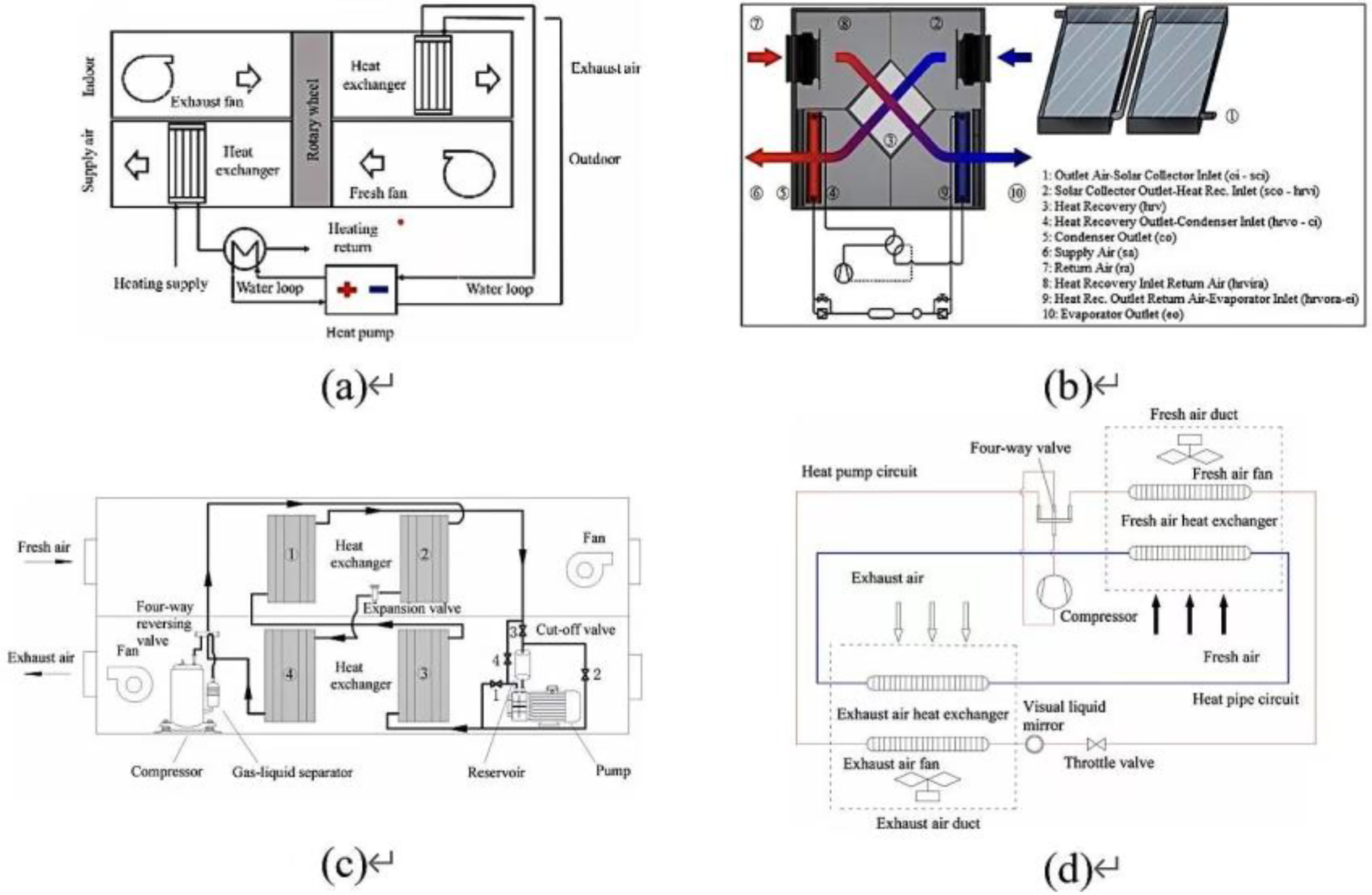
Coupling heat recovery devices with HPs enables cascaded energy utilisation, extracting exhaust air thermal energy through multiple stages to maximise system efficiency. The cascaded principle involves exhaust air first exchanging heat with fresh air through a heat exchanger for energy recovery, then HP extraction of remaining thermal energy for space heating, achieving efficiency improvement by 24% (Figure 3(a)). 16 However, frosting at low temperatures limits its performance.
Solar air collectors address frosting by providing supplementary thermal input to achieve 85% recovery efficiency whilst preventing ice formation (Figure 3(b)). 17 BIPV/T systems advance this concept by simultaneously providing thermal and electrical energy. The exhaust photovoltaic façade recovers heat from exhaust air before conventional recovery, whilst generating electricity to power the HP, resulting in 17.05% annual energy efficiency improvement. 18
Pumped loop heat pipe (PLHP) systems with forced circulation can overcome conventional limitations through three adaptive modes: standalone PLHP, standalone HP or combined operation with sequential air stream passage through both heat exchangers (Figure 3(c)). Under −15°C conditions, this increases temperature efficiency and heating coefficient of performance by 52.9% and 31%, respectively. 19 Two-stage heat pipe-HP systems with seasonal flow reversal optimise performance further (Figure 3(d)). The heat pipe provides primary recovery whilst the HP conducts deep thermal extraction in series, eliminating thermal competition and achieving 4.01% to 66.60% higher winter recovery efficiency than parallel configurations. 2 These cascaded approaches demonstrate the potential for systematic thermal energy recovery optimisation through sequential heat extraction strategies.
Challenges and future research
Whilst fresh air heat recovery systems integrated with clean energy technologies show significant promise for sustainable buildings, several critical challenges must be addressed to realise their full potential. These challenges span technical, economic and practical implementation aspects that require coordinated research efforts. The complexity of coordinating multiple energy technologies remains a primary challenge. Different components: heat recovery ventilators, photovoltaic panels, HPs and thermal storage, often have conflicting operational requirements under varying climatic conditions. Developing intelligent control algorithms that can dynamically optimise multi-technology systems while maintaining thermal comfort and energy efficiency across all seasons is essential. Laboratory results often differ from real-world performance due to occupants’ behaviour, maintenance practices and system interactions. Long-term monitoring studies are crucial to validate theoretical predictions and identify performance gaps. Future research should focus on developing robust systems that maintain efficiency under varying loads and operational conditions, while establishing predictive maintenance strategies using IoT sensors and data analytics. High initial capital costs and uncertain payback periods limit widespread adoption of integrated systems. Comprehensive lifecycle cost analyses that account for maintenance, performance degradation and local economic conditions are needed. Researchers should develop standardised economic evaluation frameworks and investigate innovative financing models to improve market viability. The lack of standardised design methodologies and performance evaluation criteria hinders systematic implementation. Research should establish comprehensive design guidelines that account for local climate conditions, building types and energy infrastructure. These guidelines must address system sizing, component selection and integration strategies to ensure optimal performance across diverse applications and geographical locations. Current limitations in heat exchanger efficiency, photovoltaic degradation and thermal storage stability constrain system performance. Research into advanced materials, including nanostructured surfaces, high-efficiency transparent photovoltaics and stable PCMs, could significantly enhance system capabilities. Smart building envelope materials that dynamically respond to environmental conditions represent particularly promising research directions.
Addressing these challenges through coordinated research efforts will be essential for realising the full potential of integrated fresh air heat recovery systems in sustainable building design and operation.
Footnotes
Author contributions
All authors contributed equally to the preparation of this paper.
Declaration of conflicting interests
The authors declared no potential conflicts of interest with respect to the research, authorship, and/or publication of this article.
Funding
The authors would like to acknowledge the coordinated support from the Natural Science Foundation of China (Grant Nos. 52278131 and 52570232).