







Abstract

Introduction
Revitalisation now holds an established place both in urban studies 1 and in public policy practice. 2 In its contemporary understanding, it no longer refers only to the technical modernisation of the built environment or to the aesthetic improvement of public spaces. 3 It is increasingly defined as an integrated process of leading degraded areas out of crisis through coordinated spatial, social, economic and environmental measures. 4 From this perspective, its aim is not simply to improve the material condition of the city, but also to restore quality of life and the functional and social value of place. 5
Despite this broad definition, revitalisation practice is still often subordinated to economic logic. 6 The success of renewal is inferred from rising property prices, 7 the inflow of investors, 8 an improved image of the district. These indicators do not determine whether revitalisation fulfils its basic public purpose: whether improved market indicators translate into a better everyday living environment for residents.
In view of the above, the authors consider that revitalisation must be situated within the three pillars of sustainable development: economic, social and environmental. The central argument is that revitalisation is effective only when rising property values are accompanied by improvements in residents’ quality of life, rather than replacing these goals. The interpretative logic adopted in this text is summarised in Figure 1.
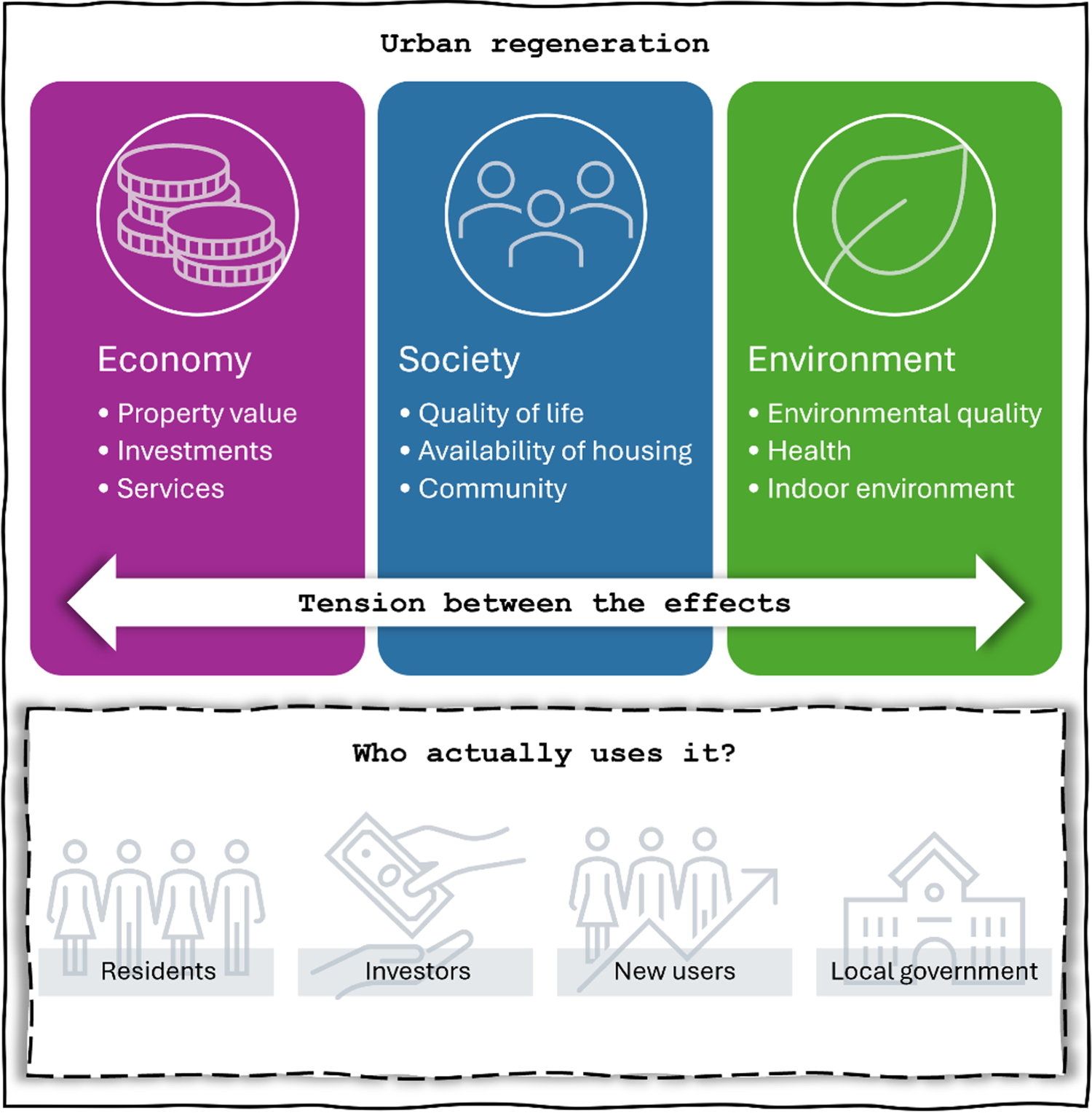
A conceptual approach to urban revitalisation from the perspective of the three pillars of sustainable development.
The rise in property values as a success and a limitation
The urban renewal can stimulate local economic activity 9 and strengthen a city's capacity for long-term development. 10 In this sense, revitalisation supports the economic pillar of sustainable development, and rising property values may be seen as one of the natural effects of improving the quality of a revitalised area. 11 The difficulty arises, however, when rising property values become the main measure of revitalisation success. Such a perspective reduces the complex process of urban renewal to market indicators and encourages the treatment of urban space primarily as an investment asset. 12 As a result, the focus of revitalisation activity shifts from residents to the market, and from quality of life to property value. 13 Revitalisation then ceases to be a tool for repairing the city in a social sense and becomes an instrument for creating competitive advantage and accumulating spatial value. 14
Rising property values usually impact increase of rents, property prices and everyday living costs. 15 The main beneficiaries are property owners, investors and actors able to participate in the property market on capital-based terms. 16 At the same time, lower-income residents may experience growing economic pressure, which weakens their ability to remain in the renewed district. 17 Revitalisation consistent with the principles of sustainable development should support economic development without shifting the costs of transformation onto the most vulnerable groups. 18
Improving residents’ quality of life and the right to remain in their existing urban space
The social dimension of revitalisation is a key point of reference for assessing its purpose. 19 Degraded areas concentrate housing, health and functional problems. Quality of life includes housing standards, safety, access to services and a sense of influence over the surroundings. 20 These are precisely the elements that determine whether residents experience revitalisation as an improvement in their everyday living environment, or as a process of change taking place alongside them or against them.
In practice, revitalisation often improves the image of a place more quickly than it improves living conditions. 20 It is possible to create a district that is more attractive, cleaner and better connected, while at the same time becoming less accessible to its existing residents. 21 In such cases, there is a risk of displacement, both direct and indirect. The first is linked to the loss of the possibility of remaining in place because of rising costs. 22 The second is more diffuse in character. As a result, the structure of services, the rhythm of the place, the profile of its users and the social character of the district may all change, so that formally remaining in place no longer means real participation in its renewed life. 23
The social pillar requires that the right of existing residents to remain be recognised as a criterion. 22 Existing residents should be able to benefit from improvements in spatial quality, rather than merely taking part in the process through which its value increases. In this context, social participation in revitalisation processes also becomes particularly important. 24 If it is to fulfil a real function, it cannot be limited to formal consultation. It should help shape the aims, priorities and scope of intervention. 25 Socially sustainable revitalisation is one that not only asks residents for their views, but genuinely takes account of their needs, experiences and constraints. 26
External environmental health and high-quality indoor environmental conditions
The environmental pillar concerns both the quality of external spaces and indoor environmental conditions, which directly affect health and comfort. 27 Many revitalisation programmes are dominated by easily visible measures like façades refurbishment. 28 However, fundamental parameters perceived by citizens like air quality, thermal comfort, noise levels and energy efficiency are equally important. Particular attention should be paid to the indoor environment. In degraded areas, it is precisely poor housing standards, dampness, overheating, inadequate ventilation, energy poverty and a lack of accessibility for older people and people with disabilities that rank amongst the most important factors lowering quality of life. 29 Revitalisation that does not improve these conditions remains incomplete. It may change the image of the city without fundamentally changing residents’ everyday experience.
For this reason, revitalisation should be understood as a tool for improving environmental health. This means modernising the building stock in ways that increase comfort of use, energy efficiency and resilience to climate risks. It also means creating public spaces that support health, social interaction and the everyday use of the city. Beyond human needs, the urban environment functions as a shared habitat, thus, a biocentric perspective argues that revitalisation must also ensure favourable conditions for local flora and fauna. Adopting a holistic approach to environmental issues ensures consistency with urban climate adaptation measures.
Revitalisation as a process of redistributing benefits
Urban revitalisation from the perspective of the three pillars of sustainable development: objectives, benefits, risks and evaluation criteria.
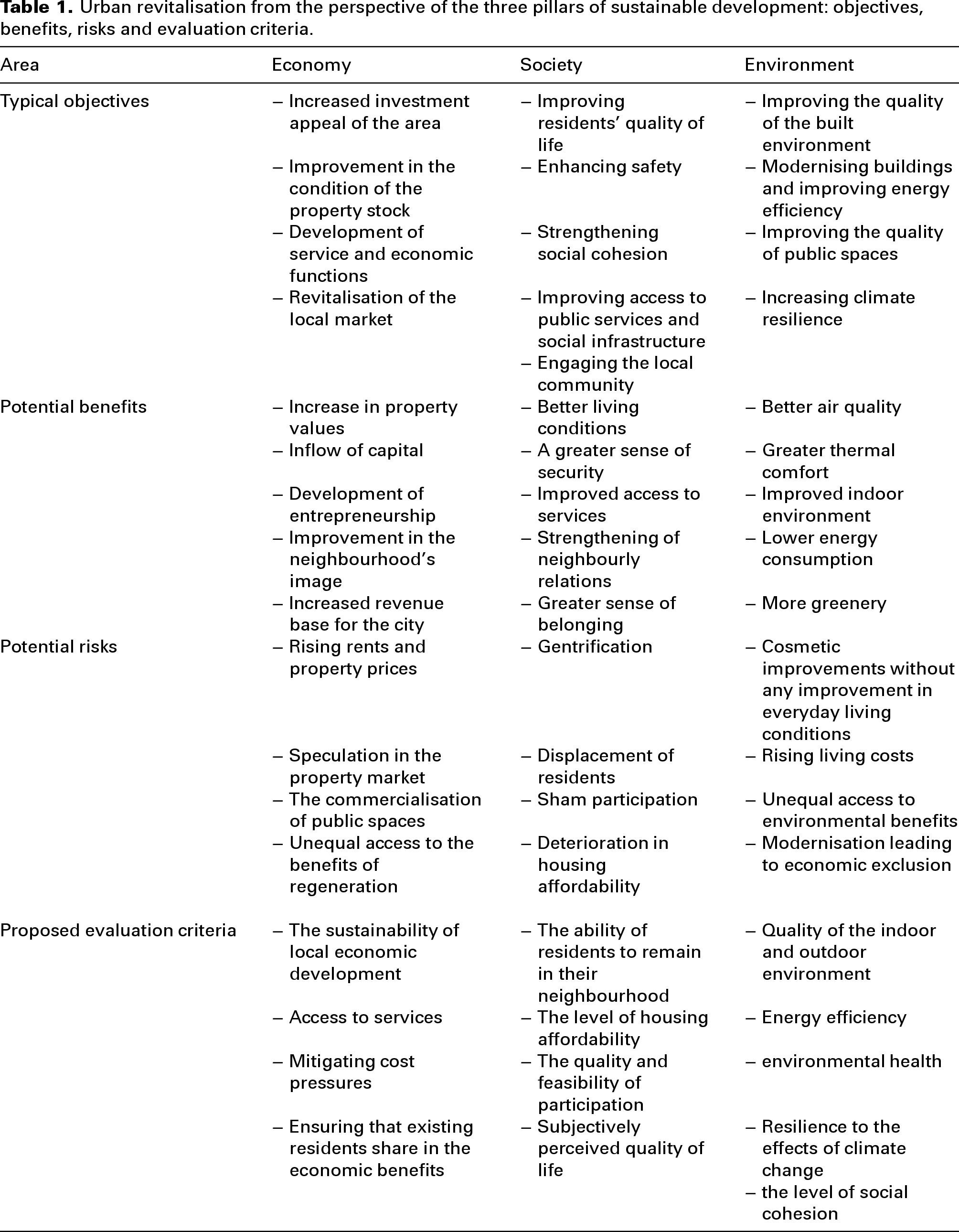
Revitalisation is not a neutral process from the point of view of the distribution of benefits. Within each of the three pillars, distinct positive effects can be identified but so can different forms of risk. These may lead to the selective capture of results of renewal by stronger market or social actors.
The question of who benefits from revitalisation leads to the conclusion that every process of urban renewal has a redistributive character. This means that the benefits and costs of transformation are not distributed evenly amongst all participants in urban life. The city may gain a better image and greater competitiveness, investors may benefit from rising asset values, and new users may enjoy renewed spaces, better services and a higher standard of surroundings. This does not, however, automatically mean that existing residents also benefit.
This distinction is fundamental to assessing whether revitalisation retains its public character. If improvements in spatial quality translate into better housing conditions, higher-quality indoor and outdoor environments, greater safety and the preservation of the possibility of remaining in place, then one may speak of a genuine improvement in quality of life. If, however, economic effects come to dominate social and environmental ones, revitalisation becomes a process of selective spatial improvement rather than one of full urban renewal.
Conclusion
Contemporary revitalisation requires a fundamental redefinition of success criteria. While rising property values are a significant indicator of urban attractiveness, they remain insufficient as a standalone metric because they fail to capture the social costs of transformation or the health-related outcomes of renewal. From the perspective of the built environment, the most meaningful effects of revitalisation are felt within the dwellings and public spaces where everyday well-being is shaped. Revitalisation is consistent with sustainable development only when it maintains a rigorous balance between economic growth, social equity, and environmental health.
This balance requires that increased spatial value coexists with the protection of housing affordability and the right of existing residents to remain in their neighbourhood. Furthermore, a holistic approach to environmental issues aligns with urban climate change adaptation strategies. Ultimately, urban renewal should not be assessed by how effectively it increases property values, but by whether it makes the city a healthier, more resilient, and more just living environment for all its inhabitants.
Footnotes
Declaration of conflicting interests
The authors declared no potential conflicts of interest with respect to the research, authorship, and/or publication of this article.
Funding
The authors received no financial support for the research, authorship, and/or publication of this article.
