






Abstract
Introduction
Due to accelerating urbanization and the continuous growing demand for building energy, energy security, and environmental issues caused by conventional fossil fuel consumption have become increasingly prominent. To effectively alleviate the dual pressures of energy shortages and environmental degradation, the exploitation and utilization of renewable energy sources, such as solar, wind and geothermal energy, have emerged as a critical direction in the global energy transition. As a major energy-consuming sector, the building industry is also attaching a greater importance to energy conservation and sustainable development. 1 Among various renewable sources, solar energy is regarded as one of the most promising options owing to its abundance, wide availability, cleanliness, safety and ease of access. Solar photovoltaic (PV) technology is a mature and widely applied means of utilizing solar energy, 2 and provides a technical foundation for integrating solar energy into buildings. Against this background, the envelope-integrated PV/thermal (EIPV/T) solar system has been developed. This system integrates PV modules into the building envelope or building components, combining the dual functions of energy generation and building enclosure. 3 It represents a pathway towards building energy efficiency and sustainable construction. The system can transform both new and existing buildings into energy-plus buildings, not only by converting solar radiation into electricity but also by reducing cooling demand in summer and heating demand in winter.
Recent research on the solar system has primarily focused on system design optimization, thermal and electrical performance evaluation, integration with building thermal management, and the dual benefits of electricity generation and thermal regulation.4–8 There has been a growing interest in the role of such integrated systems for achieving net-zero energy buildings and mitigating the urban heat island (UHI) effect, with a notable rise in experimental validations and simulation-based parametric studies.9–13
Concept and characteristics of the EIPV/T system
Concept of the EIPV/T system
An EIPV/T system refers to a building-integrated solar system in which PV modules serve as part of the building envelope while simultaneously capturing solar energy to generate electricity and useful thermal energy. In the summer mode, the system removes excess heat through the air ventilation and circulation, thereby reducing the cooling load while producing power. In the winter mode, the recovered heat can be used for space heating or pre-heating fresh air, thus decreasing the heating demand. A schematic illustration of the operating modes for both seasons is presented in Figure 1.
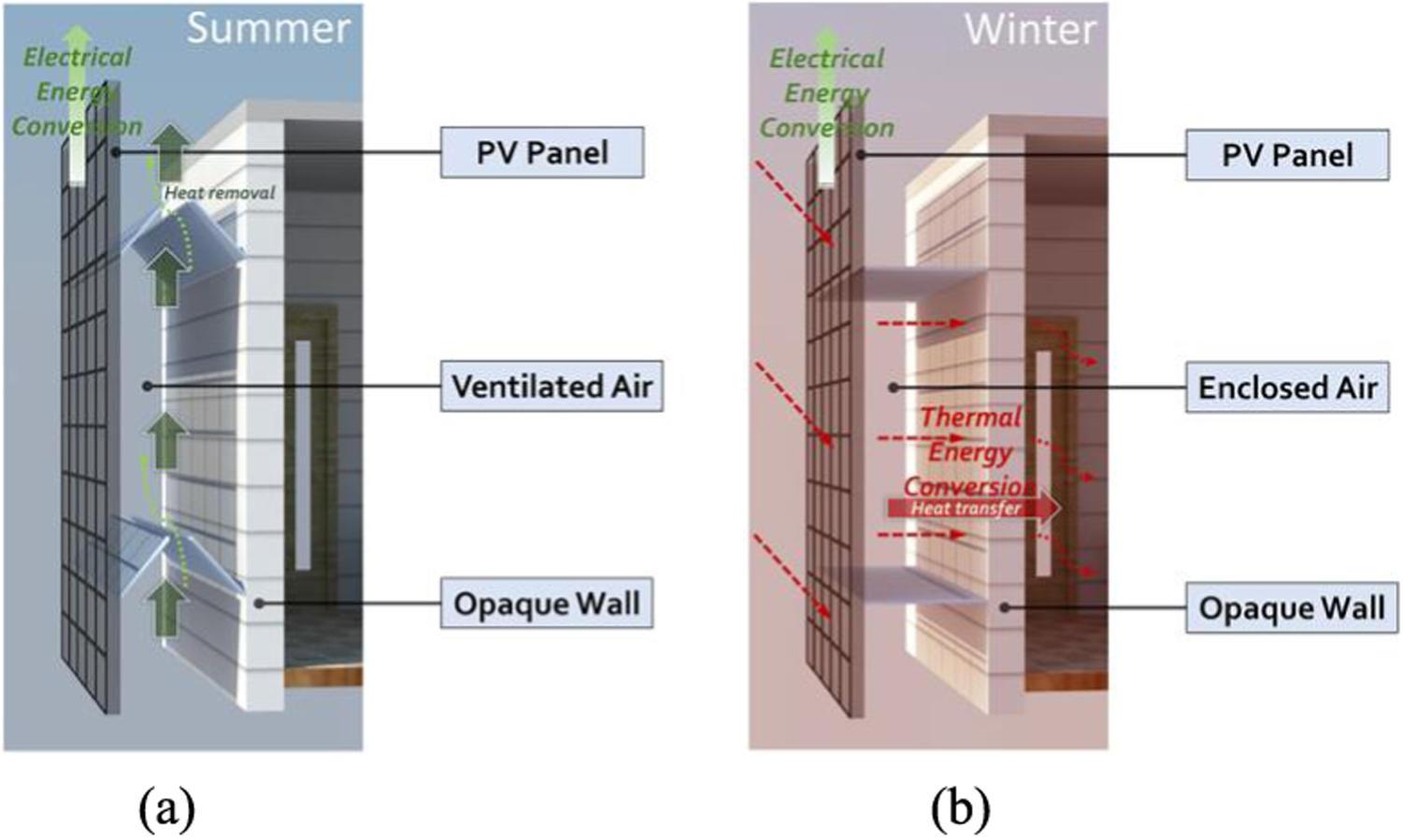
Schematic illustration of envelope-integrated photovoltaic/thermal (EIPV/T) systems: (a) ventilation mode in summer and (b) closed mode in winter. 14
Characteristics of the EIPV/T system
EIPV/T systems possess advantages that align with the dual goals of building energy efficiency and carbon neutrality, as shown below:
Carbon emission reduction: By generating electricity on-site and simultaneously reducing the building's operational energy demand for heating and cooling, EIPV/T systems contribute directly to lowering carbon emissions over the entire building life cycle. The reduction in grid electricity consumption, coupled with the decrease in fossil-fuel-based heating, translates into substantial lifecycle carbon savings. Expanded solar utilization potential: EIPV/T systems can be installed on both roofs and façades, greatly enlarging the available solar-active surface area of the building envelope. This architectural flexibility significantly increases the PV potential and the total amount of electricity that can be generated on-site. Installation flexibility and efficiency: Depending on architectural requirements and aesthetic considerations, PV/T modules can be integrated as roofing elements, façade cladding, spandrels or shading devices. With state-of-the-art cell technologies, electrical efficiencies typically range from 15% to 22%, while the recovery of waste heat as a useful thermal output can raise the overall system efficiency to above 60%, making EIPV/T one of the most efficient solar technologies for building applications.
Beyond these characteristics, the practical potential of EIPV/T systems was illustrated by the landmark project, the Yuanju Building (Building No.7) at the campus of Xi’an Jiaotong University's Innovation Harbour, as shown in Figure 2. The building utilizes energy-efficient technologies such as the geothermal heating system, high-performance composite exterior wall system, solar-electric/thermal synergistic collection and roof shading PV module. The EIPV/T system was deployed across façades and skylights, covering 2750 m2 (23% of the exterior surface), with an installed PV capacity of 458 kW that can generate ∼400,000 kWh annually and cut CO2 emissions by ∼398 tonnes per year. For its outstanding performance, this building had received the 2023 WFEO (World Federation of Engineering Organizations) H. J. Sabbagh Prize for Excellence in Engineering Construction (the only such award globally that year) and the inaugural AIUE (Asian Institute of Urban Environment) Innovation Design Award in 2024.
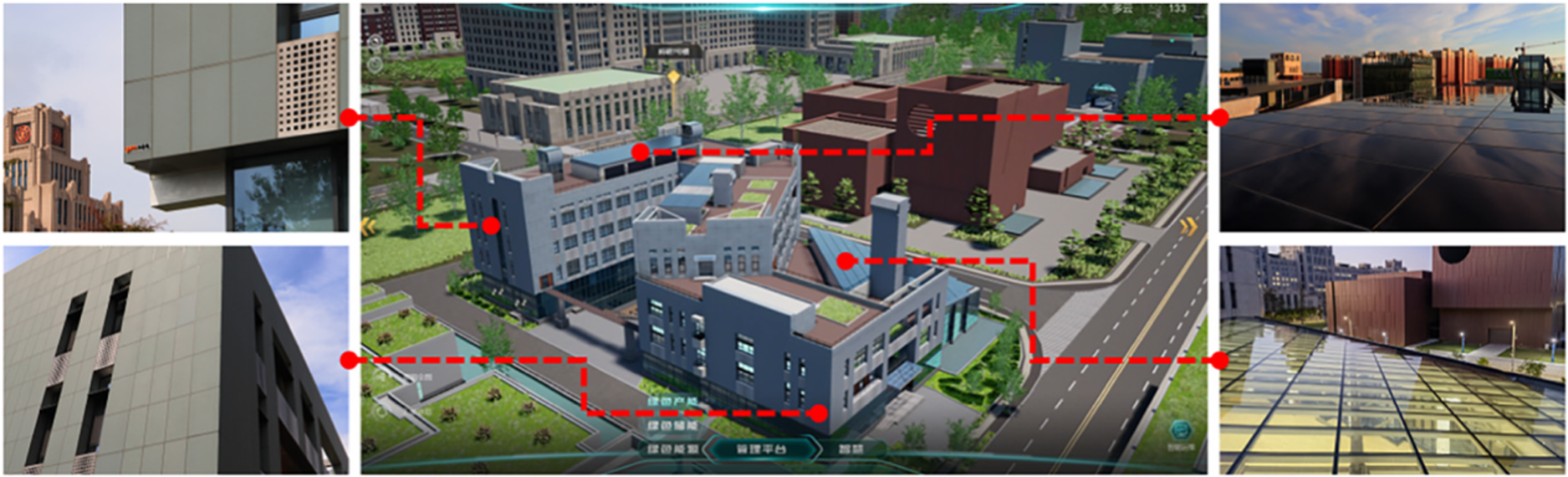
Schematic diagram and physical images of Yuanju Building (Building No 7). 14
Parameters influencing EIPV/T performance
The operational performance of an EIPV/T system is not determined by a single parameter but is jointly influenced by solar irradiance, orientation and tilt angle, ambient temperature, ventilation conditions, shading and shadows, and module characteristics, amongst other parameters. 15 The following are the major parameters affecting EIPV/T system performance.
Solar radiation conditions
Solar radiation is a key environmental parameter influencing the power generation performance of EIPV/T systems. 16 The incident irradiance directly determines the total amount of solar energy that the PV modules can harvest, and in turn affects the output power, and performance ratio of the system. In general, the richer the local solar resource, the higher the irradiation received by the modules, and the greater the system's electricity generation potential. According to China's solar resource classification, Xi’an lies in a region with abundant solar resources, with an annual global horizontal irradiation of ∼1050–1400 kWh/m2, thus providing a favourable basis for solar energy exploitation. For this reason, the Yuanju Building integrates PV into its façades and skylights, expanding the sunlight-receiving interfaces and improving the utilization level of solar radiation.
However, the influence of solar radiation conditions on EIPV/T electrical output is not linearly proportional. Higher irradiance raises the module temperature, which in turn reduces the PV conversion efficiency and power output. Therefore, the effect of solar radiation on an EIPV/T system essentially manifests as a coupled process of irradiance gains versus efficiency losses due to temperature rise. As shown in Figure 3, the monthly PV power generation was calculated by simulation with the Xi’an typical annual solar radiation conditions on the building surfaces. To maximize power generation, the EIPV/T system of the Yuanju Building increases the solar-collecting area as much as possible, while incorporating efficient ventilation cooling and structural optimization to mitigate the negative impact of temperature elevation on power performance.
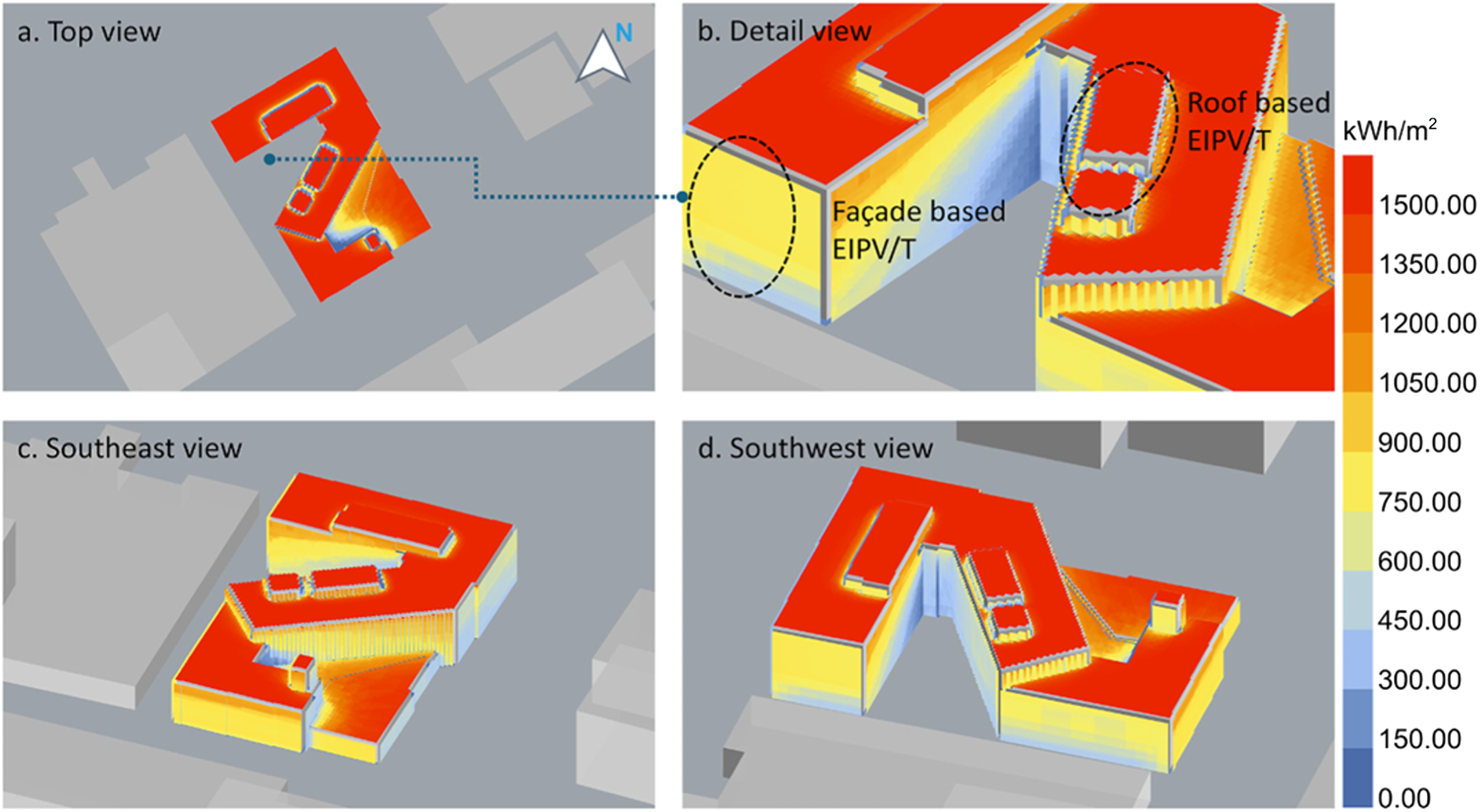
Solar radiation and photovoltaic (PV) power simulation of Yuanju Building (Building No. 7). 14
Shading and shadows
Shading and shadows are significant external factors constraining the actual power generation performance of EIPV/T systems, 17 particularly in high-density urban environments and façade-integrated applications. 18 Unlike conventional rack-mounted PV systems, EIPV/T modules are directly embedded in the building envelope and are therefore more susceptible to the combined effects of building form, construction details and the surrounding environment. Local shading or shadows can reduce heat transfer from the environment into the building, thereby lowering the cooling load. However, the low albedo of PV panels leads to absorption of solar radiation and subsequent release to the surrounding air through radiation and convection, which may aggravate the UHI effect. The UHI phenomenon occurs when urban centre temperatures are significantly higher than those of surrounding areas, owing to lower surface albedo and elevated anthropogenic heat emissions. Studies indicate that for every 1 °C rise in urban heat island temperature, peak electricity demand in summer can increase by 0.45%–12.3%, creating a feedback loop that further intensifies the UHI effect. 19 Additionally, non-uniform shading may cause uneven illumination across cells or modules, leading to series-parallel mismatches, reduced output power and impaired system efficiency. Therefore, when designing an EIPV/T system, nearby obstructions, building geometry, solar accessibility and electrical optimization should be considered together to minimize prolonged and locally concentrated shading.
During the schematic design phase of the Yuanju Building, the layout was optimized by integrating topography, daylighting and functional requirements. Through a ‘Z-shaped’ plan and a multi-surface PV arrangement, unfavourable shading conditions were reduced, thereby mitigating the adverse effects of shading and shadows on the overall EIPV/T performance.
Seasonal environmental conditions
Seasonal environmental conditions could influence the operating temperature of PV modules, affect the building's cooling and heating loads, and significantly modulate the urban heat island effect. 20 Xi’an, where the Yuanju Building is located, experiences considerable seasonal temperature differences, with an annual average temperature of ∼15 °C, a maximum of around 40 °C in July and a minimum of around −10 °C in January.
The study compared an Energy-Plus Building equipped with the EIPV/T system to a conventional building through energy simulations. 14 The results show that the application of the EIPV/T system can reduce the cooling load of the Xi’an-based block by 20%–60% in summer mode, and the heating load by about 15%–30% in winter mode. Experimental validation was also carried out based on the Yuanju Building, showing good agreement with the simulation results, as shown in Figure 4. The reduction in cooling and heating loads reduces the electricity and heating demand from external sources, thereby lowering the building energy load and the stress on the power grid. At the same time, the electricity generated by the EIPV/T system further reduces the input power from the external grid and increases the surplus electricity exported to the grid, significantly reducing the anthropogenic heat gain in the urban canopy layer, one of the main causes of the UHI effect.
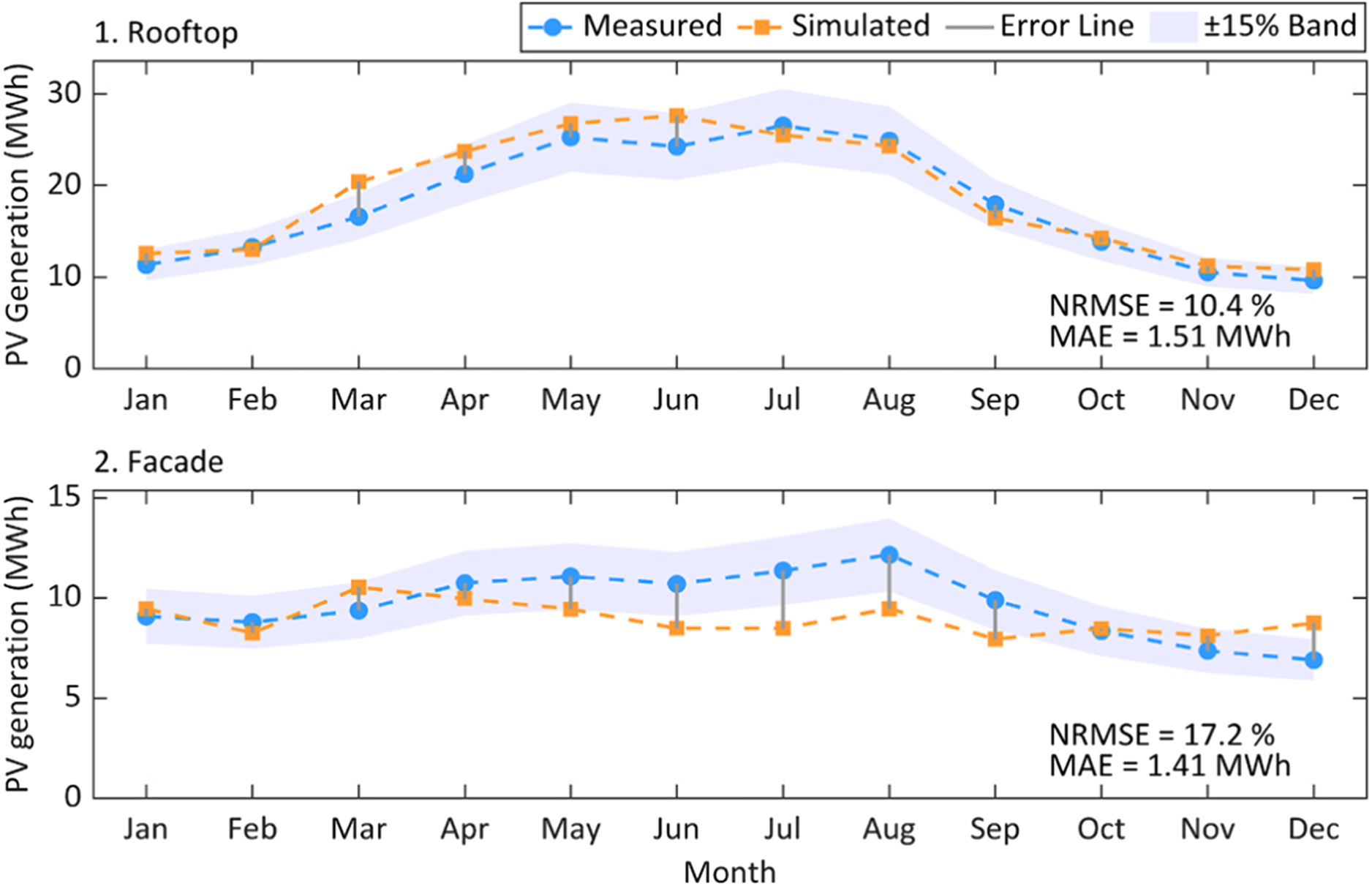
Experimental validation of the PV power generation with the EIPV/T system on Yuanju Building (Building No. 7).14 PV, photovoltaic; EIPV/T system, envelope-integrated photovoltaic/thermal solar system.
Installation position and orientation
PV installations in urban environments can increase the ambient temperature around buildings, potentially exacerbating the urban heat island effect. The installation position and orientation significantly affect the temporal and spatial distribution of solar radiation received by EIPV/T modules, and they are key design variables influencing the annual energy yield and operational efficiency. The installation position affects the temperature rise of the modules, self-shading effects and their coordination with building daylighting, while different orientations alter the duration of insolation and the radiation distribution on building surfaces. 21 Relevant studies have shown that, across various climate zones in China, PV panels should be preferentially arranged on roofs and south-facing façades. East- and west-facing façades can serve as supplementary surfaces, while north-facing façades have relatively limited utilization potential. 22 Therefore, the design of EIPV/T systems requires synergistic optimization of orientation and installation methods based on local solar paths, building form and energy demand. 23
In this study, a building energy model was established, and the simulation results indicate that façade-mounted EIPV/T systems possess considerable potential for mitigating the urban heat island effect. 14 In terms of orientation, the design of the Yuanju Building utilizes the site's elongated north-south configuration and adopts a ‘Z-shaped’ plan to create more south-facing and near-south-facing solar interfaces. The EIPV/T system uses the south-facing surfaces as the primary electricity-generating interfaces, while horizontal or tilted elements such as skylights further increase the radiation-collecting area. East- and west-facing interfaces serve as auxiliary orientations, and the north-facing interfaces mainly perform enclosure, daylighting and ventilation functions. This orientation strategy enhances the solar radiation harvesting potential and improves the overall daylighting and ventilation conditions of the building.
Conclusion and outlook
In conclusion, the EIPV/T solar system represents a highly effective technology for transforming buildings into Energy-Plus units while simultaneously addressing the intertwined challenges of building energy consumption and urban heat island intensification. Through the case of the Yuanju Building in Xi’an, this study has demonstrated that a well-designed EIPV/T system could significantly reduce both cooling and heating loads and supply considerable on-site renewable electricity and measurably lower urban heat gains. The multi-parameter analysis highlights the importance of holistic design that optimizes solar exposure, mitigates shading and temperature-induced efficiency losses, and strategically arranges PV/T surfaces on roofs and façades according to local climatic and morphological conditions. Looking forward, future research should concentrate on long-term field monitoring of EIPV/T installations across diverse climate zones, the development of smart energy management strategies that integrate storage and grid interaction, and the assessment of life-cycle environmental and economic benefits. Further exploration of advanced materials and cooling techniques may enhance electrical and thermal efficiencies, making EIPV/T systems an even more compelling component of sustainable urban development.
Footnotes
Funding
The authors disclosed receipt of the following financial support for the research, authorship, and/or publication of this article: This work was supported by Young Scientists Fund of the National Natural Science Foundation of China (52506102), National Natural Science Foundation of China (12272291), Fundamental Research Funds for the Central Universities (xzd012026036) and China Postdoctoral Science Foundation (2024M762594).
Declaration of conflicting interests
The authors declared no potential conflicts of interest with respect to the research, authorship, and/or publication of this article.
