






Abstract
Academic–industry collaborations are seen as a way to improve the translation and uptake of social science research. The ideal model is that of knowledge co-production, which regards effective collaboration as a reciprocal process between academic researchers and industry partners that is underpinned by jointly produced research outcomes. However academic–industry research partnerships can be inherently problematic, with poor collaborations impeding the translation and uptake of academic research. This article sets out to explore the realities of academic–industry collaborations in the social sciences through a study of Australian Research Council Linkage projects. Based on interviews with academic chief investigators and industry partners (n = 54) the article examines factors that influence the dynamics of research collaborations. Findings indicate that collaborations are inhibited and enhanced by particular individual and organisational factors and that the benefits of academic–industry collaborations go beyond simply improving the uptake of social science research.
Keywords
An increasing volume of work has focused on identifying ways to improve the uptake of academic social research by policy-makers and practitioners (Nutley et al., 2007). One type of model advocated is academic–industry collaborations. Evidence suggests that academic–industry collaborations can improve the policy uptake of academic research (Nutley et al., 2007; Ross et al., 2003). Scholars argue that the most effective academic–industry collaborations are underpinned by knowledge co-production, where there are reciprocal inputs by partners into the design and outcomes of research projects (Gibbons et al., 1994; Orr and Bennet, 2012; Rickinson et al., 2011). Scholars have argued that there needs to be greater reflection about the realities of knowledge co-production and the research partnership process (e.g. Orr and Bennett, 2012). This is because the perspectives and activities of academic and industry partners do not always align and are heavily influenced by various individual and organisational factors (Bammer, 2008; Bogenschneider and Corbett, 2010; Cherney and McGee, 2011; Cherney et al., 2012a, 201 b; Clark and Sinclair, 2008; Haynes et al., 2011a, 2011b). This means the operation of academic–industry collaborations can be problematic, which can make project outcomes difficult to achieve.
This article aims to explore the realities of knowledge co-production in the social sciences by shedding light on the dynamics of research collaborations and what determines their success. Data is drawn from interviews with academic investigators (n = 31) and industry partner representatives (n = 23) involved in Australian Research Council (ARC) Linkage projects in the social and behavioural sciences. The ARC Linkage scheme offers the opportunity to assess the nature of academic–industry collaborations, given the emphasis on linking academics and external partners through funded research that has an applied and scholarly focus (Turpin et al., 1999). Key results are canvassed around the following themes: the role of prior relationships; Linkage partner involvement in project design and implementation; strategies of communication and dissemination; impact and benefits of collaboration.
Background debates and studies
Compared to the health sciences there has been little attempt to examine the nature and outcomes of academic–industry collaborations in the social sciences (Bammer, 2008; Cherney et al., 2012b; Lavis et al., 2003; Nutley et al., 2007). This is a significant oversight, given it is argued that closer engagement with external partners can help academics to develop research projects that better meet the needs of policy-makers and practitioners (Jacobson et al., 2004; Lambert, 2003; Rickinson et al., 2011). This process is improved when policy-makers and practitioners are involved in the conceptualisation, design and completion of a research project, and the translation and dissemination of results. Industry input into collaborative research is seen as central to the process of knowledge co-production because it ensures the preferences of non-academic end-users of research are accommodated, improving the process of research translation (Armstrong and Alsop, 2010; Mitton et al., 2007; Orr and Bennett, 2012). This will also help to improve the uptake of social research by making it more accessible and relevant (Bogenschneider and Corbett, 2010).
However research collaborations are not without their problems. One is that the extent to which the different interests, ideologies and priorities of academics and industry partner participants can be bridged through closer interactions varies considerably (Contandriopoulos et al., 2010; Keiser and Leiner, 2009). The benefits of academic–industry collaboration can be uncertain as organisational capacities, cultural barriers and incentives all influence the outcomes sought by each party. Given that it has been argued that academics and policy-makers constitute ‘two communities’ when it comes to research needs and priorities (Caplan, 1979; Jacobson et al., 2004), academic–industry collaboration can be a difficult undertaking, because participants’ motivations for conducting joint research may not be the same. Also the capacity to make contributions to collaborative research can vary and the interest in doing so may fluctuate over time. Hence academic–industry collaborations need to be carefully managed (Bammer, 2008).
The literature on collaborative research makes clear that there needs to be a foundation of trust and familiarity between partners on which to build a sustainable and productive working relationship (Contandriopoulos et al., 2010; Haynes et al., 2011a; Mitton et al., 2007). Successful academic–industry collaborations are not just about trust and familiarity between partners but are also reliant on the role of individuals within industry partners to ‘champion’ the project across different units, which has a major role in determining whether project outcomes have an impact on policy or practice (Bammer, 2008; Cherney and Head, 2011; Meyer, 2010; Mitton et al., 2007). Also the types of impacts that might result are varied and contingent. For example, collaborations may lead to research providing new ways of understanding that help agencies to redefine the problems they need to address, without necessarily inducing a direct change in policy. This is often referred to as conceptual impact (Weiss and Bucuvalas, 1980). Outcomes of collaborations may have a direct impact on policy and practice (i.e. instrumental impact), however this can often be more the result of timing and opportunism than a concerted strategy to influence policy decision-making (Hale, 2011; Haynes, 2011a, 2011b). Industry partners may enter collaborations for strategic or political reasons because they lack capacity to generate robust data to help justify their decision-making. Hence the motivations for entering into joint research collaborations are potentially linked to the forms of uptake that may emerge among industry partners (Henry and Mark, 2003).
Study of ARC Linkage projects
The ARC is a statutory authority and the primary funder of research in Australian universities outside the Australian National Health and Medical Research Council. It funds research that falls within 22 Fields of Research, one of which relates to the social and behavioural sciences. It manages the federal government’s national competitive grants program – a taxpayer-funded initiative – which comprises the Linkage scheme.
The ARC Linkage program is focused on encouraging collaboration between higher education researchers and government and non-government sectors. Industry partners must make a cash and in-kind contribution to the Linkage project, which must be costed and justified in the grant application. Each industry partner must provide a signed letter of support stipulating how the project aligns with the agency’s mission and objectives, adds value to their role and lists their cash and in-kind contribution. Partner agencies are expected to nominate a primary contact person whose role is to liaise with the academic research team.
The current project began by purposively sampling 46 Linkage projects that fell within 10 ARC research codes comprising psychology, sociology, law enforcement, anthropology, social work, demography, human geography, political science, policy and administration and other studies in human society. 1 Projects awarded funding between 2003 and 2007 were selected. 2 The reason this time period was chosen is that ARC Linkages on average tend to be three years long and it ensured that completed projects were sampled. Also, the number of projects funded each year is not equally distributed across the 10 fields of research identified, and it was necessary to spread selection over a number of years to ensure that at least one project was selected from each field of research. It was not possible to achieve equal numbers across each research discipline.
The author successfully conducted interviews with academics and industry partners from 30 of the 46 projects selected. The distribution of projects across the ARC research codes used at the time to classify each project are as follows: psychology (n = 6), law enforcement (n = 6), sociology (n = 5), anthropology (n = 4), social work (n = 3), policy and administration (n = 2), human geography (n = 2), political science (n = 1), demography (n = 1). 3 The author was able to recruit and interview 31 academics (29 lead chief investigators and 2 research fellows). Academics could not be successfully recruited across all 46 projects. Some academics did not respond to the recruitment email message, despite repeated follow-ups, others were on leave when the study was conducted, a few declined to be interviewed and, in some instances, academics were chief investigators across 2, or in one case 3, of the 46 projects selected. In circumstances where academics were chief investigators across multiple ARC Linkages it was decided only to interview them about one project, which they were able to select. Of the 30 projects studied, 15 projects were successfully followed up with industry partners who were listed as collaborating organisations. 4 Successful recruitment was hampered by the fact that some industry partner contacts did not respond to emails or phone messages seeking participation. Particular industry partner contacts could not be located because they no longer worked for the collaborating agency, and in some instances academic chief investigators had lost contact with relevant individuals and could not provide contact details. A total of 23 interviews were conducted with representatives from partner agencies. 5 Partner organisations were drawn from government and non-government sectors, with the bulk of the partners being government agencies. All interviews were transcribed verbatim and analysed in the qualitative software package Nvivo 9.
The interviews aimed to capture how the Linkage project arose, the level of input into the design and implementation of the project, forms of impact resulting from the ARC Linkage project, the benefits of collaboration for academics and industry partners, and the organisational and individual level factors that influenced the dynamics and outcomes of the collaboration, such as the challenges of working with particular partners. Once the content of interview data had been allocated to these broad interview themes, a second stage of coding was undertaken in which each theme was divided into unique attributes to represent their various dimensions. For example, the theme ‘levels of input into project design and implementation’, was divided into two categories: passive input (meaning industry partners’ contribution did not extend beyond the provision of funding) and active input (meaning industry partners had input into project drafts and execution of the fieldwork).
A qualitative methodology was adopted because the aim was to understand the processes underpinning collaborations, which is best investigated through in-depth interviews that aim to examine the dual perspectives of academics and agency participants involved in collaborations (Gallart-Molas and Tang, 2011). This helps to cross-validate results and obtain alternative perspectives on the same issue, thus reducing the possibility that the qualitative data only reflect one viewpoint. Given that the project was based upon respondents’ retrospective assessment of Linkage projects, the issue of respondent recall was a problem. One needs to be mindful that academic researchers and collaborating organisations involved in ARC Linkages may want to portray the most favourable outcome. Interviewees who consented to participate may predominantly have been participants who had the most positive experiences to report.
Results
Initiating collaborations – the role of prior relationships
The interview data indicated that a prior relationship between academic researchers and external partners was linked to the willingness of both parties to invest in collaborative work. Having a prior relationship helped to establish a reference point on which to base judgements about the risks and benefits of entering into collaborative research and this was important for industry partners (Bogenschneider and Corbett, 2010; Contandriopoulos et al., 2010; Haynes et al., 2011a, 2011b). For ARC industry partners this was particularly salient because research collaborations can generate scrutiny of their policies and practices. For instance, in all but 2 of the 30 projects studied there was some type of prior relationship between one or more of the chief investigators (CIs) and industry partners. This was typically based on the CI having worked with, or for, an industry partner. For example, one academic CI stated: Yes, well in particular with [agency name removed] because I’ve worked for them for so many years, we’re friends. In fact, if I ever have a need for an industry partner, they’ll – I can almost guarantee they’ll be on it. But pretty much because we meet regularly, ideas emerge with them and then they’re very good at facilitating other people’s involvement. (CI interview 2)
The importance of ongoing contact was central to building a sense of trust between industry partners and academic CIs. The interview data illustrated that trust in the motives and expertise of academic CIs was particularly salient for industry partners, who sought reassurances that the research was to be conducted with their needs in mind. For example, one industry partner representative made the following statement in reference to reasons for his reported low level of input into and oversight of a Linkage project, referring specifically to the trust he had in the CI: he’s been involved off and on in a very fundamental way with the functions of the … Council.… I, in fact, hired him myself, not so much for land claim work but for other functions of the … Council…. But he goes back much further than that … if it was someone who wasn’t of his standing, and as thorough and as esteemed as him, I probably would have – either myself or designated someone to have more input.… But I and the Council have a lot of faith in [CI name removed] … that they’re doing things ethically and thoroughly and in accordance with the aims of the … Council. So, we had a little bit of – I had a little bit of input into project design and then otherwise left it to him. (IP interview 19)
Ongoing connections and relationships of trust were also seen as important to the quick resolution of problems related to data collection and in the dissemination of results. Over half of the academic CIs interviewed highlighted this point. However a prior relationship with a partner organisation was no guarantee that a specific Linkage project would have an influence on the policies and practices of industry partners. More about this issue will be canvassed below.
Industry partner involvement in project design and implementation
One largely unexplored issue in the research literature is how dense and reciprocal do research collaborations have to be to conclude that knowledge co-production has occurred. This is linked to the levels of input that partners have into project design and implementation. In the context of academic–industry collaborations this is particularly relevant because academic researchers can place a great deal of value on decisions relating to research methodology and data analysis, given their importance to an academic’s occupational identity and role. Academics may be unwilling to compromise in such circumstances due to a fear it will undermine the rigour of the research process. However, for a collaboration to be a two-way process participants need to be willing to vary their level of control over different stages of the research process.
This issue of input into collaborative research was investigated by a series of questions about the level of input CIs and partner organisations had into the design and implementation of the Linkage project. Academic CIs always reported consistent levels of input, given that they typically led the project design, data collection and analysis phases. For ARC industry partners there were three main types of industry partner involvement that emerged from the data: formal supporter, responsive audience and integral partner (adapted from Ross et al., 2003). Each involved different levels of input into the research process. Table 1 outlines how these models were evident in the current study.
Models of industry partner involvement (adopted from Ross et al., 2003).
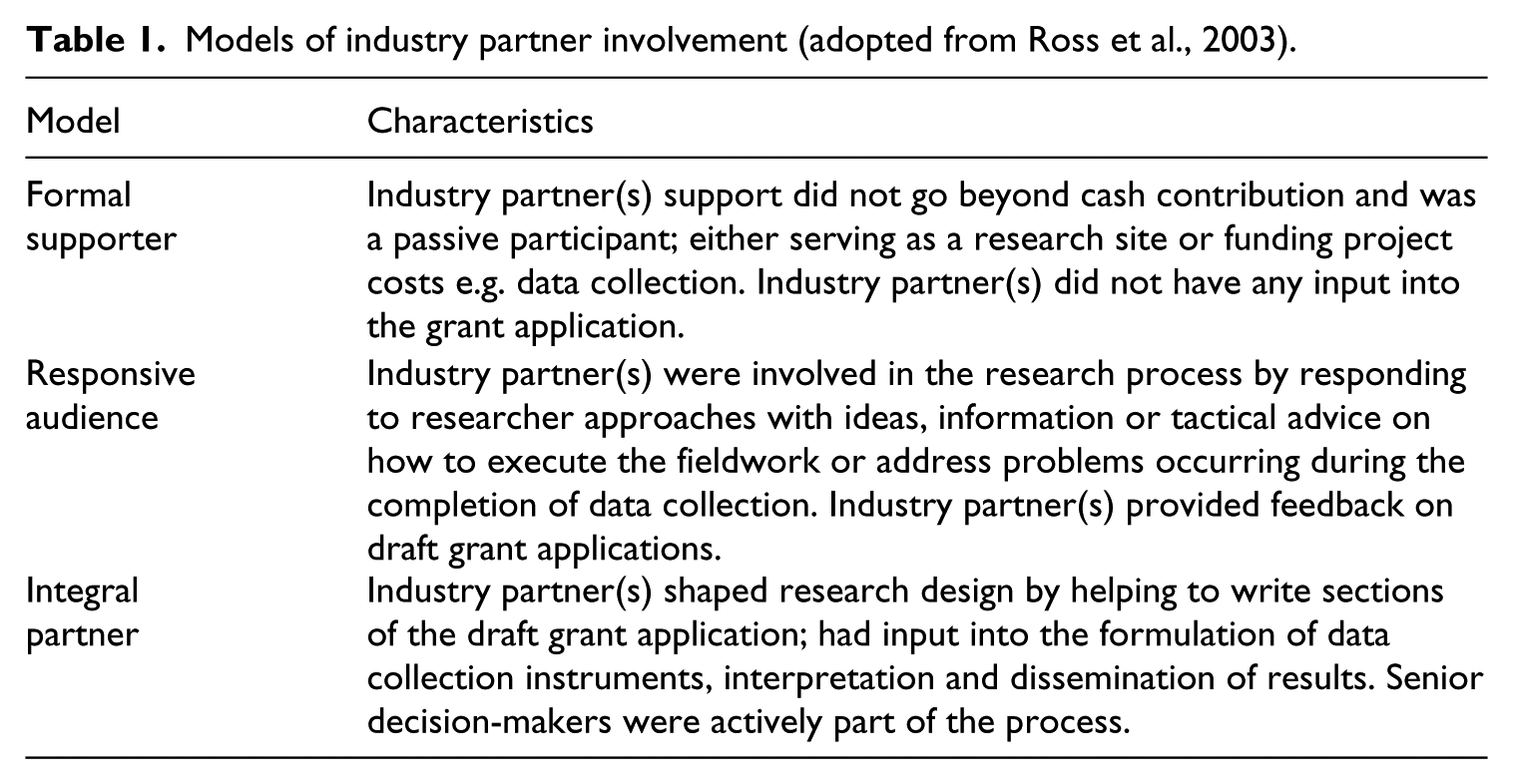
The responsive audience and integral partner model are more aligned with how knowledge co-production is envisaged. However, what became clear from the data was that the categories outlined in Table 1 should not be seen as mutually exclusive, and it was difficult to say with certainty how many of the cases investigated fell within each category. This is because partner involvement tended to shift throughout the duration of the Linkage project. Many of the collaborations studied went through a cycle that saw industry partner involvement shift from an integral partner approach at the beginning, to a responsive audience or formal support model towards the end of the project. This shift resulted from a range of factors, one being that interest in the project on the part of industry partners tended to diminish over time. Also, once data collection was completed, often the task of translation and dissemination was left to the academic researchers. This is a major weakness with academic–industry collaborations.
While the complete withdrawal of industry partner support was not observed in the current study, it must be noted that industry partner participation was in many instances unstable. For example, one problem consistently reported across 16 of the 30 ARC Linkage projects examined was that of staff turnover in industry partners. This particularly was a problem with the nominated partner contact person. This observation was consistently made by CIs working with government departments. Some CIs were more prepared than others to deal with this issue, having strategies to bring new industry partner representatives up to speed with the project, or selecting people in agencies they knew were stable. While the turnover of staff within government agencies is not all that surprising, it does create stability problems for research collaborations when new people come on board; in such cases the collaboration can falter. For instance, in a number of cases the departure of an industry partner contact person proved fatal, because it meant losing a key champion of the project, with it then proving harder for CIs to generate or encourage industry partner input or to sustain interest. One CI described the situation this way: So the people that I’ve talked to initially about doing this project have long since left [agency name removed] and not only that, but then the people who were there at the beginning of the project have also left. I don’t know if all government departments are like this, but certainly in [agency name removed] there’s been a lot of staff turnover. When we deliver a final report it will be to about the fourth person that I’ve dealt with over the life of the project.… We’re not quite sure who to deliver the report to … the person who was interested in the project at the beginning has left and they’re not quite sure why we’re doing it or what its purpose is. (CI interview 1)
Strategies of communication and dissemination
Strategies concerned with translating and disseminating research are particularly important in collaborations involving academics and industry partners given they have a bearing on research impact. This needs to involve direct and interactive dialogue and engagement with industry partners (Bogenschneider and Corbett, 2010). An important empirical and practical question is how this is best achieved, and what factors inhibit information dissemination and exchange?
In the current study CIs were asked about the methods used to communicate and disseminate results to collaborating organisations, with there being a reliance on a mix of informal approaches (e.g. emails, phone-calls, ad-hoc meetings), organised face-to-face gatherings (meetings and workshops) and written methods (i.e. summaries and reports). Some CIs placed emphasis on informal strategies while others relied mainly on written methods. While no clear strategy of success for communicating and disseminating results emerged, there was recognition that a reliance on written reports was limited in scope. As many CIs commented ‘the industry partner was committed but rarely did anything with a report’. Some industry partners’ cash and in-kind contribution was based upon assisting with dissemination, which involved organising conferences and workshops. This was regarded as helping to expose the research to potential end-users and provided avenues for industry partner representatives and other stakeholders to have input into the interpretation of findings.
Across all the collaborations studied there existed a tension between the need for academics to publish in traditional academic outlets and the translation of results to industry partners and other end-users. The two were not often seen as compatible. In some instances CIs made it clear they would ‘only go so far’ with disseminating and communicating research findings to industry partners and other stakeholders. One CI described this tension in the following way: historically we’ve been very keen to produce outputs that are quickly available and accessible to practitioners and to policy people. Well those are not Grade A journals or typically books.… But over the past three years I guess in the time of this project we have felt considerable pressure … to have outputs that are A-level journals. In fact that sort of conflicts with why we think we’re here and it conflicts with what we have experienced as the potential impact of this research we’re doing. (CI interview 22)
Hence cultural and institutional pressures and demands within academia (i.e. to publish in peer-reviewed journals) created disincentives against investing heavily in research translation to industry partners. This has been observed in other studies (see Cherney et al., 2012a, 2012b). This result gives weight to arguments that closer interactions may not bridge the divide between academics and potential end-users of social research, because organisational incentives can generate opposing priorities, especially academic contexts where dissemination and translation to non-academic end-users is not seen as a legitimate form of scholarship.
The impact and benefits of collaborations
To examine the issue of social research uptake this study divided data into the categories of conceptual, instrumental and political impact that is often cited in the literature (Nutley et al., 2007). Conceptual impact was consistently reported across all 30 projects. CIs and industry partners made reference to the Linkage project as having had an ‘impact on thinking’, or that it ‘provided insights’, ‘changed understanding’ and ‘clarified issues’ relating to the research problem or the industry partner role. Industry partners consistently reported forms of conceptual impact without the collaboration having a direct influence on policy or practice. For example one industry partner stated: No, it has had no real impact … or hasn’t had it as yet.… We feel happy that we’ve managed to contribute to furthering knowledge but it hasn’t had any great trickle-through effect … it changed conversations around the table. (IP interview 1)
When it came to instrumental forms of impact, CIs and industry partners made reference to a number of instances where projects had led to concrete changes in policy or practice. Across the 30 projects studied, 15 reported examples where the collaboration had directly influenced policies and practices within industry partners. This included changes in the training of industry partner personnel, improvements to the way industry partners interacted and supported clients, and reforms to legislation and policy in state and federal government. For example, one project examining the problem of whistleblowing reported a diverse range of outcomes ranging from impacts on legislative design and policy, with one industry partner reporting: Well the research, apart from talking about what the legislation should look like, also talked about what good practice would involve in relation to the sorts of policies and procedures that should be in place. We have modified our model, internal reporting policies in the light of that.… We’re modifying our protected disclosures guidelines in the light of that…. It then talked about what is actually good practice in the management of whistleblowers…. We are building that into our guidelines, into the training of our staff. I also use a lot of the research results in the training that we’ve been doing for many years now of public officials across [identifying information removed] in the better management of protected disclosures. (IP interview 2)
When prompted about the types of outcomes reported in the quote above, the industry partner interviewee stated the project ‘is my baby’ and that it was not ‘just an academic exercise’, commenting the CIs were ‘not just a bunch of academics thinking about it [i.e. the problem of whistleblowing] theoretically’, they were not ‘hung up on the theoretical’. These statements highlight the important role of organisational champions in helping to facilitate the impact of research collaborations internally within industry partners. This result though was not unique to the specific project referred to above; it was a consistent theme across collaborations that reported direct forms of influence on policy or practice. For example, an interviewee from a collaborating organisation that reported impacts on their training and educational practices stated unambiguously that he was ‘personally passionate about the area’ the ARC Linkage project was addressing. This respondent reported he was the main industry partner contact person for the length of the project, despite organisational restructuring that occurred during the duration of the ARC Linkage.
This is an important finding because it points to what may differentiate successful collaborations from unsuccessful ones. It provides support for the conclusion that the capacity of academic–industry collaborations to shift organisational processes and transform policy and practice, can only be achieved with the assistance of agency personnel who understand the rationale and justification of the research collaboration, and are willing to act as change agents (Cherney and Head, 2011; Mitton et al., 2007; Meyer, 2010; Rickinson et al., 2011). Among the projects studied, these individuals were not junior personnel, but typically carried weight and influence within their respective agency.
An unexpected result that arose in the interviews with collaborating organisations was the diverse way non-academic partners understood research impact. Industry partner interviewees stated that the Linkage project had the benefit of enhancing their internal capacity to access expertise and research, and in some circumstances linked the industry partner with other agencies. While the research collaborations studied clearly enhanced the networks of academics, they also provided the same benefit to industry partners. This only came to the fore once the interview moved beyond examining specific types of impact and focused on the benefits arising from participating in a Linkage project. One industry partner stated: It’s made us more aware of our lack of skills.… It’s given us confidence to be a partner in another Linkage.… The outcomes of the research was one thing.… For us to build those relationships and have us associated with this research and people understand that our work in communities is taken seriously and gives us good credentials … and being part of the project has given us a different set of skills and stakeholders we can tap in to … both individually it’s brought us a great deal of benefit. (IP interview 6)
Another unexpected result was the fact a number of industry partners stated that the ARC Linkage was the conduit through which agencies for the first time actually began to work together (i.e. it generated joined-up work). These results show that gains from collaboration go beyond purely instrumental outcomes (i.e. influence on policy) to include impacts relating to capacity building.
Collaboration was not simply generated by a desire to enhance organisational capacity to improve policy or practice, but was also driven by strategic considerations. With it increasingly the case that government and non-government agencies lack sufficient funds and expertise to conduct their own ‘in-house’ research, ARC Linkages were seen by industry partners as a way of broadening their evidence-base to influence policy decisions. Through the mechanism of collaboration the evidence produced was seen by industry partners as far more persuasive, credible and legitimate, given that it involved academics removed from the political process and could be less subject to criticisms of being biased. The quote below illustrates this point: we were more interested in getting the right answer, getting a real answer rather than just dodging. Like, we’d do our own surveys but they’re not particularly robust in terms of their outcomes…. But a key part of the research was also then communicating externally as well. So we needed something that was above board and clearly credible. So their ability [in reference to the CIs] to provide the level of statistical analysis and also being hands off from us was also a [unclear audio], whereas if it had just been research by us, even if we’d done it completely and appropriately there was always going to be a question about whether it was just us producing the answers … in relation to engaging with the State Government and the bureaucracy, having that level of credibility was important. (IP interview 20)
The data above show how organisational processes and political imperatives influence the motivation to participate in research collaborations. This can though potentially compromise their integrity and the objectivity of results (Keiser and Leiner, 2009). No academic respondent stated that they felt pressured to produce favourable results for industry partners. Rather, industry partners were mindful of not wanting to tarnish the integrity of data collection or analysis, fearful that doing so would weaken the case for using project results to influence key decisions.
Even if academic–industry collaborations help to generate practical evidence that has implications for policy, it does not mean it will have an immediate impact. The study data indicated that for collaborations to be effective consideration needs to be given to how co-produced knowledge can be integrated into policy and practice – this relates again to the practicalities of translation and uptake. For example, many CIs stated that the uptake of project results was inhibited by organisational imperatives and contingencies such as timing – ‘the agenda has moved on’ (CI interview 1) – with the project competing with day-to-day priorities: ‘you’ve got to insert yourself into their schedules and reacquaint them with your agendas, because they’re not at the forefront of their daily work’ (CI interview 28). Industry partners also recognised that internal organisational processes could inhibit research translation and uptake, with procedures absent to ensure that the findings arising from the ARC Linkage were followed through and exploited fully. The quote below illustrates this point: After the report was submitted to us, we actually undertook a fairly detailed review of the findings…. We then spent a couple of days with a cross-section of people from inside our business at a workshop where we sort of reviewed all the recommendations and findings and worked out where to from here.… There was a project team, if you like, because the recommendations spanned a number of different disciplines inside our business…. We developed really a programme of activities or actions arising from the report that were then fed back into different streams in the business to follow through…. I guess we wanted to capture all the value out of it that we could.… I think there’s been a big gap between even that review workshop where we worked out what is the value of this to us, what we should do about it and then the implementation of the actions that arose out of that too. Because then particular people were tasked with responsibilities for following certain things through…. I think where we probably fall down is in the next loop back to close off on some of those actions. (IP interview 3)
Conclusion
The results support the role that trust plays in helping to generate and sustain synergies between academic researchers and policy-makers or practitioners (Bogenschneider and Corbett, 2010; Cherney et al., 2012a, 2012b; Contandriopoulos et al., 2010; Haynes, 2011a, 2011b). Such trust is predicated on an established ongoing relationship, which offers opportunities for academic and industry partners to demonstrate they have mutual interests. Maintaining such relationships can be challenging for academic and industry personnel, as institutional demands and contingencies can create very different expectations and incentives relating to project outputs and outcomes. For academics the pressure to publish in scholarly outlets can take precedence over other needs, such as producing demonstrable practical outcomes that present value for money for policy-makers and practitioners (Keiser and Leiner, 2009).
Such practical outcomes relate to the level of investment in knowledge translation activities (Bogenschneider and Corbett, 2010). This is an area that is not well understood in the academic social sciences (Cherney et al., 2012a, 2012b; Levin, 2011). However given that academic reward systems revolve around publication in mainly ranked refereed journals, knowledge translation to industry partners can be neglected. Conducting workshops with end-users, producing toolkits, project briefs or summaries can imposes cost on academics, such as slowing their publication rate. While knowledge co-production can help facilitate the uptake of social research, this can only be achieved if there is investment in research translation. Central to the success of this process is the nature of academic reward systems, funds for translational activities and input from industry partners about the format and content of research products.
The results reported here support arguments in the literature that organisational champions are important to the success of academic–industry collaborations. However their existence alone will not guarantee that a project will have a discernible impact on policy and practice. Rather, investment in research translation activities is also vital, because something tangible must be produced that industry partners can work with and that organisational champions can actually endorse.
In the current study there were a number of clear impacts on policy and practice, but these could not be divorced from the wider organisational and political contexts in which a collaborative project was being conducted (see also Bogenschneider and Corbett, 2010). Likewise, the motivations of industry partners to become involved in research collaborations cannot be separated from the kinds of utilisation that can emerge. This was clearly the case when industry partners participated in ARC Linkages for strategic reasons. This was not about the untoward misuse of the research, but a belief that engaging with academics can provide the quality of evidence that is persuasive within policy debates. Such strategic motivations for policy-makers and practitioners to engage with academic researchers have been observed in fields of public health and criminal justice (e.g. see Hale, 2011; Haynes, 2011a, 2011b). However results also make clear that engagement in research partnerships is not just about improving the instrumental impact of social research, with a range of other benefits resulting from academic–industry collaborations. For industry participants this relates to improving access to research knowledge and enhancing their own internal capacities to conduct research. These types of outcomes cannot be easily quantified or measured.
Footnotes
Funding
This project was supported by a University of Queensland Early Career Researcher Grant.