







Abstract
In the courtroom legal authority must be performed by the presiding judicial officer. It is also a social situation where information and emotions must be managed in face-to-face interactions. This paper investigates how magistrates perform their authority in the delivery of decisions in open court. An observational study of criminal cases in Australian lower courts shows that magistrates communicate sentencing decisions in a distinct manner. Magistrates frequently look and speak directly to the person being sentenced (the defendant), in line with everyday conversational conventions, and preface their decision with explanations, which allow for some engagement with the defendant. When delivering other kinds of decisions (in criminal cases), such as adjournments, magistrates display less engagement with the defendant. These findings underscore the important ways in which the embodied presence of the defendant and the interactional dimensions of the courtroom can impact on the legal process and the legitimacy of judicial authority.
In Weber’s theory of authority, claims to legitimacy may be based on ‘a belief in the legality of enacted rules and the right of those elevated to authority under such rules to issue commands (legal authority)’ (1978: 215). Authority requires enactment or performance, typically in social settings constituted by professional and lay actors and driven by institutional and everyday imperatives, which in turn shape the ways authority is performed (Goffman [1967]1982, 1983). Although the legitimacy of judicial decisions is formally based in law, judicial officers must perform their authority every day in court settings bounded by legal norms and procedures and delineated professional roles. Conventionally, this entails impartial adjudication embodied as impersonal, unemotional detachment (Roach Anleu and Mack 2005; Mack and Roach Anleu 2010). In lower criminal courts, the high volume of cases, time pressures, unrepresented participants and visible human emotions can make this conventional performance difficult, so that additional elements may be needed to accomplish legitimacy (Mack and Roach Anleu 2010; Tyler 2003; McEwan and Maiman 1986).
This paper investigates the performance of authority by judicial officers through an examination of the ways magistrates 1 communicate their decisions in criminal matters in open court. The key research question is whether sentencing decisions are communicated in distinct ways. We hypothesise that communicating sentencing decisions will entail judicial behaviours that exhibit some engagement with the person being sentenced and will not rely entirely on a detached impersonal model of judicial authority. Conversely, we hypothesise that other non-trial decisions in criminal cases (such as adjournments or bail) will entail more routine communication and less personal engagement than sentencing decisions (Emerson 1983). These differences reflect different demands on the performance of judicial authority essential to accomplish or sustain legitimacy. The main conclusion is that sentencing decisions require more legitimacy work, while other kinds of decisions entail reduced pressure on judicial authority and so formal sources of legitimacy are sufficient.
This analysis draws on data from a national court observation study of criminal cases in Australian lower courts. It is not a study of judicial decision-making or reasoning; it does not examine the cognitive processes of arriving at the judicial decision, how judges decide cases, the nature or content of the reasons, nor does it analyse the substance or outcomes of sentencing. Its focus is on the ‘actual working practices’ (Fielding 2011: 113) of magistrates in court as they communicate diverse decisions to various audiences, most particularly to the person facing criminal charges (also see Hutton 1987; Lynch 1997; Travers 2007). It examines the manner in which magistrates communicate their decisions within the parameters of the socio-legal setting of the courtroom and considers the implications of those behaviours for performing authority and maintaining legitimacy. This paper investigates how magistrates perform their authority in the face-to-face delivery of decisions, particularly to the defendant. 2 Three separate aspects of judicial behaviour in the courtroom context are observed. These aspects are important dimensions of communication and include commonly understood or ordinary social behaviours as well as institutionally specific requirements:
whether the magistrate looks at and/or speaks directly to the defendant,
the magistrate’s ordering of the decision and the reasons, and
how these encounters are affected by the presence of a legal representative.
The findings suggest that when magistrates deliver one of the most significant legal decisions – sentencing – they do not rely solely on the formal markers of legal authority and conventional judicial performance behaviours. They also deploy other behaviours that can enhance legitimacy.
Judicial authority and legitimacy
Weber explicitly tied authority to legitimacy and recognised that accomplishing authority normally requires ‘the belief in legitimacy’ (1978: 213, emphases added and deleted, also see Galligan 2010: 986). In the courtroom, it falls to the judiciary to cultivate this belief in legitimacy (Sahni 2009: 210), supported by institution-specific factors (Tamanaha 2010: 187-99). Formal language, prescribed procedure, delineated roles, court room design and the architecture of the court building are all institutionally specific markers of formal legal authority that aim to confer legitimacy, engender a belief in legitimacy and enhance compliance (Mulcahy 2007, 2011; Resnik and Curtis 2010; Tait 2002).
In the common law adversarial system, the judicial officer is constituted as neutral, adjudicating the claims of the contesting parties, each presenting its own case (Moorhead 2007: 406; Tamanaha 2010: 3-5). Conventional understandings of this judicial role emphasise impersonality and dispassion as central to neutrality and therefore to legitimacy and legal authority (Bandes 2009; Maroney 2011).
The individual subject to criminal charges becomes a defendant – a legal category – or simply a case number. This depersonalisation of participants is seen as essential for fairness, so that like cases are treated in the same way according to legal rules and the proceedings are not improperly influenced by the defendant’s personal characteristics or by the judicial officer’s own values or biases (Heimer 2001; also see Resnik and Curtis 2010: 95-105). If the defendant is legally represented, the judicial officer formally interacts with the lawyer not the defendant, who in turn becomes more removed from and less visible to the proceedings.
The courtroom is not only a legal setting; it is also a social situation – an ‘interaction order’–where information and emotions must be managed in face-to-face interactions (Goffman 1983: 8, [1967] 1982; Roach Anleu and Mack 2005; Rock 1991). Considerable empirical research underscores the social and organisation dynamics of the courtroom work group in criminal cases, constituted by the regular participants, especially the judge, the prosecution and the defence lawyer (Roach Anleu and Mack 2010). The defendant, as a temporary rather than regular participant, has been characterised as outside this court community (Eisenstein et al. 1988; Mather 1979; Provine 1998). The combination of the large volume of cases, the rapid pace of the proceedings, the courtroom workgroup and the depersonalisation of participants through formal delineated roles results in the marginalisation of the person facing criminal charges (Carlen 1976; McBarnet 1981; Petersen 1983). This temporary and marginal location in court proceedings is a challenge for the judicial officer’s capacity to perform authority in a way that can cultivate the necessary belief in legitimacy. Previous research demonstrates that routine case processing can result in an alienating experience for the defendant (Baldwin and McConville 1977; Emerson 1983; Mileski 1971). If legal processes are too routinised, impersonal and ritualised, then they may become meaningless, rendering achievement of legitimacy problematic (Tyler 2003).
Goffman describes the intersection of face-to-face effects with organisational imperatives: A great deal of the work of organizations – decision-making, the transmission of information, the close coordination of physical tasks – is done face-to-face, requires being done in this way, and is vulnerable to face-to-face effects … the interaction order bluntly impinges on macroscopic entities (1983: 8, emphasis added).
This dynamic can be observed in the face-to-face encounter between the judicial officer and the defendant in court. The magistrate must manage the interactional dimensions of courtroom work (the interaction order) in accordance with the conventional model of judicial authority in the adversarial legal system (a macroscopic entity). However, the face-to-face interaction with participants will itself impinge on the magistrate’s communication of judicial decisions in ways that depart from expected formal legal practices. Formal roles alone may be insufficient for the performance of authority that facilitates legitimacy, especially when the defendant is physically present.
Communicating decisions face to face is a moment when the magistrate may engage or interact directly with a defendant as an individual, even when he or she is legally represented. It is an encounter where the magistrate can indicate that she/he has listened to the defendant’s story and considered her/him as an individual. Such direct communication can cause the defendant to become central rather than marginal to the proceedings (Carlen 1976; Cowan et al. 2006; McBarnet 1981; Rock 1991). This can be essential for achieving legitimacy beyond that based on established legal rules of decision-making.
The concept of procedural justice can bridge the challenge face-to-face encounters create for conventional detached adjudication. Procedural justice emphasises the importance of those in authority treating people with dignity and respect, acknowledging their concerns and recognising them as individuals rather than treating them as a legal or bureaucratic category. Procedural justice ‘shapes people’s feelings of responsibility and obligation to obey rules and accept decisions because it enhances the legitimacy of rules and authorities’ (Tyler 2003: 297; also see Casper et al. 1988).
The importance of procedural justice in the legitimacy work of the courts is confirmed through empirical research. A Canadian study finds young people’s views of how they were treated by the judge and their own lawyer is significantly related to their assessment of the legitimacy of the court and the legal system (Sprott and Greene 2010: 283). Research in Scottish Drug Courts concludes that increased dialogue between sentencers and offenders may increase perceived legitimacy and enhance compliance with court orders (McIvor 2009). Travers (2007) examines sentencing hearings in a youth court and finds that magistrates interact directly with the young offenders, usually with courtesy and respect. Mack and Roach Anleu (2010) investigate magistrates’ demeanours towards different participants in court proceedings, indicating greater engagement with defendants compared with prosecutors or defence lawyers. Research on housing possession cases in England highlights different styles of judging which vary in terms of judges’ engagement or even interaction with the defendant (Cowan and Hitchings 2007; Cowan et al. 2006; Hunter et al. 2008).
This paper investigates how magistrates perform their authority in the face-to-face delivery of decisions, particularly to the defendant. It finds that when communicating their decisions, magistrates generally rely on an impersonal performance of the judicial role. The important conclusion is that when delivering sentencing decisions, magistrates exhibit a greater degree of engagement with the defendant than when they deliver other decisions. These findings demonstrate that performing legal authority in court requires a level of engagement, in particular with the defendant, as well as the more formal elements of rationality, logic and impersonality.
The Court Observation Study
This analysis of the delivery of decisions in a legal setting draws on observational research of magistrates and their courts across Australia. It draws on prior observational studies of courtroom behaviour and practice but does not dissect courtroom dynamics in minute detail as do the more ethnographic or linguistic/discourse interpretations of the proceedings or the conversational analyses of court transcripts (Bogoch 1999; Drew and Atkinson 1979; Drew and Heritage 1992; Lynch 1997).
The research design incorporated courts from a variety of locations: each state and territory and from capital cities, suburbs, and regional centres. Male and female magistrates of varying ages and experience levels were observed. The study observed magistrates’ everyday work in the natural setting of the courtroom. The general criminal list was chosen for observation as it is a central element in magistrates’ everyday work (Roach Anleu and Mack 2010). All jurisdictions have some version of the criminal list which is part of the work of virtually all magistrates at some point in their career. The list is constituted mostly by proceedings relating to such offences as drink driving, theft, assault and some drug offences and includes decisions on bail, adjournments, standing matters down (to be heard later in the list), setting the matter for another procedure, such as a trial, taking guilty pleas, and sentencing. (This project did not undertake observations of trials. As most defendants plead guilty, trials constitute a small proportion of cases in the magistrates court.)
Two researchers (in nearly all instances the two co-authors) conducted the observations across several different courts, using pre-printed templates to record similar information relating to the defendant, his/her offences, legal representation, aspects of the magistrate’s interaction, and information for decisions and outcome, with space for additional comment. The templates were developed from extensive preliminary observations of court proceedings and pilot-tested in three different magistrates courts. Detailed instructions were formulated to maximise consistency between observers and to provide specific guidance on the coding of magistrates’ behaviour and other activities in the courtroom (Mack and Roach Anleu 2010). The unit of data collection was the matter; 3 each time a new matter was called the observers separately filled out a new template. At the end of each day’s observations, the two researchers discussed their coding and classifications for each matter and resolved any gaps or differences in their coding in order to produce a single code sheet per matter. The total number of matters observed and coded (regardless of whether the defendant was present or not) was 1,287. As it was not possible to hear or identify everything in court from observation, some information, such as defendants’ demographic data and offence categories, was obtained from court records.
Overall, 27 different magistrates (or more than six per cent of all Australian magistrates) were observed conducting a general criminal list in 30 different court sessions in 20 different locations (including all capital cities, five suburban and four regional locations) (Mack and Roach Anleu 2007). As a group, the magistrates observed closely match the gender, age and years as a magistrate distribution of the Australian magistracy as a whole.
This data set contains a very large number of matters pertaining to one type of legal setting, the courtroom, and provides information on a range of decisions in criminal cases across several different offence types. 4 Magistrates’ communication of sentencing decisions can be compared with their communication in non-sentencing matters, including variations in the use of ordinary conversational techniques and institution-specific communication strategies. Such comparison allows assessment of the socio-legal significance of the sentencing decision and investigation of the particular demands for accomplishing judicial authority when delivering those decisions.
Communicating decisions
One-quarter (26%) of the matters observed involved a sentencing decision, with the defendant being sentenced for one or more offences. The most frequently imposed penalty was a fine, given in nearly three-quarters of sentences (74%). 5 Approximately, one-quarter of those sentenced (24%) received some other non-custodial sentence such as a community service order or a bond and/or supervision by corrections, probation or other agency. Only 11 per cent of sentenced matters (n=37) received a custodial sentence and nearly half of those (n=17) were suspended. This pattern of sentences parallels sentencing outcomes for magistrates courts more widely in which fines are the dominant penalty and custodial sentences rare (O’Malley 2009).
Defendants are not always present when magistrates give decisions. Unless stated otherwise, this paper only reports matters where the defendant was present in the courtroom at the time of the matters observed. The defendant was present in 68% of the matters. In two per cent of these matters the defendant appeared via video link (17 individuals).
Looking and speaking when communicating decisions
The first two indicators of communication considered are: whether the magistrate looks at the defendant (for more than a single brief glance) and whether the magistrate speaks directly to the defendant when delivering the decision. Looking at and speaking to others entail ordinary social behaviours and are manifestations of ‘face-work’ (Goffman [1967] 1982). ‘A person tends to experience an immediate emotional response to the face which a contact with others allows him [sic]’ (Goffman [1967] 1982: 6). Face-work can also entail ‘self-conscious consideration and intentional management’ (Qi 2011: 280). It is thus an extra-legal resource that magistrates might rely on to accomplish legitimacy by communicating to the defendant that his/her situation has been considered in more than a routine, impersonal fashion.
Considering all observed matters, combining sentencing and non-sentencing decisions, looking at and speaking to the defendant nearly always occurred simultaneously or at least during the same matter. Of all the matters when the magistrate looked at the defendant (n=468), there were only two where the magistrate was not recorded as speaking to the defendant.
Considering sentencing and non-sentencing decisions separately reveals different interaction patterns. In most sentencing decisions the magistrate looked at (79%) and/or spoke (87%) directly to the defendant. In contrast, looking and speaking was observed in only about half of non-sentencing decisions (Figure 1). Type of decision appears to be a strong influence on the magistrate looking and/or speaking to the defendant.
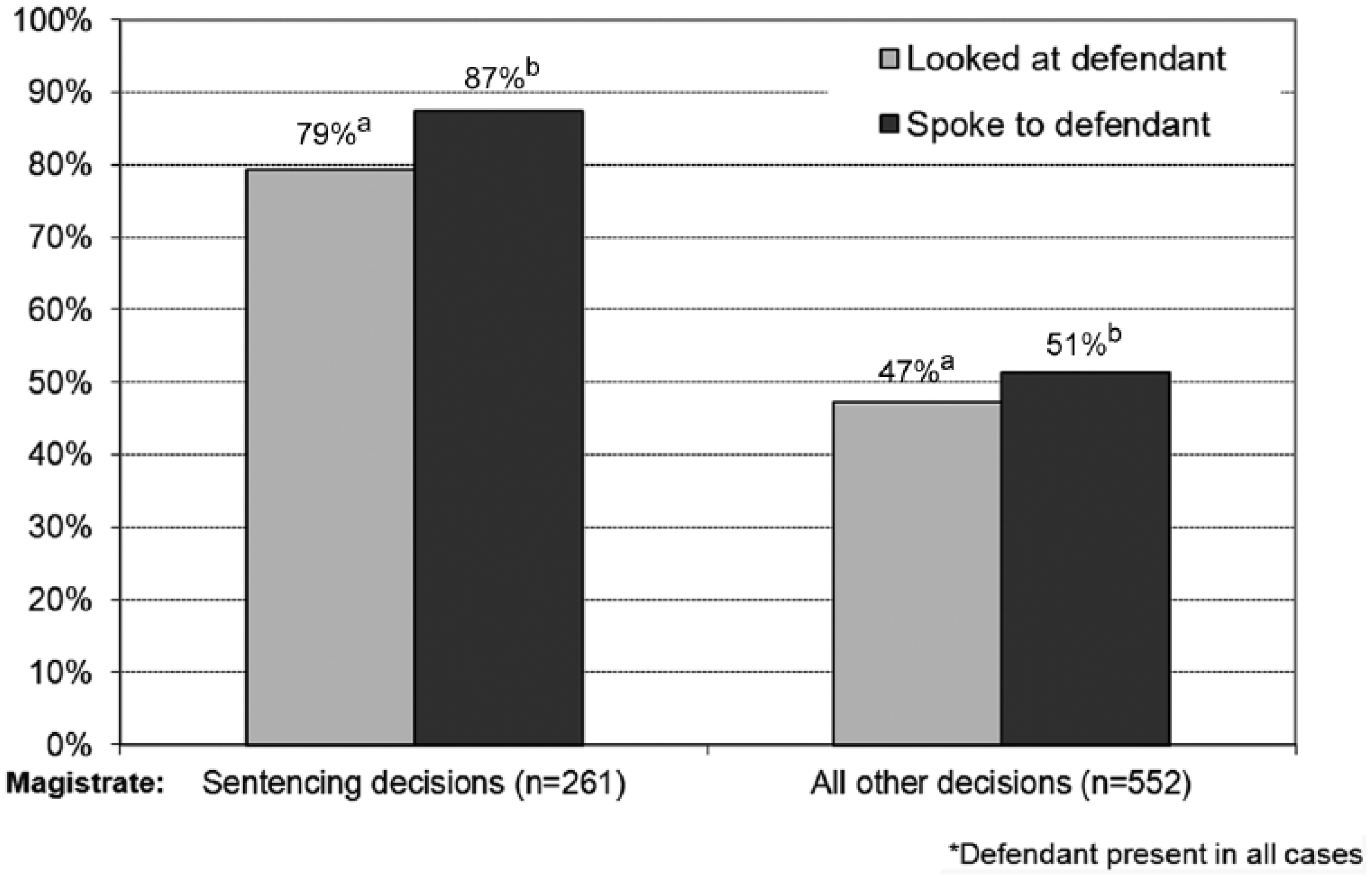
Delivering decisions: Magistrates looking at and speaking to defendants*.
The type of decision being communicated (sentencing or another decision) is significantly and positively related to the magistrate looking at (χ2 = 74.415, df = 1, p ≤ 0.001) and/or speaking to (χ2 = 98.849, df = 1, p ≤ 0.001) the defendant.
The presence or absence of the defence representative seems to make no difference to magistrates’ direct engagement with the defendant when delivering sentencing decisions (Figure 2). Magistrates looked at and spoke to defendants directly in about four-fifths of sentencing matters, regardless of whether or not the defendant has legal representation present. The pattern for magistrates to look at (χ2 = 83.567, df = 1, p ≤ 0.001) and speak to (χ2 = 100.862, df =2, p ≤ 0.001) the defendant in sentencing matters, even in the presence of legal representation, is significant. This is a surprising finding; when defendants have legal representation, legal norms imply that communication from the magistrate to the defendant would occur only via the lawyer.
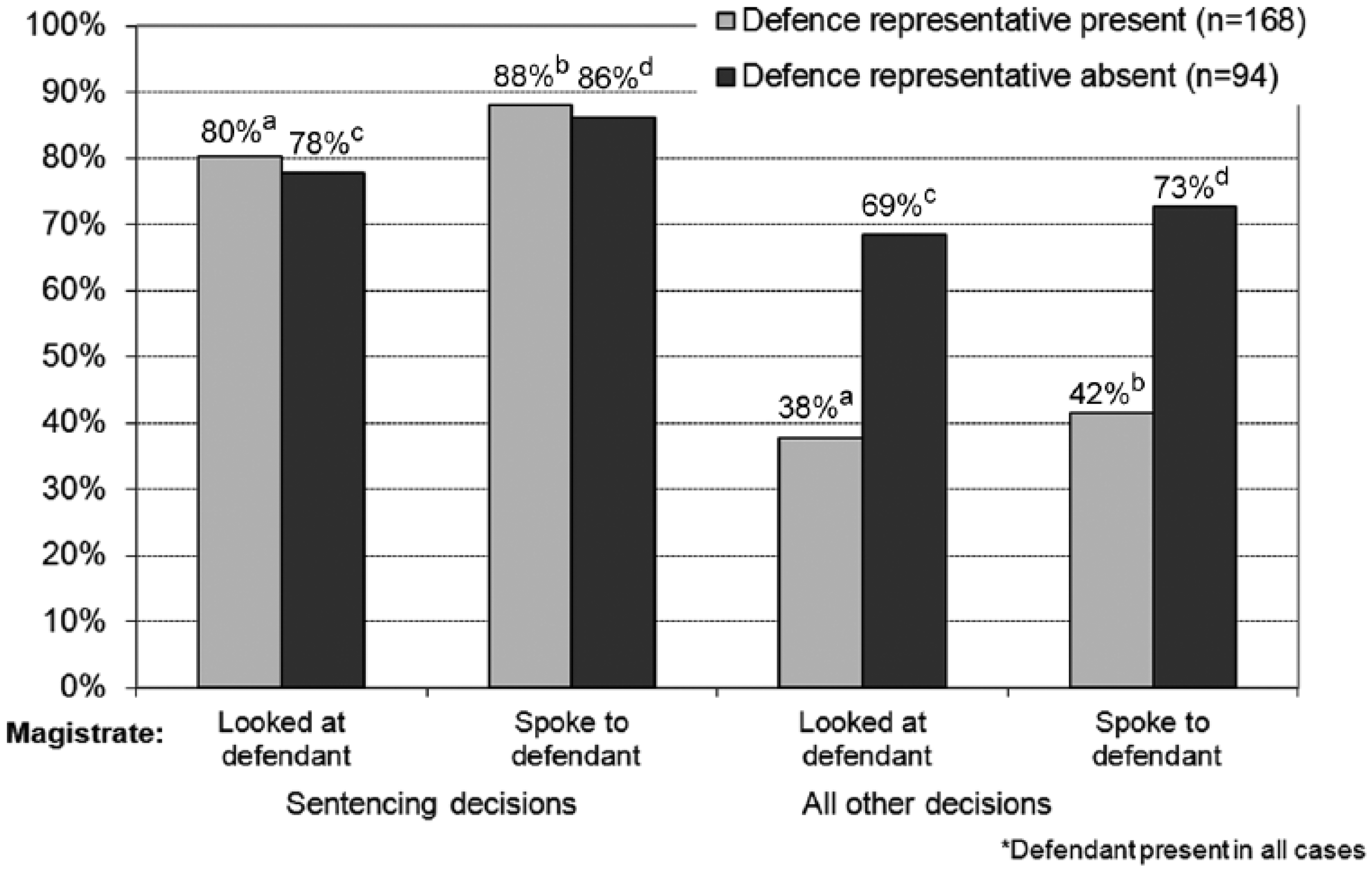
Magistrate looking at and speaking to defendant by presence of defence representative*.
However, legal representation does appear to make some difference in non-sentencing decisions. The least frequent occasions where a magistrate looked directly at (38%) and spoke to the defendant (42%) are when the defendant is legally represented in non-sentencing matters (Figure 2). While the magistrate looked directly at (69%) and spoke to the defendant (73%) in a high proportion of non-sentencing matters when the defendant had no legal representative, this is still somewhat less frequent than in sentencing decisions.
Findings that sentencing decisions are delivered in distinct ways may not be surprising. The news about the sentence is of sufficient weight or import to the individual defendant and to the wider community that some level of direct engagement and more legitimacy work should occur. For individuals and their significant others, the conviction and sentence can result in status degradation and continuing stigmatisation and disadvantage (Garfinkel 1956; Pager 2003). Following Durkheim (1984: 31-44), court proceedings, especially in criminal matters, can symbolise (or galvanise) collective consciousness and be important sites for the affirmation or articulation of social norms and emotional expression (Garland 2001; Rock 1998; Smith 2008).
Direct judicial communication with the defendant, especially when sentencing, may indicate to the defendant that the magistrate regards him or her as a person worthy of direct communication, regardless of legal representation. This judicial behaviour may display or communicate values of procedural justice that could facilitate the defendant’s acceptance of this news and cultivate a belief in legitimacy (Tyler 2003). Non-sentencing decisions are capable of greater routinisation (Emerson 1983) and can be dealt with without much judicial attention.
What is important from these findings is that the delivery of sentencing decisions is a moment when the defendant becomes less marginal. This is captured through direct communication from the court to the person being sentenced, regardless of legal representation.
Direct engagement is less evident, and less important for legitimacy, when the magistrate is communicating a non-sentencing decision. In over one-quarter of the matters when magistrates gave a decision other than sentencing and the defendant was unrepresented, the magistrate either did not look at (31%) and/or did not speak to (27%) the defendant (see Figure 2). Most of these decisions (50%) were adjournments. The remainder was also forms of adjournment, either standing the matter down to be dealt with later in the list (20%) or setting for another procedure (20%). The magistrates’ behaviour when communicating these decisions implies that they are more amenable to routine case processing and not damaging to the defendant’s sense of self or identity, though we are not able to determine here if this is how they are interpreted by the defendant (Emerson 1983). 6 Performing authority in these matters does not rely on the same level of engagement as communicating the news about sentence. Rather, the formal markers of legitimacy − courtroom procedure, the magistrate speaking from the bench − are sufficient.
The structure of communication
Communication of decisions in the courtroom can reflect structures that accord with institutionally defined roles and procedures. One important legal institutional expectation is giving reasons for a judicial decision. Reasons for decision is a general principle of English derived legal systems, and sometimes legally required, especially when the court is imposing sentence (Australian Law Reform Commission 2006: 484; Mackenzie, 2005: 25). Reasons may convey that the decision is based on legal norms and logic thereby aligning with Weberian concepts of impersonal legal authority and legitimacy. Ensuring the courtroom participants and members of the public have an opportunity to know the legal and factual basis for the sentence is also important for procedural justice and legitimacy (Warner and Davis 2012). Whether an explanation is formally or legally required, giving reasons can generate a perception of fairness and the belief in legitimacy, especially for the individual being sentenced (Casper et al. 1988).
Accepting that reasons are essential for legitimacy does not determine where the reasons are located in the communication sequence. Magistrates can structure their decisions in one of three distinct formats:
Issues, elaboration of reasons, then decision
Decision only
Result first, then reasons
The location of these reasons in the decision delivery sequence can be a resource for the magistrate in performing or doing authority separate from the content or nature of the reasons given. 7 The structure of magistrates’ communication – that is, the order in which the decision itself and the reasons for the decision are given – can signify different approaches to accomplishing judicial authority and reliance on strategies of engagement or impersonality.
Type of decision – sentencing or non-sentencing – seems to make a very substantial and significant difference to the ordering of the magistrates’ communication of decision (Table 1, χ2 = 208.022, df = 2, p ≤ 0.001).
Magistrates’ communication of decisions a .
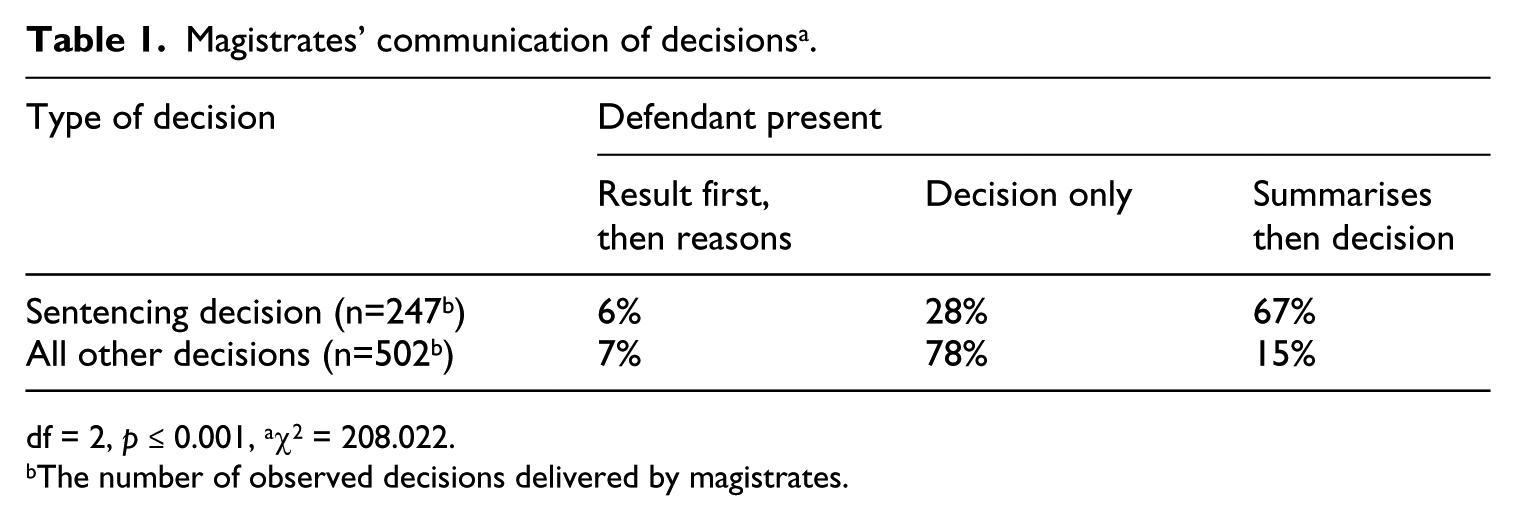
df = 2, p ≤ 0.001, aχ2 = 208.022.
The number of observed decisions delivered by magistrates.
Magistrates give the decision only with little or no explanation in 78 per cent of non-sentencing decisions. It is very unusual for magistrates to first state the result, and then explain the reasoning in any kind of decision, whether sentencing (6%) or non-sentencing (7%). Where any reason or explanation is given, it nearly always precedes the result, and this is most often done when sentencing.
In sentencing decisions, the magistrate summarises issues and submissions then gives the decision in fully two-thirds (67%) of cases. In contrast, in non-sentencing decisions, the magistrate summarises then gives the decision in only 15 per cent of cases. Communicating reasons before announcing the actual sentence allows the magistrate to highlight the law (precedent, guideline judgments, and statutes) and facts that underpin the sentence. This structure can also provide some key elements of procedural justice where the magistrate indicates some consideration of the particular circumstances of the person subject to the decision. Delivering the sentencing decision in this way enables magistrates to ‘do’ legitimacy by relying on the rational legal model of authority
First, magistrates may be formulating the sentence while speaking. As most sentencing decisions are given ex tempore, the recapitulation of reasons and factors underlying the decision may be the magistrate almost literally deciding aloud before communicating the decision. By setting out the legal requirements, the facts, assessments of the offence and the offender, the magistrate can demonstrate that the sentence results from careful reasoning and a dispassionate evaluation rather than from personal bias or emotional reaction (Thomas 1963). This can reinforce the formal legitimacy of the exercise of judicial authority.
Second is the importance of personal details. Often, before passing sentence the magistrate has heard (from the defence representative or the defendant) details of the defendant’s personal circumstances, including family and work life. The person being sentenced may expect that the magistrate would have listened and taken into account these mitigating, personal details. Putting reasons first, indicating that the individual circumstances of the defendant have been considered, can show that the defendant is being dealt with as a person, not as an offence category. Not considering this information could jeopardise legitimacy.
Third, prefacing the sentence with reasons allows the magistrate to forecast an outcome so that the news about the decision will not be a surprise. If the news is bad, this forecasting may avoid a disruptive emotional outburst. If the news is good, the defendant may experience relief after waiting, perhaps anxiously, and listening to what they may regard as a lengthy lecture to hear their fate (Maynard 2003, 2006; Mileski 1971: 523; Rock 1998). 8 This may be an example of the sentencing process as part of the punishment (Feeley 1979). In either case legitimacy can be enhanced. If courtroom decorum is maintained, that reinforces formal judicial authority; if the defendant experiences relief and so accepts an outcome as fair, that may also engender a positive view of judicial authority.
In spite of the legal and practical importance of reasons, over one-quarter (28%) of the sentencing decisions were communicated without providing reasons. Half of the decision-only sentences were for driving offences, typically with mandatory penalties, and often scheduled immediately after each other in a block, usually the first group of matters dealt with in the morning sessions. Thus, each of these matters is heard in the presence of other defendants. Due to the similarity in many of these offences – driving under the influence of alcohol/drugs, driving whilst disqualified and/or unregistered – the magistrate might give reasons for the sentence in the first case such as the mandatory nature of the penalty – fine and/or licence suspension – then refer to that earlier explanation when sentencing other defendants, expecting them to have heard the remarks and reasoning (c/f Roach Anleu and Mack 2009). These decisions may be examples of ‘routine case[s] regularly encountered in the course of work’ (Emerson 1983: 426). Indeed Petersen’s study of drink-driving offences found that drink drivers considered that the magistrate was ‘automatic’ in what she/he was doing and that the proceedings were ‘seemingly perfunctory’ (Petersen 1983: 30).
All of these considerations treat the defendant as the primary audience for the decision on sentence. However, reasons for decision can be for different audiences: the defence representative, the prosecution, the victim, the appeal court and the public in general (Baum 2006). Magistrates provide reasons and commentary in the lead up to announcing the sentencing decision more often if a defence representative is present (74%) than absent (54%) (Table 2). The magistrate infrequently gives a decision-only sentence in matters when both defendant and their legal representative are present. This occurs in only one-fifth of matters (20%). When the defence representative is absent, this rises to two-fifths (41%). Magistrates rarely (7-8%) communicate the result followed by reasons regardless of type of decision or presence of legal representative.
Magistrates’ communication of decisions: Presence and absence of defence representatives a .

Defendant present in all cases.
χ2 = 177.264, df = 2, p ≤ 0.001.
χ2 = 40.102 df = 2, p ≤ 0.001.
The number of observed decisions delivered by magistrates.
These significant findings suggest that the magistrate’s comments in sentencing are directed at diverse audiences; reasons are for the legal profession and perhaps the appeal court as well as for the defendant. Appellate courts indicate that they will be less likely to interfere with a sentence when reasons are given by the sentencing court to justify a sentence beyond the normal range of penalties given in other similar cases (Mackenzie 2005: 25). Another possible explanation for a magistrate giving a fuller expression of reasons when a defence representative is present is that the charges may be more serious. This seriousness may cause the defendant to be legally represented and cause the magistrate to give more detail, rather than the magistrate’s behaviour being affected by the presence/absence of the defence representative per se. The magistrate might give reasons in more serious matters, and legal representatives are present in more serious matters.
Alternatively, one might expect less explanation when the defence representative is present, as magistrates may believe the defence representative will provide the explanation to the client later. However, magistrates may be cautious about the willingness or capacity of lawyers to fully explain the weight and implications of the sentencing decision. In a 2007 survey of Australian magistrates, one-half (52%) report that legal representatives are well prepared only sometimes, with only about one-third (37 %) agreeing that they are often well prepared (Mack and Roach Anleu 2010: 155).
In matters involving a decision other than sentence, the magistrate often gives the decision without elaboration, regardless of whether the defence representative is present (78%) or absent (77%) (Table 2). This pattern might be partly explained by the nature of the decisions being made and the brevity and uncontroversial nature of most of these decisions. Non-sentencing decisions in the criminal list are often requests made by the defendant (and not opposed by the prosecution) for adjournment, bail or a date for another procedure, such as a trial or sentencing. The magistrate is usually undertaking several tasks simultaneously: formulating the decision, reading papers on the file, noting and signing the decisions made during the list. As Mileski notes: ‘encounters of short duration along with mass processing are two means that mitigate some of the caseload pressures’ (1971: 517).
The key points are that in sentencing matters, regardless of legal representation, the magistrate gives reasons more frequently than when communicating non-sentencing decisions and more often summarises the reasons for decision before communicating the decision. Non-sentencing decisions tend to be given as the decision only without explanation. The presence of the defence representative is associated with different decision structures only in sentencing decisions. When the defence representative is present during sentencing, magistrates summarise issues or reasons before the decision more frequently than when the defence representative is absent.
Findings about the structure of judicial decisions suggest that magistrates are combining institution-specific legitimacy requirements to apply legal rules and to give reasons (which are especially relevant to defence representatives and appeal courts) with other more social and engaged strategies for delivering sentencing decisions, that might enhance the belief in legality. In contrast, non-sentencing decisions may not require elaboration for legitimacy, and so are delivered typically as decision only, relying primarily on formal, impersonal concepts of judicial authority.
Conclusion
As Weber proposes, every ‘system attempts to establish and to cultivate the belief in its legitimacy’ (1978: 213). While legitimacy might be cast as a ‘general social process’ (Johnson et al. 2006: 53), its accomplishment in the courtroom relies on institutionally specific obligations as well as everyday strategies. In the courtroom it falls to the judiciary to cultivate this belief and ‘do’ authority (Sahni 2009: 210). Judicial officers might seek to accomplish legitimacy by relying on the conventional model of legal authority that emphasises impersonality and formal legal rules as well as a more engaged, personal encounter with the defendant. The Weberian model of formal legal authority is necessary for legitimacy, but alone appears to be insufficient, especially for sentencing decisions communicated orally in open court.
This observational study of lower criminal courts in Australia approaches the courtroom as a social situation
Magistrates’ strategies of delivering decisions in criminal matters are related to the type of decision and to the presence or absence of legal representatives. The delivery of the news on sentence is delivered in a distinct manner. Magistrates very frequently look and speak directly to the defendant, in line with everyday conversational convention, and more frequently state reasons, in line with legal expectations. The sequence of reasons and decision is distinctive to sentencing decisions. The magistrate summarises issues and then gives the decision in two-thirds of all sentencing decisions compared with only 15 per cent of other decisions.
Having a legal representative present during the sentencing decision does not change a magistrate’s pattern of frequently looking at and speaking directly to the defendant. It does make a difference in the structure of communicating the decision. When a legal representative is present, magistrates provide summaries and then the decision in approximately three-quarters of sentencing decisions, compared with just over half when the defence representative is absent. These findings suggest the importance of the structure, content and manner of the delivery of sentencing decisions for enhancing legitimacy for the legal profession and potentially the appeal courts. In contrast, in other decisions, magistrates look at and speak to defendants much less often, especially if the defendant is legally represented. Over three-quarters of these decisions are given without elaboration or reasons either before or after the decision.
These findings demonstrate that performing judicial authority in court relies on more than legal decision making and other formal markers of judicial authority, especially in sentencing matters. When the defendant is present and being sentenced, whether represented or unrepresented, s/he is often spoken to directly and looked at by the magistrate who gives reasons for the decision. Directly conveying a sentencing decision in this way is important for procedural justice (Casper et al. 1988). The defendant becomes less marginal and more central to courtroom process, which in turn can enhance the legitimacy of the legal system (Mack and Roach Anleu 2010).
The patterns identified in this research challenge the conventional, detached, passive role of the judicial officer and demonstrate that magistrates engage actively and directly with defendants when communicating some decisions, especially sentencing. These findings underscore the important ways in which the embodied presence of the defendant and the interactional dimensions of the courtroom impact on the legal process and the legitimacy of judicial authority.
Footnotes
Acknowledgements
We are grateful to Russell Brewer, Carolyn Corkindale, Colleen deLaine, Elizabeth Edwards, Ruth Harris, Katrina Hartman, Julie Henderson, John Horrocks, Lilian Jacobs, Leigh Kennedy, Lisa Kennedy, Mary McKenna, Rose Polkinghorne, Wendy Reimens, Mavis Sansom, Chia-Lung Tai, Jordan Tutton, Carla Welsh, Rae Wood, and David Wootton for research and administrative assistance. We appreciate the many helpful comments given us by Carroll Seron, Cyrus Tata, and Max Travers. Earlier versions of this paper, or parts thereof, were presented at The Australian Sociological Association annual conference, University of Melbourne, 2-5 December 2008, the First Symposium of the Sentencing & Penal Decision-Making Working Group of the European Society of Criminology, Oxford University, 15 April 2011.
Funding
This research was initially funded by a University-Industry Research Collaborative Grant in 2001 with Flinders University and the Association of Australian Magistrates (AAM) as the partners and also received financial support from the Australasian Institute of Judicial Administration (AIJA). From 2002 until 2005 it was funded by an Australian Research Council (ARC) Linkage Project Grant (LP210306) with AAM and all Chief Magistrates and their courts as industry partners with support from Flinders University as the host institution. From 2006 the research was funded by an ARC Discovery Project Grant (DP 0665198) and from 2010 it is funded by ARC DP1096888. All phases of this research involving human subjects have been approved by the Social and Behavioural Research Ethics Committee of Flinders University.