







Abstract
The main goal of our approach is to analyse the social representations of alternative rock in Portugal (or, using a terminology more akin to 1980s Portugal, of the “modern music vanguard”) from 1980 to 2010. This is part of broader research into the 30 years of modernization of the country (from the post-revolutionary period initiated in 1974 on), in which alternative rock is regarded as a significant social practice within the scope of the social, artistic and musical structuring of the country itself. We consider that alternative rock is a subject that is illuminated by Bourdieu’s theory of fields, without overlooking its clear interconnection with ‘art worlds’ or music scenes, and the aesthetic cosmopolitanism of late modernity. The article is a pioneering work on the Portuguese sociology of culture, whose results may be the starting point of a debate to problematize the functional logic of popular music in various Anglo-Saxon settings.
‘What Difference Does It Make?’ 1
Speaking of alternative rock in contemporary Portugal entails referring to a set of positions in a specific social space situated within the pop/rock universe, and simultaneously located within the structural contexts of the Portuguese artistic field and, consequently, of its social space. Thus, we can hypothetically assume that music as practice and consumption is related to the complex functioning of social structures; as such, the creation, dissemination or consumption of music depends on creative instances, which are subject to relevant cultural, economic, social or symbolic imperatives.
Kruse argued that the study of musical diversity through its genres plays a key role in popular music studies since each genre’s designations are mostly constructed and imposed by the cultural industries (1993, 2010). To explain her point of view, Kruse argued that alternative music is a genre that does not relate solely to distribution channels: ‘everyone […] implicitly defined themselves as “alternatives” by claiming singularity in their music and audience: no one was doing what we were doing’ (1993: 35). ‘Indie’ rock appears to be in opposition to pop, which mainly refers to the music usually found in the charts. It is an alternative rock branch produced out of the mainstream reality by ‘indie’ labels (Frith, 1978). We discuss the social representations of indie rock maintained by the actors who participate in the alternative rock scene in different roles (musicians, promoters, editors, bloggers). These representations derive simultaneously from the place occupied by the actors in the alternative rock scene and the position they hold in the overall social structure (Hibbett, 2005).
We mainly aim to identify the self-(re)presentations of both creators and producers of alternative rock in Portugal, and consider the dynamic and symbolic roles played by musical genres and subgenres. We also address the particularities of these representations in Portuguese society over the last 30 years and the sociological challenge it entails, acknowledging that the adoption of musical genres in particular historical and social territories is both highly complex and embodies patterns of plurality (Regev, 2007; Stankovic, 2001; Szemere, 2001). Another issue we must deal with is the term ‘indie’, which was conceived in the last years of the 1980s and is used both in Great Britain and the United States to describe a set of music labels located on the outskirts of the industry, away from the production, distribution and promotion dynamics of majors (Hesmondhalgh, 1997). Commonly marked by scarcity of human and economic resources, independent labels develop an informal production and distribution infrastructure (Azerrad, 2002). Due to their low-key approach to music production and creation, bands and musicians using indie labels did not achieve recognition by the masses (Strong, 2011). We use the term ‘alternative rock’ in this study as this has been a more popular term in Portugal (Guerra, 2013).
The data presented and discussed here are the result of a long-term research study conducted between 2005 and 2010. 2 Semi-structured and biographical interviews were carried out with 202 individuals (involved in both the production and publishing spheres of the Portuguese alternative rock segment), following snowball sampling techniques. The analytic object was established through contacts provided by the interviewees, which gave the research extensive territorial coverage. Our methodology was driven by categorical content analysis of discourse segments in order to ascertain the meanings and purposes of social actions, 3 privileging, therefore, qualitative and intensive approaches. Data processing techniques additionally included polyhedral analysis, used to describe the structure of alternative rock (concerning subjects’ ways of relating and associating with each other). 4
Our sample was composed of sets of individuals classified as follows: 55 interviewees aged 36–40, 33 interviewees aged 31–35 and 35 interviewees aged 41–45. Predominantly male, the sample reflects gender logics generally present in rock, especially among the older generations in the Portuguese context. The group also displayed high educational skills (85 college graduates and 54 with university attendance). The highly placed social positions of the participants seem congruent with their scholarly, professional and social qualifications, which clearly contrast with the average Portuguese population profile, but closely relate to the typical profile of artistic groups. Most of our sample came from the metropolitan areas of Lisbon (75%) and Porto. The sample is geographically distributed in accordance to the spatial distribution of members of the artistic field in general, reflecting the cultural dualities and asymmetries (if not macrocephaly) of the country.
Questioning music’s unstable matter
Pursuing a relational line of thought, the origin of the concept of ‘field’ will be sought, a task that requires a contextualized analysis of Bourdieusian theory (see Regev, 2007). Sociology does not deify mechanisms: social fields are fields of force, but they are also fields of struggle to transform or preserve those mechanisms. To Bourdieu, the notion of ‘field’ represents a social space of domination and conflict, where each field possesses relative autonomy and its own rules of social organization and hierarchy (Bourdieu and Wacquant, 1992: 24). Bourdieu defines social space as an organized set or system of social positions that are defined in relation to each other. The components of this system interact with each other in a durable and not arbitrary way (Hesmondhalgh, 2006).
For two fundamental reasons, a pertinent and heuristic approach to Bourdieu’s theory of fields demands articulation with Danto’s (1964) and Becker’s (1984) theories regarding the art world: first, these theories have undergone extensive empirical application in sociological investigations of culture; second, there is a need for theoretical confrontation of ‘fields’ theory with more current conceptual frameworks. Becker emphasized the importance of conventions (i.e. the sharing of knowledge in a certain context), postulating that the ways in which knowledge is obtained are diverse and connected to the kind of relations one has with the artistic environment in question (Maanen, 2010). Some conventions are derived and adapted from wider societal frameworks, while others are specifically developed within an art world.
Focusing on the interactions within the different segments of the cultural field and on the cooperation that cultural agents develop with the aim of producing works of art, Bourdieu is simultaneously interested in the reconstitution of positions that structure the functioning of specific artistic fields, seen, essentially, as spaces of antagonism and struggle (Regev, 1994). However, Bourdieusian and Beckerian perspectives entail no irrevocable incompatibilities. Santos (1994) noted that Becker’s description of art worlds shares a goal that is common to Bourdieu’s; to demystify an aesthetic conception of art. By thoroughly describing art as a collective activity, Becker refuses to accept that the work of art is the product of a solitary genius. In fact, works of art are the result of the cooperation between different agents and institutions on different planes (production, dissemination, mediation), developed in reference to a set of conventions that reflect a common understanding of the art world and generate common practices (much like the Bourdieusian illusio).
The construction of the social world is inseparable from the representations continuously (re)produced by its actor, over time and space; it is in this continuous (re)production of representations that we find the genesis and the outline of alternative rock in Portugal. Sarah Thornton’s approach (1996), complementing Bourdieusian theory, draws attention to the different kinds and amounts of capital existing in each subcultural community and highlights their function in the definition of roles among the subcultural hierarchy. This identity reinforcement dimension is rather important in Thornton’s (1996) definition of subcultural capital, and it is used by members of subcultures to distinguish themselves from ‘outsiders’ as well as from one another internally, both in an objective way (hairstyle, record collection, etc.) and in an incorporated way (language, dress code, dance styles, etc.), an element of the utmost relevance for comprehending the generative and functional processes of alternative rock.
Our analysis would be incomplete if we dismissed the interpretation of a musical scene as a concept. Thus, the concept of ‘scene’ must be intertwined with the concepts of ‘social field’ and ‘art worlds’. Will Straw argues that scenes are spaces in which several musical practices displaying varying degrees of distinction between them can converge (Straw, 1991). When the concept of scene is used in music it is usually constrained by a specific location, such as a city where a certain music genre arises and/or is developed, appropriated and adapted. Bennett reiterated ‘the developing scene’s perspective and its value as a means of understanding and theorising the various forms of significance that musical activity, both production- and consumption-orientated, assume in specific everyday contexts’ (2004: 232). Since the beginning of the 1990s, this concept has become a relevant model for academic analysis as a result of the rejection of previously used theoretical paradigms and concepts (namely, subcultural theory), and also as a consequence of the influence of works on art worlds and cultural industries. This interpretative approach relies on the continuous (re)construction of musical styles by social actors, both as an answer to daily circumstances and contingencies, and as their way of experiencing them.
The (re)adaptation and enrichment of scenes’s theory is deemed necessary, articulating it with Bourdieu’s field theory, as well as with the other theoretical perspectives previously outlined. These articulations are the central mark of our analytical model, combining several theoretical choices in order to provide full account of what is different about Portuguese alternative rock. Here, Regev’s view is crucial. His approach to pop rock represented the possibility of cultural proximity, given that the expressive elements that different cultures use to highlight their singularity are quite close to one another. There are, undoubtedly, local singularities in Portuguese alternative rock, but its fundamental processes and expressive tools can be found everywhere (Regev, 2013). The cosmopolitan concept of aesthetics is only applicable when a world culture is formed as a complex, interconnected entity in which various social groups share a common ground in aesthetics, expression and culture. Starting with this common ground, we shall now highlight the Portuguese features of alternative rock in terms of a local–global dialogue.
Inception and constitution of alternative rock in Portugal
A key question that should be asked is: how is the field of Portuguese pop rock configured, and what factors underlie the genesis of the alternative segment within it? The field of pop rock in Portugal was established throughout the 1960s and 1970s due to the growing capacity of agents and structures, namely, recording studios, record labels, newspapers and magazines, radio shows, artists and bands, venues and so on. The democratic revolution of 25 April 1974 also had a major role in the emergence of the Portuguese music industry. The beginning of the 1980s marked the ‘boom of Portuguese rock’, as a whole series of profound transformations within this cultural industry occurred, enhancing its viability and substantiating the pop-rock industry as a complex constellation of labels, media, products (LPs, tapes, magazines, newspapers) and social agents (musicians, producers, journalists, critics, radio announcers, DJs, record shops, etc.). Although occurring on a considerably smaller scale, the process was similar to what happened in other countries, especially the US. The 1980s brought forth the banalization of art works (LPs and hit songs), and thus of the ‘revelation’ that artists and bands were not isolated from the world and that, to the contrary, their productions maintained strong links with a collective memory of music. The portrait of the artist as an isolationist ‘rebel’, distanced from the masses, was also, in many ways, demystified by then. Social and artistic dynamics converged. First, the democratic revolution contributed to opening up Portuguese society to different lifestyles and cultural references. Furthermore, accession to the European Community, technological innovation, greater access to musical instruments and equipment, a growing recording market, wider media coverage and interest, and the international circulation of values, ideas and images; all these elements contributed to the consolidation of the pop-rock field in Portugal. The commodification of pop-rock clearly demonstrates its interconnection with society in general and its integration within a broader business structure. This is, after all, one of the basic tensions that greatly influence the dynamics of the rock music field, particularly the so-called alternative segment; despite presenting itself as a lifestyle liberated from social constraints, it never ceases simultaneously to be a business and a variable within the economy of culture.
After 1986, this tension grew and materialized into different movements, constituting the subfield of alternative rock within the general field of pop rock in Portugal. The genesis of this subfield took place through the agents and structures that opposed the establishment and its values and mission. The cultural opening up of the country, the reinforcement of urbanization and the emergence of postmodern values in Lisbon and, to an extent, in Porto, came alongside the appearance of seminal bands (Mão Morta, Pop Dell’Arte, Mler If Dada), indie labels (Ama Romanta, Fundação Atlântica, Facadas na Noite), fanzines and radio shows (Som da Frente) within the subfield. Specific references and places of dissemination and leisure allowed this subfield to emerge in opposition to the general principles of pop/rock ‘massification’. The repercussions of the activities and stances of such agents and structures are still felt today.
The emergence and consolidation of the subfield of alternative rock in Portugal was substantiated by the creation of niche audiences, the increase in specialized producers and creators, the occurrence of instances of consecration and, above all, by the emergence, at a certain point, of a range of works – implicitly or explicitly – directed to the subfield and reflecting its history. The best example of this is perhaps the strategy, deployed by several bands, of assuming and declaring a ‘genuine’ attitude of loving music for the music itself; the band Mão Morta exemplifies this, as their members have never projected exclusive professional dedication to the project. Pop Dell’Arte also seems to adopt this position through its recurrent enunciation of instances of legitimation, or through allusions to some sort of artistic and aesthetic community. 5
In Portugal, where the market is as small as it is, I find it hard to make a living through music. However, it was never our goal, neither for me nor for any of us in Mão Morta, to make a living through music. Even when we had larger crowds, after the Mutantes S21 album etc., we have always rejected that possibility. When I say rejected, I mean we didn’t even consider it. (Miguel, 50 years old, university post-graduate, Braga)
The structure of the field is always an issue at stake: the struggles within it have their enjeux (background) in the process of monopolizing legitimate symbolic violence; a characteristic of the aforementioned field. This means in practice the preservation or subversion of the structure of distribution of specific capital. Therefore, it is crucial to focus on the self-representation of musicians, event promoters, journalists and critics, managers, and editors in the subfield in which they operate. A clear recognition that this is a highly conflictual field, crossed by several hierarchies of power and struggle, prevails. This hierarchical trait is accentuated by perceptions that music fields heavily rely on interpersonal ‘relations’, ‘sympathies’ and ‘bargaining’. Hence, the proximity between diverse agents in the field ends up being a relational constraint to decision-making. This is why we have to consider the difficulties experienced by smaller bands, which have less cultural and symbolic resources, and the capacity of those agents who, despite not being musicians, have power because of their position in the field (as critics, promoters, etc.).
Portugal is very small and it is administered by a few people who do what they want to. For instance, there is a certain way of thinking based on this: ‘We are doing you a favour by letting you play in this festival.’ That’s the reason why parents don’t like their children to have bands. This mentality is generalized to all kinds of art with the exception of architecture. It’s the matter of seeing art as a luxury. People don’t value a small band when they watch it. It’s easier to reach the top because the average is low. If you control the networks, you can do it. (Beatriz, 29 years old, university graduate, Lisbon)
Although the subfield of alternative rock has contained sharp discourses against the market, it has increasingly adopted market strategies by introducing new divisions and hierarchies, as well as ways of detaching itself from ‘influences’ and ‘lobbies’. The representation of the conflict inherent to this subfield also relates, according to some interviewees, to the non-existence of a national music industry capable of structuring and defending the bands’ works and presentations. Alternative rock was consolidated through the presence of agents who had settled within the alternative culture; with the enlargement of its audiences and its relative commercial success, the role of this segment within the broader field of pop rock was altered, making it a key player. Its role is embodied in an alternative and critical attitude of reaction and subversion towards the ‘mainstream’, the ‘dominants’ and the ‘bad artists’, as well as towards a considerable group of newcomers and protagonists set on entering the field.
Regev (1994, 2013) argued that rock music constitutes a global cultural component in which popular musical styles – both local and national – are constructed. Such a perspective adequately explains the national context of alternative rock, vastly led by a penchant for differentiation, escape from the mainstream and distinctiveness. Hybridizing appears to be an important component in alternative rock’s musical and editorial projects. It should also be stressed that, from the 1980s onwards, the expression ‘alternative rock’ became reified in Portugal, referring to actors, promoters, bands, labels, radio shows and specific scenes in Lisbon and Porto and, although less representatively, in Coimbra and Braga. Alternative rock began to acquire specific materiality and language, articulating a field of social positions and art world logics, but also corresponding to an experiential gathering space, as a scene.
Determinants and properties of alternative rock in Portugal
Musical genres are fluid categories whose frontiers are seldom well delimited, as they are open concepts that respond to intense, instituted genre blends. As categorizations, they constitute symbolic–ideological organizations that sustain the continuity of underlying cultural industries’ procedures and the mental and symbolic routines of both producers and consumers (Hibbett, 2005). A central and recursive argument used by the devotees of alternative rock relates to its ‘purity’, that is, its impermeability to commercial logics and imperatives. Another commonplace is the self-representation of their ‘artistic taste’ as eclectic and non-labelled, attempting to remove the works from classificatory ‘pigeon-holes’, simplistic logics and commercial success. Genres are the result of intense social classifications (both auto- and hetero-produced), and it is via this endless classificatory process that musical genres and subgenres are constructed. In the case of Portuguese alternative rock, understanding the context of its constitution and canonization is paramount, as the influence its qualification exhorted remains strong until present times.
Thus, these devotees embody a dual role in the field – they criticize commercial artists and, simultaneously, work as gatekeepers for those who want to penetrate the field through the segment they dominate. Such dual role is based on the constant resettlement of alternative scene’s boundaries and the cementing of its legitimacy and kred via the emergence of alternative circuits and name repetition in media channels. Agents can be both calculating and strategic; confronted with an uncertain universe, they try to reduce its uncertainty by producing norms or finding support in conventions (Hibbett, 2005). Here, we may question whether ‘love of art’ is not followed by a rationale of art as a means to an end.
Maybe in mainstream music there is the problem of sales that falls in those disputes, but for those less-known artists, that’s not much of an issue. I actually think that, for the most part, they know each other and want everyone to succeed, and they are happy with each other’s success. I don’t think there is a lot of envy because there isn’t much financial return. I don’t think one can find major problems in such niches, which are what I know best. (Xavier, 29 years old, university graduate, Lisbon)
At a certain stage of power struggles, those who monopolize the specific capital tend to apply conservation strategies (orthodoxy upholding); conversely, agents who have less capital (usually newcomers and youngsters) tend to use ‘subversion strategies’ (Bourdieu, 1995). Within the field, such struggles are fundamental and dominant positions are highlighted. It is the small dimension of the field that makes it an arena of interpersonal connections, which are the basis of its hierarchical and conflictual functioning. When asked about the central agents of the field and the actual determinants of the subfield, the interviewees first highlighted the role of critics and journalists, even though they also reiterated that the latter had lost influence ever since new channels and sources emerged, especially online blogs.
And those lobbies are very important and can build or destroy careers, they can propose new things or they can completely reject those new proposals and do only exactly what they want to, what suits them. (Rodrigo, 32 years old, 12th grade, Cascais)
Among these social actors, there is an understanding that alternative rock coincides with so-called indie rock, viewed as opposed to the mainstream, that is, opposed to the charts and the dominant trends of mass-oriented popular music. Such understanding maintains seemingly close links to the American scene of the 1990s (heir of the 1980s British indie labels), in which alternative rock was associated with minor labels whose editorial guidelines and projects were moulded by an uncompromising love of music, regarded as an end in itself, coupled with creative freedom and liberty vis-a-vis economic fetters. It is also important to recognize that we are looking at an artistic autonomy that developed through the linking of musicians to independent entities emerging from post-punk, with musicians being led by a purpose of cooperation (superseding financial security motivations). Here, the ideology of creative autonomy is personified by the romantic notions of the ‘artist’ (Hesmondhalgh, 1997), even if one advocates a plural approach in which music is considered to be the result of human creativity in a given theoretical, historical, sociological, anthropological and cultural context.
Alternative music is the one you find for yourself, in blogs, websites, even in some specialized press dedicated to non-conventional stuff, everything besides catalogued music. (Afonso, 35 years old, 12th grade, Lisbon) Indie rock has to do with people that make music with love for itself, without attending to a pop format, choosing a more experimental set-up. (Hélder, 33 years old, university graduate, Porto)
The main personalities of Portuguese alternative rock expressed an opposition to the use of art to make money, as they longed for ‘purity of form’, which was in earlier times the ideal that propelled the forefront of modernism (Fowler, 1997); they also longed for the existence of an important alternative scene that was able to challenge the status quo of pop rock. This is played out in Menger’s (2002) perspective that views the life of the artist as a symbolic and economic ‘gamble’: peer recognition compensates for the lack of economic gain, which may be converted to economic gain over time.
Another fundamental property of every field is the objective complicity that underlies all antagonisms: all the agents involved in a field have a fundamental interest in its existence, as the field entails a belief that the stakes are worthwhile and that the game is worth playing. This ‘field effect’ happens when a work of art (and its value) can no longer be understood unless one is aware of the history of the field. In this study, we found multiple forms of representation relating the present-day social status of musicians in the discourses of the interviewees: the musician as a ‘glamorized’ entity, as a transitory and unprotected social condition, as a common citizen, as adopter of a sui generis lifestyle, as ‘targets’ for stigmatized social representations associated with behavioural and lifestyle deviance, and as having social status but little recognition. What this multiplicity seems to stress is the idea that the agent’s ‘merit’ lies in the possibility of ‘not being dependent on music’, and therefore being ‘freed’ from market constraints, thus reaching a ‘status’ of independence regarding the achieving of commercial success.
Therefore, there is nothing better than doing like Mão Morta; they were dangerous guys because they were able to have jobs other than music. And they were dangerous guys because they weren’t dependent on their commercial success in order to have a worthwhile life. […] The importance/need of having a job besides music, so they don’t have to depend on it to survive – an issue of the musician’s independence/freedom to do what he wants. (Humberto, 38 years old, university graduate, Lisbon)
A proposed illustration of the alternative rock subfield in Portugal
During the investigation, it was possible to identify and create a topology of the positions that define the alternative rock (sub)field in Portugal. Previously, our main focus was on understanding the underlying logic and functioning of the Portuguese indie rock segment, in what concerns the individuals’ representations; henceforth, to better comprehend such conceptions, we shall refer to polyhedron dynamics. This algebraic procedure is grounded on a pluridimensional approach, based in several connected structures pointed out by our interviewees in respect to national and international bands, blogs, journalists, critics, venues, record shops and key actors of the indie national scene (see Scott, 2000). These connection structures between the elements identified by the interviewees were conceived with the use of frames of common references, with the goal of describing and discussing structuring questions in the characterization of alternative rock (see Gould, 1982: 7). Polyhedron dynamics or Q-analysis was developed by Atkin (1974); it is designed to describe structures (the ways in which objects are related to and associate with one another) and, as a technique, does not make use of traditional mathematical languages of inferential and descriptive statistics, being instead specifically adapted to describe structures and networks. Therefore, what is at stake here is the use of algebraic language to describe, in precise and well-defined terms, the structure of the objects and how they are combined and related to one another. This algebraic procedure is designed to define, describe, map and represent the complexity of the relationships that substantiate the underlying structures of actors, venues, bands and promoters that compose Portuguese alternative rock. With such complexity being explored in the previous sections of this article, in this section that complexity finds specific configuration as a network sub(field). Exploring our object through polyhedron dynamics, we have noted an important recurrence: thus, the words used by our interviewees to identify said actors, venues, shops, promoters and media may inspire a hierarchical layout based on the number of references to those same words.
Illustrating this, the existence of a symbolic universe of reference was supported by allusions to national bands (Figure 1). A first group of bands (represented, in Figure 1, by the biggest orange ellipse) seems structural in the formation of Portuguese alternative rock, entailing bands which are associated by nearly all interviewees with indie rock. Most of these bands were formed in the second half of the 1980s, deeply influenced by post-punk aesthetics, and have assumed roles as field ‘institutions’ due to their longevity, protagonism, leadership in the definition of the canons of artistic creation, independent relationship with labels and the media, and continuous proclamation of DIY ethics –with their members shunning professionalization in their musical careers. These primary ‘veteran bands’ are accompanied, in the second ellipse, by the ‘newcomers’, who follow a logic of sonic exploration and experimentation, avoid involvement with major labels, and were formed by members previously integrated in ‘field institution’ bands’ line-ups. We can, in fact, refer to the existence of a canon-producing structure of a musical subgenre (grounded in post-punk, musical experimentation and bridging into electronica) in the two major cities of Portugal, Lisbon and Porto. Such a structure is characterized by its DIY ethics and logic, a mostly amateur presence in what concerns professionalization, a search for an alternative to majors – in the creation of independent and personal labels – and a claim for a cosmopolitan sphere of action on a Portuguese scale (Guerra, 2013). This spectrum of bands is located within the major arcs of alternative rock of the last three decades in Portugal; the bands clearly illustrate what underlies the ‘alternative world’ in Portugal, even if that alternative is plural and dynamic, comprising hybrid sonority, songs, independent labels, live concerts, DIY logics, canonization by critics and so on. The widespread growth of a creative space of alternative rock, with the concomitantly growing possibilities of musical production, paves the way for a blurring of the borders between genres, additionally generating the impossibility of a single tendency outshining the others. Most relevantly, then, multigenre fusions stand out as a quite an unpredictable variable, especially given the unequivocal impact of new technologies. Far from being contemporary, this stance would always be a part of the music world, if nothing else because music has invariably evolved through recurrent cycles.
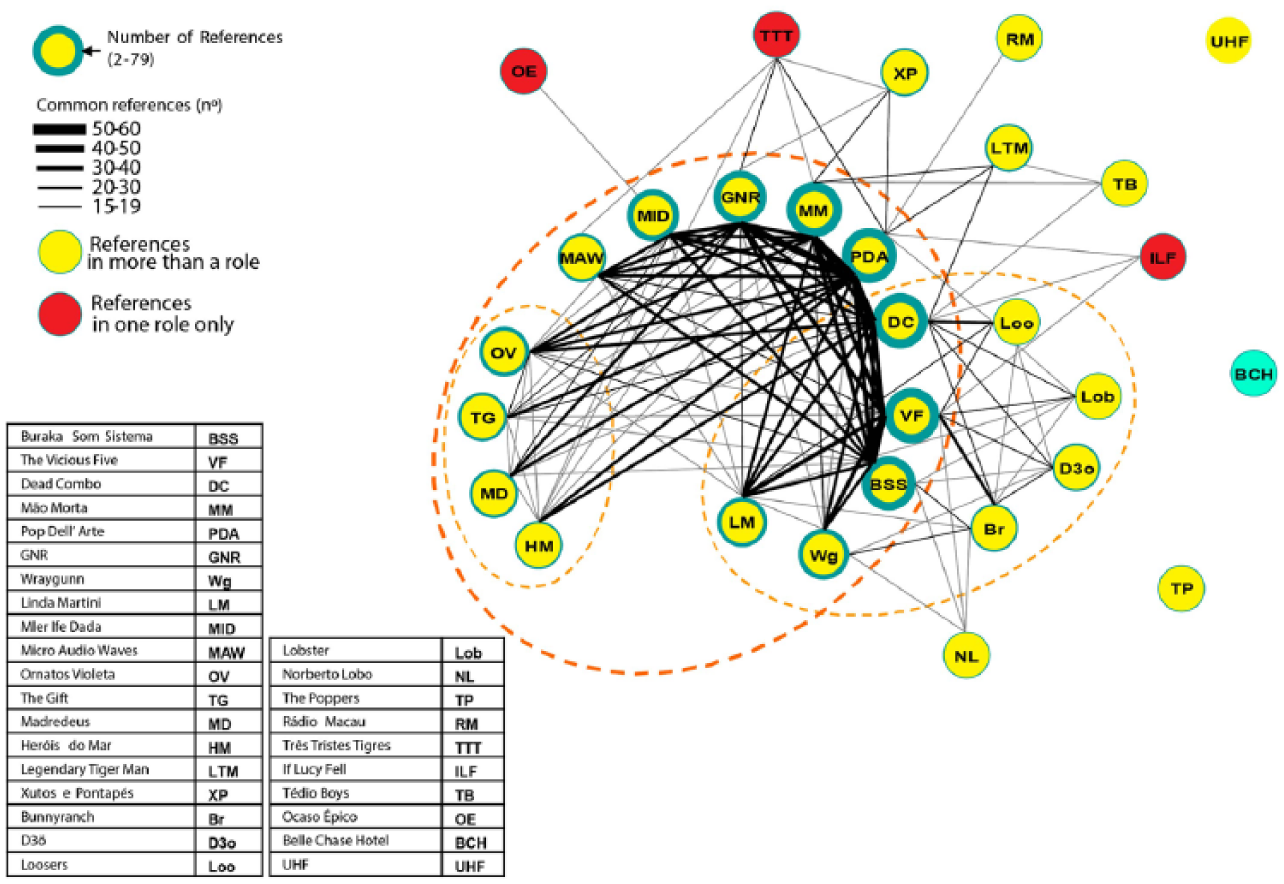
Polyhedron dynamics: referenced national bands.
Relating the segment of labels, event promoters and record stores (Figure 2), it is important to notice the way a structure is constituted around the positions of alternative and mainstream organizations: at first glance, the data seem to contain some contradictions. Despite the crisis associated with the record market, the promoters, the majors and the indie labels all retain a recognized and valued position within that structure, which is based on the importance of such labels and promoters in the definition of ‘alternative’, a vital condition for the indie rock approach. However, in a way that is strongly linked to Portuguese socio-history and the music industry (Szemere, 2001), a major role can be attributed to promoters who have nowadays expanded their activities beyond the alternative niches (as they endeavour to organize some of the biggest events in Portugal), kicking off in the late 1980s and early 1990s through DIY strategies, informal organizational structures and functions, fuelled by a leitmotiv of searching out ‘the alternative’). Nonetheless, their activity has gradually branched out into more mainstream expressions, namely in the creation of major events, such as festivals (see Hibbett, 2005). Moreover, the evolution of the Portuguese music industry in itself is recent, leading some of the indie labels of the early 1980s to eventually adopt a more mainstream and corporation like posture towards music production. What seems evident here is the apparently conflictual coexistence between micro and macro organizations, and a mainstream and alternative ethos: but it should be stressed that this is much more an apparent conflict than an actual one, an outcome of general evolution dynamics within the music industry. These are the main structuration principles of this alternative rock subfield, which neither hide the general dynamics of struggle within the segment, nor do they stem the opposition between ‘kings of the segment’ versus ‘newcomers’ (Regev, 1994).
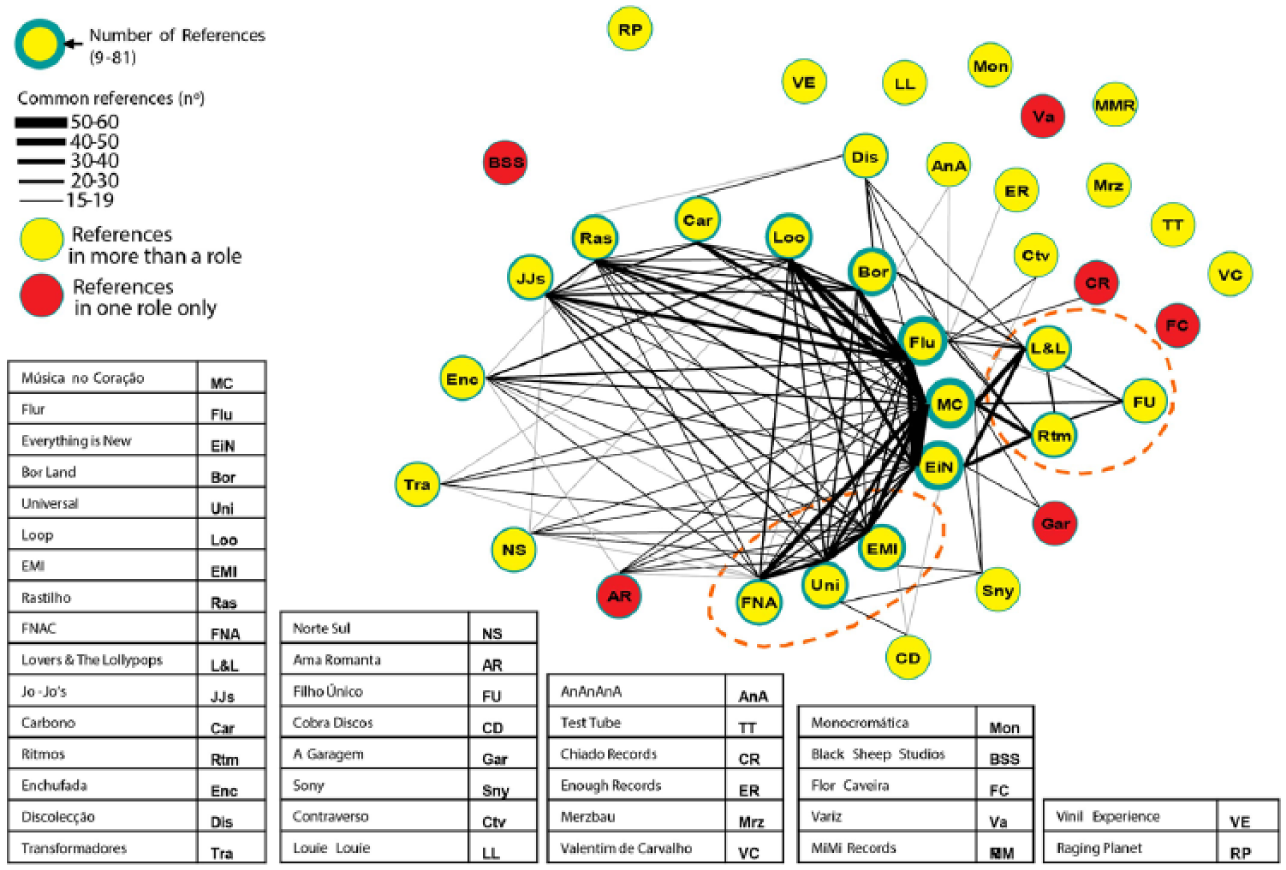
Polyhedron dynamics: referenced labels, promoters and shops.
The configuration of key agents in the alternative rock subfield (represented in Figure 3) also invokes important elements. This structure maintains two groups at its core. The first group (wider orange ellipse) is composed of key actors (both musicians and media agents) in the emergence of the alternative rock subfield in Portugal, during the mid 1980s. For example, António Sérgio (considered the ‘Portuguese John Peel’ and responsible for early dissemination of alternative music) assumes the role of ‘pioneer diffuser’, as invariably mentioned by nearly all the interviewees. Adolfo Luxúria Canibal, lead-singer from the band Mão Morta, is equally highlighted within this structure, not only in terms of the volume of references, but also because of some common references relating the structuring elements of the field. He assumes the role of a pendulum (i.e. keeping the whole thing going), and is undoubtedly an actor who holds significant (internal) capital amid the canonization processes of the Portuguese ‘alternative’ subfield. He has also attained widespread notoriety in Portuguese society in general and in the artistic world in particular (external capital). In a Bourdieusian language, these two figures exert subfield ‘dominance’, concentrating in their hands in the largest volume of capital(s) in the social-relational space of indie rock.
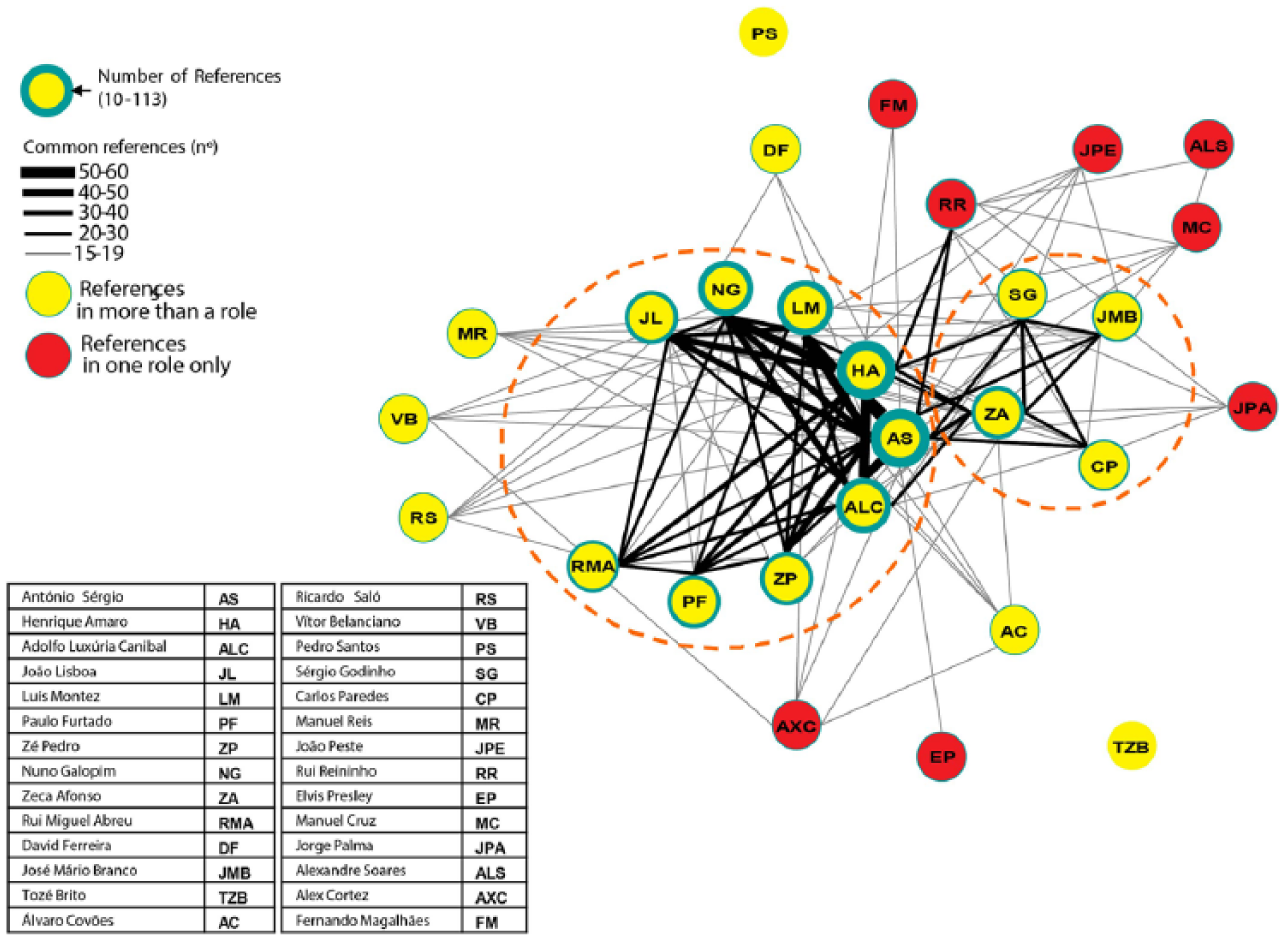
Polyhedron dynamics: referenced key agents of alternative rock.
Concluding remarks: Your Future Our Clutter 6
By undertaking an historical and empirical approach in this study, we have obtained an array of data that enabled us to understand and explain the structure of the (sub)field of alternative rock in Portugal. The object was analysed by means of a coherent and complex model based on the theory of fields (assisted by middle-range theories emanating from the concept of scene and the theories of cultural production). Regarding the former, we hold a knowledge base that allows us to reread the sociological theory of music as social practice situated in a relational social space. Concerning the latter, these provide the basis for the foundation of an alternative subfield of rock in Portugal. We define alternative rock as a subfield due to the limited reach of its temporal and spatial extensiveness, and because of its dependence and correlation vis-a-vis the field of Portuguese pop-rock music in general. It is also a subfield because of its relevance within a more segmented and plural analysis of present popular/mass culture manifestations. Thus, our perspective emphasizes both the pertinence of Bourdieu’s perspective, and that of the post-subcultural theories on contemporary contingency, plurality and instability within production of culture processes.
Portuguese alternative rock is marked by several features commonly shared with indie rock (genres, patterns of composition and musical referencing, labels, fans and local scenes). Thus, it shares common traits with what has been named indie rock throughout the globe. Also because of that, it currently assumes a hybrid tendency, mixing musical genres and subgenres, a process accelerated by the use of new technologies. Part of its nature stems from constant volatility and oscillation between mainstream and alternative, in a context of advanced capitalism and late modernity. Here, Regev’s (2013) concept of aesthetic cosmopolitanism is paramount, since we stand in a global culture which is a complex and interconnected entity, in the face of which social groups from all over the world share extensive common references in their aesthetic perceptions, expressive forms and cultural practices – something which is clearly evident in alternative rock.
However, it has assumed particular features, mainly through its protagonists and leaders, due to the country’s historical idiosyncrasies and the specificities of Portuguese music industry. After 1986, several changes led to the creation of a subfield of alternative rock inside the more general field of pop rock. The existence of agents and structures opposed to the ‘establishment’ largely explains the subfield’s genesis. The country’s political democratization, its opening-up to foreign influences, increased urbanization, its accession to the European Community, the emergence of a certain post-modern ‘movida’ (leisure community) in Lisbon (mainly) and Porto, have all contributed to the rise of an ‘alternative segment’, contrasting the principles of mainstream pop-rock massification. All these elements facilitated, additionally, the ‘boom’ of bands, indie record labels, fanzines, radio shows, critics and venues. The repercussions of their activities and stances have echoed in space and time up to this day (Hesmondhalgh, 1997).
The contributions of the investigation which we summarily present here are grounded in two key points. The first is the application of Bourdieusian theory to a specific artistic and musical segment beyond the literary field or pop rock in general, operating a theoretical (re)adaptation in an effort to legitimize the analysis of a musical segment which calls for specific approaches and investigative tools. The second concerns the empirical grounding of the approach which, considering the volume of interviews and contacts made, we risk stating is one of the first of its kind, within a non-Anglo-Saxon reality, to take the theoretical discussion regarding alternative rock so far. Still, there are two other questions which seem highly relevant: the importance of the glocalization of a musical subgenre, substantiated by the discourse and representations of those who participated in different roles in the scene; that takes us to the core of the sociological object, since we have conceived alternative rock as an object of explanation and understanding in the context of volatility of social and musical classifications of late modernity. Thus, this endeavour has sought to place alternative rock, as cultural production, in the core of the social structure, reflecting its contemporary struggles, interests, conflicts and contradictions.
Footnotes
Funding
This article is part of the research project entitled ‘Urban Cultures and the Youth Ways of Living: Scenarios, Sonorities and Aesthetics in Portuguese Contemporaneity’ (Foundation for Science and Technology, SFRH/BD/24614/2005) that has supported the author’s PhD thesis in sociology – The Unstable Lightness of Rock: Genesis, Dynamics and Consolidation of the Alternative Rock Scene in Portugal (1980–2010) – at the Faculty of Arts and Humanities of the University of Porto, presented in 2011.