







Abstract
This research explored the intersection between participants’ parenting role and housing difficulties, in rural communities. Thirteen parents were recruited from drug and alcohol and mental health agencies in rural Australia. Transcripts were analysed using content analysis, along with inter-rater reliability. The quandary of gaining access to their children while living in inadequate housing was indicated. Participants also described the ‘spiral’ nature of problems, highlighting the interrelated nature of mental illness, substance use, housing difficulties and losing access to children. The impacts of housing problems on parenting roles and children were described as well as those supports considered to be useful in obtaining appropriate housing. Living in rural areas where ‘everyone knew everyone’ made it difficult for some to obtain housing. The need to address housing, parenting, mental illness and substance abuse as interrelated, rather than as singular issues is highlighted.
Vulnerability is an inherent characteristic of those who are without housing or living in unsuitable or unstable housing. This vulnerability is further exacerbated when an individual has children. This article aims to present the experiences of parents with housing difficulties who were recruited from mental health and drug and alcohol agencies in a rural community. This information can be used to inform policy, resource allocation and practice, especially for rural mental health and substance abuse agencies.
How homelessness is defined differs according to government policy, country and service provider. The Australian Bureau of Statistics states that: ‘the core elements of home … may include: a sense of security, stability, privacy, safety and the ability to control living space. Homelessness is therefore a lack of one or more of the elements that represent home’ (ABS, 2012: 7). Under this definition, an individual is homeless if they live in a dwelling that is not adequate (i.e. not fit for human habitation), has no or only short/not extendable tenure, and is not able to control for, and access social relations (ABS, 2012). Homelessness is not a static or fixed state, but may impact on families and individuals at different times and in different ways. Those who have housing issues are a diverse population, involving many and varied subgroups. This article will focus on parents, including both mothers and fathers, who experience a range of housing issues in rural areas.
Much of the research in this area tracks the precursors of family homelessness, with the general consensus that family homelessness is the result of individual, structural, institutional or relationship breakdowns, and, for women and children in particular, is related to domestic and family violence (Anooshian, 2005 Shinn et al., 1998; Walsch et al., 2003). Shinn et al. (1998) identify several variables that contribute to housing issues for families, including persistent poverty, impoverished social networks, trans-generational family functioning, behaviour disorders (such as mental health and substance abuse issues) and the loss of affordable housing.
In situating this study in theory, Neale (1997) and more recently Scutella and Johnson (2012) argue that researchers on homelessness tend to be polarized into two camps, with some providing structural explanations, for example unaffordable housing, while others focus on individualistic explanations (such as substance misuse). This dichotomy is then expressed in terms of homeless people being either deserving or the undeserving of assistance. Based on the work of Neale (1997), Scutella and Johnson (2012) argue that the process of becoming homeless, or avoiding homelessness, is mediated through both agency and structure. Accordingly, the precise combination of structure and individual agency can vary from person to person.
Another significant body of literature has sought the views of parents who are experiencing housing difficulties, though this overwhelmingly focuses on mothers in emergency shelters in urban North American areas (Anooshian, 2005; Barrow and Laborde, 2008; Benbow et al., 2011; Cosgrove and Flynn, 2005; Hinton and Cassel, 2013; Styron et al., 2000; Swick and Williams, 2010; Sznajder-Murray and Slesnick, 2011). Across this research some common themes can be found. Mothers develop adaptive parenting strategies to accommodate the various contexts they are placed in (Cosgrove and Flynn, 2005; Swick and Williams, 2010) and report experiencing and witnessing frequent violence (Anooshian, 2005) and feeling unsafe (Swick, 2005). Some described the difficulties in maintaining a stable and private environment and providing consistent, nurturing parenting in shelters (Cosgrove and Flynn, 2005; Howard et al., 2009). Moreover, an adult may not be able to stay in a shelter if they have their children accompanying them (Montgomery et al., 2011) although, conversely, without children, parents risk the loss of family benefits (Zlotnick et al., 1998). Many parents are afraid of losing their children, especially to child protective services (Sznajder-Murray and Slesnick, 2011). Another theme arising from this research is the ‘never-ending cycle of homelessness’, described as a ‘complex cyclic nature of becoming homeless, obtaining housing, living in a dangerous environment and often returning to homelessness’ (Benbow et al., 2011: 691). Similar to the various studies on mothers, the seven fathers living in urban, family shelters interviewed by Schindler and Coley (2007) also described the challenges of parenting in homeless shelters and the subsequent constraints on family interactions. Issues specific to men were their struggles to maintain a sense of masculinity when they were no longer ‘in charge’ (Schindler and Coley, 2007: 49) and no longer providing money for the family upkeep.
Three papers were found that document the experiences of homeless families in Australia. Kirkman and colleagues (2014) interviewed 12 mothers in transitional supported housing and found that economic decline and domestic violence were the two main contributors to homelessness. The mothers reported an adverse impact on their mental health as a result of being homeless, though reported receiving little support in securing residential stability. Hulse and Sharam (2013) interviewed 57 families and found that while parents had clear ideas about what was required to care for their children, because of their homelessness they felt that they were scrutinised for their caring practices. Walsch and colleagues (2003) conducted focus groups and interviews with 62 parents from across Queensland and found that humiliation, isolation and fear of child protection services were some of the issues facing parents. Similar to North American research (Anooshian, 2005; Swick, 2005) these Australian studies found that parents were exposed to violence from a range of people (other than the parent’s partner), sometimes in emergency housing centres. It is unclear where the parents were located in the Kirkman et al. (2014) study and, while the sample groups in the other two studies included those living in rural areas, no allowances were made in the analysis for potential differences between urban and rural families. In sum, Australian and overseas research on families who are experiencing homelessness present this as an urban problem. This marginalizes rural families and means that policy and services designed for families are not informed by their experiences.
The challenges faced by people who experience homelessness in rural communities are somewhat different from the challenges faced by people who experience homelessness in the capital cities. This is because there are fewer housing and mental health and drug and alcohol services in rural areas, and existing services tend to be geographically dispersed (Helbok, 2003). Additionally, a lack of public transportation and negative attitudes toward public support services means that rural populations have less access to such agencies (Leight, 2003). Such issues are especially pertinent given that mental health issues and homelessness are commonly associated, even though the causal relationship between the two is unclear (i.e. whether homeless leads to to mental health issues, or whether having a mental illness leads to homelessness, or both) (see, for example, Johnson and Chamberlain, 2011; Kirkman et al., 2014).
In England, Milbourne and Cloke (2006: 2) found that people in rural areas experiencing homelessness are more likely than their urban counterparts to be ‘dispersed across rural settlements [and] living in precarious forms of housing or experiencing more hidden forms of rooflessness’. Similarly, in the United States of America, Whitley (2003) found that homelessness was often a transient and temporary experience in rural areas, with individuals cycling in and out of low-rent apartments, motels, hostels and ‘couch-surfing’; he continues by suggesting that those who experience housing difficulties in rural areas share much in common with other marginalized rural people. Perhaps indicative of the social networks that rural people are able to draw on, Post (2002) found that those experiencing rural homeless were more likely than their urban counterparts to receive cash assistance from friends and family and were two to four times more likely to live with a family or friend when experiencing housing difficulties.
In Australia, Jones and colleagues (2014) found that for rural homeless people, social networks can be both an asset and a hindrance. They found that ‘the community grapevine’ in rural localities meant that their history of substance misuse and mental illness was passed between community ‘gatekeepers’ such as real estate agents, making it difficult to secure housing. At the same time, family members were critical in finding and maintaining houses. While such research highlights the differences that exist between urban and rural homelessness, it does not specifically consider the needs of parents caring for children, who experience housing difficulties and live in rural areas.
The aim of this study was to present the experiences of parents in rural areas facing housing difficulties. This included both mothers and fathers, who are currently facing or have recently experienced significant housing issues in rural areas. The broader lens of parenting and housing in rural communities is the main focus of this research, in order to investigate possible interrelationships between housing and parenting and how one might impact on the other.
Method
Context
Using data from the 2006 Census of Population and Housing, combined with information from the SAAP (Supported Accommodation Assistance Program) National Data Collection and the third National Census of Homeless School Students, Chamberlain and MacKenzie (2006) found that, across Australia, 26,790 people in families with children were homeless, an increase of 17 percent from 2001. Simultaneously, vacancy rates in the private rental market declined from 3 percent in 2001 to 2 percent in 2006 (Chamberlain and MacKenzie, 2006). Forty-two percent of families reported domestic violence as the main reason for their homeless, while 58 percent listed a decline in housing affordability and increased difficulty in finding private rental accommodation (Chamberlain and MacKenzie, 2006). The situation in rural areas might be worse, especially in holiday coastal or forested areas where former urban residents have settled permanently (in Australia called the sea-tree change phenomena), as tenants often face high rental costs due to competition (Beer, 2005). In Australia the availability of public housing is based on a combination of need and length of time on waiting lists (Spinney and Nethery, 2013).
The specific study catchment area of this current project includes an industrial area, agricultural land and forest areas as well as an extensive coastline with significant tourist infrastructure and accommodation. During peak holiday periods the population in this part of the region has a three-fold increase (Department of Human Services, 2013). In the last ten years, this particular region has among the highest growth rates in the state, with an influx of retirees and sea-changers (Department of Human Services, 2013).
Framework
Data were collected and interpreted according to a qualitative or ‘discovery oriented’ approach (Mahrer, 1988), in which themes and issues were sought from participants rather than extracted from pre-determined hypotheses. In-depth, one-to-one, semi-structured interviews with participants who fitted the inclusion criteria were employed as the method of data collection. Interviews were conducted to allow for the negotiation of meaning between each participant and the interviewer, with the aim of reporting participants’ experiences as closely as possible to their original constructions. Interviews are considered a sensitive and representative way of ascertaining the experiences of vulnerable populations (Reupert et al., 2012). Additionally, the ABS (2012) suggests that definitions and discussions of homelessness need to take into account people’s perceptions of homelessness, which is consistent with the approach employed here.
Procedure
After approval from the appropriate ethics committee was obtained, a reference group was formed to oversee this project. Given the small number of housing agencies in the study area, and a need to recruit participants from a broad geographic and social area, agencies such as mental health and drug and alcohol services across the region were invited to participate. Eight such agencies agreed to assist in recruitment. Agency staff discussed the project and disseminated written information to eligible clients. Interested clients sent/emailed a signed consent form to the research team or had the option of asking their case worker to pass on their contact details to the research team. The research team then contacted participants to arrange an interview.
Criteria for participation
For inclusion, participants needed to:
currently be experiencing or have recently experienced significant housing issues, for example living in unstable or unsuitable accommodation;
be over 18 years of age;
have obtained support from one of the participating agencies;
be living in the nominated rural area;
have at least one child (a dependent child who was or was not living with them, or adult children who were living with them).
Parents were recruited who had dependent children in their care, as well as children living with others, such as in foster care or with ex-partners, because we expected that these parents would want some contact with their children and the option of having them stay with them (though this assumption was checked in the interviews). We also included participants with adult children who were living with them because they were still assuming their parental role. These decisions were made as the study was exploratory and allowed for a broad perspective on housing and family dynamics. Clients were excluded if they did not fit the above criteria or were judged by the interviewer not to be in a position to give informed consent.
Interviews
Interviews were conducted by members of the research team, using the same interview guide. All of the interviews were undertaken in a public place convenient to the participant, such as a café or community house. Participants were invited to discuss their perceptions as a parent who was experiencing housing issues. Sample questions included: What housing issues have you experienced? What is/was that like for you as a parent? For your children? Although the interview was structured, there were also opportunities for participants to discuss any issues they considered salient in relation to parenting, housing and living in a rural community. Interviews were audio taped (with consent) and then transcribed for data analysis. Participants were given a $50 nominal honorarium (a gift voucher) in acknowledgement of their time and inconvenience in attending the interview.
Data analysis
Throughout the data collection phase the project team met regularly to discuss the evolving data set. Themes were identified independently by the four research team members, who subsequently met to discuss and reach a consensus on the final themes reported here (inter-rater reliability). Data analyses proceeded in two stages, the first within each case or individual transcript and the second across all transcripts or cases (Yin, 2009). The thematic analysis was conducted in a six-phase process as outlined by Braun and Clarke (2006), which involved familiarizing ourselves with the data, generating initial codes, searching for themes, reviewing themes, defining and naming themes, and writing the final set of themes as presented here. Possible differences between mothers and fathers, between those with children living with them and those whose children were not living with them, and between those with dependent children and those with adult children, were sought but no clear patterns were found, perhaps because of the small number of participants. In line with giving voice to our participants, we relied on direct quotes as much as possible to ground findings as well as interpretations.
Results
Thirteen participants agreed to participate, ranging in age from 23 to 64. Three participants owned a car, while the other participants relied on public transport or other forms of transport. All participants reported past mental health challenges, including depression, schizophrenia, anxiety, bipolar disorder, schizophrenia and/or trauma, with seven indicating that their mental illness was a current problem for them. Eleven reported past substance abuse issues, with three indicating that these were still current. It needs to be noted that all participants presented in a lucid manner throughout the interviews. All participants self-identified as Australian with a non-indigenous cultural background. See Table 1 for further information about participant demographics.
Participant demographics.
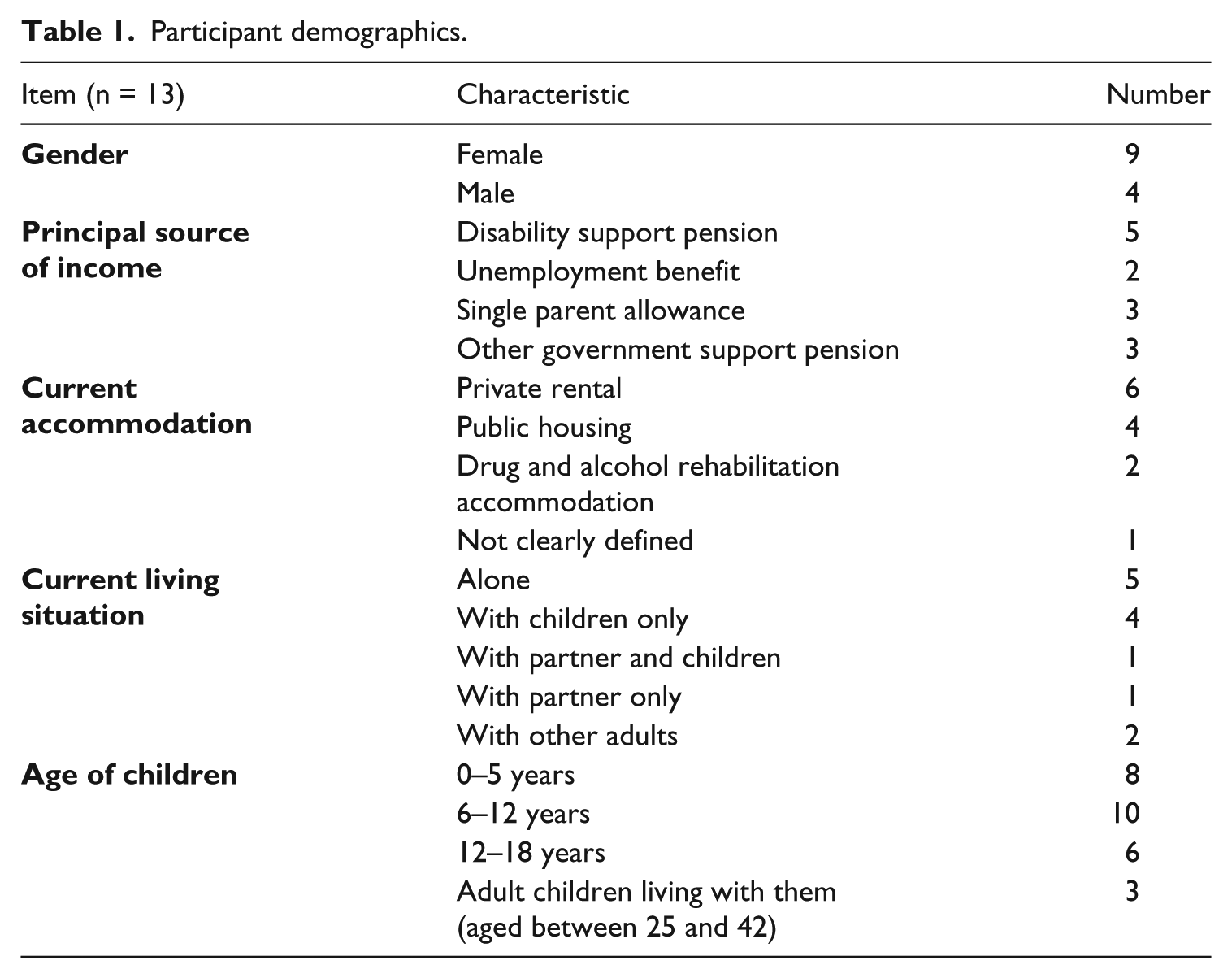
Eleven participants had children under 18 years of age (number of children = 24). Two participants had adult children living with them (n = 3; aged 25, 28 and 42). One participant reported:
the oldest son has a disability so he lives home too. The other one has just started work … [but before that] he had been out of work for five years.
Five participants currently had their children living with them, while the remaining participants indicated that their children lived with ex-partners, extended family members or were placed in foster care. All participants saw their parenting role, for both adult and dependent children, as part of their identity and important to their daily lives and housing decisions. Those whose dependent children were not living with them indicated that they wanted their children to stay permanently, or at least visit regularly.
The types of housing difficulties they currently faced or had experienced in the recent past included a range of issues: sharing with friends/family; substandard accommodation – ‘The place is falling down around my ears; it’s a dump … my house leaks, mould’s two inches thick’ (49-year-old female); or unsafe accommodation – ‘I don’t think it’s safe for the kids … [it’s] a really big veranda area but no barriers, and it’s very slippery … there’s a couple of holes in the actual floor, and I use a walking stick, so I have to dodge them’ (48-year-old female). Many experienced multiple issues in relation to housing, for example, one 43-year-old female participant who had recently moved from a caravan park into public housing described the park in the following way:
[there was] no hot running water or anything, just cold water, tiny little sink to work with. We’ve got the three of us [the children] and me crammed in the tiny little caravan that’s meant for probably two people…. Having to go to the toilet in the night in the pouring rain and … across backwards and forwards from the toilet block. We were copping abuse from the rough tenants…. I didn’t like the kids being in that sort of environment at all, and we’re at least a kilometre out of town. Up hill, a really steep hill and I don’t have transport with me, and the kids were walking up and down that to town with the shopping, lugging backwards and forwards and it was just too hard.
Data analysis identified five interrelated themes for participants.
Which comes first, child access or housing?
Children are a motivator to make a better life.
The ‘spiral’ nature of problems.
Impact of housing issues on children and parenting.
Supports in rural locations where ‘everyone knew everyone’s business’.
Which comes first: child access or housing?
Those with dependent children but without custody were clear that because of their housing issues they were unable to gain access to their children. One 33-year-old male bluntly reported, ‘Well obviously I don’t get to have them.’ At the same time, many believed that, without children in their care, they ‘moved down’ public housing waiting lists:
because I haven’t got the kids with me … being a single bloke, you just don’t get the public housing, you just don’t get it … if I was a single dad, then I’d probably almost walk straight into one, but yeah, just a single bloke by themselves, it’s hard. (40-year-old male)
Similarly, because of housing issues, both men and women reported difficulty in gaining custody and obtaining visiting rights for their children:
I was looking for public housing, but they will only give me a one bedroom unit – because they say the kids aren’t with me long enough…. So, the foster carer system is saying, no they can’t come [because you do not have adequate housing] … and the housing commission are saying, well you can’t have a three-bedroom house because you don’t have your kids with you … (42-year-old female)
Children are a motivator to make a better life
For many, the responsibility of caring for children was a significant motivator to getting better, accessing services and/or maintaining medication. One female participant described feeling suicidal but:
I think the thing that has always kept me going is my two children. No matter how low I felt, sometimes it’s sort of over the depression, etcetera, it’s overridden that, but always, in the back of my mind were my two children of going, no, come on mum, you can do it, you know? (47-year-old female)
In a similar way, some described being a role model to their children in terms of obtaining adequate housing.
I think it [having children] motivates me more to get to find somewhere so you can have them more and be that role model of the parent. (33-year-old male)
One male participant spoke of his commitment to rehabilitation because:
I’ve gained so much with the kids, like I see them every weekend, I went from having supervised access, and then now since January I’ve got unsupervised access, so I can actually be alone with my own kids. And I want to keep it that way. (40-year-old male)
Another said that her children prompted her to move on and get better:
I’ve got to rely on the kids for a prod in the ribs here and there. Mum you haven’t done this or you should be doing that … (43-year-old female)
The ‘spiral’ nature of problems
Underscoring the complexity of participants’ lives, and the interrelationship across multiple domains, many described the spiral nature of drugs, alcohol, mental illness and housing issues, of which losing children was only one component, albeit an important one.
I was in a permanent home … but couldn’t afford to pay the rent, and I had to hand over custody … of my children to my ex-husband … and that led me into the spiral of, I’ve got to move out of where I am … you move from place to place to place … you get into this situation where you go to one place; it’s not suitable for where you’re at, at the time … with the situation of drugs and alcohol, or anything else, so you go and find somewhere else; same issue. You go find somewhere else; worse issues … you get robbed … that’s the spiral that I’m talking about that ends up with people being homeless and going, bugger it; I’ll go and live under a bridge (47-year-old female)
Another participant described this spiral in the following manner.
[I] can’t look after children because of mental illness … [and] mental illness affects my children [through] separation … [at the same time] I can’t parent because [I am] in unsuitable accommodation. (43-year-old female)
Conversely, when things were going right, everything was going well in a participant’s life. All participants were asked about the circumstances, if any, when they experienced stable accommodation; inevitably, this related to a time when they had a job and were in a relationship. For example, in response to this question, one female participant indicated that:
And I had a career and I had friends and I had a husband and I had a house, like this beautiful big, gorgeous brand new house, had a brand new car. I know material things are wrong but they all go together. (57-year-old female)
Similarly, another who had recently moved into stable accommodation reported:
I get anxiety attacks, but most of my anxiety has just been sorted with my new accommodation so that’s going to be good for me for sure. (43-year-old female)
The impact of housing issues on children and parenting
Many described the impact of having inadequate housing on their parenting and their children. One 47-year-old female described the consequences of trying to find suitable accommodation, ‘that physically and mentally, I was not capable of looking after them’. Others emphasized how unsuitable crisis accommodation was for children.
When I was house sharing [I] was moving around from place to place, and none of them were actually suitable for my children to be able to be staying there overnight, and I knew that, and they knew that … (43-year-old female) it certainly affects my ability to effectively parent my children when I’ve got no stable accommodation, how on earth can I, if I’m in a room full of people that are all on drugs, how can I effectively parent them even when I’m not on drugs? (47-year-old female)
Other difficulties for children included maintaining school work, impact on their physical health (because of lack of sleep and good nutrition) and the impact of peer relationships once their peers knew they lived where they did ‘They’re all very standoffish and critical’ (43-year-old female). Another reported ‘They [the children] were very insecure, they were angry, anxious all the time. They were getting picked on’ (49-year-old female). The unwanted presence of others was noted by one:
It’s not the best, you know, it’s full of blokes, and yeah most of them are alcoholics or drug addicts, like I lived there for three months … (43-year-old female)
One male participant concluded that his children were better placed with others given his circumstances.
Well I’m unable to care for them either, look [the] reality is I might not have a house, or, you know, I haven’t got a car, I haven’t got a job, moving kids in there is not an option, so yeah, I just couldn’t have the kids because of my housing situation … but at least I see them every weekend and they’re safe. (40-year-old male)
Another 43-year-old female suggested that her children were stronger for having experienced the housing issues they had:
They’re very sensible and older, they’ve had a lot of extra life tools thrown in there over the situations they’ve been in over the past few years and I feel it’s helped them deal with life a lot better…. Because the kids their age don’t have those experiences and now things don’t shock them as much as they would and stress them out because they’re used to different situations and feelings. It’s not a good thing but it’s not a bad thing either.
Support in rural locations where ‘everyone knew everyone’s business’
Participants described the importance of receiving practical support and advocacy related to obtaining housing:
Well she [mental health agency case worker] got us the emergency house; [she] has been putting in applications for me flat out, filling them out and faxing them off to whoever and ringing up in regard for me … to try and hurry the process along a bit. Just how are you going there on the list and how close I am now and explaining how extreme my circumstances were at the time. (43-year-old female)
This support was not always realized however.
I asked [case worker] – I know there’s public housing in [town] but she wasn’t really helpful when I asked. She just said ‘Oh you just got to ring up’ or something like that…. Don’t really discuss where you’re living do they? They don’t really help, you know … (42-year-old female) Well, they don’t really openly sit down and talk about our house and stuff or anything, which would be good if we did that … (49-year-old male)
Many emphasized the need for more types of housing across the area, ‘They need more like housing commission houses built … and just cheaper rentals’ (33-year-old male). Another required furniture:
I’m hoping to get all single beds and all my utensils and that, because I left a three-bedroom house with everything and just walked away with four bags of clothes … (40-year-old male)
The support received from family (such as participants’ parents) was invaluable in finding housing by ‘doing all the paper work’ and maintaining a rental property (e.g. gardening). When family support fell through or the relationship had broken down, some reported being left with no support. For example, one 43-year-old woman reported that her mother had been a backstop during periods of uncertainty:
yeah, we’ve been moving from my mum’s to different houses and back again over the years and whenever we moved out, mum would say, come on back … and you’ll be right. It was always a backstop for me and when she passed away I was lost.
Many described the nature of rural communities where, in the words of one participant, ‘everyone knew everyone’s business’ and, in the words of another, it was difficult to ‘have a fresh start’ (23-year-old female). Another participant, who had worked through her drinking and drug issues, reported:
even when you confront and deal with those issues, your accommodation problem doesn’t fix itself does it? You have 20 references from people but if they’ve [real estate agents] got that real idea in the back of their mind, then they think they know you, yeah you’ve got no hope. (49-year-old female)
Discussion
The aim of this study was to ascertain the experiences of parents in rural areas who were facing housing difficulties. A number of limitations apply in interpreting the findings. Only participants who were already in support services were interviewed: others may well have different experiences, especially those who may be at the extreme end of the homeless spectrum (literal homelessness). The views of other stakeholders (e.g. children, agency support staff and real estate agents) are required to further inform the field. Additionally, housing issues are dynamic and change over time; but the data presented is static and offers individuals’ perspectives at one point of time only. Further research is required to track pathways out of housing insecurity over time, in order to identify what is effective for different types of families. The comparative numbers of mothers and fathers was small so it is difficult to ascertain whether experiences may differ across gender lines. Representations from various cultural groups (including Indigenous families) and investigating the potentially different experiences of a greater number of mothers and fathers in rural areas would also refine this research area.
Notwithstanding these limitations, a number of issues emerge from the data. The potential for staff from mental health and substance abuse agencies to support their clients’ housing needs in rural areas was highlighted here. However, being in rural areas where ‘everyone knows everyone’s business’ makes it difficult for some to obtain appropriate housing. The interviews here speak to the need to address housing, parenting, mental illness and substance abuse as interrelated, rather than as singular, unrelated issues.
In the first instance, participants described their understanding of waiting lists for public housing in Australia, where they did not believe they were a priority for obtaining public housing if their children were not living with them. There is a lack of transparency about the processes by which housing decisions are made in Australia (Spinney and Nethery, 2013) and the waiting lists for public housing are long (Beer et al., 2003). Nonetheless, according to parents interviewed here, living in unsuitable housing (or housing that wasn’t sufficiently large) meant that some parents with dependent children were unlikely to obtain custody. Both men and women felt trapped by the circular problem in not being able to access their children without the appropriate housing, but then not being able to obtain appropriate housing without having their children living with them on a permanent basis. Given that parenthood was an important motivator for ‘getting better’ for both men and women interviewed, the aspirations of non-custodial parents need to be identified and discussed when working with these clients, especially when addressing housing issues.
Being a parent was important for those interviewed and children served as significant motivators for making their lives ‘better’. Accordingly, clients’ parenting identity needs to be recognized by agency staff in mental health and/or substance abuse agencies issues, for mothers as well as fathers, even if not living with their children (as recommended by Reupert and Maybery, 2009). While mental health clinicians often target employment or education in a client’s treatment plans, they rarely incorporate a clients’ ability to work at home (parenting, activities with the children), though there is some evidence that this is changing (Maybery et al., 2012). Nonetheless, substandard housing is a significant impediment to being able to provide adequate parenting, where one participant acknowledged that his children were better off elsewhere, given the problems he was having with his accommodation.
Multi-need families require multiple agencies (Matos and Sousa, 2004) and these agencies need to work collaboratively together to ensure that services directed to families are not duplicated or worse, offer contradictory support (Reupert et al., 2012). Participants described the potential for mental health and substance abuse clinicians to support their housing needs, that was sometimes but not always realized. Within the constraints of workload and time demands, this result underscores the need for professionals to use a holistic and collaborative approach. The interrelated nature of drugs, alcohol, and mental illness and housing issues as seen here and in other studies (e.g. Johnson and Chamberlain, 2011) also underscores the importance of a collaborative and holistic stance.
Some participants described the stigma that often follows rural people when trying to make a ‘fresh’ start. Similar to the recent Jones et al. (2014) study, the current project also found that social networks in rural communities can facilitate housing opportunities, particularly through the support of family members, but also have the potential to impede housing availability, through a lack of confidentiality and anonymity, as well as social discrimination and stigma. Likewise, Beer (2005) suggests that rural communities often have small populations with close social networks but, at the same time, are insular and conformist. This means that in rural areas, services need to be clear that clients’ rights to privacy are upheld. The location of services also needs to be considered (e.g. not in highly visible, public spaces).
There are other implications arising from this research. Policy and service provision needs to focus on the ‘whole person’ in terms of his or her mental health/substance abuse needs and parenting role (aspirational as well as current) and housing needs. There appears to be tension around assuming one’s parenting role and accessing housing that meets the diverse and often transitory needs of families (where children might only be staying for the weekend). A broad commitment is required from governments for social inclusion and the allocation of resources, including affordable housing, that different families may require.
At the same time, families experiencing housing issues are not a monolithic group; they present with a considerable degree of diversity in their personal backgrounds, housing histories, support needs and housing preferences (Neale, 1997). Moreover, gender, ethnicity, education and family background are all factors that impact on life chances, including homelessness. Given the intersection between individualistic qualities and external factors related to the structural fluctuations of a capitalist economy, a family’s social position may strongly influence the possibility of homelessness occurring. This means that the type and degree of services might need to reflect the needs of different families at different times.
The potential role that alcohol and drug and mental health services can play in providing support to parents with housing problems in rural areas has been highlighted here. The availability and affordability of different types of accommodation to meet the transitory situations of families in need is also indicated. Finally, promoting a holistic view of clients, that includes their parenting aspirations and role alongside strategies to tackle stigma appear to be important in rural areas.