






Abstract
Across the globe, alcohol plays a major role in traffic-related injuries. It impairs the motor and cognitive coordination of drivers leading to motor vehicle collisions, which severely or fatally injure individuals across cultures and socioeconomic spectra. Although most public health initiatives have focused on driver intoxication, there is a high prevalence of alcohol use among pedestrians who are struck by motor vehicles, especially in collisions involving pedestrian fatalities. Alcohol use by pedestrians impairs judgment and coordination leading to risky street-crossing behaviors. Intoxication influences medical management by disrupting the reliability of the physical examination often necessitating expensive imaging modalities to rule out injuries. Alcohol abuse continues to impede traffic safety injury prevention efforts. This article reviews alcohol’s notorious role in traffic safety and pedestrian trauma.
Alcohol and trauma
Trauma is a major cause of morbidity and mortality worldwide. Over five million annual deaths and ten percent of the world’s morbidity are a consequence of trauma (Peden et al., 2004; WHO, 2007). Globally, trauma remains the leading cause of death for ages 1 through 40 years (Peden et al., 2004).
Alcohol’s role as an important associated risk factor in trauma is known. Its use contributes to both intentional and unintentional injuries. Alcohol accounts for 1.8 million deaths (3.2%) annually, half of which it is estimated relate to injury (WHO, 2007). Developed nations continue to struggle to find a solution; in the United States (US), alcohol use contributes to half of all trauma deaths and non-fatal injuries (Soderstrom et al.).
Alcohol plays a major role in traffic-related injuries. In this review, we will examine the role of alcohol in road safety and pedestrian trauma, including its use by motor vehicle drivers and vulnerable roadway users. We will discuss the epidemiology, environmental factors, patterns of injury, outcomes and preventive strategies involved in alcohol-related road traffic incidents.
Alcohol: metabolism and the brain
Cognitive and physical impairments of alcohol.

Alcohol and road safety: scope of the problem
Injuries resulting from motor vehicular transportation account for one quarter of all trauma deaths (Peden et al., 2002). Worldwide, an estimated 1.2 million deaths are attributed to road traffic crashes annually, while the number of non-fatal injuries may be as high as 50 million per year (Peden et al., 2004). Over 85% of the world’s road fatalities occur in low- and middle-income countries (Natulya and Reich, 2002). In low-income nations, most road deaths (70–80%) are among vulnerable roadway users including pedestrians and cyclists; in contrast, the majority of deaths in countries with higher incomes involve motor vehicle occupants (Natulya and Reich, 2002; Natulya et al., 2003). Although high-income nations such as the US report a lower proportion of vulnerable road user fatalities (35%), the absolute number of deaths in this subset (i.e. 4,722 fatalities in the US in 2009) (Field et al., 2010; NHTSA, 2009, 2011) remains unacceptably high and further supports international calls for action (Toroyan et al., 2009). Globally, several risk factors have been linked to these staggering numbers including dense urban areas, poor traffic control, and rough rural roads (Factors influencing Pedestrian Safety, 2006; Vulnerable Road User Safety, 2004). However, one indisputable common thread across nations, cultures, and socio-economic spectra is alcohol.
Drinking and driving laws and road traffic deaths attributed to alcohol.
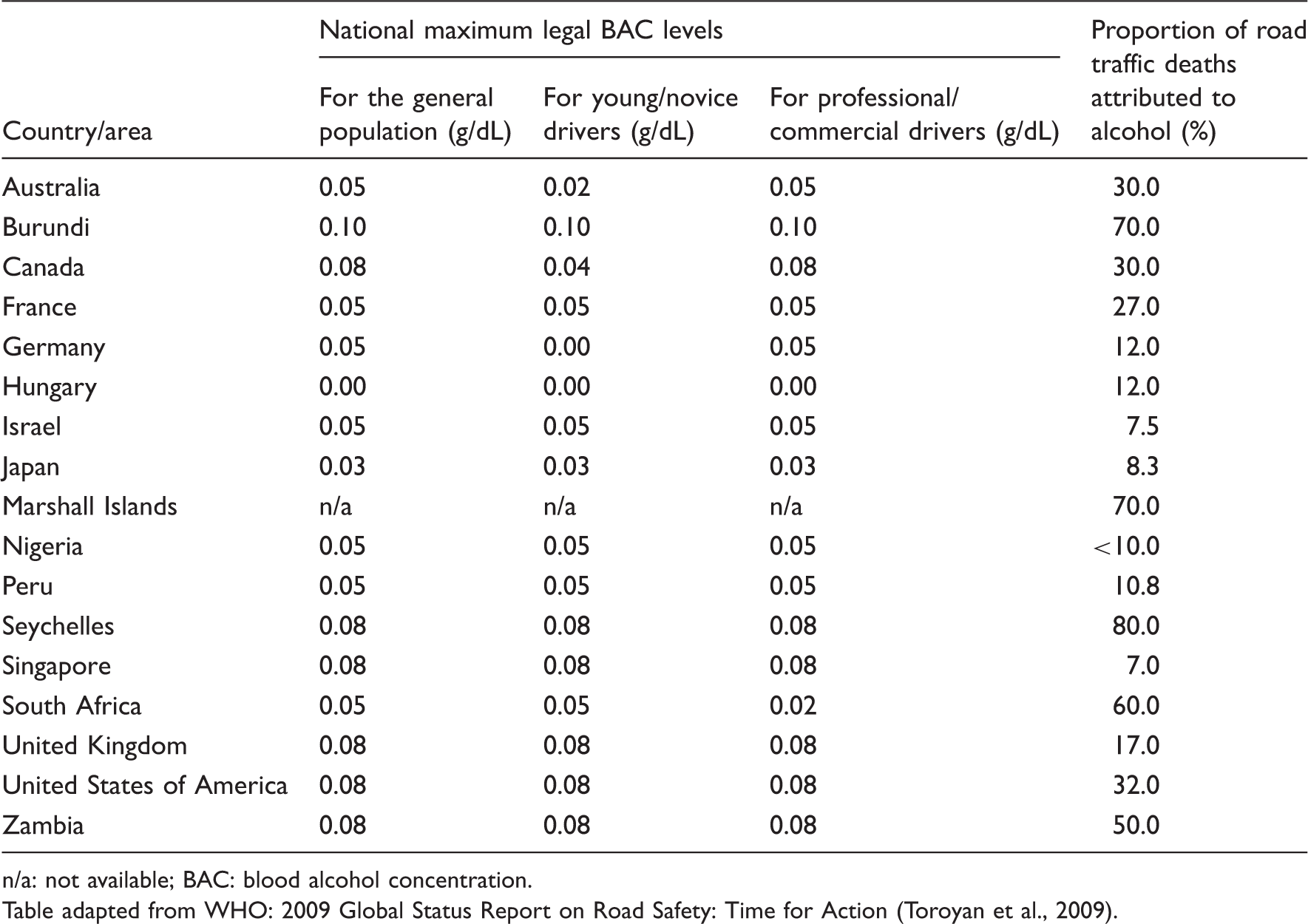
/a: not available; BAC: blood alcohol concentration.
Table adapted from WHO: 2009 Global Status Report on Road Safety: Time for Action (Toroyan et al., 2009).
A WHO survey involving 178 countries found that only 10% had both ‘adequate’ drink-driving laws and enforcement of such laws (Toroyan et al., 2009). Implementation and enforcement of sobriety checkpoints (Peek-Asa, 1999) and the lowering of acceptable BAC legal levels (Shults et al., 2001) may potentially lower the rate of drunk-driving and road fatalities. These types of laws, of course, fail to identify pedestrians who have been drinking and data suggest that a drunk pedestrian is as much at risk for fatal injury following a collision as an intoxicated driver (NHTSA, 2009).
Since the clinical exam for alcohol use is frequently unreliable (Sporer et al., 2012) and BAC levels are not drawn on most trauma victims, the reported 25–50% of pedestrian fatalities globally where alcohol is involved may be an underestimate (NHTSA, 2009; Vulnerable Road User Safety, 2004). In the US in 2010, 10,228 people were killed in driving-under-the-influence (DUI) crashes representing 31% of all motor vehicle traffic fatalities (NHTSA, 2012). The previous year, according to the US National Highway Traffic Safety Administration (NHTSA, 2009), 4092 pedestrians were killed and an estimated 59,000 were injured in motor vehicle crashes. Alcohol use by either driver or pedestrian was reported in 48% of crashes involving a pedestrian fatality. A BAC of 0.08 g/dL or higher was reported in 35% of pedestrians and 13% of drivers, while in 6% of cases, both were found to be legally intoxicated (NHTSA, 2009).
Drivers under the influence of alcohol
During the 1970s in the US, DUI emerged as a pressing public health issue prompting legislative attention and action. At a time when greater than 20,000 people perished annually in alcohol-related crashes, organizations such as Mothers Against Drunk Driving were contributing to the public awareness. State laws for standardized BAC under 0.08 g/dL while driving were lobbied for and instituted. Due to the rigorous public campaigning efforts and legislation, annual alcohol-related traffic crash fatalities have been reduced to current estimates of just under 12,000 (Teigen and Savage, 2009). While progress has been made, undoubtedly much work remains. The annual costs of DUI-associated deaths are approximately 17.6 billion with an additional 13.7 billion for non-fatal alcohol-related motor vehicle crashes (Bouchery et al., 2011).
Driving is a complex skill which involves motor and cognitive coordination. Alcohol significantly impairs both motor coordination and inhibitory control on driving (Weafer and Fillmore, 2011) with greater impairment observed in women (Miller et al., 2009). This impairment persists at BAC levels under 0.08 g/dL (a common legal threshold) with both sexes displaying slower responses and more errors (Field et al., 2010). Similar results are reproduced in the elderly, who also demonstrate slower response times with BACs within legal limits (Hegeman et al., 2010). Such evidence of a cognitive impairment after drinking even small amounts of alcohol affirms the difficult predicament all governments, traffic safety bodies, and citizens face (Hegeman et al., 2010).
DUI places not only the driver and vehicle passengers at risk for serious bodily harm but also pedestrians and cyclists who share the road. Although vehicle safety upgrades (e.g. airbags, structural integrity) and educational and legislative campaigns (e.g. seatbelt use, child seats) have made driving safer and reduced the number of deaths of motor vehicle occupants, studies from both the US (CDC, 1993) and Australia (Holubowycz, 1995) indicate that alcohol-related pedestrian collisions and deaths have not decreased to the same extent.
Most injuries and deaths related to motor vehicle crashes involve vehicle occupants, but, when struck, pedestrians sustain more severe injuries and are more likely to die. US NHTSA 2009 data illustrate that pedestrians were involved in 3% of all traffic collisions but accounted for 12% of all traffic-related deaths (NHTSA, 2009). Unlike occupants, following a collision, a pedestrian’s vulnerability to injury has remained unchanged over time. Pedestrians are also at higher risk for hit-and-run incidents, which can delay medical care and further worsen outcomes (MacLeod et al., 2012). Between 1998 and 2007, while the total number of annual pedestrian deaths in the US decreased, the proportion of hit-and-run pedestrian deaths increased accounting for 18.1% of fatalities (MacLeod et al., 2012; National pedestrian crash report, 2008).
Pedestrian fatalities are more likely to involve men and more often occur in urban areas commonly between dusk and dawn (NHTSA, 2009). Alcohol use on the part of the driver has consistently been shown to be a related or independent risk factor (MacLeod et al., 2012; NHTSA, 2009; Zajac and Ivan, 2003) for pedestrian-struck incidents, a finding especially true in hit-and-run scenarios (MacLeod et al., 2012). However, drivers who are alcoholics are not the major contributors to drunk-driving incidents and alcoholics are proportionally much more likely to be fatally injured in non-traffic events such as falls or fires (Haberman, 1987). Rather it is ‘casual’ drinkers behind the wheel who cause the majority of fatalities and must be particularly targeted in DUI education and prevention programs. Additionally, when alcohol is involved in a police-reported motor vehicle crash, the probability of a pedestrian being fatally injured is four times greater than when alcohol is not involved (National pedestrian crash report, 2008).
Alcohol use by pedestrians
Most pedestrian injuries involving a motor vehicle occur in congested cities with complex traffic patterns. In general, these collisions occur in the pedestrian crosswalk or just outside its boundaries (Factors influencing pedestrian safety, 2006). In the US, pedestrians account for 11–14% of crash-related fatalities (NHTSA, 2009). Although alcohol use on the part of the driver has warranted most of the attention, several organizations and independent studies have shown a high prevalence of alcohol (14-36%) among pedestrians struck by motor vehicles supporting the notion that pedestrian alcohol use is an important associated factor in these incidents (Demetriades et al., 2004; Dultz et al., 2011; NHTSA, 2009; Plurad et al., 2006; WHO, 2007). In fact, in the US, nearly four out of ten pedestrians killed by motor vehicles have alcohol in their system (National pedestrian crash report, 2008).
Injured pedestrians who consume alcohol tend to be young, single, and male, commonly unemployed or poor, and often heavy drinkers (Dultz et al., 2011; Neuner et al., 2010; Soderstrom et al.). Their ethnicities vary considerably, not unexpectedly, depending on the geographic region in question (Dultz et al., 2011; Plurad et al., 2010; Ryb et al., 2007). Areas around bars or other establishments which serve alcohol are frequent hotspots for pedestrian injury (Schuurman et al., 2009).
Alcohol use by pedestrians impairs judgment and cognitive function as they navigate their environment (Tagawa et al., 2000). Intoxicated pedestrians frequently cannot fulfill the perceptual, cognitive, and physical skills required to cross safely in the complex traffic patterns seen in most urban cities (Oxley et al., 2006). They are much more likely to engage in risky street-crossing behaviors including crossing against the signal or mid-block instead of at a designated crosswalk (Dultz et al., 2011).
The physiologic effects of alcohol on a patient’s cardiopulmonary function following trauma are still being delineated. A study of pedestrian fatalities from motor vehicle collisions demonstrated that pedestrians were more likely to have no vital signs on arrival when a positive alcohol or drug screen was detected suggesting that this may be the result of cardiopulmonary suppression (Demetriades et al., 2004). Other studies have suggested a higher likelihood of hypotension and greater blood product requirements as a result of a diminished catecholamine surge following trauma (Bilello et al., 2011; Greiffenstein et al., 2007). The effects of alcohol in laboratory studies examining cardiovascular responses to hemorrhage and resuscitation have been inconsistent. A swine model of alcohol and hemorrhage demonstrated a marked reduction in the ability to resuscitate from shock and an increased mortality possibly due to loss of vasomotor tone or myocardial suppression (Bottoms et al., 1990). Other lab studies suggest alcohol increases tissue hypoxia, oxidative stress, and disordered cellular signaling (McDonough et al., 2002; Molina et al., 2003). Conversely, a rat model of hemorrhage demonstrated a decrease in platelet aggregation, increased vasodilatation, increased tissue oxygenation, and enhanced survival when alcohol was added (Daughters et al., 1995). An in vivo hemorrhage model similarly demonstrated a suppression of pro-inflammatory cytokines and a decrease in mortality with alcohol (Relja et al., 2012).
In the medical management of the injured pedestrian, an understanding of the mechanistic subtleties of the event may be helpful. The height of the patient determines the location of the initial impact of the vehicle’s bumper to the lower extremities. A second impact may occur as the pedestrian’s thigh, trunk, and head hit the hood and windshield of the car. The final impact may involve the victim hitting the pavement placing them at risk for head injury (Trauma: mechanism of injury). Although unclear exactly why, there appears to be a higher rate of severe abdominal injuries in intoxicated pedestrians struck and killed by motor vehicles (Demetriades et al., 2004).
Glasgow Coma Scale (GCS).
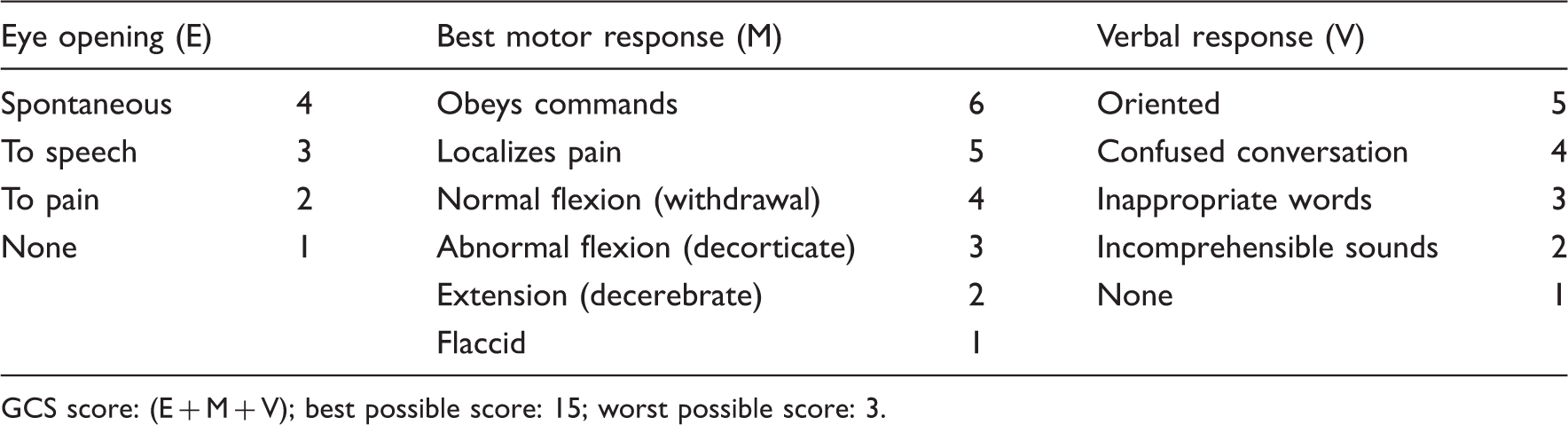
GCS score: (E + M + V); best possible score: 15; worst possible score: 3.
Traumatic brain injury classification.

GCS: Glasgow Coma Scale; CT: computed tomography.
Injury Severity Score and hospital length of stay of injured pedestrians stratified by alcohol use (a New York City Study).

One patient with indeterminate ISS excluded.
Table adapted from Dultz et al. (2011).
While the majority of injured pedestrians are discharged home from the emergency department (ED) (Stutts and Hunter, 1999), intoxicated patients have a higher likelihood of admission (Dultz et al., 2011). The reasons are many including an unreliable physical exam, a need for additional testing, a greater injury severity (Dultz et al., 2011), and a required observation period to allow for sobering (Bradbury, 1991). Patients are often admitted merely for the alcohol in their system to be metabolized, so that they may be discharged home safely or screened for possible intervention and treatment of an alcohol disorder prior to discharge. The overall result is that these admissions and longer LOS translate into higher healthcare costs, often with little reimbursement for hospitals as many of these patients are uninsured (Dultz et al., 2011).
Blood alcohol testing in the emergency department
BAC testing for injured patients in the ED may assist in the anesthetic management of pain, in assessing the risk of withdrawal syndromes, and in explaining altered states of sensorium, all of which may aid a treating physician (Soderstrom et al., 1997). In an effort to reduce alcohol-related pedestrian injuries, several studies (Gentilello et al., 1999; Longabaugh et al., 2001; Monti et al., 1999; Zatzick et al., 2004) have examined the role trauma centers and EDs play in obtaining BACs and screening patients for intoxication, withdrawal, dependence, and abuse. Unlike primary care visits, the ED offers a unique and possibly essential opportunity to address abuse. Screening injured patients and providing a brief intervention if positive has been shown to reduce subsequent abuse, hospital readmissions, and related consequences.
Despite its potential advantages, BAC screening is not routinely performed anywhere in the world. A survey of US trauma surgeons documented that BAC levels are routinely drawn at fewer than two thirds of trauma centers in the US (Soderstrom et al., 1994). Reliance on physical exam by hospitals in most nations undoubtedly leads to a universal underreporting of alcohol use (Soderstrom et al.).
The WHO has found it difficult to collect ED data on alcohol use because of this lack of uniform screening. There are several reasons universal screening has not been more aggressively pursued. Culturally, many do not consider alcohol use a significant problem to warrant screening (WHO, 2007). Others suggest that the ED is not the appropriate place for interventions targeting alcohol use as it imposes undue stress on resources and staff (Verelst et al., 2012). Still others suggest that although an ED may be able to readily identify the problem, there is consistently a lack of follow-through as most centers do not have proper systems in place to maintain the support and treatments many of these patients require to combat their alcohol disorders (WHO, 2007). The medico-legal implications of recording alcohol intoxication are also often considered (WHO, 2007). The clearest example is the US’s Uniform Accident and Sickness Policy Provision Law (UPPL) which has been passed in most US states. This law allows third-party payers (i.e. insurers) to deny reimbursement for medical services if a patient is found to be intoxicated at the time of the incident (Chezem, 2004). As a result of the UPPL, US trauma centers do not routinely measure BAC even though over 91% of trauma surgeons believe testing is important (Gentilello et al., 2005). Most trauma surgeons indicate that, if there were no insurance barriers and external financial pressures, they would be willing to establish a brief alcohol intervention program in their centers (Gentilello et al., 2005).
Prevention and intervention strategies
A 2009 WHO road safety report recommended governments pass comprehensive laws to protect all road users, including setting appropriate speed limits to the type and function of the road and encouraging collaboration among different sectors involved in collecting road traffic injury data (Toroyan et al., 2009). These same governments need to ensure that the institutions responsible for tending to road safety issues have the necessary human and financial resources to act effectively (Toroyan et al., 2009). Unfortunately, there is no magic bullet in the prevention of pedestrian road traffic crashes as they relate to alcohol. Stiffer DUI laws and public awareness to the risks of drunk driving have certainly played a role in deterrence but will unlikely come close to eliminating the problem. As long as people drink altering their cognition, alcohol-related traumatic events will continue to occur.
Although cohesive screening methods for alcohol abuse are lacking, most studies have focused on the ED as the primary location for screening and brief interventions (D’Onofrio et al., 2012; Sommers et al., 2006). The ED has been shown to be an effective place to reduce recidivism (Neighbors et al., 2010). Brief interventions targeting risk-taking youths combining motivational interviewing with follow-up after discharge have shown promise in reducing alcohol-related injury (Monti et al., 1999; Neighbors et al., 2010). A separate study spearheaded by ED nursing staff demonstrated a reduction in visits and injuries when patients were screened and treated on their initial visit (Desy et al., 2010). Similar ED interventions providing motivation feedback and negotiating reasonable short-term goals have also been shown to successfully decrease alcohol recidivism (D’Onofrio et al., 2012). Unfortunately, most hospitals in developed countries and certainly all of those in less developed regions lack the financial resources to support the infrastructure needed for any long-term success in this realm.
Summary
Alcohol-related injuries represent a significant global health burden. While much has been done to raise public awareness and decrease drunk-driving rates in many parts of the world, alcohol use by both drivers and vulnerable roadway users continues to play a notorious role in traffic safety and impedes the success of injury prevention efforts.
Pedestrians struck by motor vehicles are more severely injured than motor vehicle occupants and account for a large proportion of fatalities. Pedestrians who are drunk sustain more severe injuries, require more imaging, encounter more complications, and require longer hospital LOS. The prevention focus may need to evolve in the ensuing years from strategies focusing primarily on motor vehicle occupants to ones that target the vulnerabilities and distractions of pedestrians and which emphasize a safe co-existence within their shared environment.
Footnotes
Funding
This research received no specific grant from any funding agency in the public, commercial, or not-for-profit sectors.