





Abstract
Introduction:
Tibial plateau fractures can be challenging to manage, and as such, they are often referred to tertiary referral centres for specialist input, and with the advent of Major Trauma Centres, this is likely to increase. The financial implications of this are unknown. The study aims were to: (1) analyse the cost of tibial plateau fracture management at a major trauma centre, (2) identify the proportion each aspect of the admission contributed to overall cost, and (3) investigate how tibial plateau fractures were coded.
Patients and methods:
A retrospective review of all patients presenting between July 2010 and October 2011 with a tibial plateau fracture was performed. Data were collected on all aspects of each patient’s admission. The cost for each part of the admission was obtained from the institution finance department with the total cost of treating tibial plateau fractures in each patient subsequently calculated.
Results:
Forty tibial plateau fractures were included (mean age 43.6 years; 70.0% male). Fractures occurred as a component of polytrauma in 37.5% with operative fixation performed in 65%. Mean total cost of treating tibial plateau fractures was £4941 with ward costs (57.6%) and operative costs (34.1%) accounting for the majority. Mean cost of managing fractures sustained in polytrauma (£3073) remained significantly higher (p = 0.012) than those sustained in isolation (£1401) when excluding ward costs and adjusting for length of stay. This was true irrespective of Schatzker grade. No specific injury code was available for tibial plateau fractures. In patients sustaining polytrauma, the tibial plateau fracture was never coded as the primary injury, but instead using a subsidiary code, which attracted less remuneration.
Conclusions:
Tibial plateau fractures sustained during polytrauma incurred the highest costs. As ward costs contribute to the majority of overall cost, it is recommended that mechanisms are in place to facilitate early discharge back to referring centres or to provide remuneration for incurred admission costs once definitive fracture fixation has been performed. Hospital coding must be modified to more accurately reflect the injuries sustained.
Introduction
Tibial plateau fractures are often complex injuries and account for approximately 1% of all fractures. 1 These intra-articular fractures can be sustained in isolation or as a component of polytrauma and are most commonly graded by the Schatzker classification system. 2 The higher grades of fracture are usually the result of high-energy trauma, and therefore the blunt delivery of this energy are often associated with significant soft tissue injury3,4 and damage to adjacent structures. 5 Operative and non-operative methods exist for treating these injuries. The aim of operative management is to achieve anatomical reduction, maintain stability of the articular surface and restore length and alignment.6,7 Temporising measures, such as external fixation, may be employed to delay definitive surgery until the soft tissues have settled 8 and to allow comprehensive surgical planning. 9
Complications following definitive surgery have been widely reported in the literature. 4 The infection rate for internal fixation ranges from 2% 10 to 11% 11 with another study 12 reporting 14 out of 43 patients treated with internal fixation required removal of metal work. This highlights the complexities of treating these fractures surgically, and as such, they are often referred for specialist input, for example to a major trauma centre or to specialist knee surgeons. 13
This institution has recently become a major trauma centre, therefore it was hypothesised that complex trauma requiring specialist management, such as tibial plateau fractures, would be referred to this centre more frequently. The primary study objective was to determine the potential future financial implications of treating tibial plateau fractures at this centre by undertaking a retrospective financial analysis of cases already managed and identify the proportion each aspect of the admission contributed to the overall cost. The secondary study objective was to investigate how tibial plateau fractures were coded.
Patients and methods
This retrospective cohort study was performed at a single large major trauma centre. All patients presenting to this institution over a 16-month period (July 2010 to October 2011) with a tibial plateau fracture were identified from the hospital’s electronic clinical coding database and from prospectively maintained daily patient admission lists.
Data on all patients were collected from case notes, the electronic Picture Archiving and Communication System (PACS), operative notes and theatre logbooks. Specifically, data were collated on patient demographics, all injuries sustained at the time of index admission, investigations performed and treatment received during the hospital admission; this included total operative time and length of hospital stay. Admission radiographs were reviewed to determine the Schatzker classification 2 of each fracture. In some instances, more detailed imaging (computerised tomography scan and magnetic resonance imaging) of the fracture was also performed for surgical planning. These scans were also reviewed to assist in determining the Schatzker classification. 14 All components used in each operative procedure performed were recorded by reviewing the prospectively maintained theatre logbooks.
Summary of main costs used to calculate total cost of treating tibial plateau fractures.

Due to the numerous components used for fracture fixation amongst the cohort, the cost of each individual component has not been provided but has been included in the total cost calculations.
Statistical analysis
All statistical analysis was performed using PASW Statistics 18 (SPSS Inc., Chicago, IL). Different statistical methods were employed depending on the specific data being analysed and included unpaired t-test, ANOVA test and Tukey’s honestly significant difference test. A p-value of less than 0.05 was considered statistically significant.
Results
Patient demographics
A total of 40 patients with 40 tibial plateau fractures (34 closed fractures and six open fractures) were eligible for study inclusion. Mean age at injury was 43.6 years (range 18.4–98.3 years), and 70% (n = 28) were male. Fractures occurred as a component of polytrauma in 37.5% (n = 15) of cases with the remainder sustained in isolation. Three patients were referred to us from other centres. The Schatzker grade for each fracture is provided in Figure 1. Operative fixation was performed in 65% (n = 26) of cases with the remainder treated conservatively. Of patients undergoing surgery, 15% (n = 4) were managed initially with external fixation prior to definitive internal fixation. No patient had any further surgical intervention in the index admission other than those planned for fracture fixation.
Schatzker grading of tibial plateau fractures (n = 40). Number (%) of Schatzker grades: 1 = 3 (7.5%), 2 = 12 (30%), 3 = 1 (2.5%), 4 = 8(20%), 5 = 11 (27.5%), 6 = 5 (12.5%).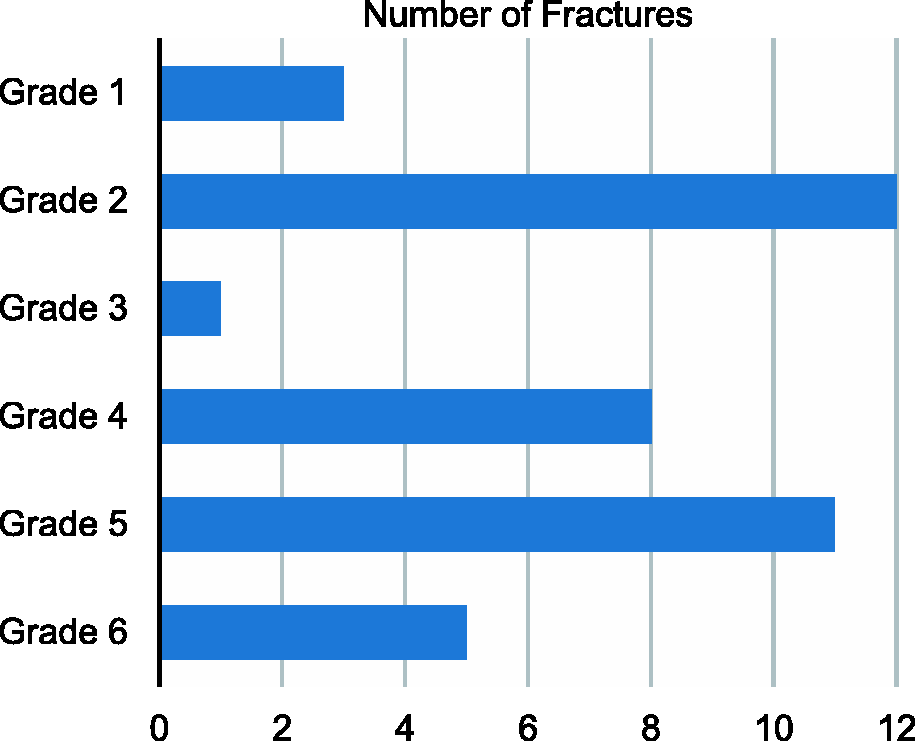
Financial cost of managing injuries
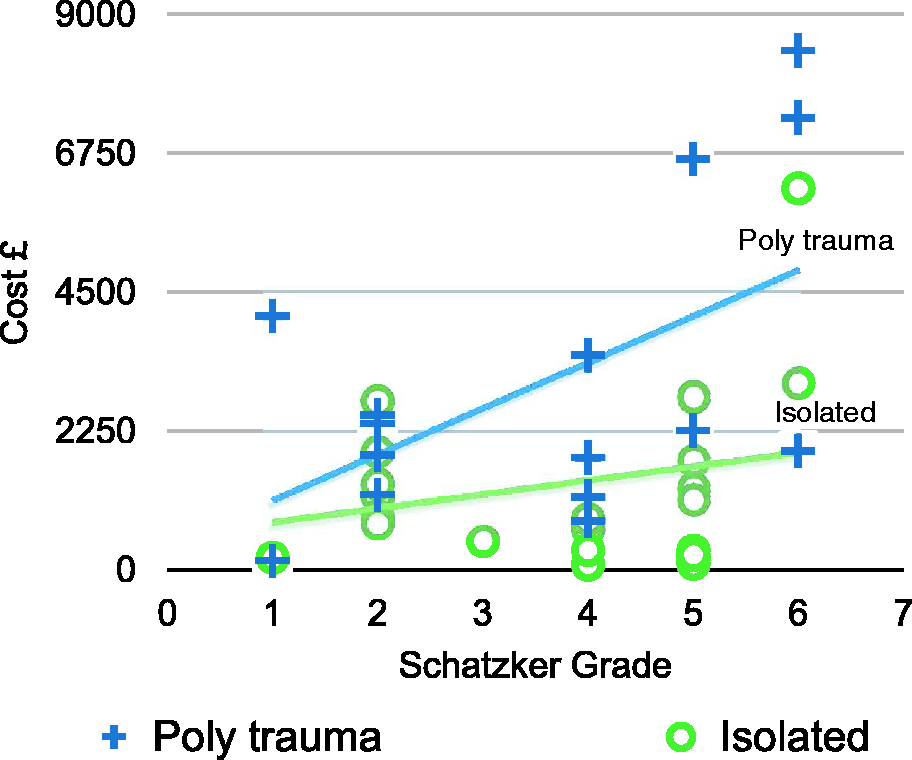
The mean total cost of treating a tibial plateau fracture at this centre was £4941 (median £3114, range £396–£26,583). Ward costs (57.6%) and operative costs (34.1%) accounted for the majority of overall treatment costs (Figure 2). Irrespective of Schatzker grade, the mean cost of managing a tibial plateau fracture sustained as a component of polytrauma was £7670 (range £919–£26,583) compared to £3304 (range £396–£17,577) for those fractures sustained in isolation (Figure 3). When analysing the log of cost of all polytrauma and all isolated fractures using an unpaired t-test, this difference was statistically significant (p = 0.004). The cost of managing the other injuries sustained by polytrauma patients was not included in the financial assessment, and as such, the only way additional injuries could influence our findings was through length of stay. As ward costs were responsible for the majority of total management costs, further analysis was performed which excluded ward costs from the overall cost and adjusted for the total length of hospital stay (Figure 4). This demonstrated that the cost of managing tibial plateau fractures sustained in polytrauma (mean £3073) remained significantly higher (p = 0.012) than those sustained in isolation (mean £1401).
Breakdown of costs for managing tibial plateau fractures. Cost according to Schatzker grade of tibial plateau fractures (no adjustments made). Solid lines are lines of best fit. Cost according to Schatzker grade of tibial plateau fractures (excluding ward costs and adjusting for length of hospital admission). Solid lines are lines of best fit.

Higher Schatzker grades were associated with increased treatment cost (Figure 5). The average cost of managing Schatzker grade 6 fractures was significantly more expensive (p < 0.05) than managing fracture grades 1 to 5 using the pairwise difference Tukey’s Honestly Significant Difference Test.
Overall cost of management by Schatzker grade. Solid line is line of best fit.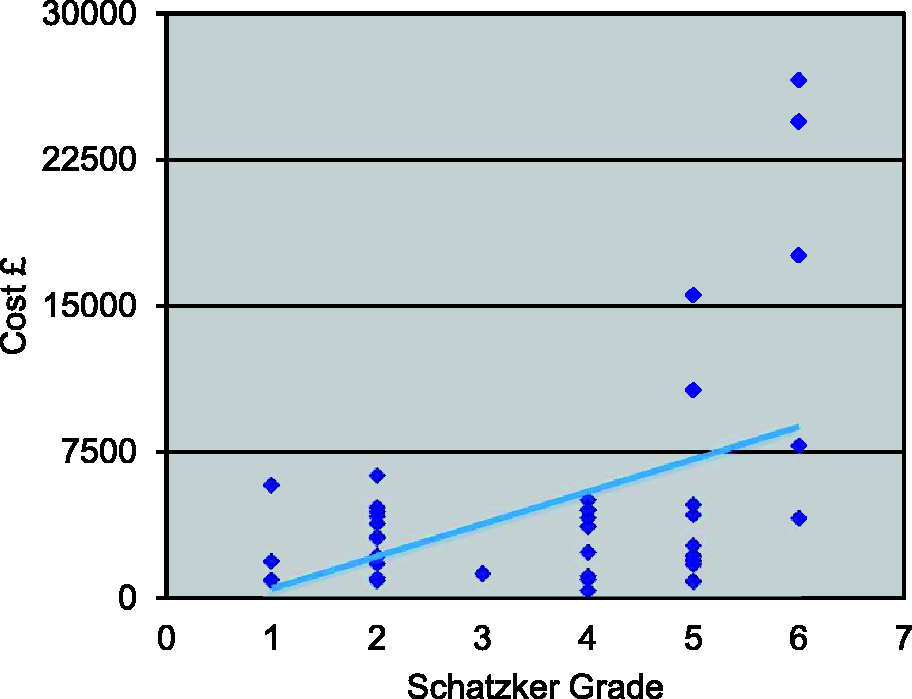
Coding of injuries
On review of the institutions coding process for the injuries sustained in these 40 patients, no specific injury code for the diagnosis of a tibial plateau fracture was available. The lack of an ICD-10 classification for this particular injury led to inconsistencies when coding tibial plateau fractures. In this study, all tibial plateau fractures were classified using an inappropriate code. Two-thirds were coded as injuries of the knee with no further clarification and the remaining one-third were coded as injuries of the proximal tibia, distal femur or ankle. Coding for financial reimbursement uses a primary injury code and a compilation of up to 14 subsidiary codes for complications and additional injuries. In our polytrauma patients (n = 15), the tibial plateau fracture was never coded as the primary injury and subsequently included only as an additional code. These subsidiary codes do not attract as much remuneration as when they are documented as the primary code.
Discussion
This study has demonstrated that there is a significant cost associated with the management of tibial plateau fractures. These costs are influenced by a number of factors. Although some factors are injury related and therefore fixed (for example, Schatzker grade), other factors may be modifiable (such as ward costs) and therefore could reduce total costs, if managed appropriately. This study has provided an interesting insight into the likely future financial implications for major trauma centres in dealing with complex trauma, and lessons learnt from this study may be applied to any traumatic injury requiring specialist input.
Our findings demonstrate that injuries sustained as a component of polytrauma are more costly to manage than those sustained in isolation. This is unsurprising as events with high-energy transfer are associated with higher grades of fracture3,4 damaging more body regions, and doing so more significantly, than low-energy events. It was also expected that certain aspects of management would contribute more than others to overall cost; however, the identification that ward costs were responsible for 57% highlighted a significant potentially modifiable factor. Other recent studies also demonstrated hospital stay was the predominate financial contributor for trauma admissions in Ireland 15 with length of hospital stay found to be an independent predictor of increased costs in Australia. 16 These findings suggest that it is not only the National Health Service in England that has to consider the financial implications of managing trauma in the current economic climate. Mechanisms which facilitate early discharge of our patients, to either an outpatient rehabilitation unit for supervised mobilisation or back to the referring hospital for further inpatient care, may decrease overall cost to specialist trauma centres for treating these complex injuries.
The present study demonstrated the process of remuneration is complex, but fails to recognise several important issues. This includes lack of a specific code for tibial plateau fractures, a failure to recognise the increased costs of managing this injury as a component of polytrauma and the potential for a less severe and less costly injury to be prioritised ahead of a tibial plateau fracture, which further reduced the proportion of management cost received. The importance of having a specific code for tibial plateau fractures should be given fair consideration. Under the current system, an elderly patient sustaining a low-velocity distal fibular fracture may receive the same ‘ankle injury’ code as a young male following a high-energy tibial plateau fracture. If no specific code is possible, guidance on which ICD-10 injury code to be used should be provided by the consultant surgeon. Similarly, there should ideally be differentiation within the coding system to recognise the higher costs associated with more complex and polytrauma fractures. Like other major trauma centres, this institution is likely to see an increasing number of patients with multiple injury codes in the future. To achieve accurate remuneration, these codes must be modified to more accurately reflect the type and severity of injury with these put into context with any other injuries the patient may have sustained.
This study has recognised limitations. Although revealing important information about the cost of managing tibial plateau fractures and the process of coding, our study has been limited by a small data set. The study population of 40 cases limits interpretation of results obtained for the subgroup analyses. More patient numbers are required to make further comment on the data when subcategorised into the six different Schatzker grades and current results must be considered in light of this. In order to gain the most information from our small data set, a statistician was used. This was to ensure the most appropriate tests were employed to analyse our data. An argument can be made that with the existence of coding issues, as highlighted in this paper, relying on coding to identify patients for study inclusion is flawed. To mitigate for this, the initial data trawl included all codes from the femoral diaphysis to the ankle before the tibial plateau fractures were identified. A further limitation concerns our methods used to determine cost. As previous studies have demonstrated, it is not possible to determine the precise cost of managing patients within the health service. 17 Our estimated values for the 40 tibial plateau fractures did not match the actual values provided to us for comparison by hospital financial services and for which the hospital received in remuneration. This is likely to be due to the fact that additional injuries or complications were not included in this study as well as inconsistencies in hospital coding. This reasoning also forms the basis for not presenting the cost difference per patient, which we ourselves calculated. Despite this, our methods of breaking cost down into different components has been used previously 17 and ensuring that each case is assessed according to the same framework provides a good basis on which to compare cost. It is therefore considered that the methods employed in this study provide an accurate and standardised costing profile for the patients treated at this centre.
Conclusions
This study has assessed the financial cost of managing tibial plateau fractures at a major trauma centre. Tibial plateau fractures sustained during polytrauma incurred significantly higher costs with ward costs contributing to the majority of overall cost. Current coding of tibial plateau injuries is not sufficient and needs to be improved. Major trauma centres are likely to play a large role in the health service, and if these centres are to continue performing specialist work on behalf of other hospitals, they will require appropriate reimbursement. The lessons learnt from the present study may be useful when considering other complex traumatic injuries, which require referral to specialist centres for management.
Footnotes
Acknowledgement
The authors received statistical assistance from Mr Peter Nightingale, a University of Birmingham statistician.
Conflict of Interest
None declared.
Funding
This research received no specific grant from any funding agency in the public, commercial, or not-for-profit sectors.