






Abstract
Background
WeChat has become a central platform for health information seeking in China, particularly among young adults. Understanding the mechanisms underlying this behavior is crucial for improving digital health literacy and designing effective interventions.
Objective
This study applies the Comprehensive Model of Information Seeking (CMIS) to examine how WeChat use shapes users’ perceptions of health information characteristics and utility, influencing health information-seeking behaviors among Chinese young adults.
Methods
Data were obtained from a cross-sectional online survey of 890 WeChat users aged 18–35 conducted in May 2024. Structural equation modeling (SEM) and the PROCESS macro were applied to test the hypothesized associations and mediating mechanisms involving perceived characteristics and utility.
Results
WeChat use, salience, and beliefs predicted perceived utility. Perceived characteristics and utility were positively associated with health information-seeking behaviors and mediated the relationship with WeChat use both in parallel and sequentially.
Conclusion
Integrating platform-specific use into CMIS can promote health information seeking and inform digital health communication.
Keywords
1. Introduction
China has the largest and most active population of social media users globally. As of January 2024, the country had 1.43 billion social media users, representing 74.2% of its total population. 1 Additionally, in China, nearly all internet users (97.7%) engage with one or more social media platforms. In this context, social media platforms have become a dominant digital infrastructure for health information acquisition, shaping how individuals access, evaluate, and utilize health-related information in their daily lives. Among these platforms, WeChat has become the most widely used and popular in China. 1 With 1.37 billion monthly active accounts as of June 2024, WeChat supports high-frequency usage among a broad user base. 2 The gender distribution of WeChat users is nearly balanced, with 52.9% male and 47.1% female users. Young adults aged 18-35 represent the most active user group. 3
The fast-paced lifestyle, work-related stress, and unhealthy habits have exposed young Chinese adults to a growing number of health threats, including obesity, sleep deprivation, and mental health issues. 4 Conditions traditionally associated with older age, such as fatty liver disease and cervical spondylosis, are increasingly affecting younger populations, contributing to a rising public health burden and potential losses in labor productivity in China. These emerging health challenges heighten young adults’ dependence on accessible and timely health information to support everyday health-related decision-making. In response, the Chinese government has prioritized health communication and management through national initiatives such as the Healthy China 2030 Outline.
In this digital context, WeChat serves as a central platform for health communication in China. It provides access to a wide range of health-related content, covering topics such as diabetes, hypertension, obesity, smoking, sedentary lifestyle, depression, and insomnia, supporting users’ acquisition of health knowledge and daily health management (e.g., dietary regulation, weight control, rest, and relaxation). 5 Beyond information dissemination, WeChat integrates multiple health-related functions within a single platform. Official WeChat accounts (OAs) deliver tailored health and medical information, while embedded mini-programs connect users to electronic health services, including self-tracking systems, online consultations, medical payments, and free health lectures. 6 From a health informatics perspective, WeChat constitutes an integrated health information ecosystem that combines information access, interpersonal communication, and health service utilization.7,8 As a result, a growing number of users actively and purposefully seek health information through WeChat via OAs, group chats, tags, and the built-in search engine.
Health information-seeking behaviors play a vital role in enhancing individuals’ knowledge, raising public awareness of health risk factors, and promoting healthier lifestyle choices.9,10 Although a growing body of research has examined health information-seeking behaviors on WeChat and identified a range of individual, psychological, instrumental, and contextual predictors, existing studies have largely focused on direct associations between these factors and information-seeking outcomes without systematically theorizing the perceptual mechanisms that mediate these associations.11,12 Less attention has been paid to the cognitive and perceptual mechanisms by which routine platform use shapes users’ evaluations of health information and, in turn, motivates active information seeking, particularly within highly integrated platforms such as WeChat. As a result, it remains unclear how users’ routine engagement with WeChat shapes their perceptions of health information and, subsequently influences their decisions to actively seek it.
To address these gaps, the present study examines general health information-seeking behaviors on WeChat among Chinese young adults aged 18–35 years by applying the Comprehensive Model of Information Seeking (CMIS). Specifically, this study investigates how platform-specific use of WeChat functions as a contextualized antecedent, shaping users’ perceptions of health information characteristics and utility, which, in turn, influence health information-seeking behaviors. By focusing on a highly integrated digital platform, this study contributes to a more nuanced understanding of health information seeking in contemporary digital health environments.
1.1. Comprehensive model of information seeking
This study is guided by the CMIS, which posits that antecedent factors influence information-seeking behavior indirectly through individuals’ perceptions of information carrier factors. CMIS provides an integrative framework for understanding health information-seeking behaviors across a range of contexts, from general health information to disease-specific topics such as COVID-19, 13 cancer, 14 mental health, 15 diabetes, 16 and multiple sclerosis. 17
The CMIS comprises seven key variables organized into three categories: antecedent factors, information carrier factors, and information-seeking behaviors. Antecedent factors, including demographics, salience, and beliefs, shape individuals’ perceptions of information carrier attributes. 18 Salience captures individuals’ perceptions of the threat posed by a disease or condition, whereas beliefs reflect their confidence in adopting health-promoting behaviors. 19 Information carrier factors consist of two variables: perceived characteristics and utility. Perceived characteristics refers to the attributes of the message content, including editorial tone, which reflects the credibility and intentions of information, and communication potential, which captures the style, clarity, and comprehensibility of the information provided. 18 Perceived utility refers to an individual’s evaluation of the relevance, importance, and topicality of the content provided by a medium. 18 Finally, health information-seeking behaviors capture concrete engagement in actively seeking health information. 20
1.2. Incorporating WeChat use as a contextualized antecedent
In the original CMIS, antecedent factors are typically categorized into four components: demographic factors, direct experience, salience, and beliefs. 19 Johnson and Meschke described CMIS as providing the “bare bones” of a causal structure, permitting researchers to adapt the framework by including or excluding variables depending on specific contexts. 18 Consequently, CMIS studies have expanded to incorporate additional antecedent factors, such as social stigma, 14 social support, 15 cultural worldview, 21 interest, 22 political ideology, 23 health consciousness, 24 and health status. 13 However, the CMIS has been criticized for its limited inclusion of media-related factors as potential antecedents.25,26
To address this gap, recent studies have incorporated media-related elements into the CMIS framework, including media exposure and television use.26,27 However, these studies have rarely been explicitly theorized or operationalized media use as a central antecedent shaping individuals’ perception of information carriers. To date, only one study has explicitly examined media use, measured by frequency and time spent on the Internet, as an antecedent factor influencing perceived credibility and utility of online health information, and this evidence is limited to the Indian context. 25
These limitations highlight the importance of explicitly theorized media use within the CMIS framework. Media use refers to individuals’ routine engagement with and exposure to specific media platforms. 28 In the Chinese context, the conceptual ambiguity of terms such as “online media,” “new media,” or “social media” is particularly salient, as these labels often conflate search engines, social networking platforms, and mobile health applications. 29 This issue is further exacerbated by the highly integrated nature of Chinese digital platforms, where multiple functions, including communication, information search, content dissemination, and health services, are embedded within a single application. Treating “media use” as a homogeneous construct thus obscures important platform-specific differences and limits the ability to accurately assess how different media channels shape perceptions of health information characteristics and utility. 30
Drawing on this perspective, the present study conceptualizes WeChat use as a context-specific antecedent that reflects users’ intensity and depth of use. Previous studies have consistently found that media use is positively associated with perceived characteristics and utility.25,26 For example, Korean adults’ frequent use of television enhances their impression that television is beneficial for health information. 27 Likewise, Indian users who spend more time on the Internet are more likely to trust and value online health information. 25 Social cognitive theory (SCT) supports these findings by positing that users form evaluations of media utility and credibility through vicarious learning, primarily through observation and repeated exposure.31,32 Given WeChat’s multifunctional role in Chinese daily life, integrating communication, information access, services, and entertainment, frequent use is likely to cultivate familiarity and positive evaluations of health information on the platform. Therefore, we hypothesize:
WeChat use is positively associated with users’ perceptions of the characteristics of health information on WeChat among Chinese young adults.
WeChat use is positively associated with users’ perceptions of the utility of health information on WeChat among Chinese young adults.
1.3. Relationships among CMIS core constructs
Extant CMIS literature has demonstrated that antecedent factors, such as salience and beliefs, predict perceived utility, which in turn influences health information-seeking behaviors.13,15,33 Perceived characteristics of the information, such as credibility and clarity, can also directly affect perceived utility and information-seeking behaviors.
These relationships have been validated across multiple contexts. For instance, in traditional media studies, Johnson and Meischke (1993) found that adult women who perceived a higher personal risk of cancer (high salience) or believed in the preventability of breast cancer evaluated cancer-related information in magazines as more relevant and useful, which increased their likelihood of actively seeking information from these magazines. 18 In social media contexts, a recent study applying the CMIS to Chinese women’s mental health information seeking on Douyin (TikTok) found that beliefs, salience, and characteristics of mental health information influenced its perceived utility, which subsequently shaped information-seeking behaviors on that platform. 15
Studies in non-disease contexts further illustrate the applicability of CMIS.34,35 For example, anxiety about the health consequences of smoking, along with beliefs that quitting smoking reduces lung cancer risk, influences the perceived trustworthiness of smoking cessation information, thereby prompting information seeking. 35 Cross-cultural evidence also supports these mechanisms.33,36,37 For example, survey data from 5,469 participants in mainland China, Hong Kong, and Taiwan revealed that individuals’ perceptions of COVID-19 risk and confidence in COVID-19 preventive measures influenced the perceived utility of COVID-related information, which affected information-seeking behaviors about COVID-19. 33
In this study, individuals’ perceptions of susceptibility, severity, and concern about illness (salience), along with their confidence in managing or preventing disease (beliefs), are expected to influence their evaluation of the credibility, accuracy, relevance, and importance of health information on WeChat (perceived utility). Perceived information characteristics, such as credibility, clarity, and accuracy, is also expected to directly affect both perceived utility and engagement in information-seeking behaviors. Based on this reasoning, the following hypotheses are proposed:
Salience is positively related to perceived utility of health information on WeChat among Chinese young adults.
Beliefs is positively related to perceived utility of health information on WeChat among Chinese young adults.
Perceived characteristics of health information is positively associated with perceived utility of health information on WeChat among Chinese young adults.
Perceived characteristics of health information on WeChat is positively related to health information-seeking behaviors on WeChat among Chinese young adults.
Perceived utility of health information on WeChat is positively related to health information-seeking behaviors on WeChat among Chinese young adults.
1.4. The mediating effects of perceived characteristics and utility
Although prior studies have explored the relationship between WeChat use and health information-seeking behaviors, the underlying mechanisms through which this relationship operates remain insufficiently theorized within the CMIS framework. While media use has been identified as an antecedent of health information-seeking behaviors, 25 and perceived characteristics and perceived utility have been recognized as key information carrier factors that facilitate these behaviors,38,39 few studies have empirically tested how these factors jointly explain the effects of WeChat use on health information-seeking behaviors. In particular, the potential parallel and sequential mediating roles of perceived characteristics and utility have received limited empirical attention. Examining these mediating mechanisms is theoretically important, as it clarifies how media use translates into information-seeking behaviors through cognitive evaluations of information quality and usefulness, thereby extending the explanatory power of CMIS. 40
Recent studies found that media use contributes to individual’s knowledge and abilities, enabling them to selectively seek information through familiar media platforms and thereby increasing the likelihood of finding relevant health information.27,41 Familiarity reflects prior interactions and experiences guiding what, why, when, and where to seek health information. Based on this literature, this study postulates three potential mediating pathways linking WeChat use to health information-seeking behaviors: (1) WeChat use enhances perceived characteristics, which in turn affect information seeking. (2) WeChat use promotes health information seeking via increased perceived utility; and (3) WeChat use increases perceived characteristics, which subsequently enhance perceived utility, ultimately leading to greater health information-seeking behaviors. Therefore, the following research question is posited:
Figure 1 illustrates the conceptual framework comprising seven hypotheses and one research question. The Conceptual Framework.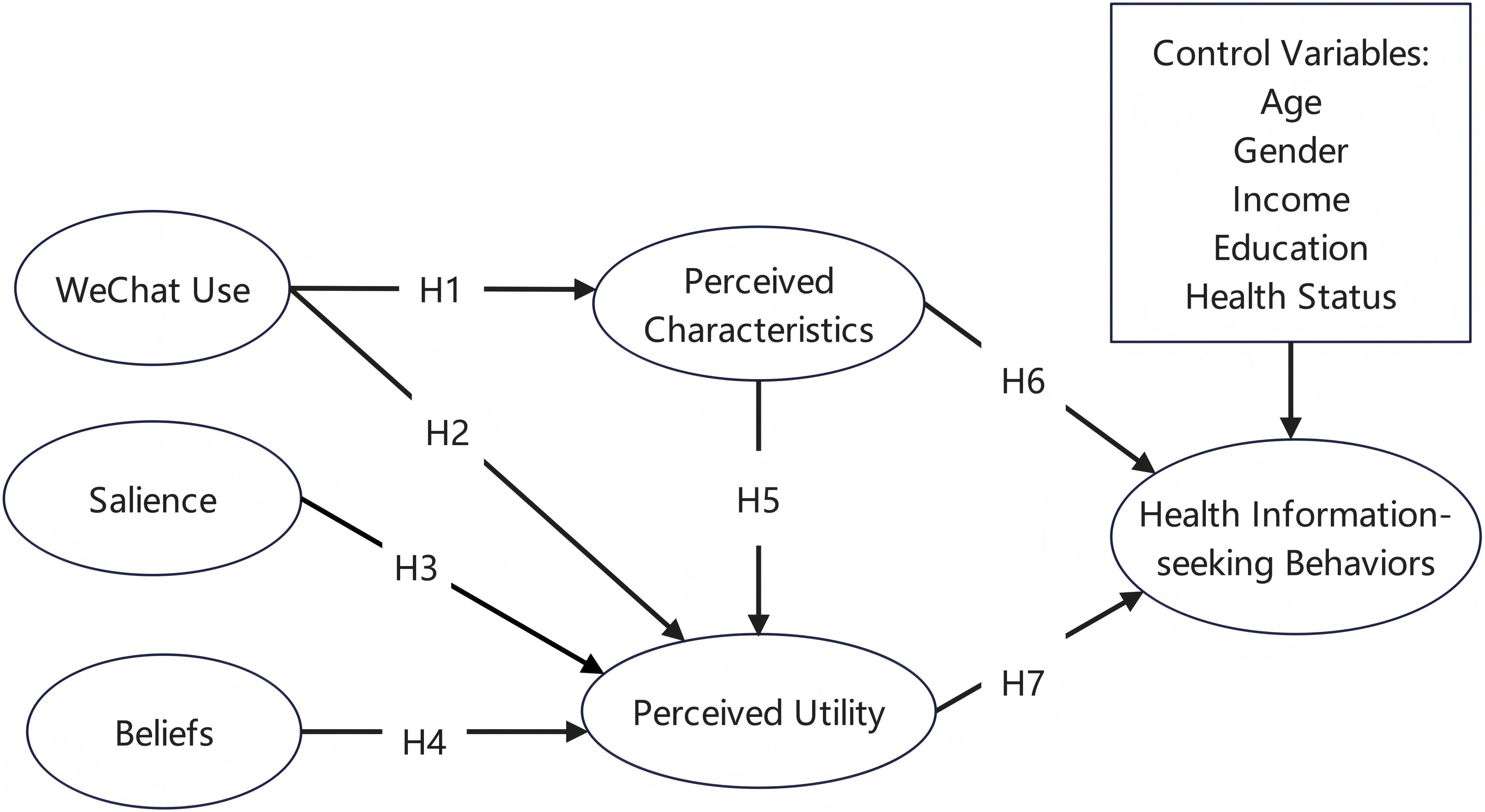
2. Method
2.1. Data collection
The data for this study were collected through an online questionnaire platform (https://www.wjx.com/) between May 15 and May 25, 2024. The study population consisted of Chinese young adults aged 18–35 who used WeChat. Participants were recruited using a non-probability, quota-based sampling strategy, with the survey link distributed through WeChat via personal networks, group chats, and contact lists to reach potential respondents within the target age range. Quotas ensured a relatively balanced gender distribution among participants. Upon accessing the survey, respondents first completed a brief eligibility screening based on age and WeChat usage. To ensure data quality, each IP address was allowed to submit the questionnaire only once, and incomplete or invalid responses were automatically excluded by the survey platform.
At the beginning of the questionnaire, all respondents were provided with an electronic informed consent statement outlining the study’s purpose, the voluntary and anonymous nature of participation, and their right to withdraw at any time. Participation required clicking “Agree”; those who did not consent were not allowed to continue. Data collection was entirely anonymous, and no personally identifiable information, such as names or ID numbers, was recorded. The procedure for obtaining electronic informed consent, along with the overall study protocol, was reviewed and approved by the Institutional Ethics Committee of the corresponding author’s institution.
2.2. Measures
The questionnaire comprised seven sections: demographic information, WeChat use, salience, beliefs, perceived characteristics, perceived utility, and health information-seeking behaviors. All variables were adapted from previous empirical studies to fit the context of this research. A pilot test was conducted with 30 participants, confirming that the items were clear and reliable, with satisfactory internal consistency (Cronbach’s α > 0.8).
These variables were measured using a 6-point Likert scale. The WeChat use scale was adopted from Wen et al. and included three items assessing (1) the number of WeChat friends (e.g., less than 100, more than 500); (2) daily time spent on WeChat (e.g., no time at all, almost online all the day); and (3) duration of WeChat account ownership (e.g., Less than 12 months, 5 years or more). 42 (Mean = 4.687, SD = 0.920, α = 0.894). Salience was measured using three items. A sample item is: “I believe that I am likely to be diagnosed with an illness at some point in my life.” 13 (Mean = 4.660, SD = 0.960, α = 0.887, 1 = Strongly Disagree to 6 = Strongly Agree). Beliefs was assessed with four items. A sample item is: “There’s not much you can do to lower your chances of getting sick.” 23 (Reverse-coded, Mean = 5.201, SD = 0.666, α = 0.9, 1 = Strongly Disagree to 6 = Strongly Agree). Perceived characteristics was assessed with four items. A sample item is: “I trust WeChat contents for the provision of health information and health management.” 23 (Mean = 3.386, SD = 0.959, α = 0.917, 1 = Strongly Disagree to 6 = Strongly Agree). Perceived utility was measured by asking respondents to evaluate whether WeChat contents for the provision of health information and health management: (1) improve their life; (2) are useful; and (3) help with health issues. 34 (Mean = 3.975, SD = 0.956, α = 0.916, 1 = Strongly Disagree to 6 = Strongly Agree). Health information-seeking behaviors were measured using items adopted from Zhang et al. 6 A sample item is: “I use WeChat to get information and description of various diseases diagnosis, and treatment.” (Mean = 2.092, SD = 0.908, α =0.948, 1 = Never to 6 = Very Often). The demographics included six questions on respondents’ age, gender, average monthly income, education, and health status, which were used as control variables in the data analysis.
2.3. Analytical strategies
To examine and validate the proposed model, covariance-based structural equation modeling (CB-SEM) was conducted using AMOS. This approach was chosen for its suitability in estimating complex relationships among latent constructs. Gender, age, education, income, and health status were included as control variables to minimize confounding, and mediation effects were tested with the PROCESS macro after SEM analysis.
3. Results
A total of 890 valid responses were collected. Among the respondents, 405 were male and 485 were female, with an average age of 21.8 years. The majority had an educational background at the undergraduate or junior college level (n = 847, 95.2%). Most respondents reported a monthly income between 3,000 and 5,000 RMB (n = 688, 77.3%). Regarding self-reported health status, the majority reported their health as either “good” (n = 435, 48.9%) or “sub-healthy” (n = 317, 35.6%).
Mean, SD, and convergent validity (N = 890).
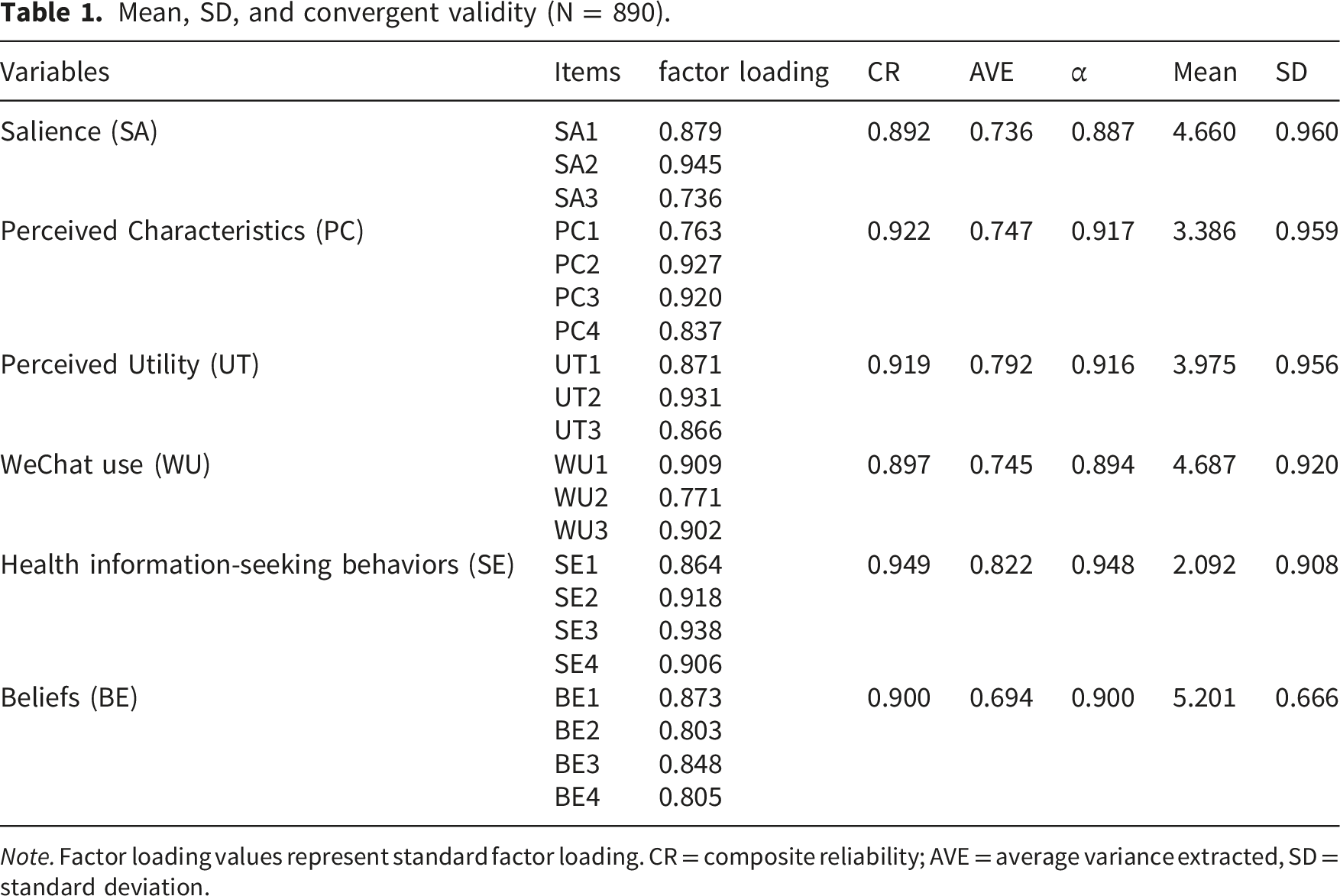
Note. Factor loading values represent standard factor loading. CR = composite reliability; AVE = average variance extracted, SD = standard deviation.
Discriminant validity (N = 890).
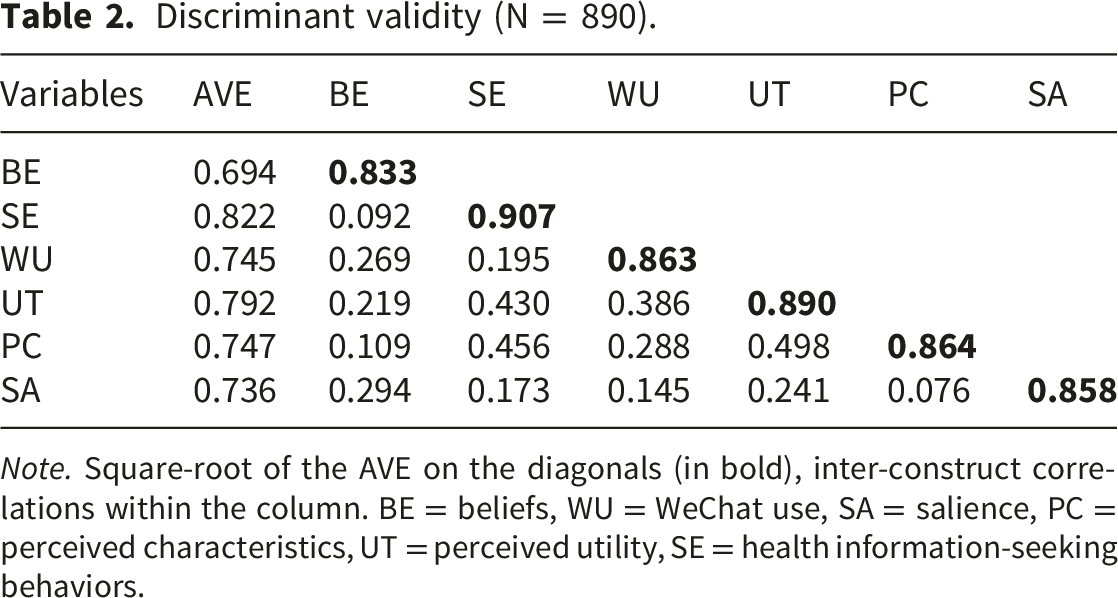
Note. Square-root of the AVE on the diagonals (in bold), inter-construct correlations within the column. BE = beliefs, WU = WeChat use, SA = salience, PC = perceived characteristics, UT = perceived utility, SE = health information-seeking behaviors.
Statistical findings of structural model (N = 890).
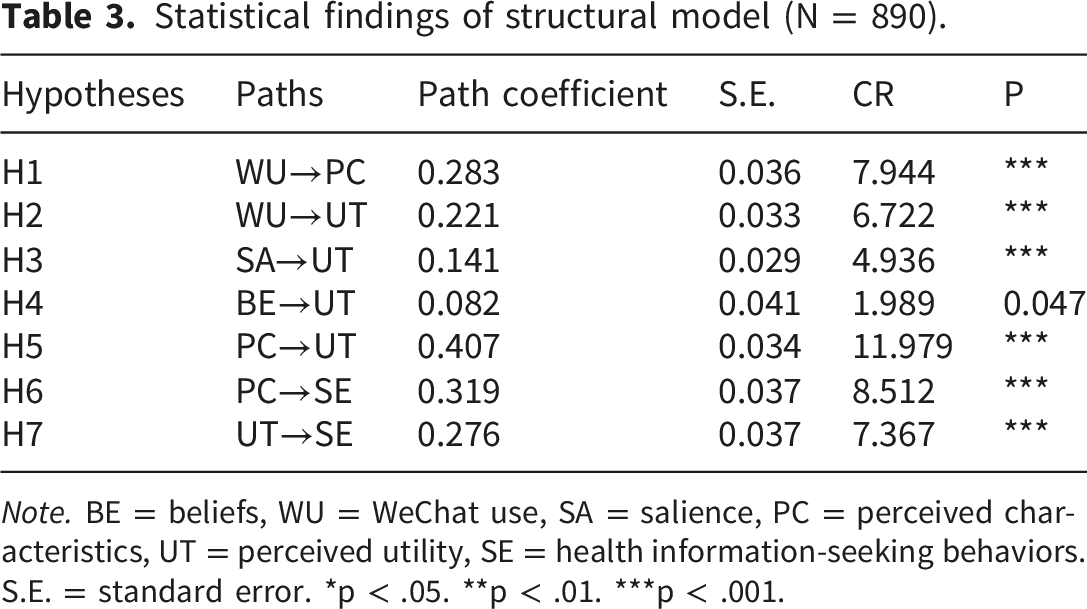
Note. BE = beliefs, WU = WeChat use, SA = salience, PC = perceived characteristics, UT = perceived utility, SE = health information-seeking behaviors. S.E. = standard error. *p < .05. **p < .01. ***p < .001.
Mediating effects (N = 890).
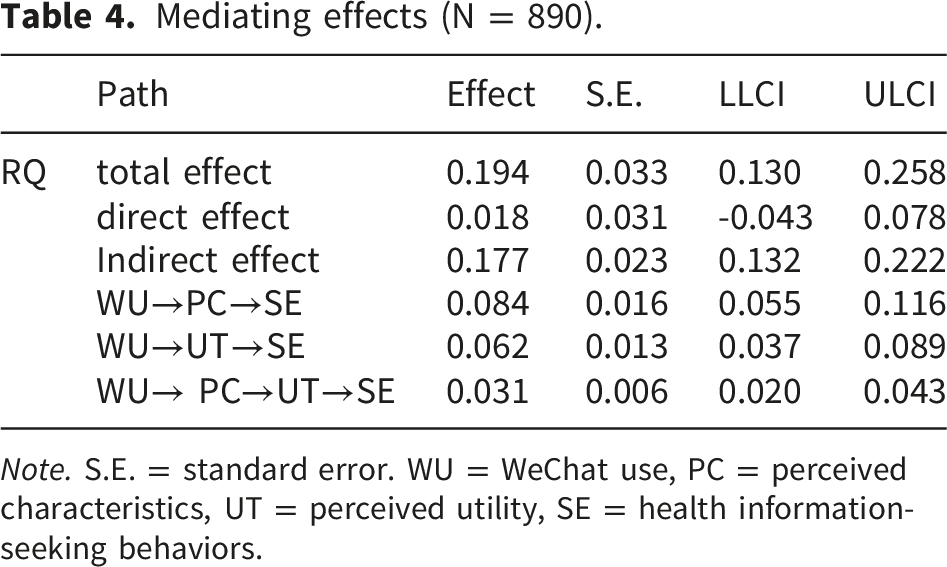
Note. S.E. = standard error. WU = WeChat use, PC = perceived characteristics, UT = perceived utility, SE = health information-seeking behaviors.
4. Discussion
This study applied the CMIS to examine health information-seeking behaviors on WeChat among Chinese young adults, focusing on the perceptual mechanisms linking WeChat use to information-seeking behavior. The results fully supported the hypothesized direct effects of WeChat use, salience, beliefs, and perceived characteristics on perceived utility. Moreover, both perceived characteristics and perceived utility were found to be directly associated with information-seeking behaviors. These findings are consistent with previous studies in contexts such as COVID-19, chronic illness, and smoking cessation, where heightened salience and beliefs increase perceived characteristics and utility of health information, thereby motivating information seeking.13,35,43
Notably, WeChat use showed a stronger positive association with the perceived utility of health information on WeChat than either salience or beliefs. This highlights a shift in the dynamics of health information processing: rather than relying primarily on individual-level cognitive assessments, such as perceived susceptibility and severity (salience) or perceived benefits and barriers (beliefs), young adults increasingly evaluate the utility of health information based on their patterns of platform use. In other words, users’ WeChat usage, as reflected by their number of friends, daily usage time, and account duration, plays a more significant role in shaping how useful they perceive health information obtained on the platform to be. This may be attributed to the immersive and multifunctional nature of WeChat, which integrates social interaction, news dissemination, service booking, payment, and entertainment into a single digital ecosystem. Such integration fosters habitual use and platform familiarity, which, in turn, cultivates users’ perceptions of the credibility, clarity, and accuracy of health information on the platform, which is positively associated with its perceived utility. 44 As users become more accustomed to navigating WeChat’s interfaces, they may develop implicit expectations that the health information obtained through the platform is reliable, convenient, and tailored to their needs, and this may relate to higher levels of perceived utility.
This finding aligns with media system dependency theory, which posits that the more individuals rely on a medium to fulfill their informational, social, and functional needs, the greater role that medium plays in their attitudes, cognition, and behaviors. 45 From a CMIS perspective, these findings suggest that platform engagement can function as a contextual antecedent that reshapes how traditional cognitive variables operate in contemporary digital environments.
More importantly, this study identified multiple mediating effects of perceived characteristics and perceived utility of health information on WeChat between WeChat use and health information-seeking behaviors. The identification of parallel mediation effects suggests that perceived characteristics and perceived utility represent two distinct cognitive pathways through which WeChat use is associated with health information-seeking behaviors. Specifically, users may engage in information seeking either because they perceive the information as credible and clear (characteristics pathway), or because they perceive it as useful and relevant (utility pathway). This distinction highlights that information quality and perceived usefulness operate as complementary but independent mechanisms.
Perceived characteristics of health information on WeChat mediated the relationship between WeChat use and health information-seeking behavior, consistent with the findings by Basynat et al. 25 Frequent use of WeChat for diverse activities, such as messaging, booking services, gaming, shopping, and accessing official resources, is positively associated with users’ perceptions of credibility, clarity, and trustworthiness of health information on the platform, which in turn is positively associated with users’ willingness to seek health information via WeChat. 46 On the one hand, individuals tend to seek information on platforms they trust. 47 If users distrust WeChat, they are unlikely to use it to acquire information. WeChat use reinforces trust. 48 On the other hand, sustained media use increases users’ confidence in the reliability of information content, which reinforces their likelihood of using that platform for a variety of needs, including health-related ones. 49
Perceived utility of health information on WeChat also mediated the relationship between WeChat use and health information-seeking behaviors, aligning with previous studies.25–27 Users unfamiliar with mobile-based social platforms may initially view them as unhelpful or difficult. However, consistent use of WeChat is positively associated with users’ familiarity, both in terms of navigating the interface and prior informational experiences. 50 This familiarity is positively associated with more targeted searches and more effective content evaluation, which in turn relates to the perceived usefulness of health information. 25 In other words, positive experiences with WeChat are positively associated with stronger perceptions of the usefulness of the health information it provides, which in turn relates to continued health-related information seeking.34,51
The sequential mediation pathway provides further insight into the cognitive processing mechanism underlying health information seeking. It suggests a hierarchical evaluation process in which users first form judgments about the characteristics of health information (e.g., credibility and clarity), which then shape their perceptions of its utility.26,52 Only after evaluating information as both credible and useful do users become more likely to actively seek it. This finding extends CMIS by demonstrating that information carrier factors may not operate independently but can function in a structured, stepwise manner.
Overall, these findings indicate that the relationship between platform use and health information-seeking behaviors is fully mediated by cognitive evaluations, underscoring the central role of perceptual mechanisms within the CMIS framework in digital media environments.
5. Limitations
Several limitations should be acknowledged. First, the cross-sectional design limits causal inference among WeChat use, perceived characteristics and utility, and health information-seeking behaviors. Although the model specifies directional relationships, reverse or reciprocal effects cannot be excluded, as information seeking may also shape users’ perceptions over time. Specifically, mediation results should be interpreted with caution, as cross-sectional data do not allow verification of the assumed temporal ordering (WeChat use → perceptions → information seeking), and alternative explanations remain possible. Longitudinal studies are needed to confirm these pathways. Second, the measurement of WeChat use (network size, usage time, and account duration) captures overall engagement but does not distinguish between passive and active use or platform-specific functions, which may have different implications for perceived utility and behavior. Finally, the sample was limited to Chinese young adults aged 18–35, which may restrict generalizability to other age groups and contexts.
6. Study’s implications
Despite these limitations, this study offers several important theoretical and practical implications, particularly within the field of health informatics. Theoretically, this study extends the application of CMIS by adapting it to the WeChat context in China and focusing on health information-seeking behaviors among young adults. By integrating WeChat use into CMIS, the study provides empirical evidence for a modified CMIS model in a social media environment. In particular, the study demonstrates that WeChat use has a greater effect on perceived utility than individual beliefs or salience, indicating a shift in the relative importance of predictors when digital media becomes the primary source of health information. This contributes to the theoretical refinement of CMIS by emphasizing technological and channel-specific determinants of health information processing, thus bridging behavioral theories with emerging trends in health informatics and digital communication.
From a practical standpoint, the findings provide actionable insights for designing digital health communication interventions tailored to the behavioral patterns of young adult users in China. As WeChat use strongly predicts perceived characteristics and utility, and subsequent information-seeking behavior, public health professionals and health informatics practitioners should leverage the affordances of social media to facilitate the dissemination and uptake of reliable health information. Strategies may include enhancing the credibility, clarity, and personalization of content through verified official accounts, interactive designs, and AI-driven content recommendations. Moreover, integrating peer-to-peer sharing mechanisms and fostering social endorsement within users’ WeChat networks can help increase message trustworthiness and encourage proactive health information seeking. These implications align with a growing recognition in health informatics that digital ecosystems must be user-centered, trust-enhancing, and socially embedded to effectively influence health-related decision-making and behaviors.
7. Conclusion
This study employed a modified CMIS to examine the predictors and underlying mechanisms of health information-seeking behaviors on WeChat among Chinese young adults. The findings confirmed that both psychological antecedents (i.e., salience and beliefs) and WeChat use significantly impact perceived utility, which in turn predicts information-seeking behavior. Notably, WeChat use emerged as a particularly strong predictor of perceived utility, surpassing traditional cognitive variables, thereby highlighting the platform-specific dynamics shaping digital health information processing. Furthermore, mediation analyses revealed both parallel and serial indirect pathways, demonstrating that perceived characteristics and utility function as critical mediators linking WeChat use to health information-seeking behaviors. These results validate the applicability of the CMIS framework within a digitally mediated, multifunctional social media environment, and underscore the evolving nature of information-seeking behaviors in the era of mobile health communication. Taken together, this study extends theoretical understandings of health information behaviors by integrating technology-driven variables into an established behavioral model. It also offers actionable insights for health informatics practitioners and public health communicators: leveraging platform use, optimizing content utility, and aligning health communication strategies with users’ everyday social media habits can significantly improve the reach and effectiveness of digital health initiatives among younger populations in China and beyond.
Footnotes
Acknowledgement
We thank all those who participated in the survey.

Ethical considerations
Ethical approval was obtained from the Ethics Committee for Research Involving Human Subjects at Universiti Putra Malaysia.
Consent to participate
Informed consent was obtained from each respondent.
Consent for publication
All the authors approved the final version of the manuscript.
Funding
The authors received no financial support for the research, authorship, and/or publication of this article.
Declaration of conflicting interests
The authors declared no potential conflicts of interest with respect to the research, authorship, and/or publication of this article.
Data Availability Statement
The data that support the findings of this study are available from the corresponding author upon reasonable request.
Contributorship
QianYing Ma: conceptualized and designed the study, analyzed the data, drafted the manuscript.
Jen-Sern Tham: conceptualized and designed the study, revised and supervise the manuscript.