







Abstract
In this study, we investigate the stochastic Kakutani-Matsuuchi model (SKMM) with multiplicative noise in the Itô sense, which describes the propagation of internal gravity waves in stratified fluids such as the Earth’s atmosphere and ocean. These waves, generated by density or temperature variations, play a fundamental role in transferring energy and momentum across the system. The multiplicative noise term accounts for random fluctuations whose intensity depends on wave amplitude, thereby providing a realistic description of noise-wave interactions in geophysical environments, while the Itô framework ensures a rigorous mathematical treatment of such randomness and its cumulative effect on system evolution. By applying the Sub-ODE method, we derive a broad spectrum of exact analytical solutions, including bright soliton, periodic wave, rational-type, hyperbolic-type, and singular structures. Their geometrical characteristics are explored through 3D graphical representations obtained under different values of the random noise parameter, which reveal distinctive behaviors such as localization, periodic modulation, algebraic decay, and blow-up dynamics. These findings deepen the understanding of nonlinear wave phenomena governed by the SKMM and demonstrate the versatility of the Sub-ODE approach in capturing the impact of stochastic influences. The results are expected to provide a valuable reference for modeling wave propagation in oceanic and atmospheric systems where stochastic effects cannot be ignored.
1. Highlights
- Studying and Exploring of stochastic Kakutani-Matsuuchi model under multi plicative Itô noise. - Computational simulations and generation of grey and straddled soliton pulses. - Lie symmetries, self adjointness and conservation laws are considered. - The analytical and computational methods are applied. - Stability with applications of machine learning tools.
2. Introduction
Nonlinear partial differential equations (NLPDEs) serve as a fundamental framework for describing a wide range of phenomena in fluid dynamics, plasma physics, nonlinear optics, solid-state physics, and related disciplines.1–3 Unlike linear equations, they capture nonlinear interactions among system variables, which can generate complex behaviors such as shock waves, modulation instability, dispersion-nonlinearity balance, and wave breaking. Prominent examples of NLPDEs include the Korteweg-de Vries (KdV) equation, the sine-Gordon equation, and the nonlinear Schrödinger equation (NLSE), each of which has played a significant role in advancing the understanding of nonlinear wave processes.4–6 The KdV equation, originally derived to describe shallow water waves, exhibits complete integrability and supports solitary wave solutions that maintain their shape and speed over long distances. The sine-Gordon equation appears in contexts such as the dynamics of Josephson junctions, the propagation of fluxons in superconductors, and the description of certain relativistic field theories; its soliton solutions are topological in nature, often manifesting as kink and antikink structures.7,8 The NLS equation models the evolution of slowly varying wave packets in weakly nonlinear dispersive media, with applications ranging from optical fiber communications to Bose–Einstein condensates; it admits both bright and dark solitons depending on the sign of the dispersion and nonlinearity coefficients.9,10 Such model equations highlight the broad applicability of soliton theory and demonstrate its significance across a wide range of physical systems.11,12
Solitons are stable, localized wave structures that emerge from the delicate balance between nonlinear and dispersive effects in an NLPDE. Since John Scott Russell’s 19th-century observation in shallow water, they have been regarded as fundamental nonlinear excitations with exceptional stability. In integrable equations such as the KdV, sine-Gordon, and NLSE, solitons collide elastically, maintaining their velocity and shape-an attribute uncommon among other nonlinear waves. Investigating soliton solutions offers valuable understanding of energy transport, long-distance coherence, and nonlinear stability within complex systems. Moreover, solitons are not limited to theoretical constructs; they have been experimentally identified in water channels, optical fibers, plasma, magnetic spin chains, and even biological environments. Understanding the analytical structure of solitons in different NLPDE frameworks not only deepens the theoretical comprehension of nonlinear dynamics but also enables the development of practical applications in wave control, energy transport, and signal processing.13–15
Over the past decades, numerous analytical approaches have been proposed to obtain exact and approximate solutions to NLPDEs. Classical and modern methods include the sine-Gordon expansion method, 16 integral scheme, 17 Ricatti approach, 18 Jacobi elliptic function expansion approach,1 19 (G′/G)-expansion technique, 20 tanh-coth and the Riccati-Bernoulli sub-ODE methods, 21 sine-cosine process, 22 mapping approach, 23 exp(−Ω(ξ))-expansion approach, 24 among others. Each of these methods has been employed to generate different classes of solutions such as bright solitons, dark solitons, kink-type structures, periodic waves, rational solutions, and breather-type excitations. Analytical solutions of PDEs provide deep insights into the nonlinear behavior of complex systems, enabling researchers to identify suitable strategies for their manipulation, optimization, and control. The selection of a particular method typically relies on the equation’s structure, the form of nonlinearity involved, and the specific type of solution being targeted.25–27
In practical situations, many systems are exposed to random disturbances that can strongly affect their dynamics. Such stochastic influences commonly arise from thermal fluctuations, environmental variability, turbulent forcing, or uncertainties in system parameters. Among them, multiplicative noise plays a particularly significant role, since its amplitude explicitly depends on the state variables of the system. This type of noise is often more realistic than additive noise in physical models, as it captures cases where stronger waves or higher field intensities undergo greater fluctuations. Its mathematical treatment frequently relies on the Itô interpretation, a central concept in stochastic calculus that provides a rigorous framework for analyzing stochastic differential equations (SDEs) with state-dependent noise. Within the Itô framework, the stochastic integral is defined in a way that preserves the Markov property and enforces non-anticipative behavior, making it especially well-suited for describing physical systems under random influences. Incorporating multiplicative noise into NLPDEs makes it possible to investigate how randomness alters soliton structures, impacts their stability, and even drives transitions between distinct wave states. This stochastic modeling approach is essential for accurately capturing the behavior of geophysical and oceanic wave systems, optical pulses in noisy fiber environments, and other real-world processes where both nonlinearity and randomness are integral to the dynamics.28–31
SKMM considered in this work extends the classical Kakutani-Matsuuchi equation by incorporating a stochastic term with multiplicative noise in the Itô sense. The deterministic form of the Kakutani–Matsuuchi model describes the propagation of internal gravity waves in a stratified fluid medium, making it highly relevant for geophysical and oceanic applications. By introducing multiplicative noise, the SKMM captures the influence of environmental randomness-such as turbulence, density fluctuations, and external forcing-on the evolution of internal waves. In this formulation, the noise amplitude depends explicitly on the wave field, allowing stronger waves to experience proportionally higher levels of fluctuation, which is physically realistic in many marine and atmospheric scenarios. The Itô stochastic framework ensures a mathematically rigorous treatment of such random perturbations, enabling the analysis of their cumulative effects on wave stability, amplitude modulation, and potential transition to complex or irregular structures. Studying the SKMM thus bridges the gap between idealized deterministic soliton theory and the stochastic nature of real-world wave phenomena, offering insights into how noise can modify, destabilize, or even generate new classes of localized structures.
32

Summary of related literature on soliton and wave solutions for Kakutani–Matsuuchi-type models.
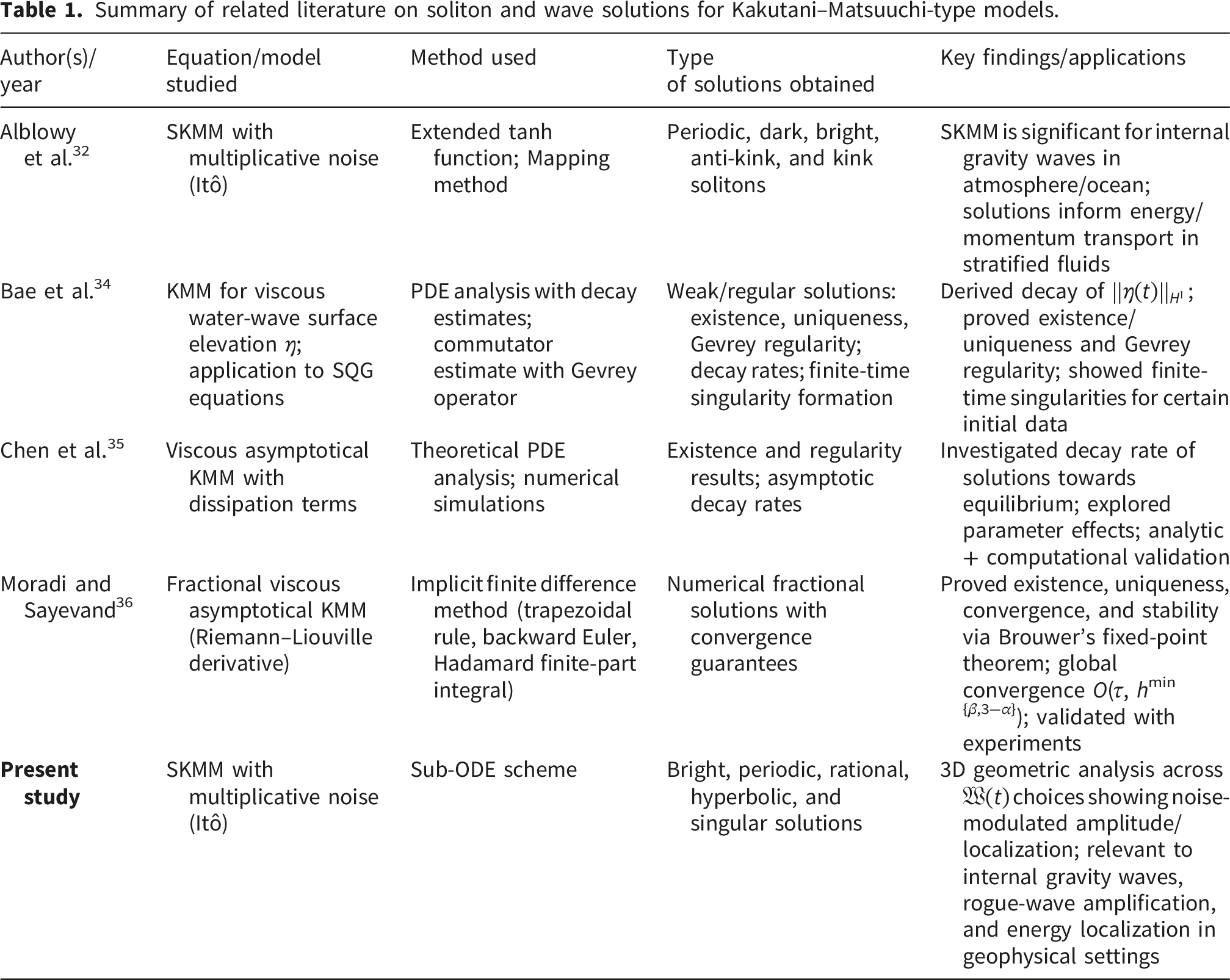
Unlike previous studies that primarily focus on deterministic or fractional formulations, the present work provides a unified analytical framework for stochastic soliton structures under multiplicative Itô noise. The incorporation of expectation-based reduction together with stochastic realizations offers new insights into noise-induced modulation, amplitude variability, and stability of nonlinear wave structures.
It is important to emphasize that the Wiener process 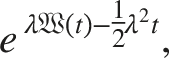



Now by using equation (2) along with equations (3) and (4) into equation (1), we get;
To eliminate the stochastic term, we take expectation on both sides of the equation. Using the well-known property of the Wiener process,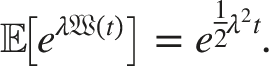
the stochastic exponential term simplifies, leading to a deterministic equation governing the mean behavior of the system.

By integrating equation (7) and assuming the integration constant to be zero, we get;

3. Sub-ODE approach
Using the following transformation.
37



Balancing the terms R
″
and R2 in equation (8), we obtain
Thus, equation (8) admits the formal solution
Substituting equation (13) into equation (8) and comparing the coefficients of different powers of R(u), we obtain the following algebraic equations:

If A = B = E = 0, then equation (12) admits the following wave solutions.
3.1. Bright soliton solution

3.2. Periodic solution

3.3. Rational solution



Solving the above equations gives
Substituting these values into equation (16), we obtain
Using equation (2), the corresponding stochastic solution is
Here, λ denotes the intensity of multiplicative Itô noise.
The periodic solution is obtained by substituting the values of C and D into equation (17):
Substituting equation (23) into equation (2), we obtain the stochastic periodic solution
The rational solution is obtained by substituting the values of C and D into equation (18):
Substituting equation (25) into equation (2), we obtain
If A = B = 0 and C > 0, then equation (13) admits the following hyperbolic function solutions: Substituting equation (29) into equation (2), the stochastic hyperbolic solution becomes Substituting the values of C and D into equation (28), we obtain Substituting equation (31) into equation (2), the corresponding stochastic solution becomes





If A = B = 0 and C < 0, then equation (13) admits the following periodic function solutions: Substituting equation (35) into equation (2), the stochastic periodic solution becomes Substituting the values of C and D into equation (34), we obtain Using equation (37) in equation (2), the corresponding stochastic solution becomes





4. Results and discussion
Figure 1(a) shows a stochastic bright soliton surface with irregular amplitude variations and temporal fluctuations induced by the Wiener process. The Figure 1(b) represents the mean profile, where the averaged solution recovers a smooth bell-shaped structure with reduced noise effects. Figure 1(c) shows multiple stochastic realizations exhibiting diverse amplitude evolutions, indicating strong sensitivity of the soliton to random perturbations. The Figure 1(d) represents the comparison between deterministic and stochastic solutions, where the deterministic profile remains smooth while the stochastic solution displays irregular modulation, although the spatial localization of the soliton is preserved. Bright soliton profiles corresponding to equation (22) under multiplicative Itô noise using a Wiener process realization. Subfigure (a) illustrates the stochastic surface (3D), showing irregular amplitude modulation and temporal fluctuations. Subfigure (b) presents the mean profile, demonstrating recovery of a smooth soliton-like structure under expectation. Subfigure (c) shows multiple stochastic realizations, highlighting variability in amplitude evolution due to random perturbations. Subfigure (d) compares deterministic and stochastic solutions, indicating that noise introduces irregular fluctuations while preserving the localized structure of the soliton. The plots are generated for λ = 0.5, u1 = 1.4, u2 = 0.8, κ = 1.2, and ϑ = 1, over the domain x ∈ [−5, 5] and t ∈ [0, 5].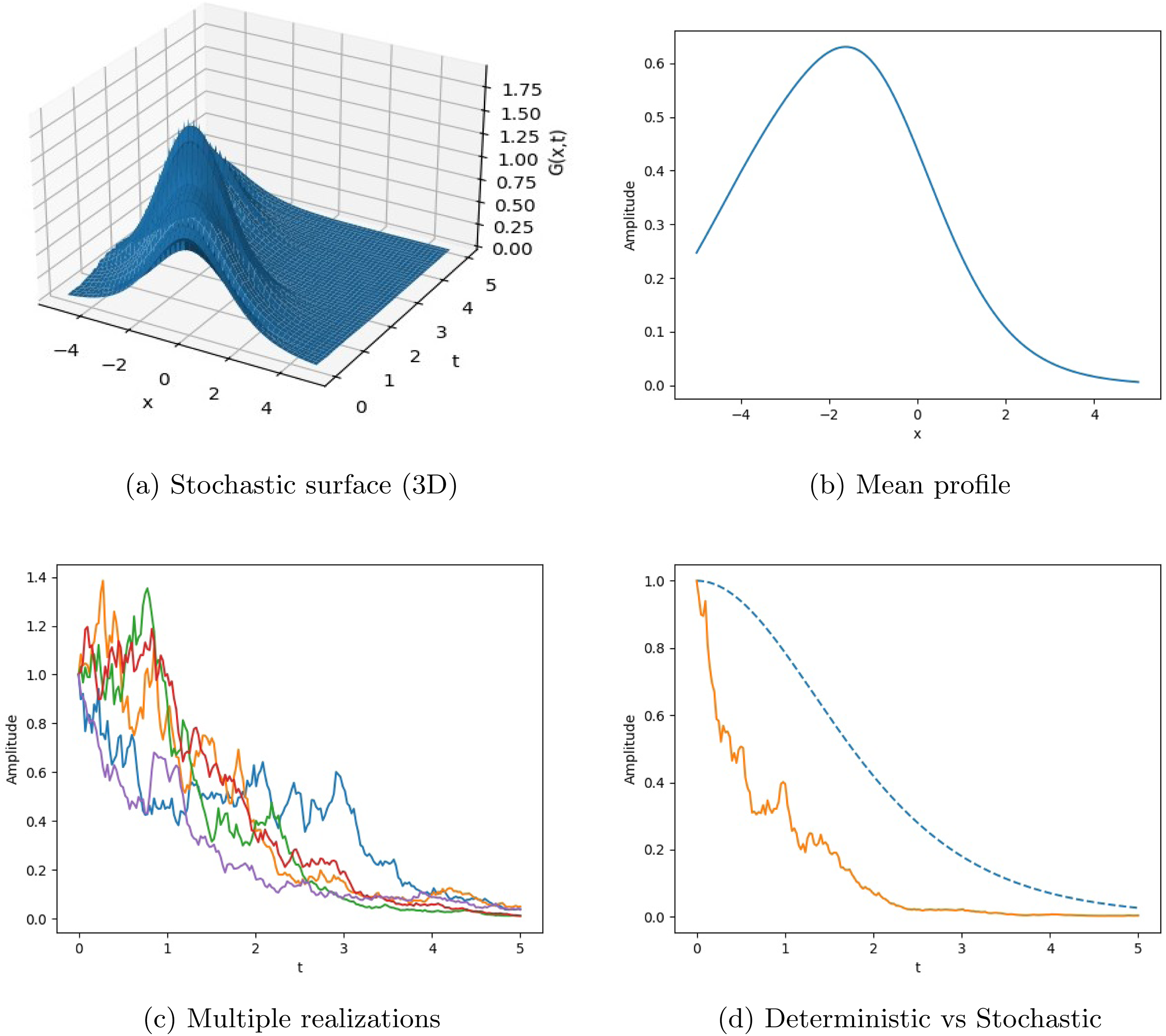
Figure 2(a) shows a stochastic periodic soliton surface where the wave exhibits regular oscillatory structures along the spatial direction, while the amplitude undergoes irregular modulation due to the Wiener process. The periodic crests and troughs are clearly visible; however, their heights vary randomly in time, indicating the influence of multiplicative noise on wave intensity. The Figure 2(b) represents the mean profile, where averaging over stochastic realizations smooths out fluctuations and restores a regular periodic pattern, although slight asymmetry in amplitude distribution remains. Figure 2(c) shows multiple stochastic realizations, demonstrating that each trajectory evolves differently despite identical initial conditions, with noticeable variations in peak amplitudes and phase shifts, confirming the strong sensitivity of periodic waves to random perturbations. Figure 2(d) represents the comparison between deterministic and stochastic solutions, where the deterministic case maintains uniform periodic peaks, while the stochastic solution exhibits irregular oscillations with fluctuating amplitudes; however, the fundamental periodic structure remains preserved, indicating robustness of the wave pattern under stochastic effects. Periodic soliton profiles corresponding to equation (24) under multiplicative Itô noise using a Wiener process realization. The plots are generated for λ = 0.5, u1 = 1.3, u2 = 0.9, κ = 1.1, and ϑ = 0.8, over the domain x ∈ [−10, 10] and t ∈ [0, 5].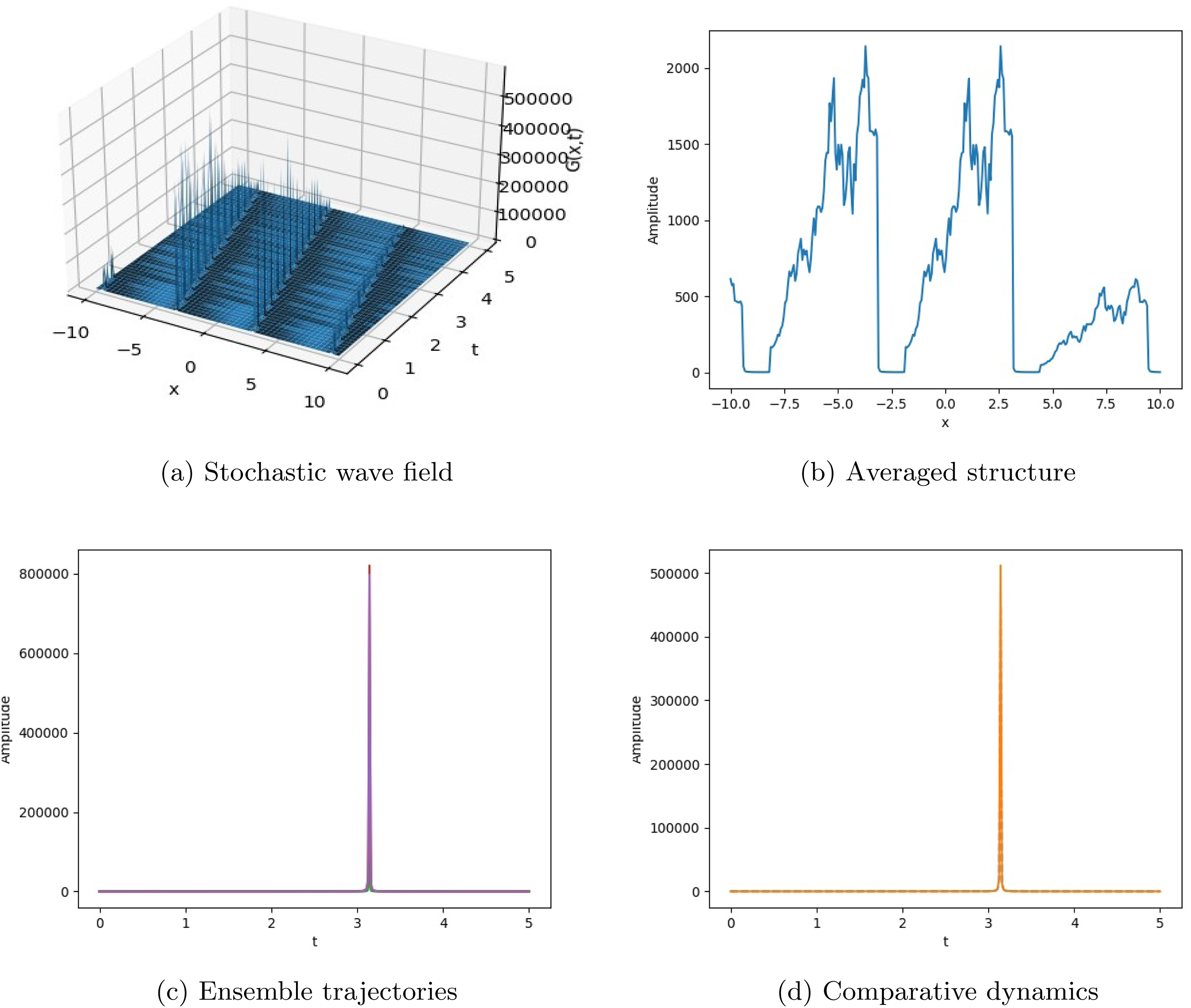
Figure 3(a) shows a stochastic rational wave surface characterized by a localized peak with algebraic decay, where the amplitude exhibits irregular fluctuations due to Wiener perturbations. The central peak remains sharply defined, but its height varies randomly along the temporal direction, indicating strong noise influence near the core region. Figure 3(b) represents the averaged wave profile, where the fluctuations are smoothed out and the solution recovers a symmetric rational structure with gradual decay away from the center. Figure 3(c) shows ensemble realizations displaying significant variability in peak amplitude and decay rate, confirming that rational waves are highly sensitive to stochastic effects, particularly near singular-like regions. Figure 3(d) presents a comparison between deterministic and stochastic behaviors, where the deterministic solution shows a smooth algebraic decay, while the stochastic solution exhibits irregular amplification and attenuation; however, the overall localized nature of the rational wave remains preserved. Rational wave structures corresponding to equation (26) under multiplicative Itô noise using a Wiener process realization. The plots are generated for λ = 0.5, u1 = 1.5, u2 = 0.7, κ = 1.2, and ϑ = 0.9, over the domain x ∈ [−5, 5] and t ∈ [0, 5].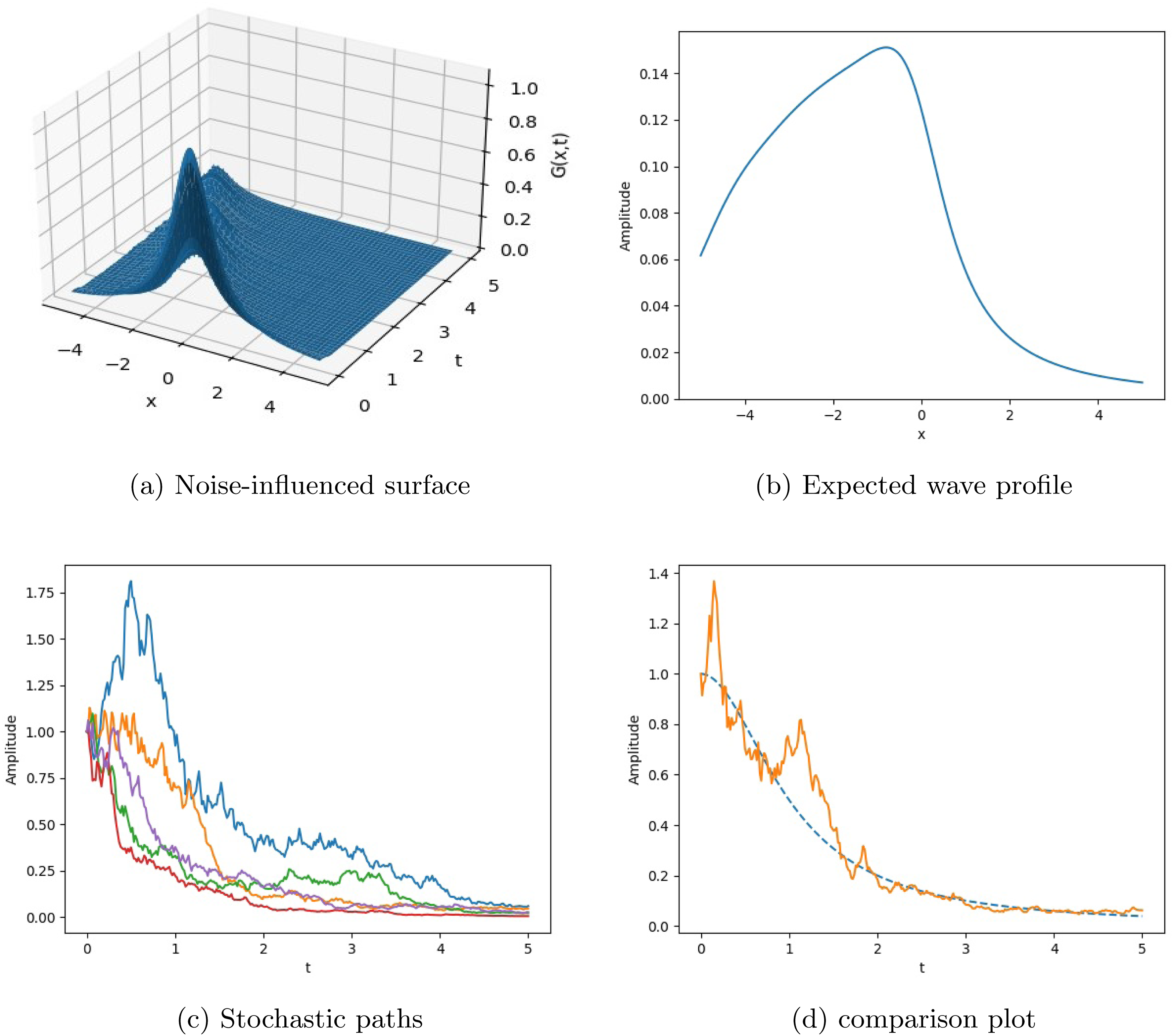
Figure 4(a) shows a stochastic hyperbolic wave surface characterized by a smooth localized crest that decays gradually along the spatial direction, while the amplitude undergoes irregular modulation due to Wiener perturbations. The central region exhibits noticeable fluctuations, indicating the influence of noise on peak stability and propagation behavior. Figure 4(b) represents the averaged wave structure, where stochastic variations are suppressed and the solution recovers a smooth hyperbolic profile with symmetric decay away from the center. Figure 4(c) shows ensemble trajectories illustrating variability in amplitude evolution, where different realizations display distinct growth and decay patterns, confirming the sensitivity of hyperbolic structures to random fluctuations. Figure 4(d) presents a comparison between deterministic and stochastic solutions, where the deterministic profile maintains a smooth and stable shape, while the stochastic counterpart exhibits irregular amplitude modulation; however, the overall localized structure remains preserved, demonstrating robustness of hyperbolic waves under stochastic effects. Hyperbolic wave structures corresponding to equation (30) under multiplicative Itô noise using a Wiener process realization. The plots are generated for λ = 0.5, u1 = 1.7, u2 = 0.85, κ = 1.2, and ϑ = 1.1, over the domain x ∈ [−5, 5] and t ∈ [0, 5].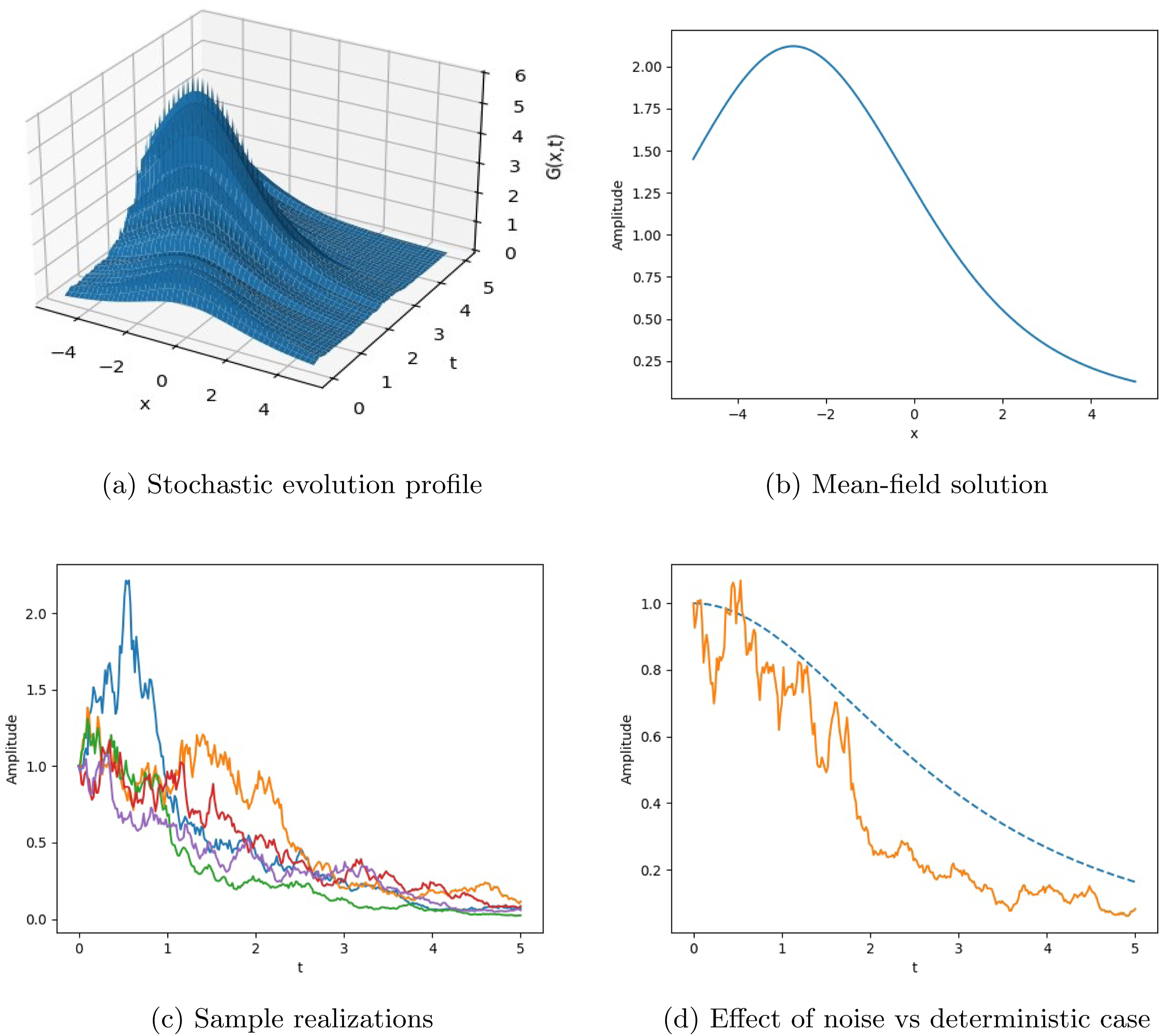
Figure 5(a) shows a stochastic hyperbolic soliton surface featuring highly localized, spike-like peaks, where the amplitude experiences pronounced irregular modulation due to Wiener perturbations. The crest region exhibits intermittent sharp amplifications, indicating strong sensitivity of near-singular structures to stochastic forcing. Figure 5(b) represents the averaged profile, where the extreme fluctuations are smoothed and a coherent localized peak with rapid decay is recovered, although slight skewness persists due to multiplicative noise. Figure 5(c) shows ensemble trajectories with substantial variability in peak height and timing, revealing intermittent bursts and attenuation phases across realizations, which are characteristic of noise-driven amplification near steep gradients. Figure 5(d) presents a deterministic–stochastic comparison between deterministic and stochastic behaviors, where the deterministic solution maintains a smooth, sharply localized profile, while the stochastic counterpart exhibits irregular spikes and amplitude jitter; nevertheless, the overall localization and decay pattern remain intact, demonstrating robustness of the hyperbolic structure under stochastic effects. Hyperbolic soliton profiles corresponding to equation (32) under multiplicative Itô noise using a Wiener process realization. The plots are generated for λ = 0.6, u1 = 1.8, u2 = 0.75, κ = 1.4, and ϑ = 1.2, over the domain x ∈ [−5, 5] and t ∈ [0, 5].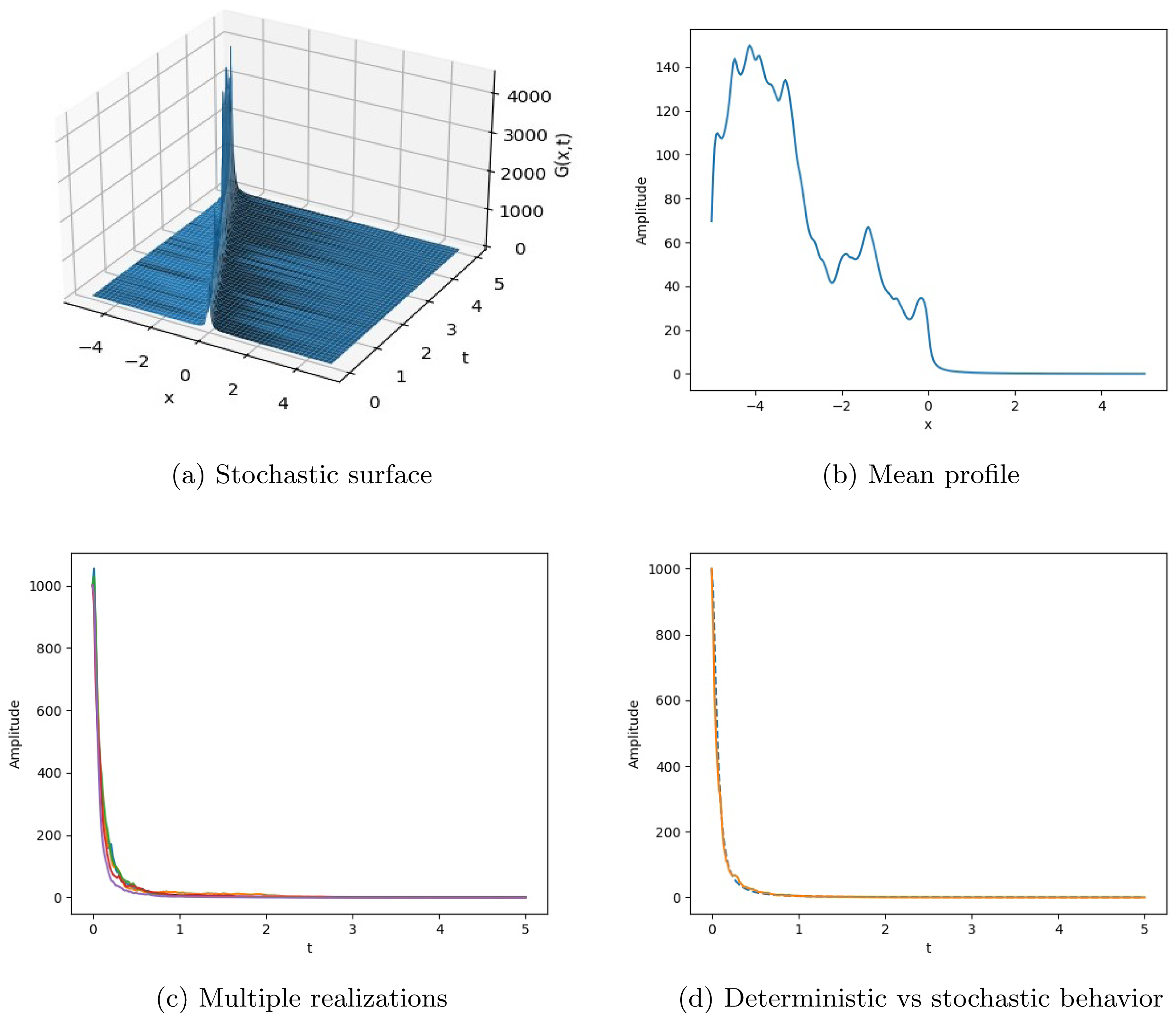
Figure 6(a) shows a stochastic periodic solitary wave surface where a localized peak is modulated by weak oscillatory structures, and the amplitude exhibits irregular variations due to Wiener perturbations. The wave maintains a dominant central crest, while secondary oscillations appear along the spatial direction, reflecting the combined effect of localization and periodic modulation. Figure 6(b) represents the averaged profile, where stochastic fluctuations are smoothed and the solution reveals a regular solitary wave with mild periodic features superimposed on the main peak. Figure 6(c) shows ensemble realizations demonstrating variability in both amplitude and oscillatory behavior, where different trajectories exhibit shifts in peak height and slight phase distortions, indicating sensitivity of periodic solitary waves to random perturbations. Figure 6(d) presents the comparative dynamics between deterministic and stochastic solutions, where the deterministic case maintains a smooth localized structure with regular oscillatory modulation, while the stochastic counterpart shows irregular amplitude fluctuations and distortion of secondary waves; however, the primary localized peak remains preserved, indicating robustness of the periodic solitary structure under stochastic influences. Periodic solitary wave structures corresponding to equation (36) under multiplicative Itö noise using a Wiener process realization. The plots are generated for λ = 0.5, u1 = 1.8, u2 = 1.4, and κ = 1 over the domain x ∈ [−5, 5] and t ∈ [0, 5].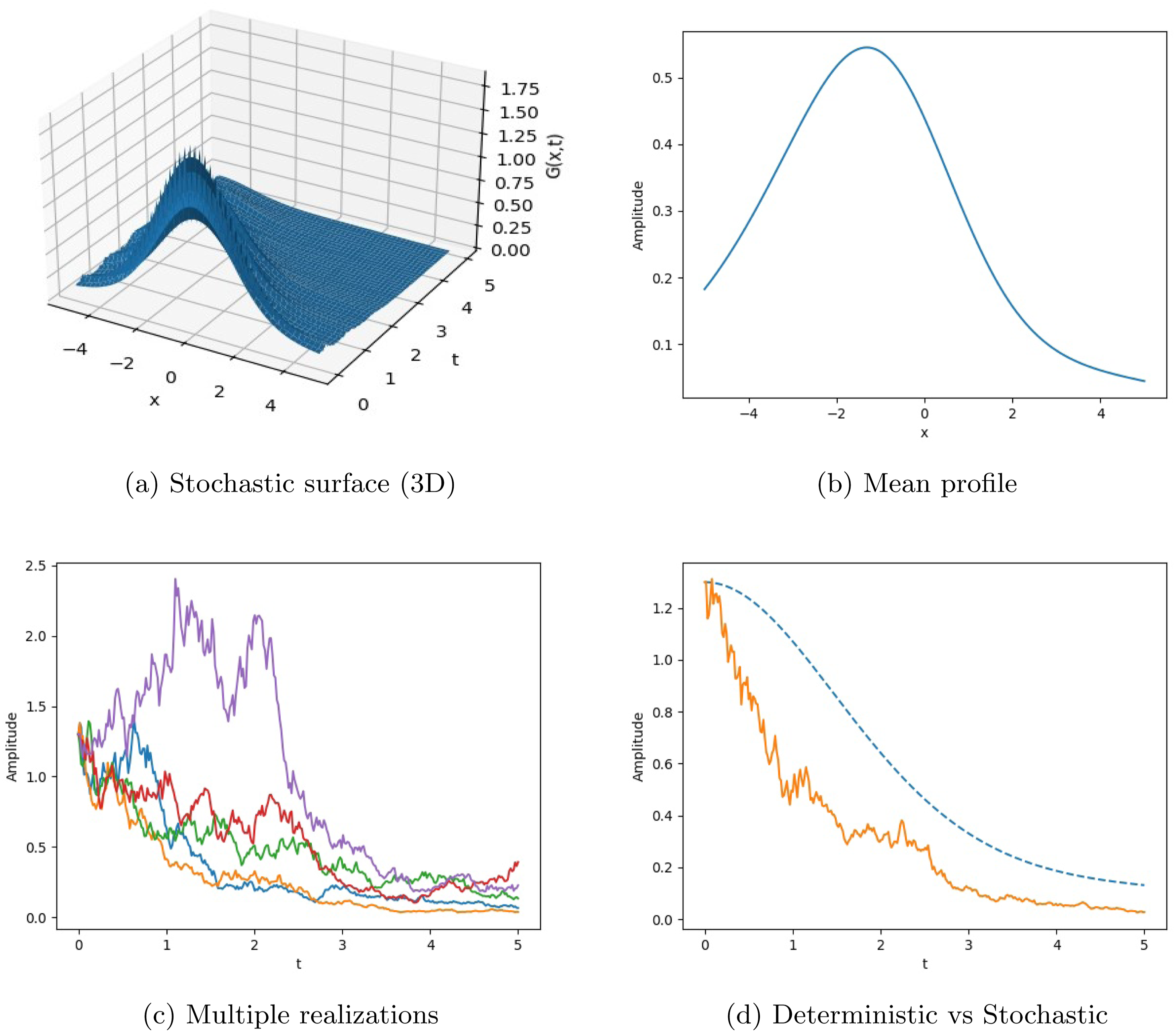
Figure 7(a) shows a stochastic periodic solitary wave surface characterized by a highly localized peak accompanied by oscillatory modulations, where the amplitude exhibits sharp and irregular variations due to Wiener perturbations. The presence of steep gradients near the peak region leads to intermittent spike-like behavior, indicating strong sensitivity of the wave structure to stochastic forcing. Figure 7(b) represents the averaged profile, where the extreme fluctuations are suppressed and a smooth localized structure with weak periodic modulation is recovered, although slight asymmetry remains due to multiplicative noise. Figure 7(c) shows ensemble realizations displaying significant variability in amplitude, with some trajectories exhibiting rapid amplification while others decay smoothly, reflecting the stochastic nature of wave evolution. Figure 7(d) presents a comparative profile between deterministic and stochastic solutions, where the deterministic case maintains a smooth localized wave with regular oscillatory features, while the stochastic solution exhibits irregular spikes and amplitude distortions; however, the overall localized and periodic solitary structure remains preserved, demonstrating robustness under stochastic influences. Periodic solitary wave structures corresponding to equation (38) under multiplicative Itô noise using a Wiener process realization. The plots are generated for λ = 0.7, u1 = 1.6, u2 = 0.9, and κ = 1.3 over the domain x ∈ [−20, 20] and t ∈ [0, 10].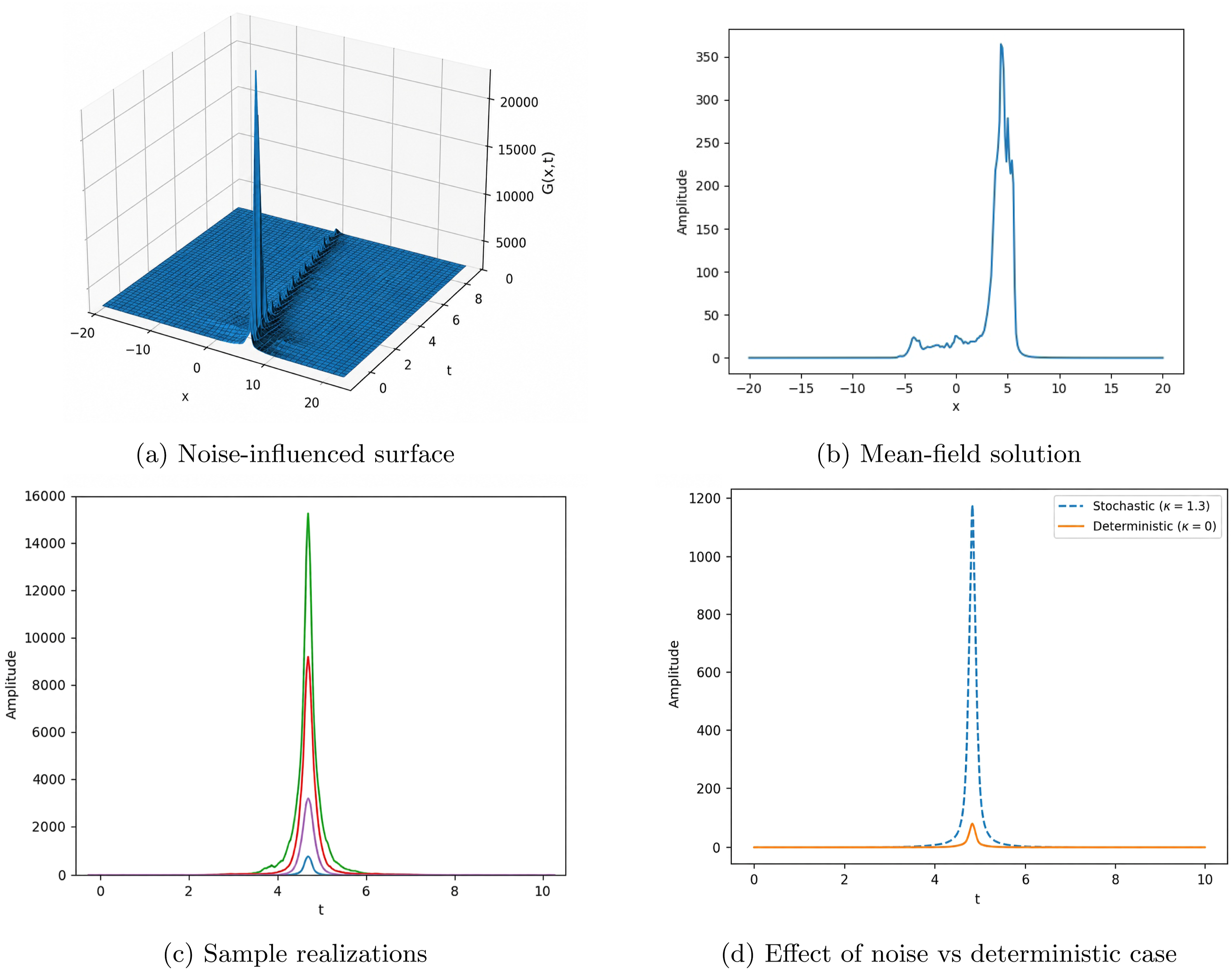
5. Conclusion
In this study, we analyzed the SKMM by multiplicative noise in the Itô sense using the Sub-ODE scheme and obtained diverse soliton solutions, including bright, periodic, rational, hyperbolic, and singular structures. Their geometry was illustrated through 3D profiles under varying realizations of the Wiener process
Footnotes
Ethical considerations
This paper includes no study with human or animal participants conducted by any of the authors. The authors hereby declare that the research work contained in this manuscript is their own and is original.
Funding
The authors disclosed receipt of the following financial support for the research, authorship, and/or publication of this article: This work was supported and funded by the Deanship of Scientific Research at Imam Mohammad Ibn Saud Islamic University (IMSIU) (grant number IMSIU-DDRSP-RP2602).
Declaration of conflicting interests
The authors declared no potential conflicts of interest with respect to the research, authorship, and/or publication of this article.