






Abstract
The present work examines the amplitude modulation and nonlinear propagation of low-frequency dust ion-acoustic waves (DIAWs) in an electronegative complex plasma comprising inertial negative ions, inertialess q-nonextensive electrons, Maxwellian positive ions, and stationary negative dust grains. Using a standard fluid description together with the derivative expansion method (DEM), the governing set of fluid and Poisson equations is reduced to a planar nonlinear Schrödinger equation (NLSE) for the slowly varying DIAW envelope. The resulting dispersion and nonlinearity coefficients, expressed in terms of the nonextensive index, the electron temperature ratio, the negative ion concentration, and the electron concentration, yield precise conditions for modulational instability (MI). It is shown that the MI threshold, the width of the unstable band, and the associated gain are very sensitive to these parameters, which in turn dictate the existence domains of stable and unstable modulated structures. In the modulationally unstable regime, the plasma supports bright envelope solitons, breather-type excitations, and rogue waves, whereas in the modulationally stable regime, gray and black envelope solitons propagate. The influence of various related physical parameters on the carrier frequency and group velocity, on the MI domains, and on the profiles of bright and dark solitons, breathers, and rogue waves is numerically investigated. The results provide physically transparent insight into energy localization and extreme-amplitude events in space and laboratory electronegative dusty plasmas with superthermal electron populations.
Keywords
1. Introduction
Owing to the diverse applications of dusty plasmas in laboratories and space, it has become a field of great interest among researchers.1–7 The study of dusty plasma is crucial to comprehending many phenomena and mechanisms of processes related to plasma waves, including diagnosis,8–10 communication,11,12 plasma parameter measurement, 13 and wave heating, 14 etc. The diverse acoustic modes that are dependent upon their temporal scale propagate in dusty plasmas,15–18 including dust ion-acoustic waves (DIAWs) and dust-acoustic waves (DAWs).19,20 For DAWs, the restoring force originates from the pressure of lighter plasma species such as electrons and ions, while the inertia needed for wave motion is mainly associated with the massive dust grains. These waves travel in a low-frequency range, with phase velocities that are lower than the ion acoustic speed. In the case of DIAWs, electron pressure serves as a restoring force, while the inertia sustaining wave motion arises from both ions and dust particles.
The negatively charged dust grains are assumed to be stationary owing to their comparatively large mass relative to ions. In the DIAWs regime, the characteristic wave frequency is typically much higher than the dust response frequency; hence, dust grains are unable to follow the rapid ion motion and effectively behave as an immobile charged background that preserves charge neutrality, as commonly adopted in earlier DIAWs studies.3,20,21 However, when the wave frequency approaches the dust plasma frequency or in very low-frequency regimes, dust dynamics may become important.
In many space and astrophysical environments, the particle populations depart from Maxwellian equilibrium and exhibit pronounced superthermal tails. A convenient and widely used way to model such nonequilibrium states is to adopt the non-extensive q-distribution, which has been used to describe plasma species in the Earth’s ionosphere and in the interstellar medium,17,22 as well as in asteroid-belt plasmas.23,24 In this description, the parameter q quantifies the degree of deviation from standard Boltzmann-Gibbs statistics: for q > 1 the distribution is super-extensive, reflecting an enhanced high-energy tail, whereas for q < 1 the distribution is sub-extensive. Several works have demonstrated that such non-extensive features can substantially alter the propagation and nonlinear characteristics of DIAWs and DAWs in dusty plasmas. Sahoo et al. 25 performed both analytical and numerical investigations to examine the nonlinear behavior of DAWs in a magnetized dusty plasma system influenced by q-nonextensive hot electrons and trapped ions. Using the reductive perturbation method, they derived a KdV-type equation, showing that q-nonextensive electrons, ion trapping, magnetic field intensity, and wave propagation angle significantly alter the properties of dust acoustic solitary waves. Roychowdhury et al. 26 analyzed DIAWs in quantum plasma, finding that relativistic effects strongly impact both the dispersive (linear) and nonlinear dynamics of DIAWs. Tamanna et al. 27 investigated DIAWs in a dusty plasma with q-distributed electrons, showing that non-extensive index q plays critical role in determining the formation conditions for dust ion-acoustic (DIA) rogue waves (RWs). Li et al. 28 examined DIAWs in a multi-component dusty plasma with inertialess ions and nonextensive electrons, and found that the formation of compressive or rarefactive solitary waves is controlled by the characteristic plasma variables. Doley and Das 29 considered DIAWs in a dusty plasma with negatively charged dust grains, positive ions, and q-distributed electrons under different pressure conditions, and reported that increasing q leads to solitary structures with enhanced amplitude and width.
Another important feature of many laboratory and space plasmas is the presence of negative ions, which gives rise to electronegative compositions. In electronegative dusty plasmas, negative ions exist alongside positive ions, electrons, and charged dust grains, which modifies the associated charge-neutrality condition. The presence of this additional ion component influences the screening length, effective inertia, and restoring forces related to low-frequency electrostatic modes. Consequently, both the dispersion properties and the nonlinear response of DIAWs are likely to become sensitive to the density of negative ions. Previous studies have shown that electronegative ions can significantly alter the structure and stability of linear and nonlinear electrostatic waves, and may play a critical role in cometary environments and in electronegative discharges relevant to plasma processing. In the present context, the combined action of q-distributed electrons and electronegative ions represents a physically relevant but nontrivial setting for the study of DIA modulated structures.
Nonlinear waves propagating in a nonlinear medium often exhibit amplitude modulation due to their self-interaction and dispersive spreading. 30 This slow modulation can be systematically treated using multiple space- and time-scale techniques,31,32 which separate the rapid carrier oscillations from the slowly varying envelope. Within this perturbative framework, two standard evolution equations emerge, namely the Korteweg-de Vries (KdV)-type equations (including Gardner, modified KdV, and Schamel-KdV) and the nonlinear Schrödinger equation (NLSE). KdV-type equations describe unipolar unmodulated solitary pulses with monotonic profiles and no rapid internal oscillations.33,34 In contrast, the NLSE governs slowly modulated, quasi-monochromatic wave packets, and its stationary envelope solutions describe localized envelope excitations that modulate the fast electrostatic carrier wave. In the DIAWs case, these envelope structures control the spatial modulation of the electrostatic potential and provide a natural description of localized intensity patterns superposed on a carrier.
When the balance between dispersion and nonlinearity is such that the envelope forms a localized hump on a vanishing or small background, the NLSE supports bright-type envelope solitons. These structures can be interpreted as localized enhancements of the wave amplitude, traveling with the group velocity of the carrier. On the other hand, if the envelope appears as a localized depression on a finite-amplitude background, the NLSE admits dark-type envelope solitons, in which the intensity drops below the background level over a localized region. Dark envelope solitons are commonly categorized as black or gray, depending on whether the amplitude (or electrostatic potential) vanishes at the center of the structure (black soliton) or retains a finite value (gray soliton). 35 In dusty electronegative plasmas, both bright and dark envelope structures are of interest, since they are associated with localized enhancements or depletions of the electrostatic field and can influence transport and energy localization.
The connection between slowly modulated wave packets and modulational instability (MI) has been clarified in a number of analytical and numerical studies. 36 Within the NLSE framework, MI refers to the growth of long-wavelength perturbations on a finite-amplitude carrier wave and is determined by whether the product of the dispersive and nonlinear coefficients is positive or negative. When the carrier wave is modulationally unstable, small perturbations can grow and evolve into localized envelope structures such as bright solitons, breathers, and RWs. For dusty electronegative plasmas, MI has been examined for both DAWs 37 and DIAWs.38,39 Alyousef et al. 40 studied MI of DIAWs in a quantum dusty plasma, showing that quantum effects and plasma parameters alter the instability threshold. El-Bedwehy and El-Taibany 41 derived the NLSE for DIAWs in a dusty plasma with generalized (r, q)-distributed electrons and identified the conditions for MI, while Wang et al. 42 showed that in a dusty plasma having positively charged dust grains and nonadiabatic dust charge variation, charge fluctuations can induce an exponential decay of the wave amplitude.
Further insight into the role of plasma composition has been gained from studies of more complex systems. The authors in Ref. 43 studied MI and localized structures of DIAWs in a weakly coupled electron-ion-dust plasma and demonstrated that the stability properties are very sensitive to the angle between the modulation direction and the wave propagation direction. Mahmoud et al. 44 examined MI of finite-amplitude DIAWs in a multi-component cometary dusty plasma and found that the onset and growth of MI depend strongly on the background plasma parameters. Shalini and Misra 45 considered three-dimensional DIAWs in a dusty plasma with superthermal electrons and showed that the superthermal parameter reduces the MI decay rate, thereby modifying the lifetime of modulated structures. These works indicate that both non-Maxwellian electron statistics and multicomponent ion-dust compositions can substantially reshape the MI landscape and the nature of the resulting nonlinear excitations. Motivated by these developments and the presence of electronegative dusty plasmas in environments such as the Earth’s plasma sheet, cometary environments, and neutral-beam source plasmas, we study here an unmagnetized, collisionless four-component dusty plasma. The plasma is made up of Maxwellian positive ions, electrons following a nonextensive q-distribution, inertial negative ions, and immobile negatively charged dust grains. Our objective is to investigate the MI of low-frequency DIAWs and the associated modulated nonlinear structures in this system. To this end, we employ the derivative expansion method (DEM) 38 to reduce the fluid-Poisson system to a planar NLSE for the DIAW envelope. The dispersion relation, group velocity, and the NLSE coefficients (dispersion P and nonlinear Q) are computed in terms of the nonextensive parameter q, electron temperature ratio δ, negative ion concentration μ N , and electron concentration μ e . These coefficients are then used to delineate the domains of modulational stability and instability, and to identify where bright and dark envelope solitons can exist. We then construct bright, gray, and black soliton solutions and analyze their parametric dependence. In the modulationally unstable regime, we further explore breather-type excitations (Akhmediev breathers and Kuznetsov-Ma breathers and first-order RWs), emphasizing how their localization and peak amplitudes are shaped by the plasma parameters and MI characteristics.
The structure of the paper goes as: In Sec. 2, we introduce the plasma model and the governing fluid equations. Section 3 outlines the application of the DEM and the derivation of the planar NLSE, together with the dispersion relation and group velocity. In Sec. 4, we analyze the MI of DIAWs, determine the critical wavenumber, and identify the stable and unstable regions in the parameter space. Section 5 is devoted to the bright and dark envelope soliton solutions and their parametric dependence. Section 6 explores ABs, KMBs, and RWs solutions; discuss their physical characteristics; and examine their sensitivity to plasma parameters. Section 7 summarizes the key results and suggests the possible future extension.
2. Physical model and fluid governing equations
Here, we intend to examine an electronegative dusty plasma consisting of inertial negative ions, inertialess Maxwellian positive ions, non-extensive electrons and negatively charged stationary dust grains. Accordingly, at equilibrium, the charge neutrality condition is maintained as n
Po
− n
No
− n
eo
= Z
D
n
Do
, where Z
D
denotes the number of electrons attached to the dust grain surface and the quantities n
eo
, n
Po
, n
No
, and n
Do
indicate the equilibrium densities of electrons, positive ions, negative ions, and stationary dust grains, respectively. The behavior of low-frequency DIAWs in the current plasma model is governed by the following dimensional fluid equations,

The Maxwellian positive ions and q − distributed electrons number densities n
P
and n
e
in Eq. (1) are, respectively, given by

Here, the parameter q denotes the non-extensive index and characterizes the deviation of the electron distribution from the standard extensive (Maxwellian) behavior and k B represents the Boltzmann constant, while T e corresponds to the electron temperature.
The above governed Eqs. (1) and (2) in their dimensionless form can be written as


3. The derivative expansion method and derivation of the planar NLSE
In this section, we apply the DEM to reduce the fluid equations (3) and (4) to the evolutionary wave equation, known as the NLSE that governs the modulated envelope DIAWs in the model under consideration.46,47 The DEM was first used by Gardner and Morikawa for nonlinear waves in cold plasmas,
48
and later extended by Taniuti and Wei
49
to weakly nonlinear dispersive systems. In the DEM, the time and space variables are rescaled in the model equations to describe long-wavelength phenomena, and the state variables are expanded using a smallness parameter ɛ (≪ 1) around the unperturbed (equilibrium) state. Let

The fast scale behavior of all the perturbed states is contained in the phase [kx − ωt], with the slow scale solely influencing the lth harmonic amplitude, given as

As needed for the reality condition, the state variables are subject to obey

The quantity v
g
appearing in Eq. (7) stands for the group velocity of the wave packets, which will be determined later. The derivative operators with respect to space and time are assumed as

Using Eqs. (6)-(8) in Eqs. (3) and (4), we obtained the following system of reduced equations:



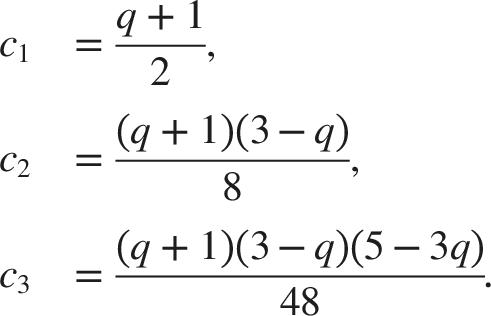
For (n, l) = (1, 1), the aforementioned reduced equations become

By solving (12), the first-order quantities are obtained as follows:

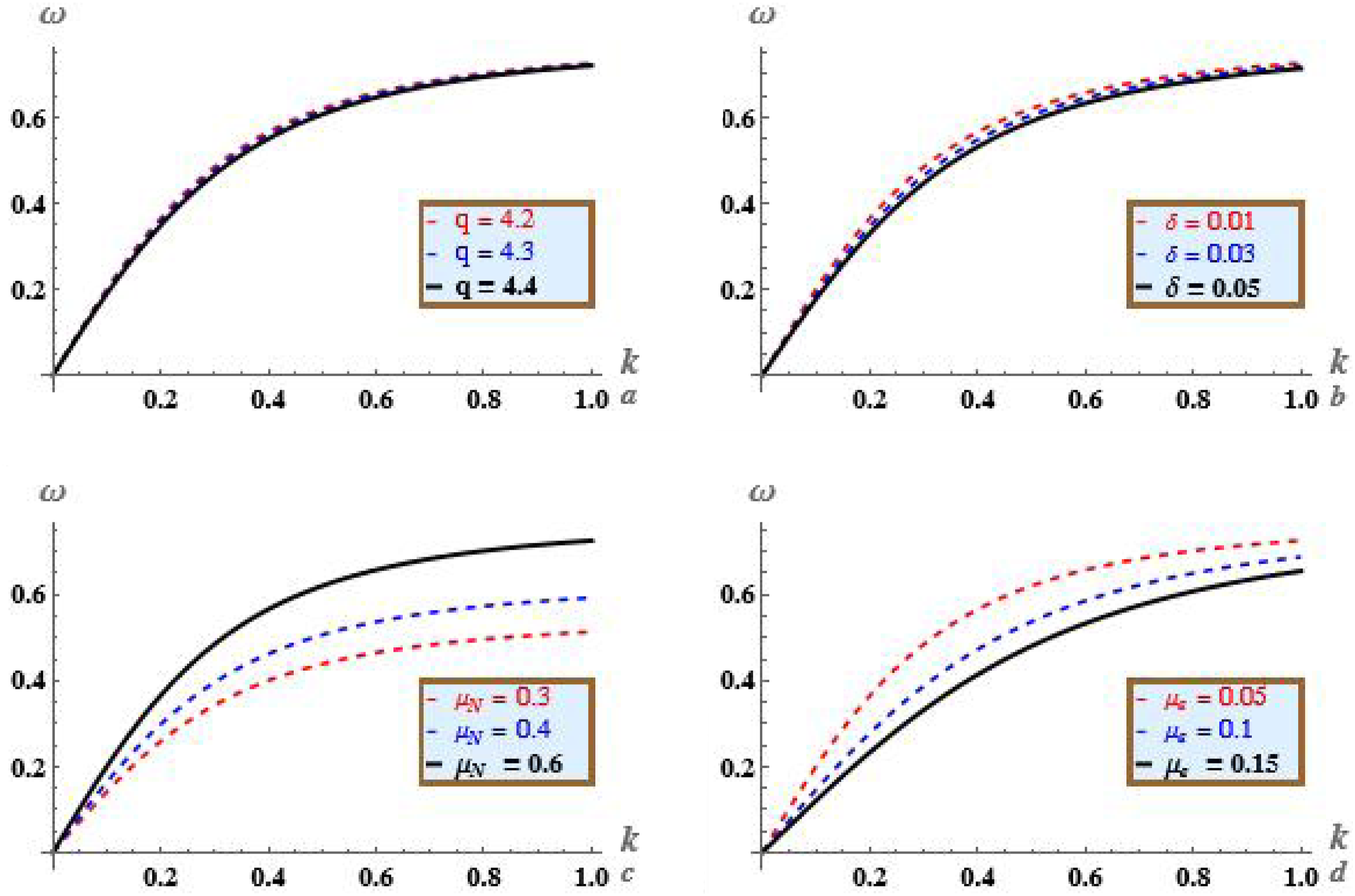
The dispersion relation for the modulated DIAWs, obtained from reduced Eq. (12), relates the normalized wave number k to the normalized wave frequency ω as follows Plot of the the carrier wave frequency ω with the physically admissible carrier wave number k for various values of (a) the non-extensive parameter q, (b) the electron temperature ratio δ, (c) the negative ion concentration μ
N
, and (d) the electron concentration μ
e
.

For (n, l) = (2, 1), the reduced Eqs. (9) to (11) become

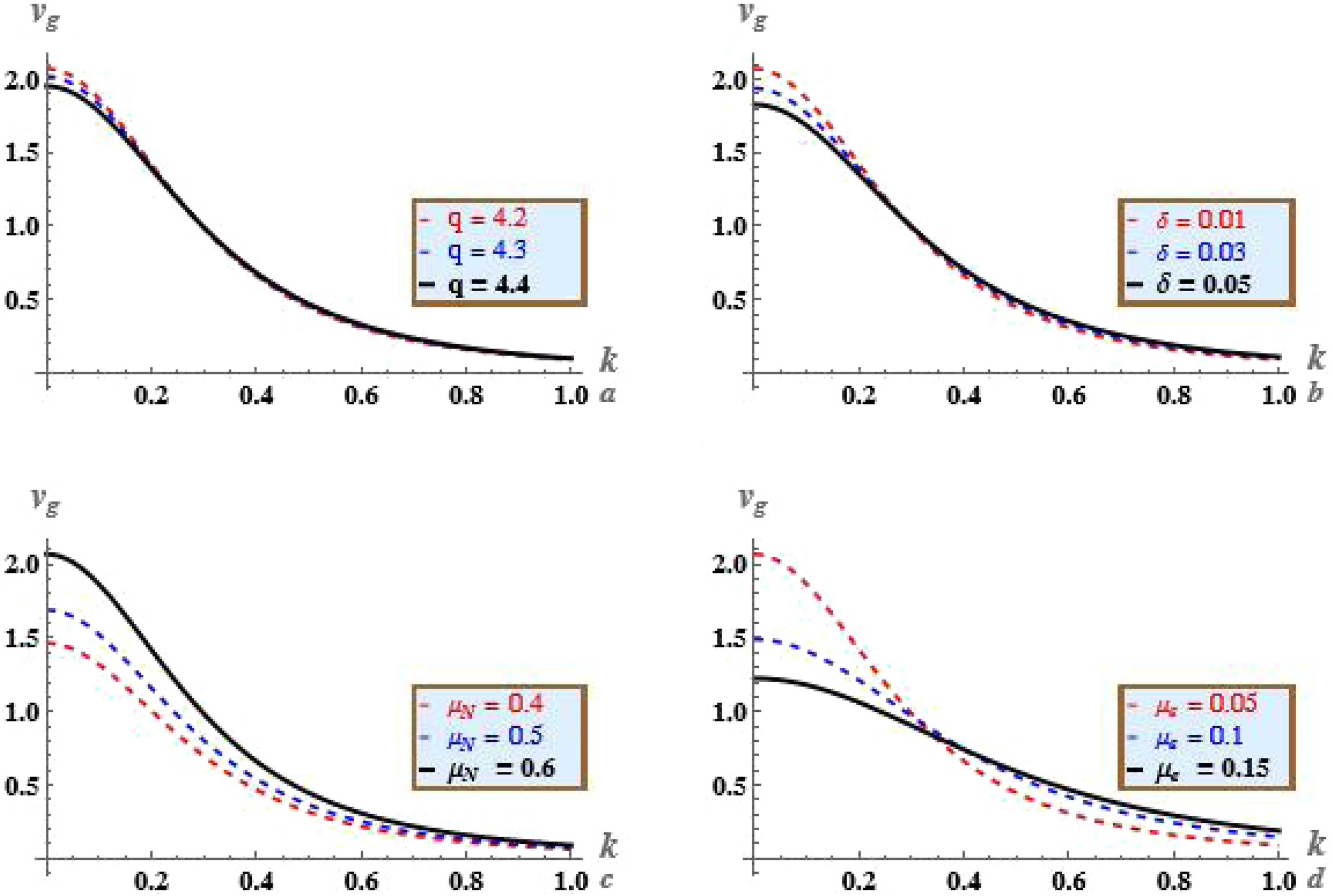
From the above system of reduced Eqs. (15), the following compatibility condition is derived Plot of the modulated structures group velocity v
g
with the physically admissible values of the carrier wave number k for varying values of (a) q, (b) δ, (c) μ
N
, and (d) μ
e
.

The system of reduced Eqs. (15) give

For
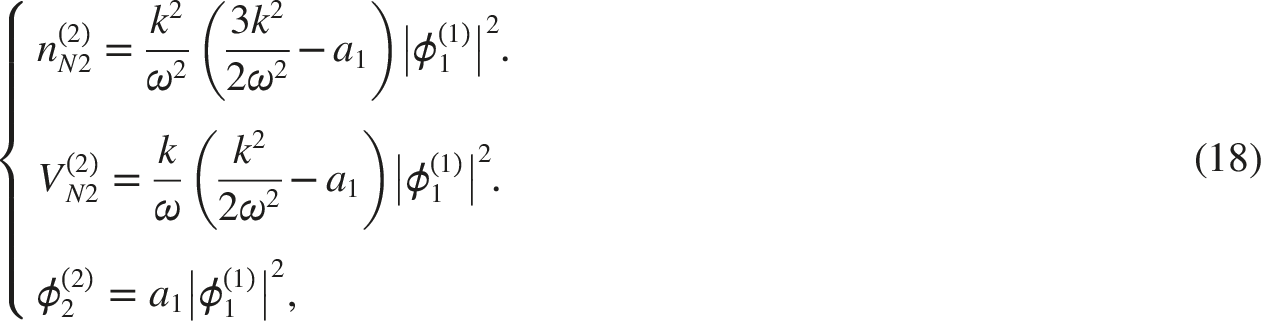

The reduced Eqs. (9) to (11) for (n, l)
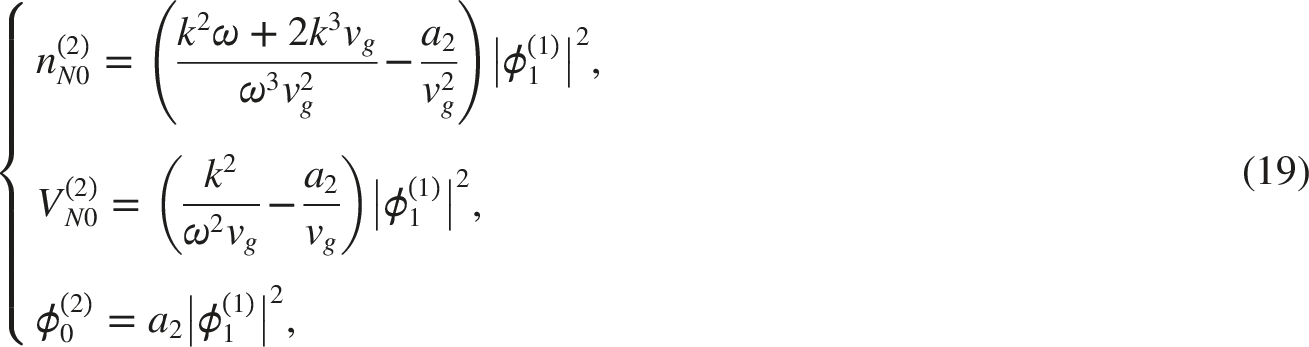

By using Eq. (13) and Eqs. (17) to (19) in the reduced Eqs. (9) to (11) for l = 1 and n = 3, the following planar NLSE is obtained:



The NLSE (20) governs the MI and modulated nonlinear structures, where P is linked to the curvature of the linear dispersion relation via P = 1/2 ∂2ω/∂k2 and Q represents the effective self-nonlinearity of the carrier wave.
4. Modulational instability (MI) analysis
Before analyzing the MI, we provide a brief overview of Li et al.’s work 50 relevant to the current investigation. Li et al. 50 examined small-amplitude DIA double layers in an unmagnetized, collisionless electronegative dusty plasma composed of inertial negative ions, nonextensive q-distributed electrons and Maxwellian positive ions as well as immobile negatively charged dust grains. By combining the Sagdeev potential method with the reductive perturbation method, they reduced the fluid model to an energy-like integral and, near a critical nonextensivity index q c , derived a Gardner equation whose exact double-layer solutions describe unmodulated electrostatic shock structures. Their analysis shows that the existence domain, polarity, and amplitude of these double layers are extremely sensitive to compositional parameters such as q, the negative-to-positive ion density ratio, and the Mach number: for suitable parameter ranges, the plasma supports either rarefactive or compressive DIA double layers, with a transition from negative-potential to positive-potential structures occurring when q increases beyond q c . In contrast, we start from a similar electronegative dusty plasma model but employ a multiple-scale reduction (here, we use the DEM) to derive an NLSE, enabling us to study the MI and the ensuing modulated structures, including bright/dark envelope solitons, RWs, and breather-type excitations. Building on the parameter regime, normalization, and physical data reported by Li et al., 50 our numerical investigations are calibrated directly against their dusty plasma configuration and are extended into the modulation-dominated regime rather than the stationary double-layer regime.
The monochromatic (Stokes) wave51,52 solution Ψ = ψeiΔτ, where


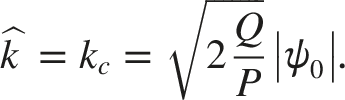

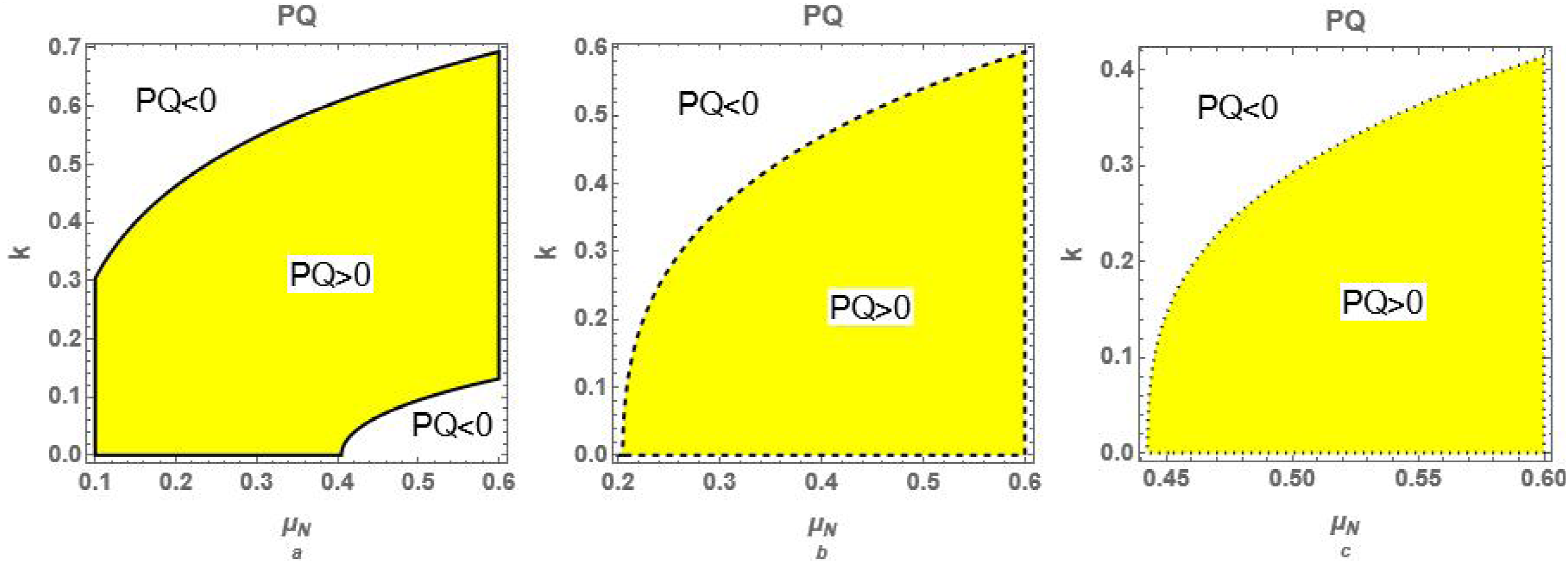
The sign of the product PQ is of central importance because it is responsible for determining the regions of stable and unstable modulated nonlinear structures. For PQ > 0, the carrier DIAW becomes modulationally unstable, which leads to exponential growth of sideband perturbations and allows for the formation of bright envelope solitons in addition to breathers and RWs on a finite background. Conversely, PQ < 0 corresponds to a modulationally stable regime, where the carrier wave remains robust against long-wavelength perturbations and supports dark-type envelope structures. Consequently, there exists one or more critical carrier wavenumbers k
c
at which either the nonlinear coefficient Q or the product PQ vanishes, and the character of the modulated structures changes. These features are summarized in Figures 3–5 for different choices of the nonextensive parameter q, the electron concentration μ
e
, and the electron temperature ratio δ. Modulationally (un)stable region(s) are examined in (k, μ
N
) plane with varying values of q. Panels (a), (b) and (c), respectively correspond to q = 4,q = 4.5, and q = 5. Here, δ = 0.01 and μ
e
= 0.05. Modulationally (un)stable region(s) are examined in (k, μ
N
) plane with varying values of μ
e
. Panels (a), (b) and (c), respectively correspond to μ
e
= 0.05, μ
e
= 0.1, and μ
e
= 0.15. Here, δ = 0.01 and q = 4. Modulationally (un)stable region(s) are examined in (k, μ
N
) plane with varying values of μ
e
. Panels (a), (b) and (c), respectively correspond to δ = 0.01, δ = 0.02, and δ = 0.05. Here, q = 4 and μ
e
= 0.1.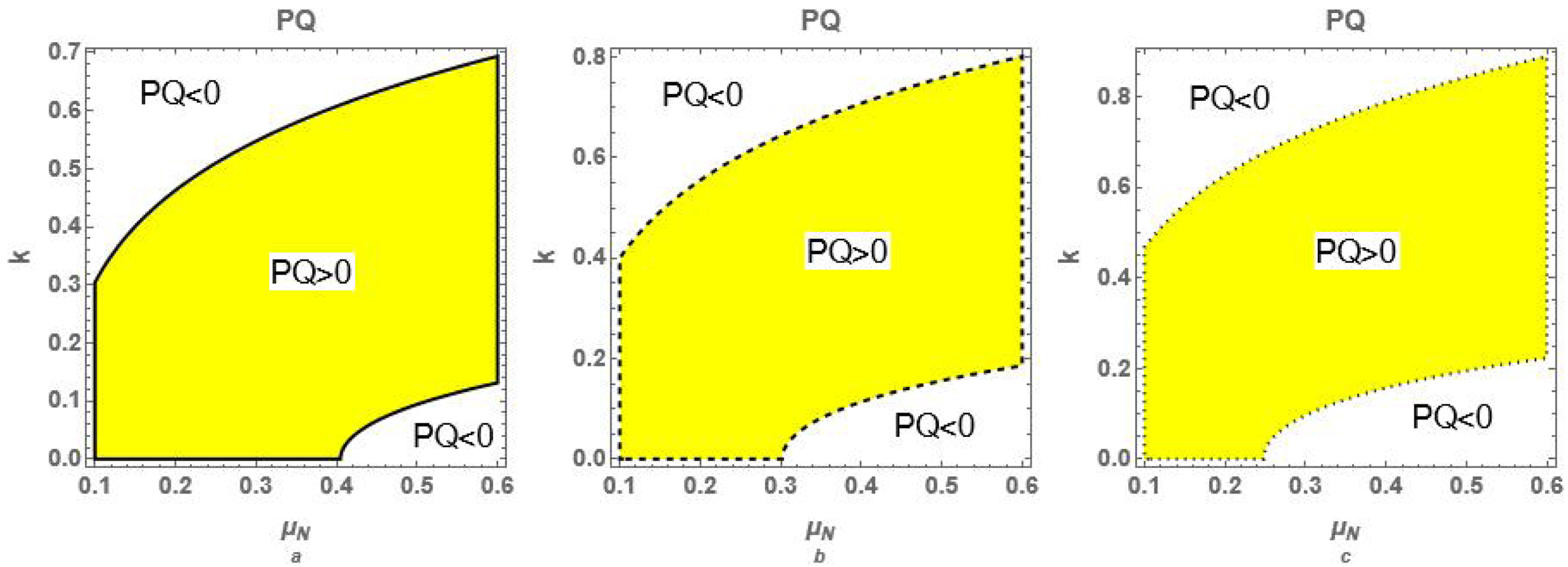
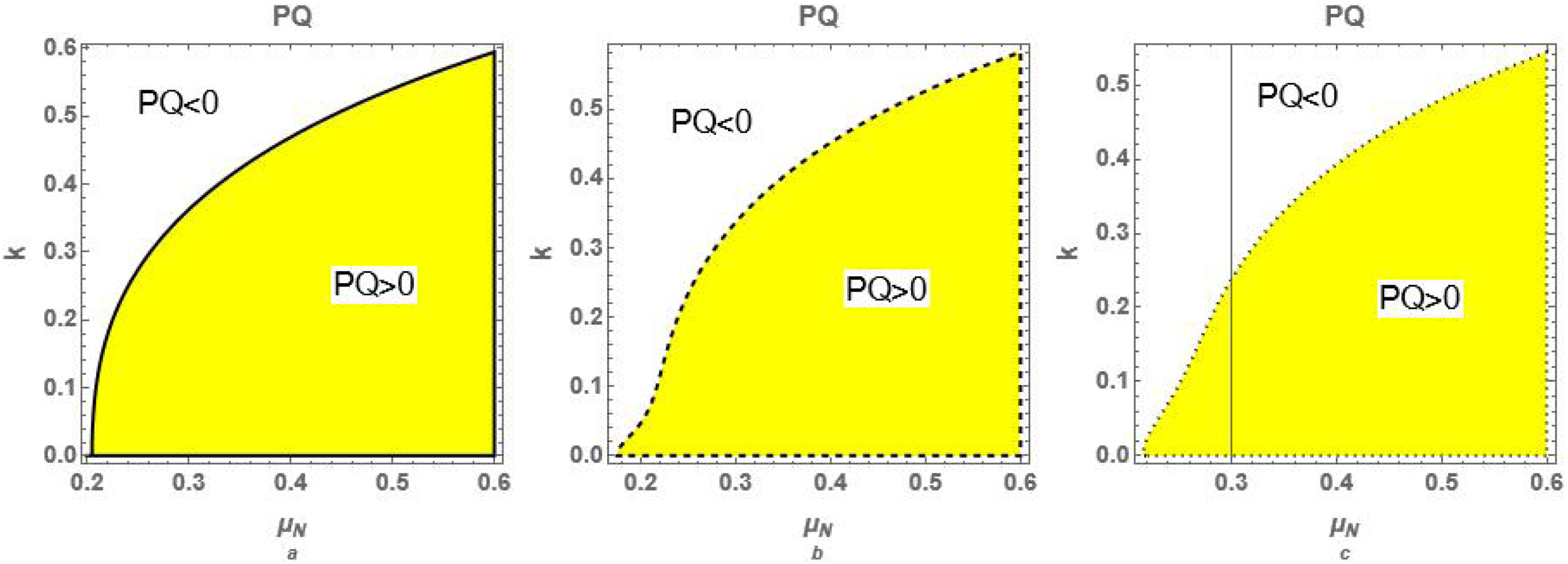
The impact of the nonextensive parameter q on the critical wavenumber k
c
and the stable regions is investigated as evident in Figure 3. This figure demonstrates that there are two critical wavenumber values
5. Formation of modulated envelope bright and dark solitons
The planar NLSE (20) supports localized envelope solutions with constant profiles, which appear either as bright or dark (gray and black) modulated solitons, depending on the sign of the product PQ. The corresponding analytical expressions can be obtained by seeking solutions of the form The bright modulated envelope soliton within the unstable region (i.e.,PQ> 0) for different values of relevant parameters: (a) the nonextensive parameter q at 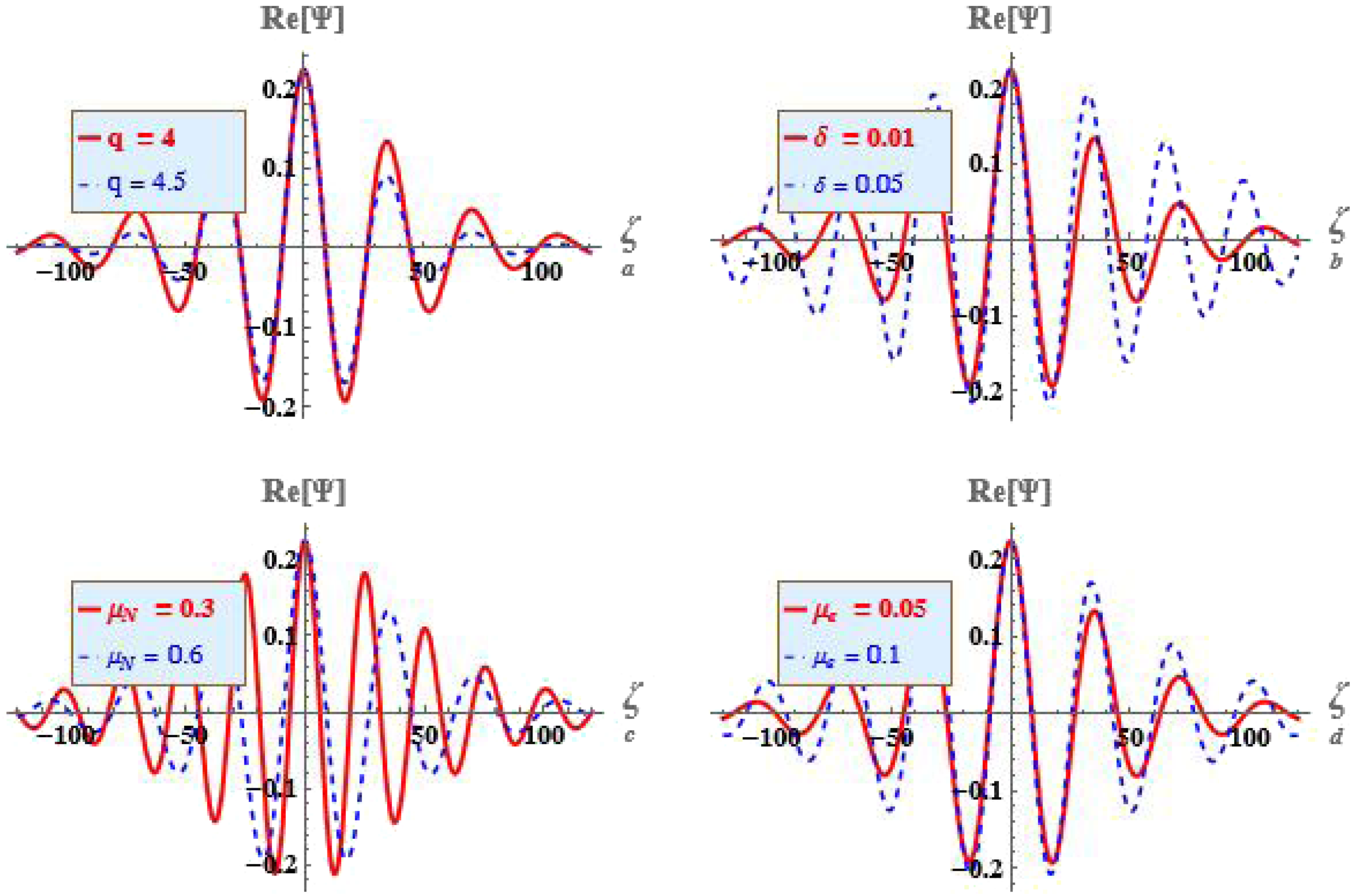
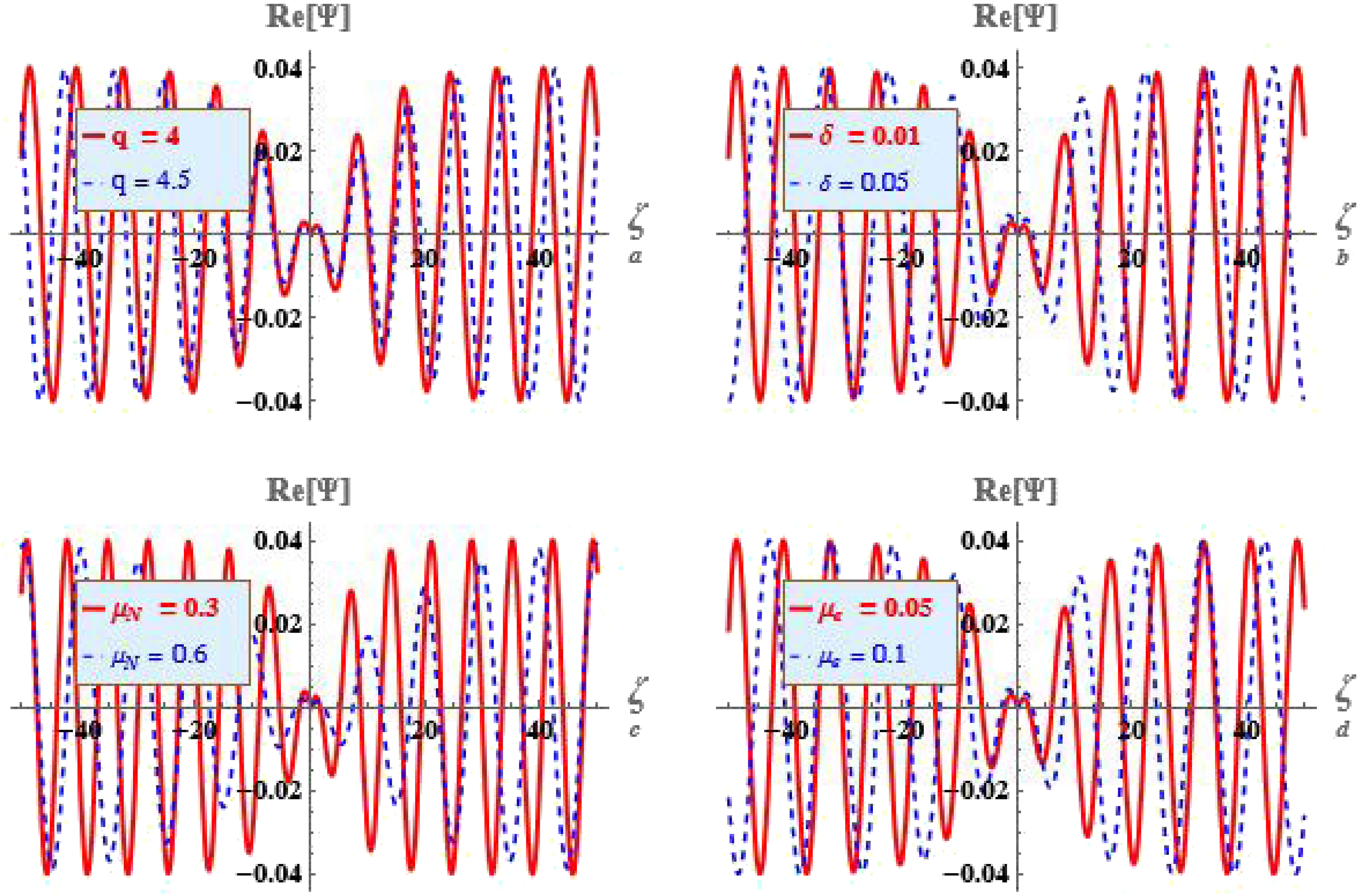
In the opposite case, PQ < 0, the nonlinearity becomes self-defocusing, and the carrier wave is modulationally stable. The NLSE then supports dark-type envelope solitons. Depending on whether the amplitude vanishes or not at the center of the structure, one distinguishes between black and gray envelope solitons. A gray soliton corresponds to a localized dip in the intensity, where the amplitude remains nonzero at the minimum, whereas a black soliton corresponds to a complete intensity hole. Figures 7 and 8 depict typical gray and black envelope solitons in the modulationally stable regime for various values of the plasma parameters q, δ, μ
N
, and μ
e
. These parameters are found to have significant influence on the soliton profiles. The gray modulated envelope soliton within the stable region (i.e., PQ < 0) for different values of relevant parameters: (a) the nonextensive parameter q at The black modulated envelope soliton within the stable region (i.e., PQ < 0) for different values of relevant parameters: (a) the nonextensive parameter q at 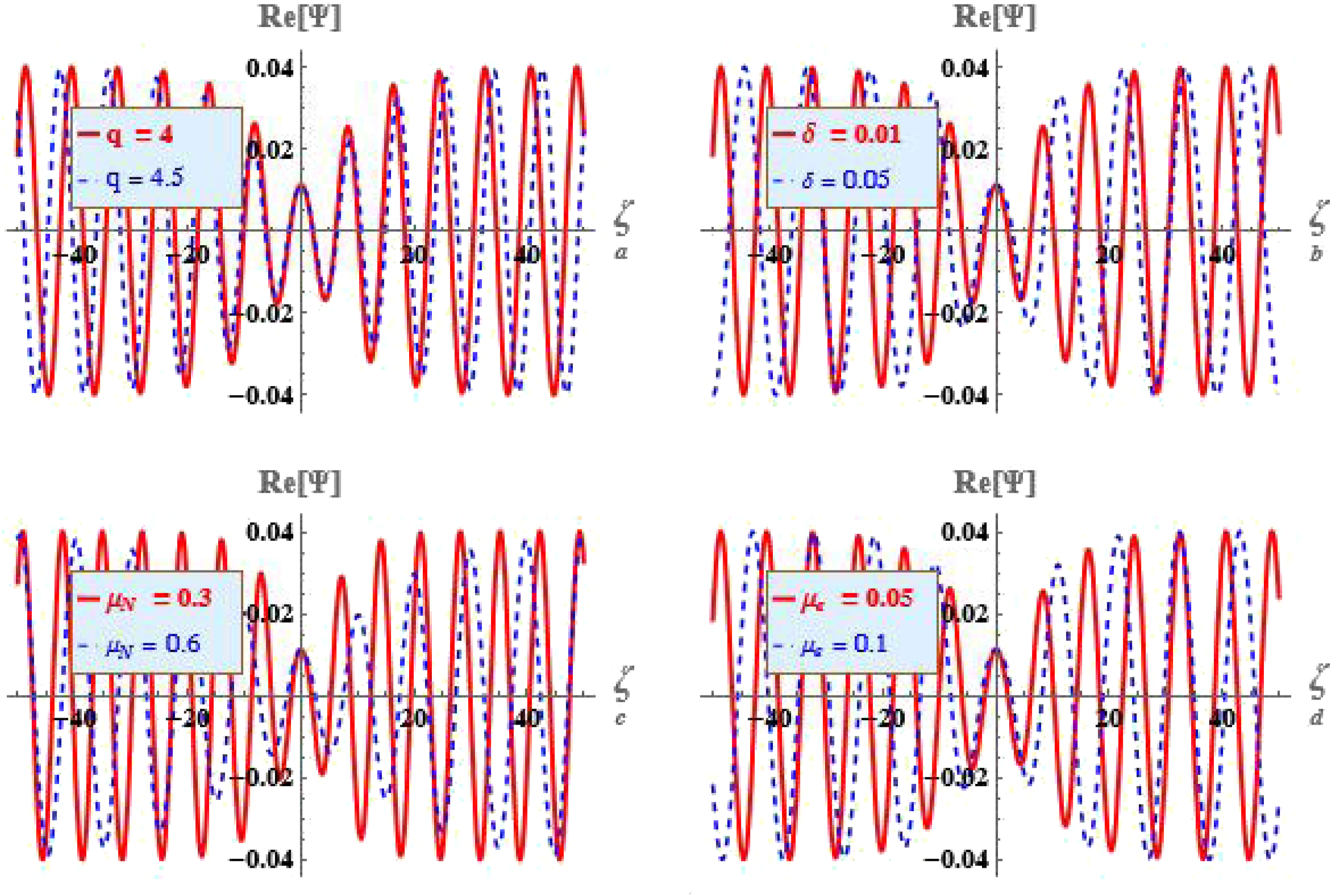
6. RWs and Breathers
It has been well documented that the NLSE (20) allows for a hierarchy of analytical solutions representing various modulated nonlinear wave structures propagating at the group velocity. Besides the stationary envelope solitons already discussed, the NLSE (20) supports doubly localized excitations in the form of breathers and RWs. RWs are highly localized and amplified wave packets formed by extracting energy from the background medium, typically occurring in modulationally unstable regimes.
55
These waves are characterized by their strong localization in both space and time, appearing suddenly and disappearing without leaving any lasting traces.
56
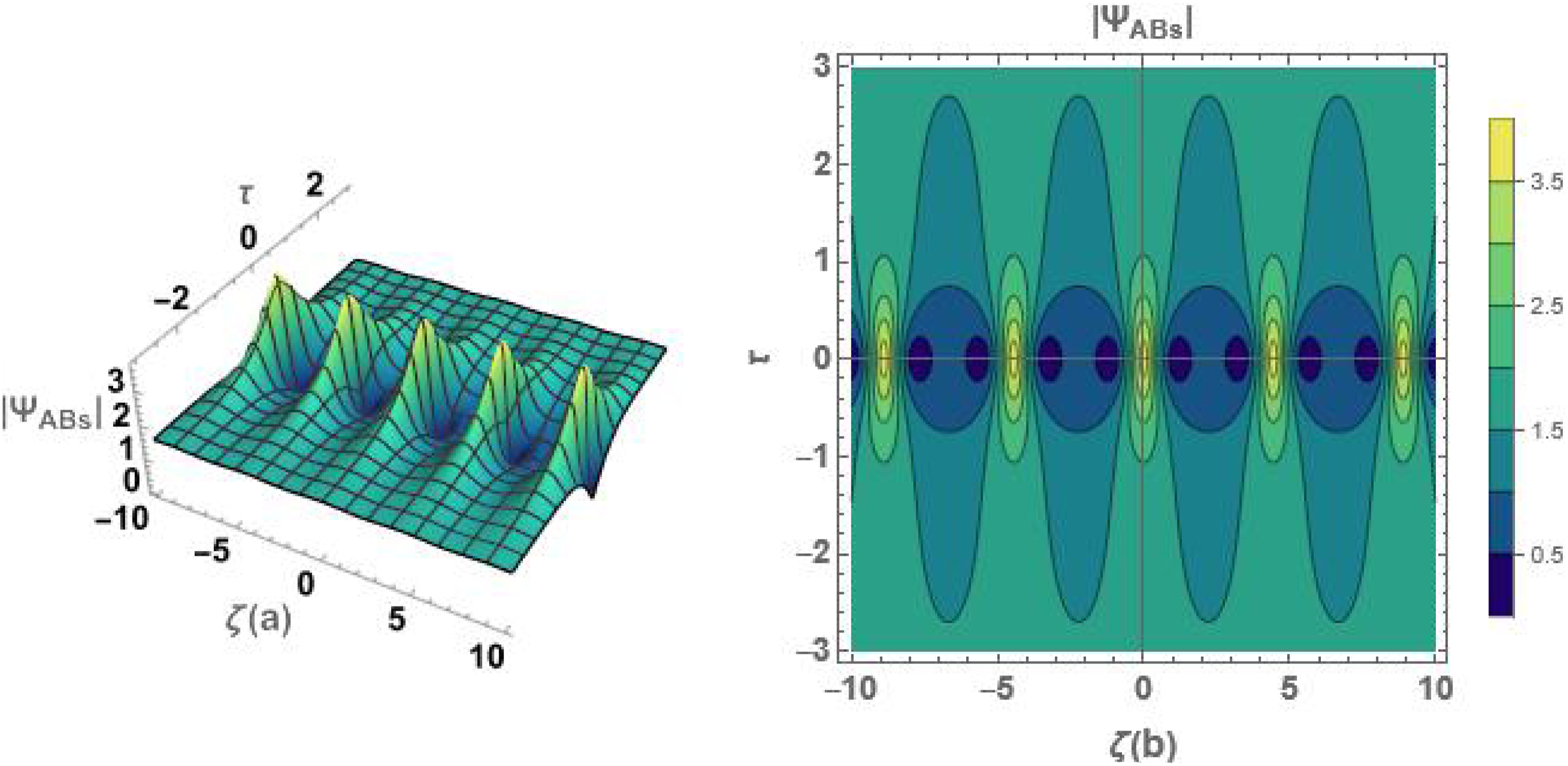
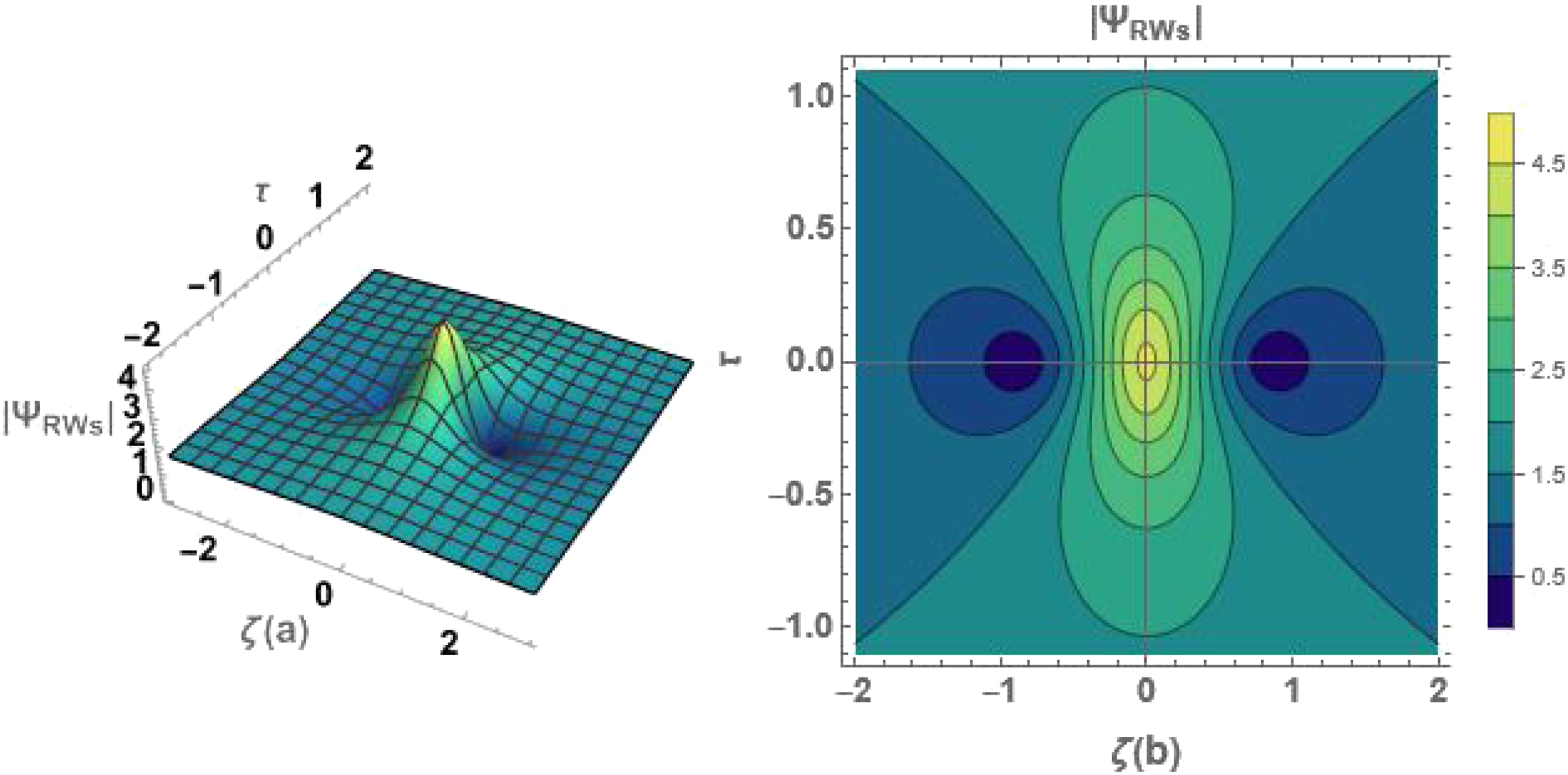
In contrast, breather solutions correspond to oscillatory localized structures and are generally divided into two main types: ABs, which are spatially periodic but temporally localized, and KMBs, which exhibit temporal periodicity while remaining localized in space. The standard planar NLSE (20) can be rewritten as follows:

The rational solution of the planar NLSE (20) that consists of both breathers and RWs structures is given below37,57

In Eq. (26), the quantities (i) The KMBs solution (ii) The ABs solution (iii) In the limiting case r → 1/2, the breather solution (26) degenerates into the first-order RW (Peregrine-type) solution


The breathers peaks derived at τ= 0 from solution (26) read:


The influence of q, δ, μ
N
, and μ
e
on the RW peak amplitude is examined in Figure 12(a)-(d). Figure 12(a) illustrates how the maximum RW amplitude |ΨRWs|max varies in (q, k) plane for fixed (δ, μ
N
, μ
e
) = (0.01, 0.6, 0.05). At small and intermediate wavenumbers, there exist a critical value of q (around q≃ 3.6 for the present choice of parameters) beyond which the RW amplitude increases with q, whereas below this value it decreases with q with all wavenumber values. At larger wavenumbers, the RW amplitude tends to decrease with increasing q. Thus, the impact of nonextensivity on the strength of the extreme events is nonmonotonic and depends on the carrier scale. Figure 12(b) depicts the effect of δ on the RW amplitude |ΨRWs|max in the (δ, k)-plane. The results indicate that the electron temperature ratio has a dual influence: in the short-wavelength (large-k) regime, increasing δ produces a slight enhancement of the RW amplitude, whereas in the long-wavelength regime the trend is reversed and the amplitude slightly decreases with δ. Moreover, Figure 12(c) shows that μ
N
has a complex effect on RW behavior. At large wavenumber values, the amplitude of the RWs is slightly decreased with increasing μ
N
, but at low wavenumber values, the behavior is reversed, i.e., the amplitude of the RWs increases with increasing μ
N
. Furthermore, we investigated the effect of electron concentration μ
e
on the the RW amplitude |ΨRWs|max, as illustrated in Figure 12(d). This figure shows that electron concentration has a complex effect on RW behavior. At low wavenumber values and low concentration values, the amplitude decreases with increasing electron concentration, but the behavior is completely reversed at high wavenumber values. It should also be noted that even at low wavenumbers, but with high concentration, the RW amplitude increases. The dynamical behavior of KMBs solution The dynamical behavior of ABs solution The dynamical behavior of the first-order RWs solution The impact of q, δ, μ
N
, and μ
e
on the maximum RW amplitude 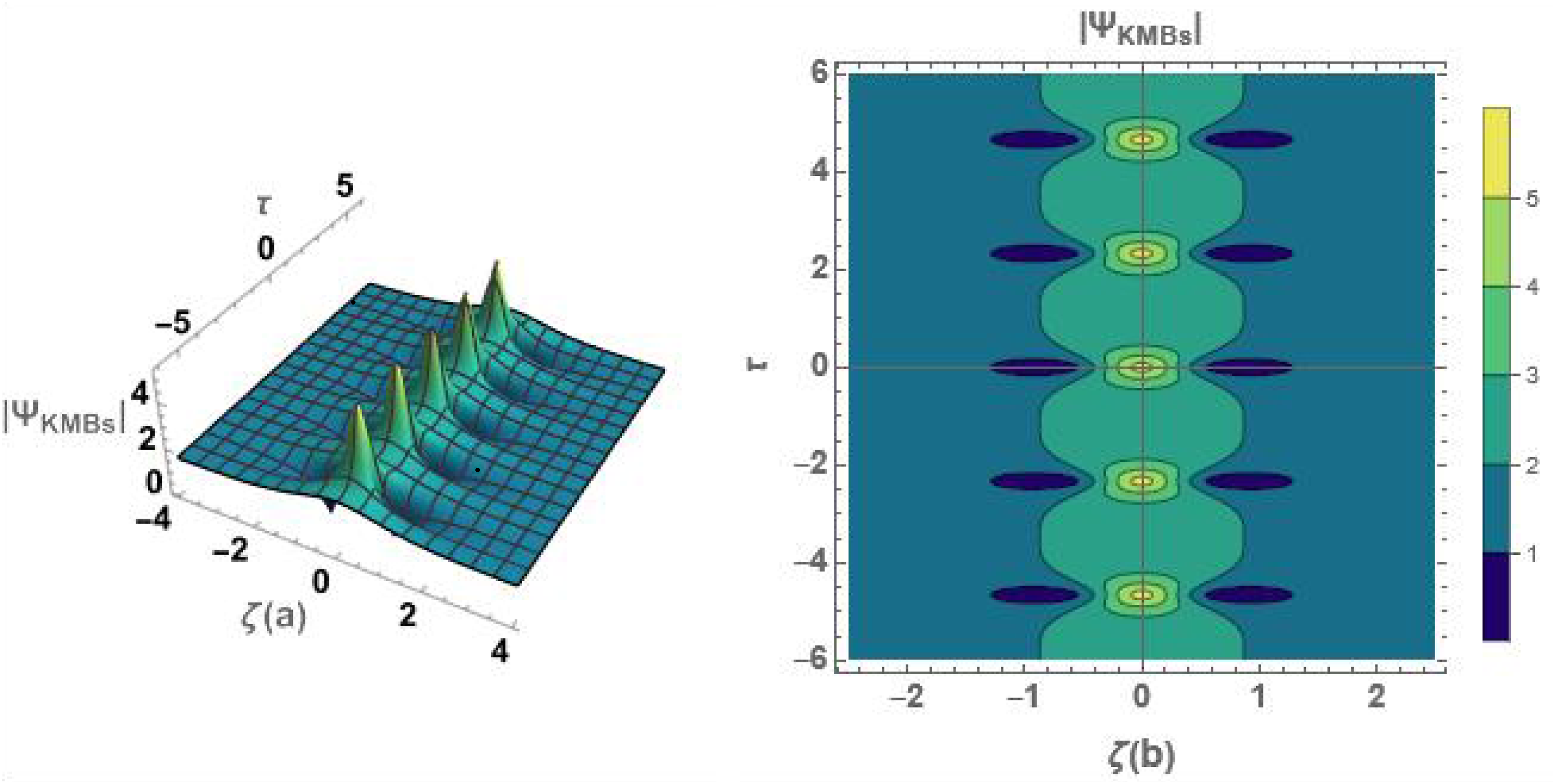
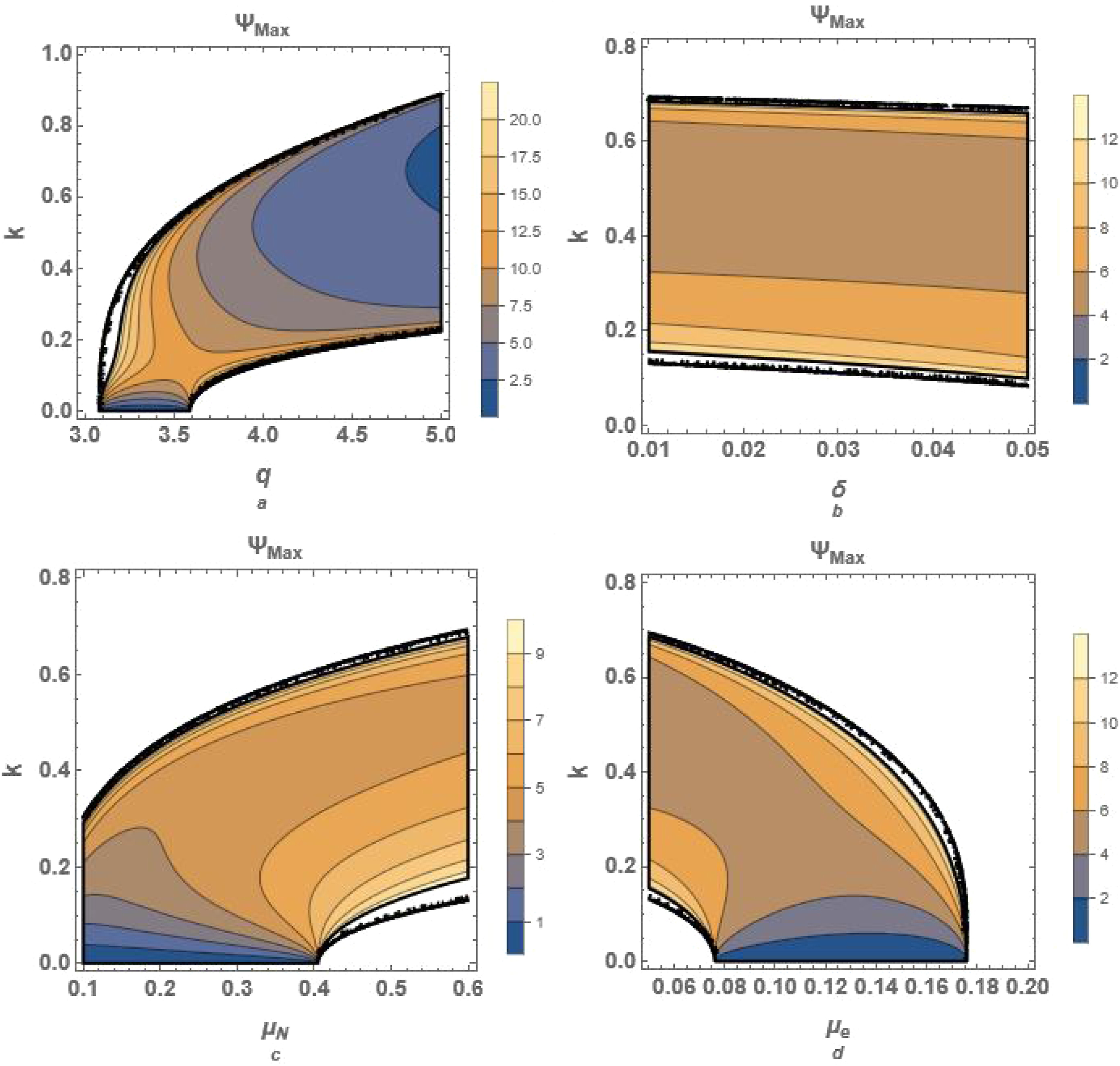
Since the breather solutions share the same parametric dependence as the RW solution in the present normalization, the qualitative trends described above also apply to ABs and KMBs. In space and laboratory electronegative dusty plasmas, such enhanced breather and RW activity may be associated with regions where nonextensive electrons and negative-ion populations are particularly pronounced. In those regions, the corresponding extreme electrostatic events can influence particle acceleration, transport, and energy dissipation, and may also affect the operation and diagnostics of plasma devices.
7. Conclusion and future work
In this work, the modulational instability (MI) and associated nonlinear envelope structures of low-frequency dust ion-acoustic waves (DIAWs) in an electronegative dusty plasma with nonextensive electrons have been investigated. This plasma model consists of inertial negative ions, inertialess q-distributed electrons, Maxwellian positive ions and stationary negatively charged dust grains. For this purpose, the DEM was applied for reducing the governing fluid equations to the planar evolutionary wave equation, know as the planar nonlinear Schrödinger equation (NLSE). The linear dispersion relation ω, group velocity v
g
, and the associated dispersion (P) and nonlinearity (Q) coefficients, have been derived and expressed in terms of the relevant dimensionless parameters, notably the nonextensive parameter q, the electron temperature ratio δ, negative ion concentration μ
N
, and electron concentration μ
e
. Based on the derived planar NLSE, the conditions for the MI of the carrier DIAWs have been established through the sign of the product PQ, and the critical wavenumber k
c
separating modulationally stable and unstable regimes was identified. The analysis revealed that the dispersion coefficient P remains negative over the considered range of relevant physical parameters, while the nonlinearity coefficient Q changes sign with k, leading to a stability transition from PQ < 0 at long wavelengths/small wavenumber (supporting dark envelope solitons) to PQ > 0 at shorter wavelengths (supporting bright envelope solitons, breathers, and rogue waves). The obtained results are summarized in the following points: • The carrier wave frequency ω was found to increase monotonically with the carrier wavenumber k, confirming the dispersive nature of the DIAWs in the present model. An increase in the electron parameters q and δ leads to a slight decrease in ω at fixed k, attributed to the enhanced population of superthermal electrons and their higher temperature, which weakens the effective electron restoring pressure. In contrast, increasing the negative ion concentration μ
N
enhances the carrier frequency, whereas increasing the electron concentration μ
e
reduces it. The group velocity v
g
of the modulated structures has been found to decrease systematically with increasing k for all examined parameter values. Moreover, at small k, it was observed that v
g
decreases as q and δ increase, while at larger k the influence of these parameters becomes weaker and may be slightly reversed. Furthermore, it was found that v
g
increases with increasing μ
N
over the whole range of admissible values, whereas its dependence on μ
e
is opposite at small and large k: v
g
decreases with μ
e
at long wavelengths and increases with μ
e
in the short-wavelength regime. • The MI of the modulated DIAWs has been analyzed in detail, and the corresponding stable and unstable regions have been determined in the relevant parameter spaces. It has been shown that, for physically reasonable values of the related parameters q, δ, μ
N
, and μ
e
, the unstable domains where PQ > 0 (and hence bright-type envelopes, breathers, and RWs can exist) generally occupy a larger area than the stable domains where PQ < 0 (supporting dark-type envelopes). It was observed that the nonextensive parameter q produces a systematic shift of the critical wavenumbers kc1 and kc2 towards higher values, so that stronger nonextensivity moves the MI threshold to shorter wavelengths. However, an increase in the electron concentration μ
e
reduces the width of the unstable regions, can cause the lower critical curve kc2 to disappear, and substantially broadens the stable domains, which are also shifted towards larger μ
N
. The electron temperature ratio δ shifts the critical wavenumber k
c
towards lower values as it increases, indicating that hotter electrons move the onset of MI to longer wavelengths and slightly weaken the instability. • The characteristics of bright and dark (gray and black) envelope solitons have been examined as functions of q, δ, μ
N
, and μ
e
. In the modulationally unstable regime (PQ > 0), bright envelope solitons arise as localized humps on a weak background and retain a robust central maximum. The main effect of the plasma parameters on these structures is to slightly change their width and phase, without altering their qualitative form. In the modulationally stable regime (PQ< 0), gray and black envelope solitons appear as localized depressions on a finite background. The depth and width of these dark structures are sensitive to variations in q, δ, μ
N
, and μ
e
. In particular, larger μ
N
and q tend to sharpen the localized depletion, while changes in δ and μ
e
adjust the background level and the fine oscillatory structure around the notch. Gray envelope solitons are associated with partial depletions of the electrostatic field (finite minimum amplitude), whereas black solitons represent complete voids (vanishing amplitude at the center). • In the modulationally unstable regime, Akhmediev breathers (ABs), Kuznetsov-Ma breathers (KMBs), and first-order RWs have been investigated. It has been confirmed that the peak amplitude of these nonlinear structures exceeds the background level |Ψ0| and increases with the control parameter r, with the hierarchy |ΨABs|max < |ΨRWs|max < |ΨKMBs|max for a given background amplitude. The influence of q, δ, μ
N
, and μ
e
on the maximum RW amplitude has been analyzed. The results indicate that these parameters influence the strength of the extreme events in a nontrivial way: depending on the range of k, they may either enhance or reduce the RW peak. In particular, there exist critical values of q and μ
N
beyond which the dependence of |ΨRWs|max on these parameters changes its character. Similar trends apply to δ and μ
e
, where the impact on the RW amplitude is opposite in the long- and short-wavelength regimes.
The adopted plasma model and the fluid-Poisson description are standard and have been widely used in previous studies of DIAWs in electronegative dusty plasmas, which supports the physical reliability of the present analysis.17,37,38 The obtained results may provide useful qualitative understanding of how modulated DIA structures form and evolve in electronegative dusty plasma environments such as cometary comae, neutral-beam source plasmas, and the Earth’s plasma sheet, where nonextensive electron populations and negative ions play key roles.
In light of the present results, several extensions of this work appear to be physically relevant and worth pursuing: (i) Firstly, in the current plasma model, the one-dimensional MI and the modulated nonlinear structures (RWs and breathers) have been studied and investigated. However, incorporating an external magnetic field into this model leads us to study multi-dimensional structures rather than one-dimensional ones. In that scenario, the fluid equations reduce to three-dimensional NLSE, where the conditions for MI and modulated nonlinear structures differ from those in the one dimensional case:

In this case, we can study the impact of transverse perturbations, which was not investigated in the one-dimensional case. (ii) Another promising aspect of this study is the consideration of collision forces in the current model, which arise between plasma components (between charged particles themselves or between charged and neutral particles). This, in turn, reduces the model’s governing fluid equations to the damped NLSE58,59:

This new evolutionary wave equation is completely non-integrable. To study the effects of different plasma parameters and the damped/decay coefficient on the behavior and dynamics of various modulated nonlinear structures (RWs and breathers), this equation must be analyzed using semi-analytical methods to obtain approximate solutions, whether analytical or numerical, that accurately describe the behaviors of these modulated damped structures. (iii) Another promising idea related to the current study is to consider the curvature (nonplanar) effect in the fluid governing equations, as it is the most realistic for accurately describing the various nonlinear phenomena that arise and propagate across different systems. Therefore, the model’s governing equations are reduced to the curved/nonplanar NLSE, which is also non-integrable60,61:

Thus, to study the various nonlinear phenomena described by this equation requires applying semi-analytical or numerical methods to gain a deeper understanding of the behavior of nonplanar, modulated nonlinear structures and the extent to which the curvature coefficient affects the propagation dynamics of these waves. (iv) Finally, one of the most important ideas, not only in plasma physics but also in fluid physics, optical fibers, and quantum mechanics, the description of which relies on the NLSE family, considers the memory and locality effects. This may reveal some of the behaviors of the various nonlinear phenomena described by the fractional NLSE:

This is one of the most important ideas relevant to the current work. For this reason, we can apply the Tantawy technique,62–67 which has been very successful in analyzing various types of fractional evolution equations, whether in plasma physics or other branches.
Footnotes
Acknowledgments
The authors express their gratitude to Princess Nourah bint Abdulrahman University Researchers Supporting Project Number (PNURSP2026R378), Princess Nourah bint Abdulrahman University, Riyadh, Saudi Arabia.

Authors contributions
Each author has made equal contributions.
Funding
The author(s) disclosed receipt of the following financial support for the research, authorship, and/or publication of this article: This work was supported by Princess Nourah Bint Abdulrahman University (PNURSP2026R378).
Declaration of conflicting interests
The authors declared no potential conflicts of interest with respect to the research, authorship, and/or publication of this article.
Data Availability Statement
The sharing of data is not needed.
Declaration of No Usage of AI tools
The use of AI tools has not been made while preparing this artic.