






Abstract
This paper presents the influence of the surface tension and the temperature on the vibration frequencies of a Timoshenko nanobeam which lays on the Winkler-Pasternak foundation. The local and Eringen nonlocal elasticity theories are considered for modelling nanobeam system. The Hamilton’s principle is firstly used to get the differential equations system as well as the boundary conditions. Based on the power series method (PSM), the recursive relation of the final single differential equation is obtained. Next, boundary condition equations enable to get and solve the eigenvalue problem for the fully supported (SS), clamped supported (CS), fully clamped (CC) and clamped free(CF) ends. After comparing our results with those existing, the PSM appears to excellently compute the vibration frequencies of a local and nonlocal nanobeam. Moreover, we observed a decreasing effects of the surface tension and temperature on a frequency of a local cantilever nanobeams and their increasing effects on the frequency for other boundary conditions. For nonlocal CF nanaobeam, the temperature and the surface tension decrease the frequency when the small scale parameter is close to zero. The contrary effect is observed when the scale parameter is bigger than 0.1. The previous parameters have an increasing role on the frequency for SS, CS, CC nonlocal nanobeams for both local and nonlocal approaches.
1. Introduction
The exceptional performances of Nano systems is the catalyst of a rapid increase of the number of scientific productions in the recent years about nanotubes and nanoplates. Nano systems mostly find their applications in micro and nanotechnology domains such as X-ray microscopy, Nano witches, actuators for sensing energy harvesting.etc.1–5 According to Lijima 6 who discovered carbon nanotubes in 1992, nanoscale engineering materials have significant thermal, mechanical, and electrical behavior compared to common conventional structural materials. This can explain why the problem of bending, buckling, or vibration of nanobeams has drawn the attention of the whole scientific community for the past three decades. Precisely, Ghannadpour 7 in 2012 studied the bending, buckling, and vibration of the nonlocal Euler beams using the Ritz method. Their works were followed by those of Lu et al., 8 who analyzed the vibration of nanobeams based on nonlocal strain gradient theory. Mouafo and Adali9–12 specifically studied the buckling of a uniform and non uniform nonlocal Euler-Bernoulli beam subjected to several loads and surrounded by and elastic foundation. Similar work was performed for nonlocal Timoshenko uniform or tapered nanobeams.13,14
Further analyses have revealed that, the important surface-to-volume ratio is the primary source of the surface effect on the nanostructures. 15 Such a demonstration explains how different conditions around the nanostructure’s environment creates an equilibrium’s difference between the atoms laying at the surface and those present in the nanobeam’s interior. That difference finally provokes an excess surface energy, viewed as a sort of layer to which a certain energy is linked.16,17 According to Wang et al. 18 and Lee et al. 19 the surface effects also induces the shift of the resonant frequency of nano-sized cantilevers. To be able to take into account the surface effect on the modeling, Gurtin and Murdoch,20,21 have developed a surface elasticity theory by modifying the continuum theory of mechanics. That new theory has shown an excellent accuracy after a comparison of their obtained results with those measured experimentally.22–25 Fu et al. 26 employed Gurtin and Murdoch’s elasticity and Euler-Bernoulli beam theories to study the surface effect on the vibration and buckling of the linear and nonlinear nanobeams, where the amplitude-frequency response was investigated, using the Galerkin method. Ansari et al. 27 carried out an investigation on the vibration analysis of the Timoshenko beam based on surface stress elasticity theory. They have also employed the Gurtin-Murdoch elasticity theory in their analysis and have concluded that, the surface effect was more pronounced for thin nanobeams and the surface effect leads to augmenting the dimensionless fundamental frequency. Surface effects on the static bending of nanowires were studied by Jin et al., 28 while Gang et al.29,30 examined the role played by the surface effect on the buckling or on the frequency of micro/nanobeams. Shahrokh et al. 31 compared the surface effect on a vibration of nonlocal Euler-Bernoulli and Timoshenko beams. The effect of the surface on the buckling and vibration of the Timoshenko nanobeam was extended in the works of Gang et al., 32 who discussed the modifications done on the buckling load and frequencies of the Timoshenko nanobeam in the presence of the surface effect. They came out to the conclusion that, the surface effect becomes more significant when the nanowires are stubby with a smaller aspect ratio. Similar works were performed in,33–35 where the dimension of the clamped-clamped nanobeam affects the surface elasticity parameter, including surface residual stress and surface elastic modulus. Rabab et al. 36 examined the surface effect on bending, buckling, and vibration of the functionally graded Timoshenko nanobeams, while the influence of surface effect on the nonlinear vibration of the Timoshenko nanobeam 37 and on the vibration or buckling of the system of two double nanobeams.38–40 have also drawn a great interest.
The temperature also appears amongst the parameters which could influence the vibration frenquencies of the nanobeam. Precisely, the effect of the temperature on the bending, buckling, or vibration of the nanobeam was examined by Tounsi, 41 while Farzad et al. 42 have examined the effect of the temperature on the buckling and vibration of the Timoshenko nanobeam. Mustapha et al. 43 carried out a research about an axially graded nanobeam under partial thermal load, while the rise of the temperature on the functionally graded nanobeams was discussed in Refs 44 and 45.
To be able to appreciate the combined effects of surface tension and the temperature on the vibration and/or buckling of the nanobeams, several studies have been performed. As example, Amirian et al., 46 carried out the study on alumina nanobeams on a two-parameter foundation. They concluded that the increase of the temperature also increases the natural frequencies, but this effect is negligible when temperature changes in the range of 20 to 100°C. Additionally, the influence of surface and thermal effects on the rotating Timoshenko cantilever nanobeam was carried out in Ref. 47, and the finding was that, the presence of the surface effect reduces the temperature change effect on the non-dimensional frequency. Also, a silver nonlocal nanobeam was theoretically analyzed, and the surface and thermal effects have shown how they could modify the nanobeam’s displacement. 48 Next, the surface and thermal effects were studied, respectively, for a single-walled nanobeam using refined theory 49 on a circular curved nanobeam. 50
Among the all previous cited researches, the only one combining both thermal and surface effects on the novel Timoshenko beam theory is Ref. 46, where only fully supported boundary condition was studied. Also, to date, only Ritz, differential quadrature, 47 differential transformation, or analytical solutions have been applied to solve the obtained differential equations of the Timoshenko nanobeams problem. To the author’s best knowledge, the power series method41,51,52 has not been employed yet for solving such a problem. Another novelty here consists on deriving the clamped-simply supported (CS), clamped (CC), and cantilever (CF) boundary conditions on the novel Timoshenko nanobeam equation, in addition to simply supported(SS) already implemented in Ref 46.
2. Formulation of the governing equation and the boundary conditions
The schematic view of the Timoshenko nanobeam with surface and thermal effects, laying on the Wrinkler ( (a) Nanobeam under uniaxial compression, (b) rectangular cross section with a surface layer, and (c) a circular cross section with a surface layer.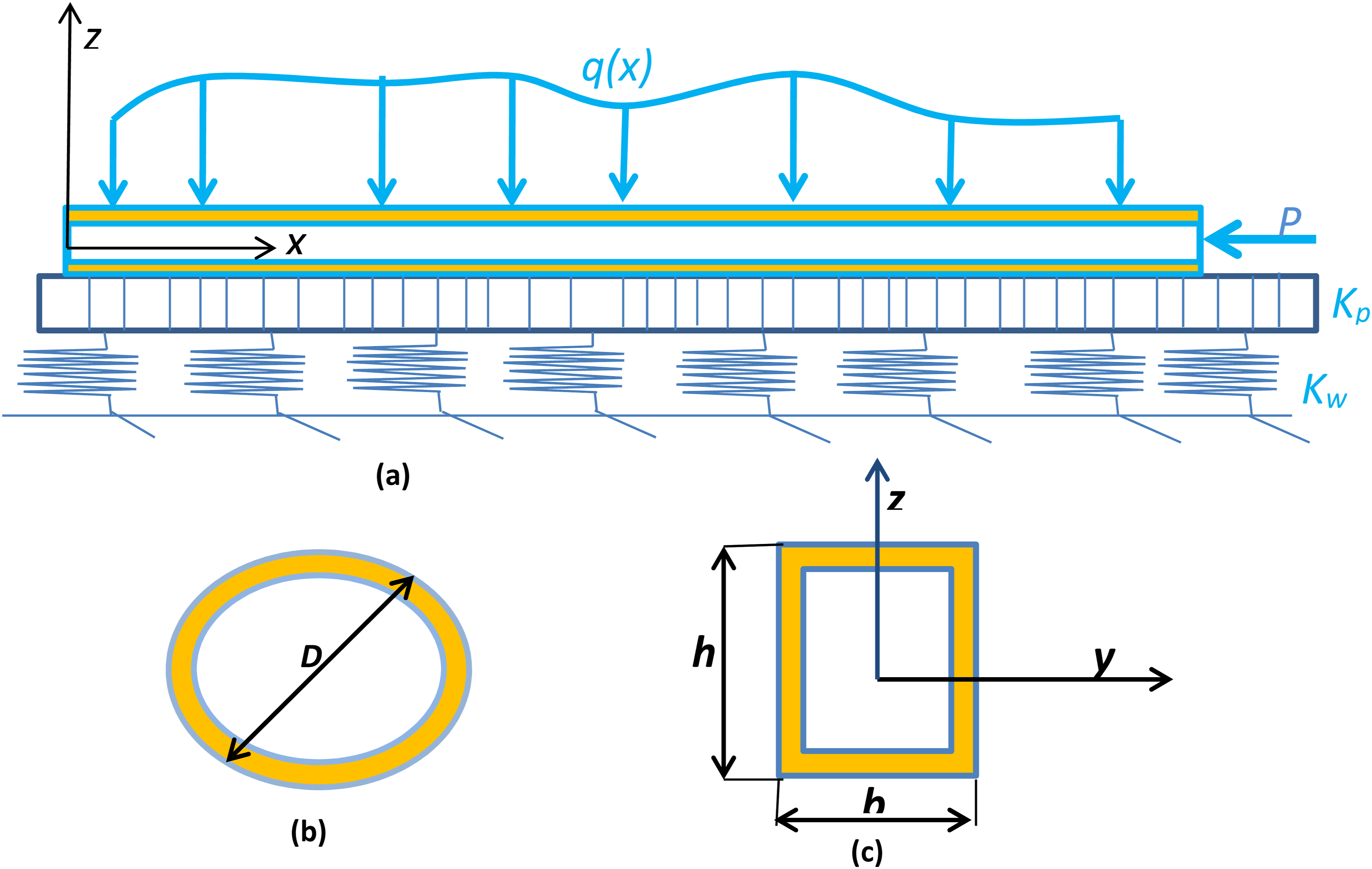


Next, the axial (





The presence of the surface stress at the surface and interior of the nanobeams is captured by the parameter


for nanobeams with rectangular and circular cross section respectively.40,54,55As shown in Figure 1,a special longitudinal loads

Additionally

To be able to determine the governing equation, the Hamilton’s principle
56
is formulated as:


The variation of the kinetic energy is then defined as follows:

The strain Energy and its vibrational form are respectively given by:






After substituting Equations (14), (16), (19) and (20) into Equation (12) one obtains a following system of two differential equations


Associated to the following boundary conditions:

2.1. The nanobeam modelled with local elasticity theory
After Replacing the Equation (5), inside equations (21) and (22), and considering the mass inertia no one come out with the following differential equation of the system:


Let’s choose the solutions of Equation (24) and Equation (25) in the following form


The novel Timoshenko beam theory consists on using the system of differential Equation (26)-(27) to obtain a single differential equation governing the system. For the purpose, the following expression is extracted from Equation (27)




Equaling Equations (30) and (31), we get the novel Timoshenko beam equation as:



Equation (32) depends only on transverse displacement as, the rotation terms have been expressed in terms of transverse displacement’s derivatives. The following novel boundary conditions are derived from Equation (23):






2.2. The nanobeam modelled with nonlocal elasticity theory
In order to capture the small size effect, the Eringen nonlocal theory is used most of the time. In fact the Bending moment


After performing a multiplication of Equation (41) by

The integration over Area

As adopted in the previous section by assuming the following expressions





After deriving Equation (46) with respect to

After equaling (49) and (50), one obtains the following single differential equation:




Associated to the following boundary conditions:







3. The normalized power series method
The Normalized power series is employed for finding the Eigen frequency of Equation (32) or Equation (52). As a four order differential equation, the PSM expresses its solution as a sum of four independent fundamental functions as follows



Next, the normalization procedure is applied by solving the following sytem
58



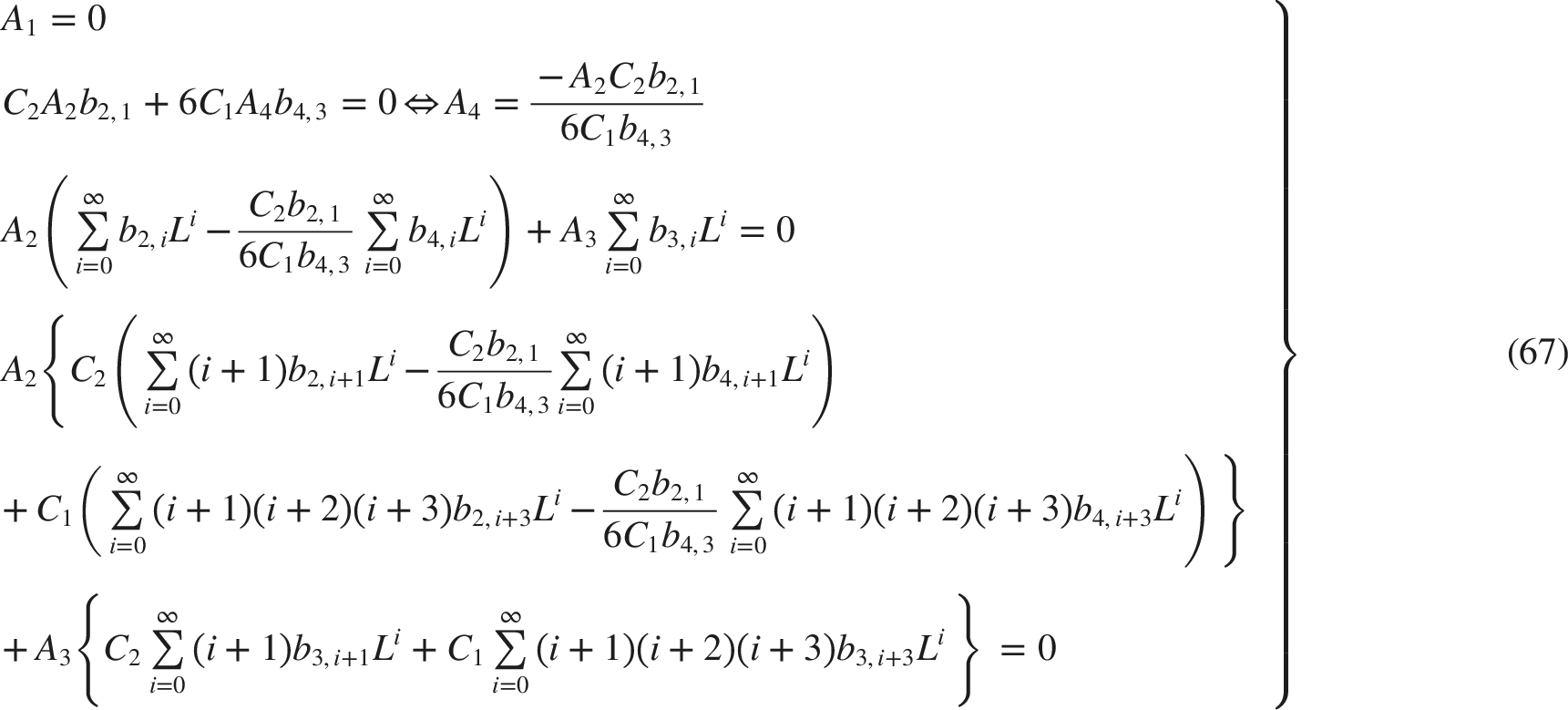
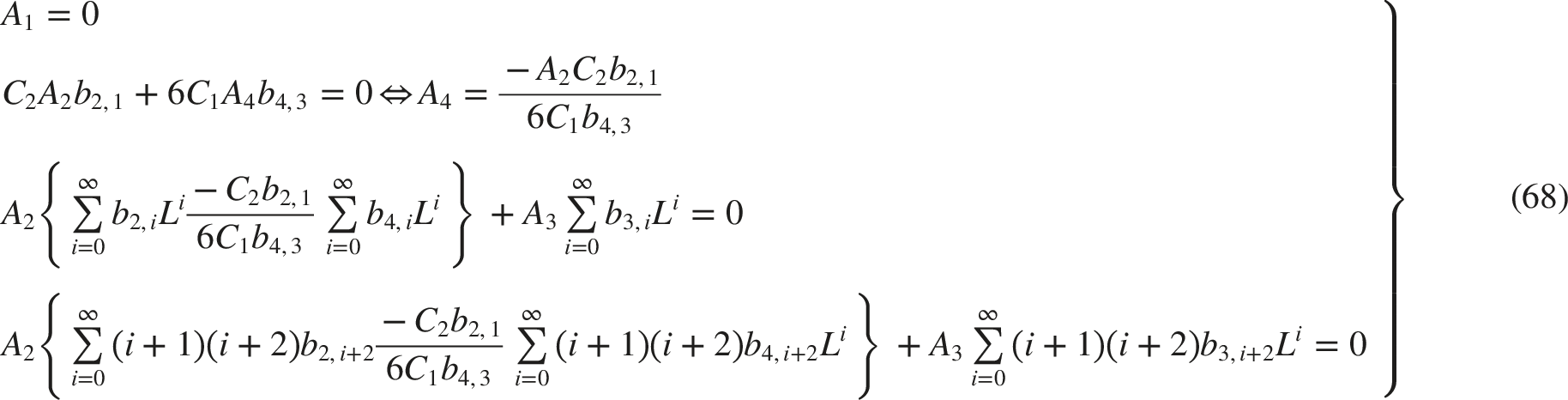
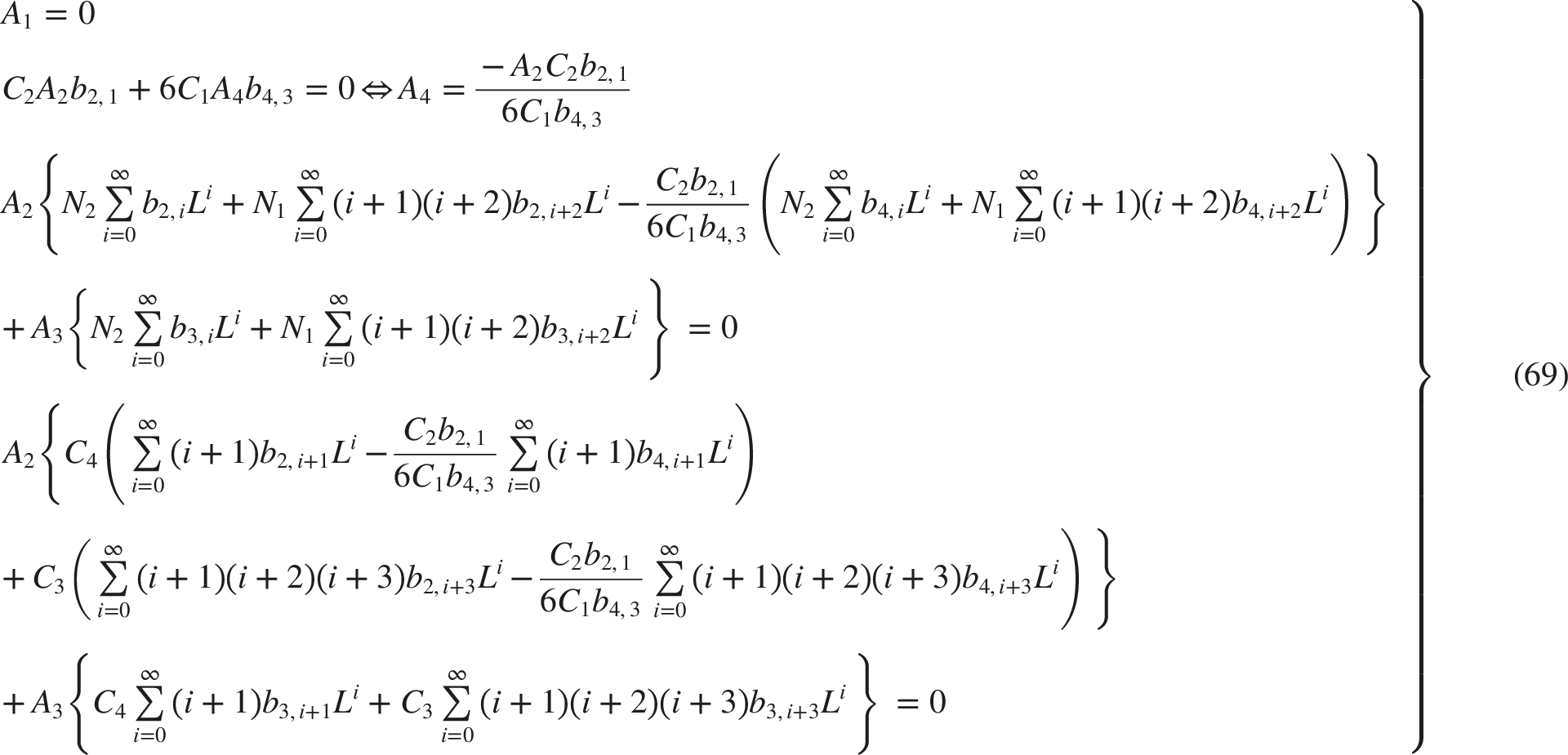
From Equations (66)-(69), obtained using a normalized power series method, the eigenfrequency equation is computed by a Matlab code.
4. Results and discussions
For sake of simplicity and stability of the PSM, the following dimensionless variables are adopted:


Also, for all tables and graphs, following values will be considered:

4.1. The nanobeam modelled with local elasticity theory
The accuracy of the PSM is linked to the number of terms N in the series of Equation (61). The process consists on solving the eigen equations (66)-(69) to obtain one natural frequency

The condition of Equation (72) is a proof that the desired accuracy is reached and also that the graph of the variation the frequency with Convergence of the first natural frequency of the nanobeam, Comparison of first three natural frequencies of a simply supported nanobeam with rectangular cross section. Comparison of first three natural frequencies (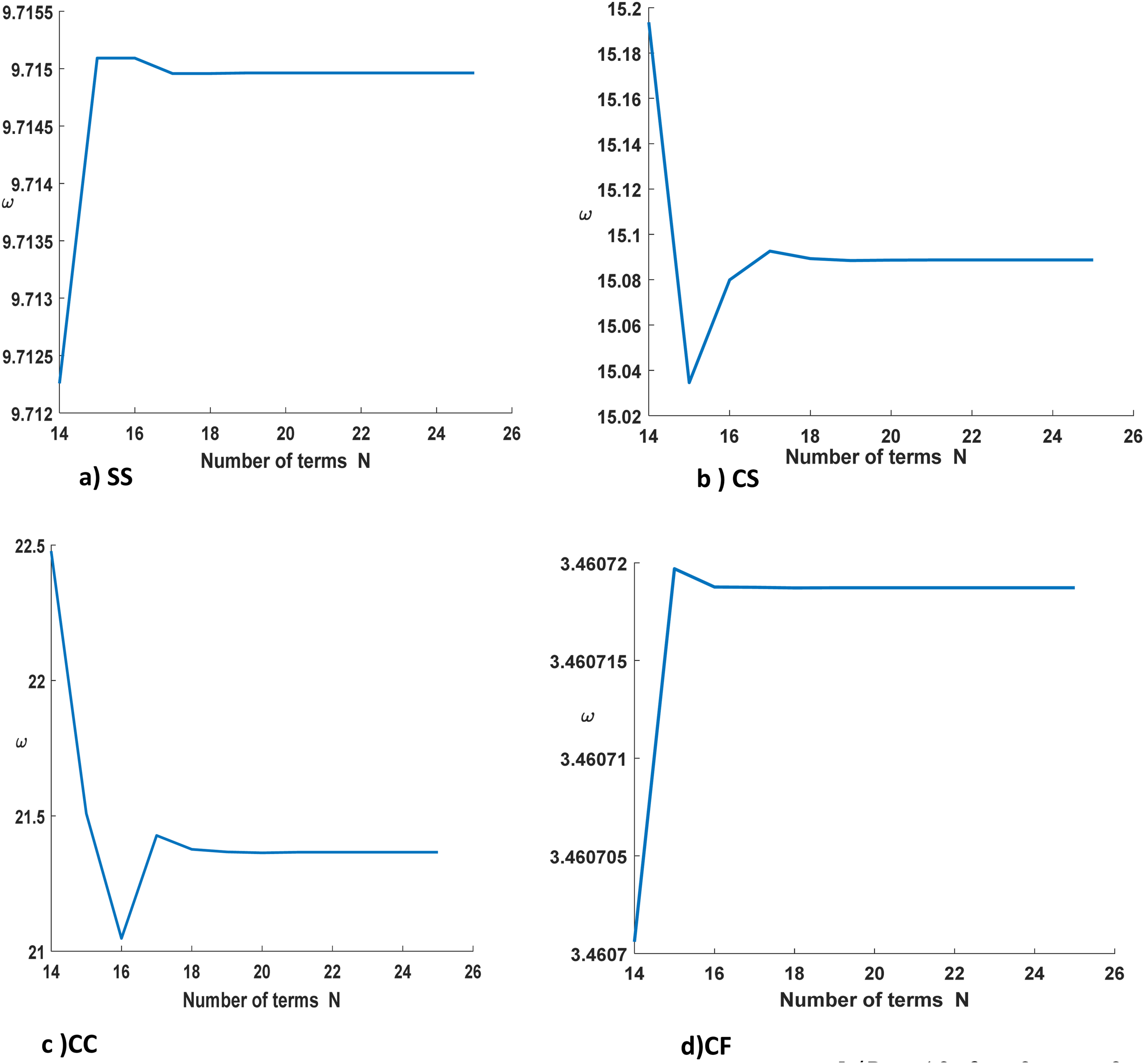

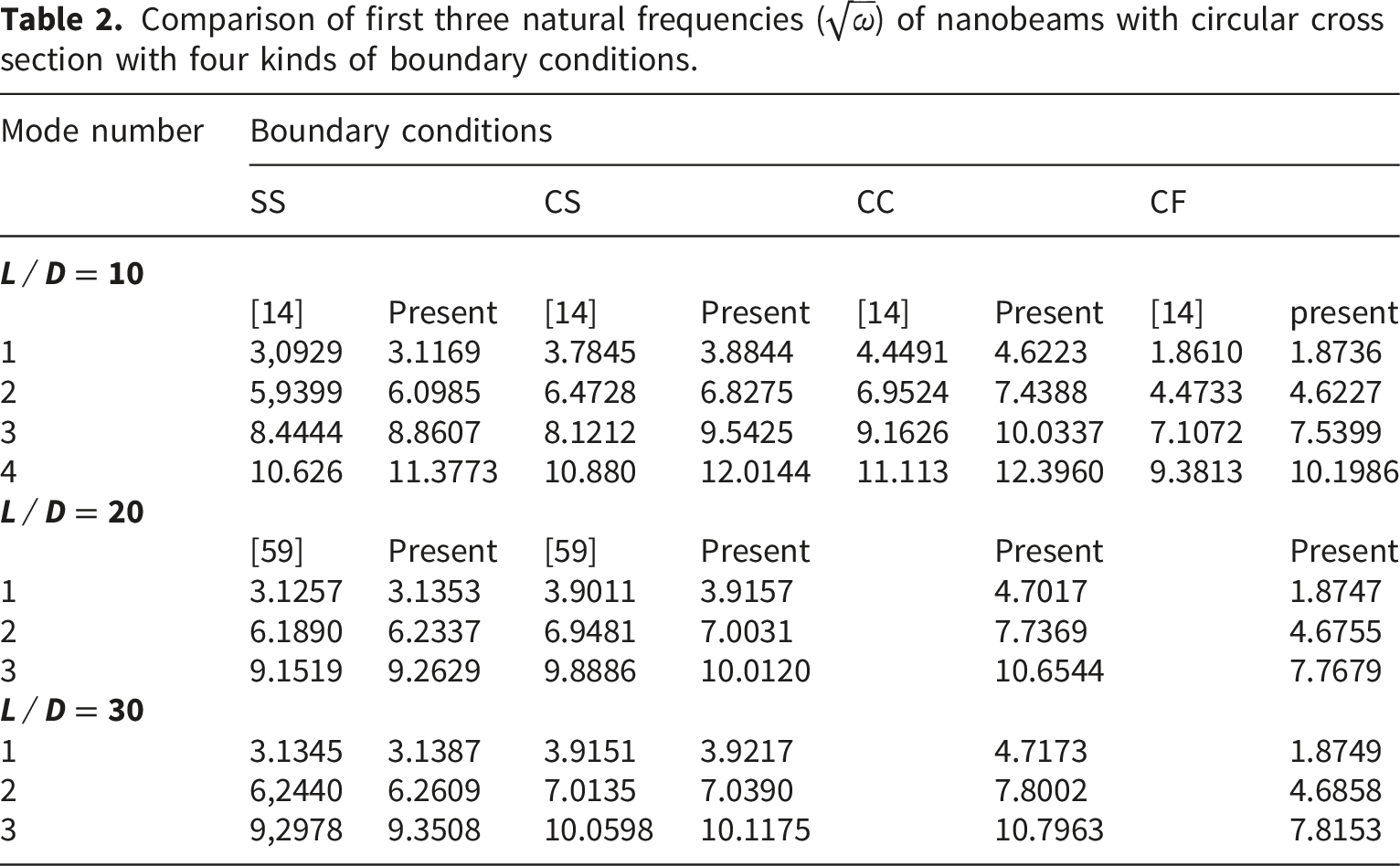
When L/D=20 and L/D=30 our results are compared with those obtained by Farzad et al., 59 using the Differential transformation method. The results obtained from the present method are little bit greater, compared to those obtained using DTM, with the difference of 0.5 to 1,3%.
Also, CS and CF results which are not considered in Ref. 59 are added in the table. Globally, Table 2 highlights that, increase the length to diameter of the nanobeam increases also the natural frequency regardless of the chosen boundary conditions.
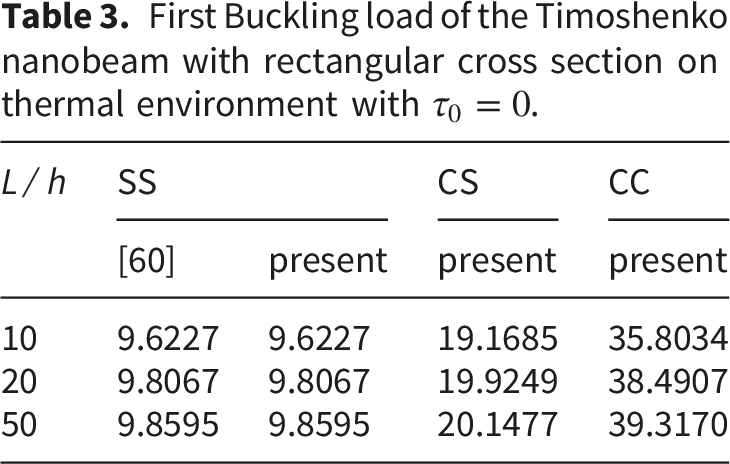
First Buckling load of the Timoshenko nanobeam with rectangular cross section on thermal environment with
The Figure 3 shows the linear variation of the dimensionless frequency of the nanobeam when the temperature increases. One can observe that, for SS, CS, and CC boundary conditions, the nanobeam with circular cross section has a higher frequency than the nanobeam with rectangular cross section. The gap between the two cross sections is bigger(about 1.5%) for CC boundary condition and smallest(0.3%) for SS case. When the temperature increases from 0 to 100OC the frequency of nanobeam with CCS also increases quickly than the RCS case. Moreover, the simply supported nanobeam is more affected by the temperature as, it frequency increases for about 10% for CCS and 9% for RCS. For CS nanobeam we get 5% for CCS and 4% for RCS while CC condition is about 3% for CCS and 1.6% for RCS. For the cantilever nanobeam, the frequency decreases instead, when the temperature augments. The frequency percentage of diminution is about 9% for CCS and 8% for RCS. Variation of frequency with temperature for nanobeams with rectangular and circular cross section ( 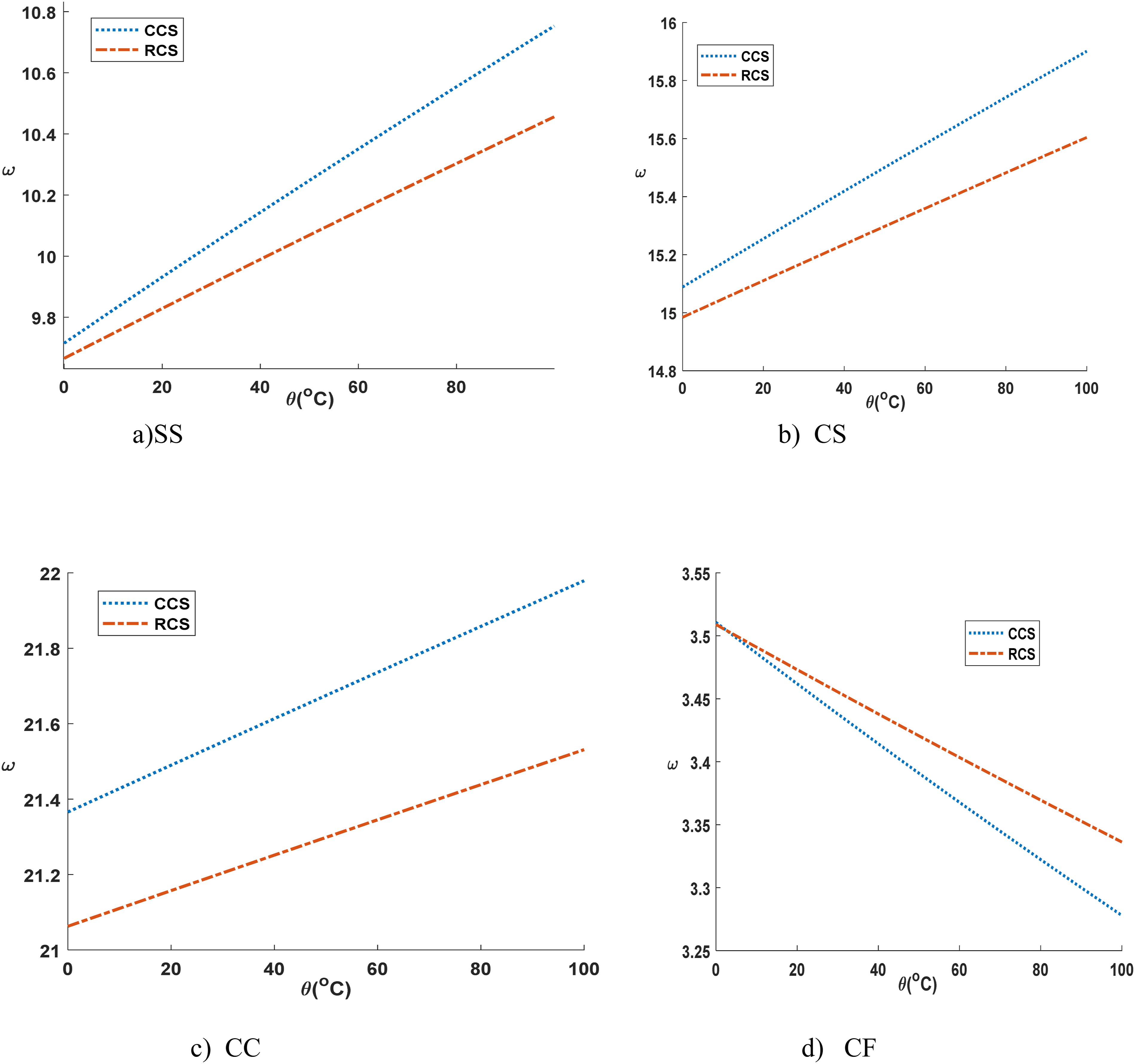
From Figure 3, we can conclude that, the frequency of the nanobeam is vulnerable to the temperature, regardless of the boundary condition and the geometry of the its cross section but, simply supported and cantilever nanobeam are more affected by the temperature increase.
Figure 4 shows graphs of the effect of residual stress on the frequencies of the nanobeam with CCS and RCS. The boundary conditions are those of Figure 3 and the observation is that, the increase of Effect of the cross-section of the nanobeams on the variation of frequency with residual stress. (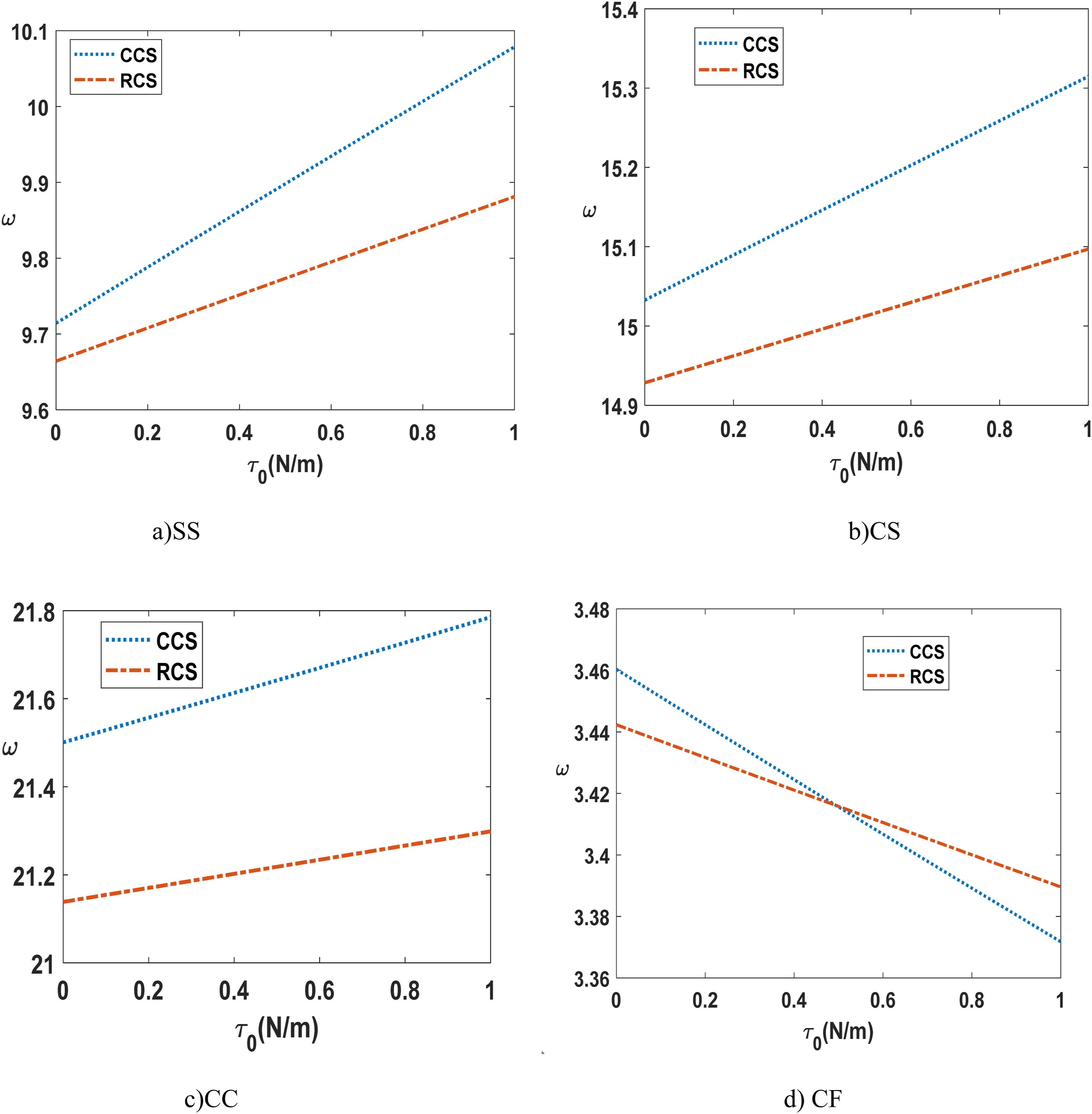
Figures 5 and 6 show the 3D surface plotsof frequency when both the diameter and the length of the nanobeam increase. The surface plot is done for three values of the temperature. In both figures it’s noted that, with a fixed length, the frequency decreases then a diameter of the nanobeam increases. When the diameter is fixed and the length augments, the frequency increases. The increase is faster when the ratio Effect of the diameter and length on the frequency of a simply supported nanobeam with circular cross section when the temperature changes. ( Effect of the diameter and length on the frequency of a clamped-supported nanobeam with circular cross section when the temperature changes. ( Effect of the diameter and length on the frequency of a simply supported nanobeam with circular cross section when the residual surface tension changes. ( Effect of the diameter and length on the frequency of a clamped-supported nanobeam with circular cross section when the residual surface tension changes. ( 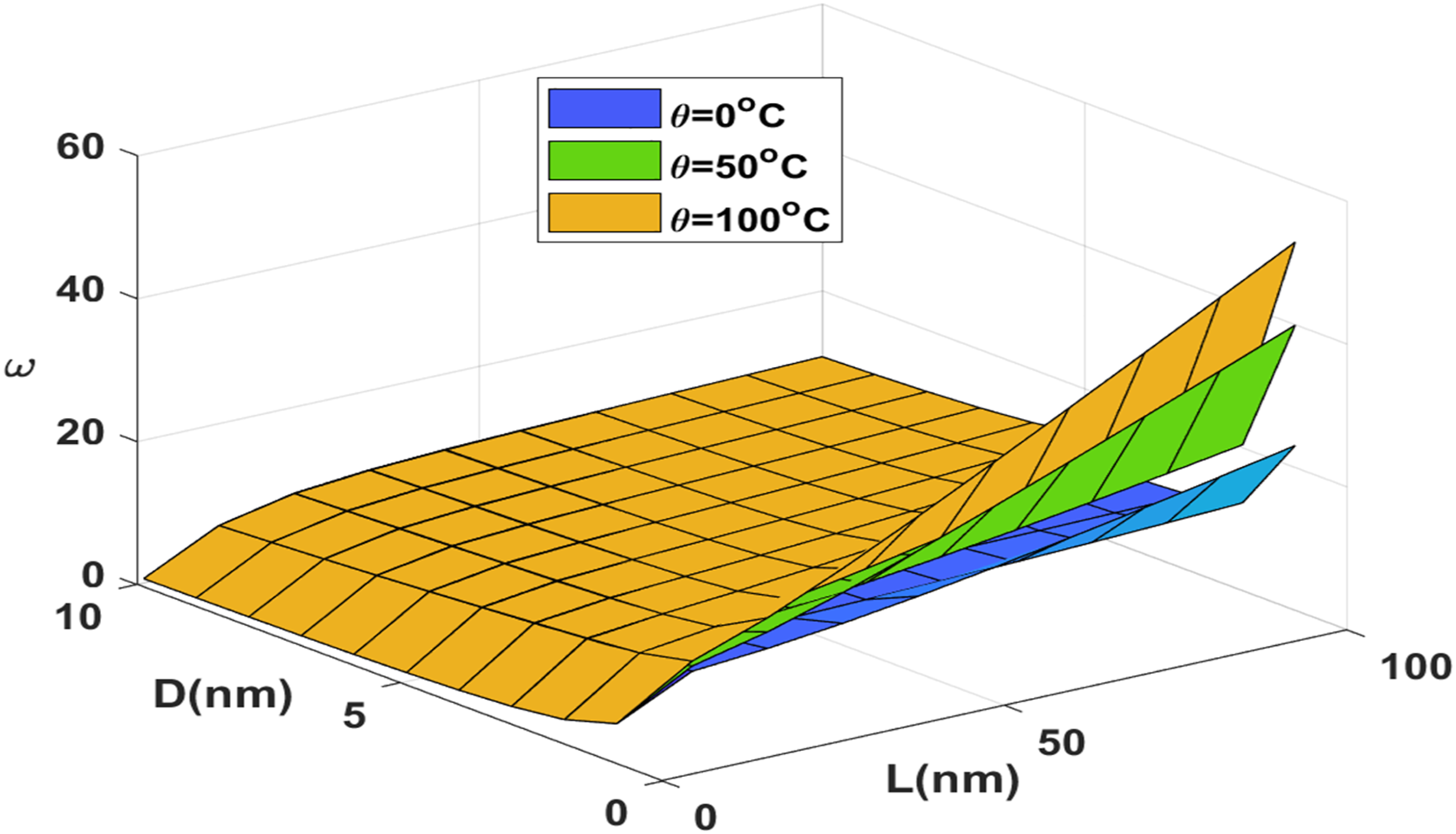
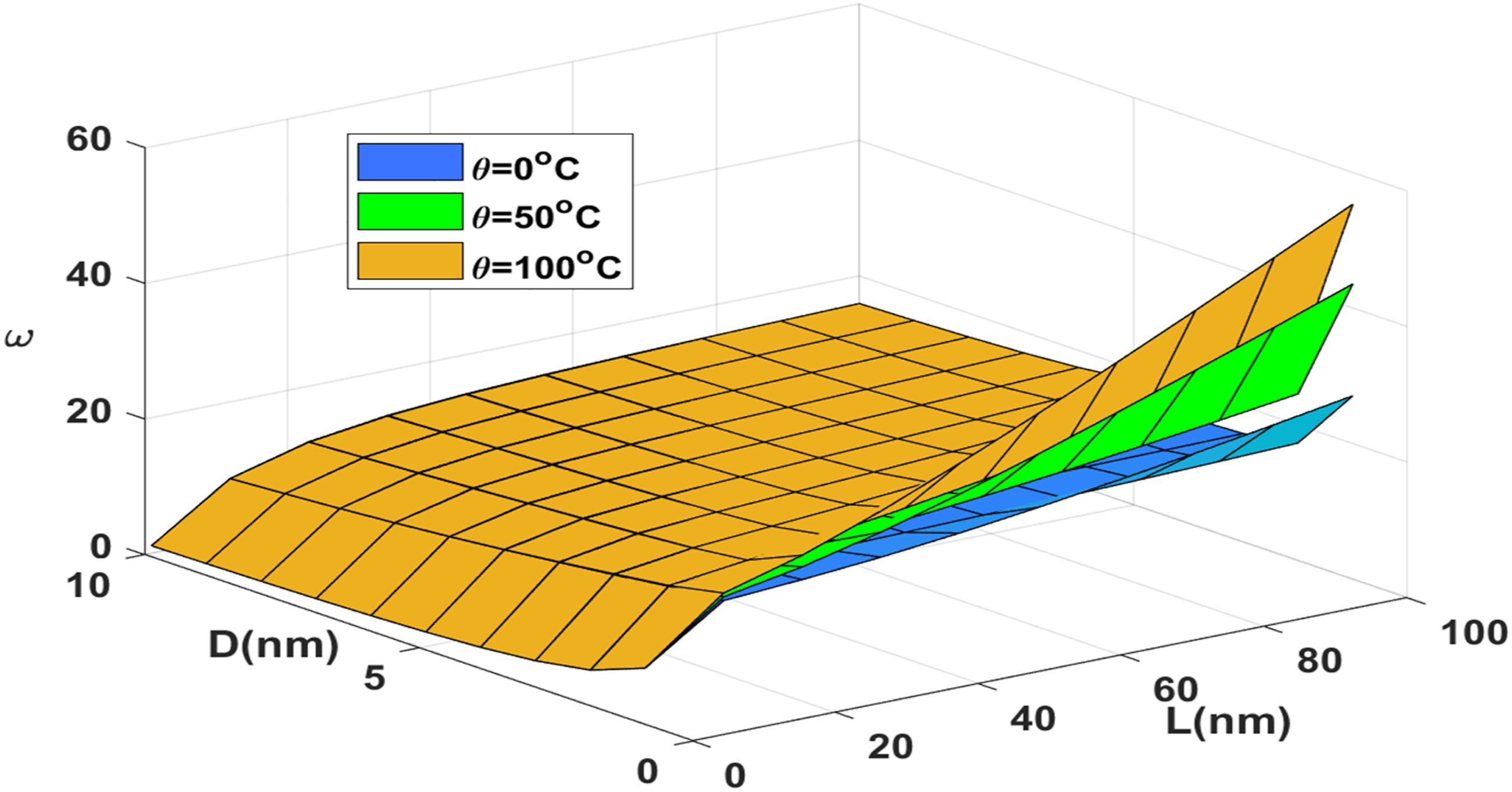
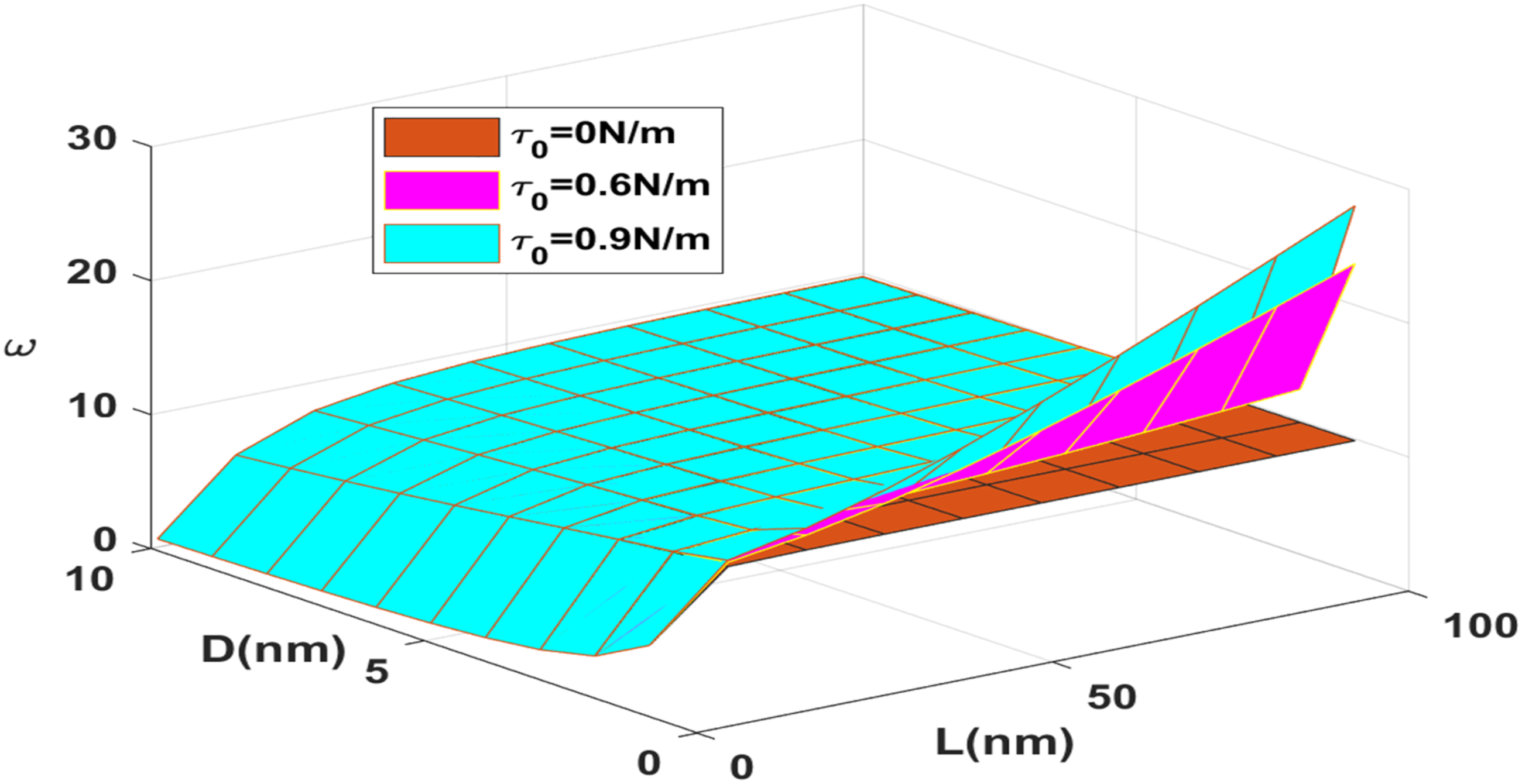
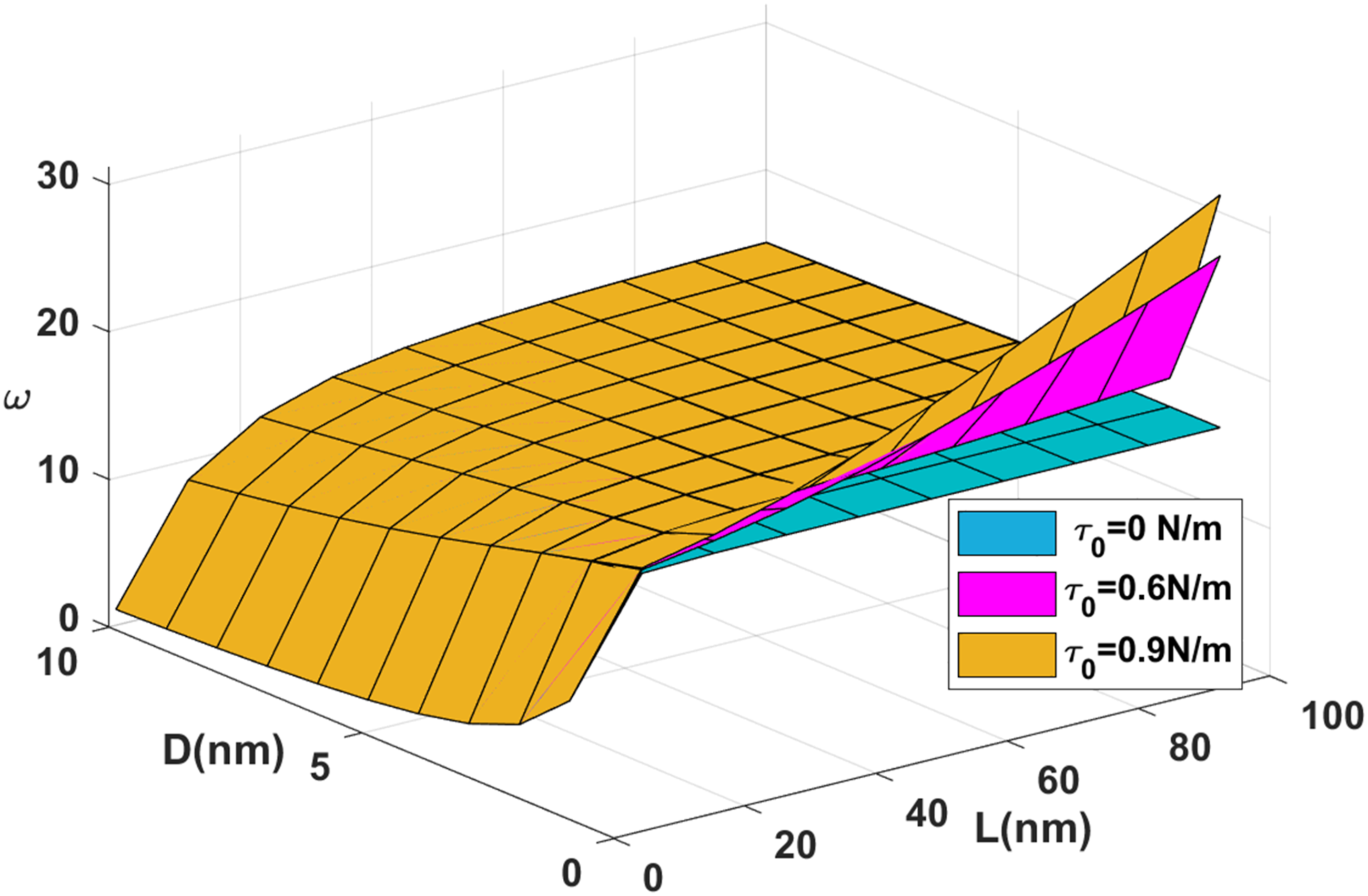
Figures 5–8 highlighte some common facts, namely the increase of the frequency with length and its decrease with diameter of the nanobeam regardless the considered boundary conditions.
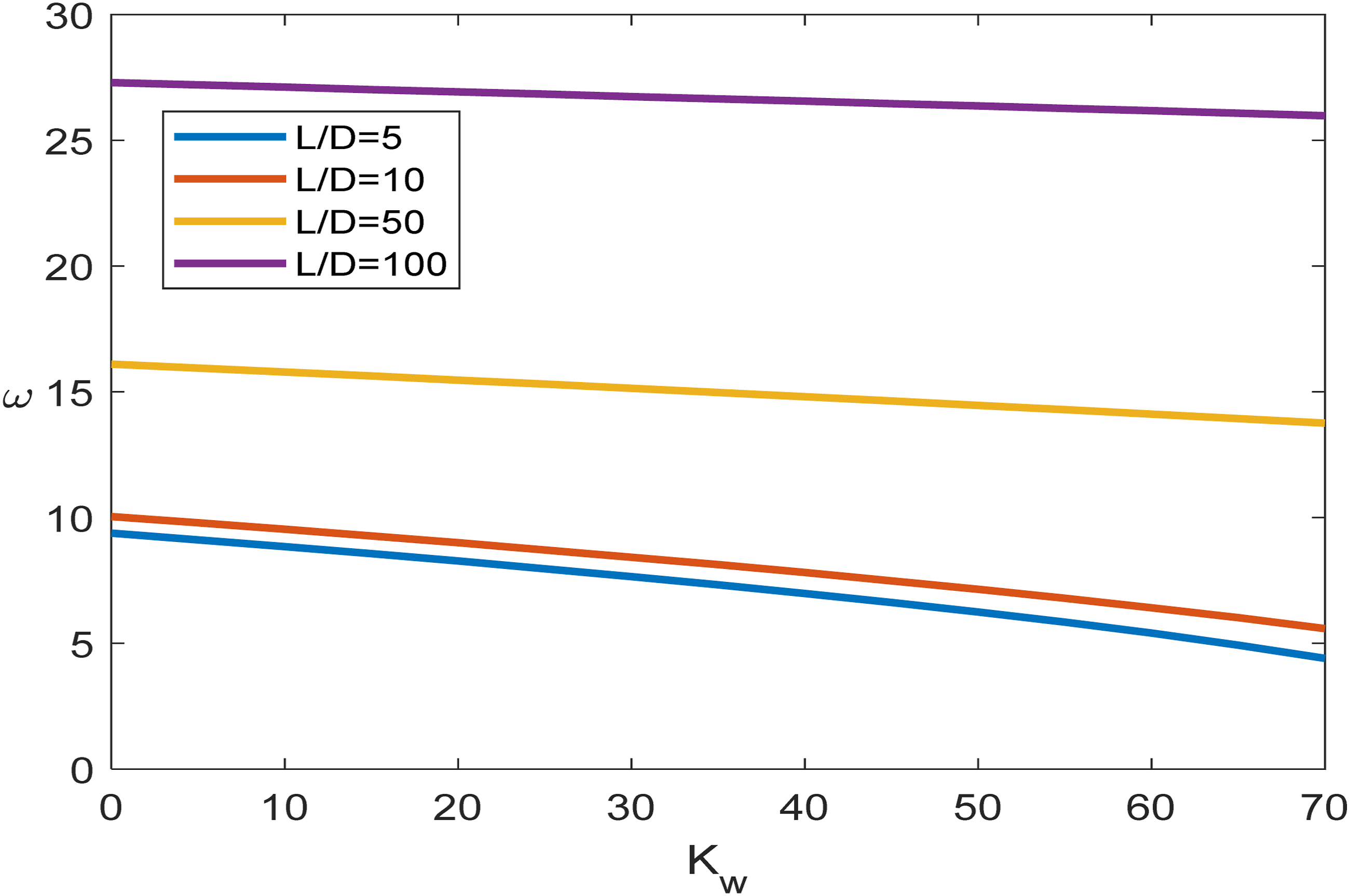
The plots on Figures 9 and 10 show respectively the effects of the shear and Winkler moduli on the vibration frequency of the nanobeam, for fully supported nanobeam. when Effect of dimension ratio on the variation of the frequency with Pasternak modulus for simply supported nanobeam with circular cross section. Effect of dimension ratio on the variation of the frequency with Winkler modulus for simply supported nanobeam with circular cross section. (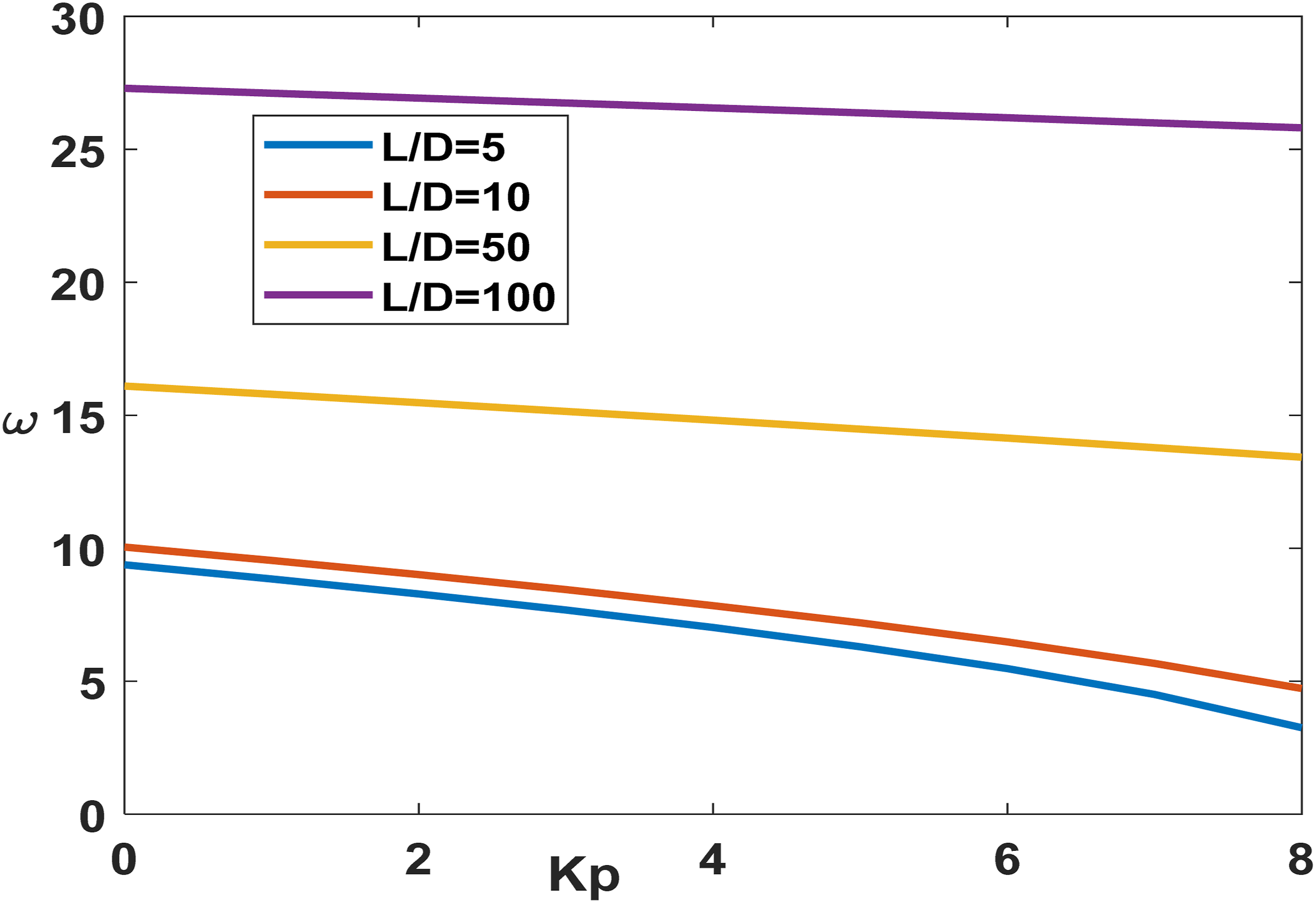
4.2. The nanobeam modelled with Eringen nonlocal elasticity theory
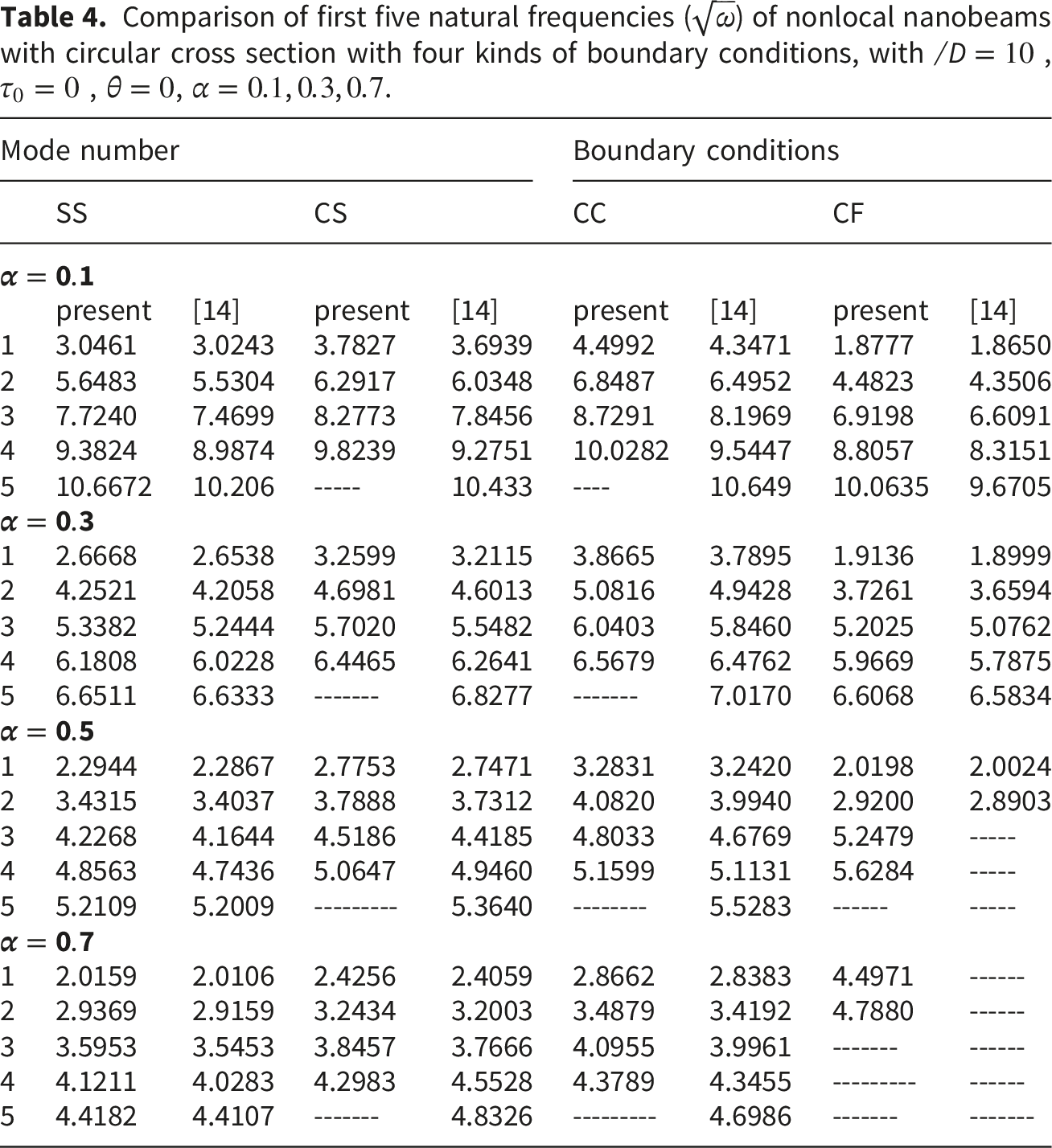
This section is devoted to on the analysis of the nanabeam based on the Eringen nonlocal elasticity theory. In fact, the equation (52) as well as boundary equations (54), (55) (57) and (58) are implemented via the PSM scheme of Equation (61)-(69). By following the dimensionless variables (70)-(71), the convergence of the eigenfrequencies of the nanobeam are computed. As shown in Figure 11, Convergence of the third vibration frequency of nonlocal nanobeam for Comparison of first five natural frequencies (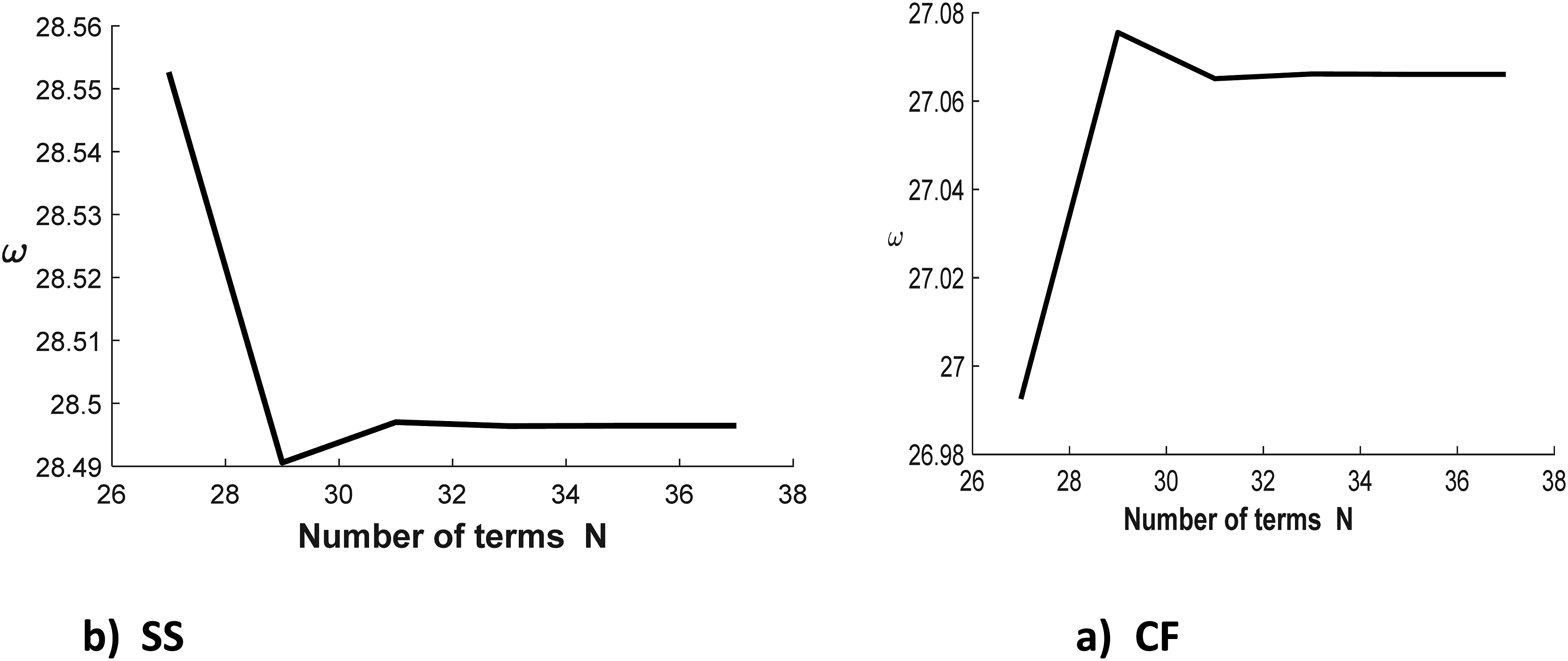
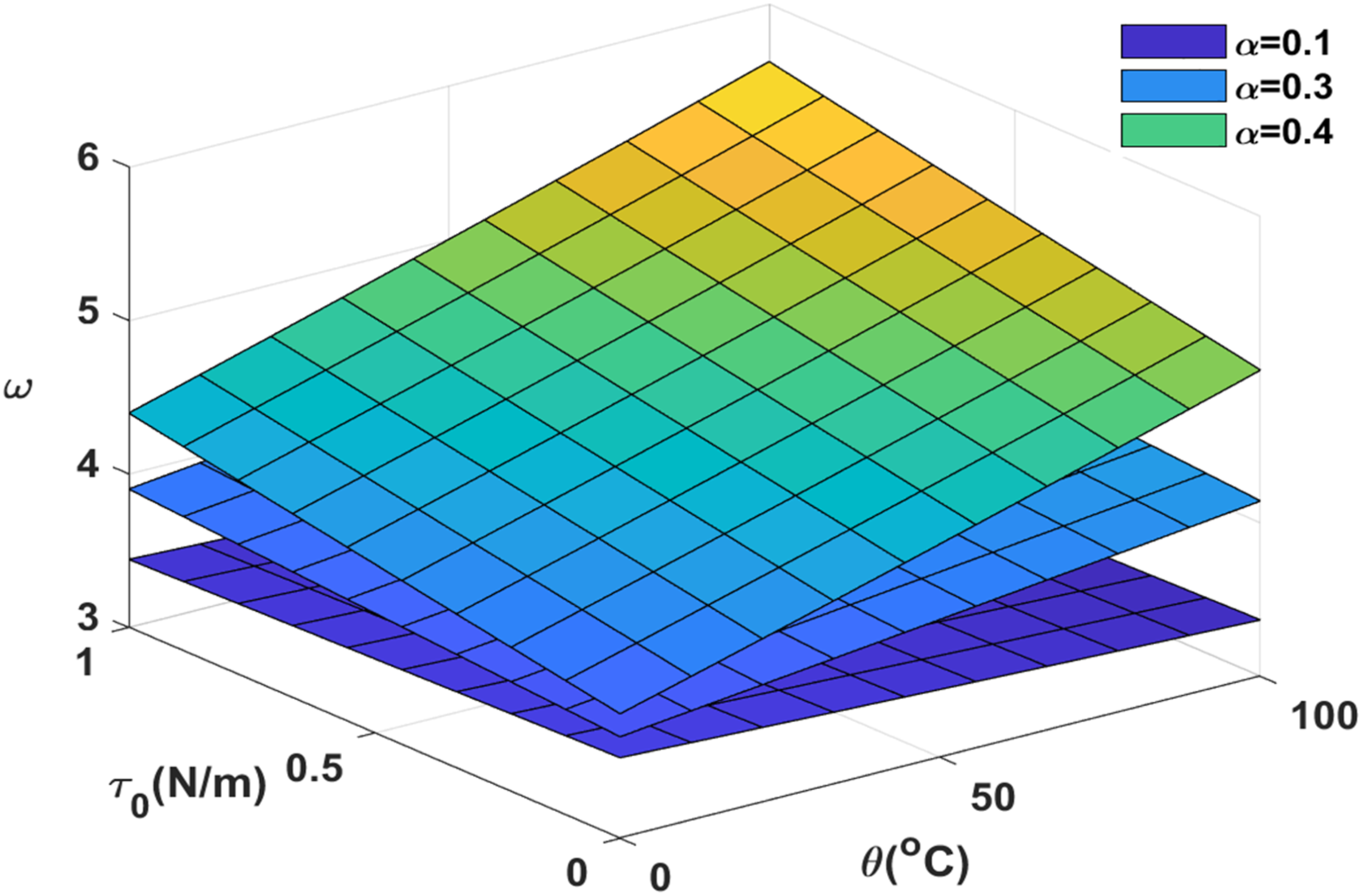
The effects of the temperature and the residual tensions were also examined through surface plot, for SS and CF nonlocal nanobeam, as displayed in Figures 12 and 13. The Figure 13 shows how both the temperature and the surface tension linearly increase the first vibration frequency of the SS nonlocal nanobeam, independently to the nonlocal parameter. In Figure 13, the first frequency of the CF nonlocal nanobeam decrease with the temperature and surface tension when Effect of the temperature and residual tension on the frequency of a SS nonlocal nanobeam with circular cross section when the nonlocal parameter changes( Effect of the temperature and residual tension on the frequency of a CF nonlocal nanobeam with circular cross section when the nonlocal parameter changes(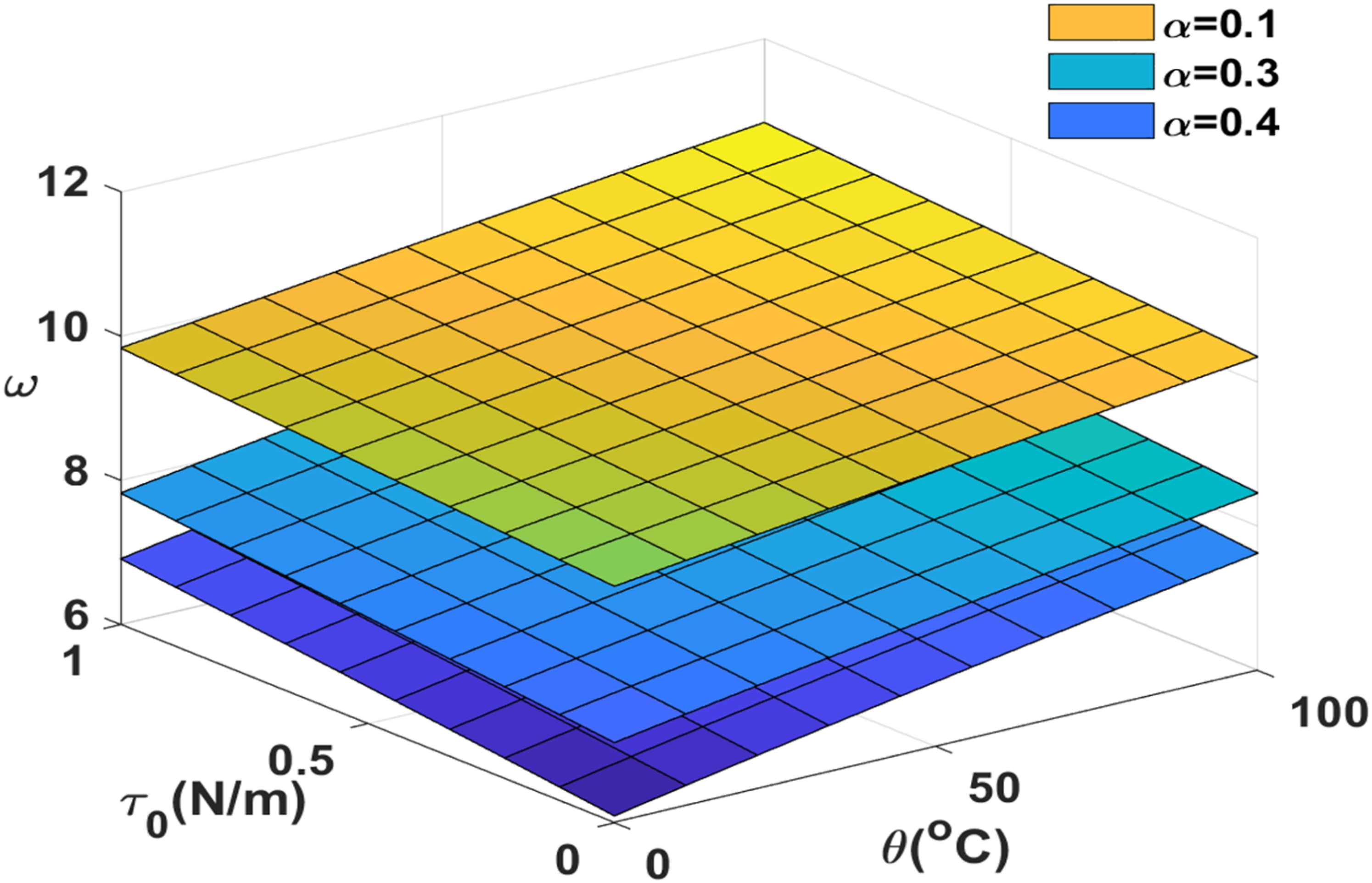
5. Conclusion
The concept of novel Timoshenko nanobeam theory was derived and explained in details in the present paper. It consists of eliminating the rotation function in the differential equation system to obtain only a single one. The boundary conditions were also treated in order to eliminate the rotation of the cross section. For the first time ever, the final single equation was successfully solved by employing power series method, for both local and nonlocal nanobeam. The obtained results were then successfully compared to the existing works, and the following conclusions have the merit to be addressed: i) The power series method is accurate to compute the frequencies of the nanobeam, considering SS, CS, CC, and CF boundary conditions. This appears to be the first novelty of this paper, as the work of Amirian et al.
46
did a similar study, but they have restricted their study to fully supported nanobeams. Our results appear to be an extension of the work of Amirian et al.
46
We have also successfully extended our study to Eringen nonlocal nanobeam. ii) As the temperature increases, the nondimensional frequency of the nanobeam with a circular cross section is always bigger than the frequency of the nanobeam with a rectangular cross section, rendering therefore the CCS nanobeam more vulnerable to the temperature. The augmentation of the temperature diminishes the frequency of the CF nanobeam and increase the frequencies of SS, CS, and CC nanobeams. SS and CF nanobeams are more affected by the increase of the temperature because their frequencies could rise up to 10% or decrease up to 9% when the temperature changes from 0 to 100°C. iii) Residual stress increases the vibration frequency for SS, CS, and CC boundaries, while it decreases the frequency of the cantilever nanobeam. Simply supported and cantilever nanobeams with circular cross sections are the most affected by the augmentation of the residual stress, as SS frequency could increase by about 3.6% while CF decreases by about 2.6%. iv) The increase of the diameter of the nanobeam might decrease its frequency, while the increase of its length leads to the augmentation of the frequency, regardless of the considered boundary condition. Moreover, the slight increase of the shear modulus could rapidly annihilates the dimensionless frequency when the length-to-diameter ration is less than 50. The Winkler modulus decreases the frequency after a considerable range of variation, showing a slower effect on the diminishement. v) Both local and nonlocal theories show an increasing role of the temperature and the residual tension NO on the vibration frequencies for SS, CS, CS nanobeams. v) For cantilever nanobeam, the temperature and residual stress augment the vibration frequencies regardless of the nonlocal parameter except on the first frequency for
All the previous findings could be useful or the Nanomechanical industries where the nanobeam is the key element.
Footnotes

Funding
The authors received no financial support for the research, authorship, and/or publication of this article.
Declaration of conflicting interests
The authors declared no potential conflicts of interest with respect to the research, authorship, and/or publication of this article.