







Abstract
The Malaysian police appealed to parliament to reinstate preventive detention without trial laws, such as the Emergency Ordinance and the Prevention of Crime Act 1959, to reduce crimes. These laws were abolished in 2012 because they violate the rights of ‘innocent until proven guilty’ and have been abused. Although the legal profession and civil society disagreed with their reinstatement, parliament amended the Prevention of Crime Act in 2013. This article shows that such laws alone have not been effective in crime prevention and that the crime rate declined between 2009 and 2012 because of the implementation of scientifically tested methods such as installing closed-circuit televisions, and the government’s mobilisation of the police to hot spots in order to meet the National Key Results Areas target of reducing crime. Lastly, the article stresses that effective crime prevention involves a judicious combination of both scientific research and strategy. The article believes that the concept of Total Defence mooted in 1986 by the Ministry of Defence should be revisited as a total strategy or comprehensive security strategy for the defence and security of the country.
Background
The 2010 Census reported that Malaysia has a population of 28.3 million (Department of Statistics Malaysia, 2010); the number of police personnel is 112,145 (Royal Malaysia Police, 2013). As such, the ratio of the police to the population of Malaysia is 1 : 252, which is better than the United Nations recommended peacetime police-to-population ratio of 222 police per 100,000 of the population or a ratio of 1 : 450 (Vira, 2011).
Since 2009, the Royal Malaysia Police’s strategic plan for reducing the crime rate has been guided by the Government Transformation Plan (GTP), the brainchild of current Prime Minister, Najib Razak (PEMANDU, 2013). The GTP, which is implemented under the purview of the Performance Management and Delivery Unit or PEMANDU, is a ‘dynamic plan of change’ to ensure that Malaysia will achieve the status of a developed, high-income nation by 2020. In order to achieve the target, seven national key results areas (NKRAs) have been identified: reducing crime, fighting corruption, improving student outcomes, raising the living standards of low income households, improving rural development, improving urban public transport and addressing the cost of living. Each NKRA is under the purview of a cabinet minister who is accountable to the prime minister.
The NKRA of reducing crime aims to reverse the rising crime rate and to increase public satisfaction in the services provided by the police. This is in view of the 2007 Royal Police Commission Report, which noted that public confidence in the police was very low (Teh, 2009). In addition to being unable to prevent or check crime, the police were viewed as corrupt. This image of the police has not changed since 2007, as reflected in the Transparency International Survey reported in Bloomberg BusinessWeek on 9 July 2013. In the report, the police and political parties are perceived by Malaysians to be the country’s most corrupt institutions. Although Malaysia has moved up from 60th to 54th place among 176 countries in Transparency International’s Corruption Perceptions Index, it is ranked worst for bribery among 30 countries surveyed.
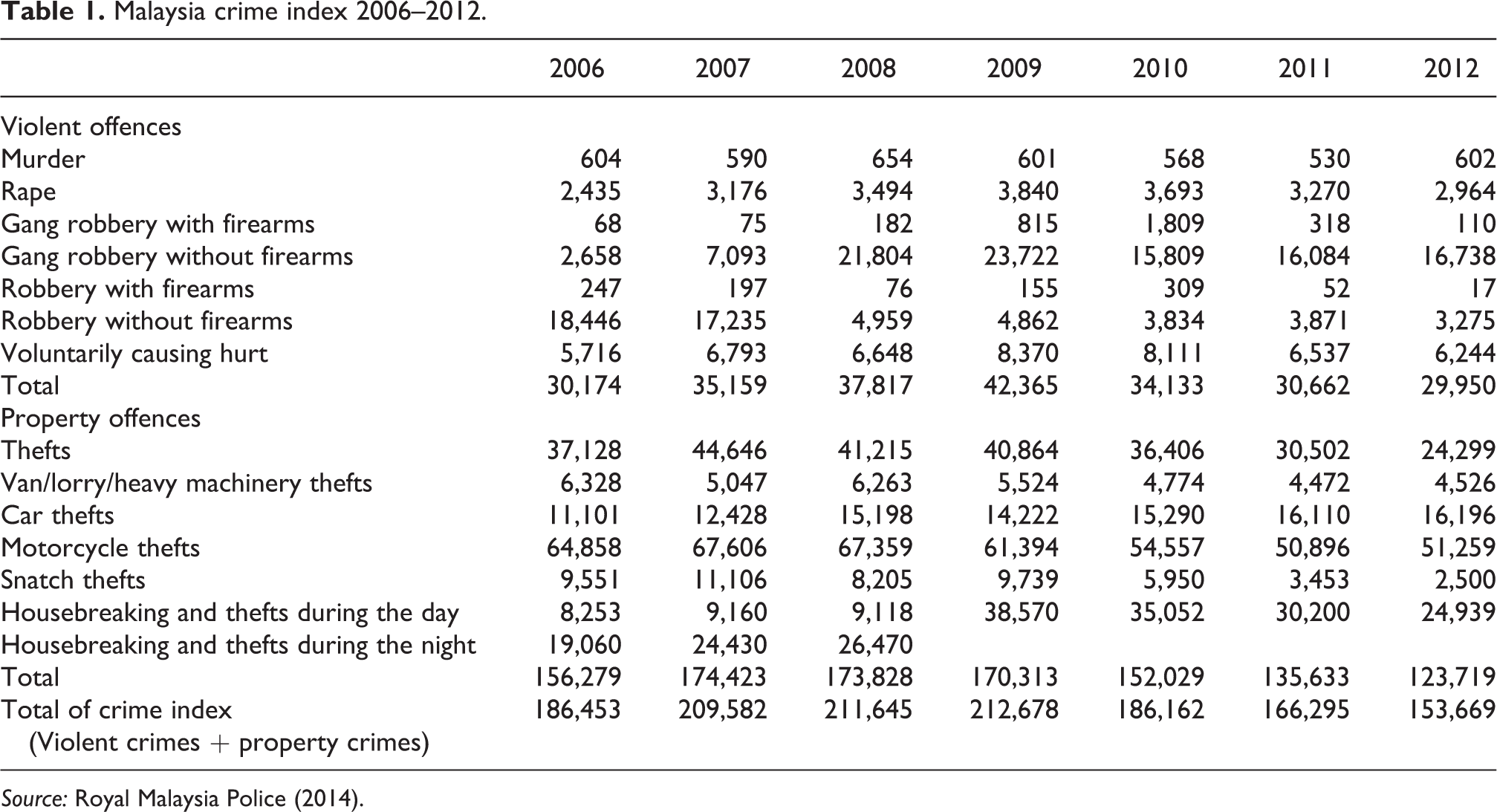
The steps taken by the government to reduce crime include installing CCTVs, recruiting more police officers, mobilising the police Ikatan Relawan Rakyat Malaysia (RELA, Volunteers of Malaysian People) and Jabatan Pertahanan Awam Malaysia (JPAM, Malaysia Civil Defence Department) to crime hot spots and brightening street lights. Since these steps were taken, the police have reported a decrease in index crime of 29% between 2009 and 2012 (Royal Malaysia Police statistics on index crime, see Table 1).
Malaysia crime index 2006–2012.
Source: Royal Malaysia Police (2014).
However, the police also reported that although crime was down for the period January to June 2013 compared with the first half of 2012, the numbers of murders and robberies with firearms had risen (The Star, 2 August 2013). Overall, violent crime increased from 14,811 to 15,098 cases. Of this, robbery (including gang robbery) with firearms increased from 69 to 74 cases and murder increased from 291 to 322 cases. A few murder cases involved high-profile personnel, for example, the founder of the Arab–Malaysian Development Bank, Hussain Ahmad Najadi, who was shot in a car park and the Customs Department Deputy Director-General, Shaharuddin Ibrahim, who was shot three times when the car he was travelling in stopped at traffic lights (The New Straits Times, 27 April 2013).
The increase in murder and robbery with firearms cases prompted the police, certain anticrime activists and academics to call for the abolished Emergency (Public Order and Prevention of Crime) Ordinance 1 (EO) to be reinstated (The Star, 2 August 2013). They argued that the EO provided the tools and means for detaining criminals, and that abolition of the EO had resulted in the release of nearly 2000 suspected hardened criminals who contributed to the spike in crime, especially serious crime (The Star, 4 July 2013).
In a crime prevention forum held on 24 August 2013, the Director of Criminal Investigation, Hadi Ho, revealed that there were more than 40,000 suspected gang members in the country and that after removal of the preventive detention laws, gang members had become more visible and violent (Malaysiakini, 24 August 2013). From the police records, 71% of gang members were Indian, 23% were Chinese and fewer than 5% were Malay. However, in the same forum, the Attorney General, Abdul Gani Patail, did not concur with the police. He argued that preventive laws, such as the EO, were unnecessary and that existing laws were sufficient in combating crime. He also pointed out that only 263 former detainees under the EO have committed crimes and this included those who were released prior to the repeal of the EO. Moreover, the crime index in Table 1 shows that when the EO was still in place, violence crime was increasing in Malaysia, i.e. from 30,174 cases in 2006 to 42,365 in 2009. However, between 2009 and 2012, there was a noticeable decrease in violent crime, i.e. from 42,365 cases in 2009 to 29,950 cases in 2012. The fluctuation in the crime rate between 2006 and 2012 could not be attributed to the EO. A possible reason for the decrease in crime could be the zealousness of the government in meeting the NKRA target for reducing crime. The collective effect of the steps taken, for example, installing CCTVs, recruiting more police officers, mobilising the police and volunteers to crime hot spots and brightening street lights, might have reduced the crime rate.
In addition to the EO, the police also pushed for amendments to be made to the Prevention of Crime Act 1959 (PCA). The amendments were passed by parliament on 3 October 2013 although the Malaysian Bar, human rights organisations and civil societies did not agree with the amendments. These groups were disappointed that their views were not taken into consideration and the amendments were passed in swiftly. The amendments to the PCA have been perceived as a resurrection of the infamous Internal Security Act 1960 (ISA) 2 , another preventive detention law similar to the EO.
A press statement released by the Malaysian Bar on 3 October 2013 pointed out four flaws in the amendments: the amendments reintroduced the preventive detention without trial laws for up to two years (it should be noted that before the amendments, the PCA allowed detention of suspects for up to 71 days); the amendments deny the fundamental rights of ‘innocent until proven otherwise in court’ guaranteed under the Constitution; the Prevention of Crime Board that was introduced had limited utility because it was dependent on the report of the Inquiry Officer; the amendments prohibit any judicial review by the courts except on procedural measures.
Members of professional bodies and civil societies such as the Bar Council of Malaysia (Khoo, 2013), Suara Rakyat Malaysia (SUARAM; Voice of Malaysian Citizens) and Lawyers for Liberty (Malaysiakini, 24 October 2013) also expressed concern that the number of deaths in police custody would increase with the prolonged detention period. This is in view of the fact that between 2000 and mid-2013, 231 detainees had died in police custody.
Is detention without trial effective in reducing crimes?
The crime statistics in Table 1 show that changes in the crime rate are not correlated with the existence of preventive detention without trial laws. When crime rate fell between 2009 and 2012, it was most likely due to the different measures taken by the government under the NKRA for crime prevention. These measures have been proven to reduce the crime rate, particularly if implemented collectively. Scientific research has been carried out to evaluate their effectiveness. For example, Welsh and Farrington (2009) carried out a systematic review and meta-analysis of 44 evaluations in the UK, USA, Sweden, Norway and Canada concerning the effects of CCTVs on crime in public places. Forty-one evaluations were carried out in city and town centres, public housing, public transport and car parks; two evaluations were carried out in residential areas; and one evaluation was carried out in a hospital. Welsh and Farrington found that CCTVs are most effective in reducing crime in car parks and in reducing vehicle crimes, and are more effective in reducing crime in the UK than in other countries. Their study was supported by that of Woodhouse (2010), who carried out an analysis of four research reports on CCTVs and crime prevention and reached the same conclusion that CCTVs are most effective in reducing crime in car parks.
Klick and Tabarrok (2005) carried out a study on whether increases in the number of police officers deterred crime. They used daily police reports of crime from the Metropolitan Police Department of the District of Columbia in their analysis and found that an increase in police presence of about 50% leads to a statistically and economically significant decrease in the level of crime (of the order of 15%). Most of the decrease in crime comes from decreases in the street crimes of vehicle theft and theft from vehicles. Klick and Tabarrok’s study was supported by Braga et al. (2012) who reviewed 19 studies containing 25 tests of police interventions at crime hot spots. Of the 25 tests, 20 reported noteworthy reductions in crime and disorder. Braga et al. concluded that policing hot spots is an effective crime prevention strategy. They also found that policing hot spots does not lead to crime displacement and that crime control benefits may diffuse into the areas immediately surrounding the targeted locations.
On the effectiveness of street lighting, Welsh and Farrington (2007) carried out systematic reviews using meta-analytical techniques on eight American and five British evaluation studies on improved street lighting and crime. Results were mixed for the American studies with four reporting that improved street lighting was effective in reducing crime, whereas the other four found no effect. However, the five British studies showed that improved lighting led to decreases in crime. Welsh and Farrington concluded that improved street lighting should be included as one element of a situational crime reduction programme, particularly in high-crime areas. This is because it is an inexpensive, effective and inclusive intervention benefitting the whole of a neighbourhood and leads to an increase in perceived public safety. Clarke (2008) supported the study by Welsh and Farrington. He reviewed literature related to improvements in lighting that were intended to reduce crime in public streets and alleys in residential neighbourhoods and concluded that improvements in street lighting led to reductions in crime, particularly in high-crime neighbourhoods. Clarke added that improved lighting might reduce crime during the day and at night. This seems to suggest that improvements in lighting act as a situational deterrent to crime, and also improve local community cohesion and pride, which in turn increases the willingness of residents to intervene in crime or cooperate with the police. Moreover, improved lighting also sends a message to potential offenders that the neighbourhood no longer offers easy opportunities for crime.
The Malaysian government seems to be on the right track with regard to crime prevention in following tested means, because the crime rate is falling. Preventive detention without trial laws, however, does not seem to contribute significantly to crime prevention. On the contrary, they may contribute to the current negative image of the police. In addition to complaints that preventive detention without trial laws have been abused, as explained earlier, complaints by professional bodies and civil societies such as the Bar Council, SUARAM and Lawyers for Liberty regarding the increase in the number of deaths among detainees in police custody should not be taken lightly and should caution the police against resurrecting the EO and amending the PCA.
On 25 July 2013, a roundtable discussion on preventive legislation and serious crime was held at the Law Faculty of the University Malaya, organised jointly with the Society for the Promotion of Human Rights (Proham), a non-governmental organisation established in 2011 by former members of the Human Rights Commission of Malaysia, and the Police Commission. The speakers and participants consisted of high-level professionals who were actively involved in the effort to reduce crime. They included: Tun Zaki Azmi, former Chief Justice of Malaysia and former Royal Police Commissioner; Datuk Kuthubul Zaman Bukhari, Proham Exco, former Royal Police Commissioner and former Bar Council chair; Shad Saleem Faruqi, Professor of Law, Universiti Teknologi Mara; Tan Sri Zaman Khan, former Criminal Investigation Department Chief with the Royal Malaysian Police Force and former Director-General of the Prison Department; Steven Thiru, Bar Council Vice President; James Nayagam, Human Rights Commissioner; K. Arumugam, chair of the Human Rights Commission of Malaysia; Datuk Baljit Singh Sidhu, solicitor and Assistant Commissioner of Police; and Ivy Josiah, Proham member and former Police Commissioner. The majority of the distinguished speakers and participants were not in favour of the enactment of laws that provided detention without trial, ‘…tough laws in themselves do not serve as a deterrent…the key is not the severity of the law, but the surety or in other words not the severity of the punishment, but certainty of the punishment’ (Proham, 2013: 3). The participants were of the opinion that existing laws in Malaysia were adequate for the police to carry out their work. They acknowledged that crime, particularly organised crime, was at a serious level and creating a sense of insecurity in society. It was noted that fewer than 15% of police officers were involved in investigating crime and that although the police budget had increased by 44% between 2010 and 2013, allocation for the crime investigation department had remained stagnant at 8% of the police budget for the last four years. Participants were also of the opinion that the government’s priority seemed to be internal security with a focus on citizens who were perceived to be a threat to the government through peaceful assemblies because the police budget for internal security and public order was 22%; by 2013, it was 28%.
Another issue that was of concern to the members of the roundtable discussion was the quality of the supervision and training of investigative officers, as well as the lack of forensic training and equipment. This issue was highlighted in the Royal Police Commission Report of 2007, which provided 26 different recommendations to improve investigative policing. This should have been acted upon by the police and the Ministry of Home Affairs. A few participants raised the issue of corruption among the police as well as in the country.
Concern was also raised regarding the inadequate rehabilitation and entry into society of EO detainees when they were released, as well as addressing the root cause of crime, which required socio-economic intervention programmes. The roundtable discussion concluded and recommended that the government should address serious crime through the effective use of investigative policing and not to resort to preventive detention.
Strategies Malaysian police should employ for crime prevention
A quote from a Korean police station reads, ‘Policing is a science and strategy’ 3 . This could be interpreted as policing depends on scientific research, as well as a proper strategy to combat crime. Researchers advocate that scientific research on factors that lead to crime has to be undertaken and any findings enacted in order for crime to be controlled. At a practical level, the police will consider steps that are feasible for them to take and, therefore, a proper ‘strategy’ is needed to combat crime. Adopting the findings of scientific research into crime prevention without a proper strategy is not wise, particularly where resources are limited. The key to successful policing will involve a judicious combination of both scientific research and strategy.
To date, what has worked to reduce crime in Malaysia? As discussed above, the Malaysian government, in collaboration with the police, has taken steps that have been scientifically research and have shown results such as installing CCTVs, recruiting more police officers, mobilising the police and volunteers to crime hot spots and brightening street lights. However, the crime rate has not decreased to a satisfactory level and the public still do not feel safe. This can be attributed to two factors: first, the government has not provided enough of these facilities to make a difference; and second, these facilities, on their own, are not enough. As such, the government should continue to provide more of these facilities, but at the same time, formulate a proper workable strategy. One such strategy that the government and the police have overlooked is the concept of ‘Total Defence’, first mooted in 1986 by the Ministry of Defence. Implementation of the concept of Total Defence was left to the National Security Council, but no significant progress has been made although the concept has not been shelved and is still being discussed. The concept is similar to that adopted by Singapore and Switzerland. It is noted that Numbeo (2014), an online database of user-contributed data about cities and countries worldwide, puts the crime index for Malaysia at 66.41, compared with 21.35 for Singapore and 31.79 for Switzerland. It is also noted that on 24 October 2013, BBC News has reported that Singapore has one of the lowest crime rates in the world.
The concept of Total Defence requires that, in addition to uniformed bodies such as the military and the police, every citizen plays a part in the defence and security of the country against both traditional and non-traditional threats and challenges. It is believed that a nation can only be strong and robust if its citizens are fully aware of these threats and challenges, and are fully prepared for the defence of the nation. This involves continuous education and communication to prepare citizens to be vigilant and able to meet challenges whenever they arise. A good example of Total Defence in action was during the 2003 severe acute respiratory syndrome (SARS) outbreak in Singapore. Singaporeans from all levels of society worked closely with the health authority to fight the deadly virus (Government of Singapore, 2013). This included schoolchildren who learnt to take and record their temperature daily. The government of Singapore admitted that without the cooperation and active involvement of every Singaporean, it would probably have taken longer to overcome the SARS epidemic.
In Malaysia, the original Total Defence plan involved five pillars: psychological resilience, strengthening of national unity, security state of readiness, economic resilience and public readiness (Malaysia Civil Defence Department, 2014). How might the five pillars of Total Defence be translated into a crime prevention strategy in which all Malaysians are mobilised to cooperate with the police in defending against the threat?
The pillar of psychological resilience
The pillar of psychological resilience inculcates a sense of patriotism, bravery and integrity among Malaysians. Malaysians should be reminded that crime prevention is not just about arresting and punishing the wrongdoers, thus, passing the job to the police and related agencies. Society has to be law abiding, and constantly upholding the values and beliefs of the country as ‘a society is as good as the people in it’ and a high crime rate is a reflection of the values and integrity of the society (Teh, 2009: 6). The police in Malaysia were reported as being corrupt in the 2007 Royal Police Commission Report, but who gave them the bribes? If the police were asked for their perceptions of society, they, too, would be able to give a list of the wrongdoings that they see every day (Teh and Ahmad Ghazali, 2013). This would include jumping red lights, jumping queues, using emergency lanes during traffic jams, and double parking. If the crime rate is increasing, the police cannot be held solely responsible because society is just as responsible for ensuring that rules and regulations are followed. If everyone in the country is orderly, anyone who tries to break the rules will be more apprehensive. As Wilson and Kelling (1982: 31) authors of the broken windows theory suggest, ‘if a window in a building is broken and is left unrepaired, all the rest of the windows will soon be broken’. This is translated as, if a wrong, even if it is minor, is not corrected immediately, others will soon follow because the perception is that ‘no one cares’ and no one is monitoring or in charge. As explained by Wilson and Kelling, untended property becomes fair game for people out for fun or plunder, and even for those who would not normally do such things. This ‘untended’ behaviour might lead to the breakdown of community controls. Therefore, broken windows need to be repaired immediately and the responsibility lies with both the police and society. The police patrol and arrest criminals, whereas society has to make sure that the place in which they live is orderly, and that rules are followed. The police and society share equal responsibility to eradicate the perception that ‘no one cares’.
The pillar of strengthening of national unity
The pillar of strengthening of national unity will unite multiracial and multi-religious Malaysians into a tolerant and kind society sharing the same objectives and goals. The 13 May 1969 race riot should be a lesson learned and should not be repeated. Through education, Malaysians will respect and be sensitive towards each other’s cultural and religious practices and differences. The different ethnic and religious communities should live harmoniously with each other, protecting each other against common threats and helping each other as Malaysians.
The pillar of security state of readiness
The pillar of security state of readiness will involve having the proper infrastructure, as well as the cooperation of the military, police and army reserves, to defend the country against all threats. Security readiness involves not only the readiness of the infrastructure, such as better street lighting and CCTVs, but also sufficient and efficient human resources for crime prevention. As suggested by Proham at the roundtable discussion on 25 July 2013, police personnel need better training and equipment to combat crime, particularly in the investigation and forensic departments. This will also necessitate the government providing a bigger budget in this area. In addition to the collaboration of the police with the military and army reserves, particularly on issues such as cross-border crime and human trafficking, the prison department and the welfare department should also be in a security state of readiness. This is in reference to the rehabilitation of prisoners and ex-prisoners to prevent recidivism. Although the prison department currently does have a rehabilitation programme, there is no aftercare for ex-prisoners. This has been highlighted by Teh (2006), as well as Proham. Without aftercare, which is in the purview of the welfare department, there is no assistance to help ex-prisoners adjust to life back within society. Ex-prisoners are also not monitored on how they are coping. At present, limited aftercare is provided independently by a few non-governmental organisations and religious bodies. Such aftercare services are much needed and the government could work together with the civil society to provide them.
The pillar of economic resilience
Where economic resilience is concerned, the government and the private sector will work together to ensure that the economy of the country is robust, and that Malaysians will never be deprived of the necessities in life. Empirical research has linked chronic and persistent poverty to crime (Hsieh & Pugh, 1993; Jarjoura et al., 2002). It is argued that resource deprivation is an underlying cause of crime, particularly violent crime, and that poverty and income inequality are both indicators of resource deprivation (Hsieh & Pugh, 1993). The government will have to address the root cause of crime, which requires socio-economic intervention programmes. For example, from the police records, 71% of the gang members were Indian, 23% were Chinese and fewer than 5% were Malay (Malaysiakini, 24 August 2013). The Indian community accounts for only 7% of the Malaysian population, whereas the Chinese community accounts for 25% and the Malay community for 63% (Department of Statistics, 2010). However, majority of gang members were from the Indian community and the Malay community has the fewest gang members. Sidhu (2005) explained that the causal factors for these statistics are urban poverty and marginalisation of the Indian community. The Indian community has been associated with plantation labour. Because the Indian share of plantation labour is declining due to factors such as commercialisation, increasing sales of plantation land and an inflow of foreign labour, members of the Indian community have drifted to urban areas in search of better opportunities. The move from plantations to urban areas has caused displacement problems, particularly for the lower labouring class, and this contributes to the high incidence of crime. The government, particularly the welfare department, has to provide intervention programmes for the poor Indian community. Programmes such as the New Economic Policy, which was introduced to eradicate poverty among the Malay population, should be extended to the Indian community.
The pillar of public readiness
Lastly, the pillar of public readiness involves educating and preparing Malaysians to face and defend the country against all forms of threat. This includes the threat from crime. Malaysians need to be educated on how they can play a role and assist the uniformed bodies in the defence and security of the country. The collaboration of everyone in the country is the spirit of Total Defence and how the five pillars work. At present, educating the public has been the initiative of professional groups and civil society such as Safer Malaysia of the Malaysian Bar, Malaysia Crime Awareness Campaign and Malaysia Crime Watch.
Conclusion
Policing involves both science and strategy. Scientific research on the causal factors of crime alone is not enough to prevent crimes. Moreover, different countries have different cultural and socio-economic problems, and no one theory can provide an explanation for all countries. As such, strategy is important, particularly when resources are limited.
In Malaysia, the police are wrong to believe that changing the law, particularly a law that has not been proven to be effective, will reduce crime. The reduction in the crime rate between 2009 and 2012 is most likely due to extra effort on the part of the government in meeting its key performance indicators for crime prevention under the Government Transformation Plan. The government referred to scientifically tested methods that have shown results, such as installing CCTVs, recruiting more police officers, mobilising the police and volunteers to crime hot spots and brightening street lights. These measures have been effective to a certain extent, but ultimately crime prevention will depend on the society itself, because crime rate is a reflection of the values and integrity of society. As such, crime prevention should not be left solely to the police, but involves the cooperation of all levels of society. This is the spirit of the concept of Total Defence, a strategy was suggested by the Ministry of Defence in 1986. The National Security Council was tasked with the implementation of the concept, but no significant progress has been made. The Malaysian government should hasten the implementation of this concept for crime prevention because this is a ‘total strategy’ or comprehensive security strategy that will help bring down the crime rate effectively.