







Abstract
This work focuses upon the training associated with patrol rifles in American police agencies. Patrol rifles are the firearms most commonly employed by tactical units, but are now often carried by police officers in their patrol cars. The inevitability thesis suggests that arming street-level officers with patrol rifles is part of the natural evolution of firearms in policing. Officers, however, must be adequately trained. Data were gathered from a broad sample of police agencies from across the country. Police officers attending the Federal Bureau of Investigation’s National Academy in the spring and summer of 2015 completed a pen and paper survey with questions about police agency training and policies regarding the use of patrol rifles. In total, 370 usable surveys were completed. Results show that over 95% of American police agencies allow street-level officers to deploy with patrol rifles. Although training is primarily provided by internal sources, officers are trained for a variety of situations in which such rifles are necessary and appropriate. A discussion of the veracity of some training is also provided.
Introduction
In the past few years, policing in the United States has been described as ‘more militarized’. There is, however, no clear conceptualization of what precisely makes the police militarized (Kraska, 2001). Characterizing the police as being militarized seems primarily to be associated with appearances. That is, the police look like the military. Kraska (2007) made this assertion with respect to how the police seem to act or dress. He suggested that the greater police use of military-style equipment and uniforms, the more militarized they were. Although this conceptualization of militarization is insufficient for policy or research purposes, it is sufficient for public opinion. In a 2015 report by the Institute for Intergovernmental Research, it was asserted that the police response to the public protests in Ferguson, Missouri was questionable because, among other things, it assumed a distinct military appearance. The police use of military-style uniforms, firearms and armored vehicles ‘inflamed tensions, and created fear among demonstrators’ (p. XIII).
The Institute for Intergovernmental Research report specifically indicated that police officers deploying with rifles as a ‘military-like tactic’ gave the impression that the police were an occupying force that had invaded Ferguson’s neighborhoods (2015). Firearms, however, are nothing new in policing. Police officers in the United States have been carrying side-arms since the Civil War, with incremental changes to the caliber and capacity of these weapons over time. Modern officers carry shotguns in their vehicles, a practice starting primarily in the 1960s. 1 The use of patrol rifles alone would seem insufficient to suggest police militarization, but their appearance suggests otherwise to the general public.
Scholarship regarding the extent and nature of patrol rifle use in the police is severely lacking. This research seeks to fill this void by examining the training practices of police agencies that allow their officers to deploy with patrol rifles. Although many police agencies allow officers to deploy with patrol rifles, these weapons are intended to be used for specific purposes. Variations in training for their application may explain why some officers are perceived to use patrol rifles in an appropriate manner, whereas others are perceived to employ the rifle improperly. The analysis offered here examines current levels of training in the use and application of this weaponry.
Literature review
Within the past 20 years, police agencies have allowed officers to be armed with patrol rifles. Patrol rifles are the firearms most commonly employed by tactical units; the police suggest that these weapons are typically smaller, lighter and easier to handle than a shotgun (Phillips, 2015). Justifications for arming street officers with patrol rifles have included ‘active shooter’ events (e.g., shooting incidents at malls, theaters and schools) and terrorist incidents (Phillips, 2015). Patrol officers are considered ‘first responders’ to these sudden emergencies because of the immediate threat to public safety (Blair and Schweit, 2014). Patrol rifles are assumed to improve the street officer’s ability to respond effectively to such events. The utility of these weapons has been demonstrated in the past year when several violent shooting incidents required a swift response by street-level police officers. 2 It was not until 2007, that the Law Enforcement Management and Administrative Statistics (LEMAS) survey incorporated a question about the ‘secondary firearms’ available to police officers. The survey included answer options for ‘assault weapon’, ‘shotgun’, ‘carbine’ and ‘patrol rifle’. The 2012 LEMAS survey used only the phrase ‘patrol rifle’. 3 The absence of scholarship examining patrol rifles, however, requires the literature review to rely upon information gleaned from studies of tactical units. 4 Other open-source reports and some web sites are also utilized.
The first tactical team in Los Angeles was examined by Beck (1972). A ‘special weapons and tactics team’ (SWAT) consisted of 15 different four-man teams. The officers were specially trained so that an individual team might handle incidents that could not be addressed by street-level officers, for example, snipers or barricaded suspects. Tactical officers were selected from street patrol officers ‘on the basis of special skills useful in the unit’ (1972: 10). Team members were assigned to four different positions: marksman, observer, scout and rear guard. The team received over 1,000 h of training in various tactical response formats (scouting, camouflage and concealment), and trained together about once a month thereafter.
The role of a contemporary tactical unit is similar to Beck’s early description, but there has been substantial growth in the number of agencies that have some type of tactical unit, and these teams have broader application in policing. den Heyer (2014) argued that the growth of tactical units was part of a ‘natural evolution’ to improve the structures and policies of policing. This perspective is observed in several ways. First, early tactical units were small teams of officers, introduced into policing to deal with the danger associated with heavily armed offenders (Beck, 1972; see also Klinger and Grossman, 2001; Klinger and Rojek, 2008), but modern tactical teams utilize nearly 20 officers (Kraska and Cubellis, 1997). Second, the notion of danger is connected to many more policing tasks. If a policing duty is considered ‘risky’, tactical units are often employed. For example, many police agencies use tactical units when serving felony search or narcotics warrants (Kraska, 2007; Kraska and Cubellis, 1997) that previously were commonly the purview of street-level officers or investigators. Neighborhoods considered dangerous, where the patrol officer is assumed to likely be ‘outgunned’ (Phillips, 2015), may now be patrolled by tactical units to counter this threat (Kraska, 2007). Finally, whereas officers in the original Los Angeles Police Department team were armed with a sniper rifle, AR 15 and shotgun, the variety of weapons of a modern tactical unit include these as well as different caliber pistols and several rifle types (i.e., M 16, H&K MP5) (Kraska, 1996). Essentially, the increased use of tactical units is a natural part of policing because policing is expected to handle a variety of problems, and some are assumed to have become more dangerous (Blair and Schweit, 2014).
Historically, street-level police officers who responded to hostage situations or barricaded suspects would secure the scene and contact a tactical unit to handle the situation in a deliberate manner. After the 1999 school shooting in Columbine, Colorado, this standard procedure was criticized because waiting for a tactical unit cost students’ lives (Klinger and Rojek, 2008). Street-level officers are now viewed as first responders to incidents that would have previously been handled by tactical units, such as active shooter events at schools, shopping malls and theaters. The danger associated with active shooter incidents justifies law enforcement’s argument that street officers require firepower beyond that available in a handgun or shotgun (Phillips, 2015).
The inevitability thesis demonstrates that patrol rifles might be considered a foreseeable progression of firearms being carried by street-level officers. DeBlois (2003: 38–39) summarized the inevitability thesis by explaining where goes man, goes the clash of opposing wills, goes the instruments to effect that clash: weapons. It was true of the territorial frontiers throughout history, true of the high seas in the Middle Ages, and true of the air realm in the twentieth century.
Now some street officers possess patrol rifles that hold multiple rounds of high-powered ammunition to augment their capabilities. Blair and Schweit (2014: 8) argued ‘for law enforcement to aggressively train to better respond to…active shooter incidents’. Reaves (2009) reported that police academy training provided ∼ 60 h. of firearms training for new officers, however, there is no information on training for patrol rifle usage.
Current research
This study attempts to provide greater understanding of one dimension of police patrol rifles: variations in training for the application of these weapons in the field. If sound training is provided and followed by street-level officers, the improper use of patrol rifles by officers should be avoided. Further, public misperceptions and misunderstanding of police militarization should be prevented. Unfortunately, this study cannot examine the actual use of patrol rifles, because there is no reliable data source for officer involved shootings or when an officer displays a weapon to control a situation (Klinger et al., 2016).
Survey items were developed based on available research of tactical units (Klinger and Rojek, 2008). This was done for two reasons. First, there is an absence of research regarding patrol rifles, thus there is no specific scholarship to guide this study. Second, because street officers are supposed to quickly handle incidents that were previously the purview of a tactical unit, it is presumed that tactical unit research provides items suitable for patrol rifle assessments. After a discussion of the data collection process, the results include descriptive information on the types of patrol rifles used in policing, the amount and sources of training, and the types of incidents that police officers are trained to handle with a patrol rifle. Bivariate and multivariate analyses are offered to unpack the issues of patrol rifle usages in police agencies.
Data
The data were gathered from a broad sample of police agencies from across the United States. A pen-and-paper survey instrument was provided to police officers attending the Federal Bureau of Investigation’s (FBI) National Academy in the spring and summer of 2015. The survey was distributed to officers on the first day of the National Academy during an orientation session, and took less than 30 min. to complete. The survey included many items related to police tactical units and their operations, but also examined training and policies regarding patrol rifles. These items are used for this study.
A comprehensive understanding of police agency practices regarding patrol rifles requires exploration from a national sample; however, collecting data from a broad number of agencies is difficult. For example, Klinger and Rojek (2008) obtained a 29% response rate in their study of tactical units in large police agencies (serving populations > 250,000). Kraska and Cubellis (1997) had a 61% response rate in their study of police agencies serving populations of between 25,000 and 50,000 residents. A reasonable alternative is surveying attendees at the FBI’s National Academy in Quantico, Virginia.
The respondents were drawn from this training venue where professional instruction is delivered to mid- and senior-level police managers and administrators, including some police chiefs, from across the country. Each National Academy ‘session’ is a 10-week educational opportunity providing college-level courses for professional career development. Police officers who participate in this program meet and exchange ideas with peers from around the world, creating an ‘enriching experience’ for all who attend (Schafer, 2009). These officers are considered ‘among the “best and brightest” within their agency’ (Schafer, 2010a). Officers work in agencies of various sizes and types (municipal, county, state and specialty agencies, such as campus police), and respondents in each session come from nearly every state. Thus, the unit of analysis is the organization, and the respondents are likely knowledgeable regarding their agencies’ policies on patrol rifles.
In the past 10 years, several scholars have gathered data for policing research using this sampling frame (Cleary and Warner, 2016; Phillips and Terrell-Orr, 2013; Schafer, 2009, 2010a, 2010b). Although the respondents represent a large and diverse sample of police agencies, the method has limitations. For example, it is possible that upper-level police managers and administrators were inaccurate regarding the specifics of some survey questions. Thus, because this is a convenience sample of police agencies, generalizations to all police agencies in the United States remain somewhat limited.
This survey instrument was given to two sessions in 2015, to 442 potential respondents. There was a 97% response rate for both sessions. To focus on municipal police agencies, sheriff’s departments and state police agencies in the United States, respondents from a U.S. federal agency or from other countries (N = 72) were removed from the study. The final number of police officer respondents included in this study was 370.
Bivariate correlations were calculated between agency characteristics, training hours, refresher training, and the index measures for training sources and training situations to gain a preliminary understanding of the relationship between the variables. A regression model was then produced to determine the training variations between police agency characteristics and two dependent variables: training sources and training situations. Because the items measuring agency size and agency type were ordinal level measures, several ‘dummy variables’ were created for each item. During analysis ‘large agencies’ (those with > 500 sworn officers) and ‘state agencies’ were used as reference categories. The number of initial training hours required for an officer to deploy with a patrol rifle was included in both models.
Item construction
A single measure asked the respondents to indicate if their agency allowed officers to deploy with a patrol rifle, and if so, which type of weapon. Two measures gauged the amount of instruction required for officers prior to deploying with a patrol rifle, and the frequency of ‘refresher’ training thereafter. The survey contained an item asking about the different types of situations for which street officers receive training with a patrol rifle, and one item asked about the different sources of training (e.g., other agencies, professional associations) that were utilized in the agency.
Findings
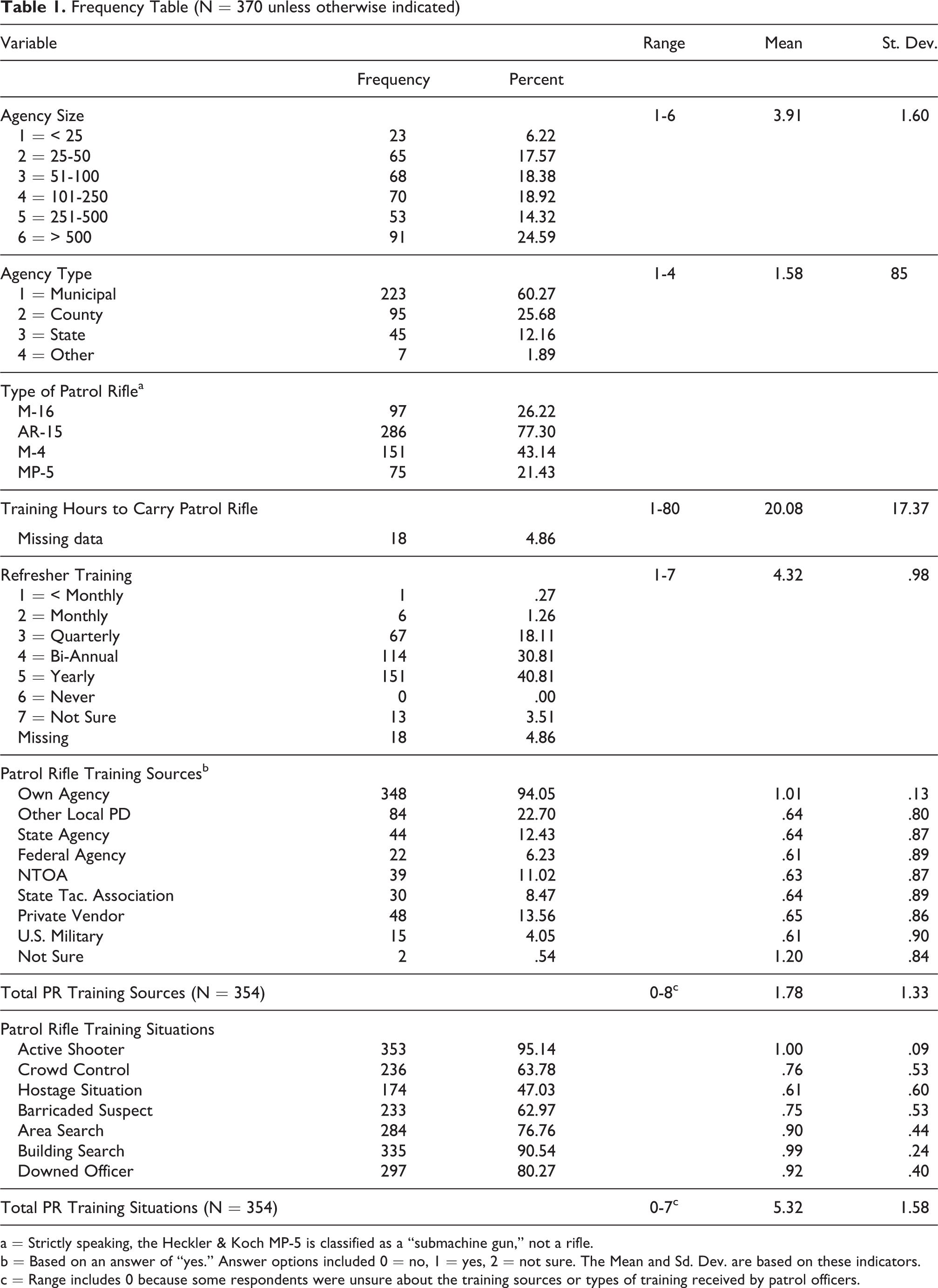
Of the 370 respondents, 95% reported that their department allows street officers to deploy with patrol rifles. Table 1 provides descriptive information from the survey. Results show that, with respect to police agency size and type, respondents come from a variety of law enforcement agencies. 5 Almost 24% of the respondents work in small (< 50 sworn officers) or very small (< 25 sworn officers) police agencies, and 42% work in agencies with fewer than 100 officers. Nearly one-quarter of the respondents worked in larger agencies (> 500 officers). In addition, ∼ 25% of the respondents are employed in county agencies. Some police agencies allowed more than one type of patrol rifle to be carried by officers. The most common type was the AR 15; M 16 and M 4 rifles are carried much less often.
Frequency Table (N = 370 unless otherwise indicated)
a = Strictly speaking, the Heckler & Koch MP-5 is classified as a “submachine gun,” not a rifle.
b = Based on an answer of “yes.” Answer options included 0 = no, 1 = yes, 2 = not sure. The Mean and Sd. Dev. are based on these indicators.
c = Range includes 0 because some respondents were unsure about the training sources or types of training received by patrol officers.
The number of training hours that street officers need prior to deploying with a patrol rifle ranged from 1 to 80 h. Just over 7% of the agencies required as little as 1 h. of training. The average amount of training was 20 h., but the mode was 40 h. (N = 85; 22.97%). Most officers were required to undergo ‘refresher’ training with the patrol rifle on a bi-annual basis. Many agencies required their officers to engage in refresher training on a yearly basis.
As seen in Table 1, most agencies provide their own training, and just over 20% rely on another local police department. Some police agencies access training from various other sources, but their role is less prevalent. When an additive index of training sources was created, it was found that, on average, fewer than two different training sources were utilized by police agencies. When examining situations, over 95% of the officers indicated training was received for ‘active shooter’ incidents, followed closely by ‘building searches’, ‘downed officer’ incidents and ‘area searches’. An additive index of the training situations was constructed, indicating that police officers receive patrol rifle training for an average of more than five types of events.
Bivariate correlations
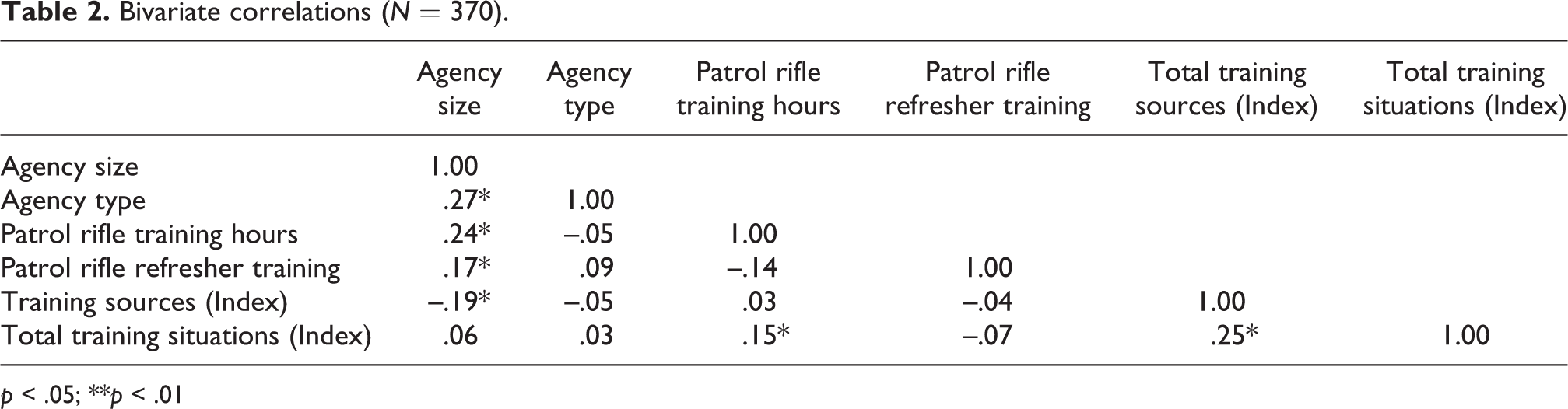
Table 2 indicates several significant bivariate relationships. Police agency size is positively correlated with the number of training hours and the frequency of refresher training. The results for these training measures seem logical, because larger police departments likely have access to resources that provide more, as well as more frequent, training. There is a negative relationship between agency size and the total training sources (r = –.19). This suggests that larger agencies, assumed to having access to more training resources, likely have those resources ‘in house’. Smaller agencies may find it necessary to access patrol rifle training from various ‘outside’ resources to insure adequate training for different situations. The index for total training situations was also correlated with the number of training hours, as well as the index for training sources. These results are also logical; more time is likely needed to adequately train to handle different situations. Further, understanding how to handle these different situations may require training from different sources.
Bivariate correlations (N = 370).
p < .05; **p < .01
Regression analysis
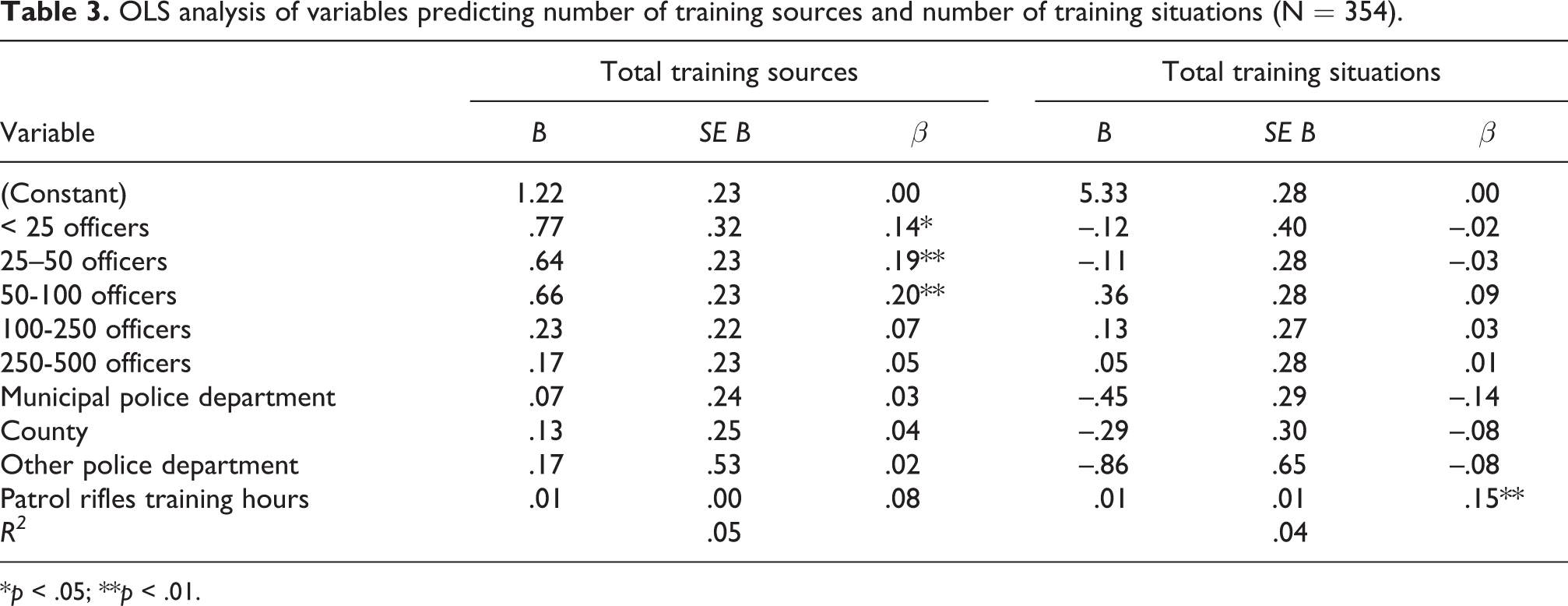
With respect to the total number of training sources used for patrol rifle training, the results in Table 3 indicate that police agency size is related to employing more patrol rifle training sources when compared with very large police agencies (the reference category). Essentially, police agencies employing fewer than 100 officers rely on more patrol rifle training sources. The model for total training situations indicates that the number of initial training hours required prior to deploying with a patrol rifle is related to the number of patrol rifle situations street officers are expected to handle. These results tend to mirror the bivariate correlation table.
OLS analysis of variables predicting number of training sources and number of training situations (N = 354).
*p < .05; **p < .01.
Discussion
Police agencies appear to have expanded the role of street-level police officers in responding to potentially dangerous situations. Ninety-five percent of the National Academy respondents reported that their agency allows officers to deploy with patrol rifles. Just a few years ago the 2012 LEMAS survey showed that 80.7% of local, sheriff and state law enforcement agencies allowed officers to carry a patrol rifle in their vehicle. Of the 26 agencies in this study that do not use patrol rifles, 15 are agencies employing more than 100 officers, and nine of these are very large agencies (> 500 officers). Although one might think that smaller agencies were less likely to use patrol rifles, this is not supported by the data. Our findings indicate that street-level officers are being equipped and trained to handle incidents that were traditionally the purview of tactical units.
When examining the training hours required prior to deploying with a patrol rifle, agencies averaged 20 h. of initial training, with a mode of 40 h. It is unclear if this amount of training is based on some type of professional standard, or would satisfy Blair and Schweit’s (2014) suggestion of ‘aggressively’ training street officers to deal with active shooters. The results show ‘spikes’ in training that correspond to the hours available in a work-day (i.e. 8 h.) or in multiple work days. It appears that the amount of training may be an issue of convenience for police agencies; if officers are going to be removed from patrol duties for training, it makes sense for that training to occupy the entire work shift. Convenience, however, should not set a standard for training. Also, ∼ 70% of the respondents reported yearly or bi-yearly refresher training. Unfortunately, the data do not allow an understanding of the details of patrol rifle instruction. Time may be spent regarding legal responsibilities in addition to any practical use of the weapon.
The results indicate that police agencies can access a variety of training sources, but typically rely on their own or another local law enforcement agency. As with the amount of training, details regarding the sources of training, such as private vendors or tactical officer associations, are unknown. Thus, it is not possible to draw comprehensive conclusions about training from these data. It seems pertinent to mention that only 4% of respondents indicated that their agency received training from a military source. This is in sharp contrast to the results provided by Kraska and Kappeler. Their sample of police agencies with 100 or more officers indicated that 46% received training from ‘active duty military experts in special operations’ (1997: 11).
With respect to the situations for which patrol rifle training is received, most respondents reported training for active shooter events. This should not come as a surprise considering that the primary argument for arming officers with rifles is for them to handle dangerous incidents prior to deployment of a tactical unit. Many agencies train officers to use patrol rifles for building searches, downed officer rescue and area searches. However, it is difficult to argue that these policing tasks have become so dangerous over time that patrol rifles are now necessary. In addition, one of the original justifications for the development of tactical units was to engage barricaded suspects (Klinger and Rojek, 2008; Kraska, 2007). The fact that almost two-thirds of respondents reported that street officers are trained for barricaded suspects seems illogical. It may be a limit of the survey that this study cannot unpack the explanation for this scenario. Patrol rifle training for barricaded suspects may amount to nothing more than securing the scene, and not active engagement with the threat. Future studies should attempt to expose the specific aspects of patrol rifle training for these types of incidents.
It is notable that training for a ‘hostage situation’ was provided by < 50% of the agencies. Police agencies may feel that tactical units remain the best way of handling these incidents, and expending resources to training street-level officers for hostage situations is unnecessary. Further, as the patrol rifle is supposed to be needed when there is no time to wait for a tactical unit, a hostage situation would likely allow a more deliberate law enforcement approach.
The use of patrol rifle training for ‘crowd control’ is also illuminating. The visual display of these types of weapons during the Ferguson protest increased citizens’ fear of the police and accusations of militarization (Institute for Intergovernmental Research, 2015). According to the respondents here, almost two in three officers receive patrol rifle training for citizen protests. Police agencies should remember that although crowd control is clearly a duty of police agencies, protests are rarely dangerous incidents (Waddington, 1999). Although protests may involve objects being thrown at officers justifying the use of shields, helmets and other protective equipment. Deploying with a patrol rifle seems pointless in these situations.
The regression results indicate that police agencies with fewer than 100 officers rely on more training resources. This outcome is likely because smaller departments may not have internal mechanisms or resources for patrol rifle training. With respect to training situations, only one variable, the number of training hours, is significantly related to this outcome variable. It is likely that training officers to deal with more situations requires more hours of training. The fact that agency size was not important to training situations is also illuminating. It suggests that all police agencies, regardless of size or type, have an expectation that street-level officers may be required to handle similar incidents requiring patrol rifles.
Conclusion
The diffusion of patrol rifles across police agencies fits within the inevitability thesis, that patrol rifles are part of a natural evolution of the police. Police officers in the USA have been armed with weapons since their inception (Phillips, unpublished). If contemporary street-level officers are expected to deal with events that were once the purview of tactical units, they need weapons normally used by officers in those units. This understanding of policing minimizes the notion that policing is becoming more militarized. The use of patrol rifles simply corresponds with the need to equip officers in a manner that seems to fit contemporary assumptions regarding danger in police work. The level of training reported here provides an understanding of the national patterns of instruction, but it is unknown if the amount and content of training satisfy any standards or best practices.
The limitations of this study should also be recognized so that future research can improve upon these shortfalls. First, the National Academy respondents are a convenience sample; however, there is no reason to believe in any selection bias regarding the police agencies who send a member to the National Academy. Second, the respondents likely do not know the behavior of street-level officers, thus the study was unable to include questions about how frequently street officers may utilize patrol rifles outside accepted police agency policies. Finally, because there was a short time frame for completing the survey, there were limits to the number of questions that could be included and the detail they might uncover.
Footnotes
Conflict of interest
The author(s) declared no potential conflicts of interest with respect to the research, authorship, and/or publication of this article.
Funding
The author(s) received no financial support for the research, authorship, and/or publication of this article.