







Abstract
This research assessed subcultural impacts on police motivation to learn and transfer new knowledge to the field by deploying a novel survey instrument, the Police Learning Environment Inventory (PLEI). Surveys were issued to 119 police officers in the southwest and northeast regions of the U.S. Subsequent statistical analyses, employing Ridge and Lasso regression, revealed that various dimensions of police subculture can impact police motivation to learn and apply new knowledge. However, two such dimensions, Innovation and Bureaucratic, were significant in all the statistical modelling. Innovation displayed a consistent and positive relationship with respondent motivation to learn and transfer training. Conversely, the Bureaucratic dimension was negatively associated with this motivation.
Introduction
Subcultures are part of nearly every larger organization. Their influence on organizational practice is ubiquitous but often not fully appreciated, with the larger organizational culture often serving as the focus of attention. But how the culture translates to smaller collectives of individuals will differ, sometimes greatly, within a single organization (Gelder, 2007). Even adjacent work units can differ greatly despite geographic proximity (Johansson et al., 2014). Ignoring an organization’s subculture(s) can result in negative consequences for the organization, ranging from disgruntlement to outright revolt (Hofstede, 1998).
The unique environment of policing, which includes the authorities bestowed upon officers and the bureaucratic structures in which they work, contributes to unique subcultural characteristics that affect the work they perform. Yet the traditional view of policing subculture is associated with a resistance to change, particularly in the context of reform efforts such as community policing (Cochran and Bromley, 2003; Paoline et al., 2000). More recently, the Policing Education Qualifications Framework (PEQF) has been introduced in England and Wales to standardize and raise educational standards. Griffiths and Milne (2018) found that there is a reluctance among those in police service to see the benefits of this change and put it into action. This resistance to change highlights how subcultures will help frame larger cultural reform efforts in various aspects, emphasizing priorities that may clash with larger cultural views.
Within the context of change, training is the answer offered for many perceived issues in policing. Training can also provide legitimacy to new policing paradigms and/or approaches (Paoline et al., 2000). Yet as Bunch (2007: 150) points out, “The influence of relationships within and between subcultures is central to understanding the persistent failure of training”. Workplace subcultures have been identified as one of the most important factors to consider in a change process. Ignoring the impact of larger and smaller culture groups can result in reduced commitment, alienation, and indifference to new ways of work (Johansson et al., 2014). However, there is little academic understanding of how police subcultures affect training.
Early in the sociological focus on policing, Westley (1970) noted that policing subcultures were critical to understand because of their impact on officer behaviors and orientations. However, traditional police subculture research has been too limited and short-sighted, marking the necessity to unpack the typologies of subcultures (Mastrofski, 2004; Paoline, 2004). To understand this phenomenon better, the authors designed and piloted the Police Learning Environment Inventory (PLEI) to gauge police subcultures. Next, to unpack subcultural effects, the authors posited and tested a five-part structure to police subcultures within training. Finally, this research assessed the predictive performance of the different dimensions of police subculture on the motivation to learn.
Increasing the collective academic understanding of this topic is timely as police agencies are pushed to reform in an age of scrutiny that demands more of public servants. Even beyond reform efforts, training is critically important to any organization (Bunch, 2007; Moore, 2015). To accomplish this, the authors relied on two distinct bodies of literature, policing subcultures and training transfer, with an emphasis on the impact of subcultural values on transfer of training. The literature review examines prior research on police subcultures, which the authors utilize to place subculture in contextually relevant terms. The second part of the literature review focuses on training transfer and how it is impacted by subculture. As explained in the methodology, key components of these two strains of literature are combined in an interdisciplinary approach to the current research.
Literature review
Chronology of police subculture
Early academic research on police subcultures concentrated largely on the traditional view (Britz, 1997). Numerous elements of the traditional view of policing subculture have been identified, including a cynical attitude toward the public, police leadership and prosecutors who hamper their ability to effectively enforce the law. This subculture idealizes the autonomy of officers to prioritize enforcement of law and order at the expense of other policing duties. Further, the insular bonds characteristic of the traditional view may adversely affect officers’ view of corruption and the expectation that fellow officers will protect their own and address problems internally (Lee et al., 2013).
Descriptive work on police subcultures stresses cynicism toward outsiders, loyalty to the “brothers in blue” and a proactive stance toward fighting crime free from the politics that the “top brass” must deal with (Broderick, 1977; Brown, 1981; Lynch, 2018; Muir, 1977). Paoline et al. (2000: 578) put the traditional view of police subculture in succinct terms, “Officers cope with the danger and uncertainty of their occupational environment by being suspicious and maintaining the edge…Officers cope with the organizational environment by taking a lay-low or cover-your-ass attitude and adopting a crimefighter or law-enforcement orientation”.
This previously conceived notion of a traditional subculture is being replaced by the idea that several subcultures can exist in any single police department. The negativity present in previous conceptions, including cynicism, hostility toward the public, and poor views of department leadership, are accompanied by more positive subcultural attitudes, such as valuing community service and integrating work into larger department goals (Nickels and Varma, 2008).
Jermier et al. (1991) examined official cultures and unofficial subcultures, looking at points of convergence and divergence in a police department. In doing so, the authors examined whether a multicultural perspective is more appropriate when conceptualizing the culture of organizations. During interviews, the authors found that subcultures existed that differed from the official narrative; from this, they developed a typology. Only one group, crime-fighting commandos, most closely resembled the official crime-fighting culture of the time. Another four types were also identified: crime-fighting street professionals, peace-keeping moral entrepreneurs, ass-covering legalists, and anti-military social workers.
Herbert (1998: 347) developed a subcultural framework that incorporates six normative orders: law, bureaucratic control, adventure/machismo, safety, competence, and morality. By employing these normative orders, the framework allowed for both formal and informal practices, as well as legal and regulatory restrictions, that impact police subcultures. In Herbert’s estimation, these normative orders should reflect the elements at play in subcultural development in any given department.
Paoline et al. (2000) examined the contours of police subculture and hypothesized that differences will exist in subcultural views depending on such characteristics as race, level of education, gender and previous exposure to community policing. A cynical attitude toward the organizational environment was not representative of the departments they studied. In fact, individual officer characteristics did not explain much of the variation in subculture. In addition, officers who were assigned to community policing assignments had more favorable views of order maintenance tasks, thus indicating a possible link between work experience and subcultural attitudes.
Cochran and Bromley (2003: 93) examined the degree to which police officers adhered to various elements of police subculture including “crime control, service, cynicism, traditionalism, and receptivity to change”. Their research found that the range of subcultural orientations reflected a mix of both crime control and community service. The results identified officers who supported a traditional subculture and displayed cynicism, strong attitudes toward crime control and a lack of openness to change. At the opposite end of this subcultural spectrum was a category that included those officers with favorable views toward community-oriented work, less cynicism and openness to change.
Terrill et al. (2003) examined the link between police subculture and behavior, and found that those officers who associated more with the traditional police subcultural views were more likely to use coercion in citizen encounters. In line with other studies of police subculture, this research confirmed that the traditional conceptualization of subculture does not accurately portray the views of all police officers. Rather, a mix of subcultural views intermingle in police departments.
Terrill et al. (2003) classified their findings into a trichotomy of those whose views closely aligned with traditional subculture, those whose views were contrary to the traditional view, and those officers whose views represented a mix of the previous two categories. The statistical analysis revealed a significant association between adherence to traditional subcultural values and the use of coercive measures.
Nickels and Varma (2008) conducted a cross-national comparison of policing subcultural attitudes in Canada, India and Japan. The approach examined several themes, including attitudes toward “the role of police in society…the formal-organizational context of policing…personal relationship to the workgroup…motivations to work” (p. 191). Using factor analysis, Nickels and Varma found a mix of subcultural elements that suggested a blending of new and old subcultural attitudes toward the work, the public and the organization. Further, there was congruence across nations on a number of these measures, suggesting that some subcultural constructs are “neutral to national setting” (p. 205). However, contextual factors cannot be discounted.
There has been speculation that cultural attitudes have shifted or weakened over time, with significant reform in areas such as recruitment strategies, enhanced scrutiny from media and public regarding police misconduct, and externally driven performance expectations. Much of the key police subculture research precede these reforms (Campeau, 2015; Chataway, 2014). In one Australian mixed-methods study, Chataway (2014) identified cultural changes that had occurred within the police organization, including a reduction in informal rituals, respect for ranks, and stigma surrounding psychological illness. Increased scrutiny had heightened a “cover your ass” element.
More recent research related to performance expectations examined higher education of police officers in the UK using semi-structured interviews (Hallenberg and Cockcroft, 2017). This research noted that certain measures in the UK, such as the Policing Education Qualifications Framework (PEQF), have been adopted to raise educational attainment by officers. However, the interviews revealed that cultural barriers, such as hostility and indifference of colleagues, were present. These qualitative findings mirror the research in other contexts. The findings also identify the multiplicity of subcultural dimensions at play in a police department, ranging from cynicism to more general openness.
As the literature on police subcultures demonstrates, there is a multiplicity of views, both new and traditional, in police organizations. This multiplicity of views represents starkly contrasting subcultural attitudes toward police administration, the profession, and how the public is framed within the context of policing. The following section of the literature review details a complementary avenue of research, subcultural impacts on training transfer.
Training transfer and subculture
The effect of subcultures on police behavior is powerful, yet it often goes unnoticed by officers as they adjust to the job during training and beyond (Dempsey and Forst, 2016). Research on training transfer supports the relationship between certain organizational cultural characteristics and the motivation to transfer (Egan et al., 2004; Tracey et al., 1995). Some of this research is framed explicitly in terms of subculture, whereas other research discusses the larger organizational culture. Both apply in this context, because organizational culture and subculture are interrelated.
As it relates to training transfer, organizational culture is viewed in terms of environmental factors that facilitate the use of trained skills, such as opportunities to perform an interaction with peers and supervisors in feedback loops as skills are applied. But organizational culture is a vast area with numerous untapped elements that play into the transfer of training. Of note are humanistic and goal-setting cultural orientations, both of which may have a role in the transfer of knowledge. The intervening mechanism linking these subcultural elements to training transfer is self-efficacy. This confidence that one can reach specific performance goals has been shown to have a positive relationship with training transfer. (Simosi, 2012).
Tracey et al. (1995) examined continuous-learning cultures and their impact on training transfer. Continuous-learning cultures were characterized by values and beliefs that emphasize support, innovation, and competitiveness, as they apply to learning new knowledge and skills. This cultural sphere encompasses both formal and informal training. This research found a significant relationship between these cultural components and the transfer of training.
Egan (2008) focused on subcultural characteristics and the motivation to transfer. Specifically, three subcultural dimensions are examined: Innovative, Supportive and Bureaucratic. The results indicated that subcultural characteristics have a stronger influence on motivation to transfer than cultural characteristics. Specifically, supportive and innovative subcultures have positive relationships, whereas bureaucratic subcultures lowered motivation to transfer.
Other research on subcultures complements the current study by examining openness to change. Previous studies have shown that cultural views that emphasize outward-looking human relations have a positive association with a willingness to change (Carlström and Ekman, 2011). Whereas more internally focused organizations, that emphasize bureaucracy and procedures, are associated with resistance to change (Savic and Pagon, 2008).
Johansson et al. (2014) employed the Competing Values Framework to examine subcultural values and resistance to change. Using this framework, subcultural values along two continuums were examined: (1) internal/external, and (2) flexibility/control. The results indicated that respondents’ values reflected a human relations orientation that emphasized trust while maintaining flexibility. Respondents also demonstrated an openness to change in their responses.
The literature on subculture and its impact on training transfer points to untapped avenues of research, as it applies to police subcultures. In particular, the two complementary avenues of research intersect at key points that carry important implications on the effect that police subcultural orientations will have on the motivation to learn and transfer new knowledge on the job. For example, both bodies of research include bureaucratic orientations, which may impact the motivations to transfer knowledge.
Further parallels can be seen when examining subcultural orientations toward goal setting as a subcultural element that promotes transfer, and competence as a normative order that shapes subcultural values. Equally important is the subcultural emphasis placed on humanistic approaches to work, which relates to the value placed in police units on the interdependence of the police work (Herbert, 1998; Jermier et al., 1991; Simosi, 2012). In sum, the research provides for a hybrid conceptualization of policing subcultural values that promote the motivation to learn and transfer new knowledge on the job.
As discussed in more detail below, the authors chose to develop a new instrument to assess police subcultures. This was motivated by both the context and goals of this research. Contextually, the unique nature of policing (e.g. normative authority, stressors) distinguishes it from most other professions (Herbert, 1998; Miller, 2006). In addition, the goal of assessing subcultural effects on training transfer has not been specifically assessed via surveys in the current context. As a result, previously developed instruments assessing organizational subculture lack critical components that would allow them to be utilized in the current research.
As detailed below in the discussion of survey instrumentation, the authors opted to utilize the literature on training transfer to provide subcultural contours on the boundaries and dimensions of subculture that apply to training transfer. For example, this literature details a range of closed (bureaucratic) and open (humanistic) subcultural attitudes and the ways they are expected to impact training transfer. The literature on policing subculture was utilized to provide context to these dimensions. Particular focus was applied to the lack of uniformity in adherence to a particular subcultural (e.g. no assumption of a monolith subculture) and the blending of new and old subcultural attitudes toward the work (Cochran and Bromley, 2003; Nickels and Varma, 2008).
Methodology
The authors approached five police departments in the southern and northeastern regions of the USA to seek formal approval to administer the survey in the respective departments. During the approval process, the goals of the study were provided, along with assurances of anonymity and confidentiality for those officers who wished to participate. In total, four different police departments agreed to participate in the study, three in the south and one in the northeast. Departments ranged in size from 10 to 200 officers and served both urban and rural communities.
Survey issuance
Because this was a non-probability sample that hinged on the authors’ ability to gain access and approval through insiders in the respective departments, the focus was on regional variation. Survey administration was targeted to reflect different regions of the USA to reduce sampling bias and increase generalizability. Projected difficulties in gaining high levels of participation were anticipated
To assess subcultural influences on training, the authors employed a five-point Likert scale. Responses were coded numerically from 4 “strongly agree” to 1 “strongly disagree”. Tailoring the instrument to the audience, the authors incorporated clear and succinct language that was appropriate to the targeted respondents (Harrison and McLaughlin, 1993).
Subject-matter experts reviewed and evaluated the instrument to assess survey quality. (Kohli and Zaltman, 1988). Next, the authors used cognitive interviewing to pre-test the survey instrument and identify any sources of response error. Participants in the pre-test phase were chosen based on previous law enforcement experience. Participants were presented with the survey and encouraged to think through each question and provide the authors with their understanding of what each item in the instrument was seeking to answer. Verbal probing followed to determine if the respondent’s understanding of each item matched the intended purpose of the question (Willis and Artino, 2013).
Dependent variable
A survey item addressing each respondent’s motivation to learn and apply new training was included for the dependent variable. This approach follows Chiaburu and Marinova (2005) and examines pre-training motivation to transfer. Thus, the instrument measured a general motivation to transfer new training to policing. However, the survey was not completed in advance of any scheduled training.
Independent variables
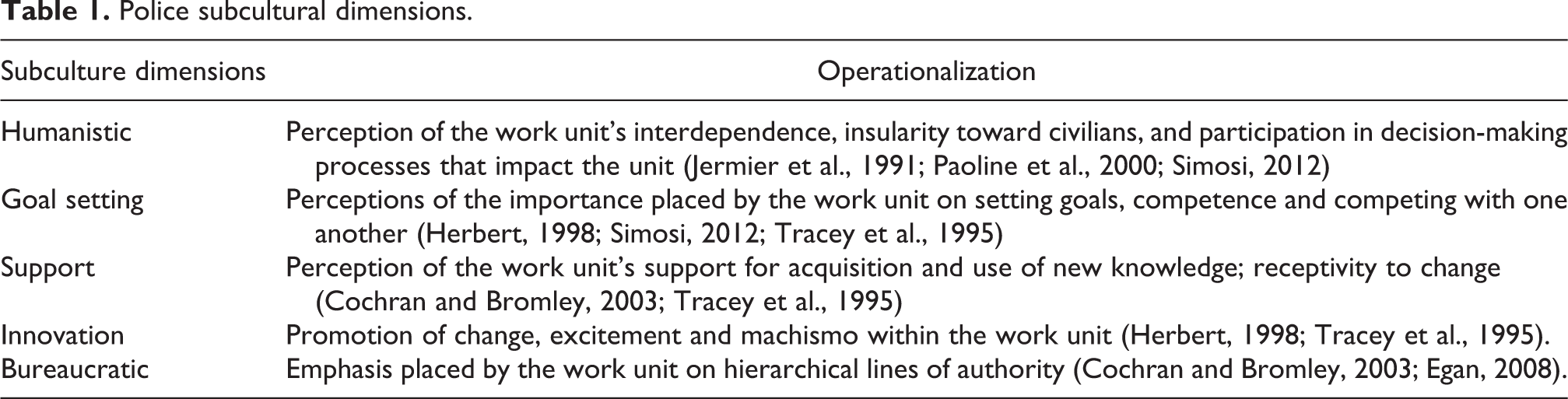
The independent variables focused on the respondent’s work unit. Based on the review of police subcultures and subcultural impacts on training transfer, the authors developed a five-dimensional scale of subcultural traits that promote motivation to transfer new training. The dimensions incorporated into the survey instrument are provided in Table 1. A total of 16 questions measured the different subcultural scales (e.g. “I am trusted to analyze situations and make independent decisions on the job” and “My supervisor encourages me to set goals and work towards achieving them”). Six questions addressed the humanistic subculture elements, three each for goal setting and innovation, while two questions each addressed support and bureaucracy.
Police subcultural dimensions.
Analytical procedures
The analytical procedures comprised two phases. In the first phase, the authors focused on examination of the survey responses in relation to the proposed five-dimension construct. The goal was to either confirm or deny the accuracy of the survey construction based on the subcultural dimensions extracted from the literature. The second phase, hinging on the results of the first phase, examined the extent to which each dimension predicted respondent motivation.
Confirmatory factor analysis was used to examine the latent structure of the instrument. This technique was chosen over exploratory factor analysis, because a latent five-dimensional structure was already hypothesized and required confirmation. Because Likert items were ordinal, the authors utilized a combination of polychoric correlations 1 and diagonally weighted least squares (DWLS) estimation in the confirmatory factor analysis using the lavaan package in the R statistical environment (Rosseel, 2012; Wang and Cunningham, 2005). The authors ensured that the CFA model specified was not overly restrictive (e.g. zero correlations between dimensions) as this is often unrealistic, particularly in the study of subcultures. Further, specifying a model with no correlation between factors, where there should be some relationship, results in poor model fit (Osborne, 2015).
The choice of modelling techniques was guided by two factors. First was the need to focus on prediction of subcultural effects and estimation of performance outside the sample of survey respondents in the interest of arriving at findings useful to both academics and professionals. This led to the use of techniques that are not typically part of the “statistical toolbox” used in analysis of survey data. As such, the techniques chosen for the analysis are appropriately justified further below. The second factor concerns the overwhelming number of positive responses to the items measuring the dependent variable – motivation to learn and apply new training. In total, 93% of respondents reported either agreement or strong agreement with this survey item. Within this response window, the split was 61% reporting agreement and 39% reporting strong agreement. Given the levels of agreement with the dependent variable, logistic regression variants were chosen to assess the predictive capacity of the subcultural dimensions on agreement and strong agreement on motivation to learn and apply new training.
For the analysis of factor scores derived from the CFA, the authors opted for two complementary penalized regression approaches, Ridge estimation and least absolute shrinkage and selection operator (LASSO). Both methods apply a shrinkage parameter, Lambda, that prevents overfitting (James et al., 2013; Marquardt and Snee, 1975). Ridge estimation was performed to examine the overall impact of each variable on prediction of different levels of motivation to learn and apply new training. With five different hypothesized dimensions, the authors employed LASSO regression as well, which will shrink some variables to zero and thus identify those variables that are the best predictors of motivation (Tibshirani, 1996).
Penalized methods such as Ridge and LASSO often do not include traditional model estimates, such as standard errors, because the shrinkage parameters introduce bias that causes certain estimates in traditional modelling to be uninformative. However, advances in Lasso regression do allow for such estimates to be calculated. Thus, two complementary techniques were utilized, one that considers all dimensions simultaneously and another that selects those that provide the best predictive accuracy, with the latter providing traditional indices for the coefficients.
These approaches have the added benefit of handling multicollinearity between predictor variables, which is possible and even necessary in many factor analysis scenarios in which complete separation of factors is either unrealistic or unsupported by the literature (Fabrigar and Wegener, 2011; Hoerl and Kennard, 1976). In fact, multicollinearity was foreseen as a potential issue that needed to be accounted for using appropriate regression techniques. Previous studies of subculture have identified multicollinearity among well-defined cultural constructs, as they often work together (Erumban and de Jong, 2006; Fischer and Smith, 2003). Simulation studies show that, particularly when contending with multicollinearity, ridge regression and related techniques have higher predictive accuracy than separate regression on predictor variables of interest (de Vlaming and Groenen, 2015).
Further, given that the issuance of the PLEI represented a pilot study, the authors opted to obtain estimates of how various subcultural constructs may behave outside the sample of survey respondents. Accordingly, internal bootstrap validation was utilized. This allowed the authors to obtain optimism scores and adjusted area under the curve (AUC) estimates for projected model performance on out-of-sample departments.
This statistical approach allowed the authors to examine two related research questions within the context of the PLEI pilot study. First, whether a five-part conception of police subculture reflects the views of survey respondents. Second, which subcultural dimensions increase or decrease the motivation to learn and apply new training.
Respondent demographics
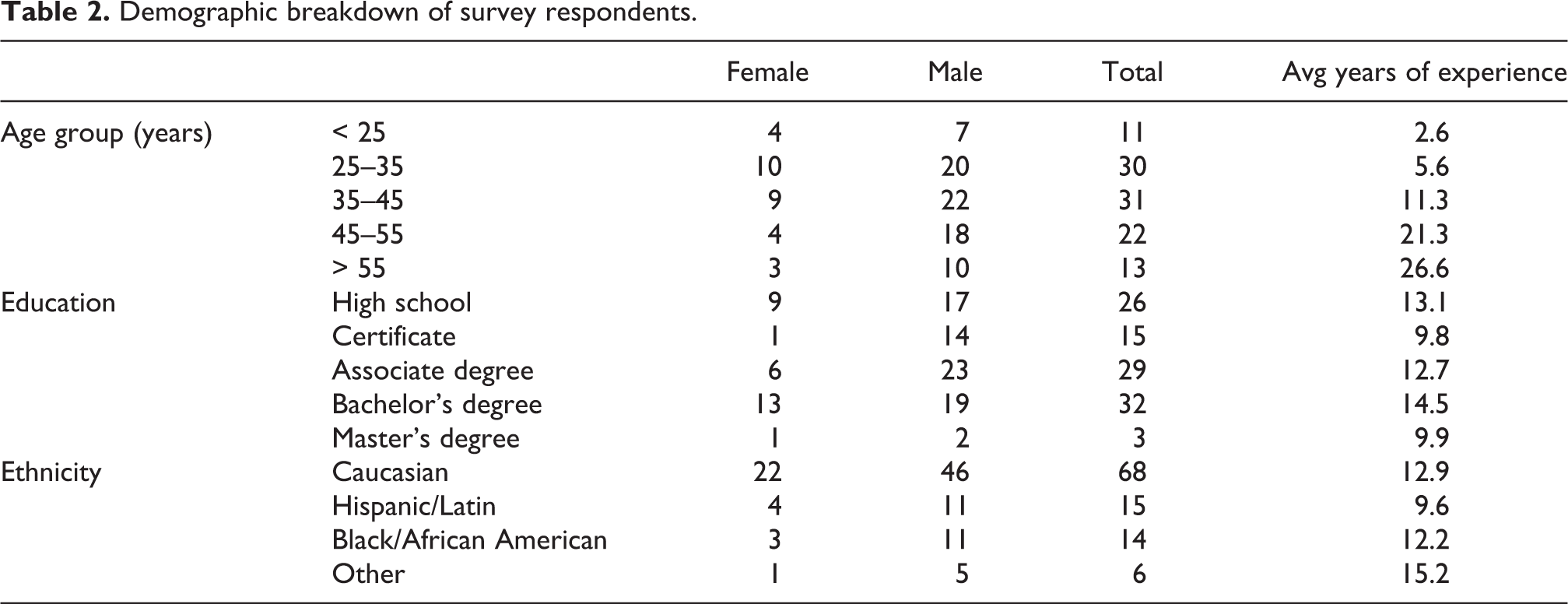
Most survey respondents (72%) were male and had, on average, a few more years of experience in policing than female respondents (13 years versus 10 years). However, there were no differences in years of work experience at the department where the respondents were surveyed; the average was 9 years for both males and females. Sixty-four percent of respondents reported their ethnicity as “white” on the survey. The categories of “Hispanic/Latino” and “Black/African American” each received 15%, while “other” was selected by 5% of respondents. Table 2 provides a demographic breakdown.
Demographic breakdown of survey respondents.
Results
As with other survey analyses in the field of policing, soliciting participation proved difficult; the authors relied on police department contacts who were often busy with pressing professional matters. Further, survey issuance occurred during shift changes when officers were preparing for work obligations. That said, 119 police officers completed the survey, which was viewed by the authors as highly favorable for the first issuance of the PLEI.
As mentioned in the previous section, CFA was utilized to conduct the first phase of the analysis that addressed the underlying dimensionality of the new instrument. It was postulated by the authors that, based on the literature, five underlying dimensions addressed police learning subcultures. This dimensional structure was specified in a CFA model to either confirm or deny the underlying subcultural dynamics before using the scale item scores for each dimension in the regression analysis.
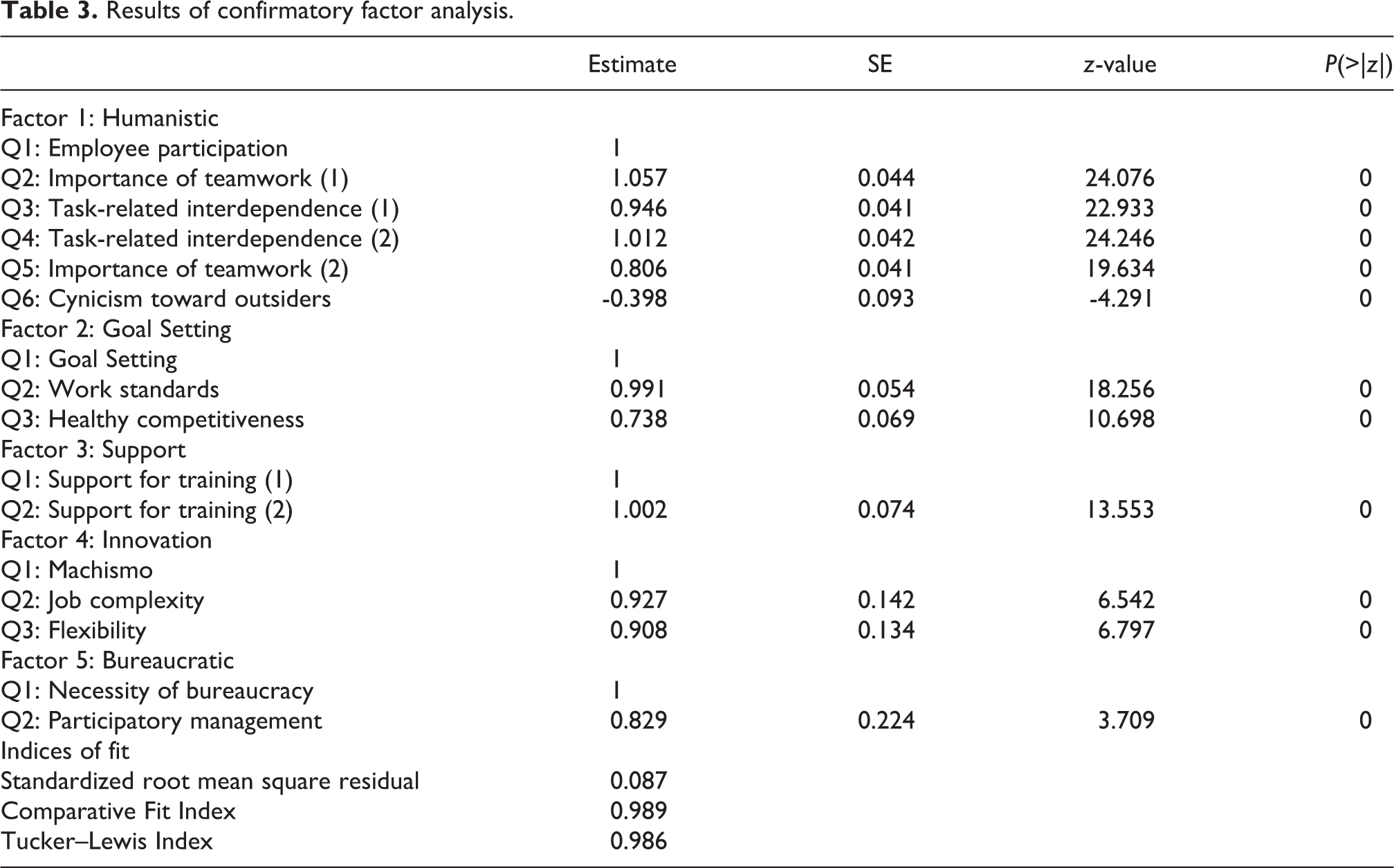
As shown in Table 3, the results of the confirmatory factor model correspond to the authors expectations. Following Hu and Bentler (1999), both relative and absolute indices of model goodness-of-fit were utilized to determine the adequacy of the factor model. Thus, the comparative fit index (CFI), Tucker–Lewis Index (TLI) and standardized root mean square residual (SRMR) were examined and all indicate good model fit. The latter was selected due to its robustness to sample size (Chen, 2007)
Results of confirmatory factor analysis.
Analysis of reliability was stratified to obtain Cronbach’s alpha for each scale. Each subculture dimension showed acceptable reliability (Humanistic = 0.88; Goal Setting = 0.77; Support = 0.84; Innovation = 0.68; Bureaucratic = 0.56). Some of the dimensions had much stronger coefficients than others, particularly the Humanistic and Support dimensions. The Bureaucratic dimension featured the lowest alpha coefficient, yet it was still within a sufficient range (Taber, 2017). The low coefficient for this latter dimension owes to the small number of questions and thus reduces to the interitem correlation.
As the results indicate, only one of the survey items did not fit the proposed subcultural framework. Cynicism toward outsiders, placed under the Humanistic dimension, was reverse coded before the CFA, yet it still had a low score in the model as well as a negative coefficient. This item was removed from the analysis before proceeding with further statistical models. The remainder of the items were utilized to derive the factors scores for each dimension that served as the independent variables in the regression analyses discussed below.
Analysis of subcultural impacts on motivation to learn
The statistical package glmnet was used in the R statistical environment to conduct the Ridge logistical regression (Friedman et al., 2010). The regression analysis began with the selection of a Lambda value (shrinkage parameter) through generalized cross validation (GCV) (Golub et al., 1979). In this procedure, various coefficient estimates are obtained based on different levels of the shrinkage parameter. Examination of deviance plots allowed for the selection of the shrinkage parameter that reduced overall model deviance (Lambda = 0.0283). Once the best shrinkage parameter was obtained, the logistic model was run to determine model coefficients as shown in Table 4.
Ridge regression model parameters for subcultural dimensions.
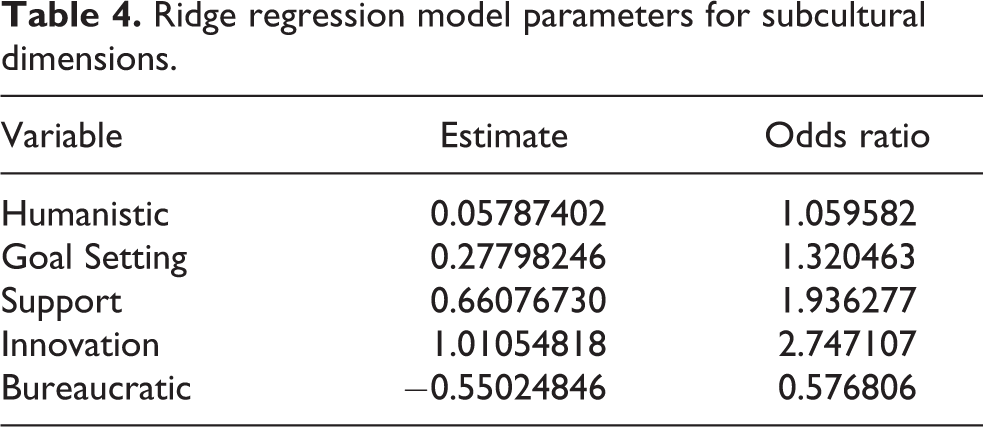
As Table 4 illustrates, the Ridge model does not use traditional standard errors or p-values as they are not particularly informative due to the shrinkage parameter. In fact, most software does not include this information in their output for Ridge regression (Goeman, 2010).
In line with theoretical expectations, the regression estimates for all dimensions are associated with an increased motivation to learn and transfer training, with the exception of the Bureaucratic dimension. Of note, Innovation and Support were associated with the highest increases in the predicted odds of strong agreement with motivation to learn. A one-unit change in Innovation was associated with a 174% increase in the odds of strong agreement, whereas Support was associated with a 93% increase.
The Humanistic and Goal Setting dimensions contributed to smaller increases in the predicted odds. Goal Setting was associated with a 32% increase, whereas the Humanistic dimension was associated with the smallest increase, at 5.95%, for each unit change in the variable. The Bureaucratic dimension, conversely, was associated with a 42% decrease in the predicted odds of strong agreement with learning and applying new training.
The final step in the Ridge regression procedure was internal bootstrap validation to assess model performance and obtain an estimate of model stability when applied to outside data. The procedure involved re-running the model over different bootstrap samples of the data (200 times) to arrive at an average of model predictive performance (Harrell et al., 1996). This validation procedure provides an optimism score of how well the model will perform with outside data (e.g. other police departments).
The results of the internal bootstrap validation indicate that the original model’s AUC is 0.839, indicative of high model discrimination between agreement and strong agreement. That is, the model has an 84% chance of correctly distinguishing between highly motivated respondents and others who are less motivated. The optimism score obtained from the validation was 0.016, which lowered the estimated AUC applied to outside data (AUC = 0.822), which is still highly discriminative and indicative of good model performance. Accordingly, the authors expect that these same subcultural dimensions will have a similar impact when applied to different police departments.
The Lasso regression was run in the same manner as the Ridge regression, to determine which dimensions would be selected over others as optimal predictors of “strong agreement” regarding motivation to learn and apply new training. Using the glmnet package, the optimal Lambda value was again selected through a GCV procedure and plots of model performance. The Lambda value selected for shrinkage was 0.00685. Once the best shrinkage parameter was obtained, the logistic model was run to determine which subcultural dimensions remained (whose coefficients were not shrunk to zero). Interestingly, the Humanistic and Goal Setting dimensions were shrunk to zero. As mentioned previously, advancements in Lasso regression do allow for the estimation of traditional model parameters as shown in Table 5 (Tibshirani et al., 2016).
Results for Lasso regression.

Only three variables remained in the Lasso model, and only two were significant predictors. In fact, the odds ratios for the innovation and bureaucratic dimensions increased substantially in the selective Lasso model, while the direction of relationship remained the same as in the Ridge model. The innovation dimension was associated with an 864% increase in the predicted odds of “strong agreement”, whereas the bureaucratic dimension was associated with a 66.7% decrease in the odds of “strong agreement”.
The same internal bootstrap validation was conducted for the Lasso regression with the more parsimonious model performing slightly better than the first model that included all variables. The original AUC for this second model was 0.844, slightly higher than the Ridge regression results. The optimism obtained for the bootstrapping, 0.015, was also similar, resulting in an estimated out-of-sample AUC of 0.829, also slightly better than the previous model. Thus, the reduced model better predicted strong agreement by a small margin.
This is an interesting finding in the larger context of which subcultural elements hold value in training contexts and how these elements will perform in other police departments. The internal bootstrap validation indicates that even with a more refined set of variables, excluding well-known subcultural elements, good predictions can still be obtained for motivation to learn and apply new training; this predictive ability can be applied to other populations of police officers with the expectation that the relationships will hold. However, it is telling that the two variables that remain significant and predictive are in opposition to one another, reflecting what can be described as the constant tension in many police departments between the need to document and standardize (Bureaucratic dimension) and the need to remain flexible and encourage creativity (Innovation dimension). In the following section, the implications of these findings will be explored.
Discussion
The goals of this study centered on police subcultural effects on the motivation to learn and apply new knowledge on the job. By developing a multi-dimensional scale that combines the literature on policing and training subcultures, the contours of this subculture have been further elucidated. The results of the CFA provided strong support for the five-dimensional construct developed for policing. Importantly, the results of both the CFA and the regression models conformed to expectations derived from the literature in terms of the direction of relationships between the various dimensions and respondent motivation.
To validate the authors’ survey instrument, the PLEI, areas for improvement were noted during the analysis. Notable was the adjustment to the humanistic scale, where cynicism toward outsiders did not fit the specified model parameters. Also, as evidenced by the analysis of reliability for the different dimensional scales, bureaucracy and innovation need to be bolstered.
Although motivation to learn and apply new training was the focus, future iterations of the PLEI should also include motivation toward different types of training (e.g. hard and soft skills); this lack of training specificity was the chief drawback of the current study. Additional covariates that control for environmental effects need to be included as well, in order to run models without a goal for prediction (as in the current research), but rather, to elucidate effects. Indeed, officers confronted with order maintenance tasks may develop positive attitudes toward non-traditional tactics that do not rely on coercion (Paoline et al., 2000). Different subcultural aspects may vary depending on such issues as rank and duties; the closer a police officer is to the street (i.e. patrol cops), the more that officer may stress reliance on fellow officers. This too will depend on shifts as well as geography (Reiner, 1992; Sun, 2002).
Based on the results of the pilot surveys, the statistical models stemming from the CFA relate to increasing already high levels of motivation to learn and apply new training. The authors view this as highly positive for a few reasons. First, the positivity of the survey results is indicative of officers who are generally motivated to learn more. Second, the results of the statistical analysis indicate how subcultural dimensions impact higher levels of motivation; they show how good levels of motivation can become great levels of motivation.
Of all the subcultural elements, Innovation demonstrated a consistent and strong relationship with the motivation to learn and apply new training. This aspect of subculture was conceived as the extent to which survey respondents perceived that their work unit promoted change, excitement and machismo (Tracey et al., 1995; Herbert, 1998). Officers were asked questions that gauged their attitudes toward such things as placing themselves in dangerous situations, the complexity of police work, and the need to apply flexible approaches to policing. The predictive strength of this dimension echoes Tracey et al. (1995) and the concept of continuous-learning cultures, as innovation and competitiveness are important components of this cultural orientation that promote training transfer.
Supporting the literature, the Bureaucratic dimension demonstrated a consistent and negative relationship with the motivation to learn and apply new training. Survey items addressed such issues as the need for bureaucracy and views toward participatory management in police departments. These results mirror Egan’s (2008) research showing that bureaucracy lowers motivation to transfer training. Further, the results reflect the consequences of an internally focused organization that, through the reinforcement and repetition of procedure, creates resistance to change (Savic and Pagon, 2008).
The Humanistic dimension was associated with an increase in the odds of strong agreement in the Ridge regression but was selected out of the Lasso model. That said, the coefficient in the first model did conform to theoretical expectations taken from the training transfer literature. Although there is no doubt that humanistic elements of police subculture are important, their role in the motivation to learn and transfer new knowledge may be of secondary importance to other dimensions. Owing to the role of self-efficacy as an intervening mechanism in this subcultural dimension, it likely has a stronger impact on officer motivation in other areas of training, such as the transfer of academy training as opposed to general motivation (Simosi, 2012).
The final dimension, Goal Setting, was also selected out of the Lasso regression, but was associated with an increase in the odds of strong agreement with motivation to learn and transfer training. As with the other dimensions, this follows the directional expectations set forth in the literature, but it does not appear to be a dimension of primary importance as it relates to training transfer as examined in this research. In fact, goal setting may play a more important role in the motivation to engage in informal training within the work unit. Previous studies have shown that supervisors who worked with subordinates to set goals and provide feedback enhanced transfer (Burke and Hutchins, 2007; Robbins and Judge, 2009).
As mentioned in the results, the findings have broader implications for how police departments promote police work among the rank and file and how officers are supervised. Based on both statistical models, a focus on promoting innovation is an effective way to increase motivation to learn and apply new training. And while this research greatly narrows the subcultural dimensions that need to be emphasized, it is maintained that there are numerous ways to promote a more focused subcultural emphasis. For example, favorable and increasing acceptance of innovation can be reinforced through discussions of how fellow officers handled certain problems in previous shifts (e.g. defusing a domestic callout).
However, one caveat must be emphasized that applies to whatever approaches are selected to enhance subcultural dimensions. Behaviors need to be placed in bounded subcultural context (regardless of the dimension emphasized) to avoid inadvertently promoting an unintended dimension (e.g. Bureaucracy versus Goal Setting). Providing such context promotes the subculture while establishing boundaries. As an example, if a supervisor highlights an innovative approach of one of the officers, it needs to be communicated in a manner that goes beyond merely highlighting the behavior so that other officers understand the range of adaptability being promoted (e.g. “Officer X applied de-escalation techniques and showed great creativity by allowing the suspect to clarify certain issues that were creating conflict…”). Such approaches, and there are countless ways to approach this issue, promote a feeling of freedom to adapt and innovate.
The research also underlines the constant tension between oppositional subcultural forces. Specifically, the need for bureaucracy within a police department and the need to foster a workforce that is motivated to learn and adapt. Bureaucracy is unavoidable in government agencies where accountability to the public is essential. This subcultural tension highlights the need to strike a balance. What this means in the policing context is that shifts in subcultural focus may be necessary to maintain a motivated force. For example, while the Innovation dimension displayed the strongest relationship to motivation, a balance between opposing subcultural dimensions may involve stressing other dimensions that also enhance motivation to a lesser degree. Combining all the dimensions examined, the learning subculture, as conceived in this research challenges the notion of a monolith culture and provides for a more contextual understanding of how subcultures can be properly harnessed to create and maintain a responsive and professional police force.
The present research was a successful first step in validating the PLEI and focusing on how police departments can harness the power of subculture to promote a workforce motivated to learn and apply new training on the job. This focus on the subculture–training nexus was purposeful, as both are connected in numerous ways and both are essential to police change, improvement, and adaptability. Perhaps most importantly, this research highlights how small changes can be made, as opposed to monumental organizational re-orientations, to motivate personnel. For both budgetary and political reasons, this is an important observation from the study. Finally, this research further highlights the inherent flexibility at the shift-level in implementing small but consisting changes. There are a multitude of ways that supervisors can implement positive feedback loops with other officers to promote desirable subcultural views in the 21st-century police department.
Concluding remarks
The next iteration of the PLEI will include important changes that reflect the findings of this research. In particular, the subcultural dimensions will be expanded to aid in further understanding their components and how they can be emphasized or de-emphasized in police practice. This expansion will also allow for further analysis of subcultural effects on other aspects of training as noted in the discussion.
Of course, expansion of the PLEI comes at a price. It can be difficult to achieve high response rates with police officers. The first iteration of the instrument was concise and reflected the reality that many officers may not be keen on filling out surveys when they have a job to perform. Thus, improvements to the instrument will strive for such conciseness to engage respondents while expanding the scope of the survey.
Related to future improvements to the PLEI, in this pilot study the authors were cautious in stretching the findings too far. It bears emphasizing that certain practices were highlighted that can promote specific subcultural awareness to raise motivation, but further extraction of practices, policies and procedures remains a topic for the next iteration of the PLEI. The study of police subcultures is a topic that is, in many ways, in its infancy, and the proper conceptualization of subculture is key to fulling defining relationships and drawing further conclusions of use in the field. The next wave of PLEI research will reflect this
Footnotes
Authors' Note
“The views expressed in this article are those of the author, and do not necessarily reflect those of the U.S. Department of State or the U.S. Government.”
Declaration of conflicting interests
The author(s) declared no potential conflicts of interest with respect to the research, authorship, and/or publication of this article.
Funding
The author(s) received no financial support for the research, authorship, and/or publication of this article.
