







Abstract
In order optimally to prepare police officers for the demands in the field, police training has to be designed representatively. However, for the German context, there is a scarcity of research investigating to what extent training meets the demands of the field. To fill this gap, the current study examined if police training in Germany meets the field demands of police officers based on the perspective of police recruits. Thirteen recruits from a German police force were interviewed in a semi-structured way to identify possible matches and discrepancies between training and the field. The qualitative were was analysed using content analysis. The results revealed that recruits valued police training very positively because they were able to apply learned skills and tactics in the field. However, results also indicated that: (a) key informational variables present in the field were missing in training, namely chaotic, highly dynamic situations; and (b) police officers need to be adaptable and flexible in the field to cope with the demands. Finally, the results suggested that police training focuses narrowly on dealing with extreme threats, which differs from the experiences recruits had in the field and may have drawbacks because continuously perceiving social situations as threatening and dangerous is a risk factor for aggressive behaviour. Taken together, the current study provides further insights into the wants and needs of recruits in police training.
Keywords
Introduction
Police training is generally perceived as a very important part of a police officer's education for operational situations (Nota and Huhta, 2019; Rajakaruna et al., 2017). In Germany, police training refers to the development of practical front-line skills, such as self-defence and arrest skills, firearms, tactical skills and communication, in order that officers can safely and effectively cope with operational and conflictual scenarios (Isaieva, 2019). However, research has consistently shown that skills transfer does not occur from the training environment to the field (Jager et al., 2013; Renden et al., 2015). In order to tackle this issue, investigating the level of representativeness of learning tasks has been considered a fruitful avenue to optimise police training (Cushion, 2020; Körner and Staller, 2018). The paradigm of representative learning design (Pinder et al., 2011) asserts that information variables upon which the individual has to act in training have to be similar to those encountered in the field if skills are to transfer readily from training to the criterion environment. For example, if conflict situations present themselves as ambiguous, chaotic or surprising, these features have to be reflected within the training settings, to allow the learner to attune his or her skills to these informational variables. Furthermore, the learner should be provided the opportunity to respond to these variables in the same way they would (should) in the field. However, evidence from observations of police training (Cushion, 2020) and interviews of learners within these environments (Rajakaruna et al., 2017) are critical of the representativeness of many police training activities. Besides the drawback of suboptimal skill transfer, a discrepancy between the learning and testing environments may negatively affect motivation to engage in current (Frymier and Shulman, 1995; Simons et al., 2003) and subsequent training programmes (Sitzmann et al., 2009).
Discrepancies between the learning environment in police training and policing in the field have been identified regularly in observational (Cushion, 2020; Staller et al., 2021) and interview studies (Preddy et al., 2019b; Rajakaruna et al., 2017), and can be categorised into two broad themes: (a) a lack of representative learning design (Cushion, 2020; Staller et al., 2021), and (b) a lack of focus on non-violent conflict resolution (Rajakaruna et al., 2017; Staller et al., 2021). Representative learning design refers to the degree to which a learner is able to use the same information sources (i.e. visual cues) present during a real-world police–citizen encounter to contextualise their decisions and movements, and the degree to which a learner's behaviour during practice replicates performance in the field (Pinder et al., 2011; Staller et al., 2017). As such, replicating the situational parameters of a real-world encounter is essential to ensure transfer from training to the field. Concerning the situational parameters of (physical) conflict situations, research (Jager et al., 2013; Jensen and Wrisberg, 2014) demonstrates the chaotic, highly dynamic, surprising and complex nature of real-world encounters. For example, Jensen and Wrisberg (2014) conducted interviews with soldiers investigating their experiences of hand-to-hand combat. The soldiers’ comments reinforced the notion of surprise, reflecting the uncertain aspect (ambiguity) of a combat situation. Furthermore, they commented on the fast nature of these conflict situations based on the perception of the brevity and rapidity of the unfolding event. The highly dynamic and chaotic nature of a real-world conflict situation is also projected by German police officers as they reflected on their experience of physical conflict situations (Jager et al., 2013), concluding that the chaotic nature of the conflict ‘looks different’ (p. 346) out there. This notion of discrepancy refers to a lack of adequate sampling of informational variables of the performance environment to training settings, which was also evidenced in work by Rajakaruna et al. (2017). To investigate the question of whether current training addresses the required skills and abilities to manage a potentially dangerous situation effectively and how annual training can foster these skills, Rajakaruna et al. (2017) conducted focus group interviews with Australian police officers. The results indicated that current training was not representatively designed, because scenarios were brief, unrealistic, predictable and repeated. With regard to designing learning environments that fulfil the wants and subjective needs of learners, the authors conclude that the employed scenarios must be ‘relevant, realistic and vary in situational factors and individual/offender characteristics to enable officers to develop and apply required skills in scenarios that reflect the reality of their work’ (Rajakaruna et al., 2017; 518).
Furthermore, the results of Rajakaruna et al. (2017) also provide evidence for the second discrepancy between training and the field that research in the domain of policing regularly points out: the lack of focus on non-violent conflict resolution. Concerning this issue, recent research (Rajakaruna et al., 2017) suggests that taught conflict management skills in police training focus heavily on the use of force at the expense of communicative and de-escalative conflict management skills. Conflict is widely regarded as a highly complex phenomenon with the individuals involved influencing the interactional dynamics of the conflict situation (Collins, 2009; Klukkert et al., 2008; Reuter, 2014). In an exploratory study investigating the emergence of aggressive behaviour in police–citizen encounters, Reuter (2014) found that conflict situations are influenced by a variety of factors, including the officer's mindset towards conflict situations. The prevalence and effects of a warrior and guardian mindset have been considered as and shown to be a predictor of operational behaviour on the street (McLean et al., 2019; Reuter, 2014). The warrior emphasises officer safety and prioritises crime-fighting as a police officer's primary mission, whereas the guardian focuses on building relationships between the police and the community through positive, non-enforcement contacts prioritising service over crime-fighting. Concerning the way that police officers communicate in conflict situations, the demonstration of power, a lack of politeness when speaking and a display of uncertainty have been suggested to promote violence in police–citizen encounters (Reuter, 2014). However, violence can be avoided by self-reflection, active listening, respect towards the citizen (Todak and James, 2018) and taking him or her seriously, as well as the use of explanatory communication (Reuter, 2014; Todak and James, 2018; Zaiser and Staller, 2015). Finally, the operational behaviour itself has an effect on the likelihood of violence occurring. For example, unauthorised physical contact, pushing the citizen or unreflective solidarity with the police partner seems to promote violence, whereas taking one's time and being in a state of ‘relaxed readiness’ can support non-violent outcomes (Reuter, 2014). It is of note, therefore, that research has identified a lack of opportunities to practise communicative and de-escalative behaviours in police training (Rajakaruna et al., 2017; Staller et al., 2021). The complexity of the conflict phenomenon demands that various options (communication, use of force, etc.) are at the disposal of acting police officers, yet education and training may not be facilitating the development of these options.
Taken together, effective training for conflictual situations has to minimise potential discrepancies between the training environment and the field based on key characteristics of the work in the field. This concerns the representative design of learning tasks and the focus on all available conflict management tools at the police officer’s disposal. To promote a positive transfer of skills learned in training to the criterion environment, it will be helpful for police trainers to know if the situational parameters of the criterion environment are adequately sampled in police training and if the needed tools and skills for conflict resolution are adequately practised. To provide insight, the current study acquired the views of police recruits graduating from a German police academy. 1 After periods operating in the field as part of their training, the graduating recruits were uniquely placed to comment on the effectiveness of police training and any discrepancies between police training and the demands of the field.
Method
Participants
The decision on sample size was guided by: (a) information power (Malterud et al., 2016), which argues that the more information the sample holds that is relevant to the research question the lower the number of participants that is needed; and (b) access to participants. Based on the relatively narrow focus of the study at hand and the strong dialogue developed by the researcher with the recruits, it was deemed that a small sample size would hold sufficient information power (Guest et al., 2006). As such, and in line with recommendations based on data saturation, an initial sample size of at least ten participants was set (Francis et al., 2010).
A setting of a rather small sample size was necessary because of the limited access to police recruits on the research site. Past research documented the difficulty of gaining access to participants in police training in Germany, as well as a general scepticism about taking part in scientific studies (Jasch, 2019). As such, data collection was bound by the time frames made available by the police academy for data collection and by the number of recruits who volunteered to take part in the interviews.
Of six classes, each with 25–30 students, the final sample included 13 recruits from one class of a German state police force with a mean age of 27.35 years (SD = 4.32) including eight males (M = 29.52, SD = 4.10) and five females (M = 23.91, SD = 1.44). Participants were about to graduate from their three years of academy training. As such, in line with the curriculum of the German police upper career path (Frevel, 2018), participants had experienced several blocks of police training and several months of practical field training in different police departments within the same jurisdiction, working alongside experienced police officers. All participants had experienced the same amount of time in police training and practical field training at the time of the interview. Participants were recruited through personal contact by a research collaborator and police trainer. After an explanation of the purpose of the research, and assurances of anonymity, all participants consented to take part in the study, which was approved by the institutional ethics committee of the German Sports University Cologne. Data collection was carried out in June 2017.
Interview procedures
Each recruit was interviewed by one member of the research team (MS and VH), with interviews lasting between 35 and 67 minutes. Interviews took place at a police academy in Germany. Participants were interviewed during breaks in their normal duty days at the academy. Participants knew prior to the interviews that they would be asked about their experiences during police training and practical field training. All interviews were conducted in German. The original questions were deliberately broad so that the answer given to each question was not led in any way. Taking this approach allowed for the scope of each participant's conceptions with the knowledge object to emerge. Following this original question and answer, follow-up probes and prompts were used to ensure that a complete description was given. The original questions are outlined below (translated from German to English):
Can you please tell me about your experiences of conflict situations during your practical field training? Can you explain to me what extent exercises in police training have prepared you for this?
Interviews were audio-recorded and transcribed verbatim by a paid and trained research assistant and resulted in 247 pages of single-spaced typewritten data.
Data analysis
As a first phase of analysis and a check for accuracy, members of the research team (MS, VH) listened to the recorded interviews as they read over the transcripts, occasionally making corrections and filling in missing words. The data were analysed using qualitative content analysis (Graneheim et al., 2017; Kuckartz, 2016). To ensure scientific rigour, themes were systematically developed in a deductive and inductive manner employing the structuring content analysis technique (Mayring, 2015; Schreier, 2014). Deductive analysis was based on the research question (experience of conflict situations and preparation through police training). The analysis was open to inductively emerging (sub-)themes (Schreier, 2014). This approach was justified by the specificity of the different material as well as the possibility of irritation of the theory by empiricism. The second phase of analysis involved the identification raw data themes and lower-order themes based on the data. Raw data themes were derived from the data based on reviewing the material in small steps with regard to new aspects of the topic of interest (Schreier, 2012). For each new aspect, a new raw data theme was created, whereas aspects already covered by another raw data theme in the category were subsumed into the already existing theme. In a next step, raw data themes were built-up into meaningful lower-order themes. This emergent category system was then re-examined and discussed with another member of the research team (SK) leading to modifications in the coding system. The third phase of analysis involved a final round of focused coding using MAXQDA data analysis software (version 18.2.0) based on the modified coding system. Having used both inductive and deductive analyses to interpret the data into raw, lower and higher-order themes, the final phase of analysis involved gaining triangular consensus between the lead (MS) and second researcher (SK) along with two additional researchers who acted as a ‘critical friend’ (Faulkner and Biddle, 2002; Kelly et al., 2018). The additional researchers were not involved with the data collection or analysis and were required to confirm, or otherwise, the placement of raw data themes into lower- and higher-order themes.
Results
Overview of the results
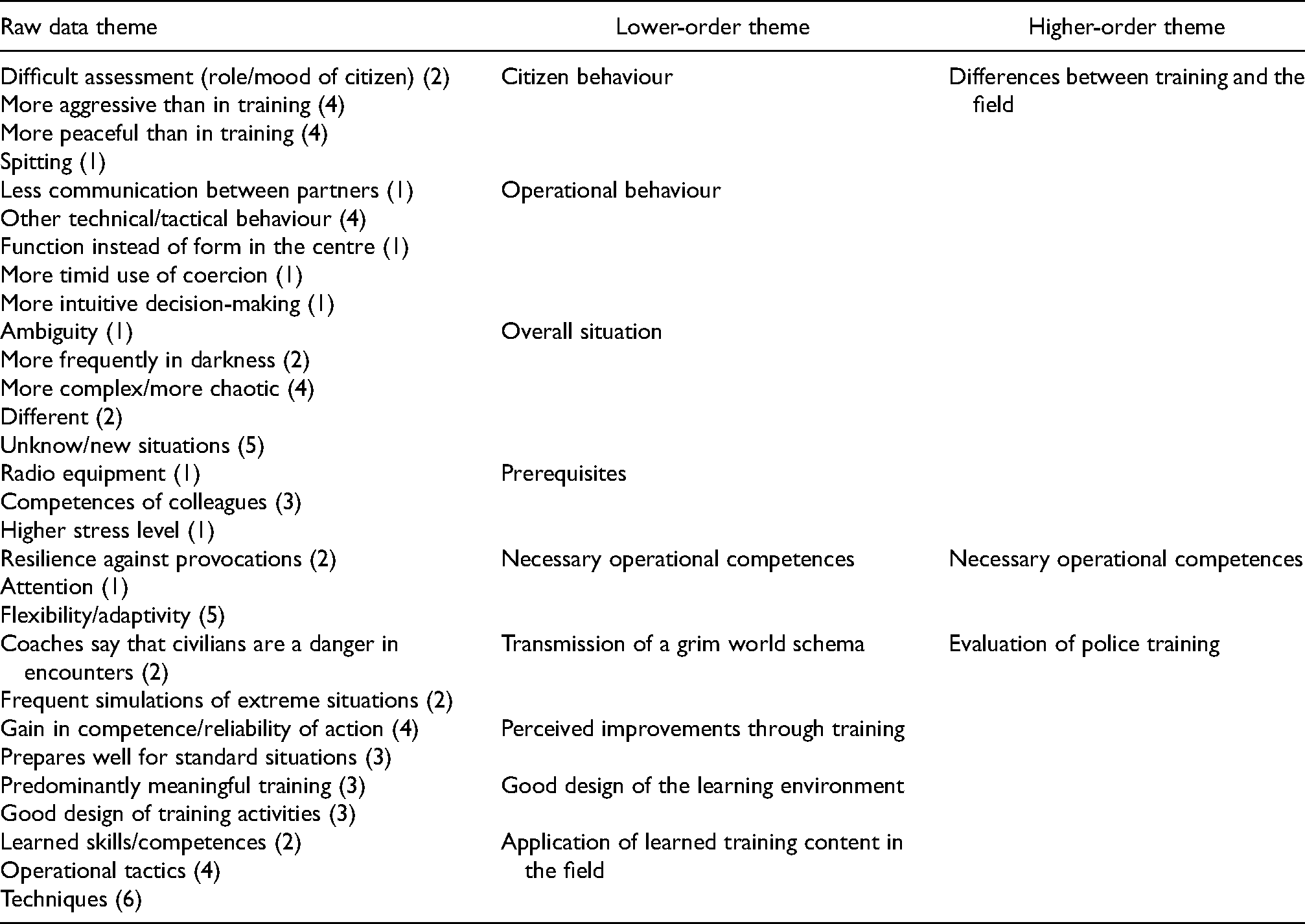
Three higher-order themes emerged from the data analysis presented in Table 1.
Results of qualitative analysis of interviews displaying hierarchical themes (numbers in brackets display how many participants contributed to the raw data).
Differences between training and the field
The differences between training and the field fell under the umbrella of citizen behaviour, operational behaviour of the acting police officers, characteristics of the overall situation, and prerequisites of operational situations in the field.
Citizen behaviour
Police recruits stated that they experienced different citizen behaviour on the street compared with in the training environment. They perceive as problematic that the role of the citizen is not as clear as in training settings. […] you don’ know the other person, you are uncertain from the beginning whether it is the perpetrator, whether it is the victim […]. I know that nothing can happen to me in here, maybe a little injury, I have to expect worse things outside. Yes, you don't know the attitude of the other person. (TN12)
Besides the ambiguity of the role of the civilian, this statement also shows that recruits know that in learning settings the role of the civilian/suspect is constrained by safety protocols. They know that purposeful pain or injury will not happen to them in the training settings, making the role of the simulator in learning settings more predictable.
With regard to the actual behaviour of the citizen encountered, some police recruits experience a heavy shift in mood that was not experienced in police training. Furthermore, recruits reported experiences of citizens acting much more aggressively towards them than feigned by peers in training settings. The following two statements describe this difference in aggressive behaviour: [The difference is] quite simply the intensity and also the consideration for colleagues. You practise with each other and not against each other. And it's completely different out there. It's relatively easy to bring one person down with your partner in training. But out there in the field, there were also four of us, five of us fighting with one person. (TN12)
The only difference was that the [suspect] defended himself extremely different during field training, i.e. he kicked with his feet, hit around with his hands and everything. This is not the case in here, of course. Here you lie on your stomach, the hands under your chest and then you stiffen yourself as good as you can. But out there it was a bit more extreme. You had to pay attention where he kicks and strikes when you lie on him, but it came very close to reality what we have learned here. (TN08)
Whereas some recruits described a more aggressive behaviour of the citizen in police–citizen encounters, others pointed out that generally citizen behaviours are more peaceful than simulated training. Yes, they were mostly much more peaceful than in training, so we always train here under extreme conditions, there is usually a weapon or something similar in the game and they are not cooperative. But outside It is relatively rarely like that. Most people are very cooperative, they provoke a bit, but then they see that it does not work. (TN10)
The different perception of citizen behaviour seems to relate to different situations. Whereas more aggressive behaviour was described in physical conflict situations (more kicking, punching, spitting, etc.), more peaceful experiences were gathered in general police–citizen encounters. These accounts suggest that in general encounters are more peaceful, and less extreme, than conveyed in learning settings. However, if physical conflict arises in the field, the situations seem to present themselves as more dynamic and aggressive than training due to the behaviour of the citizen.
Operational behaviour
Police recruits noted that operational behaviour sometimes differed as well. Particularly when it comes to tactical behaviour concerning searching buildings and apartments, the tactical approaches used by the officers differed from those advocated by police trainers. One time, when we entered and searched an apartment, the field training officer simply went alone in the apartment. You can see this happening a lot outside, so sometimes you can see that the people outside also have a low opinion of what is taught here. Perhaps sometimes there is also a little lack of transfer to the outside […]. (TN10)
Related to the application of tactical approaches, was the account of one officer who noted that in the criterion environment police officers communicated less between each other compared with in simulated operations in the learning environment. Well, outside in the field, you just do it. Although you could have taken a minute more to talk something through, to discuss something. You just do it. (TN13)
It was the view of the same recruit that, in the field, intuitive decision-making is more common than in training settings. Basically, it is the case with me that I also act very instinctively outside. So, here [in the learning environment] I’m thinking about it, I’m doing the right thing, like the coaches want it to be, because in the background there's someone looking. And outside I act very instinctively because of what I’ve learned in training. (TN13)
This statement indicates that police recruits are concerned about reproducing the behaviour that is expected by coaches in training settings. However, they look for functional solutions by themselves on the street.
Overall situation
Conflict situations in the field were regarded as generally more complex and novel than those simulated in training. The situations were a lot more complex. (TN09)
This complexity is attributed to the chaotic and messy nature of conflict situations in the real world. One police recruit explained it as follows. The person resisted passively after driving drunk and did not want to be tied up, not searched and not be taken into custody. Yes, we broke the passive resistance, tied him up and brought him into custody. And yes, in here, in the area where you are safe, in training everything works smoothly and wonderfully. And outside it's getting messy, because of the greater hecticness, the greater stress factor, because of another patrol officer, who perhaps has a different training status […]. So [here] everything is cleaner. And outside you just make sure that it works somehow. (TN13)
This difference may also account for the experienced ambiguity in conflict situations. If conflict situations are practised in a clean, prescribed way, training simulations may lack the ambiguity recruits experience on the street. There, citizen behaviours may be interpreted in different ways, depending on the context in which they take place.
Furthermore, recruits indicate that the novelty of encountered situational parameters makes it hard for them to apply everything that is learned in the same manner it has been taught. For example, darkness has been stated as a situational parameter that regularly differs from the training environment, where officers usually practise in good light conditions. The experienced differences are summed up by the following statement. What is taught here just isn't always applicable to all the situations out there. (TN12)
Prerequisites
Three recruits discussed the issue of working with officers with differing knowledge and training status. A difference has been that my fellow officer didn't know the concept [of searching and clearing an apartment] by heart, so I had to compensate for it. (TN10)
While this recruit tried to compensate for differing knowledge in action, another mentioned an attempt to discuss tactical approaches with their fellow officer. They described an attitude of stubbornness in some older and more experienced officers when it came to adopting knowledge from recent police training sessions. Most of the time they are so stubborn and then they still don't do it. (TN11)
Necessary operational competencies
The differences between the learning and criterion environments identified by the police recruits are reflected in the operational competencies that recruits deem as necessary for coping with the demands on the street.
Participants’ accounts regularly included the need of adaptivity and flexibility during police operations. I have to be clear: Depending on who I had in front of me, I adjusted my behaviour. (TN05)
Furthermore, recruits pointed out the further need to be flexible when choosing a course of action in police–citizen encounters. A participant described the experience of variability between interactions. Whereas in some situations well-trained operational procedures could be executed, other situations demanded the flexibility to adapt to solve the problem at hand. You have to be flexible in your mind! Repetitions give you the confidence in your actions. That you are confident in what you are doing, but you don't want to remain fixated on it. You always want to be open, that if […] things don't go that way, you can act differently somehow. (TN01)
Two accounts included the positive effects of and, therefore, need for resilience against provocations. For example, we had somebody who was drunk, who was under the influence of drugs, and was ranting in the anteroom of our police station. […] So, he was screaming and was aggressive. But we said we’re not going to do anything for now and hope that he’ll be out [of the police station] in ten minutes. I’m not really a fan of that, but maybe it wasn't a wrong strategy at that moment. (TN01)
The same recruits recounted older, more experienced officers’ relaxed manner in response to provocations by citizens. The young recruits initially seemed to be surprised by this reaction, since it seemed to contradict their intuitive response to use force. However, upon reflection the recruits rated this course of action as positive in the specific situations. Well, I was in [removed for anonymity purposes], it's a bit in the neighbourhood there, at a precinct where the average age of colleagues is very high. They don't let themselves be provoked any more […] and there, they usually pull back a little and cope with the situation in very defensive way… I think this isn't that bad. (TN11)
Finally, one recruit explicitly addressed the need for situational awareness in the field. Compared with the training settings, it was stated that the environment while on duty is continuously changing, making it necessary to be situational aware when entering new premises. Well, I have to scan entire premises I’ve never seen before. What kind of premises? Are there weapons there? Which people and what kind of dangerous objects? (TN13)
Even though participants were not questioned directly about necessary competencies for operational situations, their accounts included direct and indirect notions about the competencies needed on duty. In sum, the statements included the need for flexibility and adaptability, the need to be calm and relaxed when provoked, and the need to be situationally aware while on duty.
Evaluation of police training
Police recruits’ perceptions of the value of police training included positive observations about the transfer of skills, perceived competence and the design of the learning environment. The major critique was that police training transmits a grim world scheme.
Application of the learned training content in the field
Police recruits reported a capability to apply various skills acquired in training to the context of the criterion environment. Successful skill transfer of isolated techniques was noted: The thing, that brought me a lot, was the skill of apprehending a person. We practised this a lot. I really think we practised this up to point of vomiting in the second semester. For example, putting on the handcuffs. (TN08)
So, the one situation I can actually remember was the palm strike. That was almost identical [to training]. (TN11)
Furthermore, recruits reported the application of tactical concepts they had learned. This included principles of entering and searching rooms and apartments, and knowing about the strengths and limits of one's competencies in specific situations. For example, a female police officer described the concept of retreat as a valuable tool for her. There was a drunken [football] fan, who was apparently also under drugs, who had rioted at home because he had lost his key to his apartment or had not found it, whatever. He didn't get into his apartment and just went on a rampage. We were then called because of this disturbance, then we went there, I was there with my [field training officer] and yes, there we applied what we have often been told in the training. That is, that retreat is also every now and then the right measure to take, because that was a big, strong guy. Good, I am 1.70 meters tall. Not the tallest now, but my colleague was also 1.70 meters and did not weigh 70 kilos like me, but probably 50 or 55 kilos. If we had been two men, we would have had to do something, because the guy was very aggressive, spit, indicated blows and so on. In this case we withdrew and waited for an additionally called patrol car to arrive. Then the four of us solved the situation. That's where I was able to apply something that I have taken with me [from training]. (TN07)
Besides being able to apply learned content in police training in the field, police recruits also reported that police training was important since the training format improved important competencies in their perception
Perceived improvements
Participants reported that they felt they improved through police training with regard to their competence, as evidenced by the following statement indicating that tactical behaviour in various teams worked: It worked. Not just working pairs [with you partner], but to work together with a second patrol team, to coordinate four of them, to coordinate six of them. That worked out really well. We have also noticed that after the week [of intensive training] our communication with each other has improved considerably. (TN09)
Furthermore, they felt well prepared for standard situations that regularly occur in policing, such as identity checks of civilians, vehicle stops, tactical behaviour when entering rooms and buildings or apprehending a person. [What works] is that talking to a person that you want to control. That is much practised here in the third or fourth semester. That is actually the most common [situation]. (TN06).
Good design of the learning environment
A few recruits explicitly reported police training as being meaningful to their practice on duty. But what is taught [in police training] makes sense to me and 80 percent of it can also be used outside. (TN12)
Concerning the training of apprehension techniques, recruits stated that the chaotic situations in the field resembled training situations. A recruit described the training fights on the ground with the goal of apprehending the partner as a valuable training activity that resembled situations during practical field training. In self-defence training we practised exactly this situation. […] There is one person on the ground and he defends himself extremely against an arrest and this goes on for one, two to three minutes and then you see who the winner is: the two [officers] or the perpetrator on the ground, who doesn't want to be apprehended. And this happens very often, for example. So, in my field training we also had two or three situations where it was like that. (TN08)
Furthermore, some recruits praised the use and design of particular training activities. For example, a recruit pointed out that the immediate feedback in tactical training exercises with simulation weapons that fired coloured soap cartridges was important for his learning [It is good to get hit] because then you can think about such things as cover or how to put yourself better behind cover. Maybe I can come up with another solution without putting my body in danger? […] Well, I think that worked out very well when you got a hit because you didn't want the pain. (TN12).
Other accounts of a good design of training activities included training in novel premises and representatively designed scenario-based trainings. Taken together, several recruits valued the design of the learning environments in police training because of the taught content as well as certain training activities.
Transmission of a grim world scheme
Several participants mentioned that police trainers implicitly teach the principle that ‘everybody is dangerous’. I believe that this is exactly what [police training] here is intended to achieve, to learn that out of situations that are supposed to be completely peaceful, a situation can quickly develop that is no longer peaceful. And that's a point you definitely always have in mind when you’re out and you are doing traffic stops, so even if you want to hug [the civilian] because everything is so beautiful, you still have in mind that he could still flip or something else. You’re definitely focused on that and on the edge that something could happen. So accordingly, I think it's very good, because you are a bit prepared for it, as far as you can prepare someone for something like that. (TN04)
Although this recruit seemed to appreciate this approach, other recruits perceived the continuous training of extreme situations as a negative exaggeration of the reality of police duty. […] we like to complain about the fact that these horror scenarios are always done here. (TN09)
Although there is a perception that police training content and the delivery of the content can transmit a grim world scene, how this is received is different between recruits.
Discussion
The current study aimed to identify perceived matches and differences between training and the field observed by police recruits at the end of training. The interviews covered a variety of themes and revealed several key findings. First, differences between training and the field mainly related to the relative complexity of operational situations and the prevalence and characteristics of conflict situations. Second, police training is valued by recruits due to the perceived transferability of taught content and the design of learning environments.
Differences between training and the field
The study identified discrepancies in citizen behaviour, officer operational behaviour, and shared knowledge and capabilities of partners between the training and the criterion environment. Furthermore, the overall situation was described as more complex and chaotic than presented in training, and recruits reported experiences of encounters that were new or unknown to them.
The characteristics of the overall situation were in line with physical conflict research in military operations (Jensen and Wrisberg, 2014) and accounts of police officers describing physical conflict situations (Jager et al., 2013). However, besides observations of complexity, chaos and novelty in the field, recruits also acknowledged that there are a considerable number of situations that can be handled in a standardised way. This holds especially true for situations that do not involve any opposing force by the citizen, such as handcuffing a compliant citizen. Using standard operating procedures (SOPs) has been shown to be a successful strategy in standard situations in the law enforcement domain (Boulton and Cole, 2016; Heuvel et al., 2012; Schakel et al., 2016) because they require little monitoring, are fast and efficient, and free up cognitive resources to consider other aspects of the operational situation (Boulton and Cole, 2016). However, when the operational situation changes its nature (e.g. a traffic stop turning into an attack against the police officer) or novel situational parameters present themselves (e.g. never before seen attacking behaviour of citizen), SOPs have to be abandoned and behaviour has to be adapted according to the situation (Boulton and Cole, 2016; Schakel et al., 2016). As such, the skill to adapt to changing circumstances has been described as a core competency in police field work, especially in the context of conflict (Boulton and Cole, 2016; Preddy et al., 2019a; Staller and Zaiser, 2015). Likewise, accounts of the recruits in the current study included the need for flexibility and adaptivity as operational competencies in police work. To promote the development of adaptive expertise within police training, Boulton and Cole (2016) suggested emphasis on the development of mental models. Once built, training should focus on sense-making skills to recognise differences between mental models and the current situational cues, and the capability to revise and reject mental models according to the situational assessment. Experiences facilitate this ongoing sense-making by providing the grounds for application and reflection. As such, learning environments that offer representative scenarios that challenge formative versions of police recruits mental models add value to police training.
Being able to practise tasks that are representatively designed has been identified as a central factor ensuring skill transfer to the criterion environment (Körner and Staller, 2018; Krause et al., 2017; Seifert et al., 2019; Staller et al., 2017). As such, training tasks should allow the trainees to act upon the information variables that will be encountered in the field (Pinder et al., 2011). The results of the current study indicate that the information variables that recruits act upon in police training are representative, in so far as they concern standard situations that can be described as non-chaotic and not highly dynamic, and that do not need the competence to rapidly adapt and find appropriate solutions for the given context. Concerning operational situations that need problem-solving instead of the production of a standard response, informational variables allowing for practising problem-solving, flexibility and adaptation do not appear to be sufficiently present to prepare police officers for such scenarios. However, further research is needed to clarify this assumption. This can include video data analysis (Nassauer and Legewie, 2018) to identify situational characteristics and the dynamics of conflictual situations.
Finally, recruits’ accounts included perceived differences regarding the prevalence of situations involving high levels of violence (e.g. physical attack against officer) compared with less violent conflict situations, such as verbal assaults or passive resistance between training settings and the field. The focus on coping with extreme threats was recurrent in police training but experienced infrequently in the field. The rationale for this approach is likely rooted in the argument that training has to focus prominently on extreme situations, because situations with low levels of violence present themselves on a regular basis – and therefore do not need to be practised to such a great extent. However, this unidimensional focus on extreme threats comes at an expense. Continuously focusing on potential threats in training settings in the context of conflict management implicitly conveys a picture of a world in which police officers are constantly in danger (Branch, 2021; Sierra-Arévalo, 2021). Research has identified this as a risk factor for aggressive behaviour (Baier, 2020; Huesmann, 2018a, 2018b). The current accounts of the interviewees support this perspective. Recruits stated that in some conflict situations they were initially driven toward robust forms of conflict resolution (e.g. applying the use of force), while their more experienced colleagues successfully applied non-physical conflict resolution strategies. As such, it might be the case that police training implicitly develops and bolsters a warrior mindset rather than, a likely more effective, guardian mindset (McLean et al., 2019; Rahr and Rice, 2021).
Because of the focus on extreme threats, police training lacks the opportunities to practise de-escalation tactics and to diffuse conflict situations without the use of force (Todak and James, 2018; Todak and White, 2019; Zaiser and Staller, 2015). Training of de-escalation necessitates representative environments in order to facilitate the transferability of skills. The need to be able to cope with conflict in a holistic way and, hence, the need to be able to practise the needed skills in police training has been articulated by officers in the study by Rajakaruna et al. (2017) and is supported by current results (Li et al., 2021; Wolfe et al., 2020). This shows that a widening of the focus from the use of force training to more general conflict management has the potential to efficiently reduce the number of police use of force incidents.
Positive evaluation of police training
Police recruits generally evaluated police training positively. This was mainly due to experiences of successful application of taught content in the field. Having practised recurring operational situations in the learning environment (e.g. traffic stops, handcuffing, interviewing citizens, searching buildings) police recruits were empowered in the field, as long as the situational parameters experienced in training matched the criterion environment (Perry, 2011; Werth, 2011). In non-chaotic ‘standard’ situations, the match of informational variables between the learning and criterion environments is easier to achieve than for chaotic, highly dynamic and complex situations (Staller et al., 2017). The more regular occurrence of standard situations in the field also allows for the accumulation of trials to apply standard operational procedures and to adapt without the pressure of existential threat over time. However, non-standard situations, by nature, occur less frequently and exemplify significant discrepancies between the learning and criterion environments. This may explain the paradox between the complementary evaluation of police training, on the one hand, and the identification of clear differences between the learning and criterion environments, on the other.
Further research
The police recruits interviewed suggested that police training focuses primarily on conflict situations that include high levels of violence. As such, young officers are presented with a grim world scheme consisting of danger and threat to police officers. Of interest is how exposure to this perspective shapes the mindset of police recruits as they enter the field. In addition, because the results indicated a perceived lack of representativeness in training tasks with regard to problem-solving and adaptive behaviour, it would be beneficial to know how police training is structured with regard to different training activities. For example, the relationship between the amount of time spent reproducing standard techniques and tactics compared with time spent with practice tasks that require problem-solving and adaptation skills may provide further insights (Staller et al., 2021).
Limitations
Although recruits’ provided insights into their perspectives, it is important to note that this is not necessarily an accurate portrayal of police training or the real world. In order to validate these perspectives, observational studies of police training (Cushion, 2020) and the field are needed. For the latter, video data analysis (Nassauer and Legewie, 2018) may provide a useful framework to extract prevalent informational variables and to disentangle violence dynamics in conflict situations. It is important to acknowledge that learners struggle to evaluate the effectiveness of their learning environment (Uttl et al., 2017); that is, if and what they actually learned. However, the perception of how they perceive differences between training and the field, does infer information about what has been learned.
Finally, the sample interviewed (N = 13) is marginally smaller than the 15–30 participants recommended for single case studies (Guest et al., 2006; Marshall et al., 2015). Furthermore, the concept of data saturation (Francis et al., 2010; Marshall et al., 2015; Mason, 2010) could not be applied because data had to be collected on one day, due to the recruits’ schedule. As such, the concept of information power (Malterud et al., 2016) was chosen to guide sample size approximation. Based on a minimum sample size approximation of n = 10, the final sample was bigger (N = 13). Because the presented results yielded adequate information for the research question posed, it can be concluded that information power of the study was sufficient (Malterud et al., 2016).
Conclusion
The current study investigated whether police training in Germany meets the demands of the field based on the perspective of police recruits. Recruits valued police training very positively because they were able to apply learned skills and tactics in the field. However, results also indicated: (a) that key informational variables present in the field were missing in training, namely chaotic, highly dynamic situations; and (b) the importance of police officers being adaptable and flexible in order to cope with the demands of the field. Finally, the results suggested that police training focuses narrowly on dealing with extreme threats, which differs from the experiences recruits had in the field and that may have drawbacks because continuously perceiving social situations as threatening and dangerous is a risk factor for aggressive behaviour. Taken together, the current study provides further insights into the wants and needs of recruits in police training. Specifically, police training may benefit from: (a) widening the focus from dealing with extreme threats to managing conflict in a broader perspective, including the use of communicative and de-escalate means; and (b) incorporating training tasks that allow for experiencing the chaotic and highly dynamic nature of conflict situations and allowing police recruits to develop adaptable and flexible solutions to problems encountered in the field.
Footnotes
Acknowledgements
We would like to thank all police recruits for participating in the study. We also thank André Kecke for providing access to the sample and enabling this research project.
Declaration of conflicting interests
The author(s) declared no potential conflicts of interest with respect to the research, authorship, and/or publication of this article.
Funding
The author(s) received no financial support for the research, authorship and/or publication of this article.
